Antiques Know How Research
Heisey Glass Value
Our in-depth review at Antiques Know How, drawing from extensive eBay sold listings and auction data, reveals that vintage Heisey glass values range from $10 to $40 for everyday items to $400+ for rare colored pieces and large sets. Collectible Heisey patterns and items include Orchid etch stemware, animal figurines like the Elephant and Bull, Moongleam pieces, and ultra-rare Alexandrite glass. Check the Diamond H mark, glass quality, and color distinction to spot real Heisey glass.
Antiques Know How
About Heisey Glass Company!
Founded in 1896 in Newark, Ohio, by A.H. Heisey, the A.H. Heisey & Co. became synonymous with high-quality “Elegant Glass.” They made everything from serveware and stemware to decorative figurines and specialty pieces.
Unlike cheaper Depression glass, Heisey pieces were fire-polished to remove mold marks, resulting in unmatched brilliance that mimicked, even rivaled, cut crystal. Heisey also became particularly known for its unique colors, like Flamingo pink, Moongleam green, and the ultra-rare Alexandrite.
After closing in 1957, Heisey’s molds passed to Imperial Glass, and later to the Heisey Collectors of America. The original pieces remain highly collectible for their superior durability, quality, and iconic colors!
Collectible Heisey Glass Pieces Worth Finding!
Let’s take a look at some notable Heisey glassware items and lines that are highly collectible these days!
1. “Orchid” Etched Claret Wine Glasses
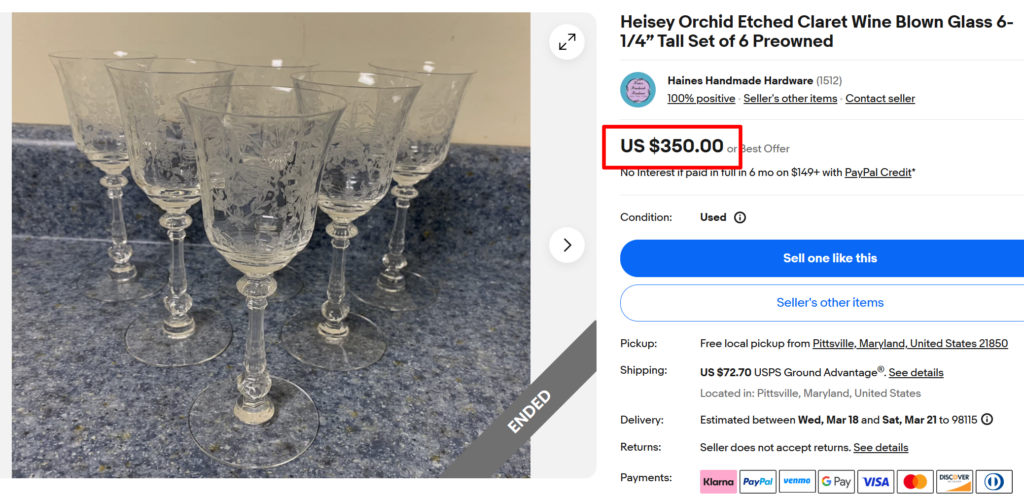
| Average Value | $45 – $80 (singles) $250 – $400 (sets) |
| Production Period | 1940 – 1957 |
| Pattern | Orchid Etch (No. 507) |
| Collectibility | Very High (most popular etch) |
| Collector Notes | Clarets & cordials are rarer |
This stemware set features the Orchid etching (No. 507), widely regarded as Heisey’s most popular and collected decorative pattern. It features a delicate acid-etched design of orchid blooms with trailing stems!
The intricate etch was applied to many different stemware lines, including the Waverly, Lariat, Tyrolean, and Empress. The claret wine glasses are one of the rarer serving forms in the Orchid pattern!
2. Clear Elephant Figurine
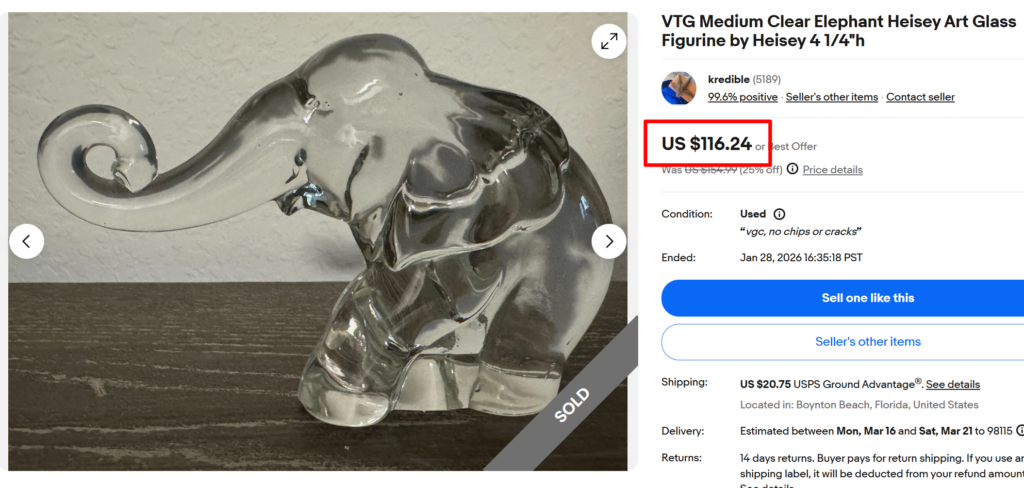
| Average Value | $100 – $150 (medium) |
| Production Period | c. 1944 – 1953 |
| Pattern | Glass Animals Line |
| Line Number | No. 2 (Medium) |
| Collectibility | High |
| Collector Notes | Large (No. 1) variant is more valuable. |
The Heisey Elephant is one of the most beloved pieces in its animal figurine series. It’s available in three sizes: small, medium, and large; the large (No. 1) elephant is the rarest and most valuable.
The medium version shown in this example is desirable for its balanced proportions. In pristine condition, it can fetch anything from $80 to $150 today.
Remember that Heisey Elephant was later reproduced by Imperial Glass, the HCA, and various glass companies in various colors from the original molds. Try to spot the H in the diamond mark to verify the authenticity of the Heisey figurine.
3. Moongleam Green Dolphin Candle Holder
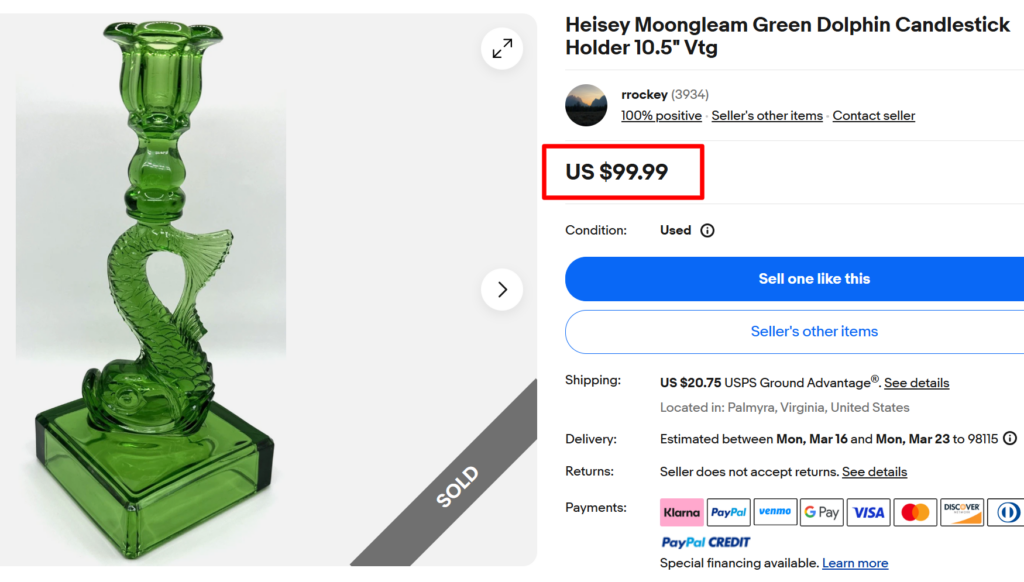
| Average Value | $80–$150 (single) $200–$350+ (pair) |
| Production Period | c. 1925 – 1935 |
| Pattern | Sandwich Dolphin Candlestick |
| Line Number | No. 110 |
| Collectibility | Very High |
| Collector Notes | Cobalt variants are the rarest. |
The Heisey Dolphin candlestick (No. 110) is one of the company’s most iconic and enduring designs. It’s often called the “Sandolphin” or “Sandwich Dolphin” design, in which the holder’s stem is shaped like a curved fish or dolphin.
Based on molds originally acquired from the Boston and Sandwich Glass Company, Heisey made these candlesticks in Crystal, Flamingo, and Moongleam green. Colored pieces, especially Moongleam and Cobalt, are most desirable!
Also, these candlesticks are almost always found singly rather than in pairs, making matched pairs considerably more valuable.
4. Gold Trim Flower Frog (Arranger)
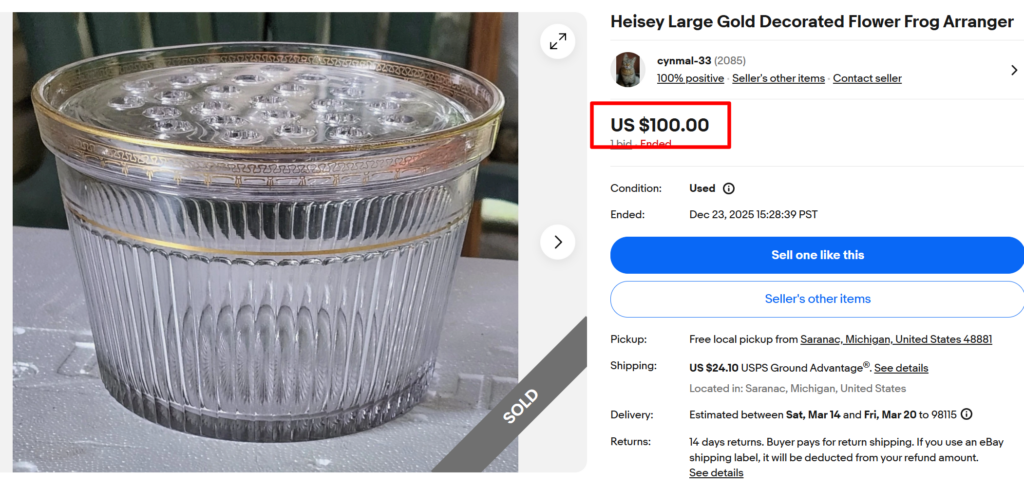
| Average Value | $75 – $125 |
| Production Period | 1920s – 1940s |
| Pattern | Various (Ribbed/Fluted forms) |
| Line Number | N/A |
| Collectibility | Moderate to High |
| Collector Notes | Look for H in the Diamond mark. |
Heisey produced a variety of glass flower frogs, also called flower arrangers or floral blocks, during the first half of the 20th century. This large decorated version with a ribbed cylindrical body and a gold trim is particularly desirable.
The condition of the gold trim is critical to the value of this piece. With intact trim and minimal overall damage, it can fetch up to $100.
5. Clear Glass Bull Figurine
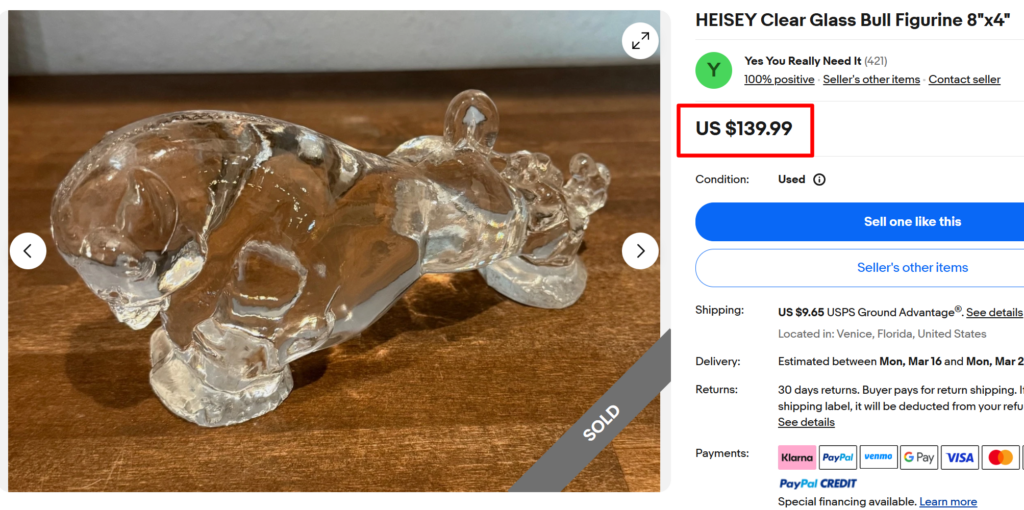
| Average Value | $120 – $200+ (crystal) |
| Production Period | c. 1949 – 1952 |
| Pattern | Glass Animals Line |
| Line Number | No. 1 |
| Collectibility | Very High (short production run) |
| Collector Notes | Check for the diamond H mark |
One of the rarest and most valuable of the company’s animal figurines! Why rarest? Because the Heisey Bull (No. 1) was only produced from around 1949 to 1952, making it one of the shortest production runs in the animal line.
Since this figurine was later reproduced by companies like Imperial or Dalzell-Viking using original molds, always check for the Heisey mark to spot the original. The value largely depends on the condition for crystal variants.
6. Asiatic Pheasant Crystal Glass Figurine
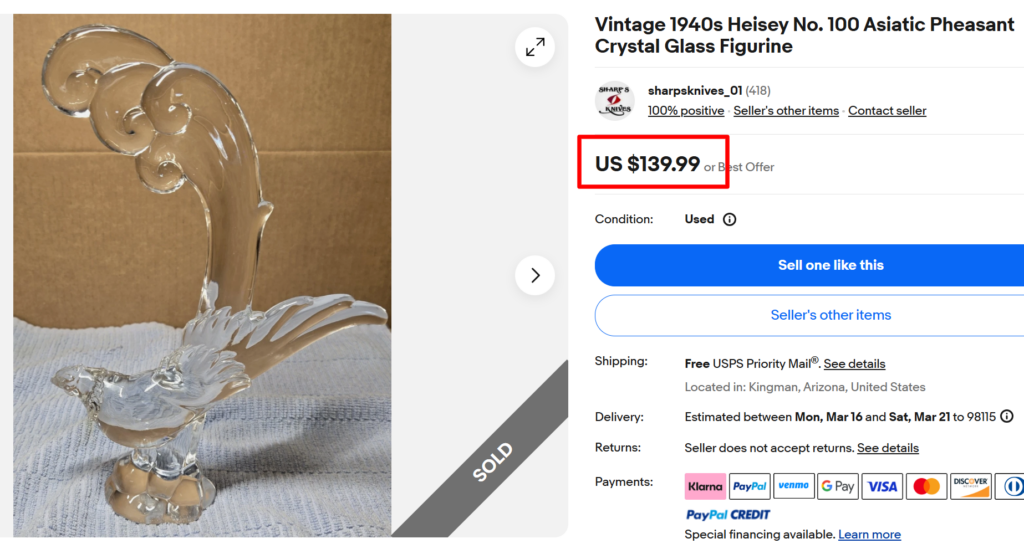
| Average Value | $120 – $175 (crystal) |
| Production Period | 1945 – 1955 |
| Pattern | Asiatic Pheasant |
| Line Number | No. 100 |
| Collectibility | High |
| Collector Notes | Trace the Diamond H on the base. |
The Asiatic Pheasant is one of the more graceful examples from Heisey’s animal figurines. Standing about 10 to 11 inches tall in crystal, it features the bird in a proud, upright pose with an exaggerated curling, sweeping tail plume.
These birds were produced in clear crystal and occasionally in colors like Cobalt or Dawn. Crystal pieces in good condition range from $100 to $150+, while colored examples can go even higher!
7. King Arthur Moongleam Green Goblets
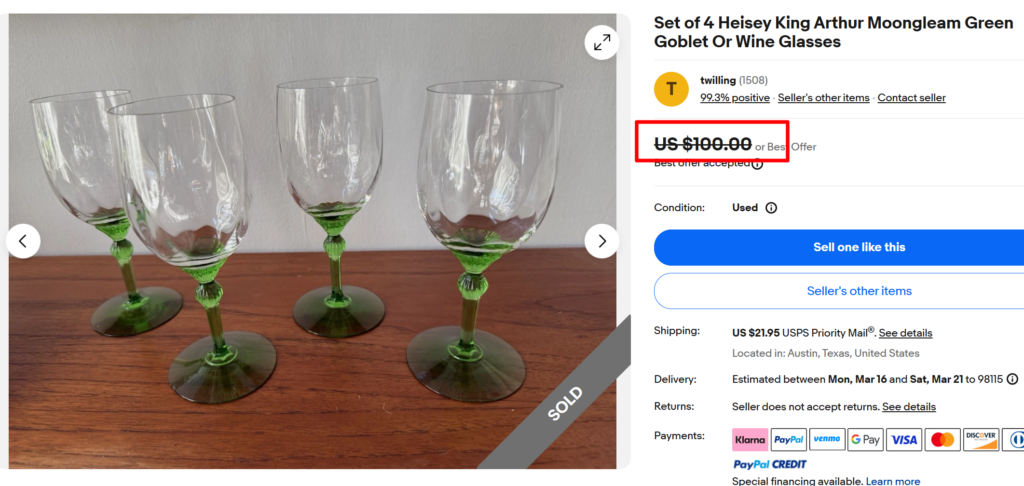
| Average Value | $20–$35 (Singles) $85–$130 (set of 4) |
| Production Period | c. 1925 – 1939 |
| Pattern | King Arthur (Diamond Optic) |
| Line Number | No. 3357 |
| Collectibility | Moderate to High |
| Collector Notes | The mark is on the pressed green stem. |
Heisey’s King Arthur line is a unique blend of a blown-glass bowl and a sturdy pressed-glass stem. Another key feature of these goblets is the “Diamond Optic” design inside the bowl, which creates a rippled effect.
Moongleam, described by Heisey as “the green of moonlight on the sea,” is a much rarer variant of these goblets, identified by green stems. The value comes from the set size and the condition of each piece!
8. Crystolite Iced Tea Glasses
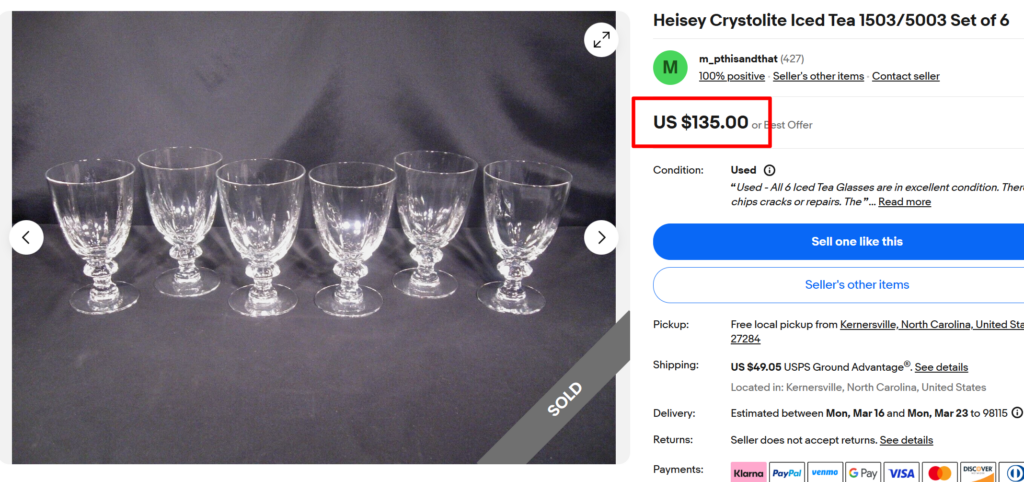
| Average Value | $18–$30 (singles) $100–$160 (set of 4/6) |
| Production Period | 1937 – 1957 |
| Pattern | Crystolite |
| Line Number | No. 1503 (pressed) / 5003 (blown) |
| Collectibility | Moderate (easy to find) |
| Collector Notes | Diamond H mark on the bottom interior. |
Crystolite was Heisey’s bestselling pattern that ran from 1937 to 1957, until the company closed. The design features a unique starlike pressed pattern with a clear, brilliant crystal finish.
The stemware in this line uses two complementary numbers: 1503 for pressed pieces and 5003 for the blown versions.
Most iced tea glasses you will find are the pressed style. The Crystolite line doesn’t have the rarity of colored Heisey glass, but complete sets in pristine condition are still quite desirable!
9. Alexandrite Empress Sandwich Plate
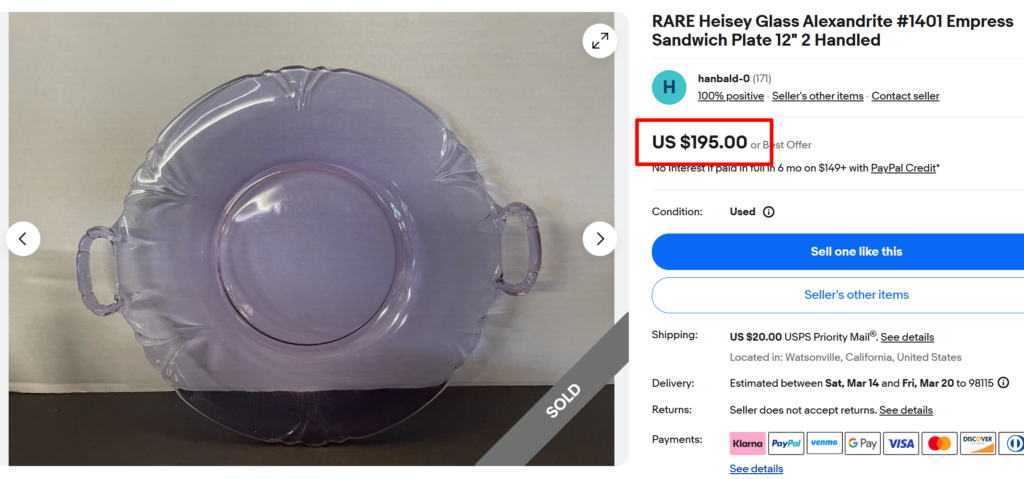
| Average Value | $150 – $250+ |
| Production Period | 1930 – 1935 |
| Pattern | Empress |
| Line Number | No. 1401 |
| Collectibility | Very High (rarest color) |
| Collector Notes | Test the color shift for authenticity. |
This plate features Alexandrite, the most legendary and rarest of all Heisey colors. Made with neodymium oxide, this glass shifts from a soft lavender in indoor light to a blue-tinged hue under fluorescent or UV light.
The Empress pattern on this plate is defined by its square shape and scrolled, “dolphin-style” feet. This pattern was the primary pressed line in Alexandrite, and these 12-inch two-handled sandwich plates are quite collectible.
Generally, any Alexandrite piece in good condition is a serious find!
A Handy Tip: Alexandrite is easily confused with Hawthorne, another Heisey lavender. The key difference is that the former will shift noticeably blue under fluorescent light, while Hawthorne doesn’t.
10. Octagon Marigold Handled Bowl & Plate
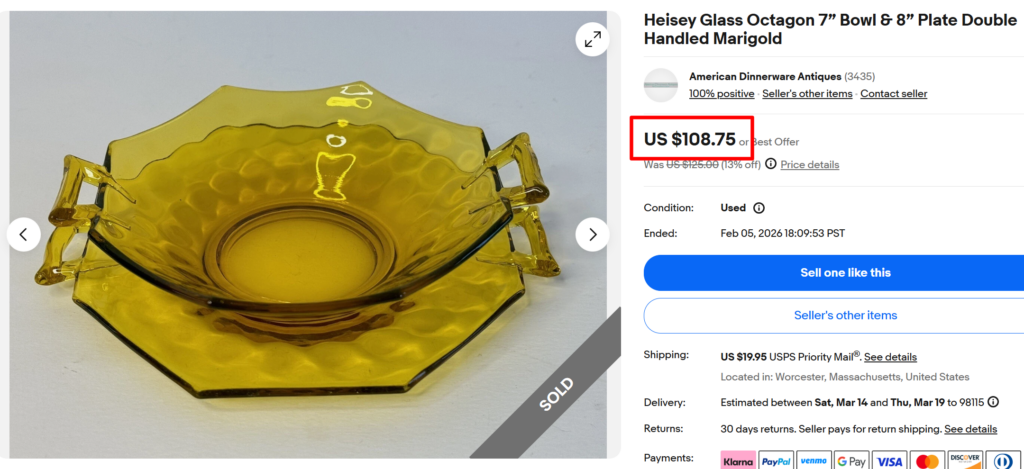
| Average Value | $80 – $130 (for set) |
| Production Period | c. 1929 – 1930 |
| Pattern | Octagon (No. 1229) |
| Line Number | No. 1229 |
| Collectibility | High (rare color) |
| Collector Notes | UV light glow confirms authenticity. |
The rarity of this octagon set comes from its color! Marigold was produced for only one year (1929 to 1930) due to challenging production and color deterioration. Heisey described this color as “sparkling with golden sheen.”
The second value factor for this example is the Octagon pattern (No. 1229), one of the few pressed patterns offered in Marigold. The combination of the rare color, a prominent pattern, and practical serving form makes this set especially collectible.
11. Carcassonne (No. 3390) Sahara Yellow Pitcher
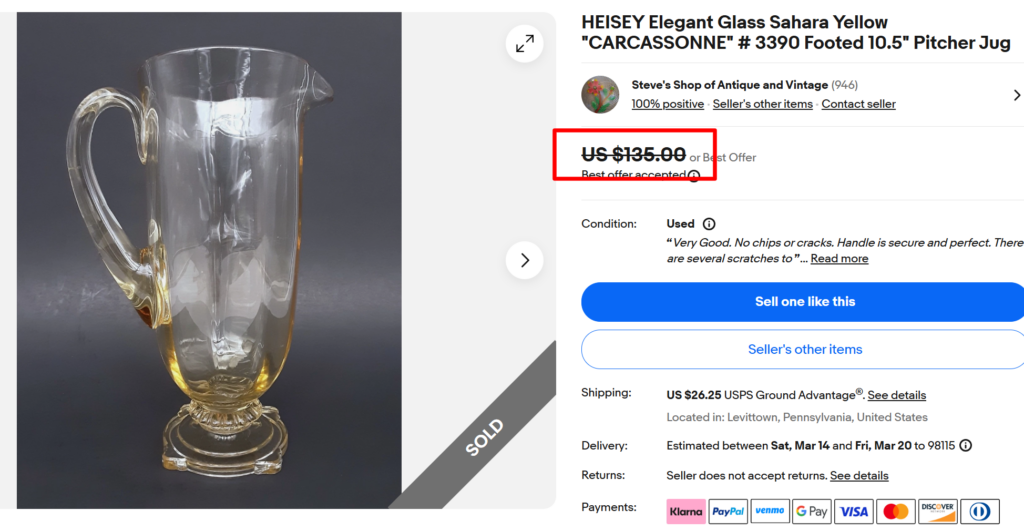
| Average Value | $100 – $175 |
| Production Period | 1930 – 1941 |
| Pattern | Carcassonne (Vertical Rib Optic) |
| Line Number | No. 3390 |
| Collectibility | High |
| Collector Notes | Diamond H mark near the handle or on the base. |
This footed pitcher is a stunning example of Heisey’s Carcassonne line, introduced in 1930. The line offered a full range of stemware and serving pieces in Heisey’s signature colors.
This example is in Sahara Yellow, a soft pastel yellow that Heisey introduced to replace the short-lived Marigold. This became one of its most sought-after shades.
Larger and dramatic pieces, like these pitchers, with a combination of a notable pattern and a rare colour, are highly sought after today.
How to Spot Real Heisey Glass?
Knowing how to identify genuine Heisey glass is crucial, as many of its original molds were later sold to companies that lacked Heisey’s signature finishing standards.
Use the following clues to ensure you’re looking at “Elegant Glass” and not mass-produced imitation ware.
The Diamond H Mark
The most famous and reliable identifier of Heisey glass is a capital “H” inside a diamond. This mark measures about 1/4 inch and is usually raised, and it can be found on the bottom of their pieces.
The majority of Heisey pieces from 1901 to 1957 carry this signature mark. On pressed glass, it is usually raised and found in the center of the interior or the base. But on blown stemware, it’s often tiny, almost hidden, at the base or on the stem. So, check carefully with good lighting.
Glass Quality & Fire-Polished Surface
If you’re unable to trace the mark, check other features, such as the glass quality. Original Heisey glass is extremely clear and brilliant, with a fire-polished (reheated to melt away the roughness and mold seams) surface that is super smooth.
Authentic pieces rarely have bubbles or unmelted sand inclusions. The pressed patterns are crisp and sharply defined, not mushy or blurry.
If a piece looks or feels rough or cloudy, it may be a reproduction or a later, lower-quality piece from another maker.
The Basics of Heisey Colors
All of Heisey’s signature colors are well-documented. For instance, Flamingo is a soft pastel pink, Moongleam is a vivid mint green, Sahara is a warm lemony yellow, and Alexandrite is a lavender that shifts toward blue under fluorescent light.
Get familiar with these colors by observing original pieces (via auctioned items or catalogs). If the color of the piece in question doesn’t match the known Heisey palette, be skeptical!
Original Patterns & Reproductions
The company made over 100 patterns during its 60-year lifespan, from simple geometric shapes like “Octagon” to elaborate etchings like “Orchid.”
Learning the specific motifs of its iconic patterns is essential, as many designs were patented and unique to the company’s catalog.
Also, since Heisey sold its molds to Imperial and other makers after closing, many of its patterns were reproduced. But the crispness of the design and construction quality are major giveaways for authentic Heisey pieces.
You can refer to guides and reference books, like the Bredehoft “Collector’s Encyclopedia of Heisey Glass” and the National Heisey Glass Museum’s resources, to spot specific patterns, production dates, and known colors to cross-reference your piece!
Note: This article is intended for informational, educational, and entertainment purposes only. Some images are illustrative and may not represent actual brands, products, or related entities. All trademarks, product names, brand logos, packaging, and other intellectual property referenced remain the exclusive property of their respective owners. Any brand mentions or references are provided solely for descriptive and educational context and do not imply any formal or commercial association.