Antiques Know How Research
Majolica Dishes Value
Our detailed eBay research at Antiques Know How shows antique Majolica dishes from Minton, Wedgwood, George Jones, and Holdcroft sell for $150–$8,000+, with top rarities like Minton oyster stands and George Jones sardine boxes at the high end. Key collectibles include fox-and-duck tureens, shell oyster plates, water lily centerpieces, reptile plates, and complete pedestal servers. Verify valuable dishes with impressed marks, unique underside glazes, full sets, and excellent condition!
Antiques Know How
Have you ever seen a heavy, ceramic dish with relief-molded designs of fish, shells, and frogs at an estate sale or your parents’ cabinets? If yes, it probably was an antique Majolica dish.
While most people discard these unique dishes as impractical, only a few know that old Majolica dishes are among the most valuable pieces today. Some have sold for thousands of dollars!
In this guide, I’m going to show you some high-value, rare Majolica dishes from renowned makers, along with what to look for and what to expect!
What Is Majolica Pottery?
Majolica is a type of earthenware famous for its brilliant, lead-based glazes and relief-molded designs. It first became popular during the Victorian era, after Minton introduced it at the 1851 Great Exhibition as “Palissy ware.”
Inspired by the 16th-century French potter Bernard Palissy, the style is known for its lifelike depictions of plants, animals, and mythological themes. It quickly caught on, and by the 1860s and ’70s, potteries across England, Germany, Portugal, and the United States were producing it.
Today, antique Majolica from the top Victorian-era makers, including Minton, Wedgwood, George Jones, and Joseph Holdcroft, is actively collected for its historical significance and bold style.
Most Valuable Antique Majolica Dishes to Find!
Below is a list of antique majolica dishes that have sold for notable prices, along with the key details that made them valuable!
1. Victorian Minton Mushroom Lidded Tureen
| Average Value | $3,000 – $6,000+ |
| Company | Minton & Co. |
| Production Period | c. 1870s – 1880s |
| Line / Pattern Name | Fox and Duck Scenic Game Dish |
| Collectibility | Very High |
| Collector Notes | Check the base for mark & shape no. |
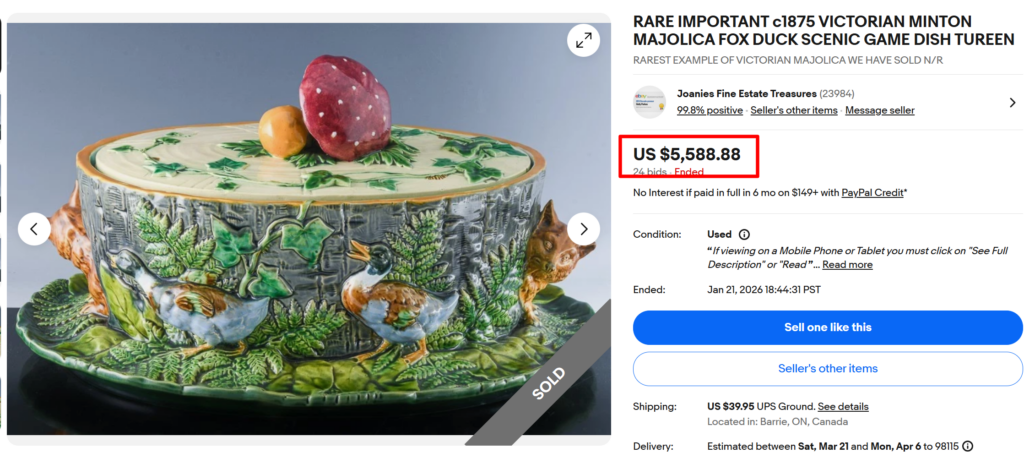
Minton’s fox-and-duck is one of its most famous designs. In fact, this game tureen (Shape No. 2062) is formally designated “Very Rare” in the Karmason Library of the Majolica International Society, and is a proper auction piece.
The design features two foxes flanking a tree-trunk tureen molded with mallard ducks, with mushroom finials on the cover. Since very few complete examples are seen in the marking, the value can reach a few thousand dollars in auctions!
Make sure to check the base for an impressed “MINTON” or “MINTONS” mark with a date cypher and shape number.
2. Minton Majolica Four-tier Oyster Stand
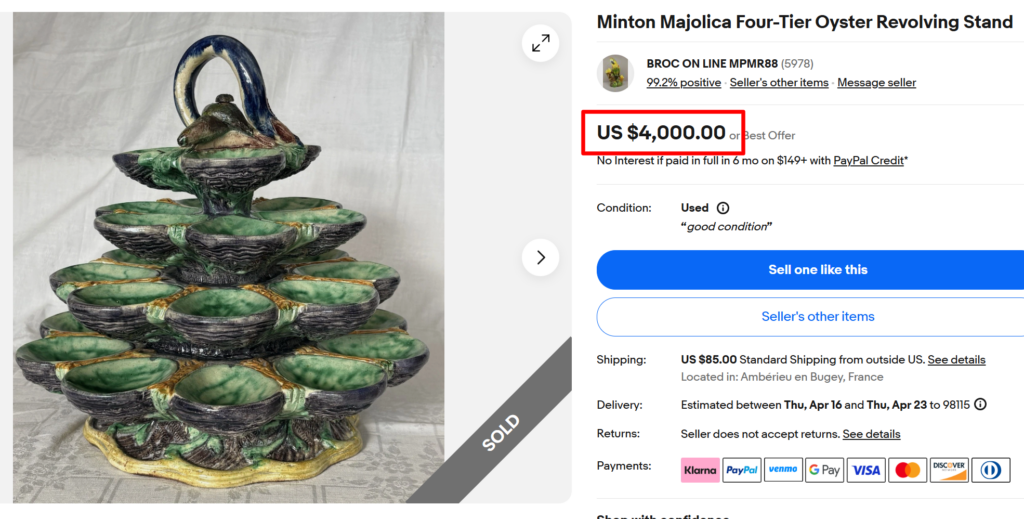
| Average Value | $3,000 – $8,000+ |
| Company | Minton & Co. |
| Production Period | c. 1860 – 1870 |
| Line/Pattern Name | Tiered Oyster Stand |
| Collectibility | Extremely High |
| Collector Notes | Original revolving mechanism is a must for top value. |
Minton’s four-tier revolving oyster stand (Shape No. 636) is among the most desirable pieces of Victorian majolica pottery.
The design features 27 oyster wells across four graduated tiers, all separated by green seaweed moldings against brown-scaled shells. There’s also an entwined fish and eel finial at the top.
The base contains a small brass fitting that allows the stand to rotate at the table so diners can reach each tier. The value of these dishes lies in the original, working revolving mechanism and, of course, the condition.
3. George Jones & Co Majolica Turquoise Oyster Plate
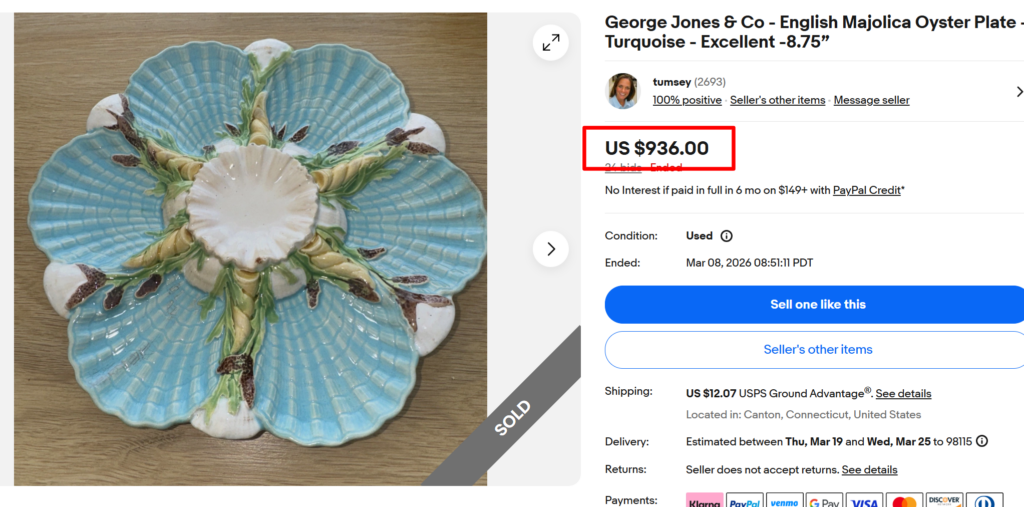
| Average Value | $600 – $1,500+ |
| Company | George Jones & Co. |
| Production Period | c. 1878 |
| Line / Pattern Name | Shell and seaweed ground |
| Collectibility | High |
| Collector Notes | Check the painted pattern number. |
George Jones oyster plates are among the most sought-after pieces in Victorian Majolica. The standard form consists of six shell-shaped wells, with a central well for sauce. The border is a shell and seaweed decoration in a naturalistic style.
Turquoise is the most common ground color, with white and aqua ground versions being less common. These dishes range from 7.5 to 10.25 inches in diameter, with a painted pattern number on an unglazed thumbprint and a maker’s mark.
4. Wedgwood Majolica Game Pie Lidded Tureen
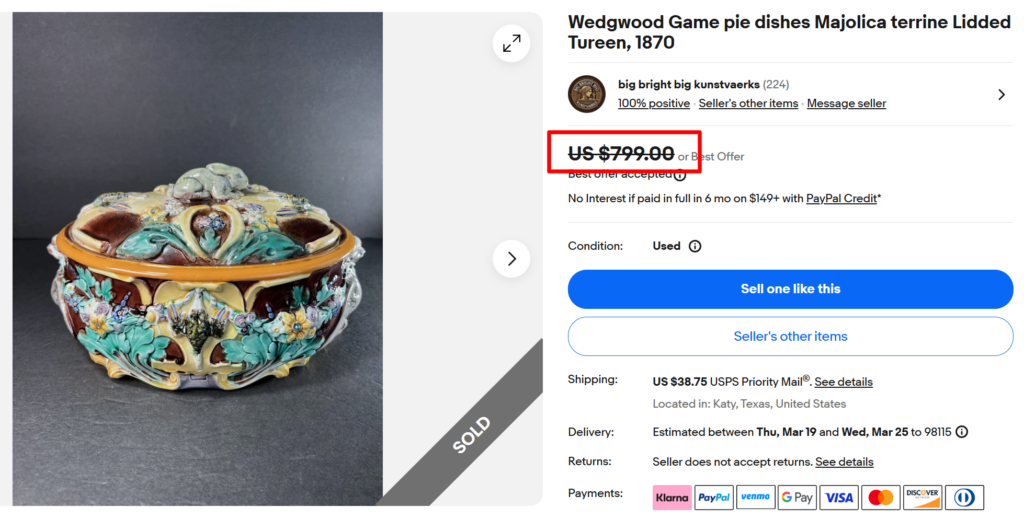
| Average Value | $600 – $1,500+ |
| Company | Wedgwood |
| Production Period | c. 1860s – 1880s |
| Line / Pattern Name | Game Pie |
| Collectibility | Moderate to High |
| Collector Notes | Check the impressed “Wedgwood” mark. |
Wedgwood game pie dishes were functional serving pieces. They often feature rabbits, ducks, or hares on the lid, resembling the look of baked, raised pastry or pie crusts.
The flower-and-foliage example shown, with a figural finial on the lid, is a less common Wedgwood style. More standard versions feature molded dead game, such as pheasant, rabbit, and mallard, on the cover.
Since liners were fragile and often discarded, finding a lidded tureen with the original liner intact is a valuable find.
5. Hugo Lonitz Majolica Mythology Cecaelias Faces Bowl
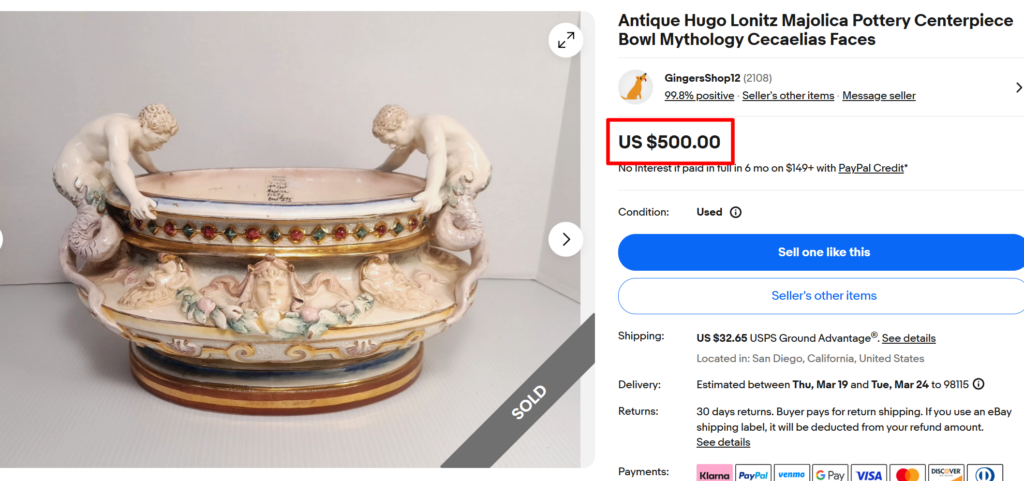
| Average Value | $400 – $1,200+ |
| Company | Hugo Lonitz & Co. |
| Production Period | 1868 to 1886 |
| Line / Pattern Name | Cecaelias on bowl’s edge |
| Collectibility | Moderate to High |
| Collector Notes | Check the double-fish oval mark. |
Hugo Lonitz’s work is among the most distinctive outside the English potteries. He’s best known for his naturalistic animal sculptures and high-relief molding with dark, moody glazes.
This example is a figural centerpiece bowl, featuring mythological characters such as cecaelias (half-human, half-sea-creature figures). The theme itself makes these pieces rare and valuable, especially if undamaged!
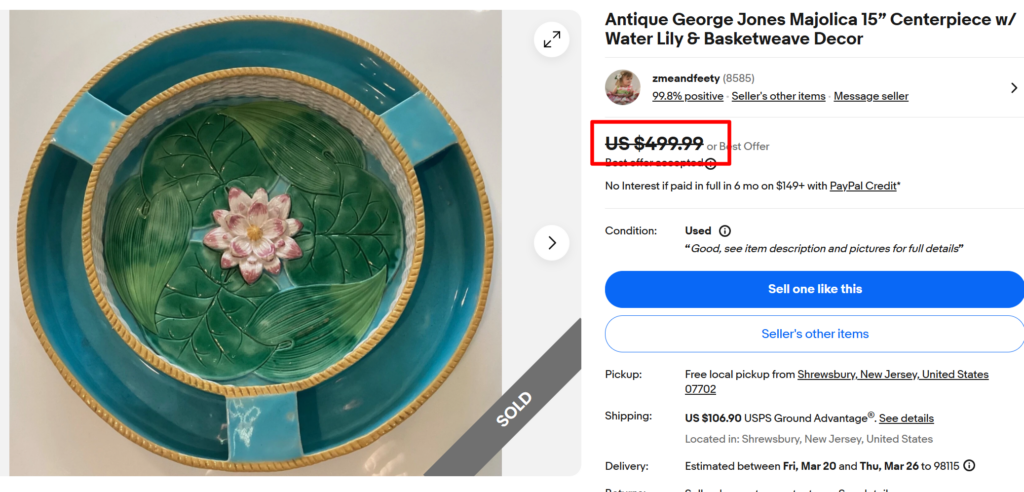
6. George Jones & Co. Majolica Water Lily Basketweave Plate
| Average Value | $500 – $2,000+ |
| Company | George Jones & Sons, Stoke-on-Trent, England |
| Production Period | c. 1870s – 1880s |
| Line / Pattern Name | Water Lily/Basketweave |
| Collectibility | High |
| Collector Notes | Check the basemark & underside glaze for authenticity |
The Water Lily pattern is one of George Jones’ most recognized Majolica designs. It features bold green lily pads with pink or white blossoms on a turquoise ground, often surrounded by a basketweave border in ochre tones.
What sets George Jones apart is the distinctive snakeskin-mottled glaze (unlike Wedgwood’s tortoiseshell mottling) used on the underside of flat pieces.
This 15-inch centerpiece example is a larger, harder-to-find form in this pattern and can fetch $500 to $1,500 at auction, with finer or rarer examples going higher.
Quick Note: The pre-1873 dishes may show the GJ monogram, while post-1873 pieces may bear the “& SONS” crescent mark, along with the registration mark. If the piece is unmarked, check the snakeskin-mottled underside glaze to identify.
7. George Jones Majolica Sardine Boxes
| Average Value | $500 – $1,800+ |
| Company | George Jones & Sons |
| Production Period | c. 1866 – 1880s |
| Line / Pattern Name | Sardine Box (seaweed and shell) |
| Collectibility | High |
| Collector Notes | “CJ” in circle mark on the bottom |
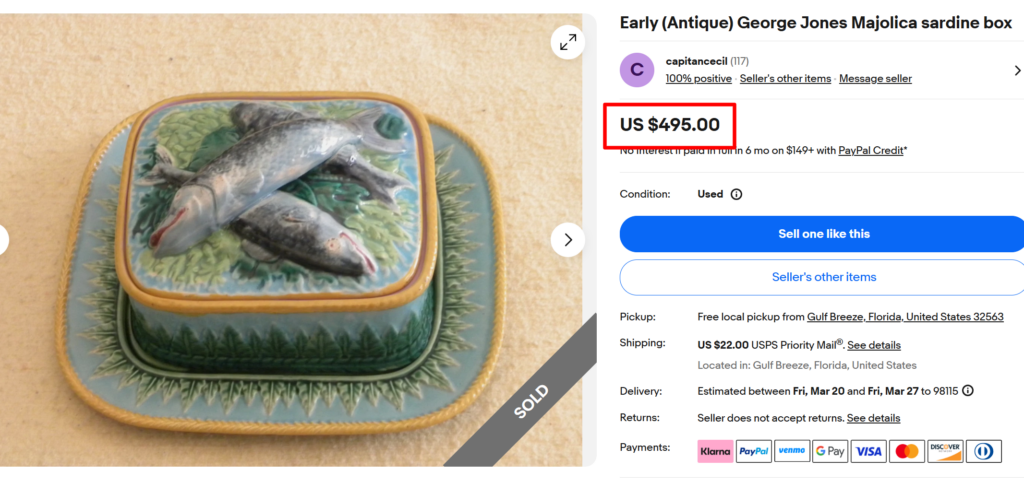
The Victorian sardine box is one of the most collected dishes in Majolica, and George Jones produced some of the finest versions. This example is a complete set with the box and the undertray.
It features a lid molded in high relief with three overlapping fish on a bed of seaweed, the base decorated with leaf borders or basketweave, and the undertray in a complementary glaze.
George Jones sardine boxes were produced in several ground colors, including turquoise, pale blue, and pink. The pink ground examples are harder to find today!
8. Smith Griffin and Hill Etruscan Shell Seaweed Pedestal Bowl
| Average Value | $250 – $600+ |
| Company | Griffen, Smith & Hill |
| Production Period | c. 1879 – 1890s |
| Line / Pattern Name | Shell and Seaweed |
| Collectibility | Moderate |
| Collector Notes | Look for the “GSH” monogram in a circular “Etruscan” mark. |
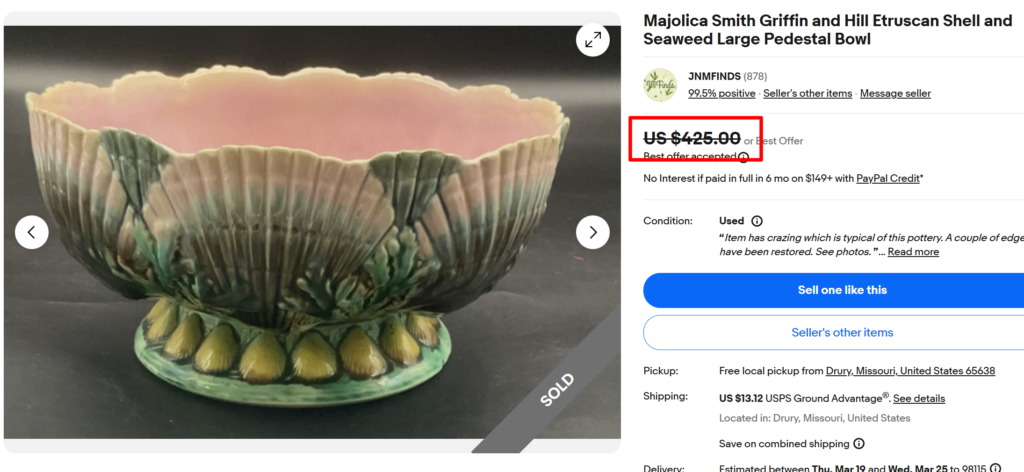
This massive bowl is from Griffen, Smith & Hill, one of the largest American majolica manufacturers of the 19th century. It features their most extensive design, Shell and Seaweed.
You can spot this piece by its unique glaze palette: a nacreous or pearlescent combination of shell pink, sage green, and warm gray, less saturated than other English makers.
This pattern was produced across an entire dinner and tea service; pedestal bowls are harder to find. Also, the earliest pieces may have a stylized “GSH” monogram, while later ones may show “ETRUSCAN MAJOLICA” around the GSH mark.
9. Portuguese Palissy Majolica Reptiles Plate
| Average Value | $150 – $600+ |
| Company | Jose A. Cunha/Manuel Mafra |
| Production Period | c. 1870s – early 1900s |
| Line / Pattern Name | Palissy Reptile |
| Collectibility | Moderate |
| Collector Notes | Check for brand-specific marks. |
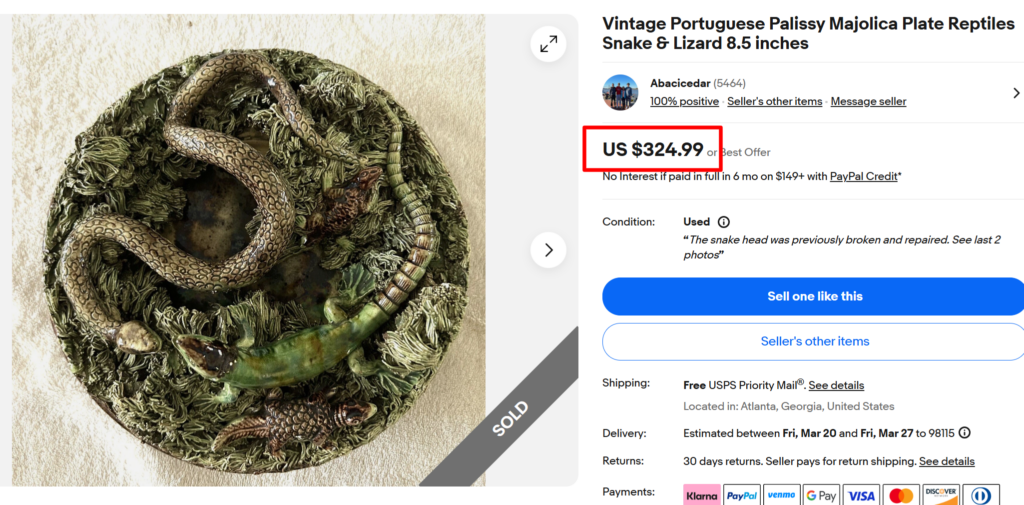
Portuguese Palissy ware was produced from around 1880 in Caldas da Rainha, with Manuel Mafra and José Alves Cunha as the two most collected makers.
Their plates feature three-dimensional reptiles, insects, and lizards on a shredded-clay “grass” ground, cast from real specimens. This style was inspired by 16th-century French potter Bernard Palissy.
Portuguese reptile Majolica plates are almost always marked. Learn about the marks from different makers to identify the piece.
10. Joseph Holdcroft Majolica Basketweave Bowl
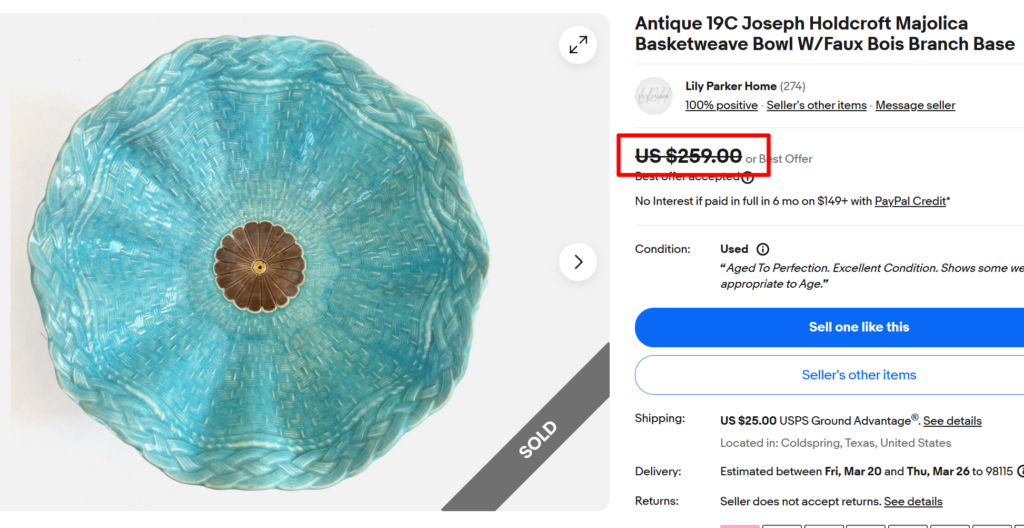
| Average Value | $200 – $600+ |
| Company | Joseph Holdcroft |
| Production Period | c. 1870s – 1885 |
| Line / Pattern Name | Basketweave (turquoise glaze) |
| Collectibility | Moderate |
| Collector Notes | Check the impressed mark or celadon green glaze for verification |
Joseph Holdcroft worked for Minton before starting his own firm, and his basketweave patterns are exquisite. These bowls in this pattern often feature a “faux bois” branch handle or base.
The dull celadon-green underside glaze is the most reliable identifier, even on unmarked pieces. Since the quality of Majolica dropped after 1885, pre-1885 examples are the most desirable ones today.
Authentic pieces may have an impressed “J HOLDCROFT” or an overlapping “JH” in a circle on the base. These bowls can easily fetch up to $500 in good condition.
11. Wedgwood Ocean Majolica Plate
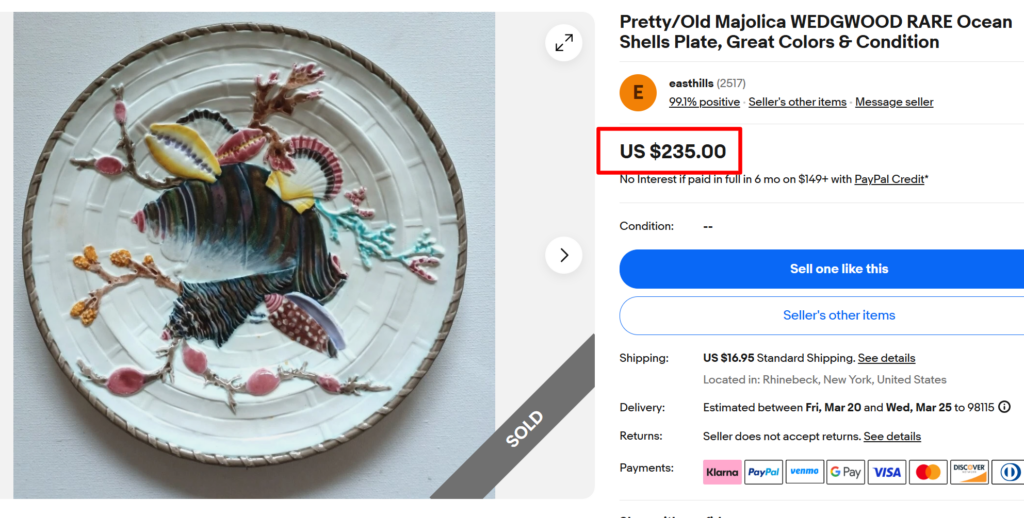
| Average Value | $150– $700+ |
| Company | Wedgwood |
| Production Period | c. 1870s – 1880s |
| Line / Pattern Name | Ocean (shell and seaweed motif) |
| Collectibility | Moderate to High |
| Collector Notes | Check the impressed “Wedgwood” mark. |
Wedgwood’s Ocean pattern was produced from the 1870s as part of its Argenta ware line, known for its subtle pastel-colored glazes and shells, waves, and coral motifs.
This particular plate is molded with a large central shell surrounded by smaller shells, coral, and seaweed in polychrome glazes on a basketweave-bordered white ground.
Authentic dishes are marked with an impressed “WEDGWOOD” stamp and three-letter date code. An “M” in that code indicates production between 1873 and about 1888.
What to Check When Trading Old Majolica Dishes
While dealing with Majolica dishes from renowned makers, pay keen attention to the following aspects:
Maker’s Marks & More
Marked Majolica is more valuable than unmarked Majolica. So, it is important to check for any mark that indicates the maker. Minton, Wedgwood, George Jones, and Holdcroft all used impressed marks, which you can feel with your finger, not painted on.
Also, a few makers, like Wedgwood and Minton, used unique date-code systems that help you trace the precise year of production.
Wedgwood, for instance, used a three-letter code from 1860 onward; the last letter in this code indicates the year. Minton used a system of year cyphers and small symbols after 1842.
To identify a piece, research the design to know the exact pattern name and its maker. You can also refer to reference guides to become familiar with the maker’s markings and check whether a piece is real.
The Underside Glaze
The underside glaze is an important aspect in identifying original Majolica dishes because the type of glaze used varies for different manufacturers.
For instance, Wedgwood’s underside is characterized by a tortoiseshell mottled glaze in brown and green colors. On the other hand, George Jones’ underside is characterized by a snakeskin pattern mottling, which is obviously not the same as Wedgwood’s.
Holdcroft is usually a flat celadon green color, while Minton is sometimes in a solid turquoise color on the underside and the bottom. These differences can help you get started with identification.
Completeness
Certain Majolica dishes, like game pie dishes, sardine boxes, and oyster stands, were often sold as multi-piece sets. Missing pieces from these sets can reduce value significantly.
A sardine box without its undertray is worth less than half the price of a complete set. Similarly, a game tureen without the original liner is less desirable than a complete example. Always check what pieces are included in the set.
Overall Condition
For Majolica pottery, value is very condition-sensitive. Even a visible hairline crack can cut value by 30–40%, while a repaired chip to a projecting element (a fin, an ear, a beak) reduces value more.
Remember that professional restoration can be hard to spot. For rare and valuable pieces, use UV light to check for differences and compare them with the original piece. Usually, original glaze shines differently from modern repair materials.
Also, always make sure to check for any damage or restoration before buying or selling.
Note: This article is intended for informational, educational, and entertainment purposes only. Some images are illustrative and may not represent actual brands, products, or related entities. All trademarks, product names, brand logos, packaging, and other intellectual property referenced remain the exclusive property of their respective owners. Any brand mentions or references are provided solely for descriptive and educational context and do not imply any formal or commercial association.