Antiques Know How Research
Trifari Brooches Value
Our team’s in-depth research of several eBay sales and auction results at Antiques Know How shows Trifari brooches range from $80-$1,500 for common pieces, with rare Jelly Belly animals, early KTF pieces, and Alfred Philippe designs hitting $3,000-$5,500+. Top collectibles include Fruit Salad clips, Jelly Belly creatures, flower brooches, crowns, and Starflight designs. Check Trifari marks, patent numbers, prong-set stones, and setting metal for authenticity.
Antiques Know How
When it comes to vintage brooches, you can’t miss the name Trifari. But as a costume jewelry brand, most people overlook Trifari jewelry brooches, assuming they’re just random faux jewelry.
What if I told you that even these costume jewelry brooches can now be worth up to $5,000 or even more? Well, that’s the beauty of Trifari.
In this guide, we will discuss the most collectible and valuable Trifari brooch styles, as well as how to spot a genuine Trifari brooch from a later copy or a fake one.
The Popularity of Trifari Brooches
Founded by Gustavo Trifari in 1910, the Trifari company is one of the most popular names in the American costume jewelry market.
Their success was largely due to the arrival of Alfred Philippe in 1930, who was a master designer with experience working with fine jewelry companies like Cartier and Van Cleef & Arpels.
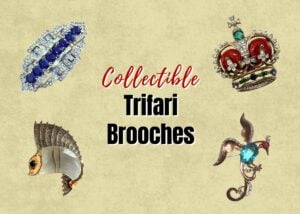
Brooches are some of the most coveted pieces of Trifari jewelry, ranging from the bold, colorful Fruit Salad brooches to the Royal Crown brooches. These are known for their ‘real look’ with rhinestones and high-quality metal finishes like Trifanium.
Trifari is still going strong as one of the most collected names in vintage jewelry.
Most Collectible Trifari Brooches Worth Finding
Let’s take a look at some of the most notable Trifari brooch styles collectors are seeking today.
1. Fruit Salad Brooches
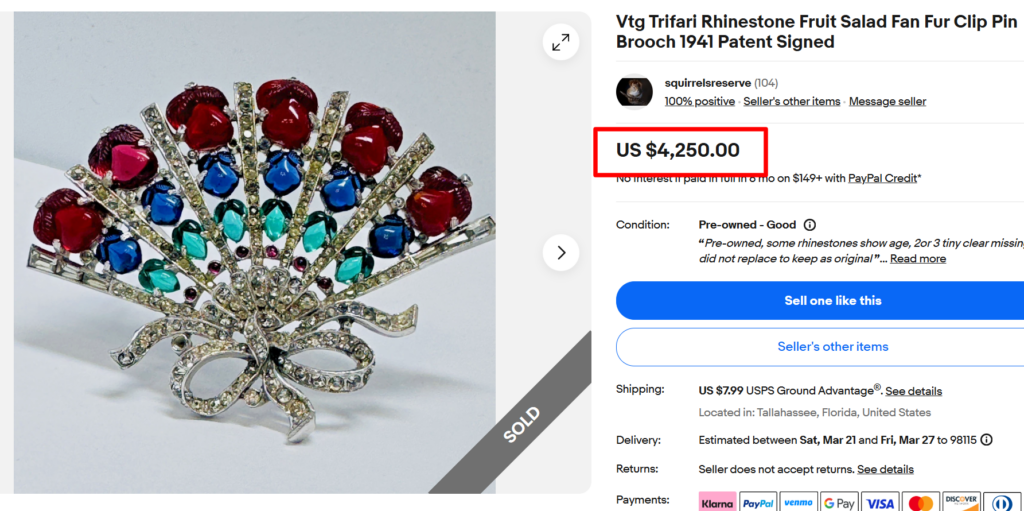
| Average Value | $300–$5,500+ |
| Key Features | Molded glass “carved” stones, multicolor jewel tones |
| Manufacturing Period | 1930s–1950s |
| Collectibility | High for KTF-era pieces |
This fan fur clip is an exquisite example of Trifari’s most popular styles, called Fruit Salad. This style was Trifari’s answer to Cartier’s famous “Tutti Frutti” jewelry.
The stones in the Trifari fruit salad brooches resemble carved rubies, emeralds, and sapphires in leaf, fruit, and flower forms.
Fruit Salad pieces from the earliest KTF era, around the early 1930s, feature the KTF mark. These are the rarest. Later versions from the late 1930s through the 1950s use the Crown Trifari mark.
Many Fruit Salad brooches were made as Clip-Mates or Duettes; two dress clips that join together to form a single brooch.
2. Jelly Belly Animal Brooches
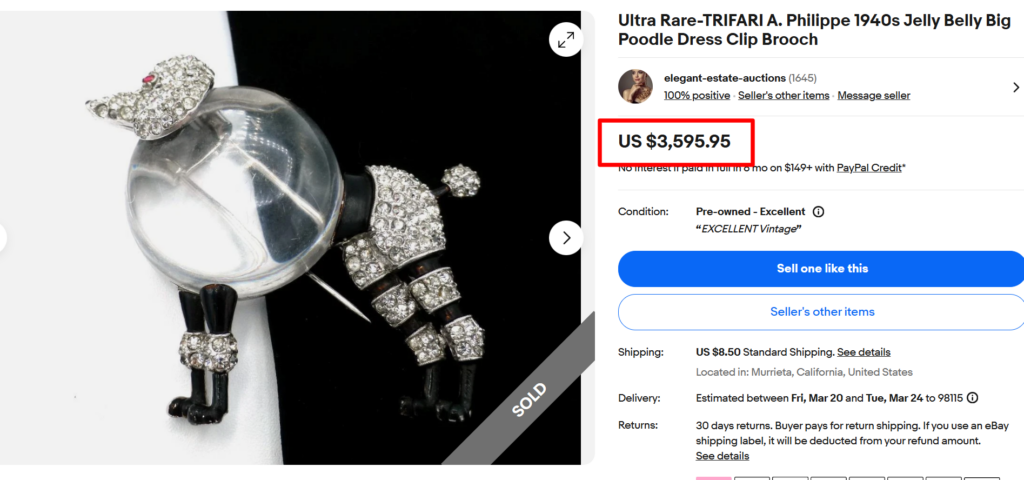
| Average Value | $500–$3,000+ |
| Key Features | Sterling setting, Lucite belly |
| Manufacturing Period | 1938–late 1940s |
| Collectibility | High for rare animal shapes |
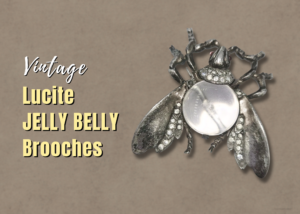
Jelly Belly brooches are among Trifari’s most collectible brooches. They are built around a clear or colored Lucite “belly” that looks like jelly, hence the name. Trifari never called them “Jelly belly” brooches in their own advertising.
Animal Jelly Belly brooches can range from dogs, roosters, pigs, to turtles, horses, and more. Rare animals, like this poodle example, can fetch thousands today.
They were designed primarily by Alfred Philippe and manufactured between approximately 1938 and the late 1940s. And most of these are made in sterling silver or gold-plated base metal.
3. Jelly Belly Sea Creature Brooches
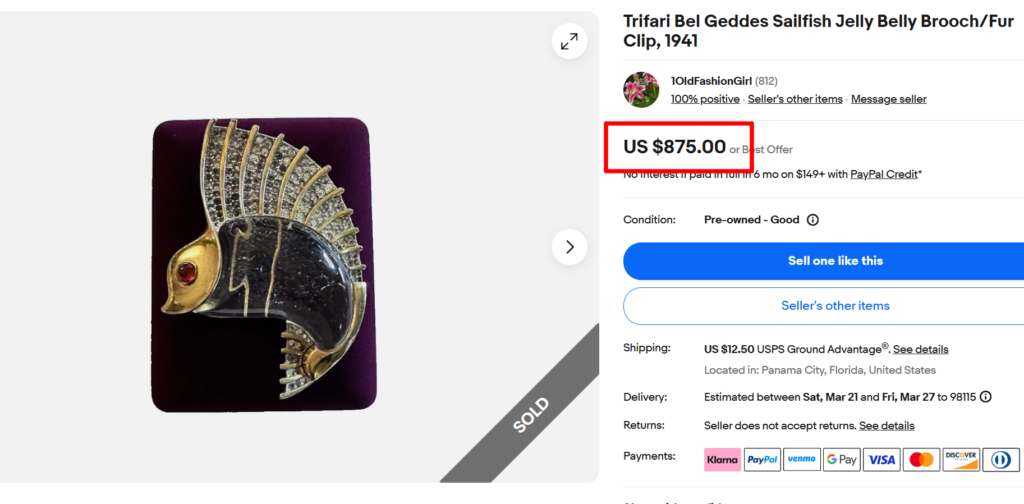
| Average Sold Price | $500–$1,500+ |
| Key Features | Lucite body, two-tone gold or sterling setting |
| Manufacturing Period | 1941–late 1940s (originals) |
| Collector’s Note | Originals have a Crown Trifari mark & Patent No. |
These Jelly Belly brooches feature a Lucite body depicting aquatic life, such as fish and seahorses. The most famous is the Sailfish Fur Clip, featuring a rhinestone-paved head and fins, a Lucite body center, a cabochon eye, and a two-tone gold and rose-gold plated metal frame.
This brooch was designed not by Alfred Philippe but by the modernist industrial designer Norman Bel Geddes in 1941, under Design Patent No. 129,165. Geddes retained the design rights, making this piece particularly desirable.
Trifari reissued this design in 1996 as part of a Classics Collection. The reissues are marked “Trifari IM 1996” and are worth considerably less than the originals.
4. Insect Jelly Belly Brooches
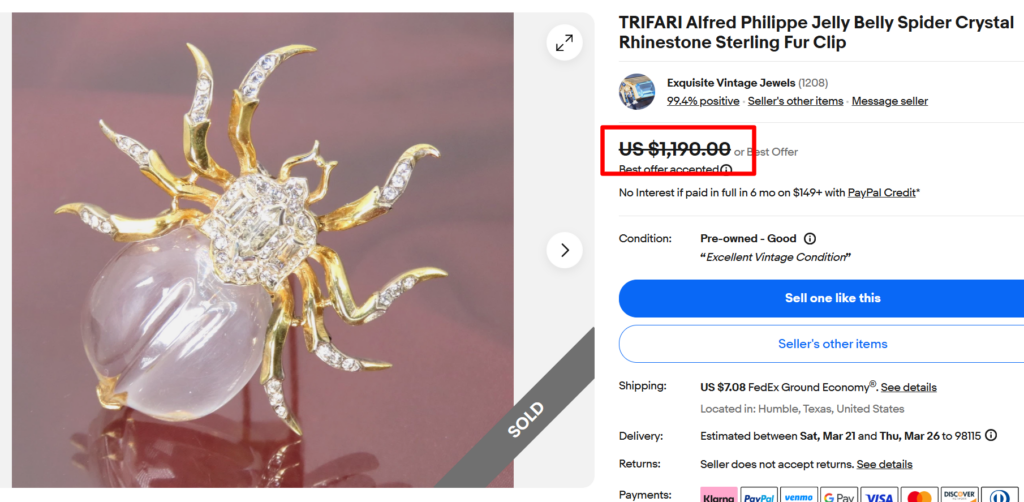
| Average Sold Price | $400–$1,500+ |
| Key Features | Sterling silver base, (1942–1947), Lucite body |
| Manufacturing Period | Early 1940s–late 1940s |
| Collector’s Note | Pieces with Crown Trifari marks are rare. |
Insect Jelly Bellies are among the rarest in the category. Flies, bees, ladybugs, spiders, and butterflies were all produced in much smaller numbers than the more popular animal Jelly Belly brooches.
The spider in particular, with its multi-legged body and large Lucite “belly” abdomen, is the most desirable. You’ll also see crystal rhinestone pave bodies and spindly, jeweled legs. Pieces with intact Lucite can sell for $200–$1,500 or more.
5. Alfred Philippe Flower Brooches
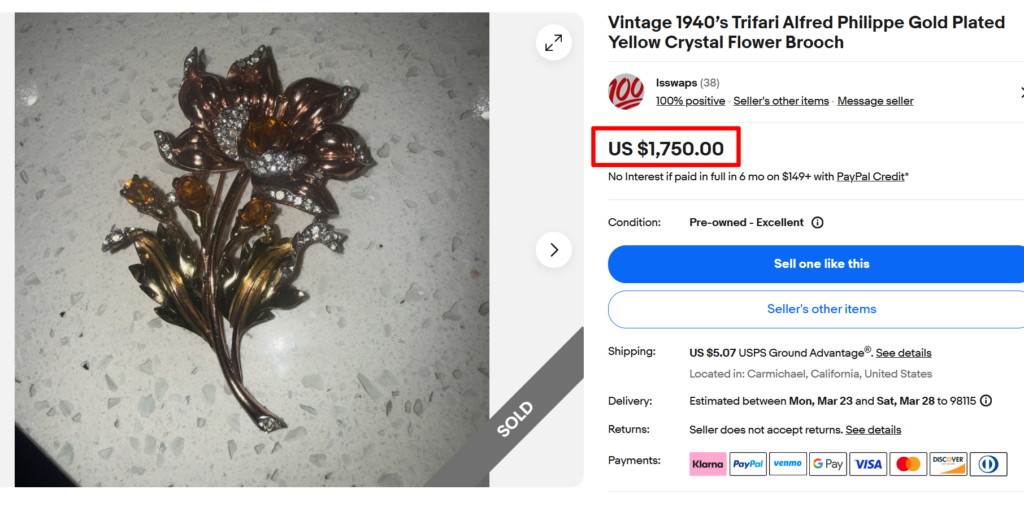
| Average Sold Price | $400–$2,000+ |
| Key Features | Dimensional construction; multiple stone sizes; gold/washed sterling |
| Manufacturing Period | 1940s–1950s |
| Collector’s Note | Look for a patent number on the back. |
Alfred Philippe’s floral brooches span a wide range of styles, from gold-plated 3D flower sprays with crystal centers to rhodium-plated designs.
The most valuable are the large dimensional pieces from the 1940s, which use the techniques that Philippe developed during his time at Cartier: metalwork, invisible stones, and graduating sizes of stones.
These large-scale floral clips from the 1940s are among the highest-selling Trifari pieces, especially when complete with original stones and minimal plating loss. Smaller or simpler Trifari flower brooches from the 1960s are far more common!
6. Human Figural Brooches
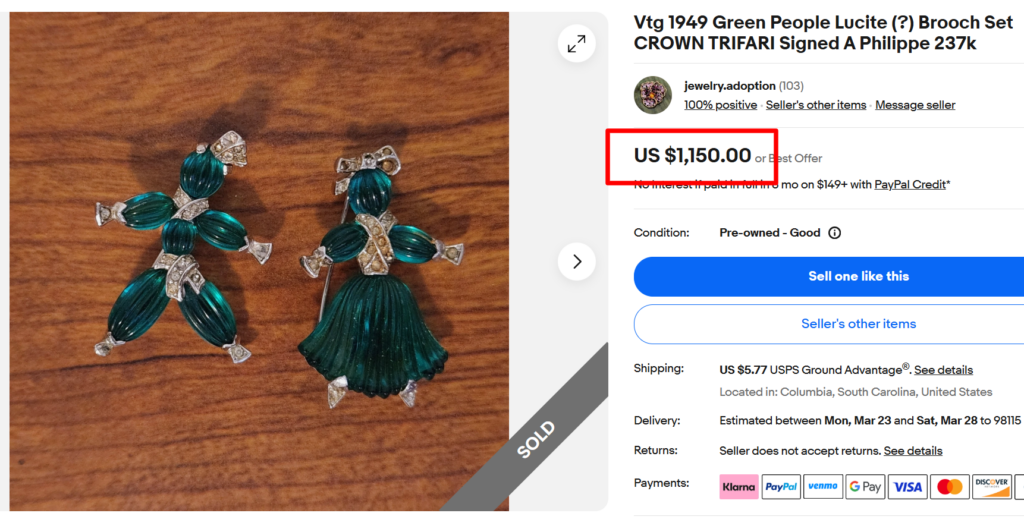
| Average Sold Price | $200–$1,500+ |
| Key Features | Sterling/gold-plated setting, Lucite or molded glass body |
| Manufacturing Period | 1940s–early 1950s |
| Collectibility | High for matching pairs |
Non-animal figural Trifari brooches are highly popular among collectors. Alfred Philippe designed many of these for Trifari in the 1940s and early 1950s. The “People” or human figures are some of the most desirable.
Many of these brooches are multi-colored and utilize “cold enamel” techniques to achieve a bright finish. They are mostly set in Sterling or gold-plated construction with Lucite or molded glass body sections.
A matched pair of human figural brooches like this is a rare find!
7. Coronation Crown Brooches (1944)
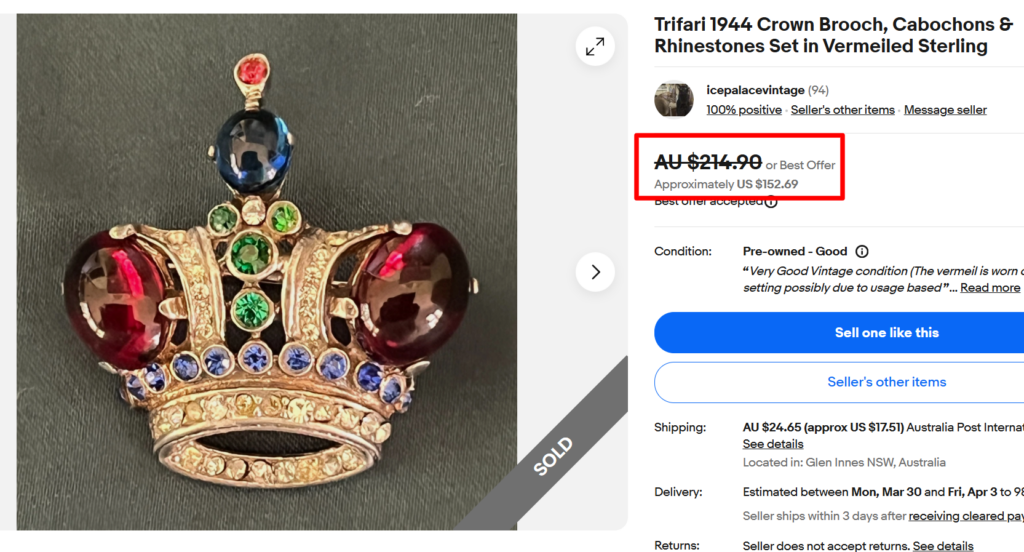
| Average Sold Price | $150–$800 |
| Key Features | Crown shape, Sterling silver (vermeil or not) |
| Manufacturing Period | 1944 (sterling) |
| Collectibility | Moderate to High (for 1944 pieces) |
Trifari crown brooches are arguably the most popular of Trifari designs. Alfred Philippe filed the patent for the most popular Trifari brooch, known as the “King’s Crown,” on February 12, 1944, with the design patent granted on March 28, 1944 (Patent No. 137,542).
The brooch features large, colorful cabochons to mimic rubies, sapphires, and emeralds, and multicolor rhinestones, in a gold-plated Sterling (vermeil) setting.
Collector’s Note: The 1944 crown brooches are often confused with the 1953 coronation pieces Trifari made to mark Queen Elizabeth II’s ascension. The 1944 pieces are sterling (marked “sterling”) and were made during WWII!
8. “Moguls of India” Peacock Brooches
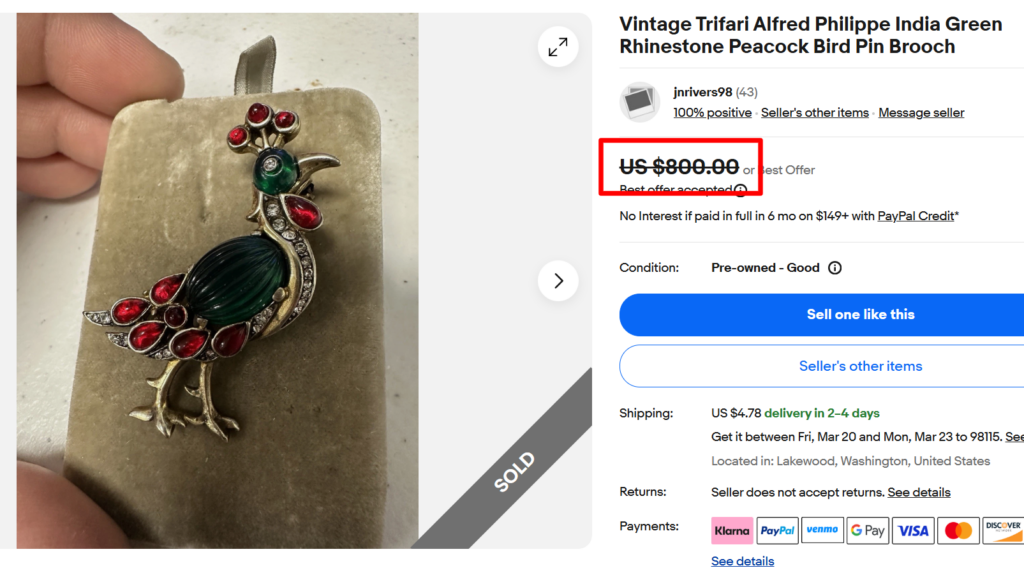
| Average Sold Price | $400–$900 |
| Key Features | Carved Lucite/faux carved glass, cabochons, aged gold-plated base |
| Manufacturing Period | 1930s to 1960s |
| Collectibility | High for 1930s and 1940s pieces |
The Jewels of India and Moguls of India (also spelled “Moghul”) series was developed by Alfred Philippe. Part of the series, this Mogul Peacock features “melon-cut” glass beads and red and green cabochons to mimic royal Indian jewelry.
The series had different forms across decades: KTF-era shield clips from the 1930s, elaborate 1949 figural pieces (turtles, roosters, elephants, peacocks), and the 1960s Jewels of India line with colored art glass cabochons in gold-plated settings.
The peacock brooches usually sell for a few hundred dollars in pristine condition. sell in the $600–$900 range. The 1960s Jewels of India pieces (the broader line with colored glass cabs in leaf and crest shapes) are more common.
9. Patriotic Brooches (Planes)
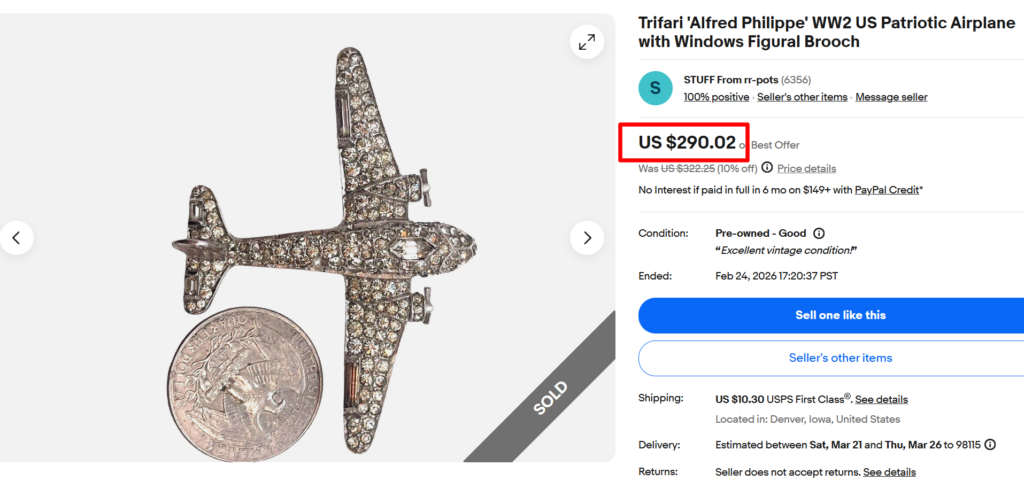
| Average Sold Price | $150–$400+ |
| Key Features | Sterling silver setting, fully paved rhinestone body |
| Manufacturing Period | 1942–1945 |
| Collector’s Note | These are only made in sterling |
During World War II, Trifari created patriotic-themed brooches to boost wartime morale. Among the collectibles are the airplane brooches, which are rhinestone-covered aircraft shapes with propellers, wings, and fuselages.
made of rhinestones and are in full detail with the inclusion of the propellers, wings, and the fuselage.
Alfred Philippe designed these, and they were made in sterling silver to comply with wartime base metal restrictions. Other patriotic Trifari brooch designs from the era include American flags, V for Victory, and eagle brooches.
These pieces are moderately valuable but collectible for their historical significance.
10. Starflight Brooches
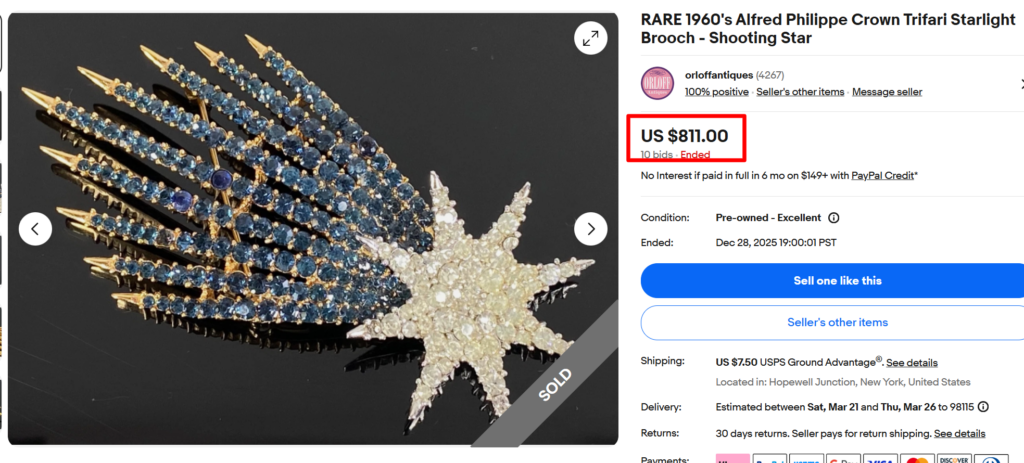
| Average Sold Price | $80–$250+ $500+ (rare forms) |
| Key Features | Starburst shapes, clear/colored stones, rhodium/gold-plated finish |
| Manufacturing Period | Mid-1950s–1960s |
| Collectibility | High for colored-stone versions |
The Starflight and Sunburst brooches are Crown Trifari pieces from the 1950s and 1960s. They have radiating pointed rays that extend from a rhinestone-set center cluster, a defining feature of the atomic-age starburst style.
Some of these brooches feature colored stones in the rays rather than just the center, making these brooches even more collectible.
How to Know if a Brooch is Trifari?
Spotting a real Trifari brooch from a lot of vintage brooches needs a sharp eye. While most pieces carry a mark, some other features will help you differentiate a Trifari piece.
Trifari Marks
Back stamps are the best way to check if the brooch is an authentic Trifari, as the company marked almost all of its pieces of jewelry. Since the mark also changed over the course of the years, the mark also gives an idea of when the brooch was created.
Below are the marks you’ll find on Trifari brooches and what they mean:
- TK: 1918 to 1925. Pieces with this mark are very rare.
- KTF (Trifari, Krussman & Fishel): Early 1930s to approximately 1937. These pieces are also rare and carry a premium.
- Crown Trifari: This mark with a crown over the T (no copyright) was used from 1937 to the mid-1950s. This era saw Alfred Philippe’s most collectible designs.
- Crown Trifari ©: The copyright mark was added after Trifari won a copyright lawsuit against Coro. Pieces from the mid-1950s to early 1970s carry this mark.
- TRIFARI in Italics with ©: This mark mostly appears on 1970s to late 1980s pieces. The crown was dropped from the mark.
- TRIFARI TM: Most late 1980s to 2000 features this block typeface, trademark symbol.
Design Patent Numbers
Trifari brooches made from the 1940s and 1950s usually bear patent stamps like “Des. Pat. No. 135172” or “Pat. Pend.” with the Trifari mark. You can cross-reference the numbers against patent records to confirm the exact date and designer.
Absence of a patent number on a piece that should have one is a red flag.
Setting Metal
Trifari produced sterling silver pieces only from 1942 to 1947 due to metal shortages during World War II. This means that any piece marked “STERLING” is from this period.
After 1947, Trifari developed Trifanium, its proprietary non-tarnishing alloy. Trifanium has held up extremely well, and items made in the 1950s and later show little wear on the metal itself.
The Stone Settings
Trifari used secure prong settings (never glue) on the main stones in collectible pieces. Run your finger over the stones. They should feel firmly seated with consistent prong pressure around each one.
Wobbly, loose, or obviously glued stones often indicate a repair or a reproduction. Also, check for foil backing on the rhinestones; Genuine vintage pieces have foil-backed rhinestones that add depth. Replacements often lack this.
Additionally, on Jelly Belly brooches, the Lucite belly is the most vulnerable part. Lucite on Jelly Belly brooches must be crystal clear with no yellowing, cracks, or haziness; fractures and stress cracks in Lucite can impact value.
Note: This article is intended for informational, educational, and entertainment purposes only. Some images are illustrative and may not represent actual brands, products, or related entities. All trademarks, product names, brand logos, packaging, and other intellectual property referenced remain the exclusive property of their respective owners. Any brand mentions or references are provided solely for descriptive and educational context and do not imply any formal or commercial association.