Antiques Know How Research
McCoy Wall Pockets Value
A detailed research of recent eBay sales by our Antiques Know‑How team indicates that vintage McCoy pottery wall pockets usually sell for $15–$150, with unusual color variants and rarer designs pushing higher. Some of the most collectible designs include the Fruits set, Birdbath, Green Mailbox, Cuckoo Clock, Flower (Poppy) with Bird, Black Umbrella, Blossom Time, Violin, Calla Lily, and Owl Family. Look for the “McCoy” or “McCoy USA” mark, period‑appropriate glazes, and intact condition for the best evaluation.
Antiques Know How
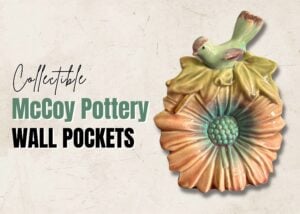
Wall pockets are decorative pieces designed to hold flowers or trailing vines directly on the wall. These are usually common until you spot a rare piece with a unique glaze color and design, such as McCoy’s Birdbath pocket.
If you love McCoy art pottery, this list is for you. Here, you will discover some of the most popular McCoy wall pocket designs, their actual worth in the market, and the things you need to check before buying or selling one.
Collectible McCoy Pottery Wall Pockets to Find!
The McCoy family started potting in the mid-1800s, but the famous decorative wall pockets were introduced primarily in the early 1940s. In the next two decades, they came up with over 300 known designs, which varied from fruits and flowers to figures, animals, and household items.
Many pieces were also made in various glaze colors, which makes them more attractive to collectors. Most McCoy wall pockets are worth $15 and $150 today, though unusual color variants and rarer designs can fetch even more.
The following are some of the most collectible McCoy Pottery wall pockets.
1. Fruit Series
| Average Value | $10 – $35 (per piece) |
| Production Period | 1950s |
| Key Features | Realistic fruit shapes, glossy glazes, textured green leaves. |
| Collectibility | High (especially as a set) |
| Collector Notes | Some fruit planters don’t have a mark. |
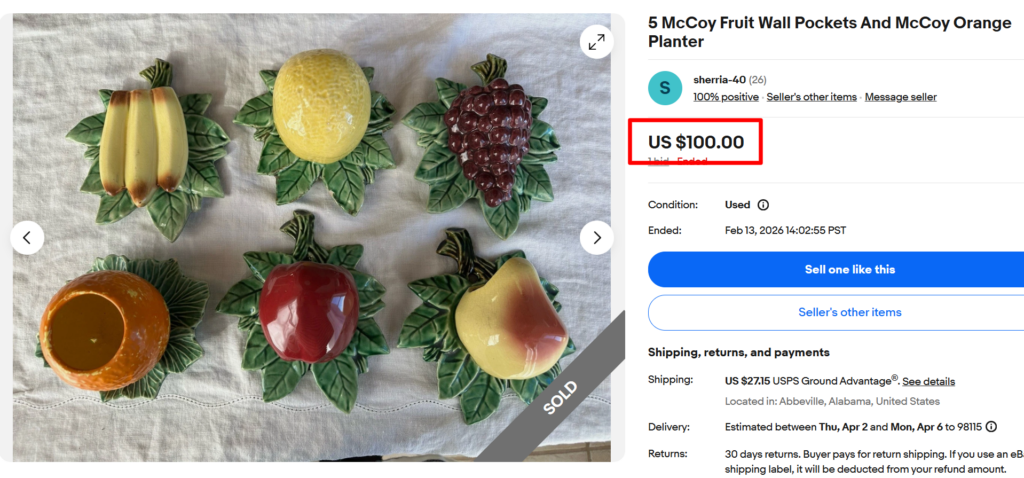
McCoy’s fruit wall pocket series included apples, pears, grapes, bananas, oranges, and lemons, each modeled as a full fruit resting on a leaf base. Each fruit planter had a realistic, vibrant glaze.
While individual pieces are common in the market, a set of all the fruit wall pockets is a rare find and fetches up to $100, depending on the condition of each.
Also, grapes and lemon turn up less often than apples and pears, making them the more desirable finds within the series.
2. Birdbath
| Average Value | $25 to $100 (high for green bird) |
| Production Period | 1950s |
| Key Features | Bird perched on birdbath; approx. 8 inches |
| Collectibility | Moderate to High |
| Collector Notes | The green bird version is rarer. |
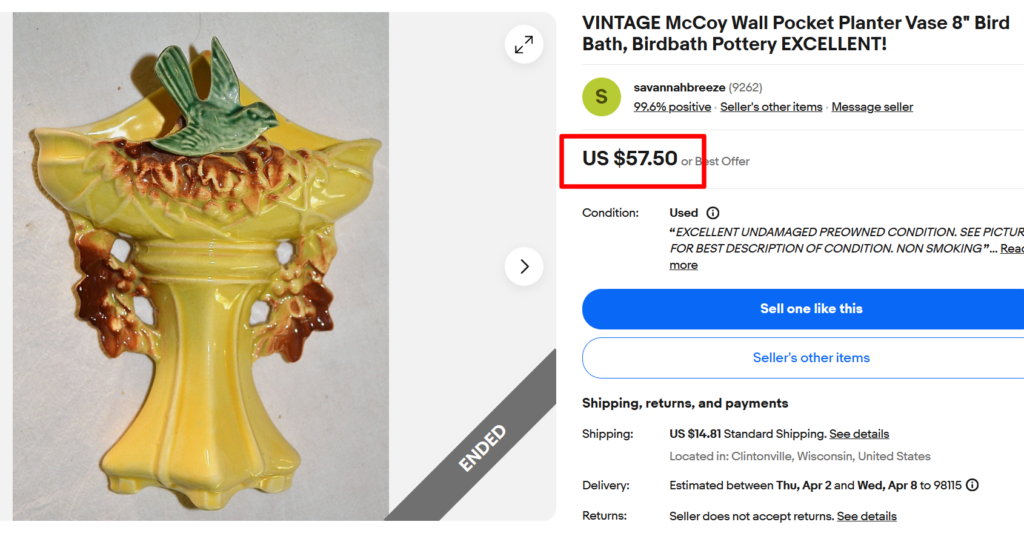
This elaborate wall pocket has a bird sitting on the rim of a pedestal birdbath basin and is surrounded by vines and leaves. McCoy made this wall pocket in at least two different colorways: with a yellow bird and with a green bird.
The green bird version shown here is the rarer of the two and consistently sells for more. Check the backside for the raised “McCoy” mark for authenticity.
3. “Letters” Mailbox
| Average Value | $30 to $90 |
| Production Period | 1950s |
| Key Features | Mailbox form; green glaze |
| Collectibility | Moderate to High |
| Collector Notes | Originally released only in green. |
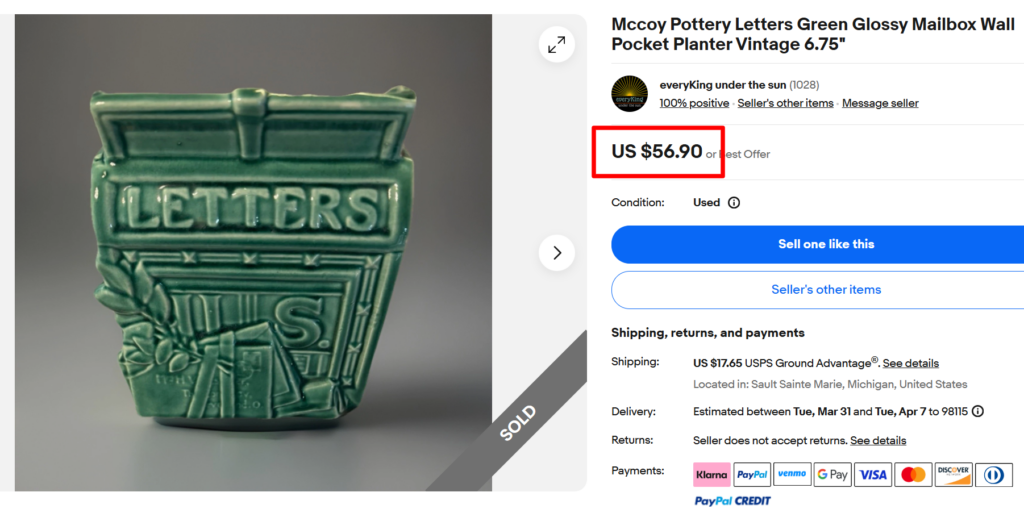
Designed to look like a traditional rural U.S. Mailbox, this green glossy pocket features the words “LETTERS” and “US” embossed on the front. This design was made exclusively in green and is about 6¾ to 7 inches tall.
Any color other than green is almost certainly a later reproduction, not an original. Also, the originals must bear the “McCoy USA” mark on the bottom.
4. Cuckoo Clock
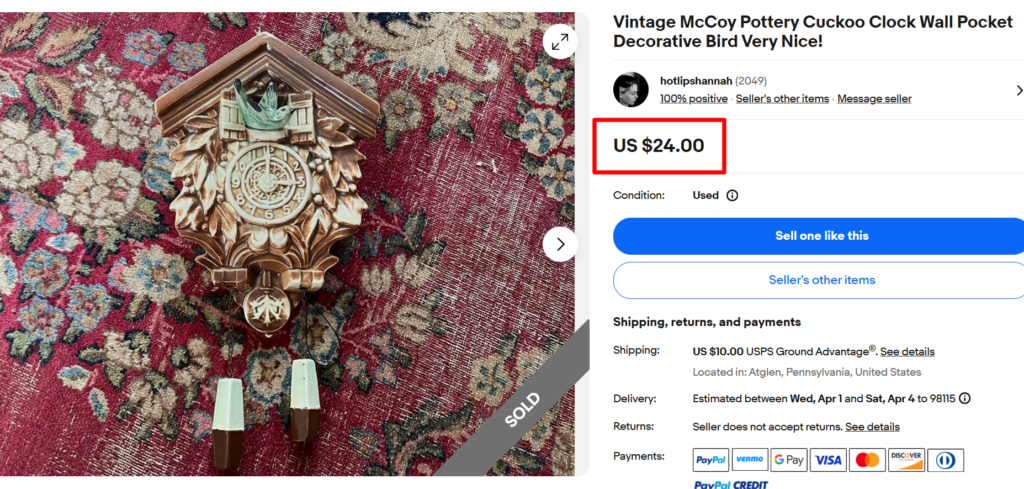
| Average Value | $20 to $80+ (mint, with intact bird) |
| Production Period | 1940s–1950s |
| Key Features | Clock face, hanging weights, perched bird |
| Collectibility | High |
| Collector Notes | Find the “McCoy” mark on the back. |
One of the most recognized McCoy wall pocket designs, the Cuckoo Clock measures roughly 10.5 inches (with the hanging weights) and features a clock face, decorative roofline, and a small bird at the top.
McCoy produced this design in brown and green variants, each with a different bird color. Also, confirmed examples are marked on the reverse.
Since the bird and the dangling pieces are the more fragile elements, finding a pocket with these intact is difficult.
5. Flower (Poppy) with Bird
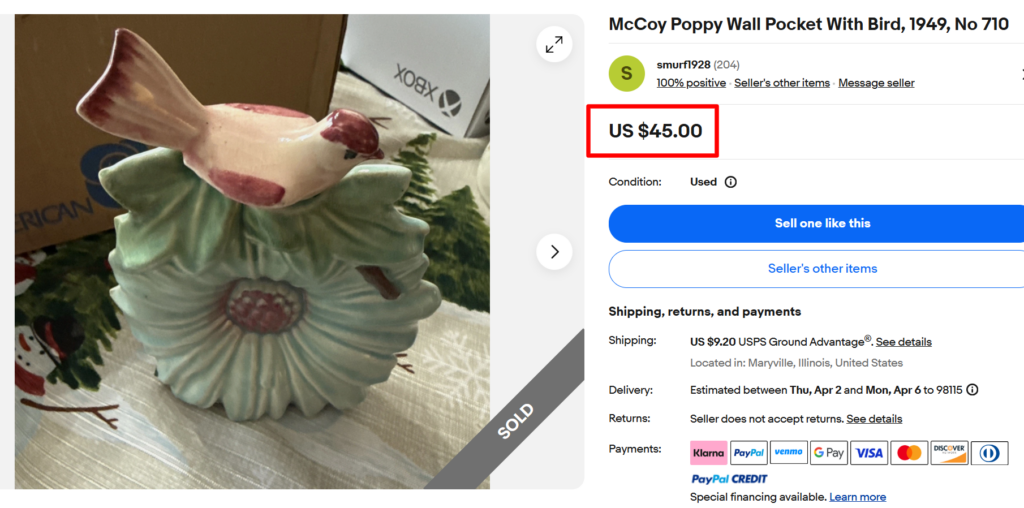
| Average Value | $20 to $75 (originals) |
| Production Period | 1948–1950s |
| Key Features | High-relief poppy petals, sculpted bird |
| Collectibility | Moderate to High |
| Collector Notes | Confirm the McCoy mark on the base. |
One of the more popular designs by McCoy, this pocket features a large stylized poppy flower with a small bird resting on top. It is 6½ inches tall and was originally made in pink, yellow, and blue.
This pocket design was widely reproduced. To spot an original McCoy piece, check for the raised “McCoy” mark on the bottom. Also, reproductions are smaller, measuring only 6 inches tall or less, compared to the original height of 6½.
6. Umbrella (Black)
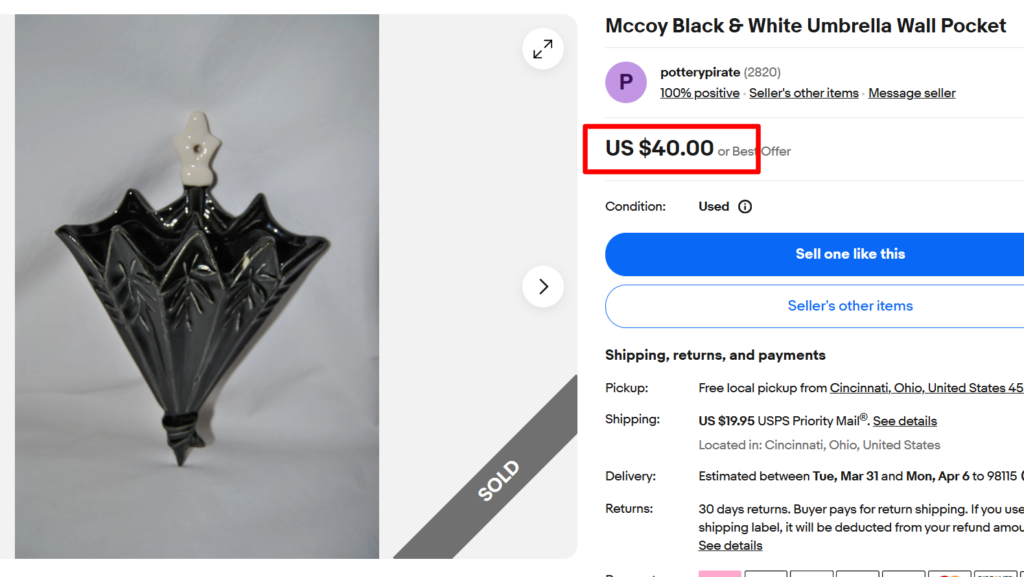
| Average Value | $15 to $30 (yellow/green); $20 to $60 (black) |
| Production Period | 1940s–1950s |
| Key Features | Fluted umbrella ribs, handle top, contrasting glazes. |
| Collectibility | High (black); Moderate (yellow/green) |
| Collector Notes | Look for “McCoy USA” on the back. |
The Umbrella wall pocket is shaped like a closed umbrella standing upright, complete with a handle as the hook. The canopy of the umbrella also shows raised leaves on each panel, and the back bears the “McCoy USA” mark.
The black glaze version shown here is the rarer and more collectible variant; yellow and green are more common.
7. Blossom Time
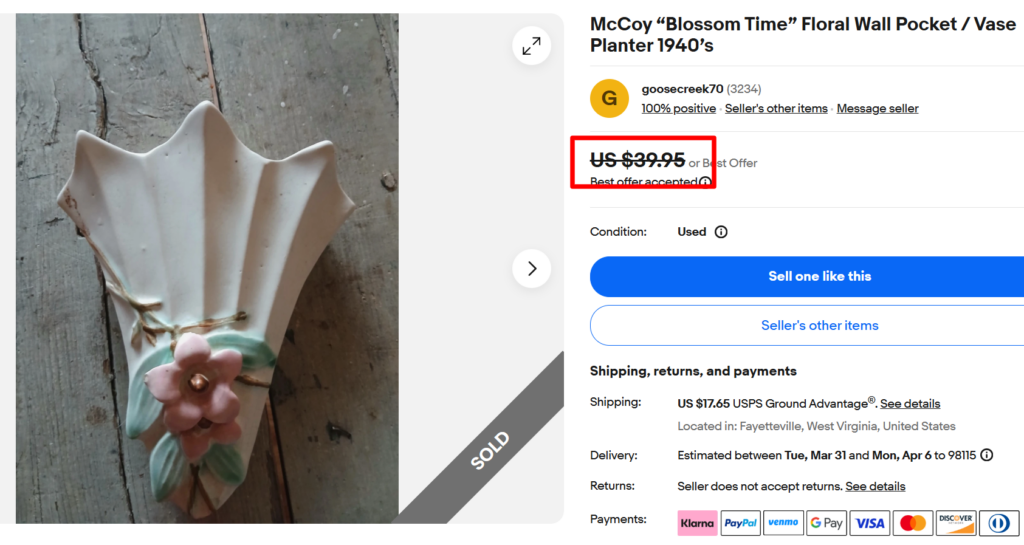
| Average Value | $30 to $80 |
| Production Period | 1946 |
| Key Features | Fluted fan shape, raised pink blossoms |
| Collectibility | Moderate to High |
| Collector Notes | Spot the “McCoy” mark of authenticity. |
Blossom Time is a popular McCoy line from the mid-1940s. The wall pocket from this line features raised pink blossoms and twigs against a matte yellow or ivory glaze. It was a short production run, which is why it turns up less often than general floral wall pockets.
This pocket measures approximately 7-1/2″ tall by 6″ wide and bears the “McCoy” mark on the back.
8. Violin
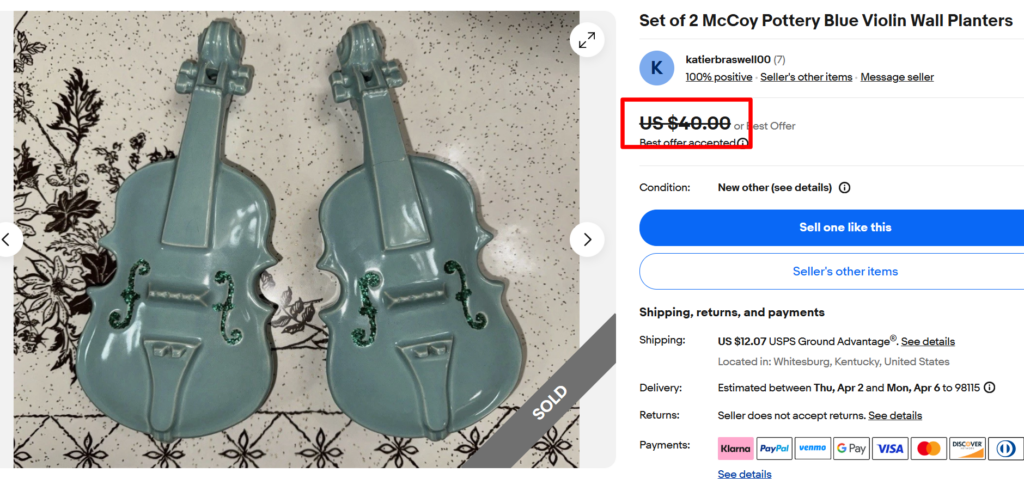
| Average Value | $40 to $60 (single with gold trim) |
| Production Period | 1950s–early 1960s |
| Key Features | Full violin shape, gold-etched strings and tailpiece |
| Collectibility | Moderate to High |
| Collector Notes | Gold strings are the main value factor. |
Shaped like a full violin with molded strings and a tailpiece, this pocket was produced in turquoise with gold-painted string detailing. The gold trim on the strings was part of the original production, not added after.
It’s marked USA on the reverse. The gold trim is the main condition variable. Heavily rubbed examples are common, and pieces with most of the gold intact sell for noticeably more.
9. Calla Lily (White)
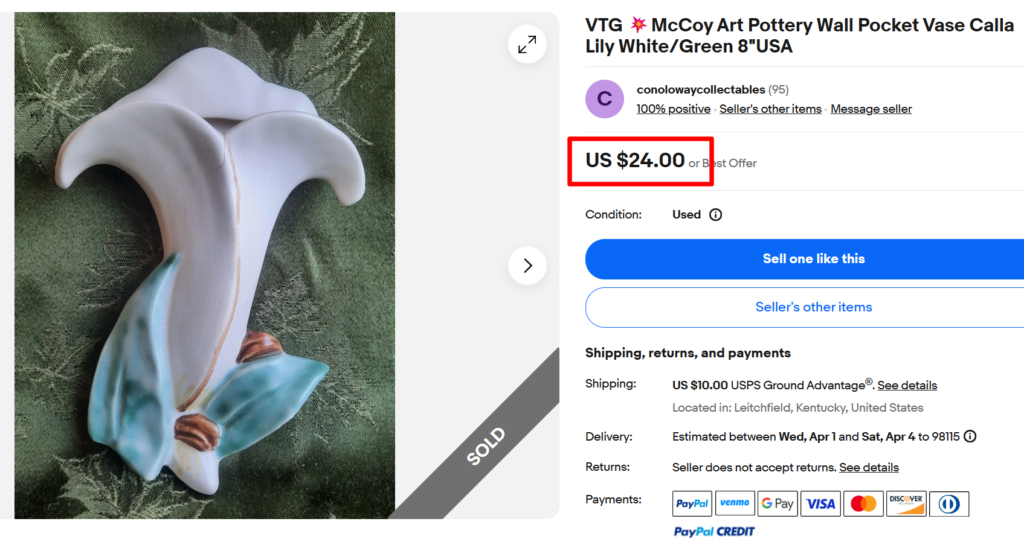
| Average Value | $25 to $65 |
| Production Period | 1940s (early); 1950s–1960s (later) |
| Key Features | Single calla lily bloom; white glaze |
| Collectibility | Moderate (later); High (early 1940s version) |
| Collector Notes | Check the “McCoy” mark on the back. |
McCoy made lily-form wall pockets and vases across multiple eras. The white Calla Lily version, which stands at a height of 7.5 inches, is one of the cleaner designs in the wall pocket series.
There’s also an earlier version that dates back to the 1940s, which usually has a yellow flower and green leaves. The earlier production pieces are more collectible. Both early and later versions carry the “McCoy” mark on the reverse, but identifying the production era matters for valuation.
10. Owl Family
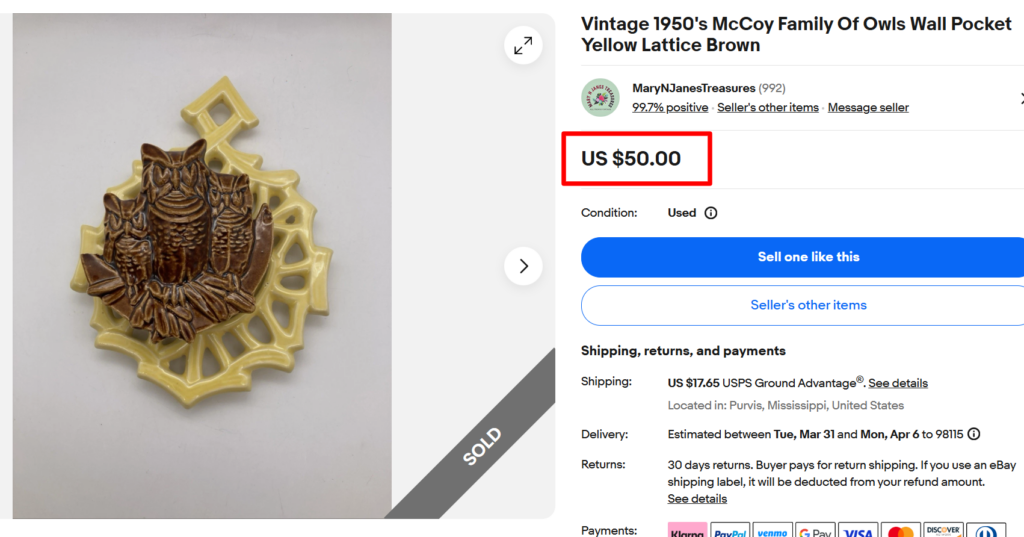
| Average Value | $25 to $50+ |
| Production Period | 1950s |
| Key Features | Three owls on a branch in brown glaze |
| Collectibility | Moderate to High (triple owl: High) |
| Collector Notes | “McCoy USA” mark on the yellow frame. |
McCoy made owl wall pockets in two distinct versions. The single owl and the owl family. This is an example of the latter, featuring three owls perched together within a decorative lattice-work frame.
Authentic owl family pockets have the “McCoy / USA” mark on the back of the yellow frame. Also, the family variant is noticeably harder to find than the single owl variant. In pristine condition, the value can go up to $50 or more.
Things to Check While Collecting McCoy Wall Pockets
Finding a McCoy wall pocket at a garage sale is easy and common. Finding one that’s truly collectible is not. Here’s what to focus on before buying.
The McCoy Mark
Backstamps are the most reliable way to verify whether a piece is genuine McCoy. Most Nelson McCoy wall pockets from the 1940s–1960s have an embossed or incised “McCoy” and/or “USA” on the reverse.
But note that some early pieces are unmarked. If that’s the case with your piece, make sure to cross-check the design against a reference guide for right attribution.
Color Variants
McCoy produced many designs in multiple glaze colors, and some variants are significantly rarer than others. The difference between a standard and a rare glaze color can double the price.
Also, since certain designs were released in specific glazes, knowing the color variants can also help in authentication. For example, if an example claims to be McCoy but is a color the company never released for that shape or form, it’s a red flag.
Condition Details
For vintage pottery, crazing (a fine network of surface cracks in the glaze) is normal and is accepted by most collectors. But deep crazing or cracks that affect a piece’s structural integrity are a different matter and will reduce its value accordingly.
Similarly, birds, handles, flag extensions, and leaf edges are the first things to break on any wall pocket. So, run your fingers along all protruding elements to spot any chips; sometimes they’re not visible, but often become obvious by touch.
Fakes and Misattributed Pieces
Several McCoy wall pocket designs have been reproduced and misattributed over the years. The pear pocket and the Flower with Bird are two common examples.
The best way to avoid trading a reproduction or fake is to learn about the exact design, dimensions, and glaze of your piece from verified resources or guides. A simple comparison from a documented piece can also help clear things up.
Note: This article is intended for informational, educational, and entertainment purposes only. Some images are illustrative and may not represent actual brands, products, or related entities. All trademarks, product names, brand logos, packaging, and other intellectual property referenced remain the exclusive property of their respective owners. Any brand mentions or references are provided solely for descriptive and educational context and do not imply any formal or commercial association.