Antiques Know How Research
Vintage Stuffed Animals Value
Our Antiques Know How research shows that most vintage stuffed animals sell in the $100–$500 range at auction, with better‑condition or rare pieces reaching several hundred dollars. The rarest models include Chrome Hearts rabbit‑fur teddies, Eaton’s Punkinhead Merrythought Bear, vintage Steiff Peter Rabbit and early bears, Rushton octopus, mint‑green Gund Snuffles, and Knickerbocker Mickey‑style plush. Key value factors include maker, presence of original tags/buttons, rarity, and overall condition with no extensive repairs or cleaning.
Antiques Know How
Once a kid’s favorite toy, most stuffed animals end up in donation bins or landfills once the kids grow up. But if you still have an old, vintage stuffed toy in your trunk, read along, because you could be having a real treasure.
Stuffed animals are no longer just playthings; they’re hot collectibles today that have been selling for hundreds, and even at times thousands of dollars.
This guide is all about discovering the rarest and most valuable stuffed animals, their market value, and tips for evaluating what makes a vintage plush so special.
Rare Stuffed Animals That Are Valuable Today
Stuffed animal toys have been around since the 1900s, after Steiff’s first plush bear became a huge hit. Since then, many companies have released a wide range of plush animal toys, some limited to a certain number, color, or period.
And such vintage stuffed animal toys are the most collectible ones today. Below is a list of 10 such rare pieces you should know.
1. Chrome Hearts Big Rabbit Fur Teddy Bear
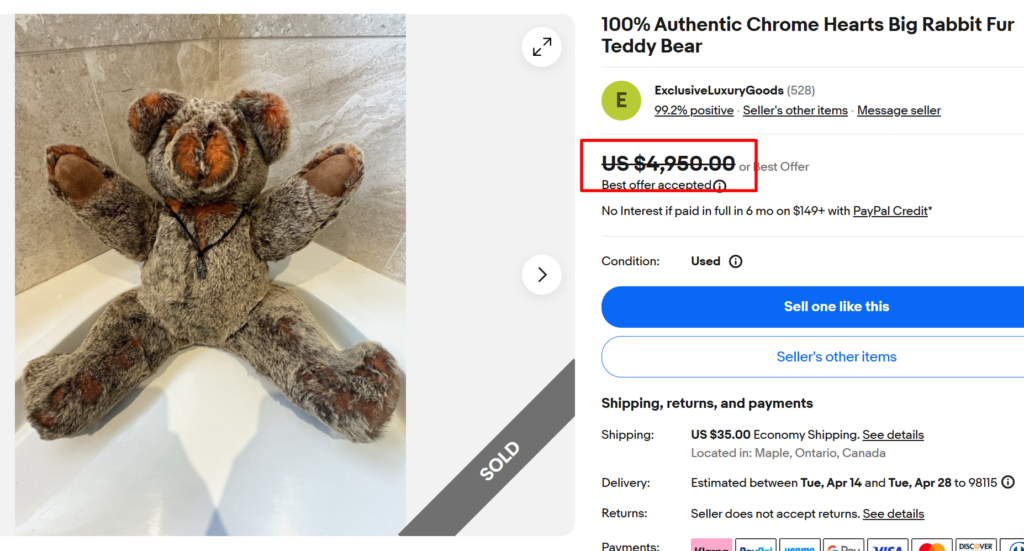
| Average Value | $2,500 – $5,000+ |
| Production Period | 2000s–Present |
| Status | Limited Edition |
| Key Features | Real rabbit fur, real silver eyes |
| Collector Notes | Check for real silver eyes, tags, accents |
Chrome Hearts is Richard Stark’s luxury brand founded in 1988. This Big Rabbit Bear is made from genuine rabbit fur and features sterling silver hardware for its eyes and accessories, which makes it extremely rare and valuable.
Original pieces also include the brand’s signature dagger necklace and the silver Chrome Hearts logo tag, often on the back or in other key areas. Make sure the silver is genuine.
Examples with real silver accents and in good condition can fetch up to several thousand dollars today.
2. Eaton’s Punkinhead Merrythought Teddy Bear
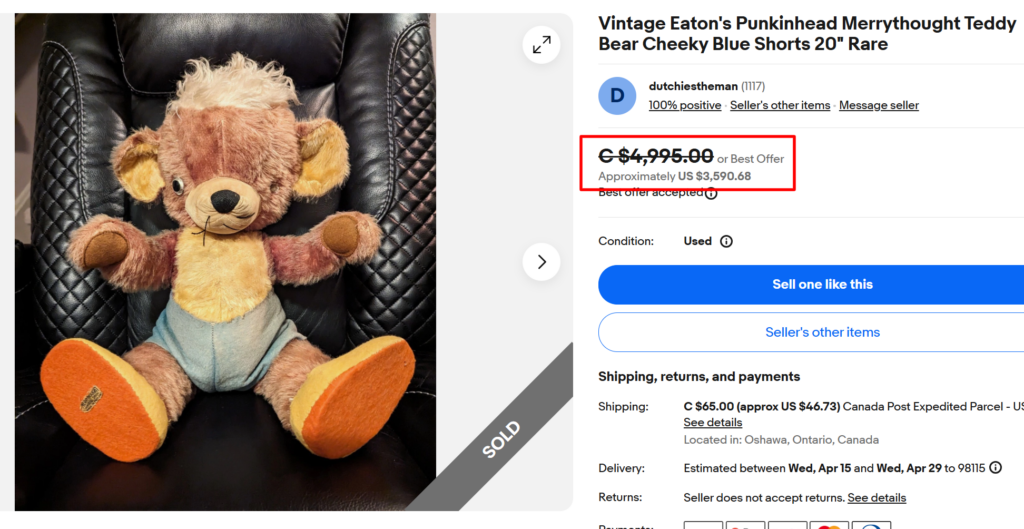
| Average Value | $1,500 – $3,500+ (originals) |
| Production Period | 1948 – mid-1950s (originals) |
| Status | Discontinued |
| Key Features | Brown mohair, topknot hair, blue shorts |
| Collector Notes | An intact topknot boosts the value. |
Punkinhead was a promotional Christmas teddy bear mascot that the British company Merrythought created exclusively for the Canadian department store Eaton’s. This bear is famous for its brown mohair, a ginger-blond topknot on top of its head, and its signature blue shorts.
Because these were largely exclusive to Canada, they are quite rare to find internationally, especially in good condition. Examples with the topknot intact are significantly rarer and sell for considerably more.
Identification Tip: The original Merrythought label reads “Merrythought Hygienic Toys / Made in England” and appears on the sole of the left foot.
3. Jellycat Nicky Bashful Bunny
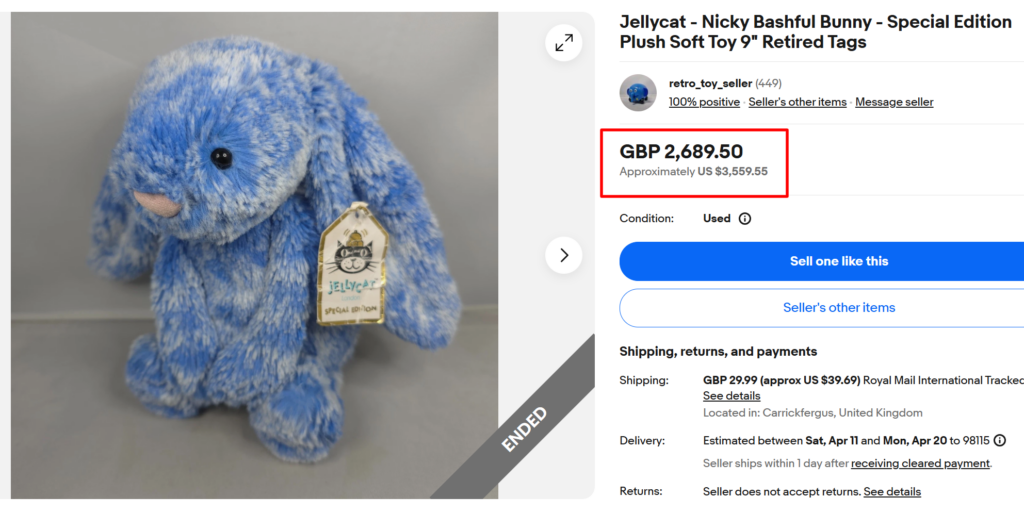
| Average Value | $300 – $3,500+ |
| Production Period | 2013 – 2016 |
| Status | Retired |
| Key Features | Blue-white tie-dye fur, black button eyes |
| Collector Notes | Intact tags can double the value. |
Although not really vintage, Jellycat stuffed animals are very popular and valuable collectibles today. Nicky is a special edition Bashful Bunny released by Jellycat in 2013 and retired in 2016.
He’s a blue-and-white tie-dyed rabbit with long, floppy ears, black button eyes, and a peach nose. Retired special-edition colorways like this example are the most desirable and expensive Jellycat items.
A used Nicky without tags might sell for $300–$500, but a new-with-tags example can easily fetch $2,000-$4,000 today.
4. Gigglee Eyes Monster
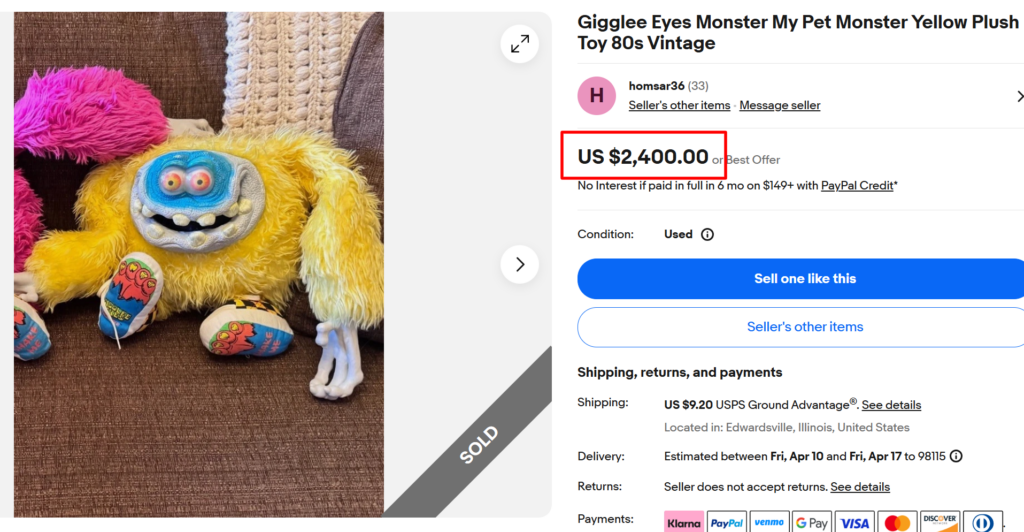
| Average Value | $800 – $2,400 |
| Production Period | 1988 |
| Status | Discontinued |
| Key Features | Yellow shag fur, googly rubber eyes |
| Collector Notes | Moving eyes, rare color boost value. |
The Gigglee Eyes Monster was made by Tamfort Ltd, as a spin-off for its highly popular line, “My Pet Monster.” It’s basically a 14-inch yellow shag-fur monster with googly eyes that rattle when shaken, a rubber face, and painted rubber shoes.
It mainly comes in two colors: yellow and hot pink; the yellow version is rarer and more valuable than the pink one, especially in pristine condition with the eyes and shoes intact.
5. Steiff Beatrix Potter Peter Rabbit Plush
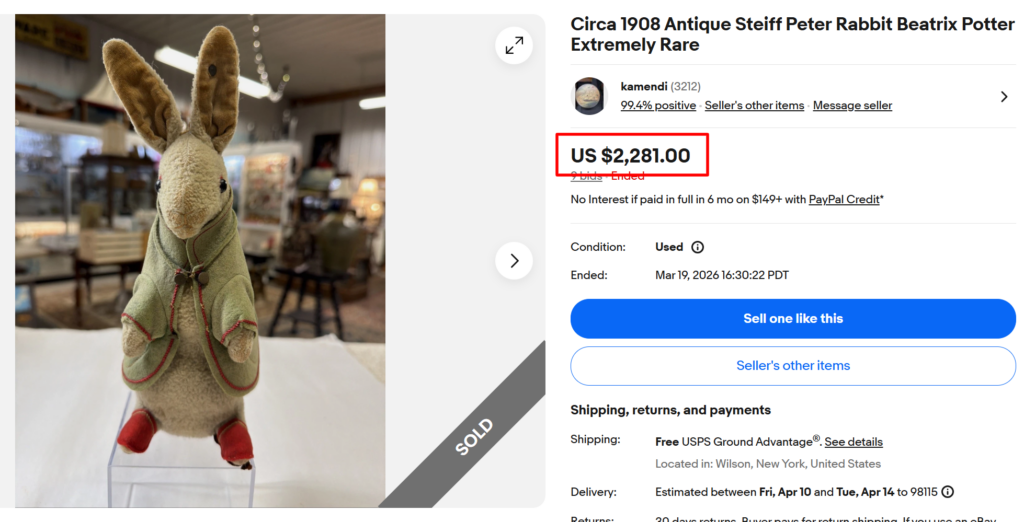
| Average Value | $2,000 – $5,000+ (originals) |
| Production Period | c.1905 (originals) |
| Status | Discontinued (originals) |
| Key Features | White wool plush, blue felt jacket, red felt slippers |
| Collector Notes | Check the Button-in-ear tag. |
Steiff produced this cute rabbit based on Beatrix Potter’s character around 1905. It comes in a white wool plush body, a felt jacket with button detailing, red felt shoes with leather soles, and a button nose with red felt backing.
Because Steiff was one of the first companies authorized to create these characters, these pieces are quite desirable among collectors. Original examples with the Steiff button intact are hard to find today and are hence highly valuable.
Since later licensed replicas exist, check the key Steiff identifiers, including the button-in-ear tag for authenticity.
6. Vintage Steiff Teddy Bear
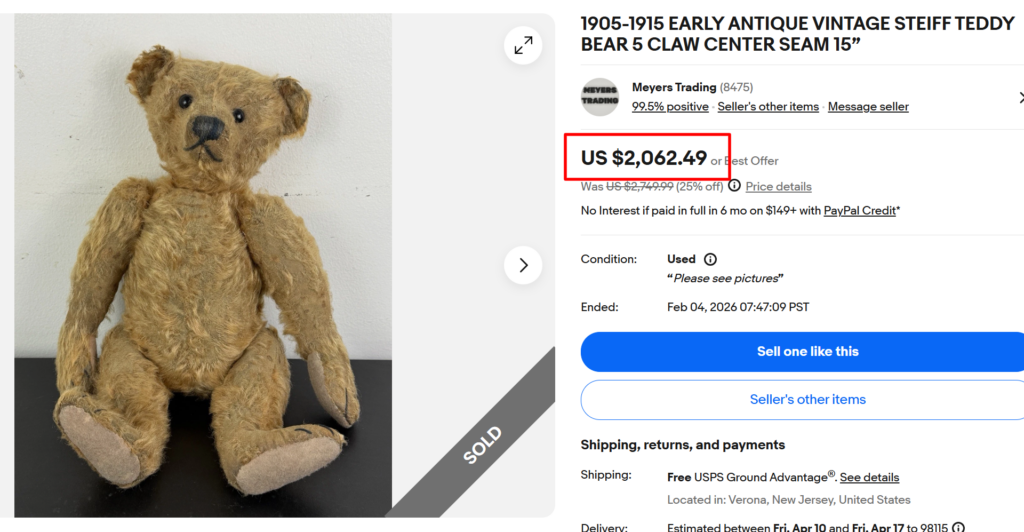
| Average Value | $1,500 – $5,000+ (good condition) |
| Production Period | 1902 – present (early period: pre-1915) |
| Status | Continued; early examples antique |
| Key Features | shoe-button eyes, center seam, five claws |
| Collector Notes | Button-in-ear is the key identifier. |
Steiff is famous all around the world for creating the first commercially successful jointed teddy bear. Any Steiff bear from before 1915 that was made using blonde or cinnamon-colored mohair with excelsior stuffing is highly valuable today.
Originals bears carry the famous Button-in-Ear, which is a metal tag used since 1904. Other key dating markers include shoe-button eyes (pre-1913), five claws per paw (pre-1906), a back hump, and long, curved arms.
Good-condition original teddy bear examples from this period consistently sell between $1,500 and $5,000+ today.
7. Rushton Rubber Face Octopus Plush
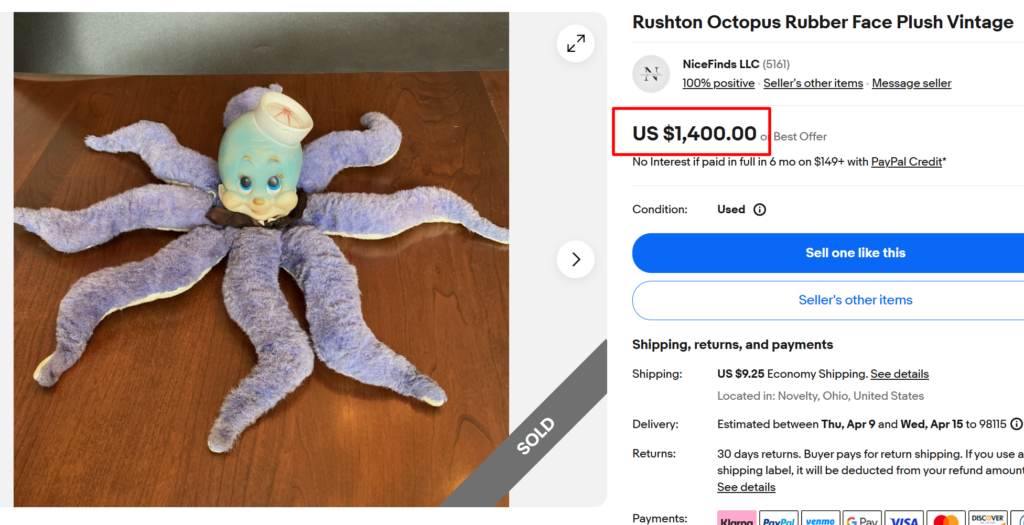
| Average Value | $800 – $1,400+ |
| Production Period | 1950s – 1960s |
| Status | Discontinued |
| Key Features | Hand-painted rubber face, fur body |
| Collector Notes | Original sailor hat and collar add value. |
The Rushton Company was famous for blending plush bodies with hand-painted rubber faces. This octopus is one of their most sought-after designs. It features eight plush tentacles in purple or blue, a hand-painted rubber face, a sailor hat, and a white felt collar.
While average Rushton plushies sell for $200–$400, the octopus, being a rare design, regularly commands $800-$1,500 or more, depending on condition.
8. Gund Snuffles Bear (Mint Green)
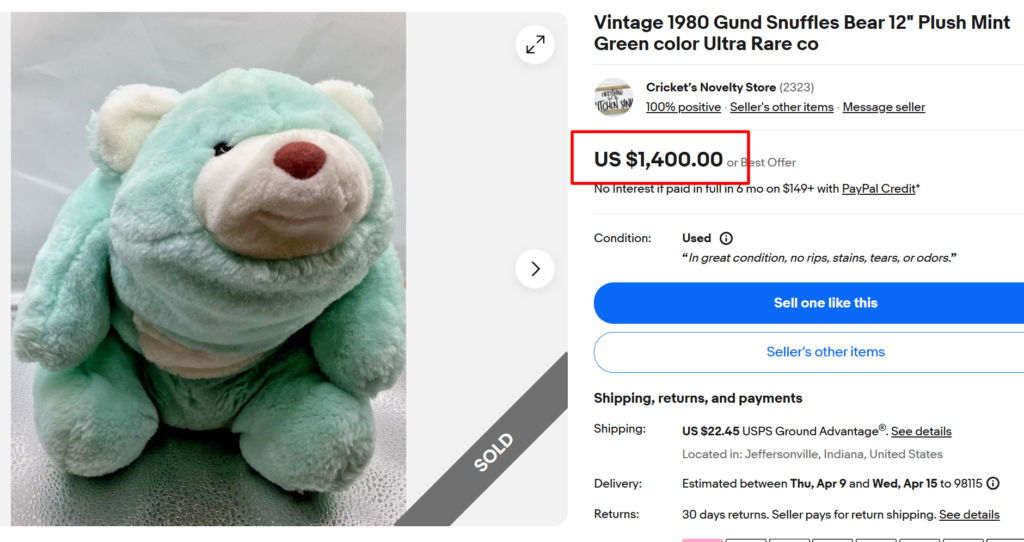
| Average Value | $800 – $1,400 |
| Production Period | 1981 – present (mint green until 1981) |
| Status | Ongoing (mint green: Limited Run) |
| Key Features | Crescent-moon face, red snout |
| Collector Notes | A paper hang tag is a must for value. |
Snuffles was designed by Rita Raiffe in 1980 to resemble a crescent moon. You can easily spot it by its face, which is angled upward so it looks directly at you when held.
Most Snuffles were brown or white; the “Mint Green” (“Gwen”) version is an ultra-rare anomaly made in far smaller quantities and is now discontinued. Finding a Snuffle bear in mint green with the original paper hang tag is every collector’s dream.
9. Knickerbocker “Mickey Mouse” Plush
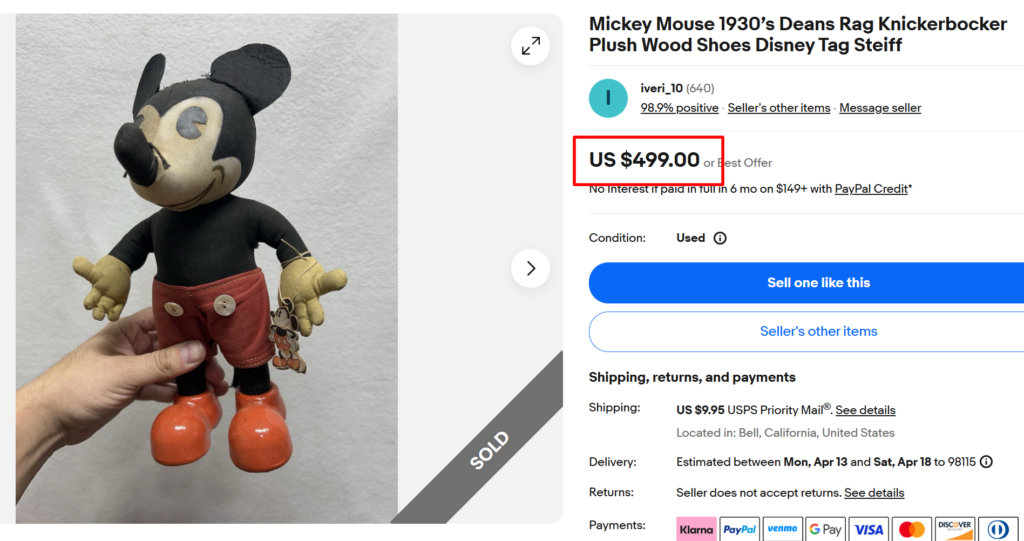
| Average Value | $400 – $1,500+ (based on condition) |
| Production Period | 1934 – 1947 |
| Status | Discontinued |
| Key Features | Fabric body, wood shoes, button-eye |
| Collector Notes | The original Disney tag can add value. |
Not exactly a stuffed animal, but this toy deserves a place in this list. It was a licensed Disney item from Knickerbocker Toy Company, released following Charlotte Clark’s original design patterns. It is easily identified by its black cloth body, “pie-cut” eyes, and distinctive wooden shoes.
As a licensed piece, this stuffed toy is highly desirable. Generally, its value ranges between $350 and $550, but very well-preserved pieces with a “Walt Disney” hang tag may even fetch $800 or more up to $1,000.
How to Tell If an Old Stuffed Toy is Valuable?
One thing is clear: not all vintage plush toys found at estate sales or thrift stores have high value. But then there are some clues you can use to spot a toy with great value against a cheap one.
Maker & Maker Marks (Tags, Labels & Buttons)
The first thing that drives an old stuffed animal’s value is its manufacturer. A marked toy from a notable brand will always be more valuable than an unmarked bear.
Some of the most collectible stuffed toy brands are:
- Steiff
- Gund
- Ideal Toy Company
- Merrythought
- Knickerbocker Toy Company
- Rushton Company
- Dakin
- Jellycat
- The Walt Disney Company
To identify the maker of your plush, always check the maker first. Look for tags, labels, buttons, or embroidery that displays the maker’s name. These elements are proof of authenticity and age.
For Steiff, the button in the ear is the key authentication marker, and it cannot be replaced once lost. For Gund Snuffles, both the paper hang tag and the tush tag are important.
For Jellycat special editions, the gold foil “Special Edition” tag significantly increases desirability.
Collector’s Tip: If you’re cleaning or “restoring” your vintage stuffed animal, consider what you might remove. A lost tag or label can hurt the value.
Rarity
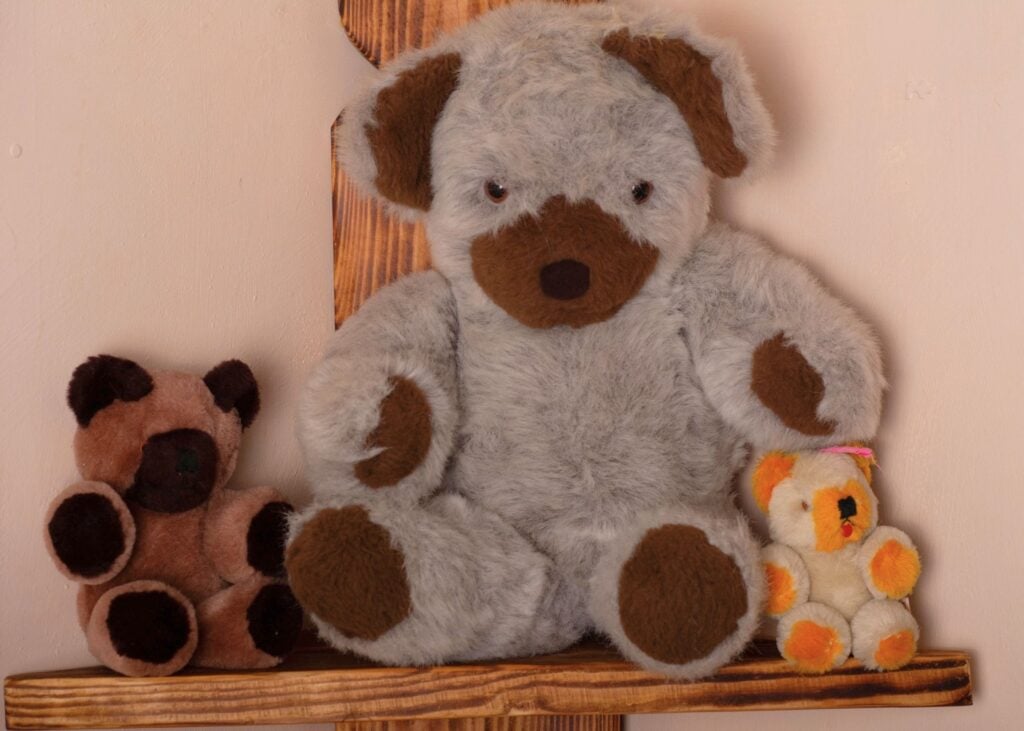
Rarity affects the worth of a vintage toy far more than people may think.
For stuffed toys, rarity depends on three factors: low production numbers, particular colors or variations made in small quantities, and age, along with limited numbers of surviving examples.
The less common (or available) the stuffed plush toy is, the higher its value will be. For example, a common-color Gund Snuffles from 1985 might be worth $30, while the mint green version of the same bear can be worth 40x that, because the color was made in very small numbers.
Unlike other vintage items, age alone doesn’t guarantee the value of stuffed animals. A common bear from 1960 in poor condition may be worth less than a discontinued Jellycat from 2013 in pristine condition. It’s more about the rarity and condition, here.
Condition
As I mentioned above, condition matters a lot for vintage stuffed toys. With antique pieces (1920s or earlier), some wear is expected and doesn’t really hurt the value.
But there are specific damage types that do cut value significantly, such as:
- Missing eyes or replaced eyes
- Replaced paw pads
- Tears or holes in the mohair
- Moth damage
- Missing manufacturer’s buttons or tags
- Visible signs of washing or restoration
Always thoroughly assess the condition of your old soft toy before buying or selling for the above-mentioned damage signs; they can significantly reduce the overall worth.
Sold Prices Analysis
For vintage toys, especially stuffed animals, real-time sales and auctions can help a lot in valuation. Once you identify your soft toy, analyze the value of sold examples on online auctions or sales sites. This will give you a clear picture of what buyers are actually paying for that specific example.
Note: This article is intended for informational, educational, and entertainment purposes only. Some images are illustrative and may not represent actual brands, products, or related entities. All trademarks, product names, brand logos, packaging, and other intellectual property referenced remain the exclusive property of their respective owners. Any brand mentions or references are provided solely for descriptive and educational context and do not imply any formal or commercial association.