Antiques Know How Research
Vintage Herend Patterns Value
Our Antiques Know How team’s in‑depth review of eBay sales and auction results shows that vintage Herend dinnerware usually ranges from $150 to several thousand for full, rare services, with top patterns. The most collectible and iconic Herend patterns include Queen Victoria (VBO, $500–$12,000+ sets), Rothschild Bird ($1,200–$20,000+ services), Macao Verdi ($800–$10,000+ sets), Poisson Blue ($2,000–$10,000+ services), Fortuna Rust, Cornucopia ($5,000–$18,000+ full sets), Indian Basket, Chinese Bouquet (Apponyi), Waldstein Pink Rose, and Ming. To identify genuinely valuable Herend, check the backstamp, pattern, and shape numbers, enamel brushwork, gold trim, and condition.
Antiques Know How
About Herend Company
Now one of the most celebrated porcelain manufacturers, Herend began as a small pottery factory in Hungary in 1826. Under the leadership of Mór Fischer in the mid-19th century, the company became a favorite among European royalty, including Queen Victoria and the Rothschild family.
Herend is known today for keeping the art of hand-painting when manufacturing dinnerware. And its products not only have high aesthetic value but are durable as well.
Most Valuable Herend Porcelain Patterns to Know
The following are some of the most popular and actively collected Herend patterns. Some of these are worth thousands of dollars when found in complete dinnerware sets.
1. Queen Victoria (VBO)
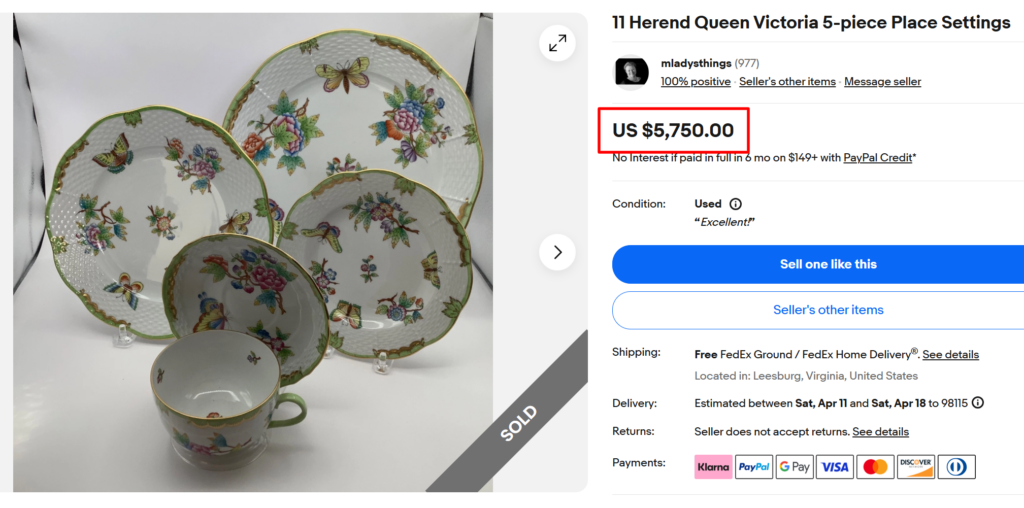
| Average Value | $500–$1,200 (small, partial sets) $5,000–$12,000+ (large services) |
| Production Period | 1851 to present |
| Status | Continued (Flagship) |
| Key Features | Butterflies, peonies, gold rim, multicolor |
| Collector Notes | Pre-1950 pieces with older backstamps command a premium |
Queen Victoria is certainly Herend’s most well-known pattern. It made its debut at the Great Exhibition of London in 1851 and won a gold medal there, catching the attention of Queen Victoria, who commissioned an entire service for Windsor Castle.
It was inspired by Chinese export porcelain and has such features as peonies, variously colored butterflies (red, blue, purple, yellow, green), and floral sprigs, all against a white background and edged in gold.
There’s also a modern version of this pattern, known as VBO, with slightly lighter colors and a dominant gold border, identified by the “VBO” in the backstamp. Usually, the pre-150 pieces are more desirable among collectors.
2. Rothschild Bird
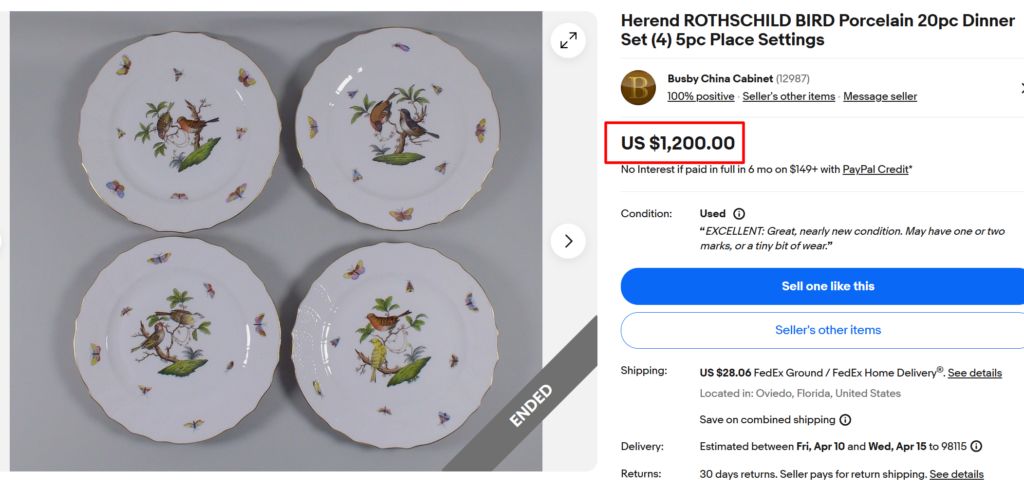
| Average Value | $1,200–$2,500 (Small/partial sets) $5,000–$20,000 (large services) |
| Production Period | 1860 to present |
| Status | Continued (Classic) |
| Key Features | 12 bird pairs, necklace, butterflies |
| Collector Notes | Early 20th-century pieces are valuable. |
Dating back to the 1860s, this pattern was named for the wealthy Rothschild banking family. The design comprises twelve pairs of hand-painted birds sitting on tree branches, along with pastel butterflies and small insects.
One distinct characteristic of this pattern is the golden necklace, which is said to reference the legend of Baroness Rothschild’s lost pearl necklace retrieved by the birds.
This is a historic design since Princess Diana herself chose it for her 1981 wedding reception. It has two other fish-scale border versions in blue (RO-ETB) and green (RO-ETV), which are also quite collectible.
3. Macao Verdi
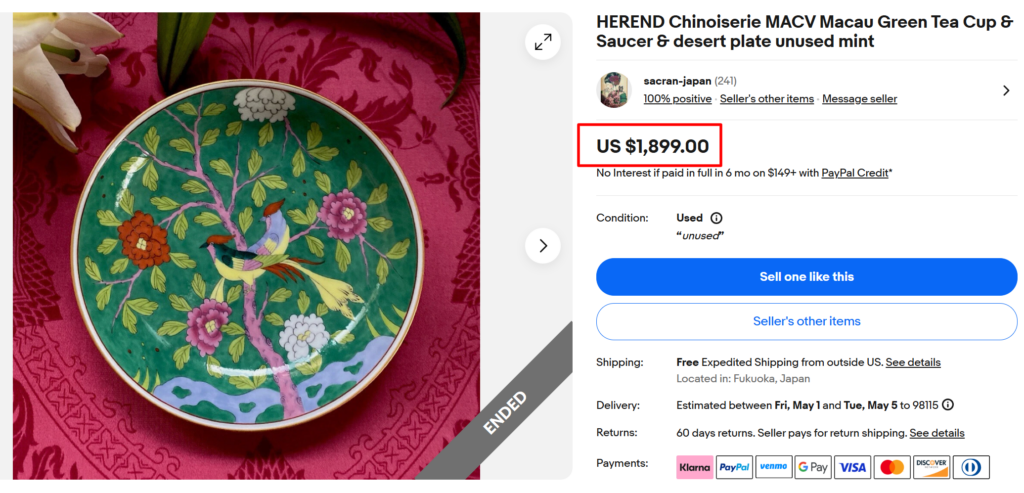
| Average Value | $800 – $2,000 (partial sets) $2,500 – $10,000 (full sets) |
| Production Period | 1904 to present |
| Status | Limited / Luxury |
| Key Features | Green enamel ground, exotic birds |
| Collector Notes | Enamel condition impact value. |
Macao Verdi is a Chinoiserie pattern that first appeared at the 1904 St. Louis World’s Fair and won a gold medal. It shows birds, flowering trees, and landscape elements painted in rich enamel colors on a deep green ground.
The pattern followed a technically demanding process and precisely controlled enamel application. Uneven application can prevent adhesion, so only experienced painters worked on this pattern.
Due to limited status and skilled craftsmanship, Macao Verdi Herend pieces, especially sets, are hard to find in the market and fetch premium prices.
4. Poisson Blue
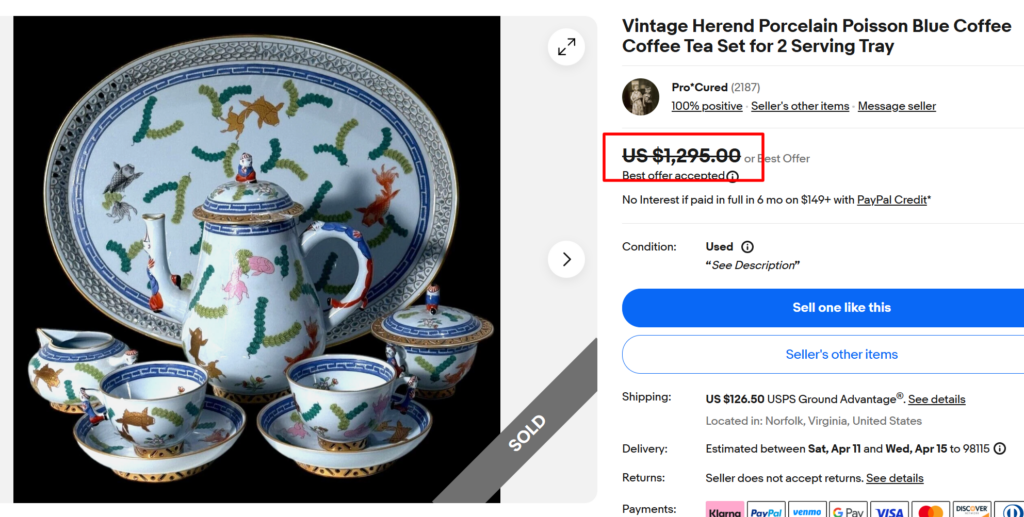
| Average Value | $2,000 – $10,000 (sets) |
| Production Period | Mid-19th century |
| Status | White version (continued); blue version (discontinued, 2015) |
| Key Features | Koi fish, aquatic plants, blue or white ground |
| Collector Notes | Blue ground variants are rarer to find. |
The Poisson (Fishes) pattern is a traditional orientalist design with aquatic elements. So, you’ll see hand-painted koi fish, aquatic flora, and sea creatures in blue, orange, green, and grey with fishscale border and gilded accents.
The pattern is particularly associated with Herend’s chinoiserie tradition from the mid-19th century. The blue background version was discontinued in 2015, making it one of the more actively sought patterns.
White background variants are also moderately collectible.
5. Fostuna
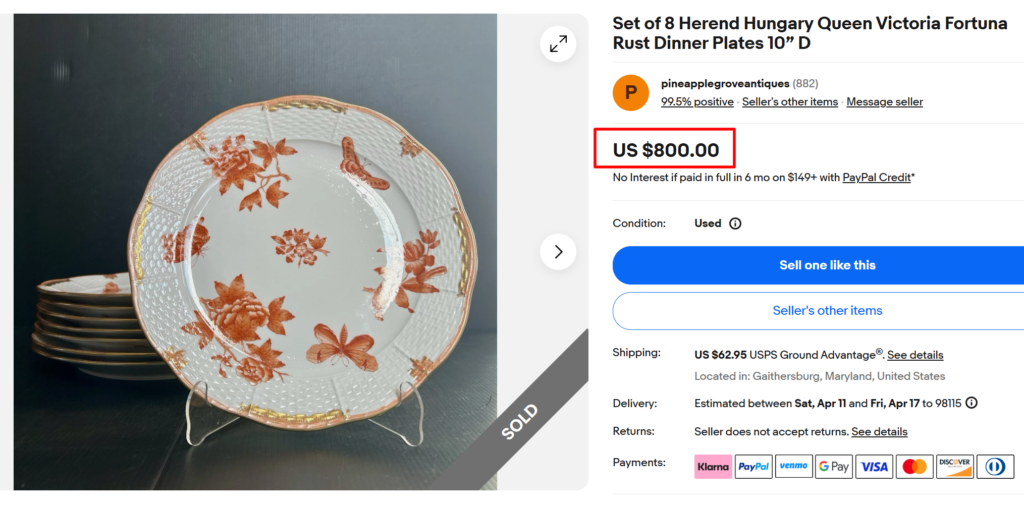
| Average Value | $100 – $900 (small/partial sets) $1,000 – $5,000 (large, full sets) |
| Production Period | 20th century to present |
| Status | Continued |
| Key Features | Monochromatic Queen Victoria motifs, 24K gold |
| Collector Notes | The rust variant is more popular. |
Fortuna Rust is a clean, monochromatic version of the classic Queen Victoria design. It features the same butterflies, floral motifs, and basketweave texture, but entirely in rust with 24-karat gold accents.
Apart from Rust, there are two other variants: blue and black. Of these, Rust is the most collectible one. Because Fortuna shares Queen Victoria’s motifs in a less commonly produced format, complete services are harder to assemble and command premium prices.
6. Cornucopia
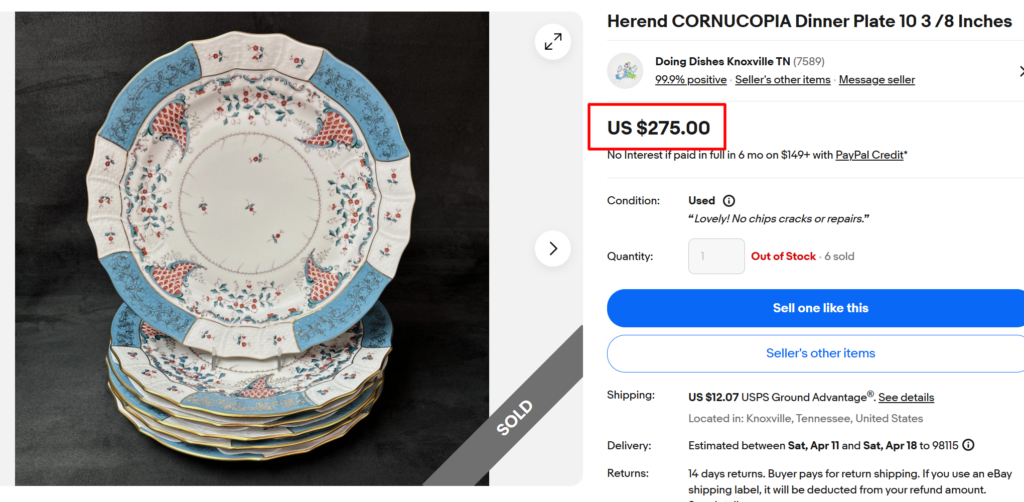
| Average Value | $5,000–$18,000+ (Full Sets) |
| Production Period | 1870s to present |
| Status | Limited / Special Order |
| Key Features | Turquoise, pomegranate, heavy gold, cornucopias |
| Collector Notes | Gilding quality is crucial for value. |
The Cornucopia pattern is considered one of Herend’s most elaborate and historically exclusive designs. It was commissioned in the 1870s specifically for the Shah of Persia.
The color palette of this design is unique. You’ll see layered partial turquoise bands, pomegranate, and heavy 24-karat gold accents on a white ground, with tiny cornucopia motifs in the center.
The gilding quality in this design is extremely fine and elaborate, even by Herend standards. This is one of the reasons for its high-value status.
Overall, Cornucopia’s association with Persian royalty, exclusiveness, and dense, detailed gold application makes it a top-tier dinnerware pattern today. Full Herend sets in this design have sold for several thousand dollars at auction.
7. Indian Basket
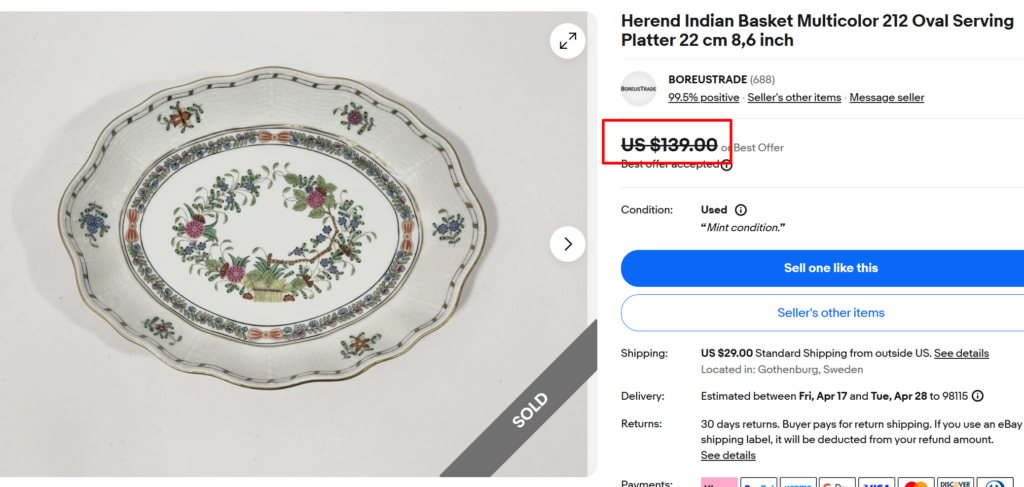
| Average Value | $120–$500 (platters, small sets) $3,000–$6,000(large sets) |
| Production Period | 1850s – Present |
| Status | Continued |
| Key Features | Flower basket center, garland border, basketweave rim |
| Collector Notes | The multicolor version is rarer. |
The Indian Basket pattern is easily identifiable by its central floral basket motif and scattered floral clusters on a basketweave ground in the Japanese style. Herend launched it at the 1867 Paris Exposition Universelle, and it was quite a hit.
The design also comes in single-color versions, most commonly in green. Both variants are actively collected, but multicolor pieces are rarer to find in complete sets.
8. Chinese Bouquet (Count Apponyi)
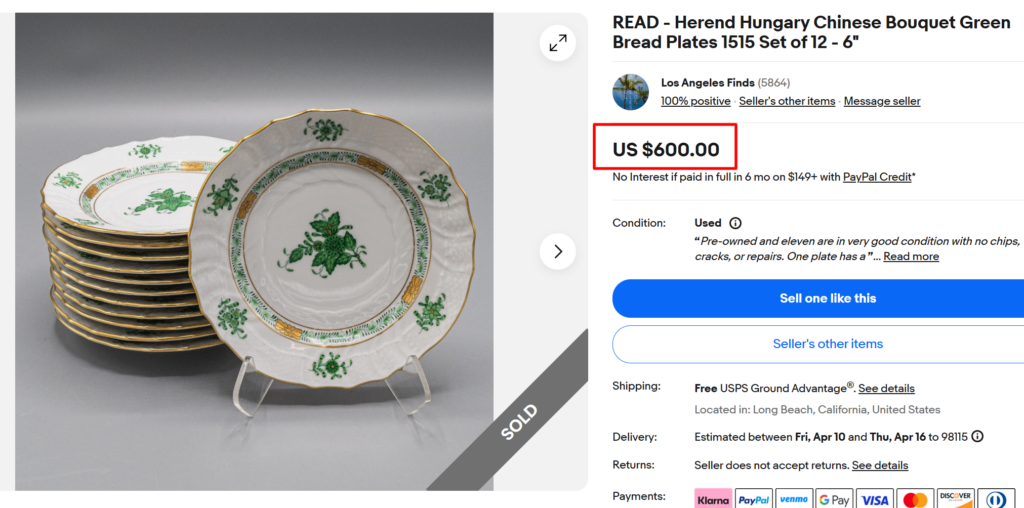
| Average Value | $400–$600 (small sets) $1,000–$5,000+ (large services) |
| Production Period | 1930/31 – Present |
| Status | Continued (multiple color variants) |
| Key Features | Single-color florals, gold rim |
| Collector Notes | Older pre-1960s pieces with 4-digit pattern numbers are more collectible |
The Chinese Bouquet pattern (aka Apponyi) was born when Hungarian Count Albert Apponyi demanded a single-color version of the “Indian Basket” when Herend showcased it at the Parisian Exposition Universelle.
So, this design features a simple central flowering plant motif with scattered floral clusters on a white ground with gold rim accents. You may also find this pattern in several colors, including blue, rose pink, burgundy/purple, yellow, and green.
Although it’s one of Herend’s most-produced patterns, it remains genuinely collectible, with complete sets selling for $3,500 to $5,000 today.
9. Waldstein Pink Rose
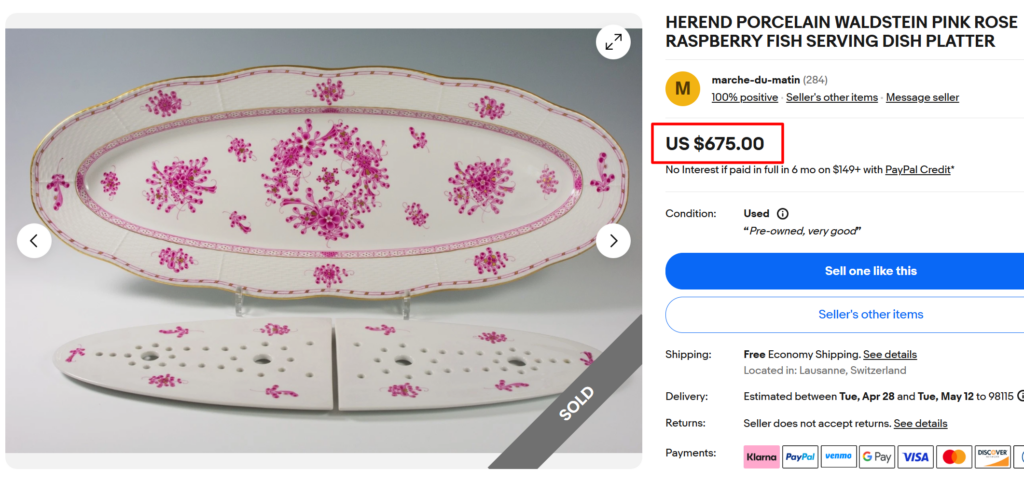
| Average Value | $200 – $700 (Serving pieces) $500 – $2,000+ (Large sets) |
| Production Period | c. 1850 to present |
| Status | Continued (multiple color variants) |
| Key Features | Basketweave texture, pink florals |
| Collector Notes | Check the backstamp for authenticity. |
As the name suggests, this Herend pattern was commissioned by Baron Waldstein in 1842. With an East Asian influence, it features stylized pink rosettes and floral arrangements inspired by 16th-century Japanese motifs.
The delicate pink hues are complemented by fine gold lines and a white basketweave border, a defining feature of Herend dinnerware.
Unlike more densely worked patterns, Waldstein has more open white space, making it look more delicate and modern. The pink rose (WMC) variant is rarer and more valuable than the blue (WB) version.
10. Ming
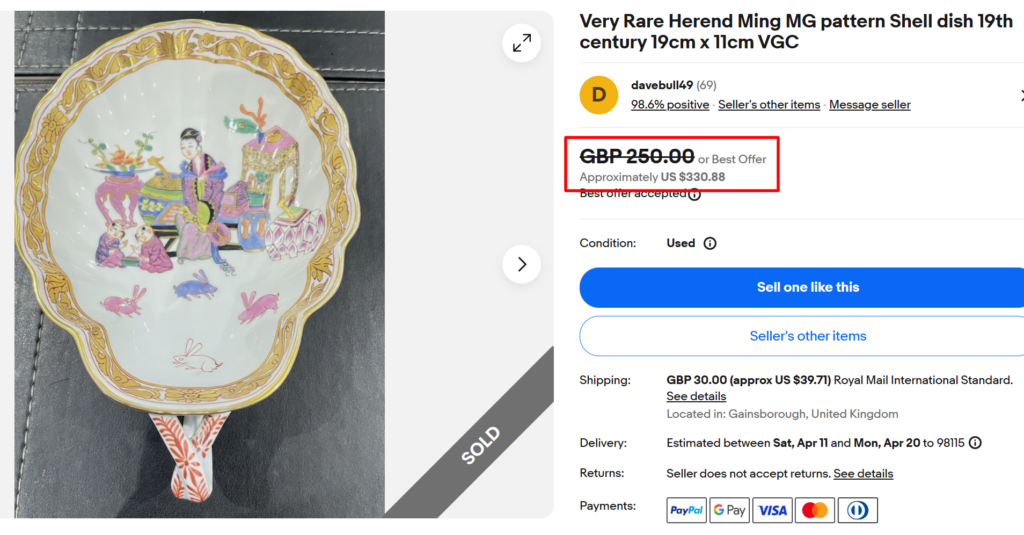
| Average Value | $300–$600+ (rare/small sets) $1,000 – $8,000 (large sets/services) |
| Production Period | 1850s; primarily vintage/antique |
| Status | Largely discontinued |
| Key Features | Chinese figures, enamel, gilded border |
| Collector Notes | 19th-century pieces are more valuable. |
The Ming pattern originated in the 1850s. It’s one of Herend’s oldest chinoiserie designs, featuring Chinese figures (a woman and other figures) in a Chinese interior, rabbits, and architectural elements.
The design elements are painted in enamel overglaze colors, framed by a gilded garland border. Herend took inspiration from the Ming Dynasty Chinese export porcelain popular in the 19th century for this pattern.
To spot Herend pieces from the actual Chinese ones, pay attention to the enamel work. Herend’s version has notably thick, raised enamel, which sets it apart from authentic Chinese originals.
Rare shapes, like shell-form dishes, are especially rare in this pattern. Finding a partial or full dinner set is even rarer.
Tips to Identify Valuable Herend China
To find out whether your vintage dinnerware is really a valuable Herend collection, check the following details:
The Backstamp
Spotting a genuine Herend piece is not that difficult since every authentic piece bears a mark on the base. The standard mark is a blue shield with the word “HEREND” printed beneath it, along with “HUNGARY” and “HANDPAINTED.”
The shield mark was introduced in the early 20th century. Very early 19th-century pieces may show only an impressed or a simple painted mark.
Older marks (pre-1950) often show just “HEREND” or “HEREND HUNGARIA” without the full company name. The presence of a proper Herend backstamp is a good sign. But since the marks can be replicated, check other key features as well.
The Pattern Number
Herend marks also usually include a shape number and a pattern code. The latter code appears after a slash. For example, “1524-0-00 RO” identifies a dinner plate in the Rothschild Bird (RO) pattern.
Knowing this code allows you to cross-reference the pattern against Herend’s catalogs and confirm authenticity. Mismatched numbers, or numbers that don’t correspond to known Herend pattern codes, are a red flag.
Raised Enamel and Brushwork
Authentic Herend pieces are entirely hand-painted with no decals or transfers. Run a finger lightly across the decorative area: genuine Herend has a slightly raised, textured feel from the applied overglaze enamel.
Pieces produced with decals (common in lower-quality reproductions) will feel perfectly flat and smooth across the design. This is one of the most reliable tests you can do without any special tools.
Examine the Gold Trim
Besides, Herend always uses real 24k gold for its accents. This gold should have a rich, deep luster and feel slightly raised to the touch.
Bright, shiny gold that looks uniform under magnification can indicate a later re-gilding or a reproduction. For valuable vintage pieces, the gold should be mostly intact; significant rubbing or “fading” can reduce overall value.
Pieces with fully intact gold, especially in less-used serving pieces, are significantly more valuable than those with worn or flaking gilt.
Condition
Condition has a significant impact on Herend’s value.
Watch out for chips, hairline cracks, and restoration. It is necessary to examine the rims and bases of the object carefully and use a fingernail to check whether there are any invisible chips. This substantially lowers its value, especially in an auction.
Small firing flaws are perfectly normal, and the dark dots in the glaze indicate that the product is handmade. But structural damage in any form significantly hurts the value.
Note: This article is intended for informational, educational, and entertainment purposes only. Some images are illustrative and may not represent actual brands, products, or related entities. All trademarks, product names, brand logos, packaging, and other intellectual property referenced remain the exclusive property of their respective owners. Any brand mentions or references are provided solely for descriptive and educational context and do not imply any formal or commercial association.