Antiques Know How Research
Vintage Rosenthal China Value
Antique Know How team’s research on eBay sales and auction results suggests that vintage Rosenthal china typically ranges from under $20 per single piece to several thousand dollars for large, early sets. The most collectible patterns include Magic Flute Sarastro, Versace “Medusa” and Russian Dream, Wheat Gold (Winifred), Fantasia, Golden Grail, Filigree Gray (Continental), Greenhaven, Pink Rose (Sanssouci), and Studio Line Flash. To judge value, check the backstamp and pattern number, the blank shape, and the porcelain and decoration quality.
Antiques Know How
About Rosenthal Company
Rosenthal is a renowned German manufacturer of porcelain household pieces and dinnerware. The founder, Philipp Rosenthal, founded the company in 1879 in Selb, Bavaria, but didn’t make porcelain until establishing the first factory in 1891.
From there, the brand has grown into one of Germany’s most respected porcelain makers.
After WWII, Philip Rosenthal Jr. rebuilt the company with world-class artists and designers like Raymond Loewy and Bjørn Wiinblad. In 1961, he launched the Rosenthal Studio Line, an ahead-of-time design featuring contemporary artists.
Today, Rosenthal is owned by Italian company Sambonet Paderno Industrie (Arcturus Group), which acquired it in 2009. Although production continues in Selb, it’s the early pieces, designs, and sets that collectors are after.
Most Valuable Vintage Rosenthal China Patterns to Know
Below are some of the most popular patterns of Rosenthal china and dinnerware sets. Some of these patterns have become so popular that even individual pieces could be worth hundreds of dollars.
1. Magic Flute Sarastro
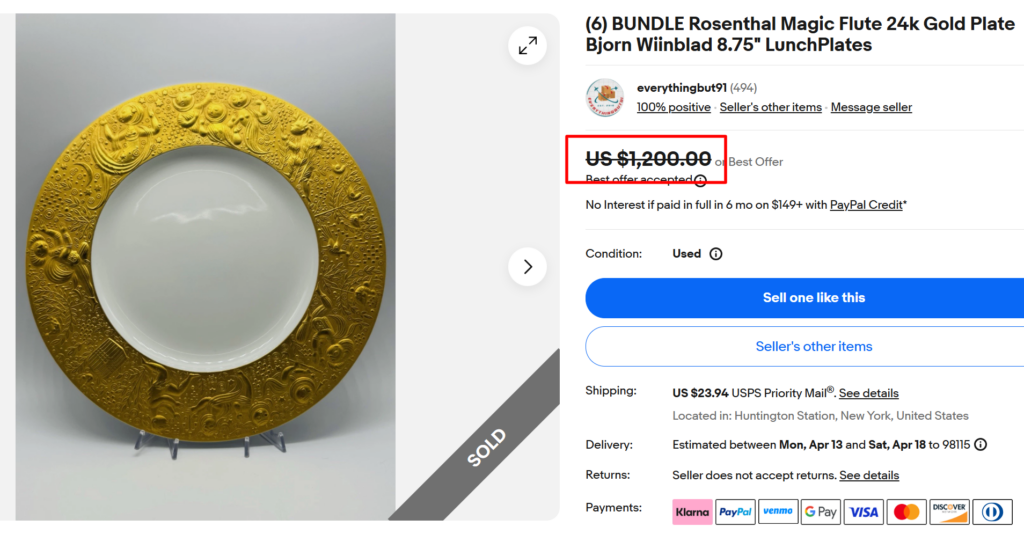
| Average Value | $150–$400+ (per piece) $3,000–$12,000+ (sets) |
| Production Period | 1977 – present (active) |
| Status | Active (limited pieces available) |
| Key Features | Gold opera relief, libretto text underside |
| Collector Notes | Handwritten libretto adds value |
Magic Flute Sarastro is one of the most distinctive dinner services Rosenthal ever made. Danish artist Bjørn Wiinblad designed it around Mozart’s opera Die Zauberflöte, with each piece showing a different scene in white-and-gold relief.
On the underside of each plate, Wiinblad wrote the corresponding passage from the opera libretto in his own handwriting, in gold. That detail alone makes this pattern easy to identify and sets it apart from other dinnerware.
There are two versions: one with gold decoration (Sarastro) and one in plain white (Magic Flute White). The gold version brings significantly higher prices, especially in complete sets.
2. Versace “Medusa”
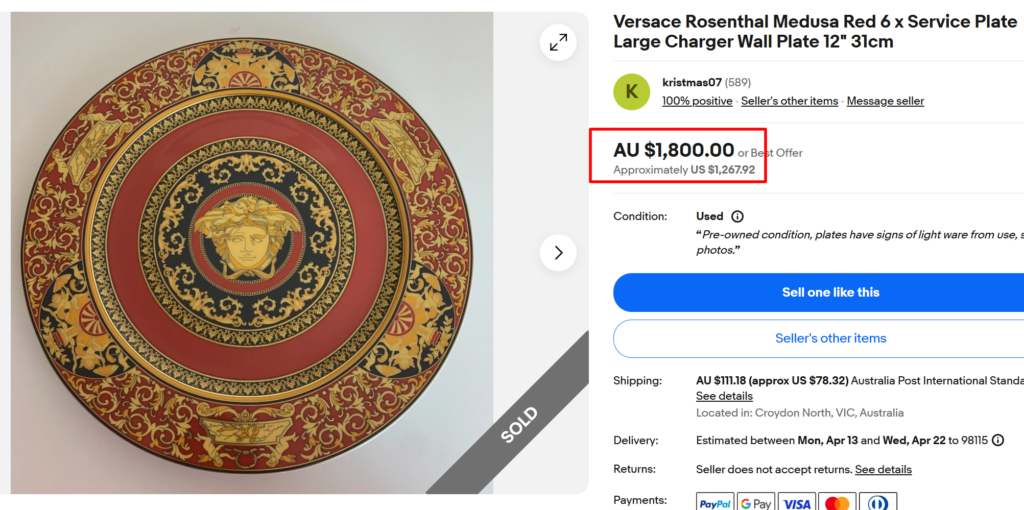
| Average Value | $150–$250 (singles) $800–$2,000+ (small sets) |
| Production Period | 1993 – present |
| Status | Active (continuously produced) |
| Key Features | Medusa head center, crimson-gold baroque rim |
| Collector Notes | Check for earlier 1990s backstamps. |
The Versace and Rosenthal collaboration launched in 1992 under Gianni Versace’s personal direction. The Medusa pattern was one of the very first collections, released in 1993.
This is the Ikarus Red version, with deep crimson and an ornate gold Medusa head at the center, surrounded by baroque scrollwork. Gianni Versace died in 1997, but the pattern stayed in production under Donatella Versace.
The collaboration is now in its 30th year, with the Medusa Red line still actively sold by Rosenthal. Pieces from the first run (1993–1997) with the original backstamp carry a premium today.
3. Wheat Gold (Winifred)
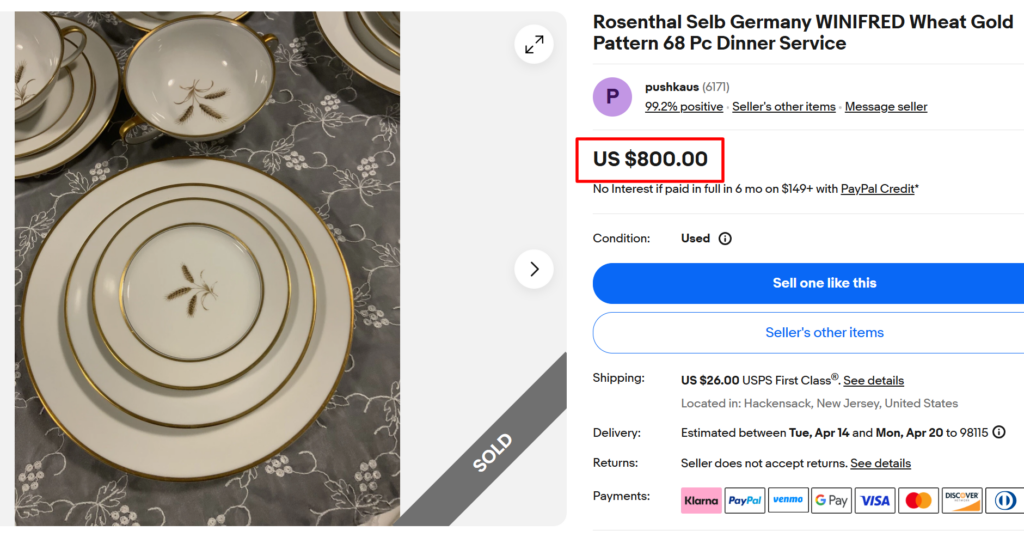
| Average Value | $10–$25 (singles) $400–$1,000 (sets) |
| Production Period | Mid-1950s – 1970s |
| Status | Discontinued |
| Key Features | Ivory ground, gold wheat, gold borders |
| Collector Notes | “Rosenthal/Serb-Germany” mark on base. |
This pattern combines Rosenthal’s iconic Winifred shape with the popular Wheat Gold motif. You can identify it by its minimalist ivory ground, a small gold wheat sprig in the center, and matching gold ring borders.
This design was produced in Rosenthal’s Selb factory through the 1960s and into the 1970s. It offers a mid-century modern aesthetic which looks quiet and refined.
The pattern number 1266 is one of the documented Winifred wheat variants, described officially as “Winifred, Gold & Black Wheat.” This is not a high-dollar pattern on a per-piece basis, but a large 60+-piece service holds great value.
4. Versace Russian Dream
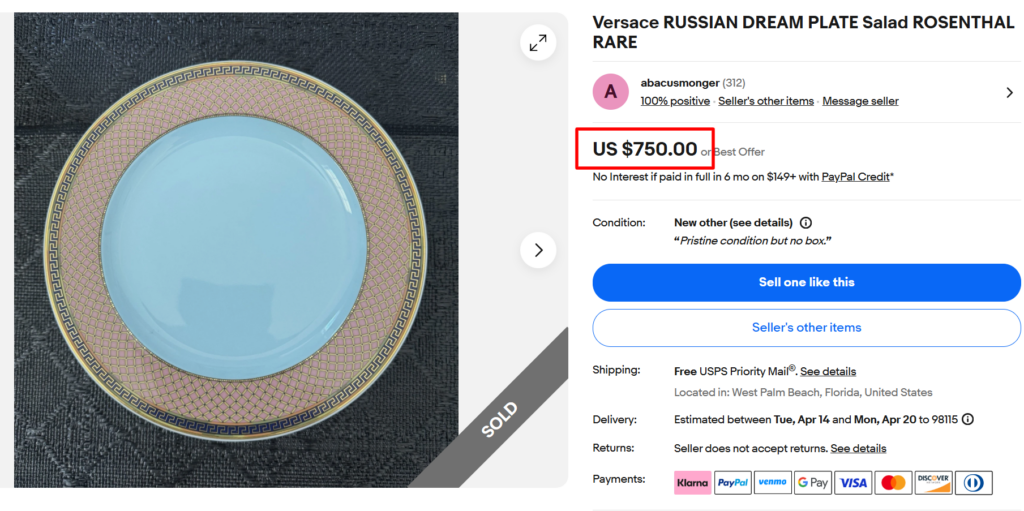
| Average Value | $300–$1,000 (as per set size) |
| Production Period | 1998 – 2009 |
| Status | Discontinued |
| Key Features | Pastel lattice, Greek key border, 24k gold trim |
| Collector Notes | Complete sets are very uncommon. |
The Russian Dream pattern was part of the “Rosenthal Meets Versace” collaboration, produced from 1998 to 2009. It’s a Fabergé-style design with pastel blues, pinks, and ivory with a lattice of small diamond shapes, framed by the Greek key meander in dark gold.
Because it was discontinued in 2009, complete sets and rare pieces like salad plates are not highly collectible. This pattern is harder to find complete than Medusa, which makes it more interesting to serious Versace collectors.
5. Fantasia
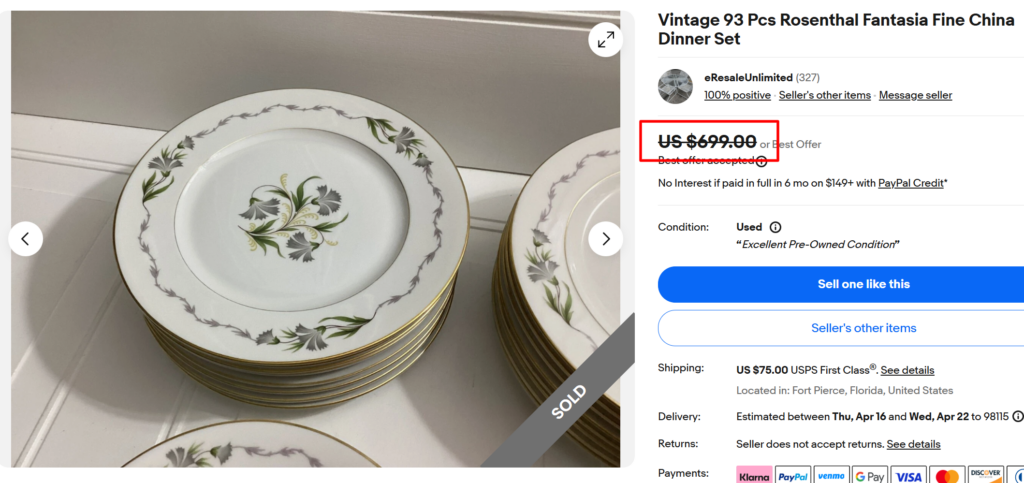
| Average Value | $5–$15 (per piece) $400–$800+ (large sets) |
| Production Period | 1960s |
| Status | Discontinued |
| Key Features | Grey-green florals & border, gold trim |
| Collector Notes | Pattern name stamped on the back. |
Rosenthal’s Fantasia is a classic mid-century floral pattern on a white ground. You’ll see thin gray carnation-like leaves wrap the rim, while a larger central floral spray sits in the plate’s well, all outlined in fine gold.
Like many Rosenthal patterns from this era, Fantasia was applied to the company’s standard Continental blank shapes. The value of this pattern lies in the completeness and the size of the set.
6. Golden Grail
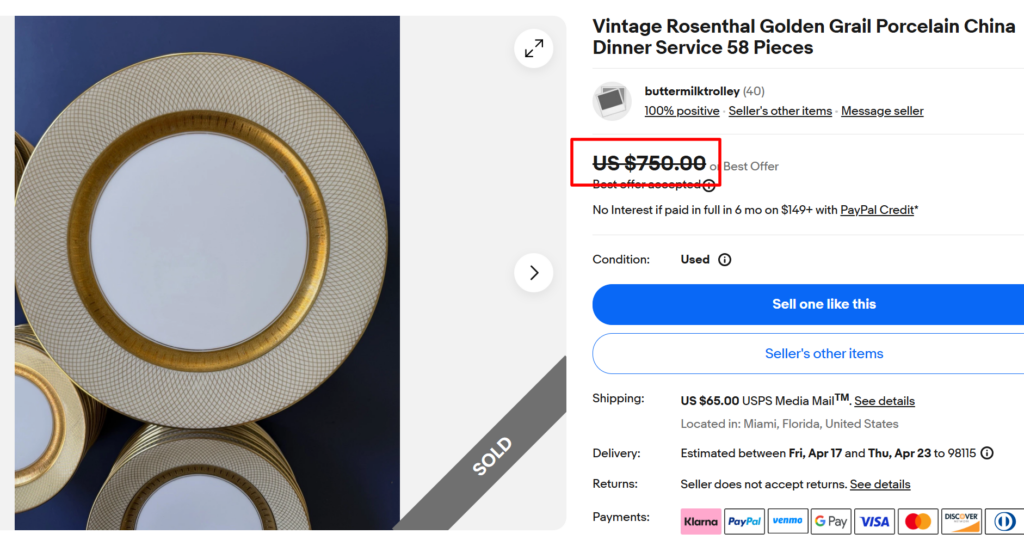
| Average Value | $100–$250 (singles) $500–$900 (large sets) |
| Production Period | 1961 – 1991 |
| Status | Discontinued |
| Key Features | Gold-encrusted rim, crosshatch detail |
| Collector Notes | Check the back for logo & pattern name |
The Golden Grail pattern features a wide, textured, gold-encrusted band with a cross-hatched, or “honeycomb,” engraved pattern. It was produced on Rosenthal’s Helena blank shape from 1961 to 1991.
A 30-year long run makes this pattern commonly available. The center remains a stark, clean white, allowing the metallic border to take center stage. This pattern is often sought after
7. Filigree Gray (Continental)
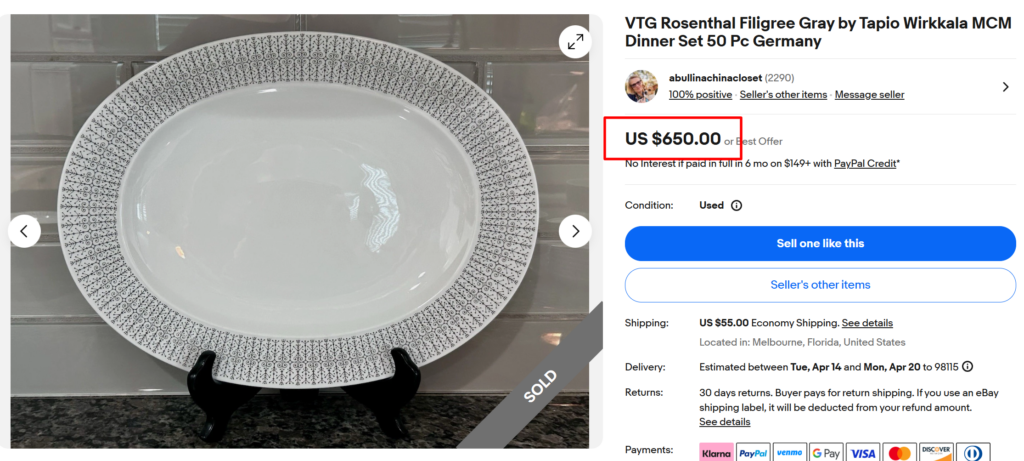
| Average Value | $20–$80 (singles) $400–$700 (large sets) |
| Production Period | 1960s – 1970s (estimated) |
| Status | Discontinued |
| Key Features | Dense black filigree, Continental blank |
| Collector Notes | Value lies in completeness. |
Filigree Gray is a mid-century modern design produced on Rosenthal’s Continental blank (a modern coupe-style shape). The pattern features a dense, repeating black filigree motif, delicate scrollwork, and repeating organic shapes across the rim of each piece.
The all-over black pattern against white looks modern and is collectible for its distinctly graphic, almost textile-like appearance. Individual platters, large serving pieces, and full dinner sets are the most collectible in this design.
8. Greenhaven
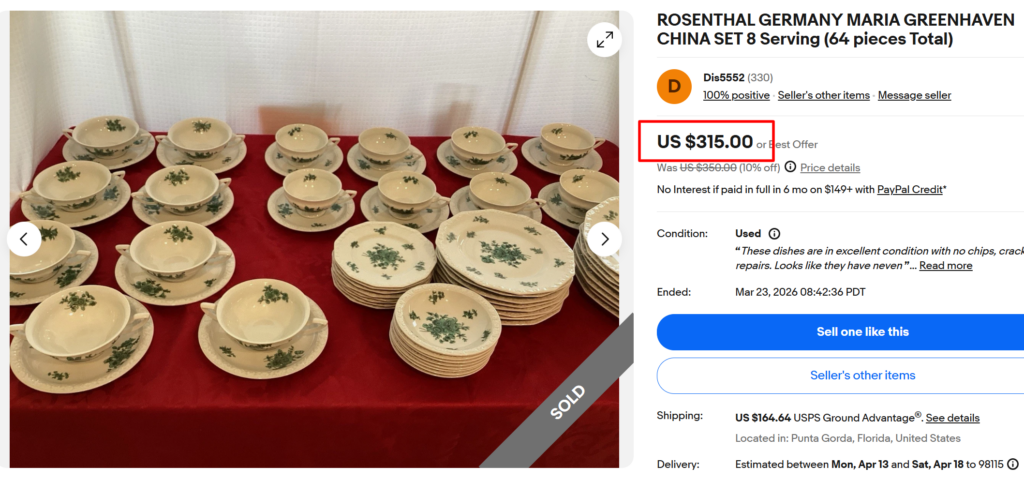
| Average Value | $5–$20 (singles) $200–$400 (large sets) |
| Production Period | Late 1950s – 1960s |
| Status | Discontinued |
| Key Features | Green florals on Maria blank, ivory ground |
| Collector Notes | Check the back for the pattern name. |
Greenhaven is a floral decoration applied to the classic Rosenthal Maria blank shape. This shape dates back to 1914 and has been one of Rosenthal’s best-selling dinnerware forms ever since.
The Greenhaven decoration features a green-teal floral spray, usually a small bouquet and leaves at the center, surrounded by smaller motifs on the ivory Maria blank.
This pattern is common and sits in the moderate value range in the market. But the Maria shape itself adds to its collectibility.
9. Pink Rose (Sanssouci)
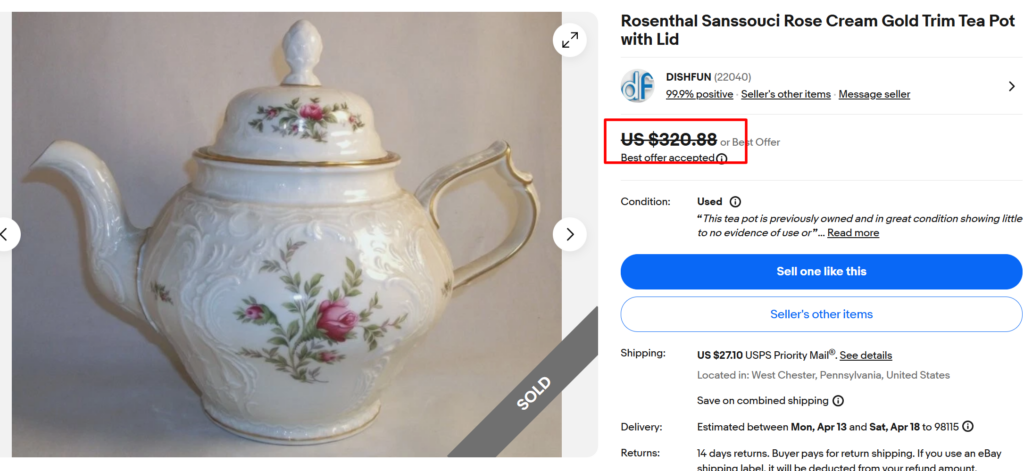
| Average Value | $20–$320+ depending on piece type |
| Production Period | 1961 and 1977 |
| Status | Discontinued |
| Key Features | Rococo relief blank, pink roses |
| Collector Notes | Pre-1974 pieces are worth more. |
The Pink Rose pattern is a part of the “Classic Rose” line, featuring delicate pink rose bouquets with green foliage. This pattern was designed on the iconic Sanssouci blank.
The blank itself was inspired by the ceiling of the Sanssouci Palace in Potsdam and features an elaborate, embossed rococo scrollwork on a cream or ivory base. The combination of a romantic pattern and a detailed blank makes this design highly collectible.
To verify authenticity, check the “Classic Rose” backstamp.
10. Studio Line Flash
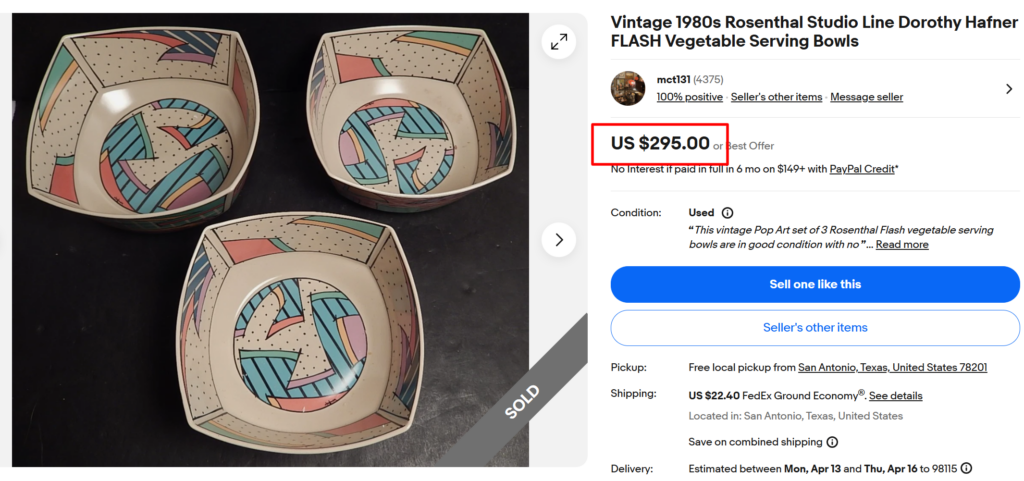
| Average Value | $50–$150 (per piece) $200–$1,200+ (partial/full sets) |
| Production Period | 1984 – late 1980s |
| Status | Discontinued |
| Key Features | Pop Art geometry, multicolor ceramic |
| Collector Notes | Check the “Rosenthal/studio-linie” mark on the back |
Flash is a Studio Line pattern designed by American artist Dorothy Hafner and released by Rosenthal in 1984. It’s instantly recognizable by its bold geometric shapes in pink, teal, yellow, and red on a cream ceramic, confetti-dot base.
The design is one of the few Rosenthal patterns where the designer, Hafner, was also the first American woman to design for the Studio Line. Her work has appeared in the Smithsonian Institution and the Museum of Fine Arts, Houston.
The Flash has been discontinued since the end of the 1980s, and pieces, especially sets, in good condition are increasingly difficult to come by.
How to Spot Genuine Rosenthal China? Key Signs
Identifying authentic Rosenthal china comes down to four things: the backstamp, the pattern number, the blank shape, and the condition of the decoration. Let’s understand each aspect.
The Backstamp
The backstamp is your first and most reliable way of identifying Rosenthal china. Besides, the marks changed significantly over the company’s history, which makes them useful for dating.
| Years | Backstamp | Notes |
| 1887–1891 | A painter’s palette with “Ph.R.&Co.” | The earliest mark |
| 1891–1906 | Crown + Crossed Rods + “R.&C.” | Production phase |
| 1907–1933 | Curved “Rosenthal” + Crown + Crossed Rods | N/a |
| 1934–1956 | Crown Mark + Added “Germany”/“Selb” | N/a |
| 1946–1949 | “U.S. Zone Germany” | Postwar occupation |
| 1957 onward | Simplified Crown Mark | N/a |
| 1961 onward | “Studio-Linie” Mark | May have designer name |
| 1974–1982 | “Classic Rose Collection” in a circle + crown | Changed to “Classic Rose” |
| 1991–2002 | “Rosenthal classic” + logo | N/a |
| 1992 onward | Rosenthal + Versace mark | Pattern name appears |
Please note that reissued Classic Rose or Classic pieces are less valuable than original pre-war or early postwar production, even when the pattern looks identical. Knowing the mark can tell you which one you have.
For Studio Line pieces with artist signatures (Bjørn Wiinblad, Dorothy Hafner, Tapio Wirkkala), check the base carefully. The designer’s name is typically printed alongside the studio mark. Hand-signed pieces are rarer and more valuable.
The Pattern Number
Apart from the standard logo, most Rosenthal pieces carry a pattern number stamped in the glaze alongside the factory mark. The number is generally 3-4 digits long and either red or green.
You can do a quick search using this number and compare it to the markings to determine its name and whether it is still currently in production.
The Blank Shape
The blank shape is a crucial identifier for Rosenthal China. The company often used the same decorated pattern on multiple blank shapes, and vice versa; the same blank shape with dozens of different decorations.
Some of the most notable Rosenthal shapes are:
- Maria: Ornate rococo embossed rim
- Sanssouci: Heavy decorative rococo design
- Helena: Smooth, plain rim
- Continental: Rimless, coupe style
- Classic Rose: Traditional curved form
- Romanze: Soft, rounded shape
- Aida: Lightly embossed border
- TAC: Minimal Bauhaus design
- Ikarus: Wide, modern presentation rim
- Studio-Line: Artistic, varied shapes
Among these, the Maria, Continental, Helena, and Ikarus are the four you’ll encounter most often. The blank name often appears as part of the backstamp designation.
The Porcelain Quality
Rosenthal is famous for its “hard-paste” porcelain. Genuine pieces are exceptionally white and translucent. If you hold a plate up to the light, you should see a faint glow through the material. Moreover, the piece must be very light while being strong.
The Decoration Condition
The gold trim is the most delicate part of Rosenthal porcelain. The authentic gold trim was embedded in the glazing process during high temperatures, giving it some durability.
One way to identify authenticity is by testing the gold trim with a finger; authentic gold should have some texture and should appear matte when touched.
Despite its durability, constant washing, stacking, and use for many years can still wear it down. And heavy loss of gold trim can significantly reduce the value of a pattern or set.
Note: This article is intended for informational, educational, and entertainment purposes only. Some images are illustrative and may not represent actual brands, products, or related entities. All trademarks, product names, brand logos, packaging, and other intellectual property referenced remain the exclusive property of their respective owners. Any brand mentions or references are provided solely for descriptive and educational context and do not imply any formal or commercial association.