Antiques Know How Research
Vintage Cookbooks Value
Our Antiques Know How team’s review of eBay sales shows that vintage cookbooks are usually worth a few dollars, but signed, first‑edition or historically significant copies can range from $200 to $5,000 or more. The most collectible titles include Julia Child’s “Mastering the Art of French Cooking,” Irma Rombauer’s 1931 “The Joy of Cooking,” Lena Richard’s “New Orleans Cook Book,” Stan Jones’ Barguide,” “Aunt Priscilla in the Kitchen,” “The Brown Derby Cookbook,” and “What Actors Eat.” The value depends on edition number, original dust jacket, author or celebrity association, and overall condition.
Antiques Know How
Did you know that the first cookbook ever printed in America came out in 1796? It was “American Cookery” by Amelia Simmons, and it sold for a few cents. Today, a first edition can fetch over $10,000 at auction.
The vast majority of used cookbooks end up in attics or in thrift shops, selling for a couple of dollars. However, a rare few of them may be worth many times more – literally hundreds or even thousands of dollars.
Here, I’ll reveal the key traits of valuable vintage cookbooks, along with some examples that have been sold for surprising amounts, and how to spot them.
Most Valuable Vintage Cookbooks to Look for
Let’s take a look at some high-value vintage cookbooks that are actively collected today and fetch stunning sums in online sales as well as auctions.
1. Mastering the Art of French Cooking (1st Ed) – Julia Child
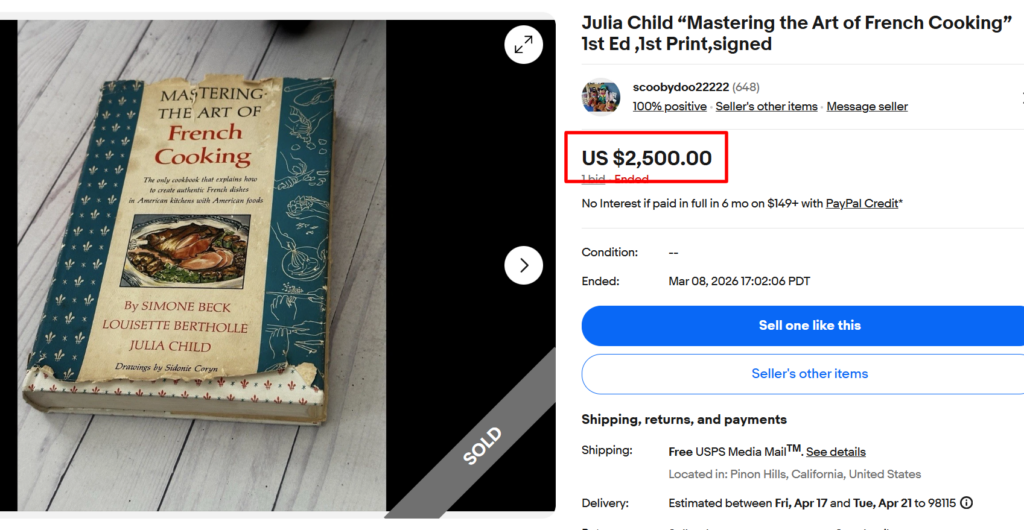
| Average Value | $800 – $2,500+ (signed first print) |
| First Published | 1961, Alfred A. Knopf (reprints followed) |
| Key Features | Teal/cream DJ, Knopf 1961 |
| Collector Notes | Book club editions are common. |
Julia’s “Mastering the Art of French Cooking” came out in 1961 through Knopf and changed American home cooking. The original edition’s dust jacket shows the original teal-and-cream design.
A first edition, first printing copy is a rare find for this title. Signed copies by Julia Child herself, like this example, are worth even more, reaching over $2,000 in good condition.
Examples with “Book Club” notation are also available in the market. Those are common and are worth significantly less.
2. The Joy of Cooking – Irma S. Rombauer
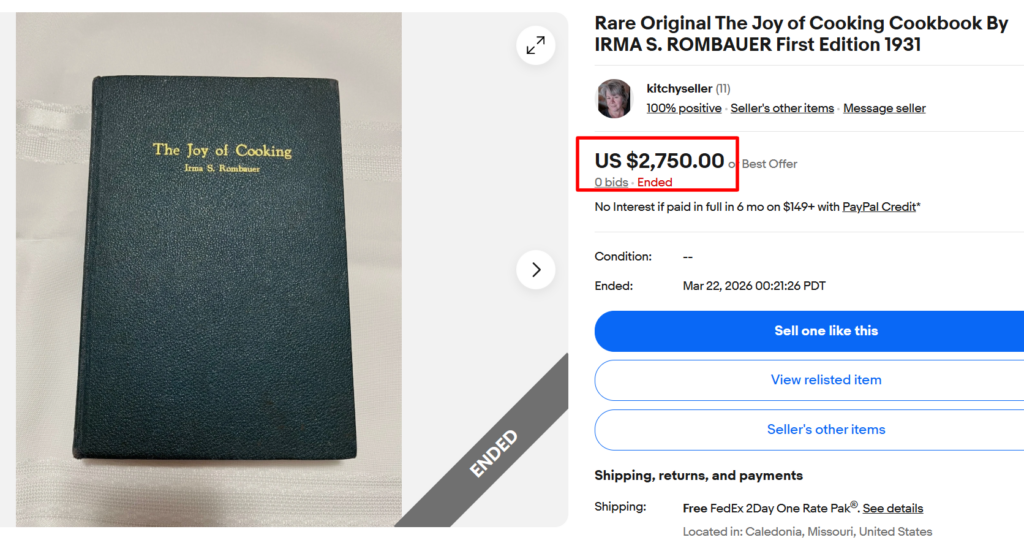
| Average Value | $1,500 – $3,000+ |
| First Published | 1931, self-published (St. Louis) |
| Key Features | Green cloth cover, gold text |
| Collector Notes | Verify it’s the 1931 self-published |
Irma Rombauer’s “The Joy of Cooking” is a renowned cookbook title. But the first book in the line is a highly valuable find. She self-published the first edition of the book in 1931 in St. Louis after her husband died.
Her book had only 3,000 copies made, recognizable through their green cover binding. Because of limited prints, the original 1931 self-published edition is hard to find today.
Later, the book was republished by Bobbs-Merrill Publishers; those versions are quite common. But if you have a 1931 book with its original gold-stamped green cloth cover, it can be worth as much as $2,500 in good condition.
3. Aunt Priscilla in The Kitchen – Aunt Priscilla
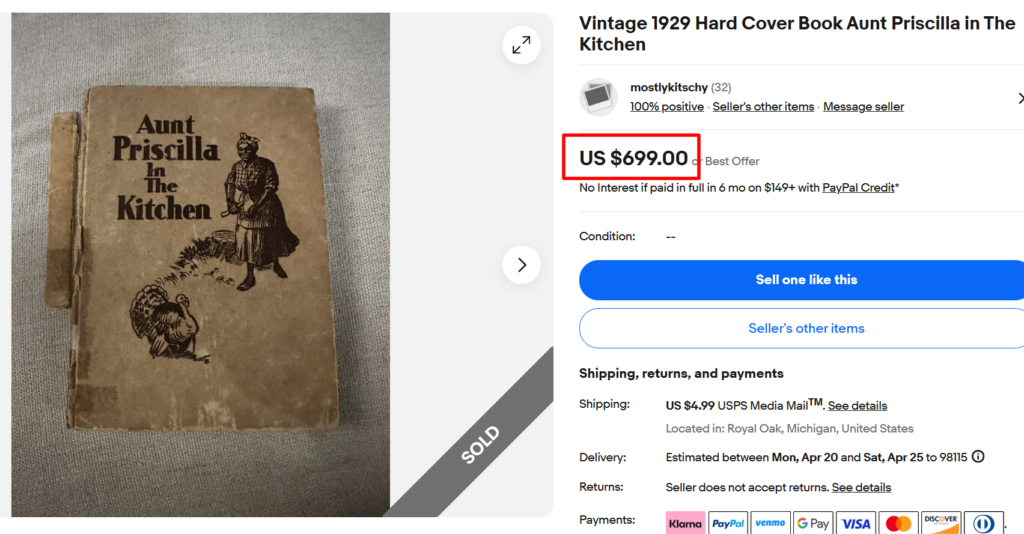
| Average Value | $400 – $800+ |
| First Published | 1929 |
| Status | First edition; very limited surviving copies |
| Key Features | Artistic cover, Southern recipes |
| Collector Notes | Intact covers can boost the value. |
“Aunt Priscilla in the Kitchen” is a Southern cooking guide published in 1929. Known for its Southern recipes and an exaggerated African American dialect, this one is not just a book, but it’s also a piece of American social history.
The book features pictorial paper boards with a unique illustration of African American characters (representing Aunt Priscilla), and winter-time recipes and seasonal menus.
The copy shown in this example sold for almost $700 even in worn condition. That’s because the first editions in any condition are increasingly scarce today.
4. Jones’ Complete Barguide – Stan Jones
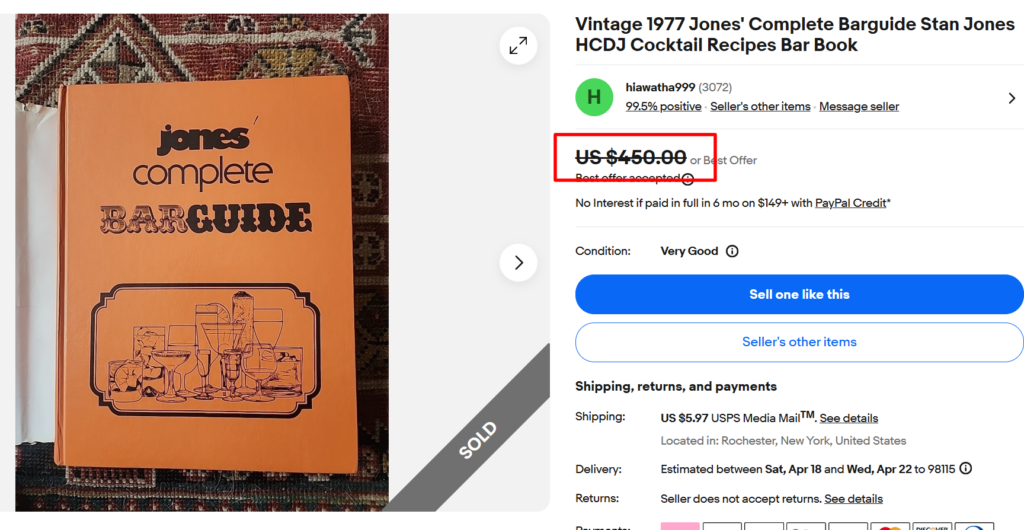
| Average Value | $300 – $450+ |
| First Published | 1977 |
| Status | First edition HCDJ |
| Key Features | Cocktail guide, 4,000+ recipes, orange cover |
| Collector Notes | Avoid liquid-damaged copies |
Stan Jones published this cocktail and bar reference guide in 1977, and it became a go-to resource for professional bartenders. The orange hardcover with dust jacket format (HCDJ) and black-and-white photographs of Stan Jones are the easiest giveaway for the earliest and most desirable versions.
It’s not as widely known as some other collectible cookbooks, but in pristine condition without significant cover damage, it can be worth $200 to $450 today.
5. New Orleans Cook Book 1st Edition – Lena Richard
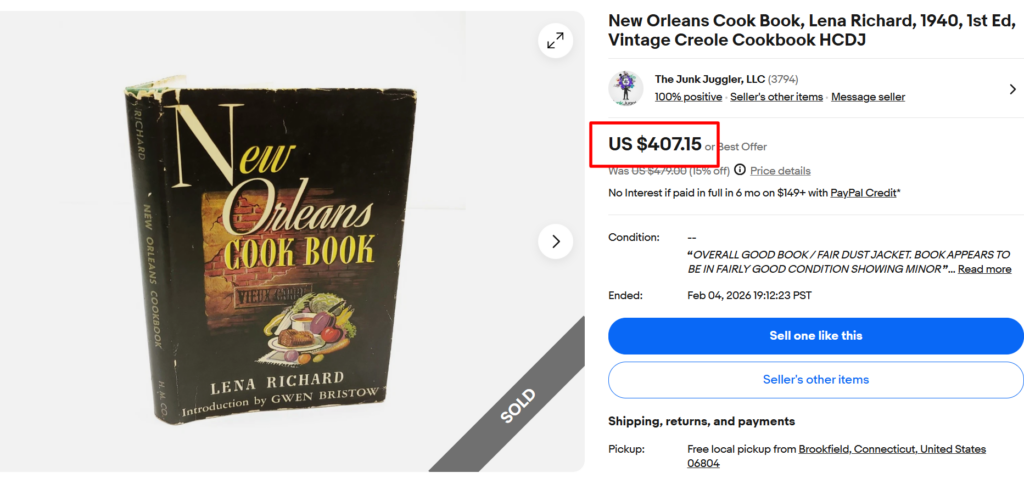
| Average Value | $300 – $475 (with dust jacket) |
| First Published | 1940, Houghton Mifflin |
| Key Features | First edition HCDJ, Creole recipes, Black culinary history |
| Collector Notes | Dust jacket condition impact value. |
Lena Richard was a Black chef from New Orleans who published this Creole cookbook in 1940. And it went on to become one of the first major cookbooks by a Black female author in American history.
So, today it’s collected for both its culinary content plus its historical significance. And the HCDJ (hardcover with dust jacket) designation is a big value driver. First editions with the original dust jacket sell for considerably more than those without.
6. What Actors Eat, When They Eat! – Kenneth Harlan & Rex Lease
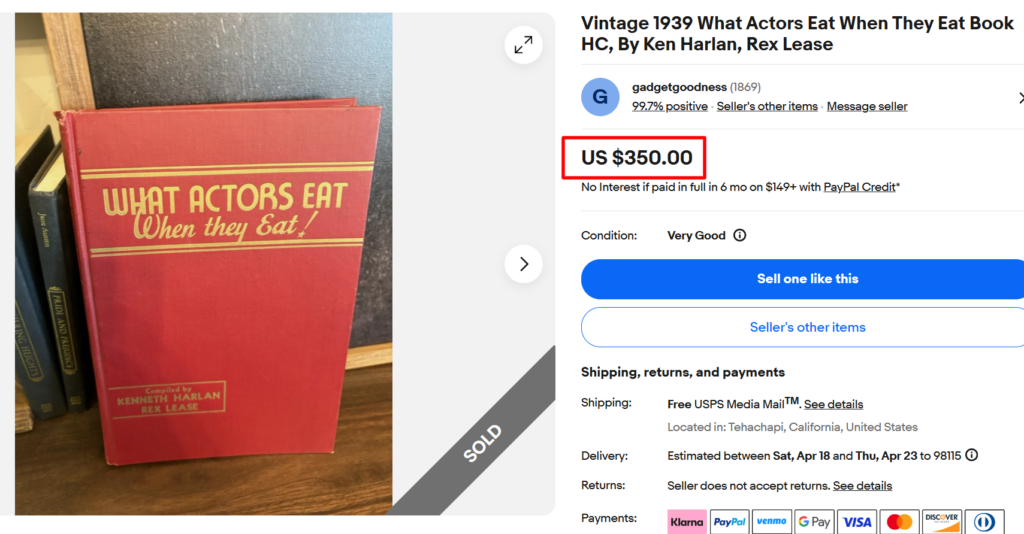
| Average Value | $250 – $350 |
| First Published | 1939 (Single print run) |
| Key Features | Hollywood star recipes, red hardcover, golden-age film tie-in |
| Collector Notes | This is the only edition to exist. |
This book is special because it was compiled by silent film actors Kenneth Harlan and Rex Lease themselves. It collects personal recipes from real Hollywood stars of the era, everything from simple home meals to party dishes.
Apart from Harlan and Lease, several other working actors from the late silent and early talkie period also contributed to the book.
You can identify the first (and only) edition by its deep red cloth cover with gold lettering on the front. The back is plain. Its value lies in the crossover appeal between film historians and culinary collectors, plus the dust jacket condition.
7. The Brown Derby Cookbook
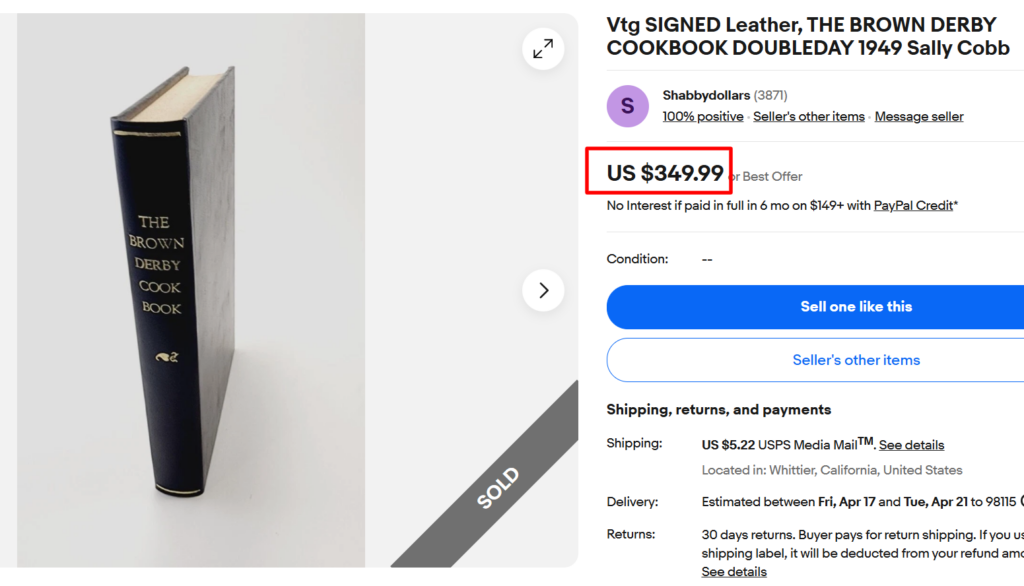
| Average Value | $200 – $350 (more for signed copies) |
| First Published | 1949 Doubleday |
| Key Features | Leather binding, Hollywood restaurant origin |
| Collector Notes | Signed by Sally Cobb |
The Brown Derby was one of Hollywood’s most famous restaurants, open from 1926 and frequented by film stars throughout the golden age. The 1949 Doubleday edition is bound in dark leather with gold spine lettering. There’s no dust jacket on this version; the binding itself was the premium presentation.
Inside, the book collects the restaurant’s actual recipes, from house salads to the dishes celebrities ordered.
Signed copies, signed by owner Robert Cobb’s wife, Sally Cobb, are increasingly rare and valuable today. An unsigned copy in good shape sells for $100–$150; a signed one can double or triple that.
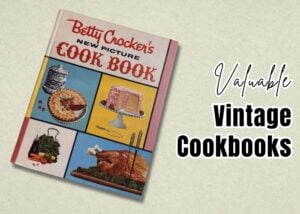
8. Betty Crocker’s Picture Cook Book
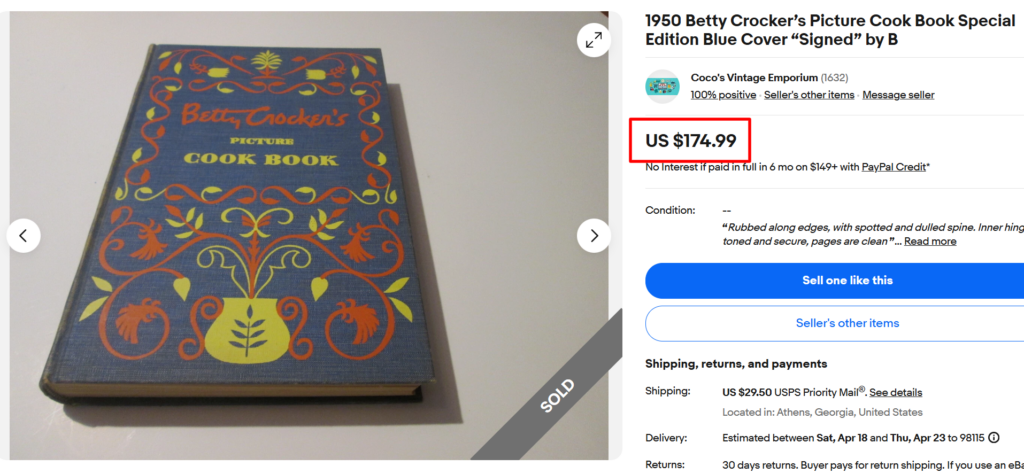
| Average Value | $100 – $175 (signed copies higher) |
| First Published | 1950, General Mills (revisions followed) |
| Key Features | Blue cover, ring binder format |
| Collector Notes | Later Red editions are common, low-value |
Betty Crocker’s Picture Cook Book came out in 1950 and became one of the best-selling cookbooks in America. It’s known for its full-color photos alongside recipes.
You can spot the first edition by its distinctive dark blue cover with yellow and orange folk-art illustrations. Later editions switched to a red cover. The ring-binder format of early editions is another identifier worth knowing.
While it is hard to find a signed copy of the cookbook, please remember that Betty Crocker was a fictional character and marketing brand created in 1921. So, the books were actually signed by different General Mills employees, making each one unique.
What Makes a Vintage Cookbook Valuable?
The value of vintage cookbooks can range from as low as $10 to as high as $10,000, or even more. The huge difference in prices stems from several important factors, including age, format, edition, and others.
Edition Number
A first edition is the original print run before any revisions, corrections, or new printings happened. For cookbooks, this matters a lot because publishers often update recipes, reformat layouts, and reprint popular titles for decades.
And, the further a copy is from the original print run, the less it’s worth to collectors.
One way to find out the edition is by looking at the copyright page. If there’s no number, it means a first edition. Or you may see a number line, which should start with the number “1”, such as 1 3 5 7, and so on. If the lowest number in the line is 3 or 5, it’s the third or fifth printing.
It’s not worthless, but it’s not as rare as the first.
The Dust Jacket
For old hardcover cookbooks, the dust jacket is often worth more than the book itself. “Does it have a dust jacket?” is most often the first question collectors ask. Its presence alone can double the value of a book, really.
Jackets usually get thrown away, torn, or easily lost. That’s exactly why intact ones are so valuable. But if found, make sure to check for fading, tears along the spine edges, and price clipping (where someone cut the corner to remove the original price).
A price-clipped jacket is less desirable, though it’s far better than no jacket at all.
Overall, a first edition with the original dust jacket in good condition can be worth three to five times more than the same book without it. So, never miss the jacket.
Authors & Signatures
Vintage cookbooks from iconic chefs and popular institutions are usually more valued than those written or published by little-known authors. Association with a famous chef, a landmark restaurant, a historical moment, or a specific cultural community directly impacts the value.
Plus, collectors love signed copies. But it’s worth noting that a signature from the author adds value, though not always by the same amount. For example, a Julia Child signature can push a copy from $500 to $2,500+. A signature from a less-famous author may only make a $20-$30 difference.
What matters is whether the author is recognizable, whether the signature is authenticated, and whether it’s on the title page or a random page inside.
Rarity (Print Runs & Their Availability)
A rare book is one that’s either out of print or has been reprinted so many times that early editions have now become extremely hard to find.
But rarity alone doesn’t add value. For a rare book to have high resale value, it must also be in demand. A small-print cookbook nobody wants is still worth nothing.
The books that are most collectible are titles with cultural significance that were only printed once or twice in limited quantities. Self-published cookbooks (like Rombauer’s 1931 Joy of Cooking) are a prime example.
Small print runs, no major distribution, and most copies long gone, that’s what interests collectors.
Condition
Cookbooks generally have a harder life than novels and other books, because they stay in the kitchen. So, grease splashes, torn pages, damage from damp fingers, and damage from opening the book on its own are quite common.
That is why a copy that remained on the shelf and was untouched is much more valuable than a book that spent 40 years by the stove. As for dust jackets, even minor damage along the edges reduces their value greatly.
Note: This article is intended for informational, educational, and entertainment purposes only. Some images are illustrative and may not represent actual brands, products, or related entities. All trademarks, product names, brand logos, packaging, and other intellectual property referenced remain the exclusive property of their respective owners. Any brand mentions or references are provided solely for descriptive and educational context and do not imply any formal or commercial association.