Antiques Know How Research
Cabbage Ware Value
Our Antiques Know How team’s review of eBay and auction results shows that vintage Cabbage Ware usually ranges from under $20 for common pieces to several thousand dollars for rare antique majolica and high‑end forms. The most collectible pieces are signed Dodie Thayer lettuce‑ware tureens and large platters, Victorian Wedgwood, Minton, and E.B. Napoli pieces, lavender and pink Bordallo Pinheiro, and yellow Secla. Check the maker, age, shape, and color rarity, and condition for value.
Antiques Know How
What is Cabbage Ware?
Just as the name suggests, Cabbage Ware is basically ceramic ware that is made to look like real cabbage leaves. It features intricate veins and ruffled edges resembling the vegetable.
The style goes back to the Victorian era, when naturalistic forms dominated decorative arts. During this time, English factories like Minton gained popularity through majolica (relief-molded earthenware characterized by bright lead glazing).
The style later reached new heights when the Portuguese potter Raphael Bordallo Pinheiro set up his factory in 1884 to produce cabbage ware.
More recently, in the 1960s, an American potter, Dodie Thayer, who was a self-trained craftsman, began creating lettuce ware from her workshop in Florida. Both signed Thayer works and antique Victorian pieces are actively collected today.
What Makes Cabbage Ware Valuable?
The value of Cabbage Ware can range from $10 for common, vintage pieces to $5,000 or more for rare, antique Victorian styles. But it’s not just the age that impacts the value; the following factors also cause this price difference:
Makers
Of all the factors, the maker matters the most for Cabbage Ware. Two pieces in the same form and condition can sell for five times the price difference based on which company made it.
Some of the most collectible Cabbage Ware makers are:
- Bordallo Pinheiro (most iconic)
- Dodie Thayer (Palm Beach luxury collectible)
- Wedgwood (majolica era)
- Minton (Victorian)
- George Jones (Victorian majolica)
- Secla (mid-tier pieces)
To identify the maker of a Cabbage Ware piece, check the specific stamps and marks on the base. For example, Dodie Thayer’s pieces always feature her hand-etched signature, sometimes dated. Bordallo Pinheiro uses a stamped frog logo or a circular “Portugal” mark.
Wedgwood usually has “Wedgwood” impressed directly into the clay along with a three-letter date code, and Secla pieces mostly show stamped “Secla Made in Portugal.”
Age
Age is another crucial factor for Cabbage Ware value; the older, the more valuable. However, age is not always obvious from the appearance itself.
Many patterns were produced across multiple decades, and newer examples can look nearly identical to older ones. So, you need to check the markings and other features to trace the age.
Victorian majolica from the 1850s through 1890s, which is known for its dense earthenware body and rich lead glazes, carries the biggest premium today. Vintage pieces from popular brands are also collectible, but are generally less Valuable.
Rarity of form
Cabbage Ware comes in a variety of shapes; the rarer or more unusual the form, the more valuable it is. Generally, tureens, pitchers, large platters, and covered serving pieces are worth far more than common plates and bowls.
For example, a Dodie Thayer tureen with lid and underplate regularly realizes for $4,000–$9,000 at auctions, while plates by the same maker can sell for $200–$400.
Color variations
Both Cabbage and lettuce are green. So, green Cabbage Ware is classic. But it was also made in unique colors, such as lavender, soft pink, turquoise, yellow, or deep cobalt blue.
These colors were made in smaller numbers and are more desirable than green pieces. For example, Bordallo Pinheiro’s lavender and pink pieces are significantly harder to find than standard green.
Condition
Those ruffled, curling leaf edges are Cabbage ware’s most defining as well as fragile feature. That’s where the most damage happens, which directly impacts the value.
Major chips and glaze loss drop values fast, especially for vintage pieces. On Dodie Thayer pieces especially, near-perfect condition is a must for value; even a hairline crack on a tureen can reduce the price by half.
For antique Victorian majolica, minor surface wear is expected and accepted, but deep chips exposing bare clay are not.
Rare Cabbage Ware Pieces Worth Money
1. Lettuce Ware Bowls – Dodie Thayer
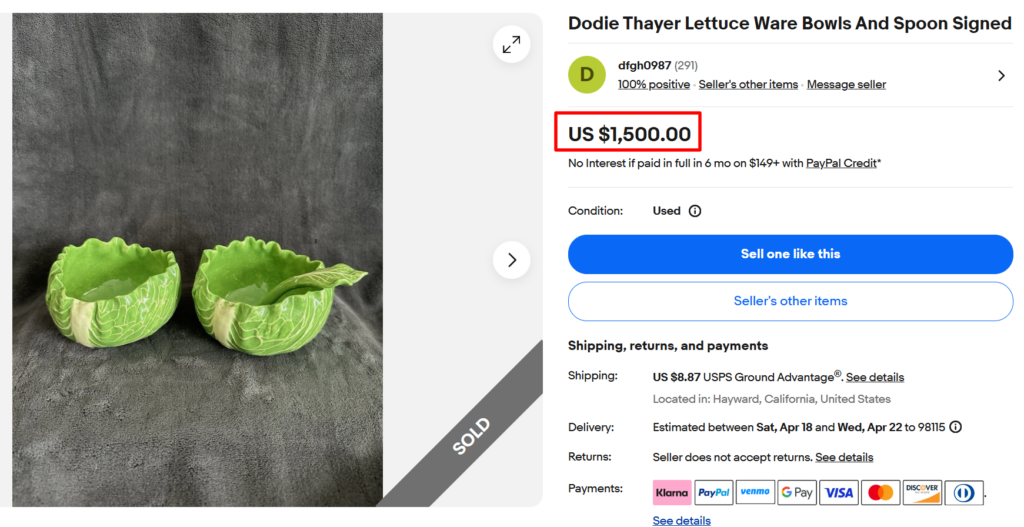
| Average Price Range | $300–$800 (per bowl) |
| Manufacturing Period | 1960s–2018 |
| Status | Highly collectible |
| Notable Pieces | Signed matched pairs; bowls with original serving spoons |
| Collector Notes | Check the “Dodie Thayer” mark. |
These delicate Cabbage/Lettuce bowls are from the American artisan Dodie Thayer. She began handcrafting lettuce ware in her Florida home in the early 1960s, by molding clay directly from real leaves and shaping every vein by hand.
Thayer’s bowls replicate the full lettuce-head form, outer leaves wrapping the base, with curling ruffled edges at the rim. They were made as both decorative pieces and functional serving bowls.
All signed originals carry an incised “Dodie Thayer” mark on the underside, sometimes with “Jupiter, Fla” and a production date. These bowls are more valuable when paired with original matching spoons.
2. Palm Beach Cabbage Platter – Dodie Thayer
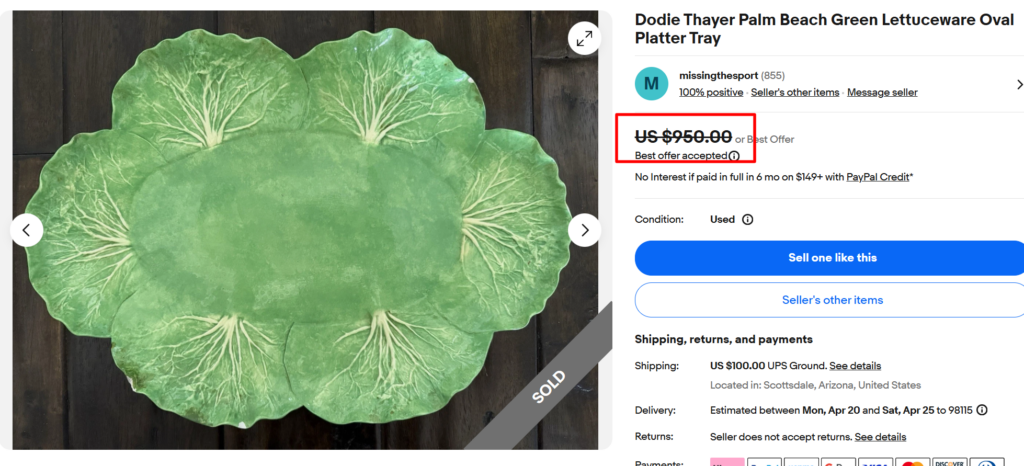
| Average Price Range | $500 – $2,500 |
| Manufacturing Period | 1960s – 1970s |
| Status | Highly Collectible |
| Notable/Valuable Pieces | Large 15″+ oval platter |
| Collector Notes | Look for the “Palm Beach/Thayer” mark |
This oversized oval tray is a highly collectible piece from Dodie Thayer’s Palm Beach Cabbage Ware. It’s a clean platter design surrounded by realistic cabbage leaves.
After lidded tureens, these platters are Thayer’s most valuable and collectible forms. Signed platters can easily range from $500 to $2,500+.
Remember that some Dodie Thayer pieces were exclusively sold at Au Bon Gout, a famous Worth Avenue boutique in Palm Beach. These pieces usually carry the hand-etched or impressed “Au Bon Gout / Palm Beach / Dodie Thayer” signature.
3. Lavender Cabbage Plates – Bordallo Pinheiro
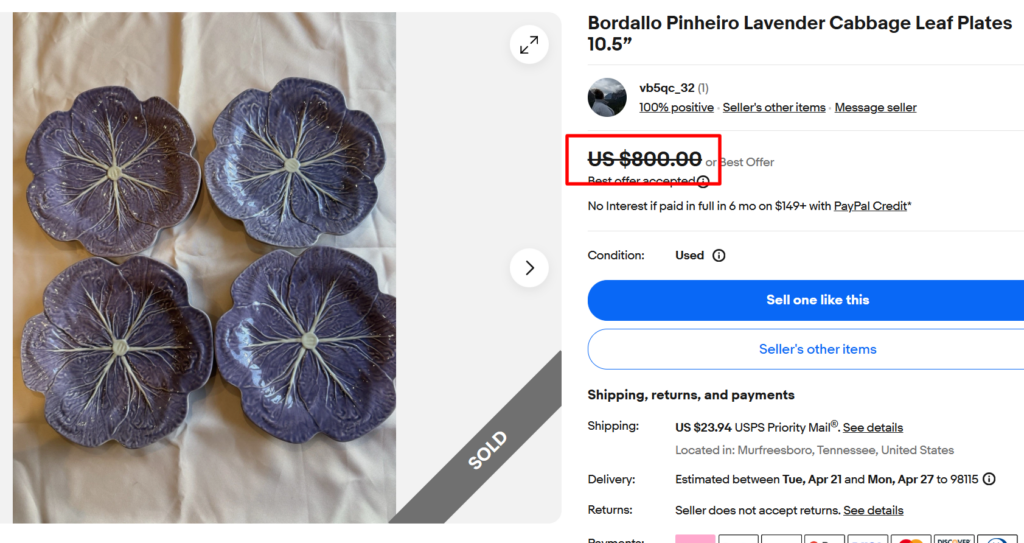
| Average Price Range | $600 – $900 (Set of 4) |
| Manufacturing Period | Late 20th Century |
| Status | Rare Colorway |
| Notable/Valuable Pieces | Large dinner plates, chargers |
| Collector Notes | Check the “Frog in Circle” & “Portugal” stamp. |
While Bordallo Pinheiro is famous for its classic green Cabbage Ware, their lavender editions are a rare find. Produced in Portugal, these plates feature the signature heavy veining but in a sophisticated, muted purple glaze.
The color was produced in much smaller quantities than the green, making full dinner sets or partial sets, like this example, difficult to build. The value lies in the size of the set and the condition of individual pieces.
To ensure authenticity, check the “Frog in Circle” stamp on the base, often along with the “Made in Portugal” mark.
4. Italian Majolica Cabbage Plates – EB Napoli
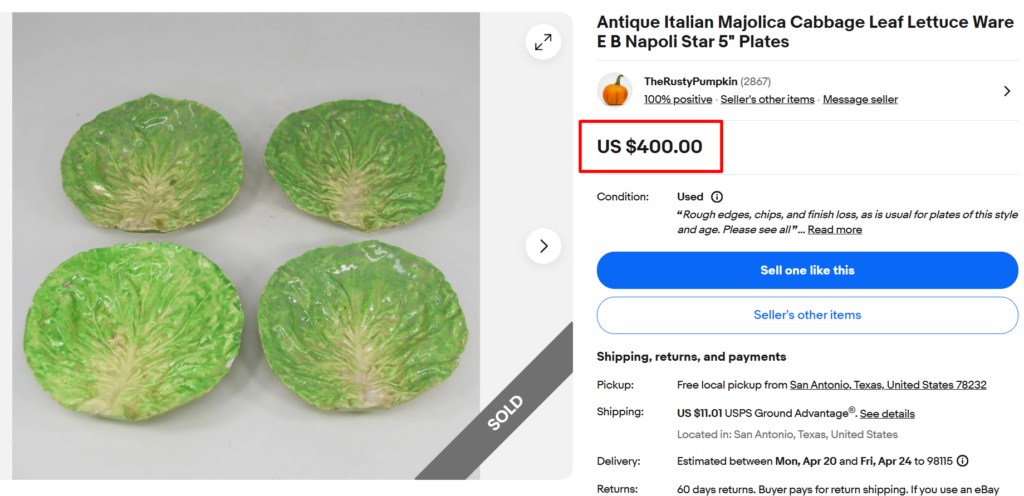
| Average Price Range | $300 – $500 (Set of 4) |
| Manufacturing Period | Late 19th to Early 20th Century |
| Status | Antique/Rare |
| Notable/Valuable Pieces | 5-inch small appetizer or bread plates |
| Collector Notes | Look for “E ★ B NAPOLI” markings. |
E.B. Napoli pieces are 19th-century soft-paste Italian majolica from Naples. These plates directly inspired the Wannopee Pottery’s “Lettuce Leaf” pattern in the 1890s and Dodie Thayer’s entire design approach in the 1960s.
What makes these pieces a real treasure is that each E.B. Napoli plate is hand-formed. So, you’ll notice variation in leaf shape, texture depth, and dimensions on each piece in a set.
Besides, all authentic pieces carry the impressed “E ★ B NAPOLI” (a star between the E and B) mark. Small sets (4 or 6) of original E.B. Napoli plates can fetch $300 to $500, while single, smaller pieces are usually worth $60–$150,
5. Pink Cabbage Plates – Bordallo Pinheiro
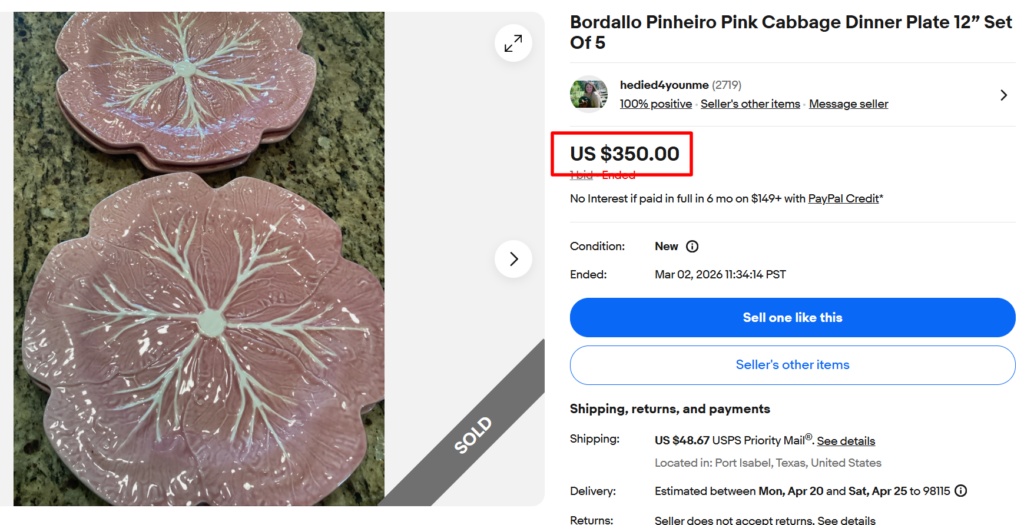
| Average Price Range | $300 – $450 (Set of 5) |
| Manufacturing Period | 1990s – Present (Small batches) |
| Status | Highly Desirable Color |
| Notable/Valuable Pieces | Large dinner plates, platters, tureens |
| Collector Notes | Look for “Bordallo Pinheiro Frog” mark |
Bordallo Pinheiro has been making Cabbage Ware since 1884. Their standard green plates are still sold today at Williams-Sonoma and Neiman Marcus. But pink Bordallo Pinheiro Cabbage Ware is very uncommon.
It was produced during an earlier, limited run and is no longer made or sold new, creating a scarcity in the market.
This example features 12-inch dinner plates, a full-size form that is way more desirable than standard plates. Each plate is substantial and features a glossy, rosy glaze that highlights the white “veins” of the cabbage leaf. A complete set of five or more plates in new condition is a rare find.
6. Majolica Cabbage Leaf Plates – Wedgwood
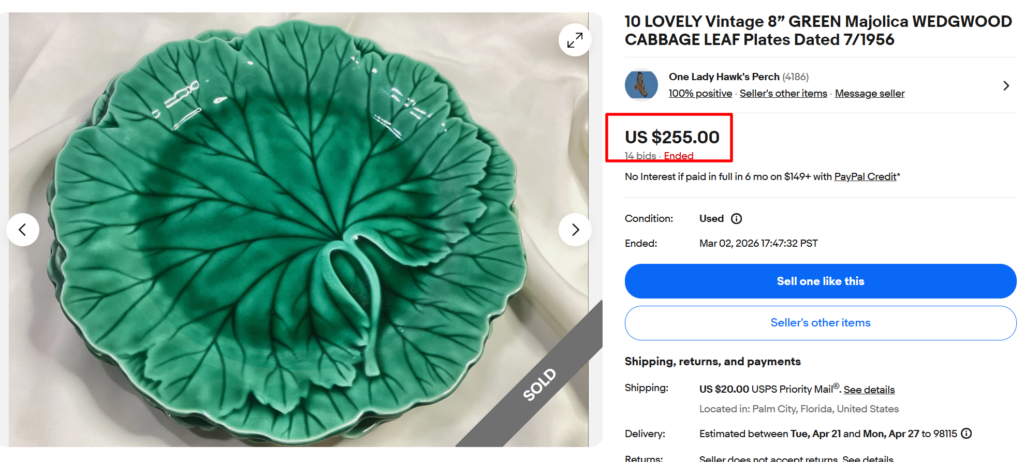
| Average Price Range | $50–$92 (single) $100-300+ (partial sets) |
| Manufacturing Period | Late 1800s–1960s (Circa 1950s) |
| Status | Vintage/Collectible |
| Notable/Valuable Pieces | Large platter, lidded dishes, large sets |
| Collector Notes | Carries the “Wedgwood” mark and date codes. |
Wedgwood’s majolica cabbage leaf pattern became one of the factory’s most enduring designs. It’s been in continuous production from the mid-1800s through the 1950s.
These plates feature the relief-molded cabbage design under a deep green glaze that pools into the lower veining. The distinctive saturated look sets these apart from later reproductions.
You can check the basestamp to confirm the age of a Wedgwood Cabbage Ware piece. Victorian pieces without “England” predate 1890 import labeling laws, while the “Wedgwood of Etruria & Barlaston” mark indicates a 20th-century production.
7. Yellow Cabbage Ware Plates – Secla
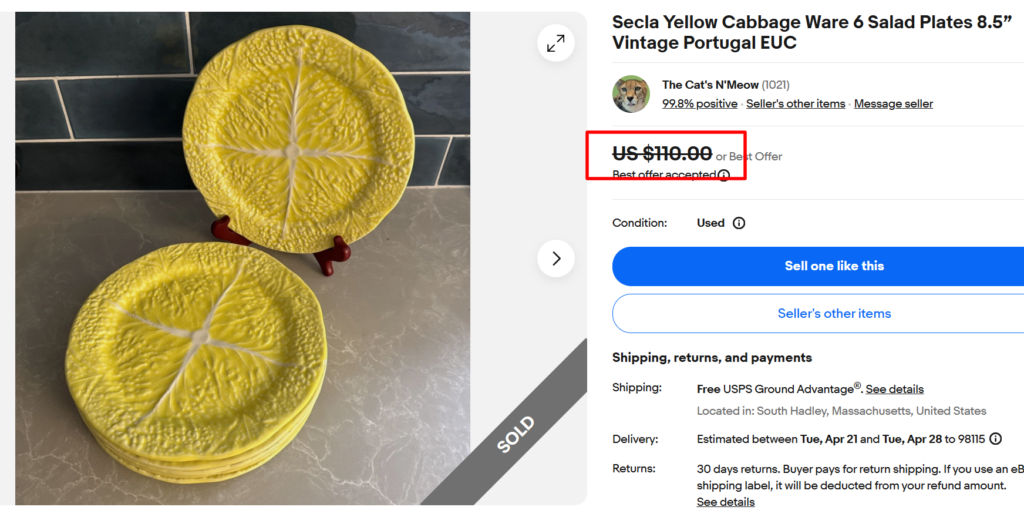
| Average Price Range | $100 – $180 (Set of 6) $15–$30 (per plate) |
| Manufacturing Period | Mid-to-Late 20th Century |
| Status | Uncommon Color/Collectible |
| Notable/Valuable Pieces | Platters, Tureens, Full services |
| Collector Notes | Check the “Secla Portugal” stamp. |
This is a rare set of yellow Cabbage Ware dinner plates from Portuguese pottery manufacturer, Secla.
Secla operated out of Caldas da Rainha, the same Portuguese ceramics hub as Bordallo Pinheiro, from 1947 until the factory closed in 2008. They produced Cabbage Ware in both green and yellow, but yellow was made in smaller quantities.
Now that the factory is gone, full yellow services are increasingly difficult to assemble, making them highly valuable. Even partial sets, like this set of 6 plates, hold decent value because of color rarity.
8. Rabbit On Blue Cabbage Leaf Tray – Minton
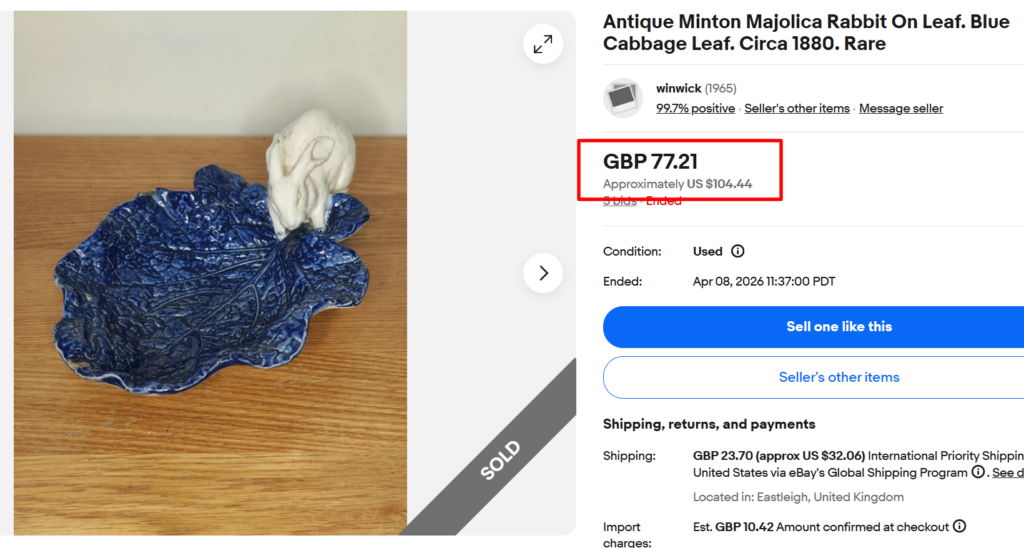
| Average Price Range | $100 – $250 |
| Manufacturing Period | Circa 1880 |
| Status | Antique / Rare |
| Notable/Valuable Pieces | Figural animal trays and tureens |
| Collector Notes | Blue glaze was expensive to produce and is very sought after. |
This rare tray featuring a white rabbit perched on a deep blue cabbage leaf is a prime example of Minton’s Victorian Majolica. The blue cobalt colorway on this piece is notably rarer than the standard green.
Minton introduced majolica at the 1851 Great Exhibition in London and went on to produce work for the Houses of Parliament, the US Capitol, and the Royal Dairy at Windsor. Its Victorian-era Cabbage Ware is highly desirable today.
To ensure a Minton piece’s authenticity, look for the impressed “MINTON” mark and a three-letter date cypher on the base.
9. Green, White, Pink Cabbage Bowl – Fitz and Floyd
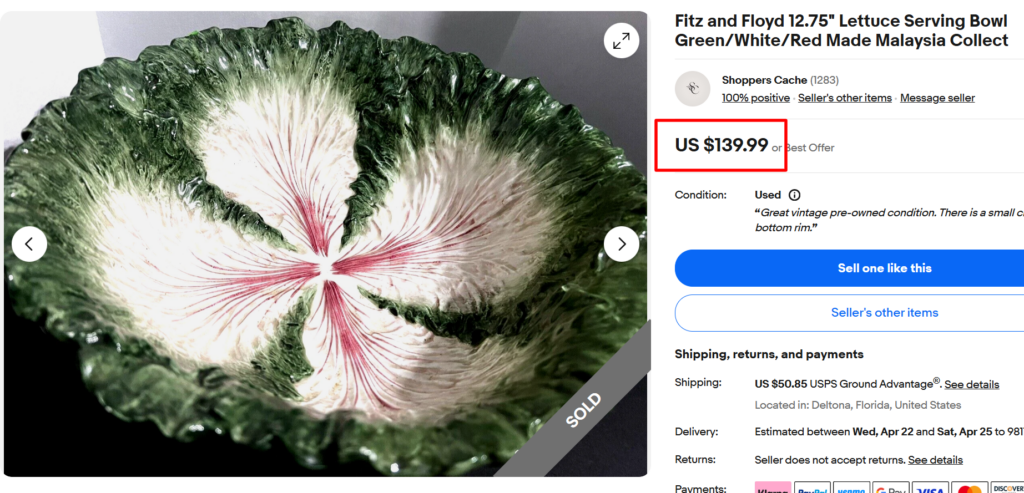
| Average Price Range | $100 – $150 |
| Manufacturing Period | 1970s – 1990s |
| Status | Modern Vintage |
| Notable/Valuable Pieces | Large Bowls, Large plates, soup bowls |
| Collector Notes | Look for an hand-engraved “FF” mark. |
This serving bowl from Fitz & Floyd features a unique tri-color palette of green, white, and red, and mimics the look of a radicchio or variegated cabbage. This pattern was discontinued in 1998, making it highly sought-after.
Large serving pieces, like this 12.75-inch bowl, are the rarest and most valuable in this pattern. Make sure to check the “FF/Fitz and Floyd” mark on the base. You may also find a foil sticker reading “Handcrafted in Malaysia.”
10. Pressed Green Glass Cabbage Ware – Indiana Glass
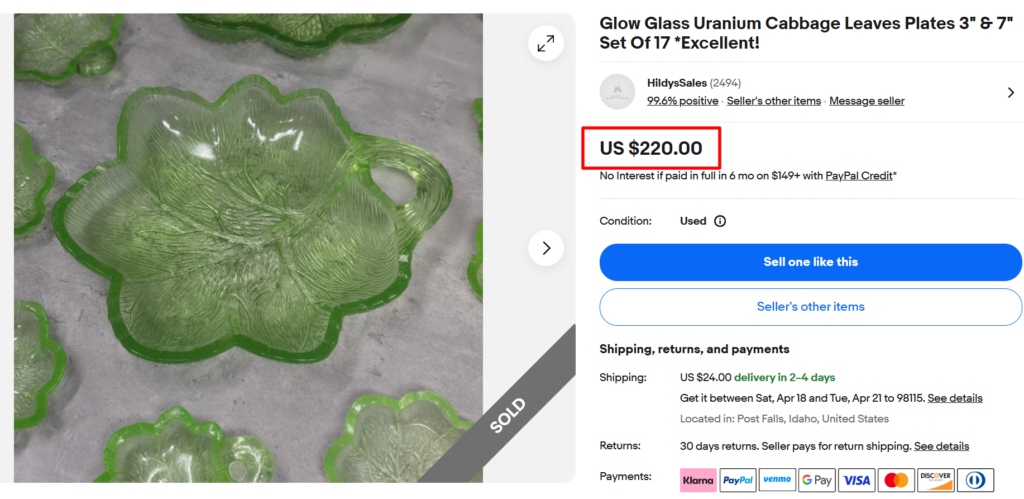
| Average Price Range | $180 – $250 $12–$40 (per piece) |
| Manufacturing Period | Mid-20th Century (1930s) |
| Status | Collectible |
| Notable/Valuable Pieces | Handled tidbit trays, 7-inch plates, full sets |
| Collector Notes | Use a blacklight to verify the authentic uranium “glow.” |
Although not ceramic, these Cabbage Ware dishes from Indiana Glass Company are also quite collectible. These are made of “Uranium Glass” and glow bright neon green under a UV light. Besides, the cabbage leaf pattern here was pressed into the glass.
The value of these pieces is in a large set of different shapes, including plates, bowls, trays, and more. But before valuing, always use a blacklight to verify the authentic uranium “glow.”
Note: This article is intended for informational, educational, and entertainment purposes only. Some images are illustrative and may not represent actual brands, products, or related entities. All trademarks, product names, brand logos, packaging, and other intellectual property referenced remain the exclusive property of their respective owners. Any brand mentions or references are provided solely for descriptive and educational context and do not imply any formal or commercial association.