
Antiques Know How Research
Antique Oil Paintings Value
An overview of several eBay sales and auctions by the Antiques Know How team suggests that antique oil paintings range from a few hundred to several thousand dollars, with top‑tier works by known Impressionists, like Robert William Vonnoh and Old‑Master‑style artists, fetching tens of thousands. The value depends on the artist’s name and signature, solid provenance with old labels and exhibition marks, period‑correct materials and brushwork, original period‑style frame, and overall condition.
Antiques Know How
Do you have a very old, framed painting gathering dust in your attic? If so, there are fair chances that you could be looking at a fortune without knowing it. Genuine antique oil paintings regularly sell for thousands of dollars, sometimes tens of thousands, today.
To tell if yours has real value, you need to assess certain factors, which this guide will help you with. You’ll also discover some high-value paintings that are currently worth big money.
What Makes Old Oil Paintings Valuable?
Oil paintings have been around for over 500 years. It replaced egg tempera as the dominant medium in Europe during the 15th century, and by the 17th and 18th centuries, the tradition was well-established across styles from Baroque to Realism.
By the 19th century, Impressionism became prominent. Every period has its own indicators, which can be used in dating, identifying the authenticity of the painting, and evaluating it today.
The Artist & His Signature
The artist of a painting is the first and, in most cases, the most crucial value factor. A signed painting is usually worth significantly more than an unattributed one.
So, always look for it in the lower corners of the canvas, both front and back. Some artists signed on the back of the stretcher or frame, while some signed the canvas itself. Some artists are so renowned that even their associates’ and followers’ art becomes collectible.
Also, the signature has to be authentically old. An authentic antique signature should age along with the painting. If the ink or paint seems new against an old background, then it is a warning sign.
Once you locate the signature of the artist, you should verify the signature by comparing it to others available on auction sites such as Invaluable.com or AskArt.com. A name that is not recognizable may still hold value for its authenticity. But be wary; many students also copied renowned masters.
Provenance
Like the artist’s name, provenance is among the strongest value drivers in antique art. It refers to the documented history of who owned a painting and where it has been.
Old gallery stamps on the back of the frame, auction house stickers, exhibition labels, or handwritten inscriptions all add credibility and traceability.
A painting that shows up in an old auction catalog or gallery record from 1920 is significantly more trustworthy than one with no paper trail. If you own an old painting, don’t clean off old labels or stickers from the back. They’re evidence, and removing them destroys value.
Age
While age impacts value, older doesn’t automatically mean valuable. Usually, oil paintings from before the 1900s command far more interest than 20th-century works.
As for the 17th- or 18th-century paintings in decent condition, they are museum-quality pieces that fetch extraordinary prices at auction.
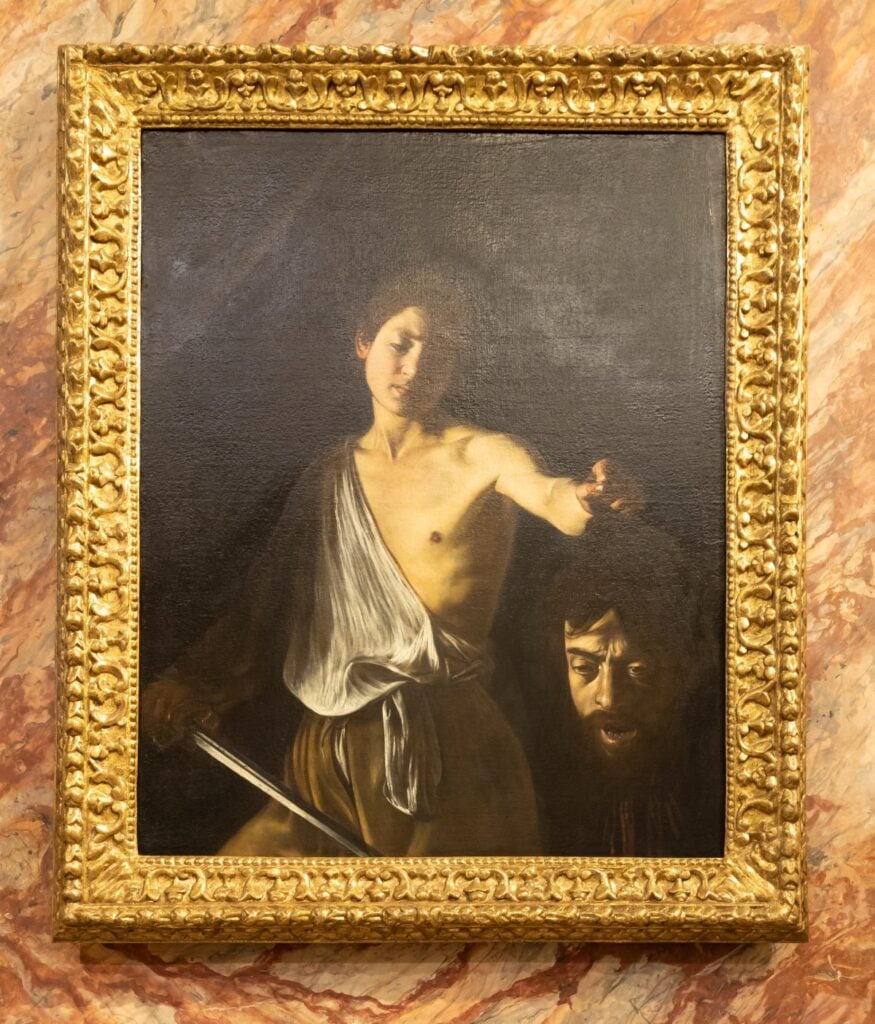
To estimate age, look at the canvas. Pre-1900 canvases were made from linen and hand-stretched. You’ll often see uneven tension and slightly irregular weave. Post-1920s canvases more commonly use cotton.
Also, the back of the canvas should show darkening and brittleness consistent with age. Fresh, white canvas on an “antique” painting is suspicious.
Technique, Style, and Materials
Genuine antique oil paintings were made with specific pigments that weren’t available after certain dates. Prussian blue, for example, wasn’t used before 1704. Titanium white wasn’t commercially available until 1921. If a painting supposedly dated to 1850 shows titanium white, something is wrong.
Apart from pigment, look at the brushwork. It alone can tell you about the painting’s age and style:
- Pre-20th-century: These paintings usually show stiff natural-bristle brushstrokes with distinct stroke patterns.
- Baroque (roughly 1600–1750): Baroque paintings show smoother blending and layered glazes. Strong contrasts between light and shadow, dramatic compositions, religious and portrait subjects.
- Realism (mid-1800s): Ordinary subjects, highly meticulous detail with clean strokes.
- Impressionism (1870s–1900s): These paintings show loose visible brushstrokes, outdoor scenes, and natural light.
- American Scene / Regionalism (1920s–1940s): American landscapes and everyday workers.
A painting that claims to be from 1820 but shows a loose Impressionist style is inconsistent. Style should match the claimed period of the work.
Frames & Canvas
The frame is as important for identification and evaluation as the painting itself.
For instance, old gilt antique frames usually consist of wood that is coated with gesso and gold leaf. When you press your fingernail on the back surface, you will notice that the old gesso is slightly soft, unlike new gesso which is hard.
Reproduction gilt frames after 1950 are mostly resin cast.
Also, look for hand-carved details that are slightly uneven. Machine-made frames from the 20th century show perfectly uniform patterns. Original frames that match the painting’s period are a strong value signal.
However, just because you have a good frame doesn’t mean that the painting is genuine, and vice versa. Not necessarily. Consider checking other factors as well.
Condition
Condition affects an antique painting’s value more than almost anything else. A small crack in the paint layer (called craquelure) is normal and expected in old paintings. But a large vertical crack running through the canvas and significant flaking can cut value by 50% or more.
Obvious amateur restoration is another big value killer, especially for oil paintings.
Examine the painting under raking light (a strong light held at a steep angle to the surface). This reveals old repairs, areas of overpaint, and uneven texture. When viewed through UV light, any recent alterations will appear as dark marks against older paint.
Examples of High-Value Old Antique Oil Paintings
Some of the most valuable antique oil paintings that were sold at eye-catching prices, along with the characteristics that made these paintings so unique, are listed below.
1. Robert William Vonnoh – Hudson River Landscape
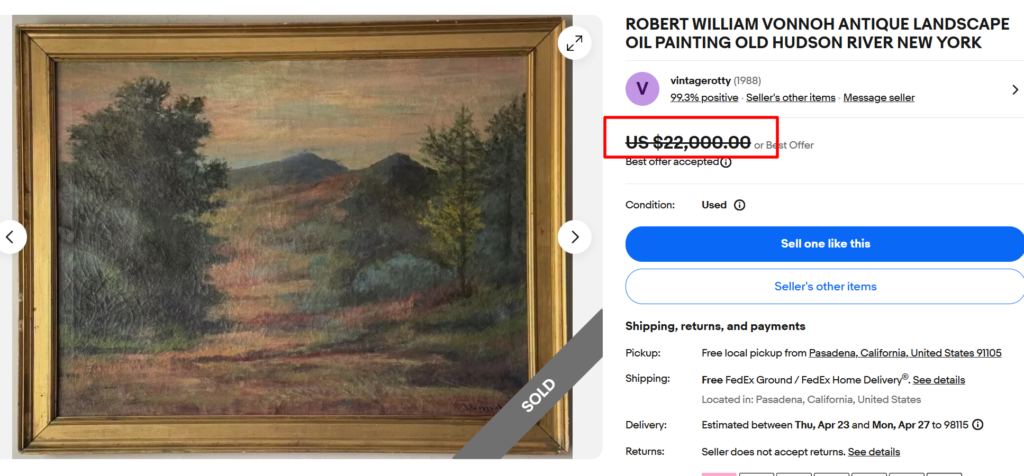
| Average Value | $15,000 – $30,000 |
| Period/Era | Late 19th / Early 20th century |
| Artist/Style | Robert William Vonnoh; American Impressionism |
| Collector Notes | Vonnoh’s work is signed lower right with “Vonnoh.” |
Robert William Vonnoh was one of the first American artists to bring French Impressionism back to the United States. This Hudson River landscape is oil on canvas with the loose, textured brushwork of his mature style.
The muted palette of greens, pinks, and grays on this example is consistent with his later landscape work. His original paintings are signed with “Vonnoh” in the lower right corner.
The works of Vonnoh have been exhibited at the Art Institute of Chicago, the Metropolitan Museum of Art, and the Pennsylvania Academy of the Fine Arts. His landscapes usually auction for $5,000 to over $50,000, based on size and era.
2. 15th–16th Century Old Master – Nobleman, Oil on Wood Panel
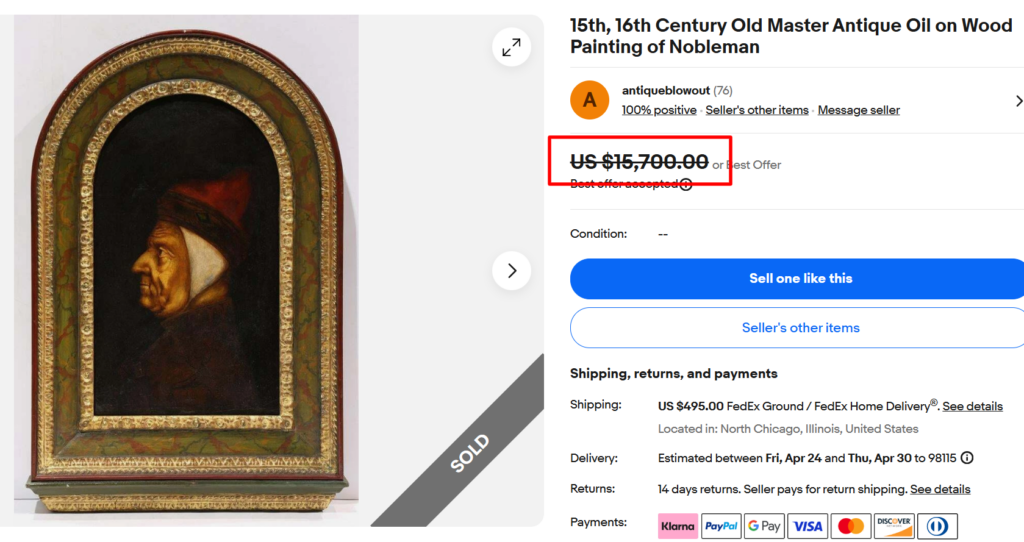
| Average Value | $10,000 – $25,000+ |
| Period/Era | 15th–16th century |
| Artist/Style | Old Master (unattributed); Northern European Portrait |
| Collector Notes | Wood panel portraits of this age are very rare. |
This rare profile portrait painting is done on wood panels rather than canvas, which was the practice before canvas became popular. It shows an elderly nobleman in profile, wearing a red cap with a white headband, in the style of Flemish or Italian 15th-century portraiture.
The arched frame format, with green marbled outer surround and gold inner molding, is characteristic of altarpiece panels from the period.
Although this artwork is unattributed, genuine period frames of this type are themselves collectible. And their value goes even further with such old art, which is evident with a steep price tag of $15,700.
Paintings of this claimed age need to be evaluated professionally, but the visual evidence is consistent.
3. Frank William Cuprien – “Isle Madera” Coastal Landscape
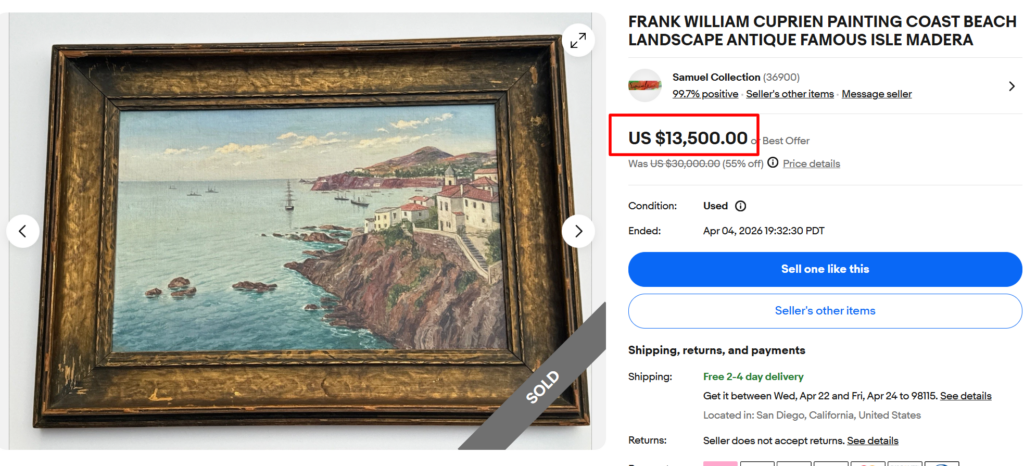
| Average Value | $10,000 – $20,000 |
| Period/Era | Early 20th century, ca. 1912–1930 |
| Artist/Style | Frank William Cuprien; California Impressionism |
| Collector Notes | His signature reads “F.W. Cuprien.” |
This piece by Frank William Cuprien shows a Mediterranean coastal scene, likely from one of his European studies. Cuprien was known as the “Dean of Laguna Artists” and was a founding figure of the California Impressionist movement.
The style in this painting matches his plein-air period, with loose brushwork to showcase atmosphere over detail. The original dark walnut frame shows genuine age wear.
Cuprien’s work is held by the Los Angeles County Museum of Art and the Laguna Art Museum. And his original paintings usually sell for tens of thousands of dollars.
4. Follower of John Frederick Herring the Elder – “Horses and Doves at a Trough”
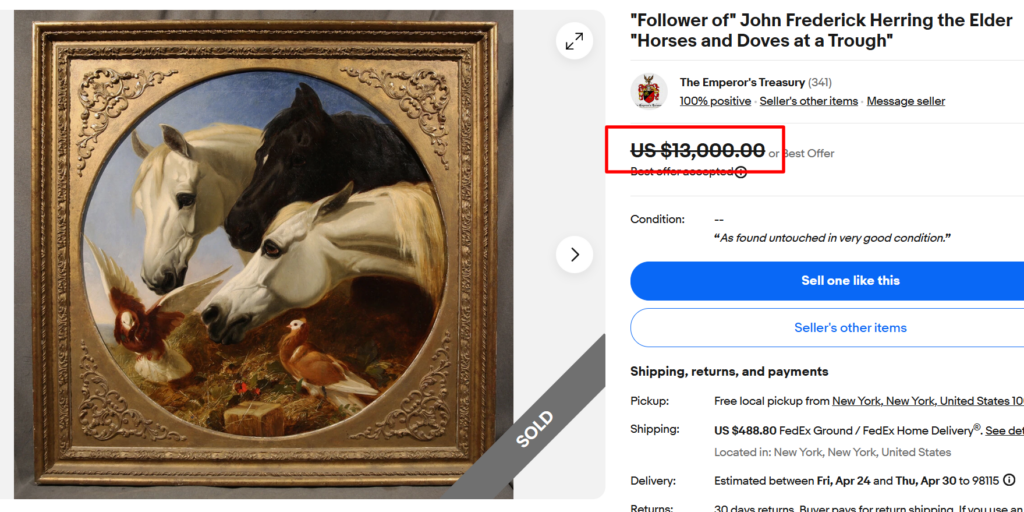
| Average Value | $7,000 – $16,000 |
| Period/Era | 19th century |
| Artist/Style | Follower of J.F. Herring; Equestrian Realism |
| Collector Notes | “Follower of” attribution means the style of Herring by another artist |
John Frederick Herring the Elder was one of the most celebrated British sporting and animal painters of the 19th century. And his style has been adapted by many artists.
This tondo-format (oval) painting by one of Herring’s “followers” shows his signature composition closely, featuring two or three horses with doves at a watering trough. The carved gilt rectangular outer frame with an oval carved inner frame indicates the original commissioning, not a reproduction.
The “Follower” paintings in good condition sell well because the quality of execution is often excellent. Original works by Herring sell for $50,000+ at auctions.
5. Charles Allen Patterson – Still Life
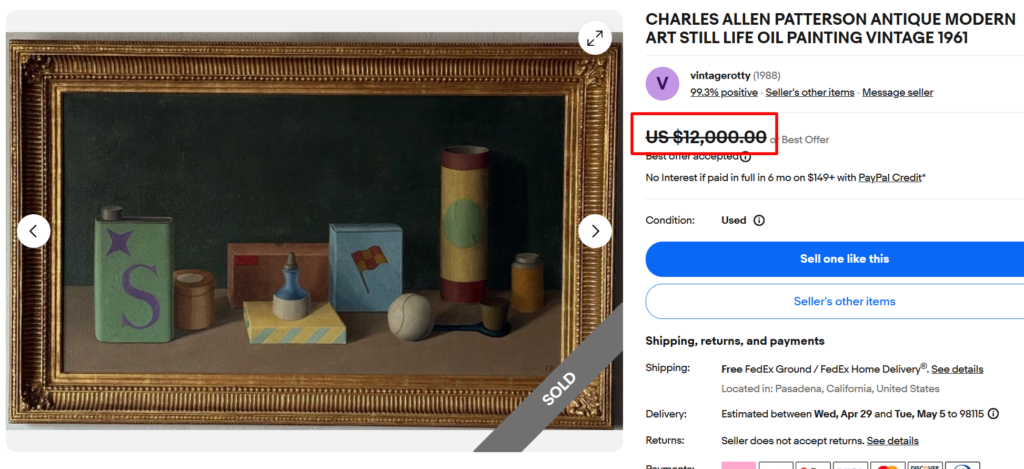
| Average Value | $8,000 – $15,000 |
| Period/Era | 1961 |
| Artist/Style | Charles Allen Patterson; American Modernist Still Life |
| Collector Notes | Signed trompe-l’œil and modernist still-life art is valuable. |
This 1961 still life by Charles Allen Patterson shows a group of household objects, a box with an “S,” a top, a ball, and cylindrical containers. All the objects are arranged with the kind of deliberate precision you observe in American Magic Realism.
The work is oil on canvas in an ornate gold-gilt frame with egg-and-dart molding. Signed works from mid-century American realist painters are harder to find than Impressionist landscapes. The subject matter is distinctive, and distinctive paintings are usually more desirable.
6. Circle of Claude Monet – “The Needles in Port Coton”
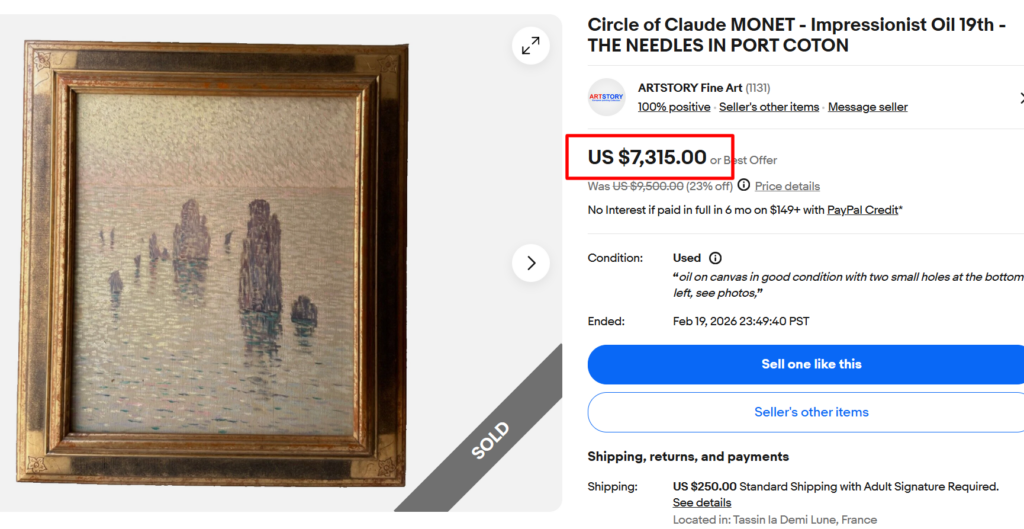
| Average Value | $5,000 – $12,000 |
| Period/Era | Late 19th century |
| Artist/Style | Circle of Monet; French Post-Impressionism |
| Collector Notes | “Circle of” attribution is for artists associated with Monet, not himself. |
This painting shows “Port Coton,” which is a real location on the coast of Brittany, France. Monet painted there in 1886. This work closely follows his approach, with the distinctive needle rock formations visible in the mist.
The attribution “Circle of Monet” means that the work came from an artist in Monet’s immediate sphere, but not himself. It’s an honest, verifiable label used by serious dealers and does not mean forgery.
The oil on canvas shows a pointillist-influenced technique. Original gold-gilt frame with ornate corner details.
7. Georges Schreiber – Railway Signal at Copper Canyon
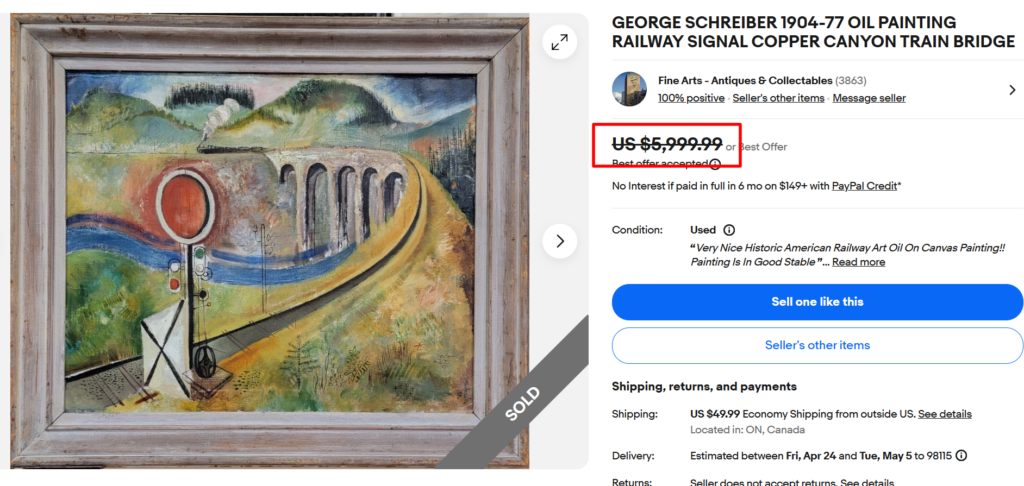
| Average Value | $4,000 – $8,000 |
| Period/Era | Mid-20th century, ca. 1940s |
| Artist/Style | Georges Schreiber – American Regionalism |
| Collector Notes | His 1936–1945 American Scene period art is the most desirable. |
This oil on canvas by Georges Schreiber shows a train crossing a massive arched bridge with a bold railway signal in the foreground. It displays the art title and artists on a label on the back.
Schreiber was born in Brussels in 1904 and became one of the key American Scene painters of the 1930s and 40s, documenting working-class America across all 48 states.
He was also commissioned by the U.S. Navy in WWII to document American industry. His work is in the collections of the Metropolitan Museum of Art and the Whitney, making his estate sale artworks highly collectible. This example itself bears the “The Santa Barbara Museum of Art” label, which adds prominence.
8. Jean Veber – “The Jurors, Paris” (1896)
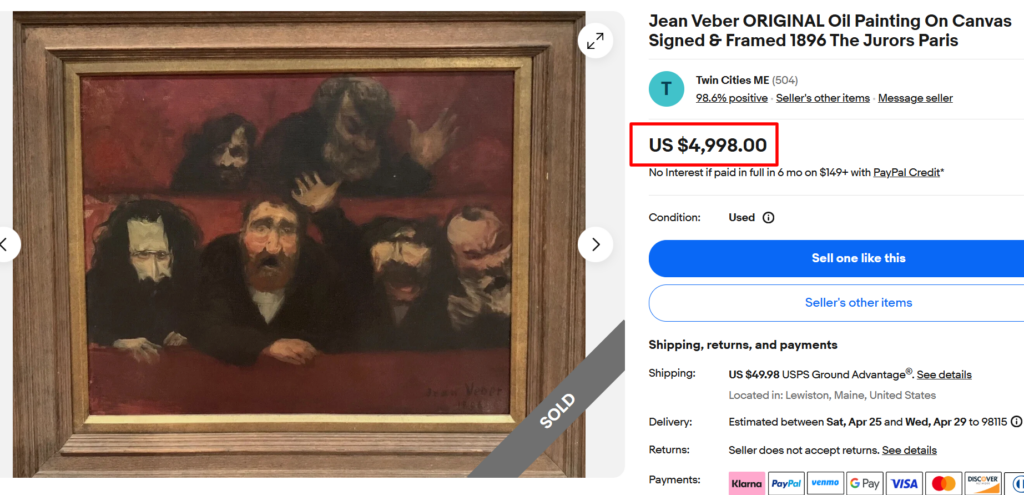
| Average Value | $3,000 – $6,000 |
| Manufacturing Period | Late 19th Century (1896) |
| Artist/Style | Jean Veber – Satirical Figurative |
| Collector Notes | Look for the signature and date |
Jean Veber was a French painter and satirical caricaturist born in 1864. While his satirical lithographs are more widely known, his oil paintings are actually quite scarce and very collectible.
Here, we have an art of five grotesque characters in a courtroom scene, executed in the dark style characteristic of his figurative paintings. It came in a heavy walnut frame with clear aging and is signed and dated 1896, which is critical.
The combination of a documented artist, original signature with a year, and rare subject matter is the reason for its high value. Most of his old paintings are usually worth $1,500-$2,500.
Note: This article is intended for informational, educational, and entertainment purposes only. Some images are illustrative and may not represent actual brands, products, or related entities. All trademarks, product names, brand logos, packaging, and other intellectual property referenced remain the exclusive property of their respective owners. Any brand mentions or references are provided solely for descriptive and educational context and do not imply any formal or commercial association.