The usual buyer who arrives at an estate sale begins their tour from the living room. When they reach the bedroom, all the silver, signed jewelry, and little bronzes have already been picked up.
This is the part of estate sale shopping nobody really teaches you. The first day is when the best antiques will still be there in the home, but the window is very short.

The good thing is that you do not require many years of experience to pick the best. All you need is to know what you’re looking at. Below is the strategy that works for the first day of any sale to spot the best antiques in different categories.
Why Does the First Day Matter?
The first day has the full inventory and the firm prices. The last day has bargains, but mostly leftovers. If you want rare finds at estate sales, the first morning is your best bet at competing for them.
Dealers and resellers know this. They line up before opening, work the house in a specific order, and they’re usually gone within twenty minutes. That’s because the competition is not for everything in the house, but the twenty or thirty items that are actually worth real money.
Buying tip: Check the photo preview on EstateSales.net or EstateSale.com the night before. Spot 2-3 target pieces and head straight for those rooms first.
What to Do Before Entering the Sale
Sometimes, a few things done beforehand can prevent you from making the same mistakes people usually make.
Firstly, take a small flashlight to be able to look at marks on the bottom sides of dishware and furniture. Take a magnifying loupe to examine stamps on jewelry, some money to make fast payments, and a tape measure to hunt for furniture pieces. The crossbody bag will keep your hands free.
Set the price ceilings for your items beforehand. If you already know that you’ll pay max $200 for sterling silver, and max $500 for a mid-century chair, you won’t feel frozen when you see such an item.
Then, plan your way through the house. The first rooms to check out should be bedrooms, the basement, the garage, and the attic. It is there that small, valuable items hide.
Tips to Spot the Best Antiques from the Most Common Categories
Below are listed the seven categories that show up at almost every estate sale, and some easy identification tips to spot the most valuable pieces in each.
1. Sterling Silver Flatware & Hollowware
Sterling silver gets overlooked at estate sales because most people don’t know the key things to look for.
Check the back of the item for signs such as “STERLING,” “925,” or maker’s mark such as Tiffany & Co., Gorham, Reed & Barton, or Georg Jensen. A regular sterling dinner fork can be sold for $15 to $30, and a serving spoon (it’s heavier) will be sold from $40 to $100.
Avoid anything with “EPNS” or just “silverplate,” that’s plated silver and has zero resale value.
2. Mid-Century Modern Furniture
Mid-century furniture is one of the strongest categories on the secondary market right now. The trick is telling original designer pieces from generic teak. Turn chairs and tables upside down and look inside the drawers to check the following:
- Real Herman Miller and Knoll furniture has paper tags, sticker labels, or stamps underneath, usually towards the front part of the piece.
- The Danish will usually have the mark “Made in Denmark” burned or inked into the piece.
- Real teak, walnut, and rosewood feel very heavy. Particle board with a veneer does not.
A real Eames lounge chair found in an estate sale is valued from $3,000 to $8,000, depending on condition.
3. Pre-1970 Costume Jewelry
Don’t skip the jewelry box. Some of the best returns at estate sales come from small, signed costume pieces priced like junk. Here’s what to look for:
- Look at the back of every brooch and the clasp of every necklace for a maker’s signature.
- Trifari, Coro, Miriam Haskell, Schiaparelli, Weiss, and Eisenberg are among the most collected names from the 1930s to 1960s.
- To spot genuine Bakelite, touch a hot pin gently to a hidden spot. If it gives off a faint carbolic smell, it’s real; otherwise, it’s plastic.
- Carved Bakelite and laminated pieces in marbled or polka-dot designs sell well.
4. Asian Antiques and Ceramics
Chinese and Japanese pieces are the category most commonly misjudged by buyers. So, always check the base.
Genuine older Chinese porcelain often has hand-painted reign marks in cobalt blue. Japanese Imari shows hand-painted underglaze blue with red and gold overglaze. Reproductions usually feel too light, have unnaturally white bases, and show printed (not painted) marks under a loupe.
Be careful while hunting this category, because the market is flooded with reproductions, especially of “Qing Dynasty” pieces.
Buying Tip: When in doubt, take a photo and check it later instead of overpaying on the spot.
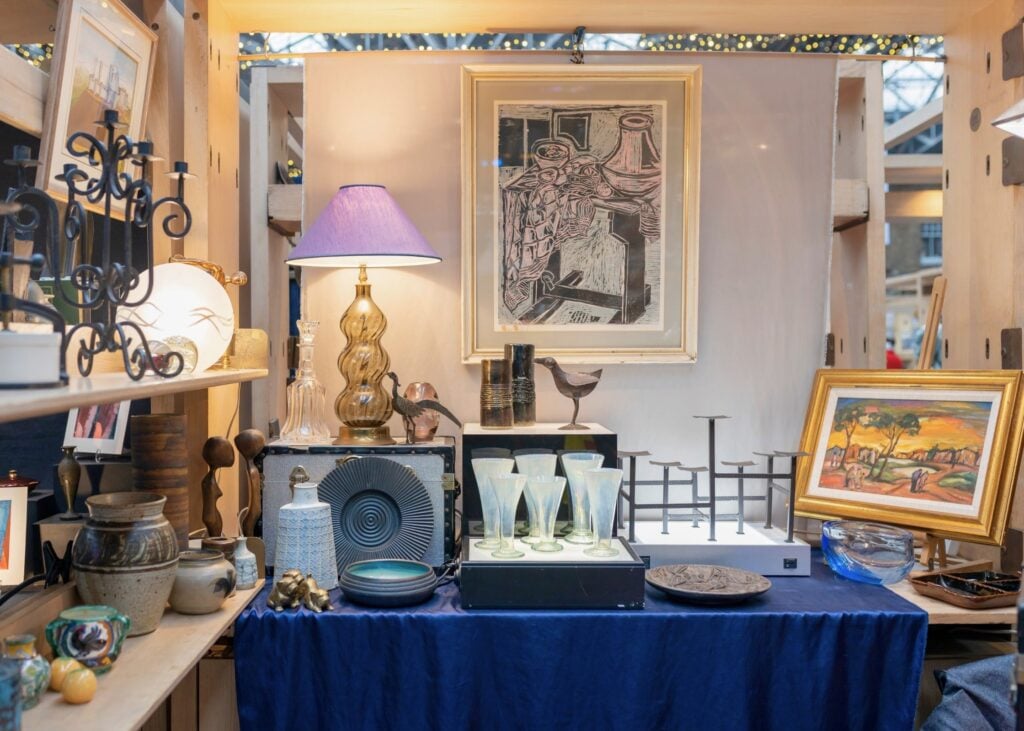
5. Original Artwork, Prints, and Frames
Most shoppers ignore the walls of the rooms, which is a big mistake.
Always flip framed pieces over and look for gallery labels, original price tags, artist signatures on the back of the canvas, or limited edition numbers in the bottom margin of a print (like “12/150”).
Original oil paintings have visible brushwork and texture; prints under a loupe show dot patterns. Even the frame matters. Carved gilt frames from the 1880s to 1920s can sell for $100 to $400 empty.
6. Vintage Watches
While looking at the old watches, open the watch back cover to see the brand name, serial number, and movement. On the dial, try to find the brand name, as well as the lume, which should be cream-colored due to aging.
The wrist and pocket watches from such companies as Omega, Rolex, Hamilton, Bulova, Longines, and Elgin have high resale value.
7. Old Books, Postcards, and Ephemera
When it comes to books, you should always look at the copyright page. The first edition will have written on it “First Edition,” or “First Printing” or a number starting with 1. A signed copy of mid-20th-century American novels by Hemingway, Steinbeck, or Capote can be worth thousands of dollars.
Postcards, trade cards, and pre-1940 photo albums also do well. Real photo postcards from the 1900s to 1920s of small American towns, occupations, or trains regularly sell for $20 to $100 each on eBay.
A Few Red Flags Worth Knowing
Keep one thing in mind – not everything old is worth buying. A quick scan for these red flags can save you from spending your money on cheap finds.
- Monograms on sterling silver and jewelry: A highly engraved set of initials reduces the value of sterling flatware and signed jewelry by 30 to 50 percent. A small, pretty engraving is still fine, but a large monogram on the front is not.
- Refinishing or stripping wooden furniture: A furniture item that has been stripped and re-stained loses its value as a collectible to a great extent, despite looking good. An authentic finish with some wear on it will fetch you a higher value than a “restored” one.
- Hairlines on porcelain and glass: Hold the piece up to a window. A hairline crack shows as a thin dark line. On ceramics, tap the rim gently with a fingernail. A clear ring means it’s sound. A dull thud means there’s a crack somewhere.
- Married sets: A “matching” pair of candlesticks or a “complete” tea service where the pieces don’t quite match in size, weight, or maker’s mark is a married set, two separate items sold as one. Worth far less than a true matched pair.
- Prices that feel too good on famous pieces: A Tiffany lamp that is placed on a folding table at $40 is definitely a reproduction. An offer like that on something that is well-known is always too good to be true.
Note: This article is intended for informational, educational, and entertainment purposes only. Some images are illustrative and may not represent actual brands, products, or related entities. All trademarks, product names, brand logos, packaging, and other intellectual property referenced remain the exclusive property of their respective owners. Any brand mentions or references are provided solely for descriptive and educational context and do not imply any formal or commercial association.