If you’re into antiques, there is a high chance that you’re standing in an antique store holding an old amber pressed bowl marked at six dollars. But you’re not sure whether it’s a genuine vintage glass item worth the money or just a replica.
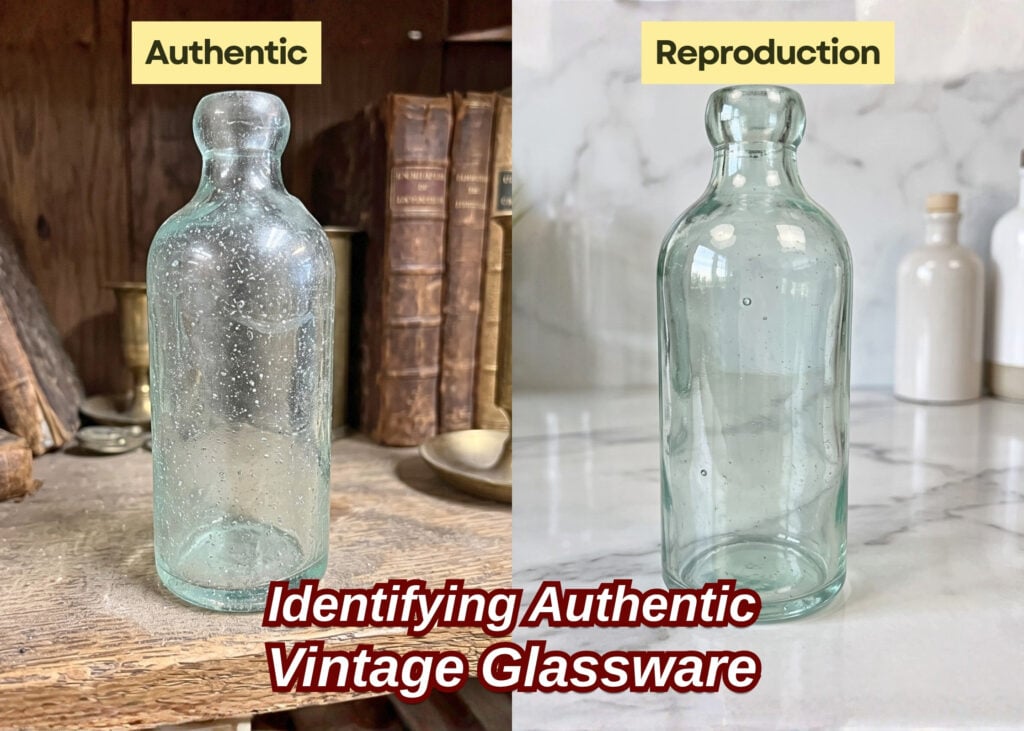
You do not need to remember every manufacturer or pattern ever produced to find out. Instead, seasoned collectors look for certain features every time they examine something. This guide will make identifying vintage glassware easy for you.
Clue 1: Begin with the Base: Pontil Marks and Mold Seams
Always start with the base and sides. There is no better place to determine the glass manufacturing method and thus narrow down the dates.
Pontil Mark on the Bottom
The pontil mark is the rough circle scar on the bottom created when the glassblower breaks away the object from the pontil rod. A rough or spiky pontil scar is an indicator of hand blowing and most likely production prior to the Civil War.
Yet even some high-quality factories used pontils throughout the entire 20th century. Thus, it is a good dating indicator rather than the exact date of manufacture.
The polished pontil is the same circular scar but ground to a smooth round mark on the bottom. The higher-end mid-century producers such as Blenko and Whitefriars used this finish to have a cleaner look on their tableware.
Mold Seams on the Sides
If there is no pontil at all, pay attention to the mold seams. This time, it is the location of the seam stops that is important. The seams that stop below the rim indicate hand-finishing and are typical for pieces manufactured during 1860-1910. Straight seams that go beyond the rim indicate full mechanization and date from the 1920s or later.
Easy Tip: Feel the edge of a seam with your finger. It is probably a modern reproduction if the seam is sharp.
Clue 2: Hold the Glass Up to the Light
Hold your glass piece at eye level next to a bright window and look through the side wall. This is where old glass will give the game away.
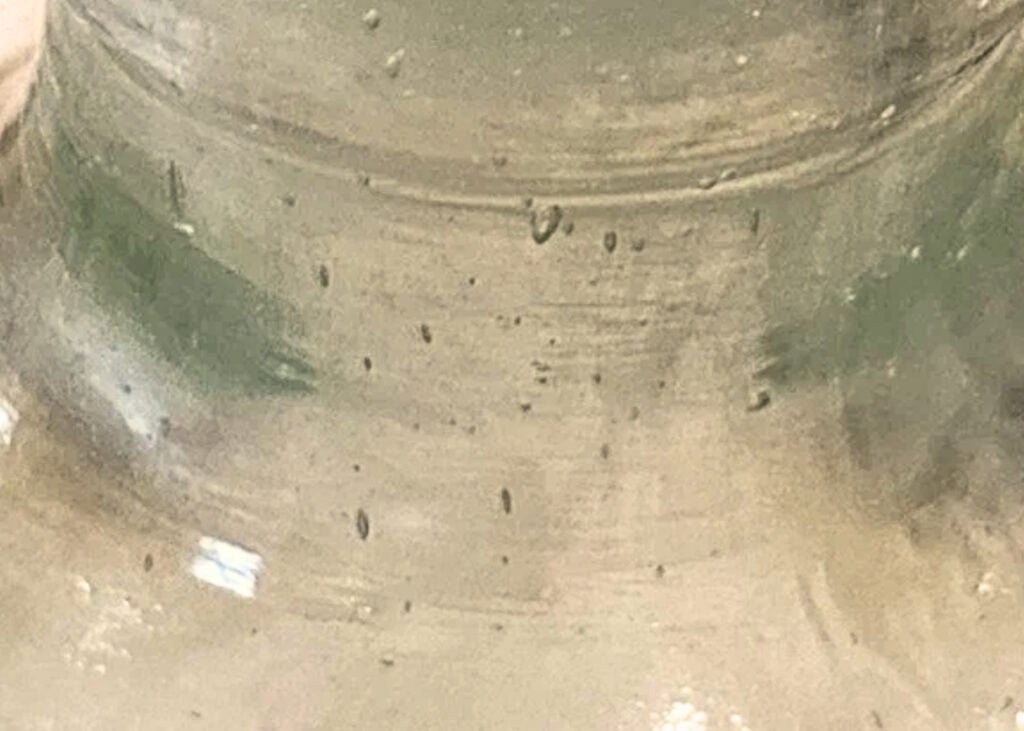
Seed bubbles and ripples in the glass surface suggest an older, less refined melt. Bubbles were harder to melt out of glass and thus more costly, so you can expect to see at least a few on pieces made before 1950.
Art glass made after 1950 might have bubbles too, but only as deliberate effects, and should be used together with the base test instead of as a replacement.
The tinge in the “clear” glass will also give you a hint of when it was manufactured. The slight pink or purple hue indicates glass decolorized with manganese, dating back to roughly 1880 – 1915. The yellow or olive tint suggests selenium decolorization that was popular around 1915 – 1930s.
Water clear with no bubbles and no distortion is a sign of modern glass.
Clue 3: Feel the Heft and Listen for the Ring
Take the piece and simply hold it. Genuine lead crystal will feel noticeably heavier than regular soda-lime glass of equivalent shape and size. It does not take more than a couple of seconds to notice once you have held several pieces.
Now give the edge a little knock with your fingernail. The genuine lead crystal will emit a ringing sound which will linger on for two or three seconds, while the regular glass will make a dull sound which will die down very quickly.
A Note to Remember
After the year 2000, European legislation forced many manufacturers to use barium crystal rather than lead crystal, due to environmental reasons. The latter also rings, just not as clearly as lead crystal.
Thus, the ringing test tells us whether a piece was made before the year 2000 or not.
Clue 4: Use a UV Flashlight for Uranium & Depression Glass
A 365nm UV flashlight is by far the best item in the collector’s toolbox, and it comes for less than $15. It truly is the quickest tool to spot something of value.
Uranium glass, aka vaseline glass, emits a vivid neon green glow under the UV light due to the trace of uranium oxide present in it. Production took place from the early 1830s until WWII, when uranium became scarce due to the war. A good green glow proves the pre-war origin of most pieces found out there.
Lead crystal displays a delicate blue/violet glow under the same UV light. Some of the pink/green pressed glass produced during the Depression period may emit a faint fluorescence, thus being of help in identifying possible Jeannette, Hazel-Atlas, or Anchor Hocking patterns.
Things to Remember
- Firstly, the fluorescence identifies the composition of the glass but not its exact age, since a few manufacturers still make their uranium glass nowadays for collectors.
- Secondly, a pale yellowish glow is not uranium. Look for the characteristic vivid neon green glow.
Clue 5: Learn the Patterns Before Hunting Marks
The experienced collector always identifies items first by pattern, and then confirms with a mark. The reverse is rare. Marks can be missing, worn away, or fake, but patterns are included in all the best reference books.
Some key vintage patterns to learn:
- Fenton Hobnail: raised, evenly-spaced bumps forming a rigid hexagonal design, available in many colors
- Fostoria American: geometrical cubed pattern manufactured between 1915 and 1980
- Cambridge Rose Point: elegant, etched rose pattern, common between 1934 and 1958
- Anchor Hocking Bubble and Fire-King Jadeite: kitchen classics from the post-war era
- Hazel-Atlas Moderntone: smooth rings in cobalt blue, pink, or amethyst
- Jeannette Cherry Blossom: small cherries and blooms on pink or green Depression glass
Pressed patterns will have clearly visible ridges, but slightly softened at the peak, because of the stacking of the item for decades. Sharp ridges in an item said to be from 1935 are an immediate cause for suspicion. Etched patterns on old glass have subtle variations in the edge of the design, while modern laser-etched patterns will be perfectly symmetrical.
For pattern identification, you can use Warman’s Depression Glass Identification and Value Guide, the standard reference, and the pattern search tool provided for free at Replacements.com.
Clue 6: Decoding Makers Marks (and Their Absence)
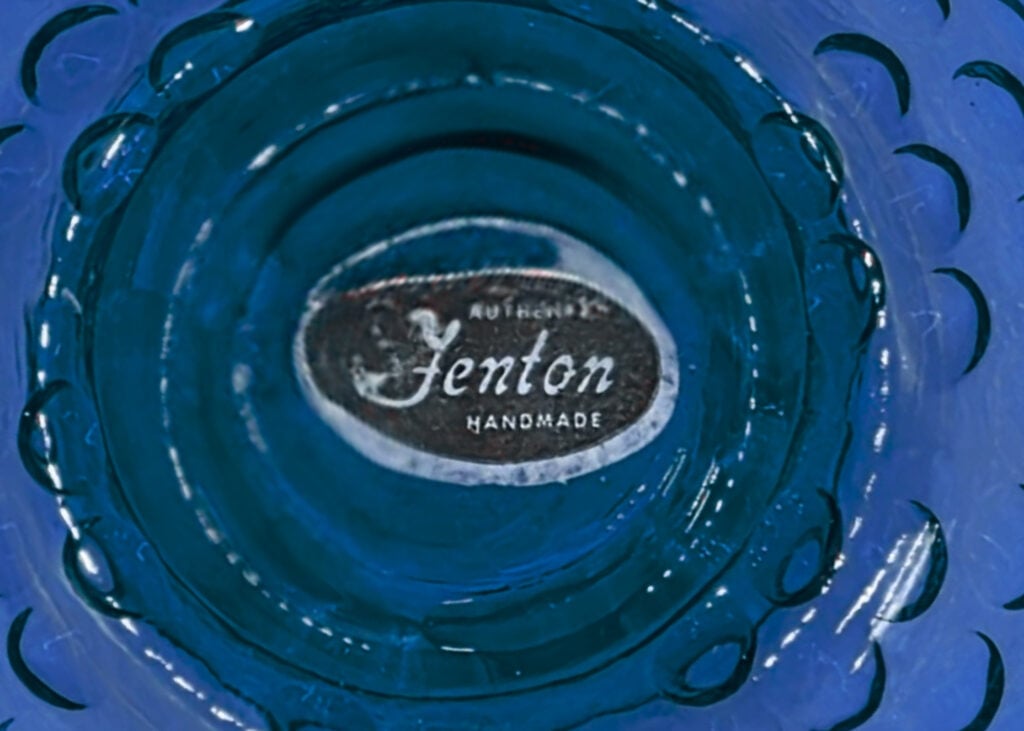
Check the base, the heel where the side meets the base, and sometimes the bottom of the foot on stemware. Marks on vintage glassware may be embossed (raised), incised (scratched into the glass), or acid-etched (frosted).
A small number of famous maker’s marks keep recurring on American glassware:
- Anchor Hocking: an anchor design with an H inside the anchor
- Hazel-Atlas: an H on top of an A
- Fenton: the script word “Fenton” within an oval, introduced in 1970 (so lack of a mark does not mean a piece is not Fenton, just that it predates their mark)
- Fostoria: block capital letters, typically only the word “FOSTORIA”
- Federal Glass: a capital F within a shield
However, it’s worth noting that most antique American glass from before the 1850s was never marked. Most Fenton made before 1970 had no marks. And Depression pieces were often sold with paper labels that fell off in the first rinse of water.
So, the lack of a mark doesn’t immediately invalidate the piece as vintage.
That being said, beware of fakes. Mark reproductions from the 1990s and 2000s were sometimes stamped with crude counterfeit maker’s marks. Deeper than expected, off-center, or even just with slightly odd font choices, look up the mark on an authority such as glassbottlemarks.com or Kovels.
Clue 7: Search for True Wear
A genuine item that has truly stood the test of time over many decades will show true wear. Reproductions always reveal themselves in this respect.
Expect to see fine scratch marks in the base ring that have been accumulated from sliding on countertops or shelves. Expect to see softened peaks in raised pattern elements, which are due to rubbing between stacked items. Expect to see tiny chips or nicks on the rim, but not large chips.
True wear is uneven and unpredictable, while uniform or consistent “distressing” is typically fake. Furthermore, a flawless base ring in an allegedly eighty-year-old piece is a definite red flag.
In glass stemware, tilt the bowl to the side and check for light scratches in the interior that resemble forks and knives. These marks are the hallmark of true use.
Clue 8: Seek a Second Opinion
If your item matches four or more of these factors but you are ready to spend real money, take pictures of the base, the mark, the pattern detail, and the rim under natural light. Publish them on an online forum or one of the many Glass Facebook groups. You’ll get your answer within the hour.
For items that you believe to be truly rare, you should seek an appraised certification by a local antique dealer. It costs about $25-$50.
Note: This article is intended for informational, educational, and entertainment purposes only. Some images are illustrative and may not represent actual brands, products, or related entities. All trademarks, product names, brand logos, packaging, and other intellectual property referenced remain the exclusive property of their respective owners. Any brand mentions or references are provided solely for descriptive and educational context and do not imply any formal or commercial association.