The 1985 Lincoln penny shows Victor David Brenner’s portrait of Lincoln with Frank Gasparro’s Lincoln Memorial reverse. By 1985, every cent had a copper-plated zinc core.
Total production was huge across four mints: Philadelphia, West Point, Denver, and San Francisco. That’s why most 1985 pennies are worth one cent. But the value goes high for coins with full red color in top grades and with certain mint errors.
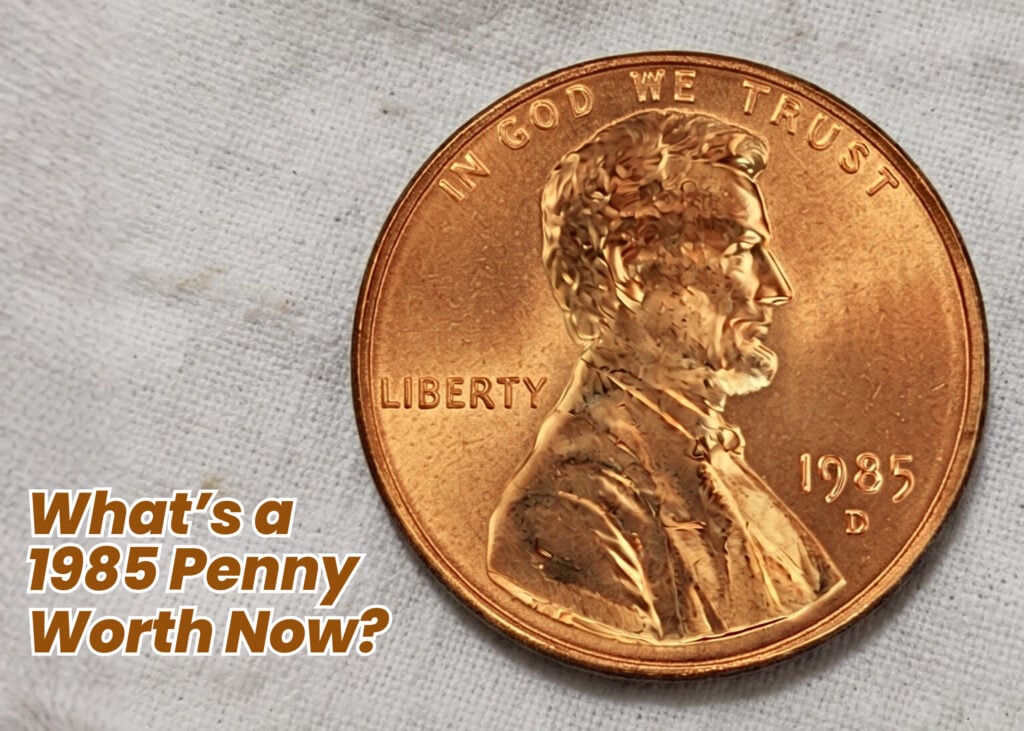
The difference comes down to three things: the mint mark under the date, the coin’s weight, and its condition. Let’s take a look at 1985 penny identification, key varieties, and values in this guide.
| 1985 Lincoln Memorial Cent | Details |
| Coin Composition | Copper-plated zinc (97.5% zinc, 2.5% copper) |
| Minting Location | Philadelphia, West Point, Denver, San Francisco (proofs only) |
| Year of Minting | 1985 |
| Face Value | $0.01 (one cent) |
| Weight | 2.5 grams |
| Diameter | 19.05 mm |
| Thickness | 1.52 mm |
| Designer | Victor David Brenner (obverse), Frank Gasparro (reverse) |
| Mint Marks with Mintage | No mint mark: 5,648,489,887 D mint mark: 5,287,399,926 S mint mark (proof): 3,362,821 |
| Total Mintage | 10,939,252,634 |
How to Identify a Genuine 1985 Penny?
Identifying a 1985 penny takes about a minute. Check the date, look below it for a mint mark, weigh the coin if anything looks off, and compare to the details below.
1985 Penny Obverse (Front):
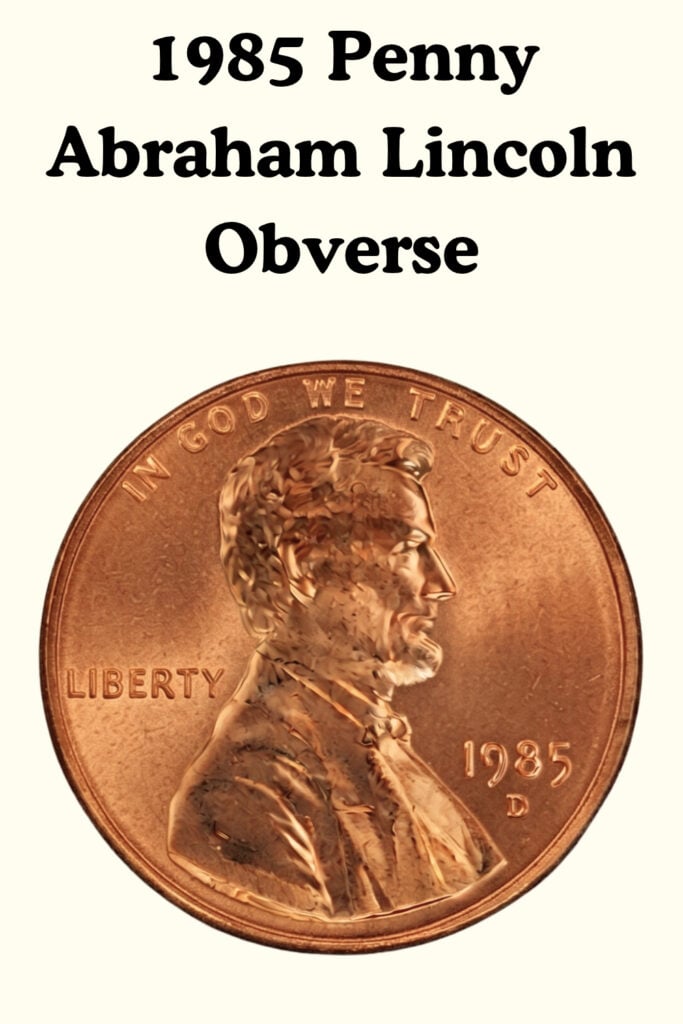
- Abraham Lincoln’s portrait facing right
- “IN GOD WE TRUST” arcs across the top
- “LIBERTY” on the left of Lincoln
- Date “1985” on the lower right and mint mark “D or S” below it
- A tiny “VDB” on the cut-off edge of Lincoln’s shoulder
1985 Penny Reverse (Back):
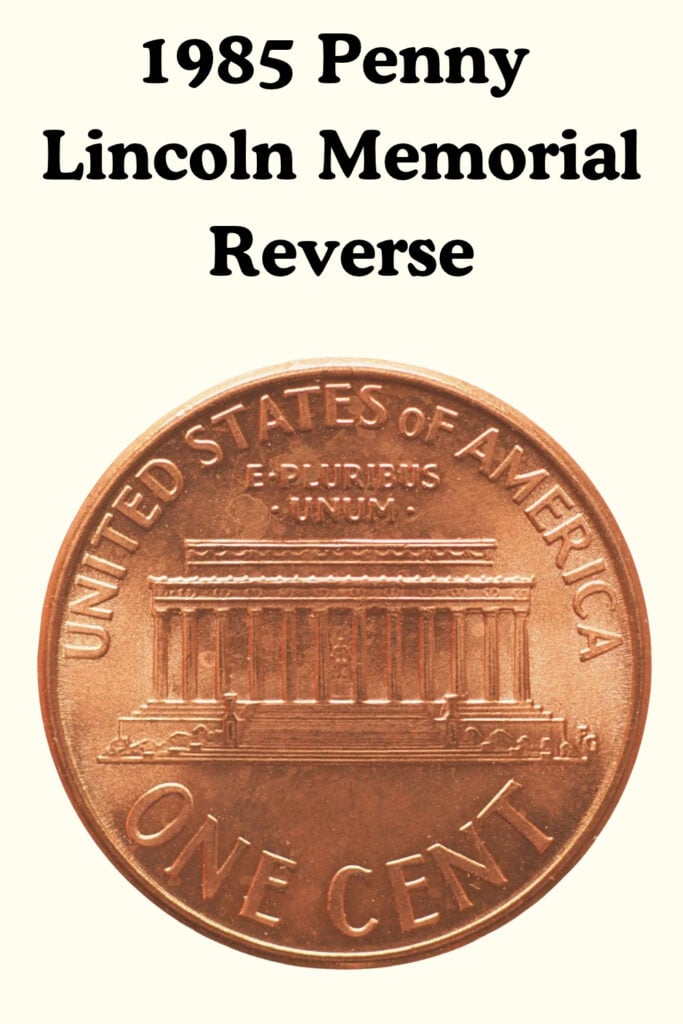
- The Lincoln Memorial as the central design
- A tiny seated Lincoln statue between the center columns
- “UNITED STATES OF AMERICA” runs along the top
- “E PLURIBUS UNUM” above the building
- The denomination “ONE CENT” curves along the bottom
- Designer Gasparro’s initials “FG” on the right of the memorial steps
- AM spacing: The A and M in AMERICA are spaced apart. This Wide AM reverse was standard on cents through 1992, so it’s normal on any 1985 coin.
Weight & Composition:
A standard 1985 cent has a weight of 2.5 grams. It has a core made up of zinc (99.2%) with a layer of copper (0.8%), making it 97.5 percent zinc and 2.5 percent copper.
You can use a regular digital scale that reads to 0.01 grams to check your coin; anything well off 2.5 grams should raise a concern.
How Much Is a 1985 Penny Worth? Value Chart
With about 11 billion struck, a circulated 1985 penny is worth about its face value. The top value lies in uncirculated pennies that are in full red, particularly those grading MS67 and above by PCGS or NGC.
Coin Grades and Color Designation
Coins are graded from 1 to 70. MS (Mint State) indicates that the coin was never circulated, and the number shows its cleanliness. For example, an MS60 coin will have lots of wear marks on it, but an MS67 coin looks almost perfect.
The color is equally important for copper coins, so graders add one of the following classifications:
- RD (Red): At least 95% of the original copper color. The most valuable category.
- RB (Red-Brown): Combination of red and brown. Less valuable.
- BN (Brown): Completely toned brown. Usually the least valuable.
Almost all of the best 1985 pennies were from the Mint’s 1985 Uncirculated Coin Sets, originally priced at $7.
Mint Marks & Mintage
The mint mark tells where the coin was struck, which connects to how many of them were struck. Four facilities struck 1985 pennies, but only two used a mint mark.
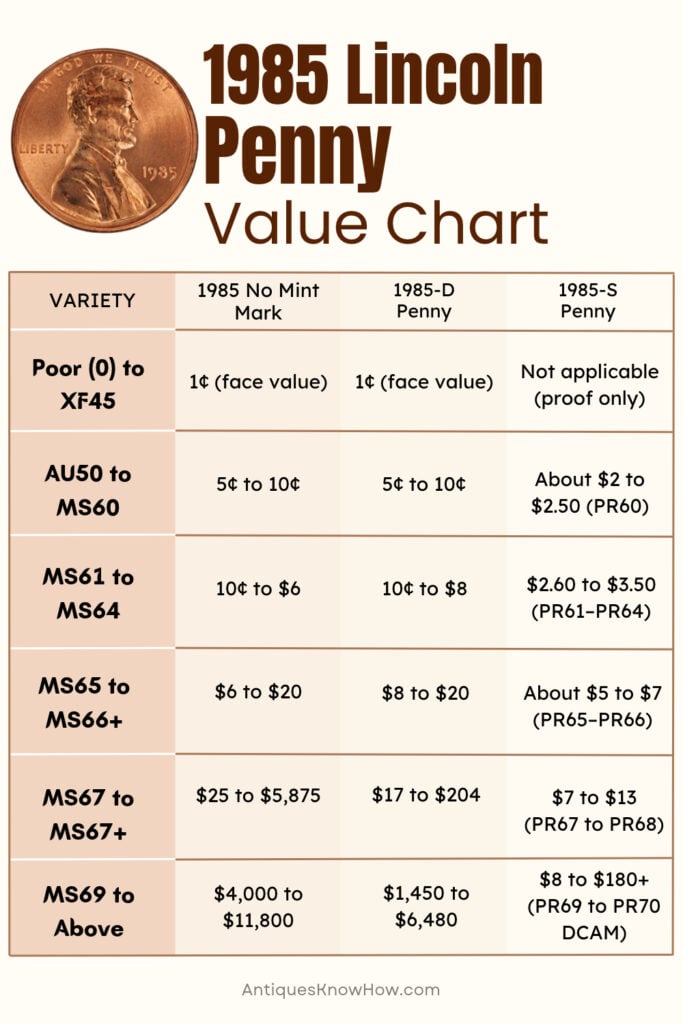
1985 Penny No Mint Mark (Philadelphia & West Point)
Philadelphia and West Point minted 5,648,489,887 pennies without a mint mark, and these two pennies are identical. Circulated pennies are worth around one cent, while MS67 RD examples sell for $25 to $35.
1985-D Penny (Denver)
Denver minted 5,287,399,926 pennies with a small D under the date. But why is the 1985-D penny considered a rare coin?
Its rarity is determined by its grade. PCGS considers MS68 rare and anything above that extremely rare, while MS67 examples are affordable and plentiful.
1985-S Proof Penny (San Francisco)
The San Francisco mint produced the 1985-S proof penny exclusively in collector sets. Proofs have mirror-like surfaces and frosted devices; most 1985 proofs are DCAM with very sharp separation between the frosting and mirror surfaces.
The Mint records sales of 3,362,821 proof sets, while PCGS records 3,010,497 coins. A full five-coin 1985 proof set, in its original packaging, is worth about $8. So, the true value is in PR69 and PR70 condition coins.
Valuable 1985 Lincoln Penny Errors & Varieties
Most coins sold online as 1985 penny errors are just damaged. The errors and varieties below all have documented examples, and several have sold for serious money.
1
1985 No Mint Mark Penny, Mint State
Typically sells for $1,000 to $6,500 (MS68+)
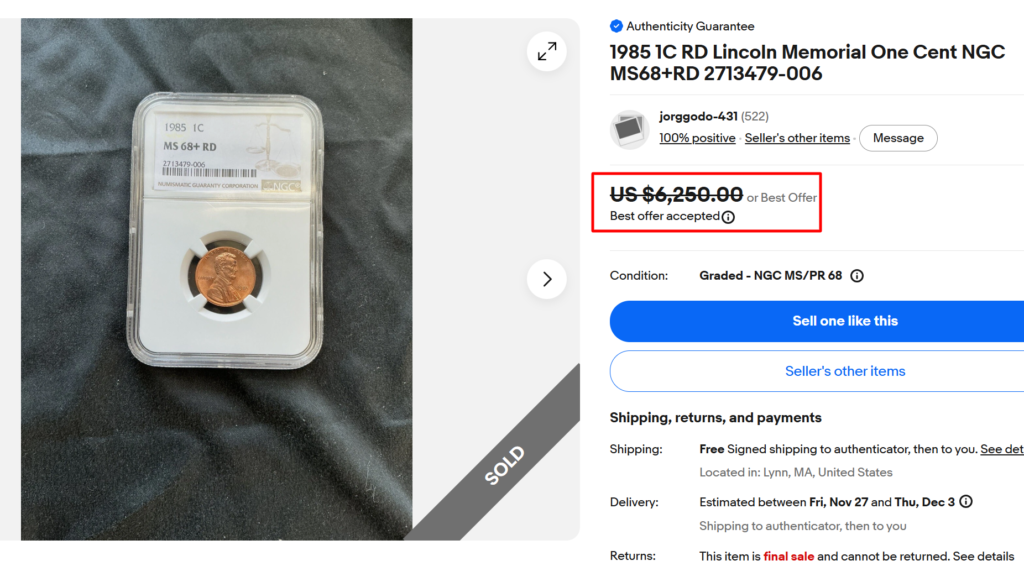
Philadelphia and West Point minted over 5.6 billion 1985 cents, but PCGS has graded very few in MS69 RD. The best specimens have come out of Uncirculated Coin Sets because the coins never saw bank bags or counting machines.
2
1985-D Penny, Mint State
Typically sells for $1,000 to $5,600 (MS69)
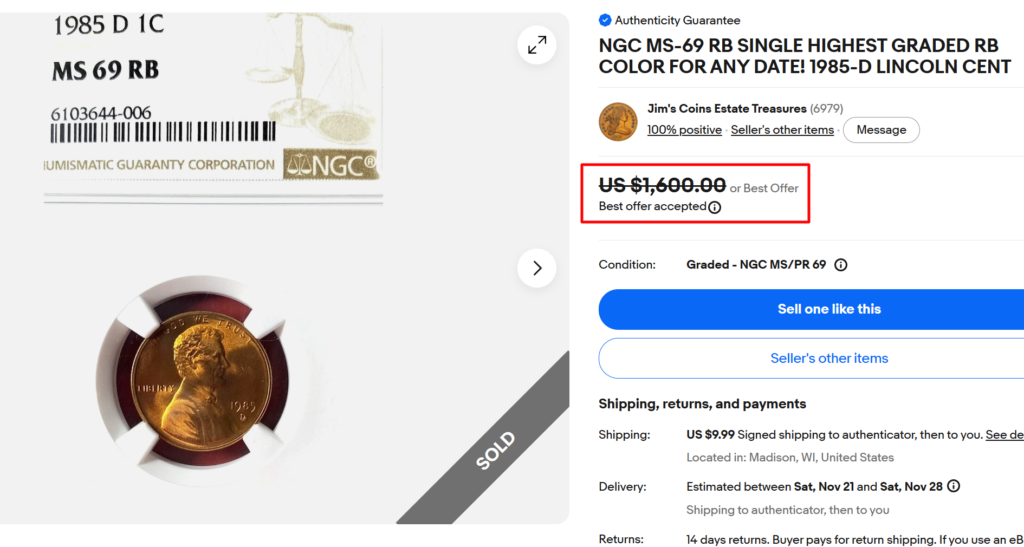
Denver’s finest grade 1985 pennies turn up more frequently than Philadelphia coins. By early 2023, PCGS had certified about 10 coins in MS69 RD, with no higher grades available. The larger number of coins keeps the prices mid-tier.
3
1985-S Proof Penny
Typically sells for $8 to $180+ (PR69 to PR70 DCAM)
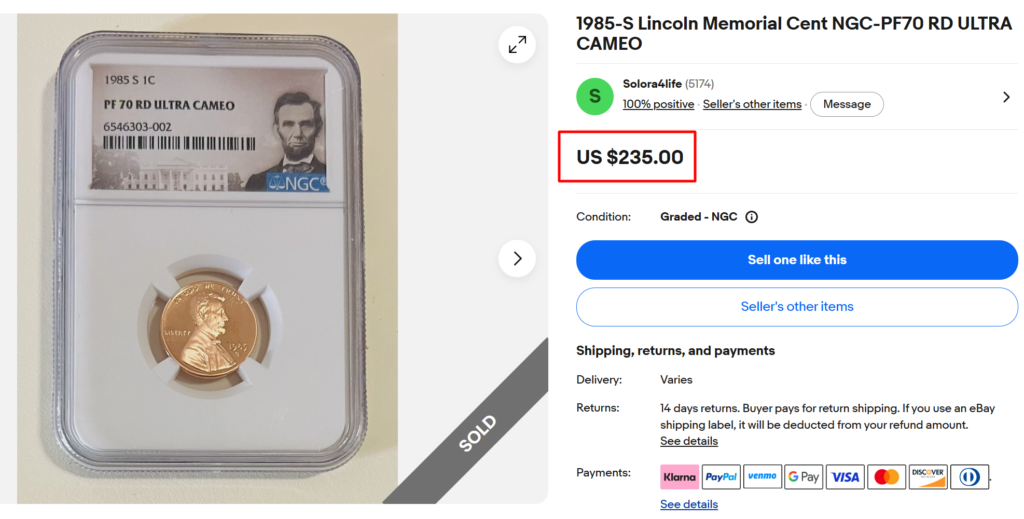
The 1985-S proof cent was issued only in proof sets, so it was not in circulation. The Mint also introduced a new “S” mint mark design, which was punched into the master die rather than all the working dies.
High Deep Cameo contrast is typical of 1985 proofs. So, only spotless PR70 DCAM coins have value.
4
1985-D Off-Center Penny with Triple Clipped Planchet
Typically sells for $10 to $225
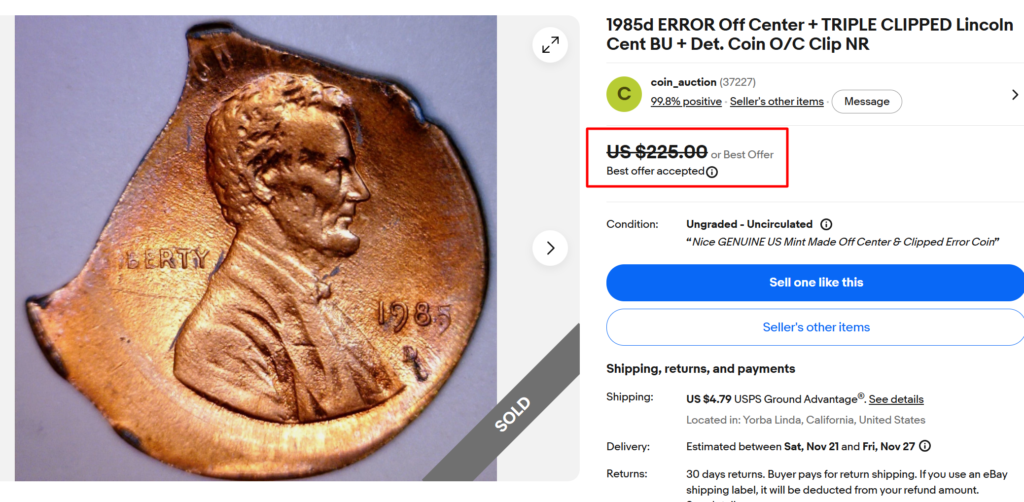
The 1985-D penny has two distinct errors on one coin. First, there are three curved clips marring the edge, and second, the strike is off-center.
A clipped planchet occurs when the blanking punch overlaps a hole that has been punched into the metal strip. The rim will be thinned out directly opposite the clip.
5
Off Center Struck
Typically sells for $20 to $65
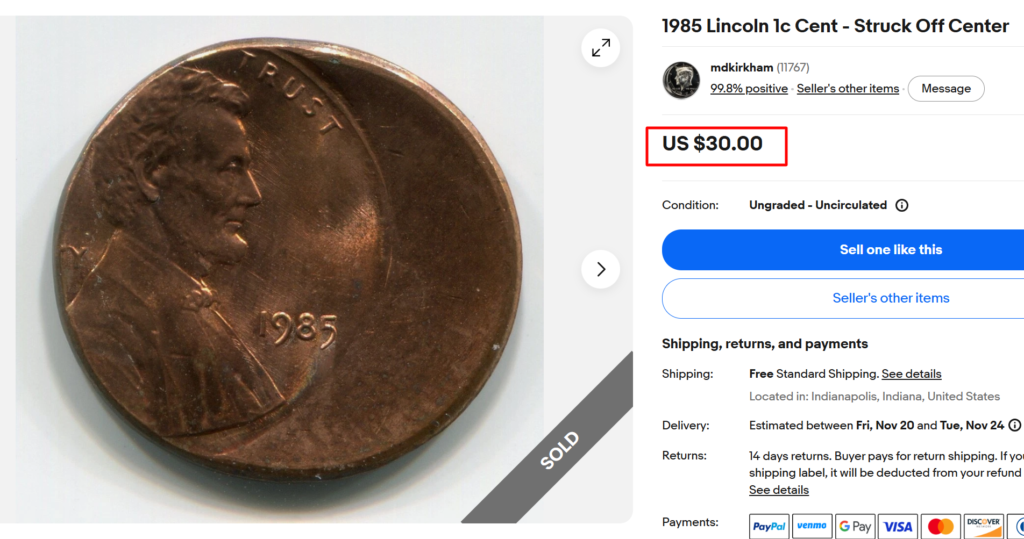
Off-center strikes occur when the planchet is misaligned under the dies. Part of the design is lost, and a blank area of the coin is left on one side. The most valuable off-center strikes are those that are between 30% and 60% off-center and have the full date and mint mark.
6
1985 Penny with a Rim Cud (Major Die Break)
Typically sells for $15 to $100
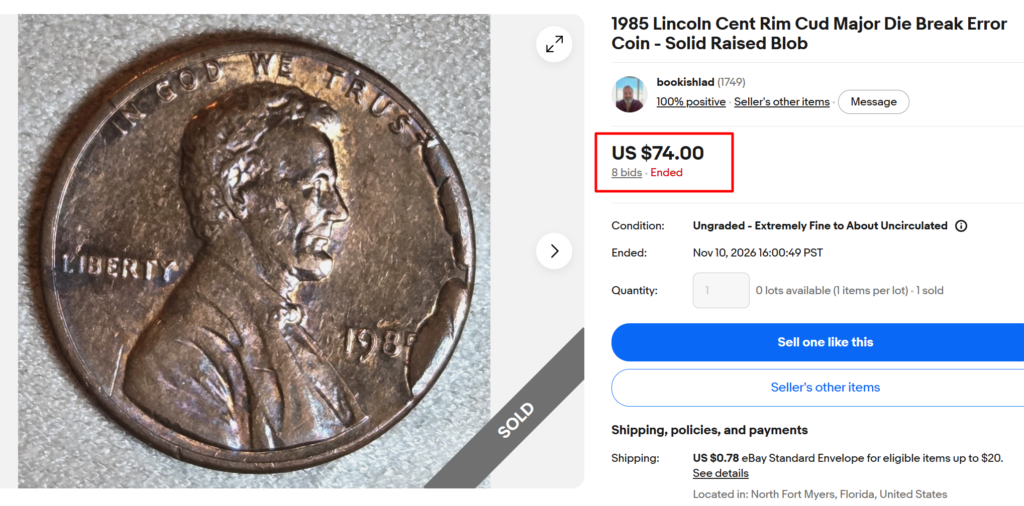
A cud is formed when a portion of the edge of the die breaks off. The metal flows into the gap, forming a lump on the coin. This one extends along the right edge, starting from TRUST and ending at the date.
This circulated specimen was sold for $74 after receiving eight bids.
7
1985 Penny Struck on Unplated Planchet
Typically sells for $20 to $550+
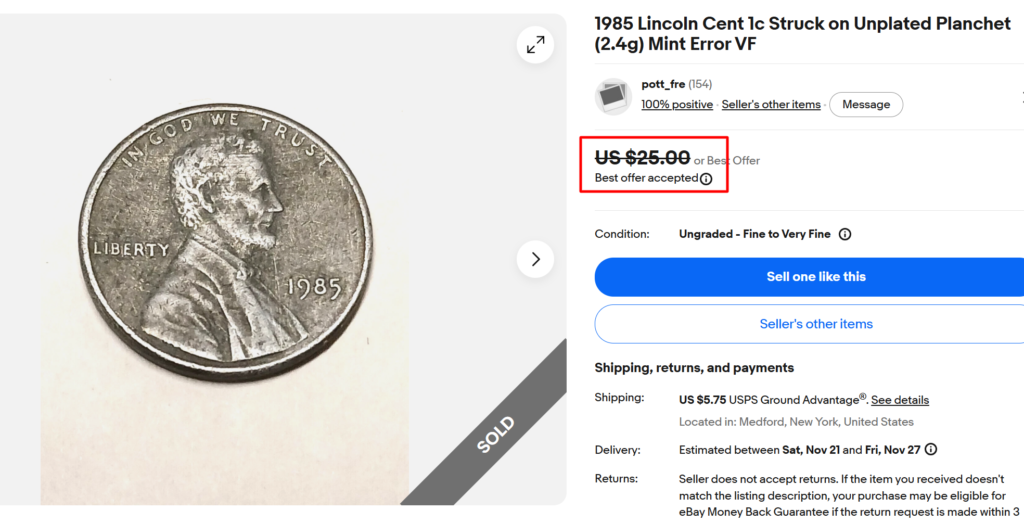
Each 1985 penny was meant to have a layer of copper applied to the zinc core. On some coins, the plating process does not occur properly, resulting in a grayish coin without copper.
However, it is important to be cautious, because acid and household chemicals can also remove the plating.
Note: This article is intended for informational, educational, and entertainment purposes only. Some images are illustrative and may not represent actual brands, products, or related entities. All trademarks, product names, brand logos, packaging, and other intellectual property referenced remain the exclusive property of their respective owners. Any brand mentions or references are provided solely for descriptive and educational context and do not imply any formal or commercial association.