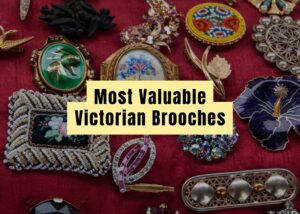
Victorian jewelry is making a comeback in the antique market as hot collectibles, especially brooches and pins! Not only are these old pieces historical wearable accessories, but they also hold great monetary value that people often overlook.
An authentic Victorian gold brooch could sell for $10,000!
In this guide, I show some of the most valuable antique Victorian brooch styles currently selling for hundreds to thousands of dollars. You will also get easy clues to check if a brooch is really a Victorian gem or just a reproduction!
Why Are Victorian Brooches Special?
From their history and craftsmanship to their quality and designs, literally every aspect of Victorian brooches makes them the adored accessory they are. These pieces reflect the cultural changes that have occurred for well over 100 years!
But that’s not just it! They also give a glimpse of now-forgotten techniques and rare materials that are now probably illegal to even carry!
And more than anything….
Victorian brooches remain stylish and versatile. You could pin them on lapels, scarves, hats, or bags, or convert them to pendants. Their strong build means they’re durable enough for regular wear.
But before you begin using them, you need to find out whether your brooch is a rare and valuable style worth thousands!
Highly Valuable Victorian Brooches: Styles & Pieces to Know!
1. Carved Cameo Brooch
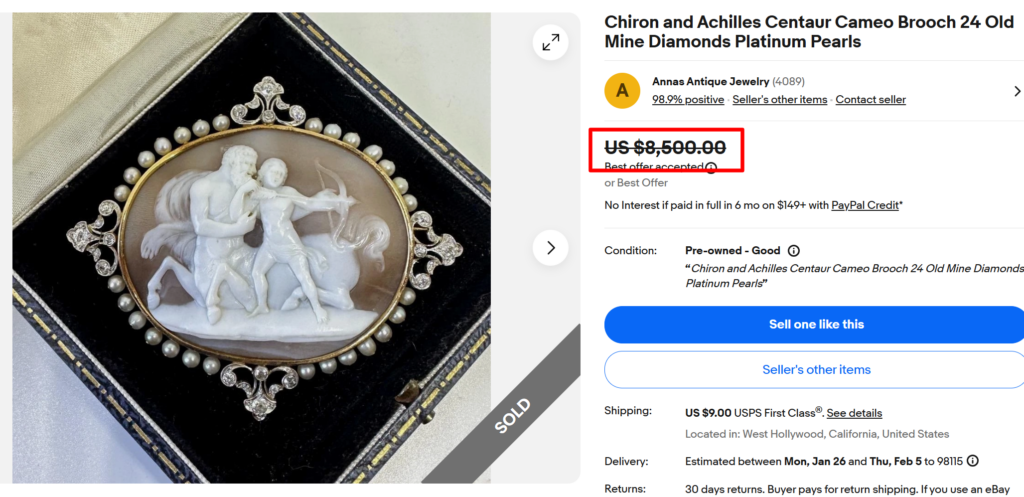
| Average Price | $300 – $15,000+ |
| Time Period | Georgian through Late Victorian (1800s-1901) |
| Key Features | Shell or hardstone carving, classical subjects |
| Collectibility | High for rare stones & detailed carving |
| Collector’s Notes | Look for detail & mythological themes |
One of the most common styles from the Victorian era, cameo brooches show carved artwork at its finest, with classical profiles, mythological subjects, or symbolical subjects raised in relief.
This beautiful example shows Chiron, the Centaur, teaching young Achilles, carved in shell or hardstone, so realistically that it has 3D depth. The cameo is set in a fancy gold frame adorned with seed pearls and old mine cut diamonds.
The best examples of cameos feature a high degree of detail, such as strands of hair, fabric detail, expressions of emotion, and are crafted from precious materials.
2. Victorian Black Enamel Memento Mori Brooch
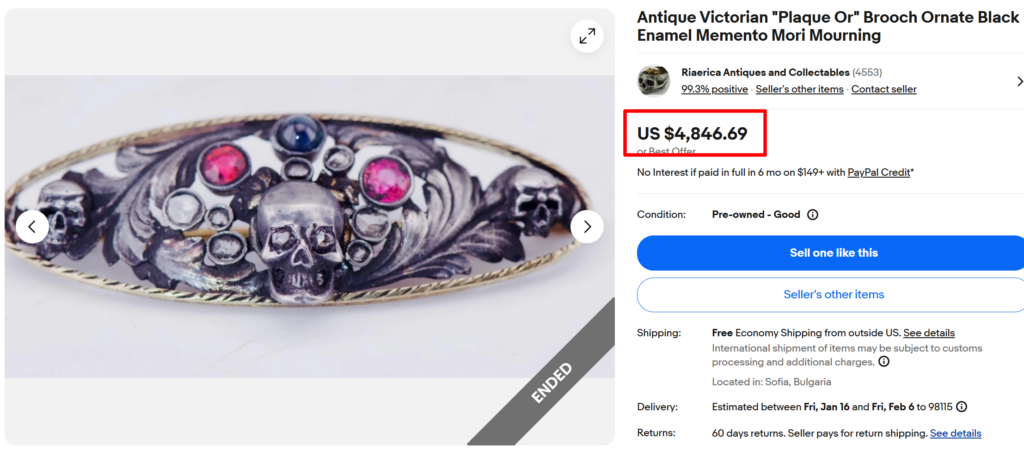
| Average Price | $800 – $10,000+ |
| Time Period | Georgian through Victorian (1700s-1901) |
| Key Features | Black enamel, skull motifs, gold or silver, gemstone accents |
| Collectibility | Very High |
| Collector’s Notes | Check enamel condition, gemstone-set skulls, Inscriptions or dates |
Memento mori means “remember you must die” in Latin. The jewelry started out in medieval times as stark reminders of mortality and then became a symbol of remembrance in Victorian times.
This dramatic brooch has intricate black enamelwork decorated with skulls, scrollwork, and ruby or pink stone accents. All these symbols are believed to celebrate eternal bonds and honor the dead.
These brooches were usually made in gold or silver with careful enamel application that had to be fired multiple times. The black enamel gave dramatic contrast to the metalwork, while gemstone eyes or accents added some color.
Collectors today love these pieces for their bold symbolism and the unmatched craftsmanship.
3. Mid-Victorian Gold Frame Micro-Mosaic Brooch
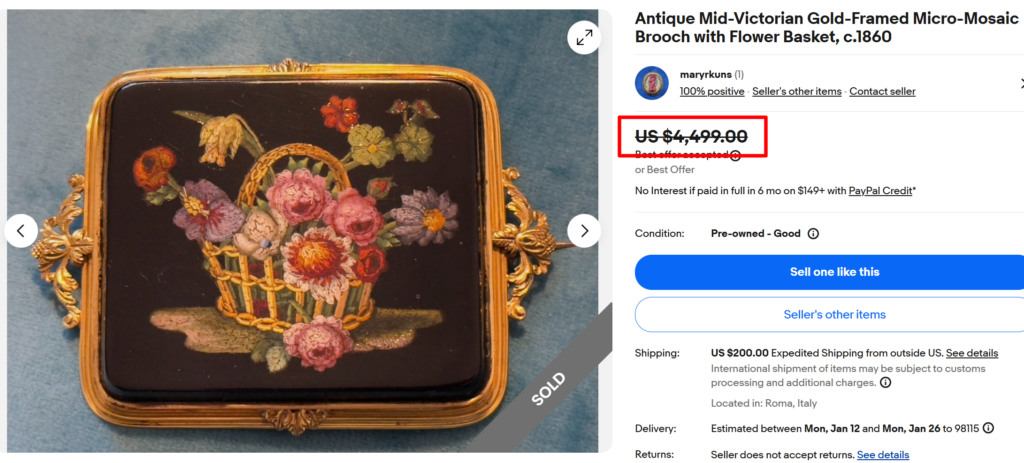
| Average Price | $800 – $8,000+ |
| Time Period | Mid to Late Victorian (1840s-1890s) |
| Key Features | Glass mosaic, Roman subjects or flowers, gold frames |
| Collectibility | Very High |
| Collector’s Notes | Signed pieces, high-carat gold, Roman themes are most valuable. |
This is an antique micro-mosaic brooch showing a basket of colorful flowers on a dark background, set in a fancy gold frame. What looks like a painting is actually an image made from thousands of tiny glass pieces called tesserae arranged together.
These brooches are incredibly rare and valuable since each piece was cut and placed by hand. And the smaller and denser the tiles, the more valuable the brooch.
First, micro-mosaic brooches were made in Rome using ancient techniques perfected by Vatican workshop craftsmen. These became the most popular souvenir from the Grand Tour!
4. Cobalt Enamel Diamond Tourmaline Brooch
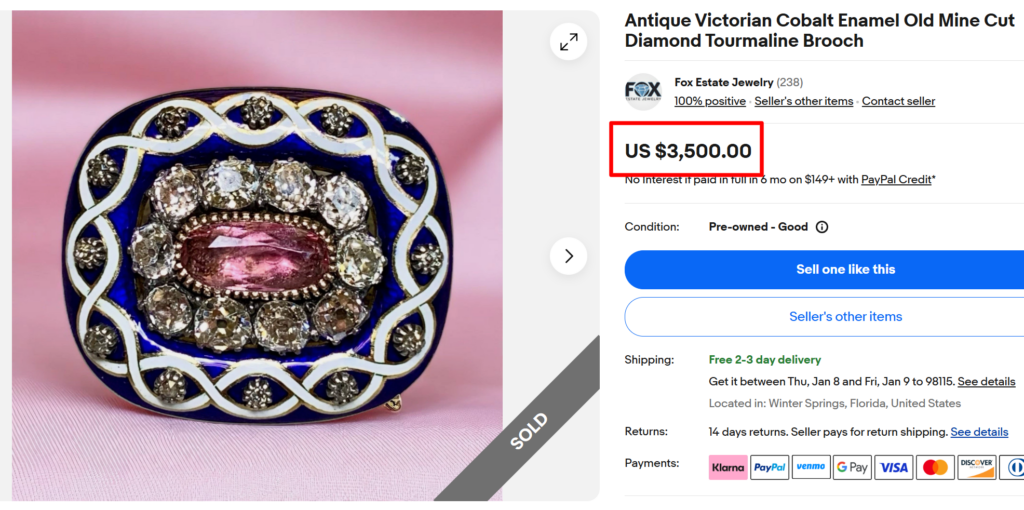
| Average Price | $1,500 – $10,000+ |
| Time Period | Mid to Late Victorian (1860s-1900) |
| Key Features | Enamel work (Guilloche), Diamonds |
| Collectibility | Very High |
| Collector’s Notes | Check enamel condition & precious stones |
This is a Victorian enamel brooch with guilloche enameling, a technique in which the maker engraves intricate patterns into metal with a machine, then covers them with translucent colored enamel.
This piece has rich cobalt-blue guilloche enamel behind a pink tourmaline center stone surrounded by shiny old mine-cut diamonds. There is also the perfect white enamel Celtic knot pattern set against deeply colored blue.
A representation of Fabergé’s work, these pieces were hard to make. Each layer of enamel had to be fired in a kiln, and every firing risked the enamel cracking or bubbling. That’s why perfect examples are rare and valuable!
5. Sterling Silver Scottish Agate Brooch Pin
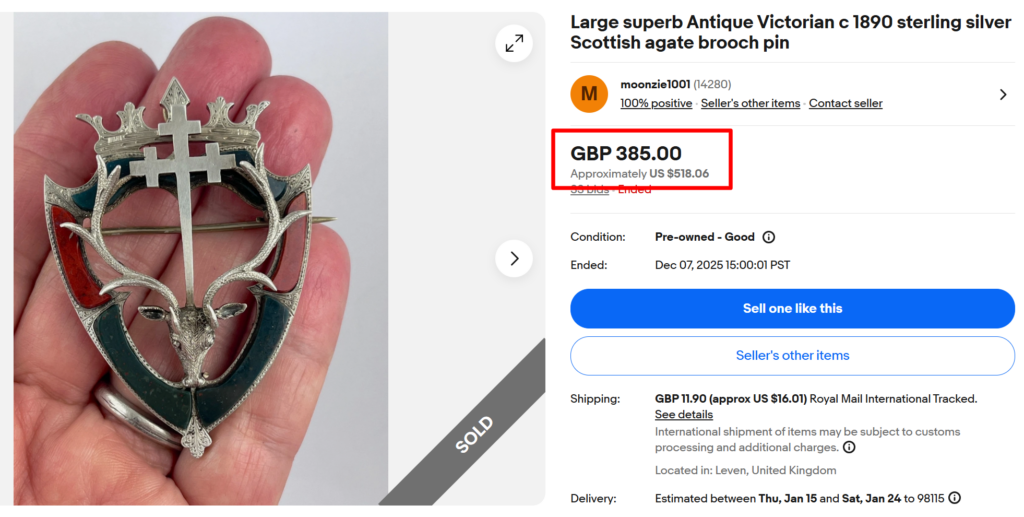
| Average Price | $200 – $5,000+ |
| Time Period | Victorian Era (1850s-1900), peak 1860s-1880s |
| Key Features | Scottish agate inlay, sterling silver, heraldic designs |
| Collectibility | Medium to High |
| Collector’s Notes | Look for large pieces & makers’ marks |
Scottish agate brooches will remind you of Queen Victoria and Prince Albert’s love for the Highlands. These are usually large, “pebble jewelry” pieces made of sterling silver and inlaid with multi-colored agates and jaspers.
This striking sterling silver brooch features a shield-and-crown design inlaid with Scottish agates in rich burgundy, deep green, and banded patterns, making it worth $500!
The collectibility and value of these brooches depend on the type of agate. For example, Montrose agate (with a unique banding), bloodstone with red flecks, and Campsie Fells’ colorful jaspers are the most valuable!
6. Essex Crystal Reverse Carved Brooch
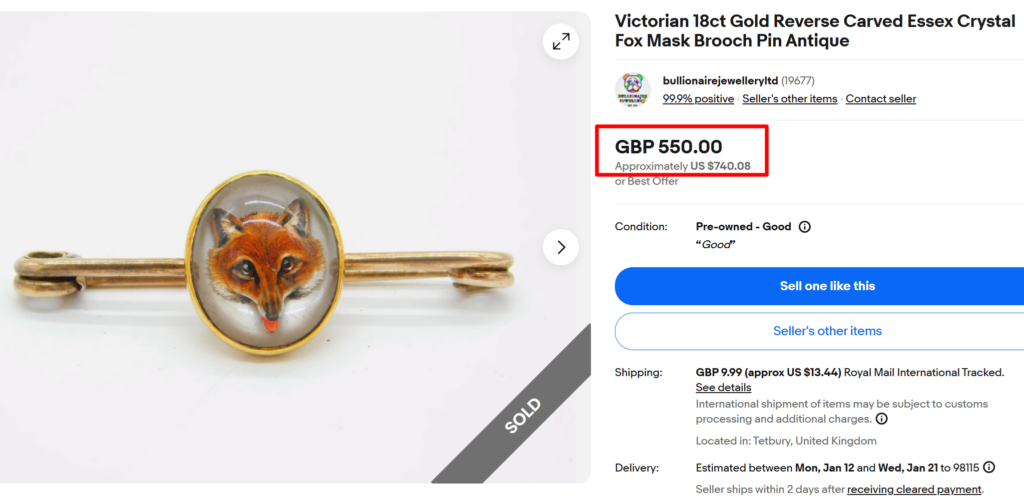
| Average Price | $400 – $15,000 (high for rare subjects) |
| Time Period | Mid Victorian to Edwardian (1860s-1910) |
| Key Features | Reverse carved crystal, hand-painted details, 3D look |
| Collectibility | Very High |
| Collector’s Notes | Check painting quality, crystal & subject |
Essex crystal brooches feature miniature paintings that appear to float inside rock crystal. This is done by carving the crystal from the back (reverse) and then hand-painting it with oils, creating an illusion of the image trapped inside.
Created around 1860 by Belgian artist Emile Marius Pradier, the technique spread to England, where it became wildly popular for sporting jewelry. This 18-karat gold example shows a beautifully painted and vibrant fox mask.
Other popular subjects included hunting dogs, horses, game birds, fish, or other hunting or sporting-related motifs.
7. Archeological Etruscan Revival Gold Brooch
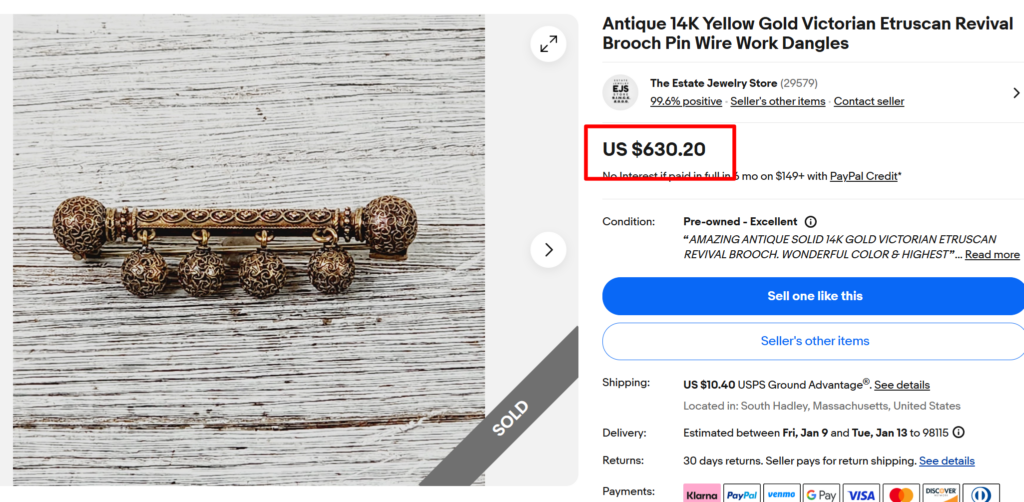
| Average Price | $600 – $5,000+ (big makers) |
| Time Period | Mid to Late Victorian Era (c. 1850s-1880s) |
| Key Features | Granulation, wirework, lacy metalwork, hanging elements |
| Collectibility | Very High – especially signed pieces |
| Collector’s Notes | Check for maker’s marks (Castellani, Giuliano), authentic granulation |
This little gold pin shows the Victorians’ fascination with the civilizations of the ancient world, uncovered by archaeological digs.
It features signature Etruscan goldworking techniques, including granulation (hundreds of gold beads placed on its surface), delicate wireworking patterns (twisted), and hanging elements.
This piece is inspired by the ornaments found in Italian burial places from the 8th to 2nd century BCE. Renowned makers like Fortunato Pio Castellani and Carlo Giuliano revived lost ancient techniques, creating high-quality pieces worth thousands!
8. Sunburst Diamond & Seed Pearl Brooch
| Average Price | $400 – $15,000 (high for rare subjects) |
| Time Period | Late Victorian (1880s-1901) |
| Key Features | Radiating rays, old cut diamonds, seed pearls, convertible design |
| Collectibility | High (wearable) |
| Collector’s Notes | Check diamond cuts, pearl losses, & mechanisms |
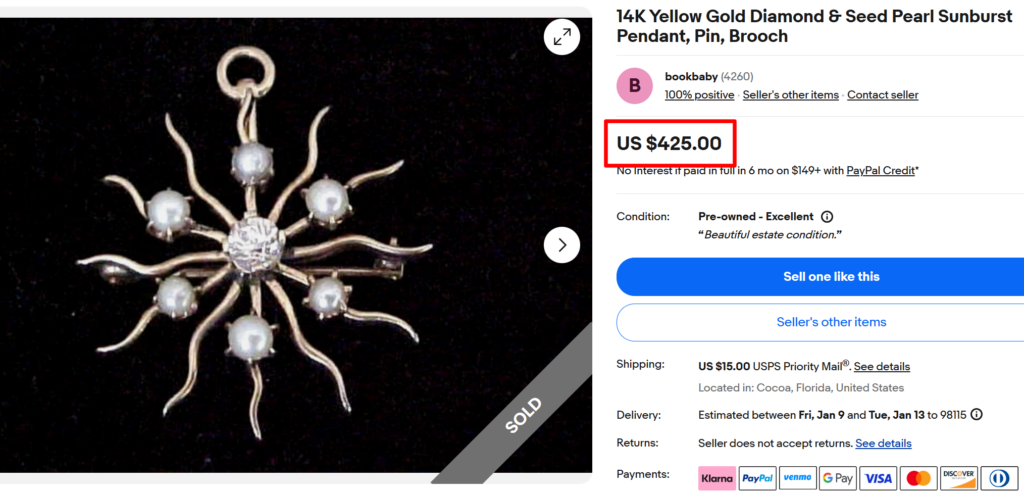
The sunburst or starburst design reflects how much Victorians loved celestial themes. This 14K gold brooch features delicately bent rays emanating from a center old mine-cut diamond, studded with seed pearls.
Dating back to the late Victorian era (circa 1890-1900), these brooch pieces come equipped with convertible mechanisms, like hidden bail studs, that let them transform from a lapel pin to a necklace.
Large, well-preserved sunburst or starburst brooches with high-quality diamonds can sell for $3,000 to $5,000 or even more.
9. En Tremblant Flower Brooch
| Average Price | $800 – $5,000+ |
| Time Period | Georgian through Late Victorian (1840s-1901) |
| Key Features | Spring-mounted parts, flower or insect designs, realistic movement |
| Collectibility | Very High |
| Collector’s Notes | Check springs, verify stones & metals |
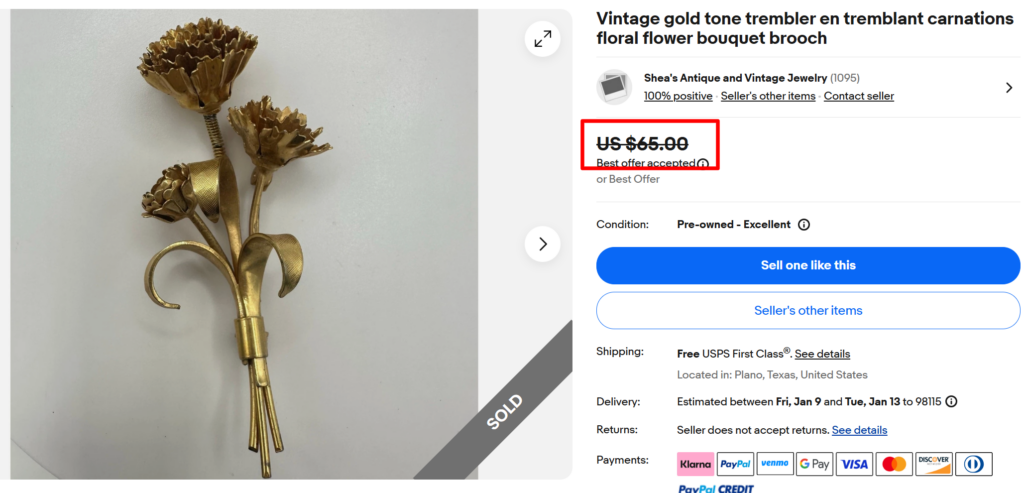
En tremblant (French for “trembling”) brooches feature flowers or insects mounted on coiled wire springs that wiggle and shimmer with every movement, hence, the name, en tremblant!
Now, this is a low-value example featuring a gold-tone bouquet with springs. But high-value pieces consist of high-carat gold or platinum, showing enamel work, pearls, and real old mine-cut diamonds-all designed to flutter like real plants in a breeze.
Developed originally in the 1700s in Paris, the technique soon gained popularity in Victorian England. The round brooches featuring butterflies with the wings trembling, flowers with shaking petals, and fancy sprays are the most valuable.
10. Gemstone-Set Insects Brooch
| Average Price | $150 – $5,000+ |
| Time Period | Mid to Late Victorian (1860s-1900) |
| Key Features | Realistic insect designs, rose-cut gemstones, anatomical detail |
| Collectibility | High |
| Collector’s Notes | Look for realistic details, gemstone losses, & moving parts |
The Victorians were quite fascinated by entomology, so insects, like flies, bees, beetles, and butterflies, became extremely popular symbols in their jewelry.
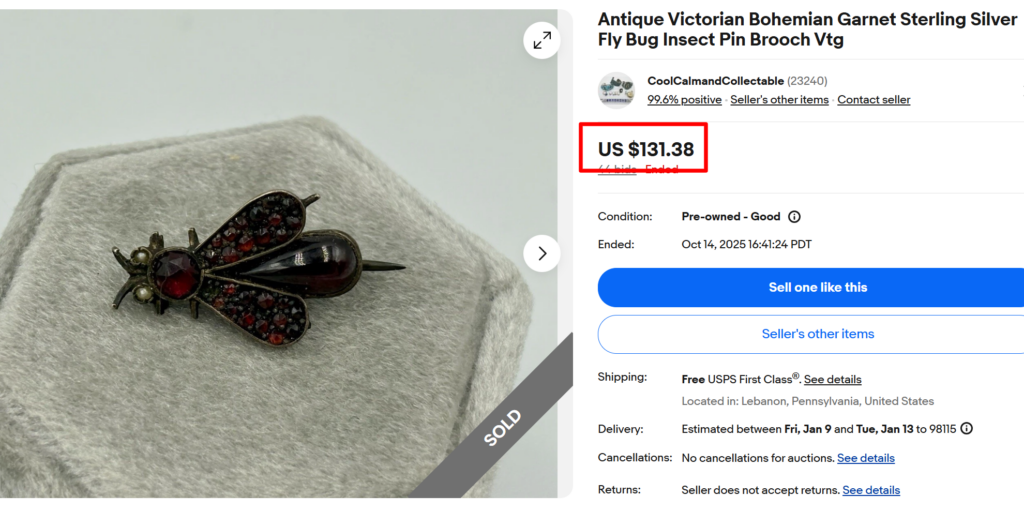
This small Bohemian garnet fly pin is a perfect example of Victorian naturalism. The body and wings of the beetle are pave-set with deep red rose-cut garnets in a setting of high-quality sterling silver (often with gold accents).
These works reveal a strong detail level, such as bodies divided into segments, antennae, and translucent wings. Detailing, naturalism, and precious materials are the reasons for their popularity and value.
11. Pietra Dura Floral Brooch
| Average Price | $400 – $15,000 (high for rare subjects) |
| Time Period | Victorian Era (1850s-1900) |
| Key Features | Hardstone inlay, floral motifs, seamless stone fitting |
| Collectibility | Medium to High |
| Collector’s Notes | Check for missing or damaged stones, gold purity |
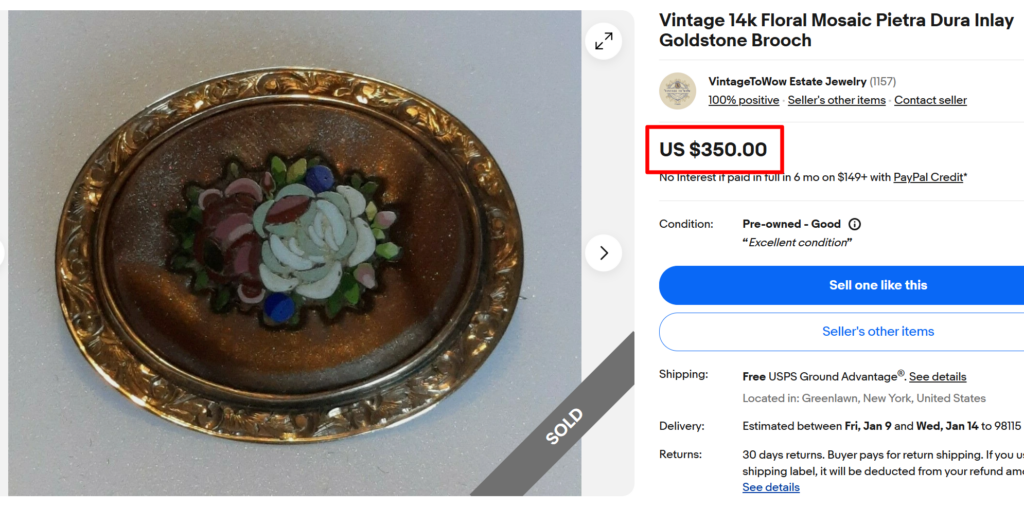
These pietra dura brooches show the incomparable Italian craft of hardstone mosaic inlay, where semi-precious stones were cut into pieces and fitted together like a jigsaw puzzle to make colorful flower patterns.
In this 14K gold example, you can see a naturalistic bouquet with a warm goldstone or brown marble background, and the flowers are made of materials such as turquoise, coral, malachite, and agate.
The intricate gold frame often has rope-twist ornamentation or details of Etruscan revival style. These are typical Victorian brooches that became a favorite souvenir for tourists on a Grand Tour to Florence.
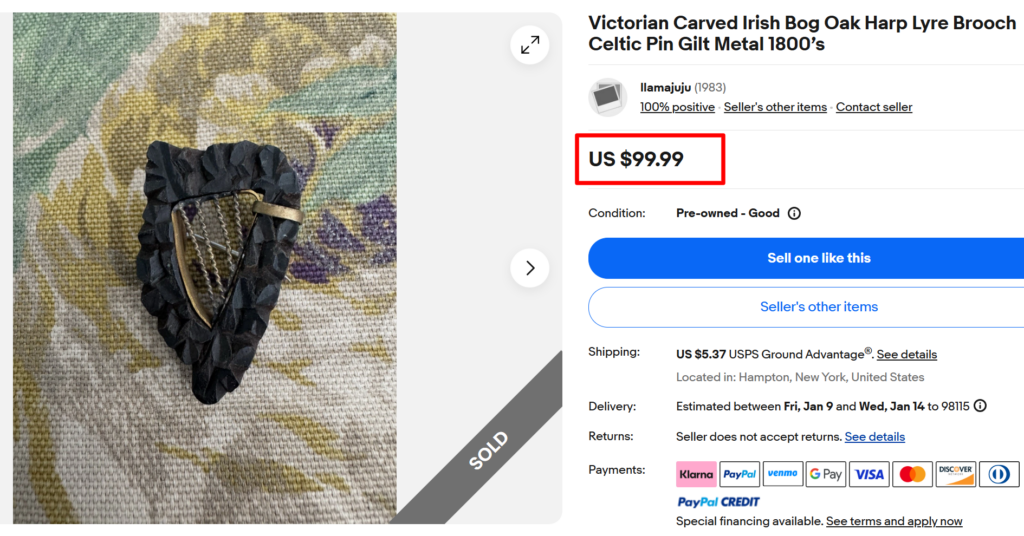
12. Bog Oak and Irish Celtic Brooch
| Average Price | $75 – $1,500 |
| Time Period | Victorian Era (1840s-1900) Peak after 1860s |
| Key Features | Fossilized bog oak, Celtic motifs, hand-carving |
| Collectibility | Medium |
| Collector’s Notes | Check for bog oak authenticity by weight & feel, chips or cracks |
These brooches are made from fossilized oak that has been preserved in peat bogs in Ireland. The brooches date from the 1800s, when they were produced as souvenir items celebrating Irish culture through the Celtic Revival.
This one features the iconic Celtic harp, one of Ireland’s most cherished symbols. The harp is generally displayed in a gilt-metal or brass frame, accompanied by shamrocks or other Irish symbolism.
Note: Authentic Bog oak is lightweight and warm to the touch, unlike Jet or Onyx, which is usually cold. Besides, it’s matte black and has visible wood grains.
Identifying a Real Victorian Brooch: Key Signs
Not every antique-looking brooch has to be a real Victorian piece, because the style is easy to copy. But a genuine piece always shows some signs that are just impossible to replicate. Here’s what you need to pay attention to:
Metal Testing
First things first, Victorian brooches used high-quality metals, like 9K, 12K, 15K, or 18K gold (15K was especially popular in Britain). To verify, look for British hallmarks, small stamps indicating gold content, maker’s mark, and assay office. Silver pieces should show sterling marks or “925.”
Besides, the metal will most likely have developed a natural patina over 100+ years. If a piece is too bright or shiny, it could be a modern piece or a repaired one.
Gemstone Cuts
Stones, especially diamonds, used in Victorian jewelry were cut differently from those in modern times. Modern brilliant cuts didn’t exist at that time.
They were mostly hand-cut in old mine cuts (chunky, cushion-shaped with large culets) or rose cuts (flat bottoms with triangular facets).
Secondly, colored stones mostly display natural inclusions (under magnification). Too perfect stones indicate synthetic or modern replacements.
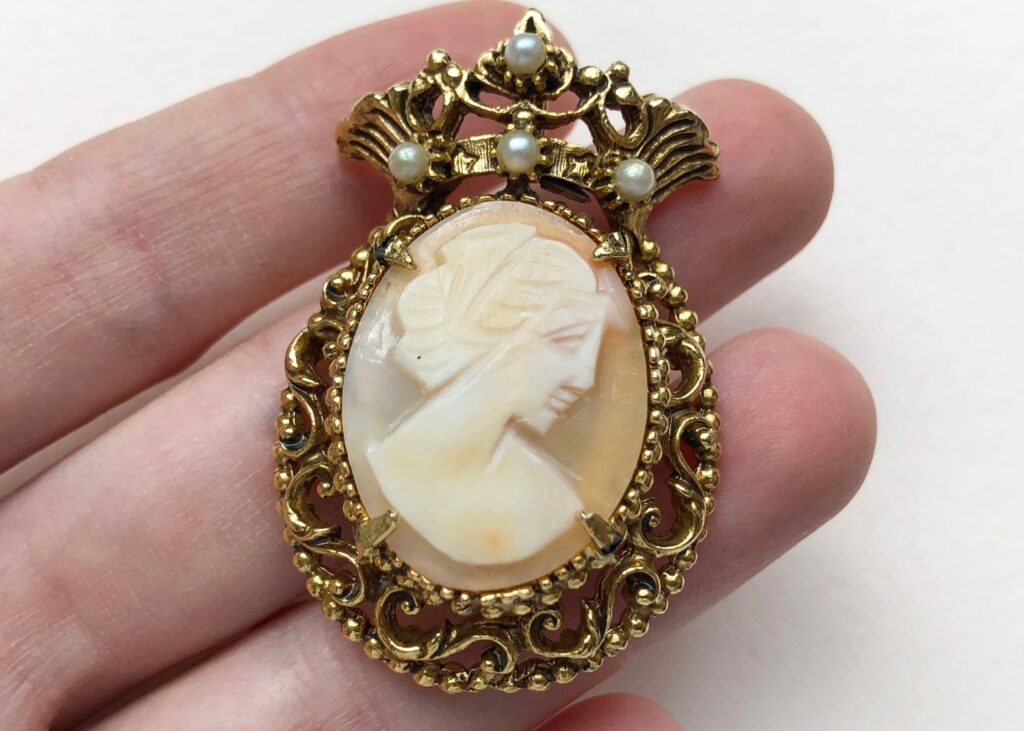
Construction & Hardware Details
Examine the back carefully. Authentic Victorian brooch pieces show hand-soldering marks with slight oddities, like tiny file marks, uneven edges, or asymmetric designs.
The hardware is another dead giveaway. Victorian brooches mainly used C-clasps (also called C-catches), a simple curved hook that slides into a tube on the pin stem.
These hand-forged pins also show slight irregularities and file marks. If you see a modern safety catch on a Victorian-style gun, it’s likely a reproduction.
Weight, Feel & Wear Patterns
Authentic antique Victorian brooches are substantially heavier because they used more and purer metal than modern costume jewelry. If the brooch feels too light or hollow for its size, it’s a red flag.
You should also pay attention to the condition. Genuine brooches generally show age-appropriate wear, like light scratches on metal, wear on high points, possible enamel chips or losses, and bent pin stems.
Pristine condition without any wear for a 150-year-old jewelry is highly suspicious.
Period-Appropriate Designs
Genuine antique Victorian brooches usually followed specific design trends that changed throughout the era.
For example, the Early Victorian (1837-1860) preferred romantic nature motifs, like flowers, birds, serpents, and hearts. Mid-Victorian (1860-1880) pieces featured mourning symbolism, archaeological revival themes, and bold geometric patterns.
Late Victorian (1880-1901) pieces showed lighter, more delicate designs with stars, crescents, and natural forms.
Understanding this is important because reproductions usually display a mix of design elements from different periods or include motifs that weren’t popular until later eras. You can learn more about identifying Victorian jewelry here!
Note: This article is intended for informational, educational, and entertainment purposes only. Some images are illustrative and may not represent actual brands, products, or related entities. All trademarks, product names, brand logos, packaging, and other intellectual property referenced remain the exclusive property of their respective owners. Any brand mentions or references are provided solely for descriptive and educational context and do not imply any formal or commercial association.