Antiques Know How Research
American Bisque Cookie Jars Value
Antiques Know How team’s detailed analysis of recent eBay sales suggests that vintage American Bisque cookie jars usually fetch $50 to $400, with rare licensed or unique jars reaching $600. The most collectible jars include Popeye and Sweet Pea, the Flasher‑eye Honey Bear, Tortoise & Hare, Moon Rocket, Astronaut jar, Yogi Bear, and the French Chef tray jar. Check the wedge‑base, airbrushed color, original cold‑painted details, condition, and lids for authenticity and value.
Antiques Know How
Most people who donated American Bisque cookie jars to Goodwill in the 1990s had no idea what they were getting rid of.
The cookie jar collecting craze had cooled off, prices had dropped, and a chunky ceramic Popeye on the counter just looked like clutter. Decades later, those same jars are showing up at estate sales with four-figure price tags.
This article will tell you exactly which ones are worth something, what to look for on the base, and how to tell an original from the reproductions that have been quietly flooding the market for years!
About American Bisque Company
In 1919, the American Bisque Company began operations in Williamstown, West Virginia. Originally, it was known for making Kewpie doll heads. B.E. Allen bought it in 1922, and the company stayed in the Allen family for the next six decades before closing in 1982.
What made American Bisque jars stand out was their airbrushing technology to apply color. This gave a soft, layered look that you don’t see in hand-painted pieces. The wedge-shaped cutouts on the base were another giveaway.
One thing worth knowing: the company’s history gets a little tangled. American Bisque had ties to American Pottery, Ludowici Celadon, and Terrace Ceramics, and some of their jars were distributed under the Cardinal China Company name.
So you may often come across an American Bisque piece listed under any of those names at an estate sale or online sales.
10 Rare & Collectible American Bisque Cookie Jars
American Bisque closed over 40 years ago, and that is exactly part of the appeal. What exists is what exists, and certain jars, particularly the Flasher series, the Mohawk Indian, and licensed character jars, rarely show up in decent condition.
So, let’s check out the top 10 rare American Bisque Cookie Jars and all you need to know about them:
Popeye the Sailor Man
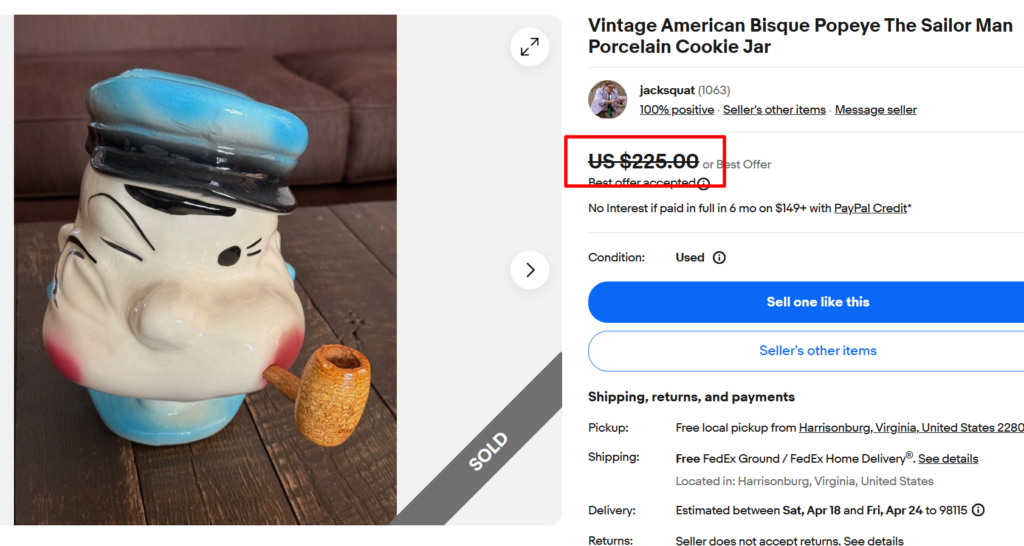
| Average Value | $200 – $400 |
| Manufacturing Period | 1950 – 1959 |
| Status | Discontinued (Licensed) |
| Design Details | Sailor uniform, barrel base, separate pipe |
| Collector Notes | Original pipe is crucial to value. |
The Popeye jar shows the iconic sailor cartoon character leaning against a barrel, and the USA mark is typical of how American Bisque handled their licensed character pieces.
The color details are thick ceramic with cold paint airbrushed over the glaze. The blue on the uniform and the yellow on the buttons were applied separately by factory workers, which is why the coverage varies slightly between examples.
Besides, the pipe was produced as a separate ceramic piece, not attached, and in most cases, it broke or went missing. So, if you come across one that still has the original pipe sitting in the holder, that alone shifts the asking price noticeably.
To confirm you are looking at an original jar, check the base for the wedge-shaped cutouts and the USA mark.
Sweet Pea (Popeye Series)
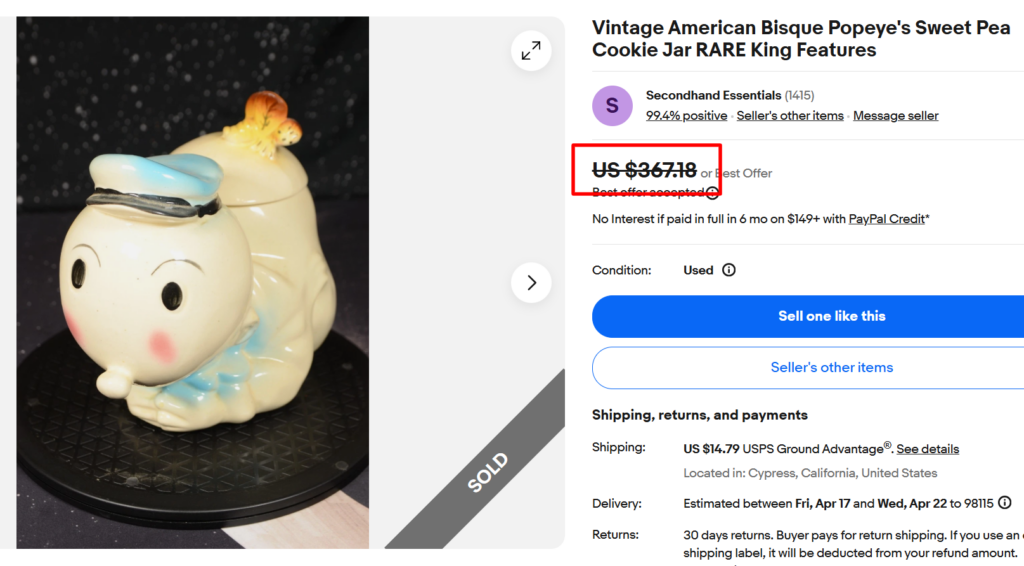
| Average Value | $250 – $400 |
| Manufacturing Period | 1950s |
| Status | Discontinued (Licensed) |
| Design Details | Crawling baby, sailor cap, butterfly handle |
| Collector Notes | Butterfly handle is extremely fragile |
Sweet Pea is one of the lesser-spotted King Features pieces in the American Bisque lineup. The character is shown crawling in a soft pastel palette. The colors are light blue and pink airbrushed over a cream base glaze.
The butterfly sitting on the figure’s back is what makes this enticing. It is molded into the lid and serves as the pull handle. Most examples have the most damage on the butterfly handle, which reduces their value. So, check it properly.
The base of this jar bears an incised stamp reading “King Features Syndicate Inc.” with a copyright date of 1961 beneath it. This confirms the official licensing from King Features (the syndicate that owned all Popeye character rights) and the year.
French Chef Cookie Tray Jar (Kitchen Kitsch Theme)
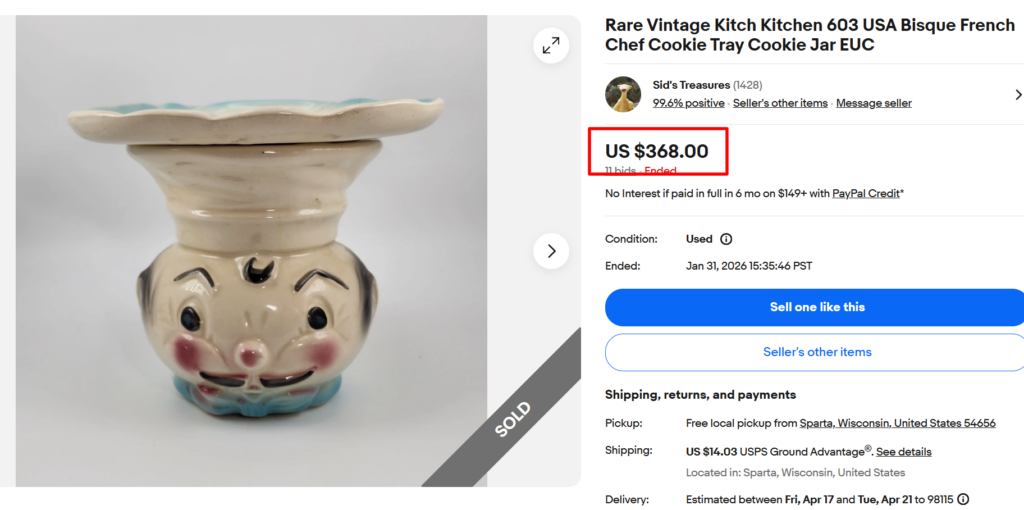
| Average Value | $250 – $400 |
| Manufacturing Period | 1950s |
| Status | Discontinued |
| Design Details | Chef head, wide tray lid, rosy cheeks |
| Collector Notes | Check the “603” mold number. |
This one breaks from the standard cookie jar format entirely. The jar’s base is a chef’s face with rosy airbrushed cheeks and painted-on features. The wide brim of the chef hat lifts off as a lid, doubling as a tray.
It is that dual-function design that gets collectors interested. American Bisque didn’t produce many pieces that crossed over into serving ware like this, which puts it in a more collectible category than their standard character jars.
Also, this jar was originally released with the mold number “603” stamped on the base. Always check it for authenticity.
Moon Rocket Jar (Out of This World)
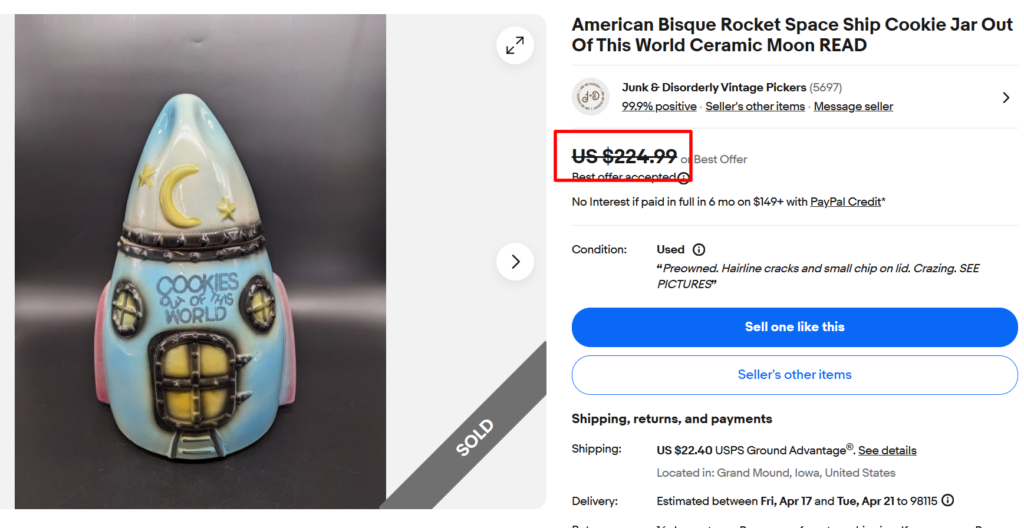
| Average Value | $200 – $600 |
| Manufacturing Period | Late 1950s |
| Status | Discontinued |
| Design Details | Rocket ship, lettering yellow/blue |
| Collector Notes | Original metallic details add value. |
This jar is quite popular among both Space Age and cookie jar collectors. Space themes became popular across American kitchenware as the space race began in earnest during the late 1950s. And this rocket jar was one of the factory’s direct responses to that cultural moment.
The words “Cookies Out of This World” were molded directly into the front body underglaze. That last detail matters. The text is not painted on; it’s part of the mold, so it won’t wear off like the cold-press painted details on other jars.
The base carries a raised “USA” mark along the lower edge. There is no additional factory name incised on this model, which is consistent with known examples. But the airbrushed finish and the raised wedge feet on the base are key signs.
Honey Bear with Beehive
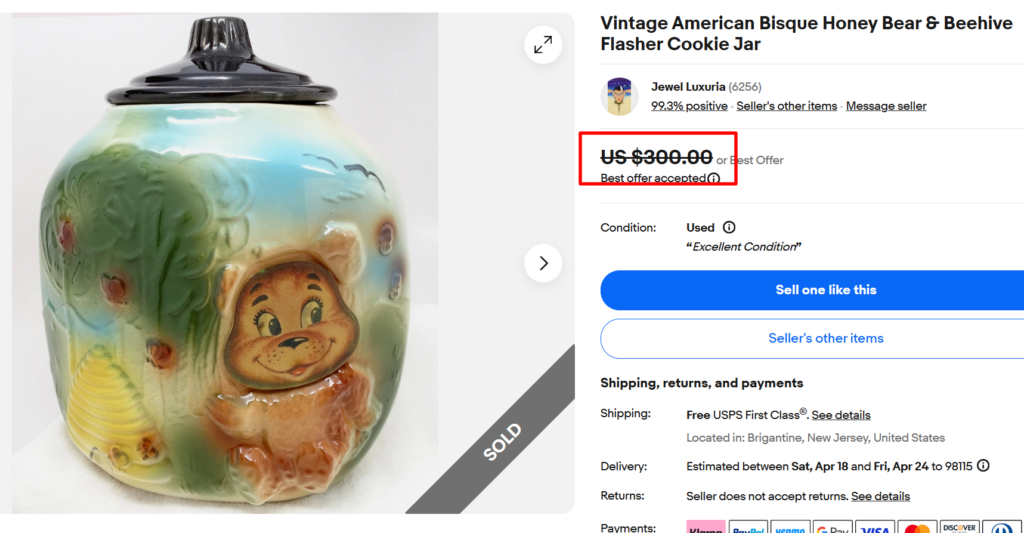
| Average Value | $90 – $300 |
| Manufacturing Period | 1950s |
| Status | Discontinued |
| Design Details | Bear, beehive, moving eyes |
| Collector Notes | The Flasher eyes add value |
In this jar, you will see the bear clinging to the side of a textured beehive, holding a honey spoon. The bear’s lenticular eyes appear to shift as you move past the jar.
This is because of the flasher mechanism, which separates the high-value examples from the ordinary ones. A painted-eye version of the same jar exists and sells for considerably less.
To check authenticity, look at the eye sockets. The original factory one ages to an amber color and leaves a slightly crystallized residue around the edges. Clear glue around the sockets usually means the inserts were replaced at some point.
Quick Note: Check the base for the USA mark. Similar beehive bear jars were produced in Japan during the same decade and are easy to confuse with the American Bisque version if you’re not looking carefully.
Cow Jumped Over the Moon
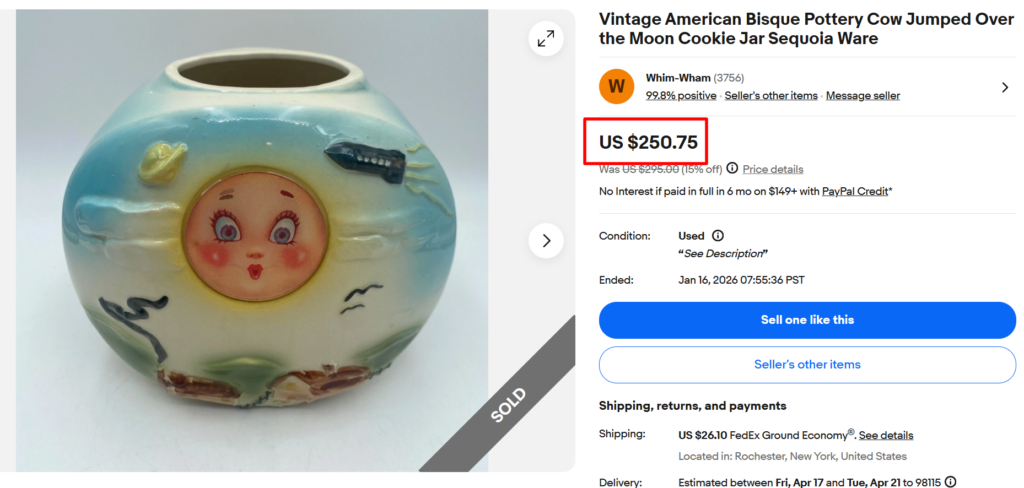
| Average Value | $200 – $300 |
| Manufacturing Period | 1950s |
| Status | Discontinued |
| Design Details | Leaping cow, crescent moon, star accents |
| Collector Notes | Look for the “Sequoia Ware” label |
This jar was released under two separate American Bisque product lines. The standard version carries the usual USA mark, but some examples feature the “Sequoia Ware” label. It is a brand American Bisque reserved specifically for gift shop distribution.
Furthermore, authentic jars come with the flicker or flasher design. You will notice a lenticular disc on the moon’s face that changes expression as you move, giving the jar a funny, sometimes creepy aesthetic.
To check authenticity, run your fingers along the rim on the underside of the lid. Genuine pieces from this era have a slightly coarse and sandy texture. Plus, look for the Sequoia Ware label and a “USA” or “806-USA” mark.
Sitting Horse
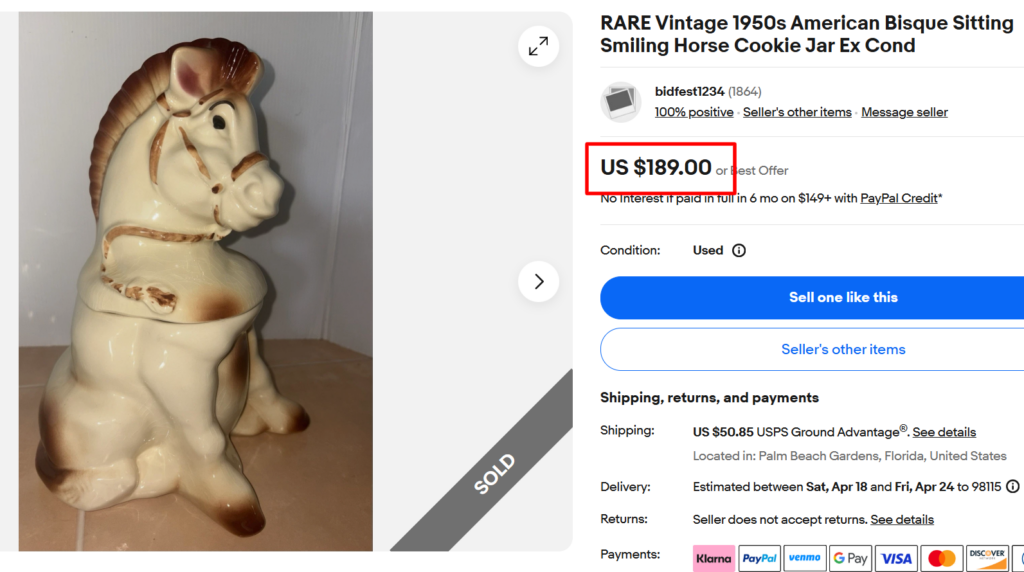
| Average Value | $150 – $250 |
| Manufacturing Period | 1950 – 1959 |
| Status | Discontinued |
| Design Details | Brown horse, upright posture |
| Collector Notes | Protruding ears are highly prone to chipping |
The Horse cookie jar was made sometime in the 1950s. It’s not a licensed character or part of a special line, just a well-made jar for everyday American homes. It shows a horse sitting upright, painted in earthy browns and warm yellows through the factory airbrush.
This design is often reproduced, so look closely at the construction to authenticate. American Bisque used two-piece plaster molds, leaving a seam on the jar. While workers smoothed the seam before firing, they never fully removed it.
Run your fingers down the body, and you will almost always feel a faint vertical line where the mold halves meet. Reproductions do not have it.
The ears are the other thing to check. They protrude sharply from the lid, which made them the first point of contact for every bump over the last 70 years. A fully intact example with no chips on the ears is a rare find.
Astronaut on The Moon Jar
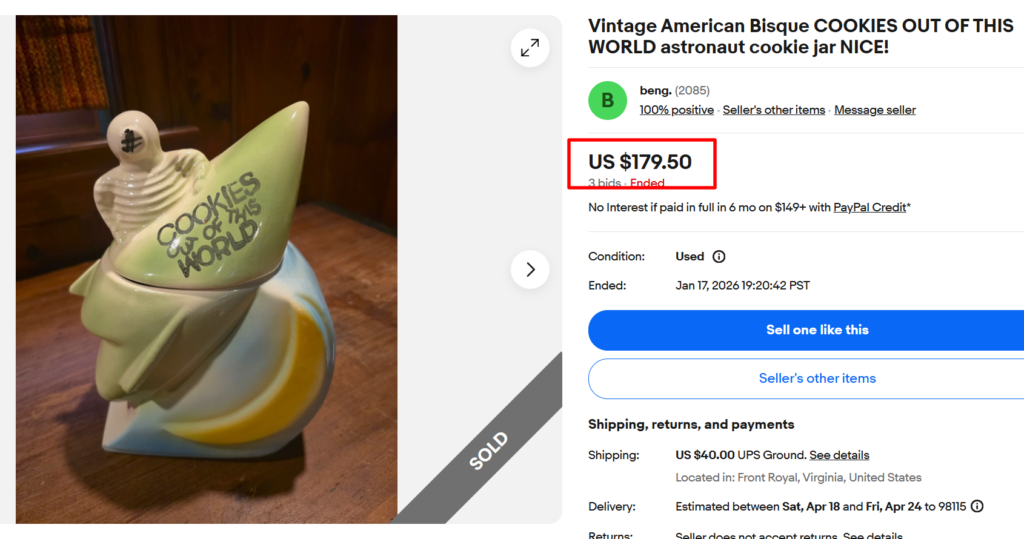
| Average Value | $150 – $200 |
| Manufacturing Period | 1960s |
| Status | Discontinued |
| Design Details | Astronaut figure, space ship, Moon |
| Collector Notes | Original metallic paint adds value. |
Like the Rocketship jar, this one also bears the “Cookies Out of This World” phrase, but features a suited astronaut rather than a rocket ship form.
The metallic paint on the suit details oxidizes naturally over decades, so expect some dulling and minor flaking on any genuine piece. What’s not normal, however, is silver or gold accents that look bright and freshly applied.
If the metallic details look like they were painted last month, the piece has likely been touched up, which is a value killer for original pieces. Untouched and pristine pieces can be worth up to $250 or more.
Yogi Bear Jar (Hanna-Barbera Animation Theme)
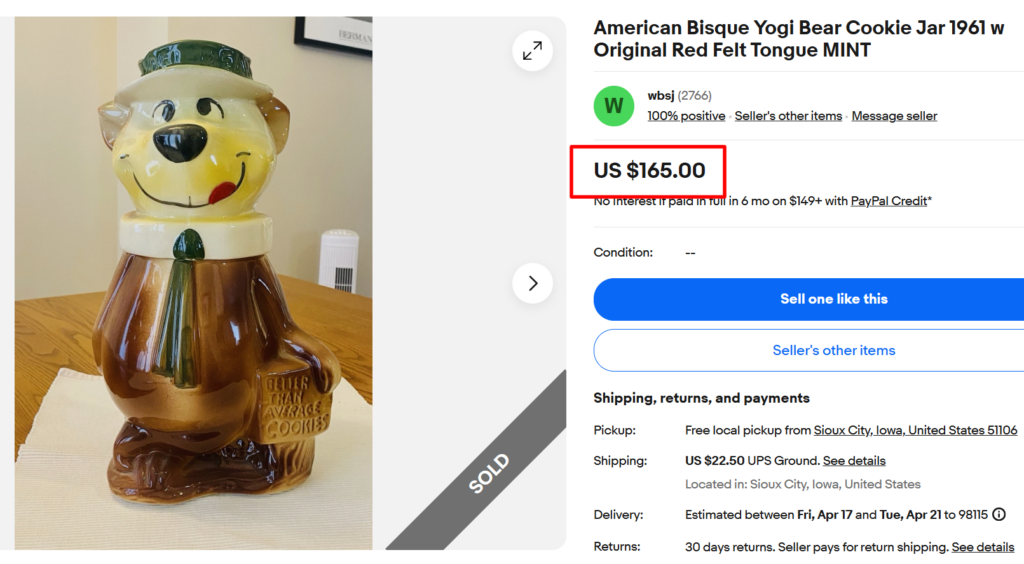
| Average Value | $125 – $200 |
| Manufacturing Period | 1961 |
| Status | Discontinued |
| Design Details | Yogi head, green hat, fabric insert |
| Collector Notes | Original felt tongue is crucial to value. |
This jar is shaped like Hanna-Barbera’s Yogi Bear. American Bisque produced this jar under license from Hanna-Barbera Productions, and authentic pieces carry the “Hanna Barbera Productions USA” marking on the back.
This licensing detail matters because it confirms the jar as an authorized production piece rather than an imitation. What also makes this jar unique is that it features an actual red felt tongue inside the open mouth, instead of a painted one.
It’s a small detail, but it makes a real difference in the value. Felt absorbs moisture and degrades easily over time, so finding one with the original felt still intact is genuinely rare.
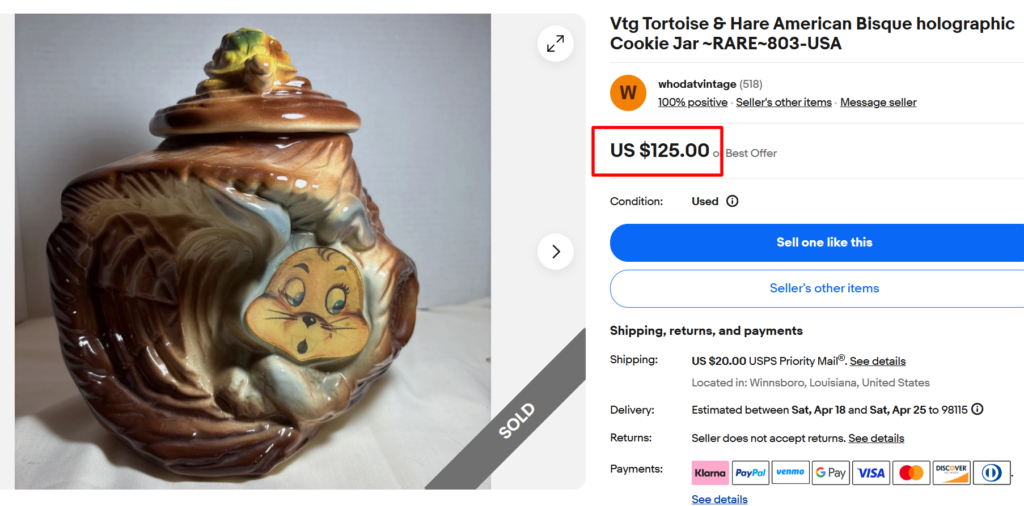
Tortoise & Hare Holographic Eyes
| Average Value | $100 – $175 |
| Manufacturing Period | 1960s |
| Status | Discontinued |
| Design Details | Turtle, rabbit, moving lenticular eyes |
| Collector Notes | Stamped with “803-USA.” |
The jar features the Tortoise and Hare mid-race, with lenticular eye inserts that shift as you move past the piece. The textured ceramic shell on the tortoise contrasts with the smoother airbrushed finish on the hare.
Besides, the mold number “803-USA” stamp at the bottom appears consistently on authentic examples, making them straightforward to identify.
A non-flasher painted-eye version of this same mold also exists and sells for less. So, confirm the eyes are actually lenticular, not painted.
Spotting Authentic Valuable American Bisque Cookie Jars?
American Bisque never marketed itself as a collectible brand. The factory made kitchen jars for everyday homes. So, how do you know if your old cookie jar is a collectible American Bisque find? Let’s take a look:
Signature Wedge Base and Marks
Check the base of the jar. Authentic American Bisque pieces have two raised wedge-shaped blocks on the base rather than a flat ring or solid bottom. This is one of the key signs of authenticity.
But remember that the wedge base is a mold design, so reproductions can copy it. If something feels off, check the glaze and weight. Reproductions tend to feel lighter with a glaze that looks too uniform or overly glossy. When uncertain, compare with verified examples.
Another giveaway is that most jars carry a simple USA stamp or mold number in raised or recessed lettering. But again, many pieces left the factory unmarked. So, don’t rely on marks alone to confirm the authenticity.
Ceramic Weight and Slip-Cast Quality
Original American Bisque jars are heavy for their size. The factory used thick slip-cast walls that feel dense and solid in your hands. If it feels thin or lightweight, you’re most likely looking at a Japanese import or a modern reproduction. Authentic pieces have a heft to them that’s hard to fake.
Airbrushed Colors and Cold-Painted Details
Look at how the color is applied. American Bisque used airbrushing, which leaves soft, blended transitions between tones rather than sharp painted edges. On top of that, details like red lips or black outlines were cold-painted.
These were applied over the glaze after firing with no protective coating. That paint flakes and wears over time. A little loss on those fine details is actually a good sign. It means the piece is genuinely old.
Rarity and Licensed Character Popularity
Not all American Bisque jars are equal in value. Licensed character pieces consistently bring the highest prices. Add a mechanical element like lenticular flasher eyes or a felt tongue, and the value goes up further, because those features rarely survived intact.
Unusual shapes like the Moon Rocket or the French Chef tray also sit at the top end because they’re simply harder to find.
Condition and Completeness
The network of small cracks in the glaze surface is completely normal on vintage ceramics and doesn’t affect value much. Deep structural cracks do. Chips matter too, especially on protruding details like ears, handles, or butterfly wings, where damage is most common.
Lid Compatibility
One thing people often overlook: confirm the lid actually belongs to the base. Check that the color tone and glaze finish match across both pieces, and that the fit feels right. A lid that rattles loosely or one whose paint reads a different shade may have been paired with a lid from a different jar somewhere along the way.
American Bisque closed in 1982, taking its molds with it. Today, the right one in the right condition is highly valuable. If you think you have one, now you know what to look for.
Note: This article is intended for informational, educational, and entertainment purposes only. Some images are illustrative and may not represent actual brands, products, or related entities. All trademarks, product names, brand logos, packaging, and other intellectual property referenced remain the exclusive property of their respective owners. Any brand mentions or references are provided solely for descriptive and educational context and do not imply any formal or commercial association.