Antiques Know How Research
Art Deco Brooches Value
Our analysis at Antiques Know How of hundreds of eBay sales shows that Art Deco brooch values range from $100 to $15,000, with top-tier fine jewelry pieces going over $50,000 to $100,000+. The most collectible styles include diamond & platinum geometric designs, double-clip Duette brooches, Tutti Frutti brooches, onyx & diamond pieces, filigree bar pins, and enamel panels. You can check authenticity by examining the materials, design elements, pin mechanism, and stone cuts.
Antiques Know How
Known for their bold lines from the Jazz Age, strong contrast, and perfect symmetry, Art Deco brooches remain highly loved accessories to date. What was once just another statement piece is now collectibles worth thousands of dollars
But not all Art Deco brooches are worth the same! The difference comes down to certain styles, materials, and craftsmanship! Let me show some of the most collectible Art Deco brooch styles with a few tips to spot a genuine piece!
Why Are Art Deco Brooches Collectible?
Among all the antique and vintage jewelry items, Art Deco Brooches are considered to be one of the most sought-after items in the market today.
Why? Well, the unique combination of a geometric design, platinum, and old-cut diamond materials, and a relatively short production time make them a rare and sought-after vintage accessory!
And, not to mention, the high-end Art Deco pieces from celebrated makers like Cartier, Van Cleef & Arpels, and Boucheron always have collectors’ eyes on them!
Most Popular Art Deco Brooch Styles Worth Money!
1. Diamond & Platinum Geometric Brooches
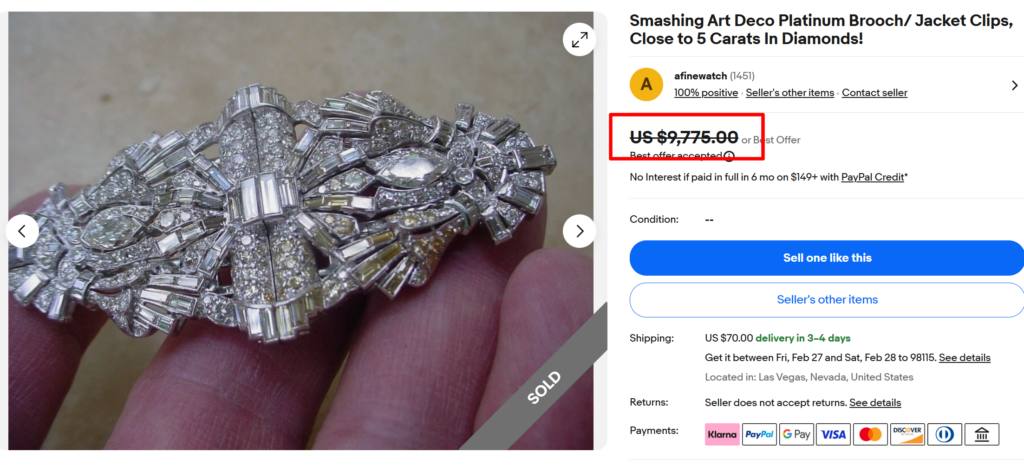
| Average Value | $1,500 – $15,000+ |
| Key Features | Symmetry, straight lines, fine milgrain |
| Key Elements | Platinum, diamonds, openwork |
| Collectibility | Early Art Deco hand-fabricated brooches are worth more |
Elegant geometric diamond brooches in platinum are some of the most valuable forms of Art Deco brooches. These pieces show a lot of geometry: circles within squares, stepped forms, fan shapes, and angular patterns.
The combination of platinum craftsmanship and old-cut diamonds makes these pieces highly collectible today. And collectors specifically look for pieces where the original diamonds haven’t been swapped for modern cuts.
The value of these Art Deco brooches largely depends on the volume of diamonds! For instance, this piece has almost 5 carats of diamonds, which justifies the steep price tag of almost $9,800!
2. Double-Clip (Duette) Brooches
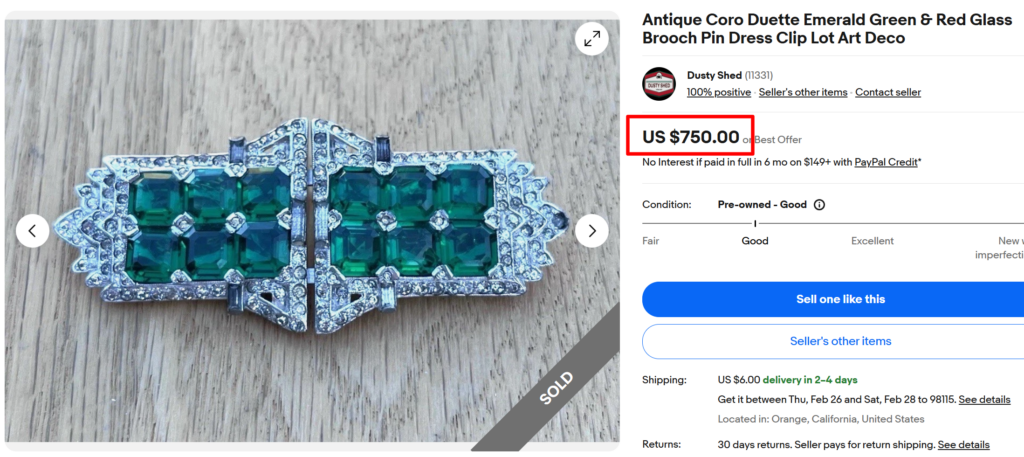
| Average Value | $1,500 – $15,000+ |
| Key Features | Symmetrical mirror-image designs |
| Popularity Period | Late 1920s to 1940s |
| Key Elements | Removable “frame” mechanism; baguette & pavé-set stones |
| Collectibility | Intact frame mechanism adds value |
Double clip or Duette brooches were one of the most ingenious jewelry forms we got in the Art Deco era. These pieces were made by pairing two matching clips/brooches (using a metal frame); you can even wear them as a long brooch or as separate pieces of clip brooches!
Fine Jewelry “Duette” pieces in platinum with diamonds from famous companies such as Cartier, Van Cleef & Arpels, and Tiffany & Co. are the most valuable. When it comes to costume jewelry, the most well-known is the Coro “Duette”.
3. Tutti Frutti (Fruit Salad) Brooches
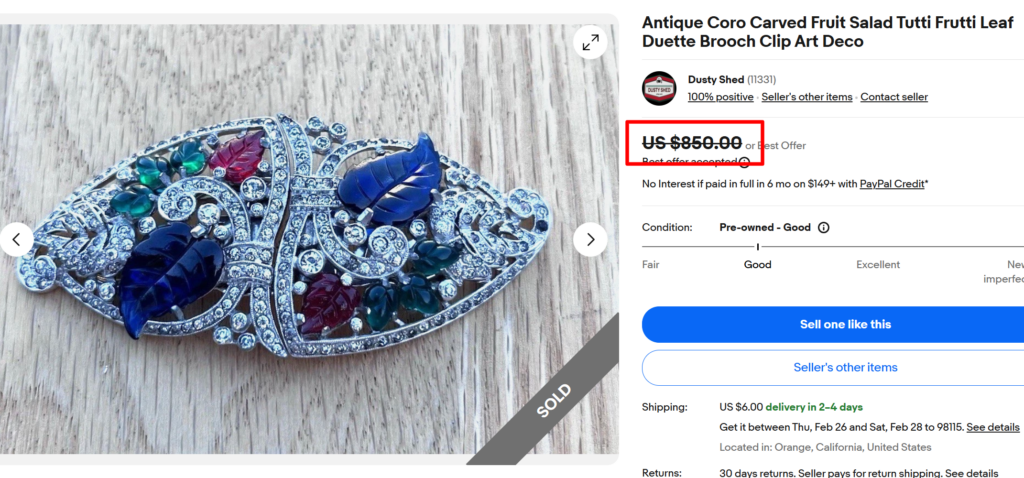
| Average Value | $500-$1,500 (Costume pieces) $1,500-$50,000+ (Fine jewelry) |
| Key Features | Multi-colored stones, organic motifs with geometric borders |
| Manufacturing Period | Mid-1920s to 1930s |
| Key Elements | Carved “molded” stones, contrasting accents |
| Collectibility | Signed Cartier pieces are worth a LOT |
Popularized by none other than Cartier, Tutti Frutti brooches are among the most recognizable and valuable Art Deco pieces. The name means “all fruits” in Italian, and the design was inspired by Indian jewelry traditions.
The defining feature of Tutti Frutti is the use of multiple colored gemstones, mainly rubies, sapphires, and emeralds. These stones are carved (molded in costume pieces) in organic forms, like leaves, berries, and flowers, and assembled into lush, colorful compositions.
While costume Tutti Frutti pieces have modest values, fine jewelry examples from top-tier brands, like Cartier itself, can fetch up to thousands of dollars. Example? A diamond Fruit Salad brooch, Cartier realized a whopping $531,000 on Christie’s!
4. Jabot Pins & Brooches
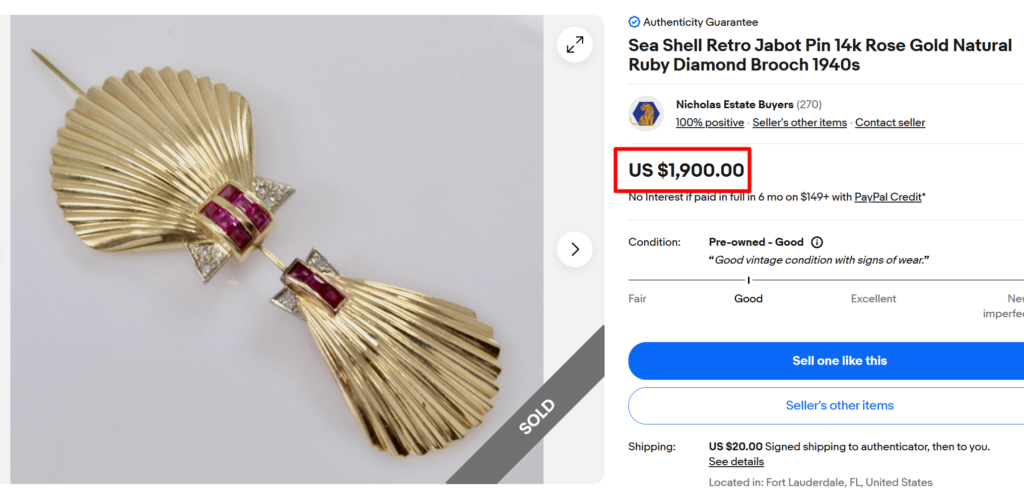
| Average Value | $400 to $8,000 |
| Key Features | Invisible pin stem & two-part design |
| Manufacturing Period | 1920s to 1940s |
| Key Elements | Arrow, sword, or scepter shapes in platinum, white, or rose gold |
| Collectibility | Cartier Jabot pins are most valuable |
The jabot pin was a unique, ahead-of-time brooch form that evolved from earlier tie pins. It’s basically a long brooch where only the two decorative ends are visible, and the connecting pin is tucked beneath the fabric.
From the front, the decorative motifs look like they’re floating on the clothes. The designs included arrows, swords, and geometric and Egyptian designs featuring diamonds, onyx, and rubies.
Cartier, Boucheron, and Van Cleef & Arpels all created iconic jabot pins in the 1920s that are highly collectible today.
5. Egyptian Revival Brooches
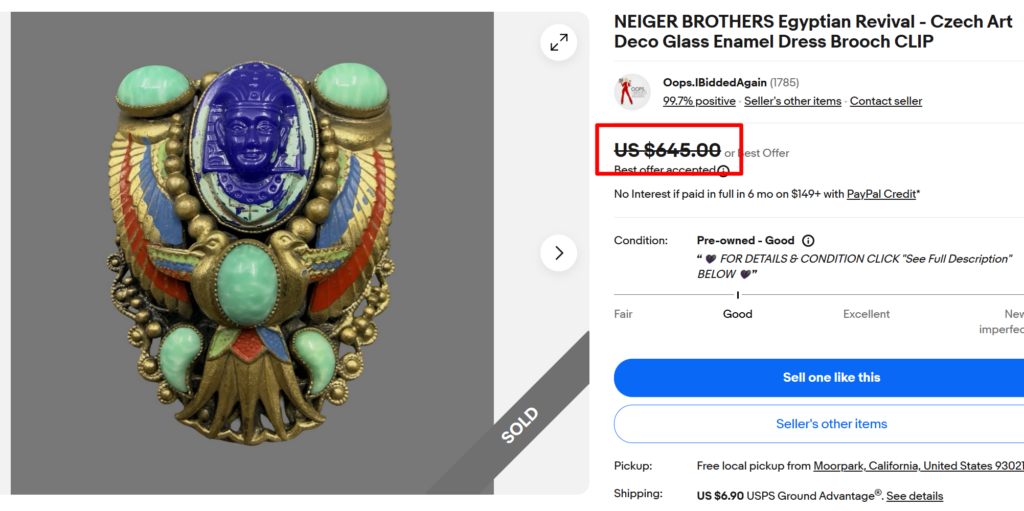
| Average Value | $100 to $5,000 (<$15,000; fine pieces) |
| Key Features | Use of blue (lapis) and gold with ancient imagery. |
| Manufacturing Period | 1922 to the Mid-1930s |
| Key Elements | Faience (glazed ceramic), enamel, and carnelian |
| Collectibility | Pieces featuring real ancient Egyptian artifacts are rare |
The discovery of King Tutankhamun’s tomb in Egypt in 1922 initiated the Egyptian Revival jewelry style. You can spot these brooches by motifs such as scarabs, winged sun discs, lotus flowers, and pharaoh figures, with geometric Deco design.
Collectible examples included lapis lazuli, turquoise, and carnelian carvings with diamonds and gold, and sometimes Plique à jour enamel work, a technique of creating a stained-glass effect.
Pieces with genuine ancient Egyptian artifacts and detailed enamelwork are worth the most in this category.
6. Onyx & Diamond Contrast Brooches
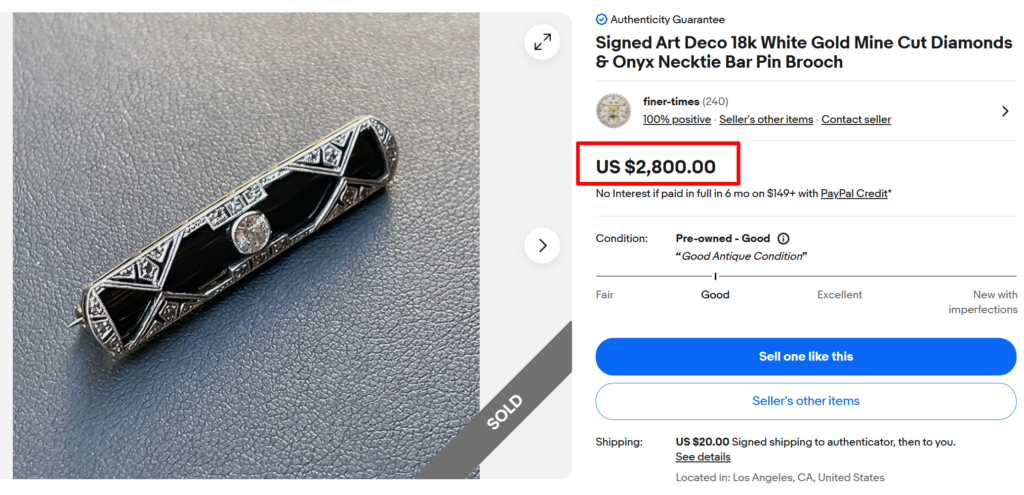
| Average Value | $800 – $6,000 |
| Key Features | High contrast, bold linear patterns |
| Manufacturing Period | 1920s & 1930s |
| Key Elements | Onyx panels, diamonds, platinum or white gold |
| Collectibility | Pieces with natural onyx & diamonds are valuable |
Black and white contrast was a defining feature of Art Deco jewelry. And in brooches, it came as a combination of onyx and diamonds, creating the Deco’s iconic bold and dramatic visuals.
These brooches are typically sleek, rectangular, navette, or stepped in design, and mostly feature platinum or white gold settings adorned with stones. These are easily one of the most sellable and collectible Deco brooches today.
7. Filigree Bar Brooches
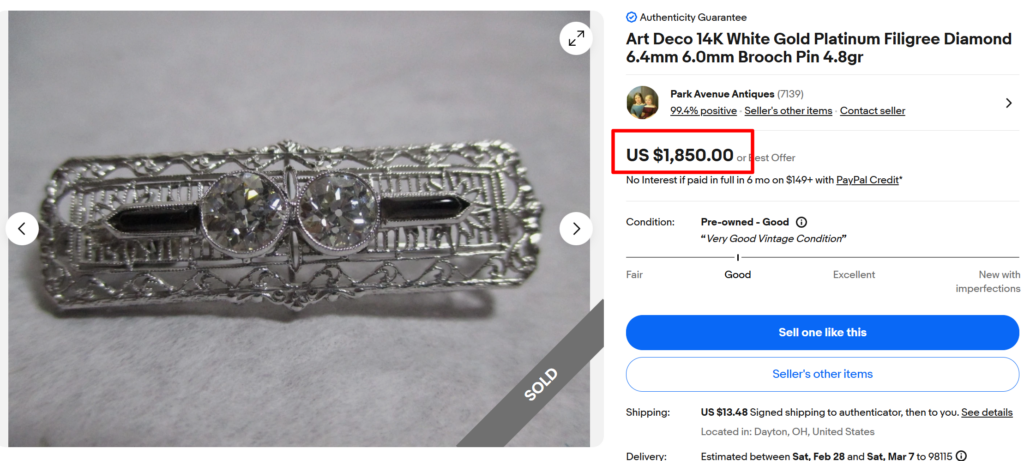
| Average Value | $200 – $3,000 |
| Key Features | Long horizontal design, pierced metalwork, milgrain detailing |
| Manufacturing Period | 1915 – 1930 |
| Key Elements | Platinum or platinum-topped gold, hand-engraved filigree, diamonds |
| Collectibility | Earlier pieces with more flowing filigree are rare |
As the name suggests, filigree bar brooches are long, horizontal pins with delicate openwork metal designs that almost look like lace. What makes the early ones so special is the craftsmanship; each bit of filigree was handcrafted!
Most of these brooches, like the one shown here, were platinum or platinum-topped 14K gold and often accented with diamonds, sometimes with blue sapphires. Simpler versions with a single diamond typically sell for around $200 to $500, while larger, more complex pieces with multiple stones can go up to $2,000 or more.
8. Enamel Brooches
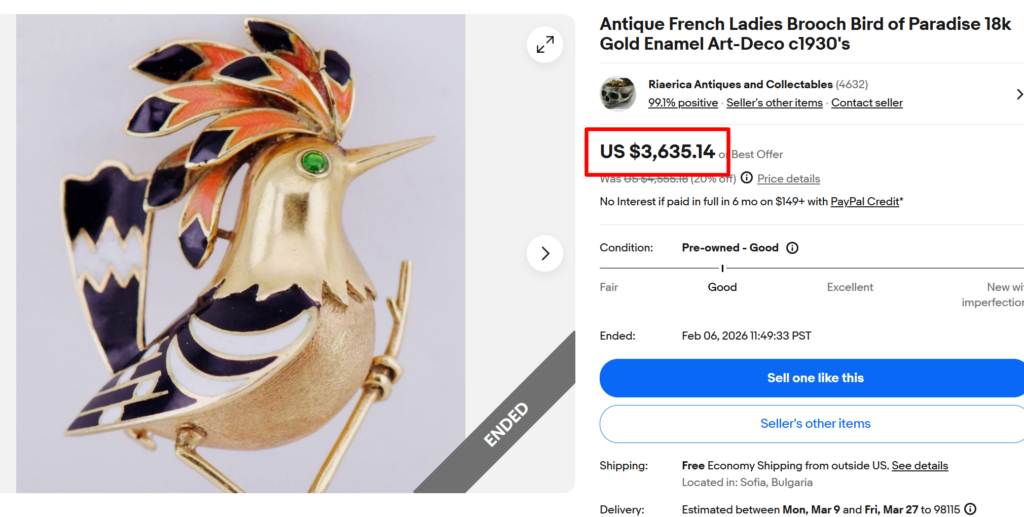
| Average Value | $300 – $4,000 |
| Key Features | Bright enamel panels, sharp lines |
| Manufacturing Period | 1915 – 1930 |
| Key Elements | Enamel over gold or silver, geometric or natural designs |
| Collectibility | Pieces with original enamel are more collectible |
Enamel Art Deco brooches are instantly recognized by their vivid color blocking and smooth “eggshell” finishes. These pieces often featured Jazz Age colors, like seafoam green, stark black, white, tomato red, orange, and lapis blue.
These pieces come in bold geometric shapes as well as natural forms like floral, animals, birds, and insects motifs.
Moreover, techniques like cloisonné (with wires dividing the colors) or champlevé (where troughs are carved/etched into metal, filled with powdered glass enamel, and fired) make enamel brooches valuable and collectible!
How to Tell If an Old Brooch is Art Deco?
Finding an attractive Art Deco brooch at an estate sale or in your jewelry shop is one thing. Being confident it’s actually from the period and not a reproduction is another. Here is how you can spot a real Deco brooch!
1. Design & Style Elements
The Art Deco style is known for its specific visual elements, like geometric shapes (triangles, rectangles, chevrons, circles, stepped forms), strong symmetry, and bold contrasts.
The presence of these elements means you’re probably looking at a real Art Deco brooch. If the design shows flowing curves, floral or natural patterns, or big, chunky stones set in gold with an uneven layout, it’s probably from the Art Nouveau or Retro era instead.
Besides, Art Deco brooches are mostly set in white metals (platinum, white gold). So, if you see one made entirely of yellow gold but with Art Deco-style motifs, take a closer look; it could be a later reproduction rather than an original piece.
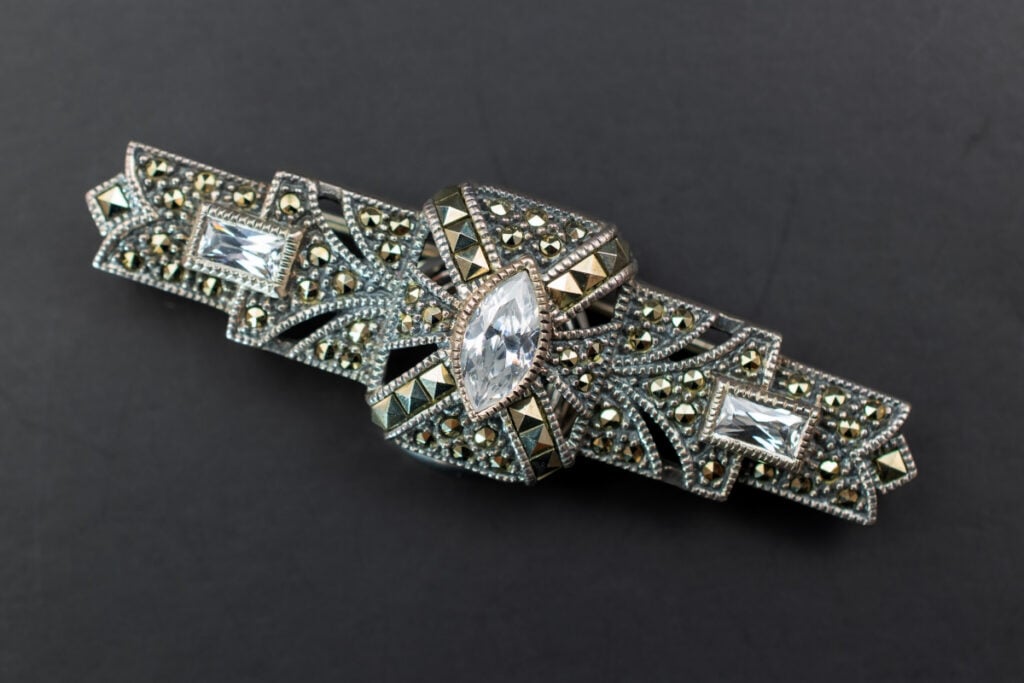
2. Metals, Hallmarks & Maker Marks
The material used to make the brooch is a strong clue as to whether it’s
Hallmarks
When it comes to metal, platinum was the signature metal in the Art Deco brooch, as it was strong enough for delicate filigree and openwork designs. To verify that a piece is made of platinum, check for the hallmarks “PLAT”, “PT”, “950”, or “IRID PLAT”, for iridium-platinum.
White gold is another common material from this era. It became popular in the 1930s as a less expensive alternative to platinum. You can identify white gold brooches by “14K” or “18K” stamps, often with a maker’s mark.
In some instances, both were used: a platinum top and a 14K gold pin stem and catch, for instance.
Note: Not all pieces have the same marks; they may have country-specific hallmarks. For example, French pieces may show the eagle head (18K gold) or a dog head (platinum), while British pieces will have assay office marks!
Maker’s Marks
You may also notice a maker’s mark on many of these pieces. It can be in the form of a logo, name, or initials. Spotting these is very important because brooches designed by big makers can cost twice as much as those from lesser-known artists or local artists.
Some of the most renowned makers in the field of Art Deco brooches are:
- Cartier (geometric platinum designs)
- Van Cleef & Arpels (mystery-set gems)
- Tiffany & Co. (sleek American modernism)
- Boucheron (exotic French flair)
- Lalique (frosted glass-metal hybrids)
- Coro (costume Deco pieces
3. Construction & Craftsmanship
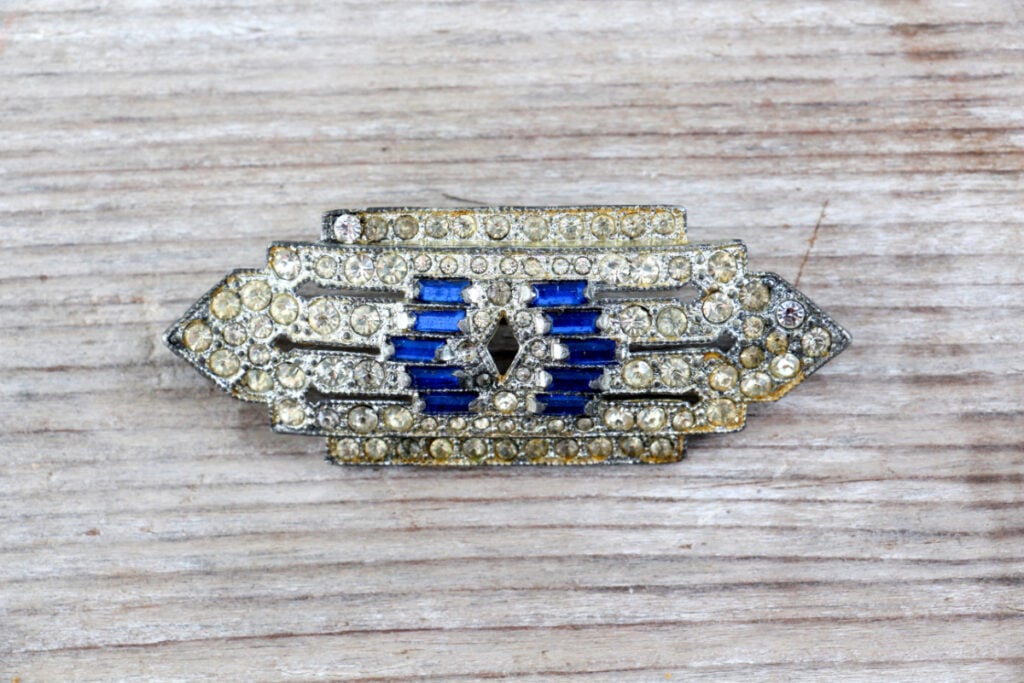
Authentic Art Deco brooches were mostly handcrafted, which often left specific traces that could be used to identify them. For instance,
- Milgrain Edging (tiny beaded borders along settings and edges) is likely slightly irregular under magnification. Machine-made milgrain on copies usually looks too perfect and uniform.
- Filigree work, too, shows slight hand-finishing marks and minor asymmetries, unlike reproductions. Run your finger along the filigree, and you’ll feel a slightly rough texture from hand-finishing rather than smoother edges.
The pin mechanism itself is a dating and identification tool. Art Deco brooches typically have a tube hinge and a C-clasp (early pieces) or an early safety catch. Lobster clasps and modern snap catches were not popular during this period.
So, if you see a Deco arrangement in the front and a modern pin at the back, you need to be alert. A repaired or replaced pin stem doesn’t necessarily mean the brooch isn’t real, but a totally modern-style mechanism is not what you should see.
4. Gemstone Cuts & Settings
Pay close attention to the stone cutting. The diamond cuts used in Art Deco jewelry are quite different from the cuts in modern jewelry. Baguette cuts and calibré cuts (custom-cut colored stones shaped to fit the settings) are defining features of Art Deco brooches.
Old European cuts (round with a small table, high crown, and large culet) and old mine cuts (a cushion shape) were also common. But transitional cuts (between old cuts and modern cuts) appear in later Art Deco pieces.
Also, check the type of setting. In authentic Art Deco pieces, stones are usually held by metal prongs, bezels, or channel settings. If the stones are glued, then it is either a costume jewelry item or a replica.
5. Real Signs of Age
An authentic Art Deco brooch would be roughly 85 to 105 years old, and it should show its age in certain ways.
The first sign is the natural patina on the metal, particularly in recessed areas of filigree work. Platinum develops a soft gray patina, while gold may show light surface scratches from decades of wear.
The pin stem and catch area on the back are the spots you should see the most wear, like light scratching and slight looseness in the hinge.
Overly bright and new-like pieces with perfectly polished metal and no wear on a supposedly period piece are unacceptable. It either means it’s a reproduction or has been heavily refurbished.
Note: This article is intended for informational, educational, and entertainment purposes only. Some images are illustrative and may not represent actual brands, products, or related entities. All trademarks, product names, brand logos, packaging, and other intellectual property referenced remain the exclusive property of their respective owners. Any brand mentions or references are provided solely for descriptive and educational context and do not imply any formal or commercial association.