Antiques Know How Research
Atterbury Milk Glass Value
Based on several eBay sales, the Antiques Know How team suggests that original Atterbury milk glass pieces typically sell for $20–$350+, with the rarest examples reaching $150–$ 350+. Highly sought-after collectibles include the “Bull’s Head” Mustard Jar, “Duck on Nest” Covered Dish, Blue Milk Glass Sugar Shaker, “John Bull” Figural Shakers, “Fish on Boat Skiff” Dish, and “Lion on Dancing Sailor” Dish. Check for patent dates, glass eyes, sharp mold details, and base patterns to identify and value.
Antiques Know How
About Atterbury & Company
Atterbury & Company (nicknamed the “White House Factory”) was founded in Pittsburgh, Pennsylvania, in 1860 by brothers James S. and Thomas B. Atterbury. It became one of the US’s top makers of milk glass and EAPG (Early American Pattern Glass)!
Thomas Atterbury alone held over 100 glass patents; many of them for the figural animal dishes the company is best known for today. Their pieces are easy to recognize by glued-in glass eyes, sharp mold details, and patent dates.
The company closed around 1902–1903, which is why original pieces hold their value. Many Atterbury reproductions came later from different glassmakers, like Westmoreland, Imperial, and Fenton, but none beat the originals!
Valuable Atterbury Milk Glass Pieces Worth Collecting
Below are listed some of the most popular and desirable Atterbury milk glass items that hold steady demand and value in the market today!
1. “Bulls Head” Mustard Jar
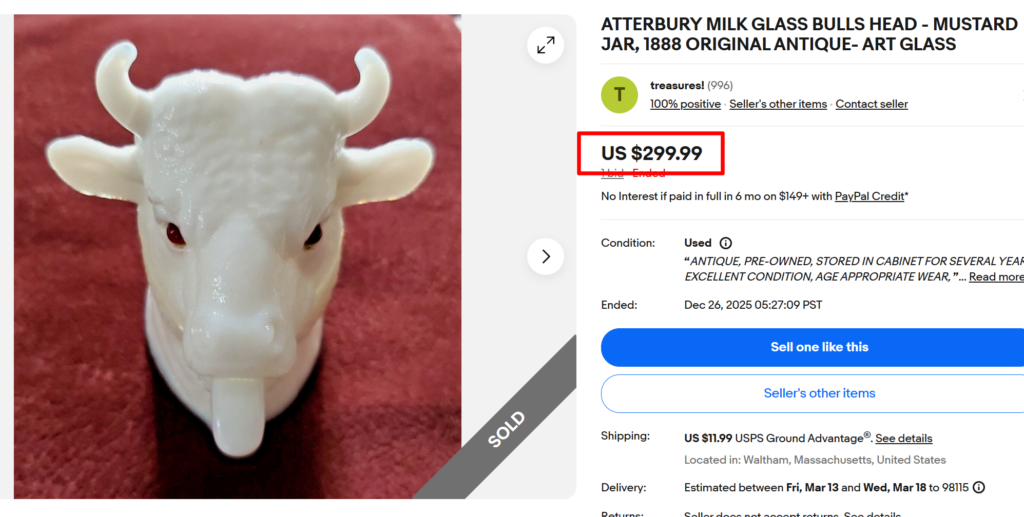
| Average Value | $150–$350 |
| Production Period | Patented July 17, 1888 |
| Pattern/Design | Bull’s head lid & a neck-shaped jar |
| Collectibility | Rare (Elite status) |
| Collector Notes | Check the raised patent mark on base. |
This “Bull’s Head” mustard jar is a three-piece set: the bull’s neck forms the jar, the bull’s head with glass eyes comes off as the lid, and the bull’s tongue serves as the spoon rest.
This design was patented on July 17, 1888, and original examples carry the patent date on the base. These aren’t as common as the duck or hen dishes, which makes them quite desirable, especially with all three pieces!
2. “Duck On Nest” Covered Dish

| Average Value | $80–$250+ (good condition) |
| Production Period | 1887 to 1899/1902 |
| Pattern/Design | Figural duck/swan lid on nest base |
| Collectibility | Very High |
| Collector Notes | Original head openings are squared. |
The Atterbury Duck is the company’s most well-known piece. It’s a covered dish with a figural duck as the lid and the oval, basketweave nest as the base.
The red or brown glass eyes (when present) are glued in, not molded into the glass. The company made several versions of this duck design, with the two-color versions bringing the highest prices.
Since this design has been reproduced more than almost any other American milk glass design, knowing what makes an original is crucial!
Note: Since patent numbers are not usually seen on these pieces, check the thumb indentation under the tail for identification; it’s flat and broad, not narrow and rounded like reproductions.
3. Blue Milk Glass Sugar Shaker

| Average Value | $25–$75 |
| Production Period | 1880s |
| Pattern/Design | Opaque blue ribbed double-bulge body |
| Collectibility | High (rare color) |
| Collector Notes | Missing metal lids reduces value. |
While Atterbury is famous for white glass, their colored milk glass, specifically “forget-me-not” blue, is highly collectible.
This sugar shaker (or muffineer) in the distinctive opaque blue milk glass features embossed floral or geometric patterns characteristic of the Early American Pattern Glass (EAPG) era.
You’ll also see an original decorative metal lid, which is an important value factor for these shakers!
4. “John Bull” Figural Salt/Pepper Shaker

| Average Value | $20–$100 |
| Production Period | c. 1870s–1880s |
| Pattern/Design | John Bull figural shaker |
| Collectibility | High (for Pairs) |
| Collector Notes | Look for original metal caps |
This Atterbury salt or pepper shaker depicts “John Bull,” a well-known symbol of Britain, in a stout, figural form with a metal shaker top. These shakers were often sold in sets during the late 1870s and 1880s.
Because of their small size and functional use, many of these shakers suffered from “glass sickness” or heavy wear. While single pieces are still collectible, an original pair of two shakers with sharp details and original caps is a rare find!
5. “Owl” Candy Jar
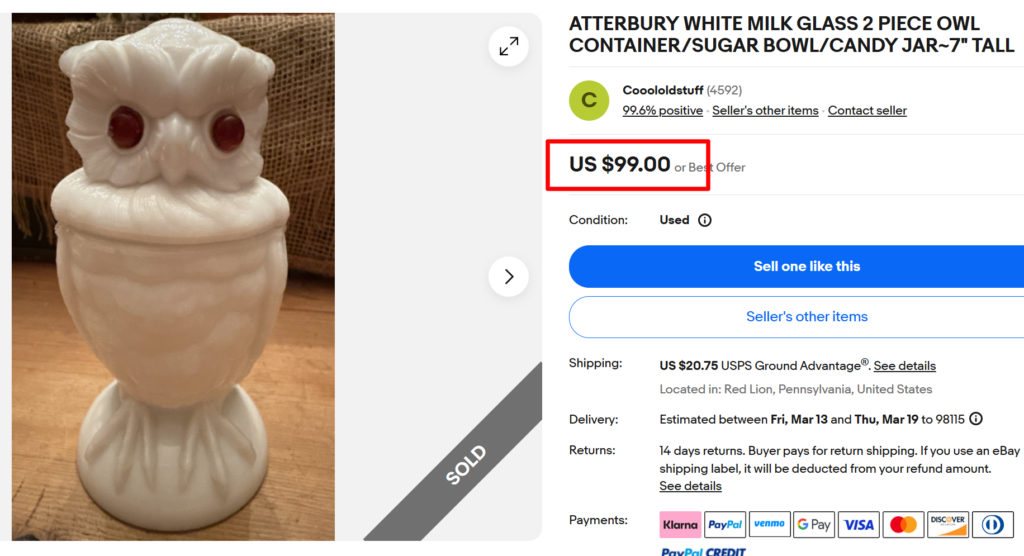
| Average Value | $50–$120 |
| Production Period | 1880s to 1890s |
| Pattern/Design | Figural Owl Jar |
| Collectibility | High |
| Collector Notes | Originals have locking lugs on the lid. |
The Atterbury owl jar is a popular non-animal dish piece. It’s a two-piece set, an owl head lid with glued-in red glass eyes and a pedestal base, standing about 7″ tall.
They are often found in white milk glass, but blue or turquoise versions also exist. Of these, standard white owl dishes with intact red eyes sell for $65–$100, while rarer colors can go higher!
Collector’s Tip: Imperial Glass made a similar owl from 1955 to the 1960s. To spot the Atterbury owls, look for locking lugs on the lid. Imperial owls don’t have them.
6. “Hen on Nest” (Blue Slag Head) Covered Dish
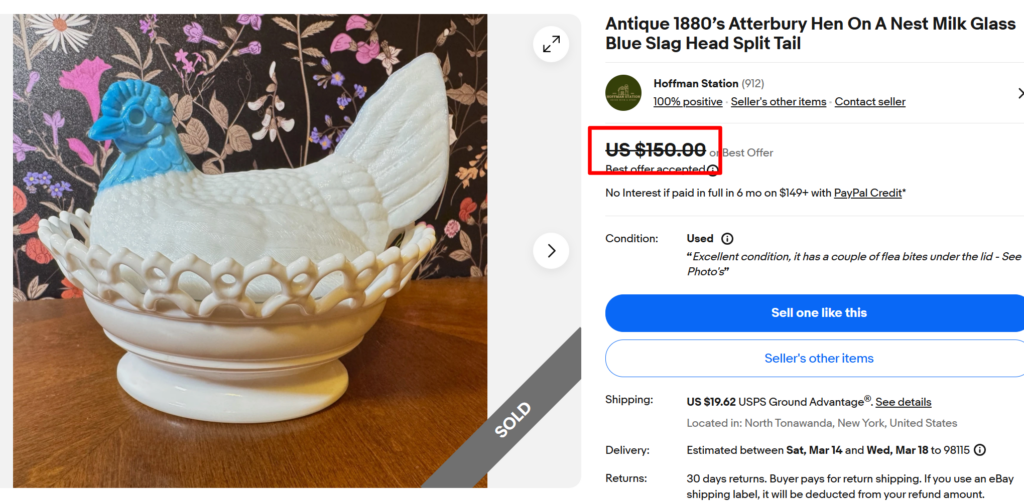
| Average Value | $100–$200+ |
| Production Period | 1880s–early 1900s |
| Pattern/Design | Blue slag head lid on lace-edge nest |
| Collectibility | High (two color variations) |
| Collector Notes | Originals had colored glass eyes. |
Atterbury’s whole white milk glass “Hen on Nest” dishes with red glass eyes on a round lace-edge base are quite common. But this example is a different story.
What makes this hen dish stand out is the blue slag head, a swirled mix of blue and white opaque glass, on an otherwise white body. Atterbury produced several colors beyond plain white, and such two-color variations are rare to find!.
Also, original pieces had colored (red or brown) glass eyes, which can boost the overall value if found intact.
7. “Fish on Boat Skiff” Lidded Dish

| Average Value | $20–$80 |
| Production Period | 1880s |
| Pattern/Design | Boat-shaped tray with a fish as the lid |
| Collectibility | Collectible |
Atterbury made a few fish-themed pieces, and this is one of the more distinctive ones. The covered fish boat tray features a single fish molded on top of a narrow, boat-shaped base; the whole thing measures about 10–11″ long.
While many companies like L.E. Smith later produced similar fish-shaped dishes, you can spot the Atterbury version by its age and the specific “chalky” texture of its Victorian-era milk glass.
Quick Tip: The flat open two-fish relish dish (often with the “June 4, 1872” patent date) is a different piece and a little more common. Both are worth knowing for Atterbury collectors.
8. “Chick and Egg Pile” Covered Dish
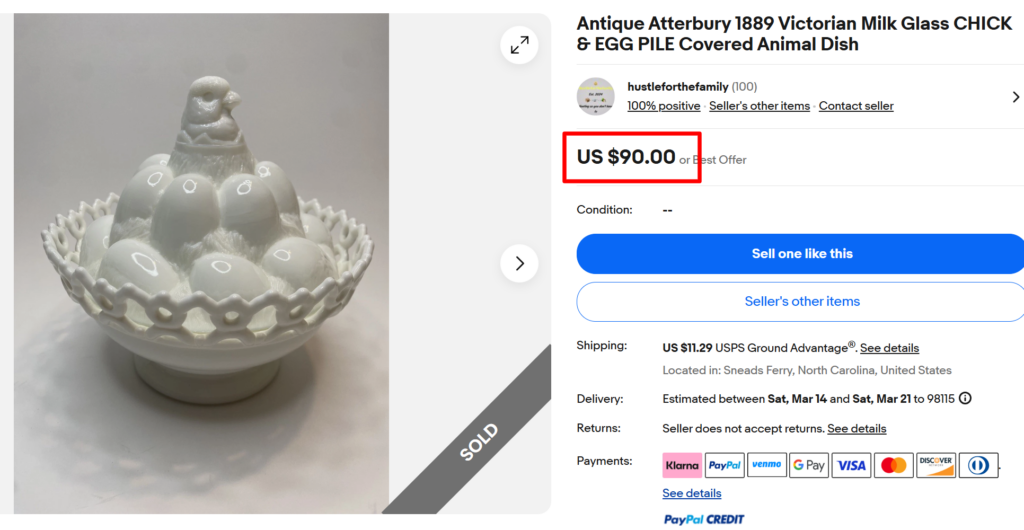
| Average Value | $150 – $225 |
| Production Period | Patented 1889 |
| Pattern/Design | Chick on Egg Pile |
| Collectibility | Rare/Highly Desirable (original eyes) |
| Collector Notes | “Pat. Aug. 6, 1889,” mark on the base |
This is one of Atterbury’s more unusual figural forms. While the duck or hen is widely produced, the “pile of eggs” design is unique to Atterbury, patented in August 1889.
It features a lid shaped like a “pile of eggs,” with a small chick hatching from the middle egg. The base is a bowl with an openwork lace-style rim. The original dish is often found with “glass eyes” in the chick, which adds to its rarity and value.
9. “Lion on Dancing Sailor” Covered Dish
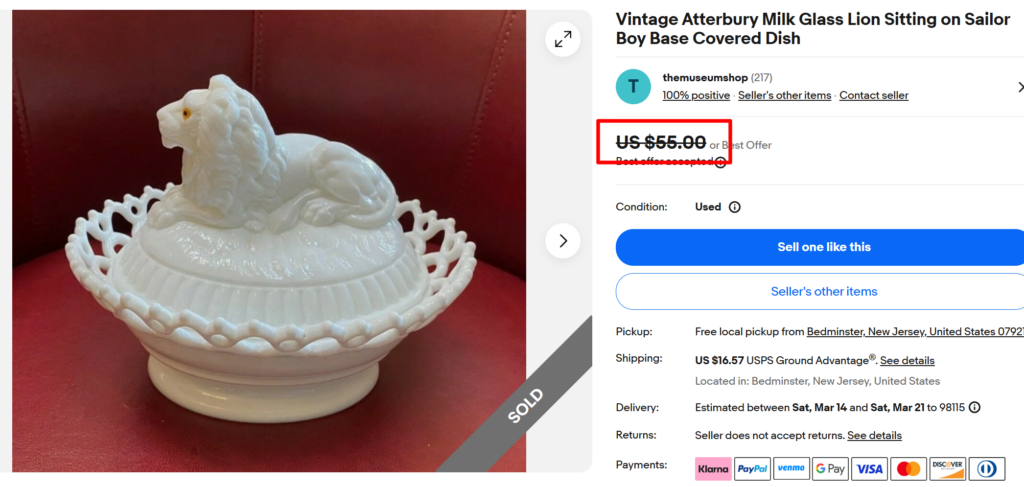
| Average Value | $80 – $150 |
| Production Period | Late 1880s |
| Pattern/Design | Lion Figural/Lace Base |
| Collectibility | Very High |
| Collector Notes | “Pat. Aug. 6, 1889,” mark on the base |
This one is among the most iconic “animal on nest” variations Atterbury produced!
This covered dish combines a majestic lion figure in a reclined pose with the popular “Dancing Sailor” lace-edge base. You’ll notice fine details in his mane and facial features.
While Westmoreland and other companies later reproduced this design, you can easily spot the original Atterbury lions by their sharper details, 19th-century glass quality, and the raised “1889” patent marks on the base!
10. “Dancing Sailor” Rim Dish Bowl

| Average Value | $25–$60 |
| Production Period | Late 1880s–early 1900s |
| Pattern/Design | “Dancing Sailor” lace rim |
| Collectibility | Moderate |
| Collector Notes | Chips on the lace edge reduce value. |
This is a rectangular Victorian “Dancing Sailor” footed dish. The name is common for Atterbury’s unique openwork lace edge, a repeating pattern of interlocking loops that looks like the silhouette of a sailor in mid-dance.
It’s one of their most recognized patterns, and it shows up on several of their covered dishes as the base. On its own, these dishes usually sell for $10–$30, but when paired with a figural lid (like the Lion), the set can go for $30–$100.
11. “Fan in Hand” Trinket Dish
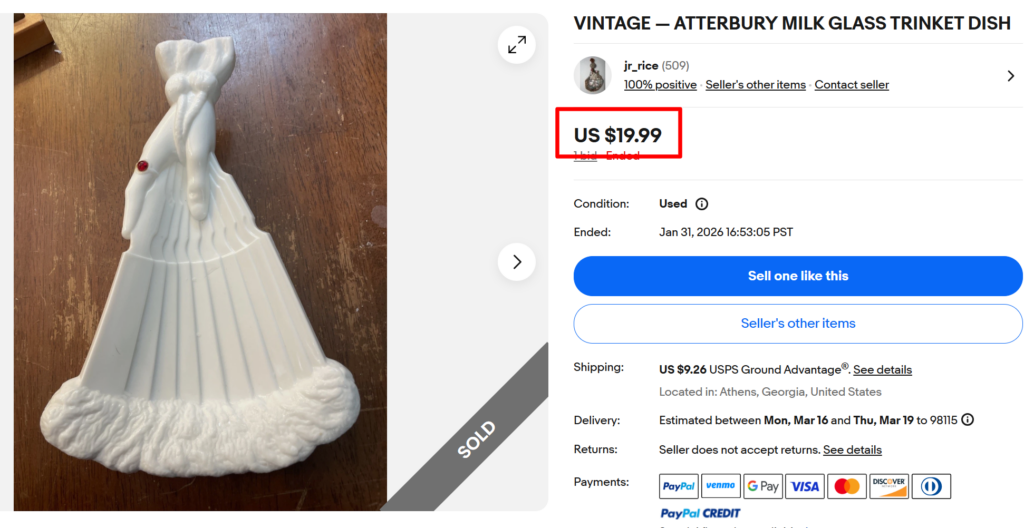
| Average Value | $10–$30 |
| Production Period | Late 1880s–early 1900s |
| Pattern/Design | Hand holding an open pleated fan |
| Collectibility | Moderate |
| Collector Notes | Most pieces don’t have a mark. |
A more distinctive novelty piece, this one is a flat tray shaped like a hand holding an elegant, open-folding fan. The whole dish measures about 9.5″ long, and the original pieces have a colored glass ring on the forefinger.
You don’t see these as often as the animal-covered dishes, making them collectible. Also, Atterbury made a different “hand” piece, like the Hand & Dove covered dish. These are often mixed up, so make sure you know which one you have.
How to Know If Milk Glass is Atterbury (& Valuable)?
Atterbury was known for making quality milk glass items. Authentic pieces show some distinct features that set them apart from later reproductions. Here are the key things you must look for:
Marks & Patent Date
Antique Atterbury pieces don’t carry a maker’s mark as such. But most genuine pieces, especially the animal-covered dishes, carry a patent date stamped on their bases, the underside of lids, or the inside rims of lids.
Some common patent stamps are:
- March 15, 1887 (Duck)
- August 6, 1889 (Fox, Lion, Chick & Eggs)
- July 17, 1888 (Bull’s Head)
- June 4, 1872 (Fish dish)
- Pat Appl for (Several)
Remember that no patent mark or date automatically means it’s fake. But a confirmed date is strong proof of authenticity, and also adds value.
Original “Glass” Eyes
Atterbury’s animal pieces originally came with glued-in glass eyes, usually red or amber. If the eyes look like painted-on dots or obviously modern plastic inserts, that’s a sign of a reproduction.
Also, the glass eyes are often the first thing to go missing, so their presence adds meaningful value.
Physical Attributes
In case there are no marks or glass eyes on your piece, you can assess the physical features of your milk glass piece to identify it.
- Detailed Figural Designs: Real Atterbury pieces have highly detailed figures, such as ducks, rabbits, fish, and owls. The molds show deep, realistic textures, like feathers, fur, or scales. Blurry or smooth features are a red flag.
- Thick, Textured Glass: Original Atterbury milk glass from the late 19th century tends to feel solid and heavier. It also has a unique “chalky” texture that you don’t see/feel in modern pieces.
- Rare Milk Glass Tone: Genuine pieces often have a slightly creamy or faint bluish tint with an opaque, softly glowing appearance. This is a defining feature of Victorian-era milk glass.
- Base Patterns: Atterbury’s covered dishes feature distinctive decorative bases unique to the company, such as basketweave, reed, lace-edge, or nest-style designs. Knowing these comes in handy for identification.
White vs. Color
Atterbury made pieces in white milk glass and several opaque colors: blue, turquoise, green, and lavender, as well as two-color combinations like white body with a blue or amethyst head.
White is by far the most common. While colored or two-tone examples are rarer and worth more, sometimes 2–3× the price of the same form in white.
Condition
As with all vintage glassware, condition is important when valuing Atterbury milk glass. But if the piece is rare enough, collectors still want it with minor damage.
For example, a small chip on a common white Hen on Nest can drop its value from $60 to $25, but on a rare blue slag hen, it may only bring it from $180 to $130!
The biggest value deductions are chips on the lace-edge rim, missing eyes, and cracks through the body. Minor manufacturing bubbles or surface staining are normal on Victorian glass and don’t affect the value.
Note: This article is intended for informational, educational, and entertainment purposes only. Some images are illustrative and may not represent actual brands, products, or related entities. All trademarks, product names, brand logos, packaging, and other intellectual property referenced remain the exclusive property of their respective owners. Any brand mentions or references are provided solely for descriptive and educational context and do not imply any formal or commercial association.