Antiques Know How Research
Valuable Ceramic Plate Designs
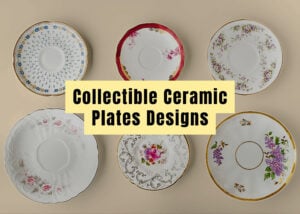
Our review at Antiques Know How of several eBay sales and auction records highlights that ceramic plate designs range from $40 to $5,000, with top-tier pieces reaching $10,000 to $20,000! Most collectible designs include Flora Danica botanicals, Meissen Blue Onion florals, Picasso Madoura surrealists, Herend Queen Victoria butterflies, Clarice Cliff Bizarre abstracts, and Blue Willow landscapes!
Antiques Know How
Old ceramic plates are a common sight in American homes, as well as at estate or garage sales. You’ll find tables full of some dishes that look impressive and seem to be worth a LOT, while others are just common and cheap.
The difference usually comes down to the pattern and the maker. Certain designs from specific manufacturers have held collector interest for well over a century. They’re sought for who made them, how they were made, and their history.
This guide covers the most collectible ceramic plate designs worth knowing, what to look for, what they sell for, and what collectors SHOULD care about most.
High-Value Popular Ceramic Plate Designs & Patterns
1. Royal Copenhagen’s Flora Danica
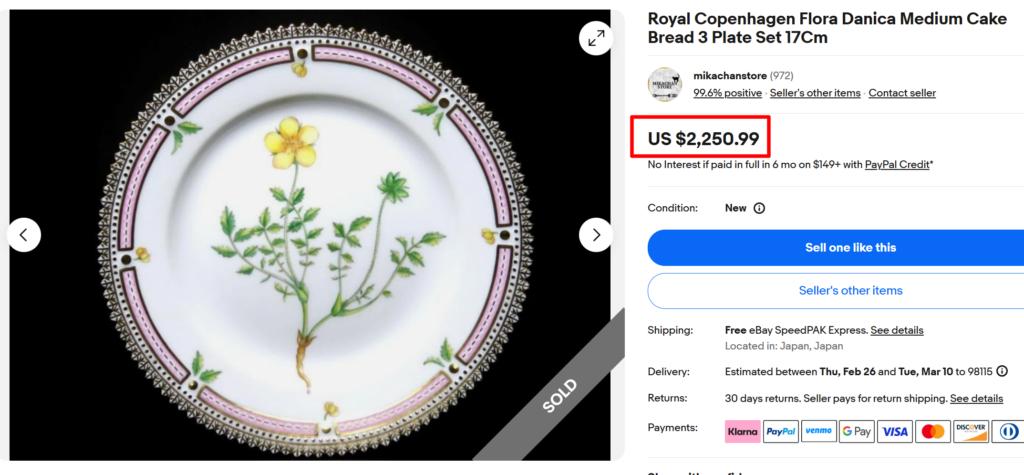
| Average Value | $1,500 – $4,000 per plate |
| Manufacturer | Royal Copenhagen (Denmark) |
| Manufacturing Period | 1790 – Present |
| Pattern/Theme | Detailed botanical specimens with 24k gold edges. |
| Collector’s Note | 18th-century pieces are the rarest |
Royal Copenhagen’s Flora Danica is considered the most prestigious dinner service in the world! It was originally commissioned in 1790 as a gift for Empress Catherine the Great.
Each plate shows a detailed hand-painted, botanically accurate plant from the “Flora Danica” encyclopedia, with its Latin name on the back. Flora Danica plates are collectors’ favorites.
2. Meissen’s Blue Onion (Zwiebelmuster)
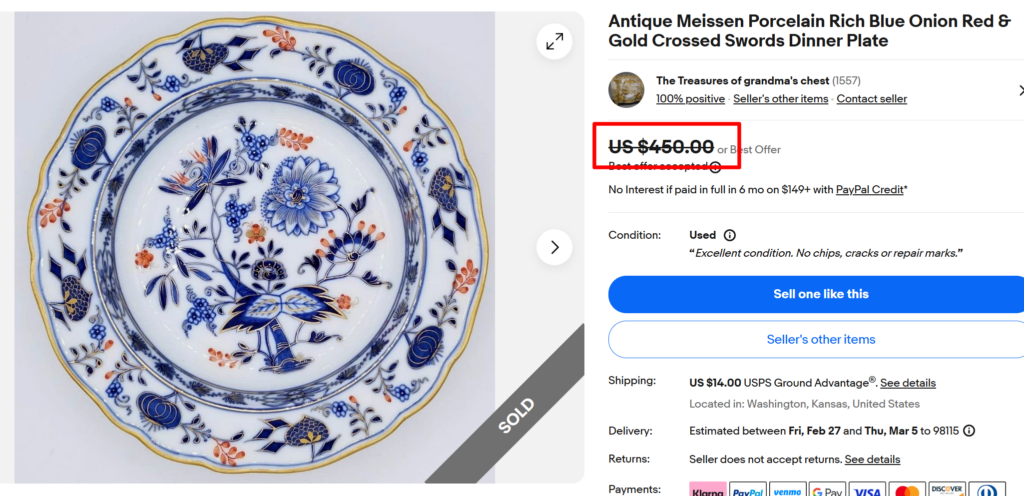
| Average Value | $80–$1,000+ per piece $5,000–$10,000+ (sets) |
| Manufacturer | Meissen Porcelain Manufactory |
| Manufacturing Period | 1739–present |
| Pattern/Theme | Blue underglaze pomegranates, asters, peaches, peonies & (NOT onions) |
| Collector’s Note | 19th-century pieces; most collectible |
The Blue Onion pattern was created in 1739 at the Meissen factory in Germany, loosely based on blue-and-white Chinese porcelain. You can identify it by the blue underglaze florals and pomegranates, peaches, peonies, and asters. That’s right, it’s not actually an “onion”.
Not only did this become Meissen’s most popular design, but it also became one of the most copied designs in porcelain history. That’s why authentication matters so much.
Individual 19th-century plates in good condition regularly sell for $300–$600. A complete dinner service can sell for over $10,000 to $20,000!
3. Pablo Picasso’s Madoura
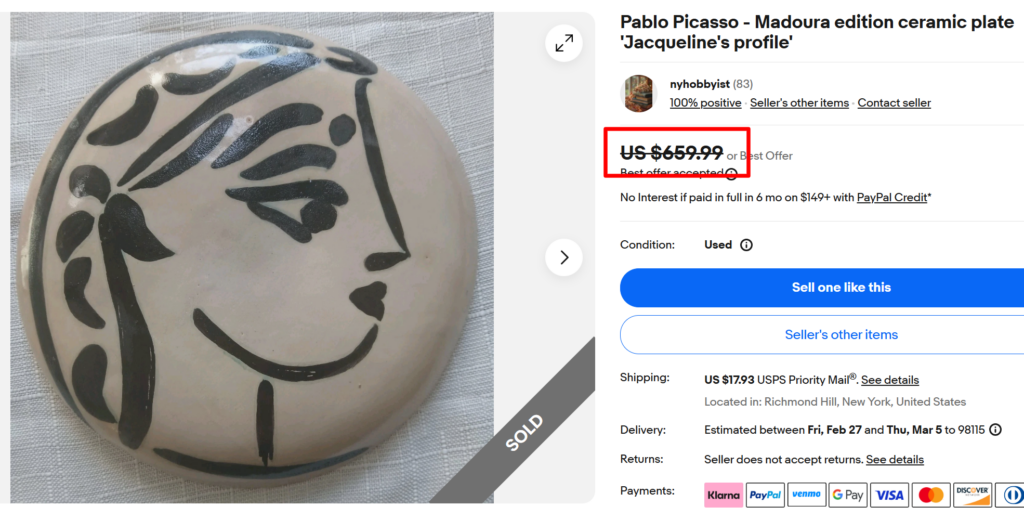
| Average Value | $500 – $5,000+ (single plates) |
| Manufacturer | Madoura Pottery (France) |
| Manufacturing Period | 1947 – 1971 |
| Pattern/Theme | Surrealist faces, bullfighting scenes, and animals. |
| Collector’s Note | Authentic plates have “Originale de Picasso” stamp |
In the mid-20th century, Picasso joined hands with the Madoura pottery studio in France to create limited-edition ceramic plates. During his 25-year collaboration, he designed around 4,000 unique ceramic items, known for their raw, earthy textures.
These are essentially original Picasso artworks, including realistic faces and animals, on a clay medium! Pablo’s ceramic plate designs are among the most valuable “vintage” designs today!
4. Spode’s Blue Italian
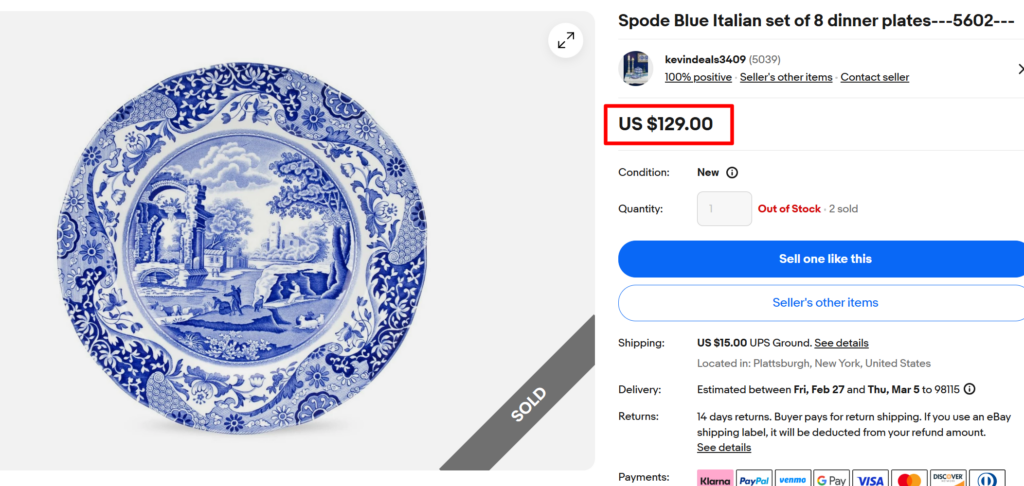
| Average Value | $40 – $300 |
| Manufacturer | Spode (England) |
| Manufacturing Period | 1816 – Present |
| Pattern/Theme | Pastoral Italian ruins in transferware |
| Collector’s Note | Pre-1833 pieces are worth the most |
This design, introduced by Spode in 1816, is literally the gold standard of Transferware! It features a central view of Italianate ruins, inspired by a 17th-century drawing, set against a river and mountains.
The central “European” view is contrasted with the traditional “Chinese” floral border, creating a fascinating East-West fusion. This adds to its historical context!
“Blue Italian” is renowned for its “underglaze” technique, in which the ink is painted on the porous “biscuit” clay before the final glaze is applied, so that the design will never fade or wear off, even after two centuries.
5. Blue Fluted (Musselmalet)
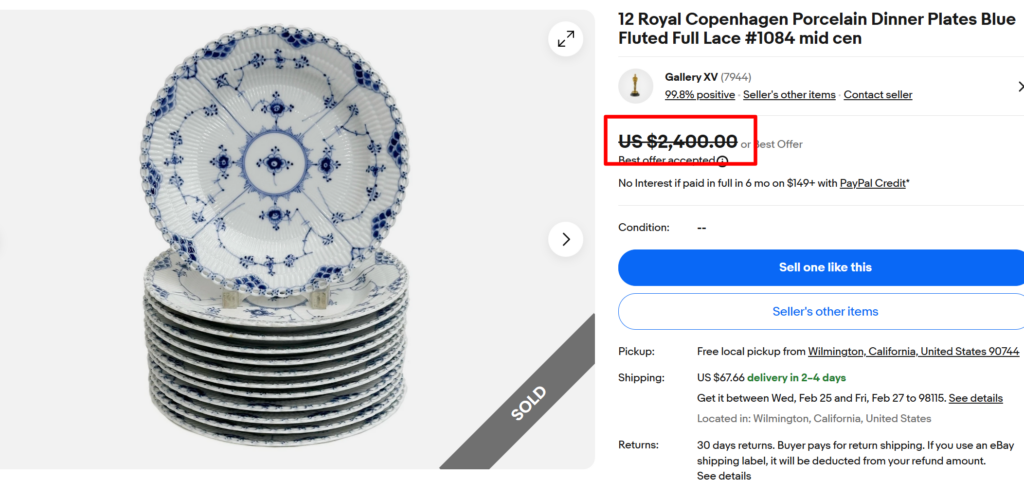
| Average Value | $100 – $800 $1,000-$2,500+ (full Lace sets) |
| Manufacturer | Royal Copenhagen |
| Manufacturing Period | 1775 – Present |
| Pattern/Theme | Stylized chrysanthemums & cinquefoil on a fluted white base |
| Collector’s Note | “Full Lace” openwork borders are worth the most |
This “Blue Fluted” pattern defines Royal Copenhagen’s identity. The pattern is a ‘Chinese porcelain look with slender necks and a European adaptation of a delicate, stylized floral motif’.
The motif is hand-painted in cobalt blue on a “fluted” (ridged) porcelain surface. More than 1,000 brushstrokes go into each plate, and the back shows the individual painter’s initials.
Also, these are three variations: Plain, Half Lace, and Full Lace (which has intricate perforations around the rim). Full lace plate sets can go up to thousands!
6. Herend’s Queen Victoria
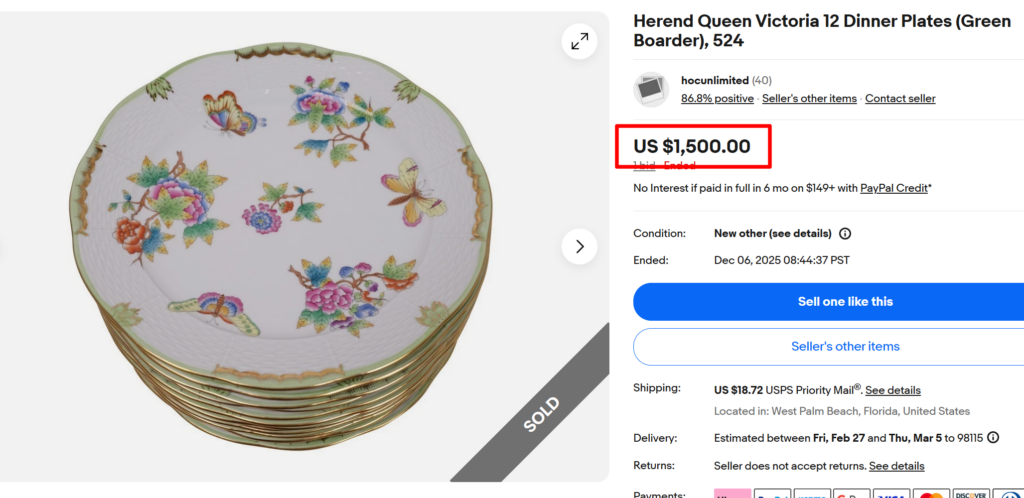
| Average Value | $100–$600 (per plate) $800-$2,000 (sets) |
| Manufacturer | Herend Porcelain Manufactory |
| Manufacturing Period | 1851–present |
| Pattern/Theme | Flowers, butterflies, moths & gold-accent basket-weave borders |
| Collector’s Note | Look for hand-painted features |
This pattern is named after Queen Victoria, who commissioned a set for Windsor Castle after seeing it at the Great Exhibition in London in 1851. You can spot it by vibrant flower and foliage motifs, butterflies, and moths, and a gilded scalloped basket-weave edge.
Herend has maintained hand-painting as its standard production method since its founding. This means every Herend plate is still hand-painted, so each piece is rare and unique.
Besides, older pieces from before the 1960s usually lack the green border found on later versions; examples without it are generally more desirable!
7. George Jones’ Majolica Oyster Plate Designs
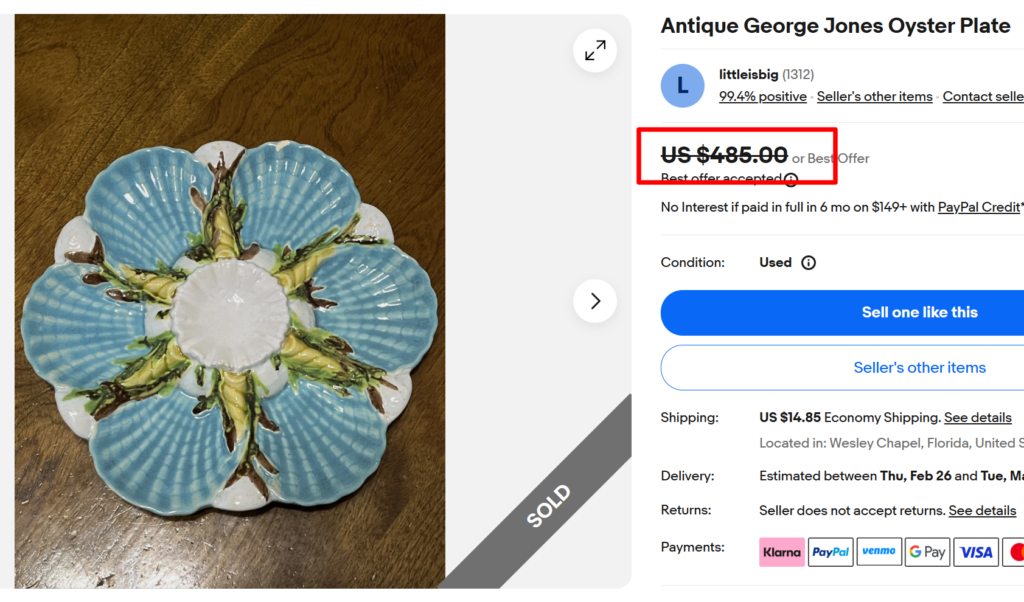
| Average Value | $300 – $1,500+ |
| Manufacturer | George Jones & Sons (England) |
| Manufacturing Period | 1860s – 1890s |
| Pattern/Theme | Shells & marine life in high relief |
| Collector’s Note | Rare color combinations are worth more |
George Jones’ oyster plates are most collectible among plate collectors! These are made of Majolica, known for its lead-based glazes that produce a brilliant, glass-like shine and saturated colors.
The designs are quite sculptural, featuring “wells” shaped like oyster shells or scallops, separated by molded “seaweed” or “coral” dividers. The color palette typically involves a vibrant “mottled” back (a mix of brown and green glaze) and a turquoise or cobalt blue front. The high-relief design makes the plates look 3D!
8. Fornasetti’s Tema e Variazioni
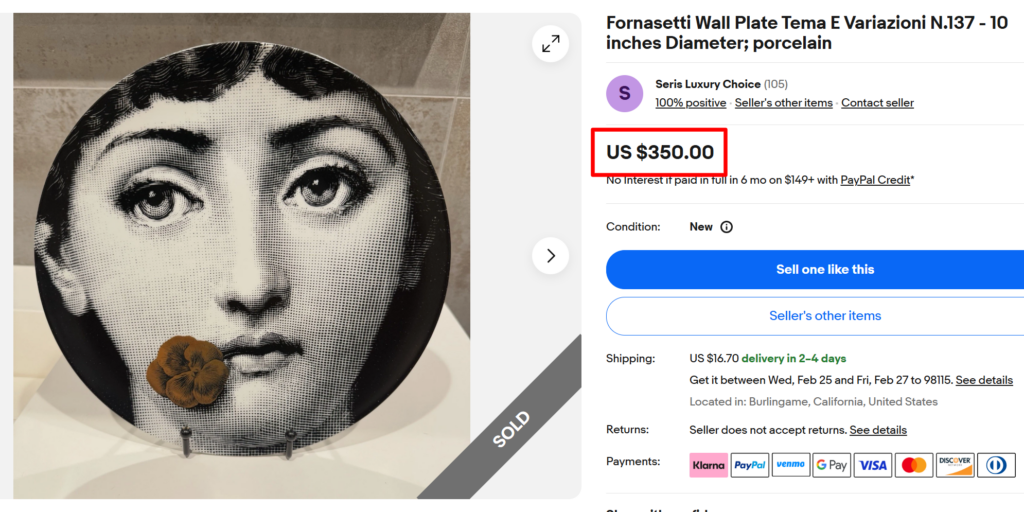
| Average Value | $200 – $800 |
| Manufacturer | Fornasetti (Italy) |
| Manufacturing Period | 1950s – Present |
| Pattern/Theme | Surrealist variations of a woman’s face. |
| Collector’s Note | 50s & 60s “Hand-applied” pieces are worth the most |
Piero Fornasetti was a master at “repetition with a twist.” The “Tema e Variazioni” (Theme and Variations) series is based on a single image of the 19th-century opera singer Lina Cavalieri, which Piero reinvented over 350 times.
Some pieces feature her as a thief in a mask, some as a sun, and some as even a piece of cheese. The plates are usually monochrome, highlighting the graphic, surrealist nature of the works. These plates reflected “Pop Art” style before Pop Art even existed!
9. Clarice Cliff’s Bizarre Series
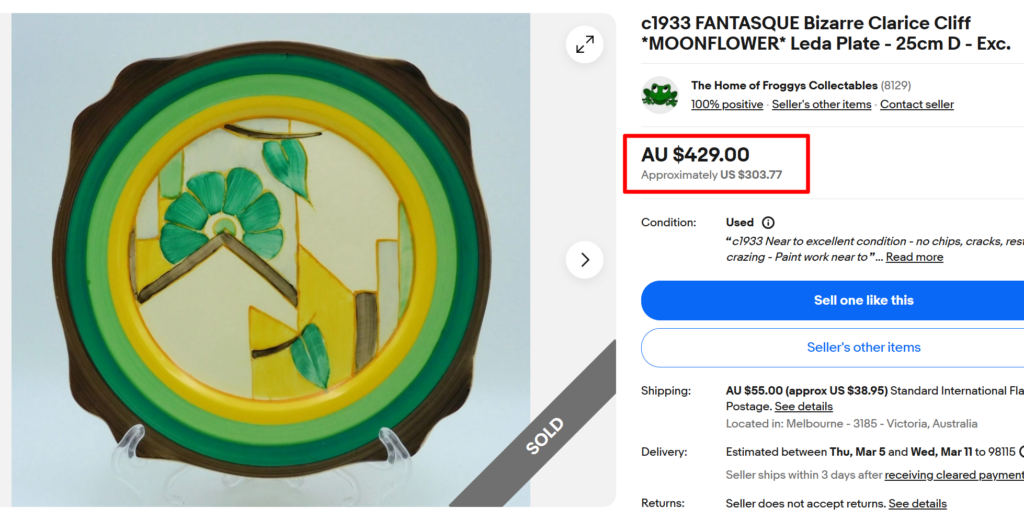
| Average Value | $300 – $2,000+ |
| Manufacturer | Newport Pottery/A.J. Wilkinson |
| Manufacturing Period | 1928 – 1936 |
| Pattern/Theme | Bold abstracts, shapes, & landscapes |
| Collector’s Note | Unusual shapes like “triangle” are rare |
“Bizarre” series displays the bold side of ceramics! Designed by Clarice Cliff, this pattern deviates from the “dainty floral” tradition of the 19th century.
Bizarre plates generally feature bold, “hand-painted” landscapes and geometric shapes in a vibrant, almost neon palette of orange, green, yellow, and black. The designs often include the “Crocus” pattern or the “Sunray” landscape with flattened perspective and thick, hand-applied colors.
These plates are prized for their “Jazz Age” energy and their ability to bridge the gap between functional craft and modern art. Authentic plates have the hand-painted “Hand Painted Bizarre by Clarice Cliff” signature on the back!
10. Sèvres’ Portrait Designs
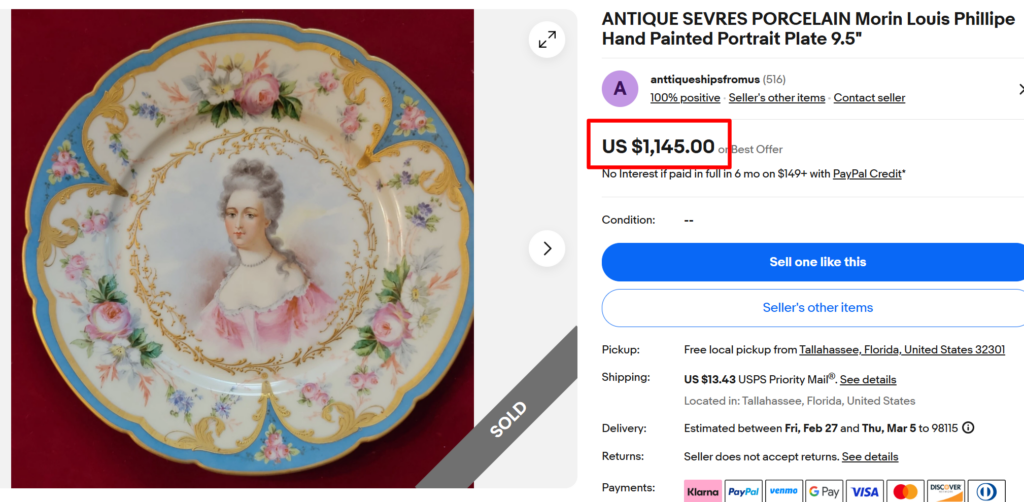
| Average Value | $1,000 – $15,000 per plate |
| Manufacturer | Sèvres (France) |
| Manufacturing Period | 18th & 19th Century |
| Pattern/Theme | Royal portraits & romantic scenes with gilding |
| Collector’s Note | True Sèvres has a soft or hard paste quality |
A pinnacle of 18th and 19th-century French dinnerware, Sèvres “Cabinet Plates” were made for display in glass-fronted cabinets rather than for food service.
The designs feature extremely accurate miniature paintings, often a portrait of an illustrious courtier such as Marie Antoinette or a “Fete Galante” (pastoral romantic scene).
The frame is usually a solid, bright color, most famously “Bleu de Roi” (King’s Blue) or “Rose Pompadour.” And most pieces are lavishly decorated with “raised gold” or “jeweled” enamel accents.
11. Blue Willow
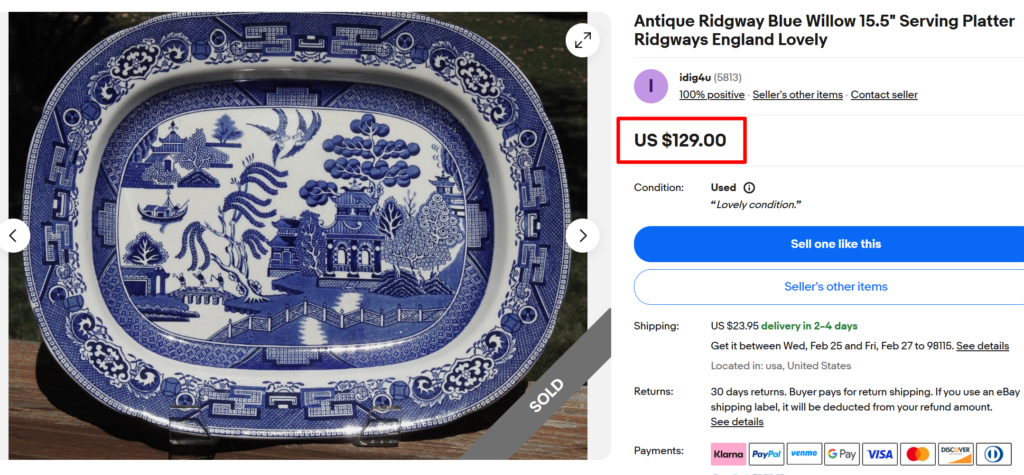
| Average Value | $100–$500 (Minton or Spode) |
| Manufacturer | Several (Originally Minton for Spode) |
| Manufacturing Period | 1790s–present |
| Pattern/Theme | A Chinese-inspired landscape |
| Collector’s Note | 18th-century Minton or Spode originals are worth the most |
The Blue Willow pattern was created by Thomas Minton in about 1790 and is likely the most reproduced transferware design in history. It features a detailed Chinese-inspired scene with a willow tree, pagoda, two birds, and three figures, all tied to the legend of two star-crossed lovers!
Generally, the earliest and original pieces from Minton and Spode are worth the most. But examples from several English manufacturers of the 19th century, i.e., Johnson Brothers, Allerton, Doulton, and Wedgwood, are also worth more than 20th-century American or Japanese pieces.
How to Tell If a Ceramic Design is Valuable?
Not all the old plates with a recognizable name are worth much. But certain factors actually separate a valuable design from a common, old one. Here are the questions you need to answer to know if you’re looking at a collectible design:
Is the Design Original or a Reproduction?
Some of the most renowned ceramic designs have documented names and histories, like Blue Willow, Blue Italian, and Flora Danica. If your plate’s design largely resembles these, you must compare it carefully with reference images.
Authentic examples have specific proportions, specific elements in specific positions, and specific border treatments. Even small differences can mean you have a copy or a different maker’s version rather than the original.
For patterns you don’t recognize, you can find similar-looking pieces on Replacements Ltd., WorthPoint, or Auction Houses. Or, you can refer to backstamp guides to connect the design to a known pattern and manufacturer.
Once you identify the pattern name, you can then learn what makes the valuable versions different from the common ones, and whether yours matches the right description.
Who Is the Maker?
The manufacturer of the plate is a crucial value driver. A plate by Meissen, Sèvres, or Herend will almost always hold higher desirability among collectors than pieces from local, lesser-known makers.
Why, you mask ask! These companies are famous for their high-end craftsmanship and expertise in their designs. Besides, many of them served royalty, and that history is part of what collectors are paying for.
So, make sure to identify the maker of your plate using the backstamp or the pattern itself, by looking it up in authentic guides and catalogs.
Is the Design Hand-Painted or Transfer-Printed?
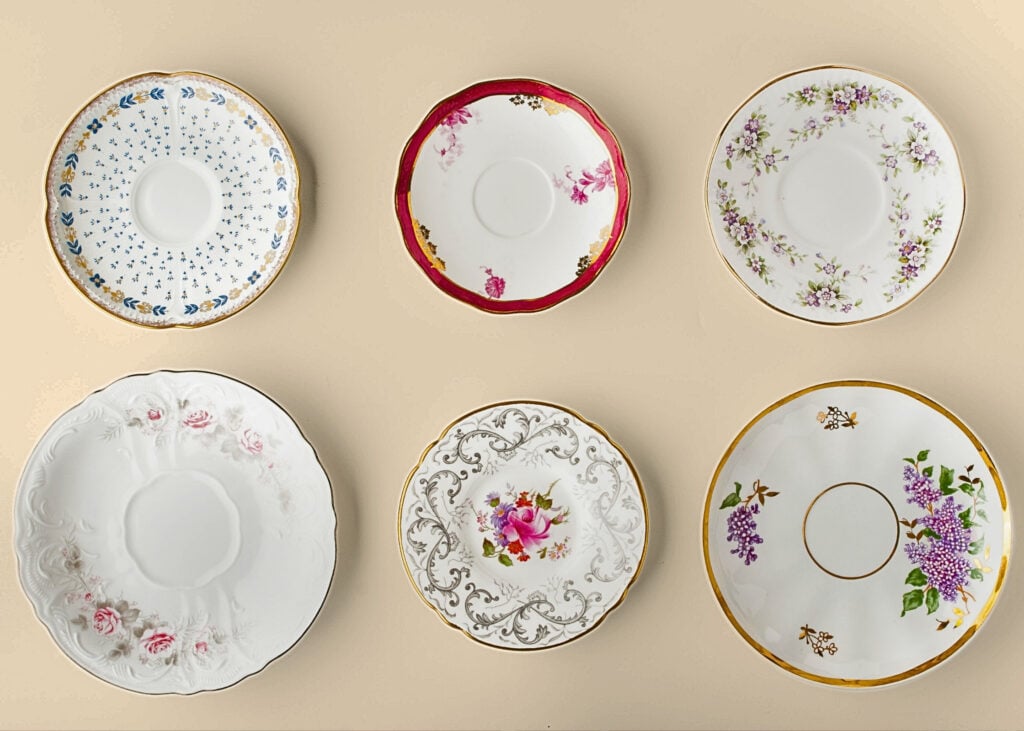
This is the first thing to check, because it determines everything else. Watch the painted areas of your plates closely.
Hand-painted designs often show a subtle brush texture, some color variation, and slight inconsistencies from plate to plate. Transfer-printed ones, on the contrary, look flat and uniform, with crisp, identical lines across every piece in the set.
Hand-painted plates are almost always more valuable. But that doesn’t decide everything. A 19th-century transfer-printed Blue Willow plate from a named English maker can still be worth $200+. Once you know which technique was used, the next step is to check the quality and origin of the decoration.
How Complex and Detailed Is the Design?
Generally, more detailed, more labor-intensive designs are more valuable, especially when the complexity is obvious. If you see detailed landscapes, a portrait medallion, or a botanical illustration, you’re looking at a valuable design!
The border design also plays a vital role. The most collectible designs will have obvious, expert craftsmanship in both the central design and the border. Multiple decorative techniques used together, like hand-painting with raised gilt borders, gilded stippling, or applied color grounds, are features of a higher-tier design.
Does the Design Include Gold or Gilt Decoration?
Gold decoration is a common feature of collectible ceramic plates, but only real gold decoration will increase the value. True 24-karat gold gilding on antique plates has a warm, matte-to-satin finish, rather than the bright, sharp metallic finish.
And with time, genuine gilding shows light wear along the rim and raised edges.
Heavily gilded borders with layered decoration, raised paste gilding, stippled gold backgrounds, and tooled or burnished gold details. All these features are signs of a higher-grade dinnerware design, like Sèvres and Herend!
Is the Design Intact?
The condition of the design, as well as the plate, is everything when it comes to value. A rare pattern only has a high value if the design is still crisp and vibrant.
Pay attention to the colored elements and gilding. If the colors and gilt look faded, dull, or “ghosted,” it usually means the dish was ruined by harsh dishwasher detergents.
Collectors see faded plates just as a “utility” item, worth only a few dollars.
Note: This article is intended for informational, educational, and entertainment purposes only. Some images are illustrative and may not represent actual brands, products, or related entities. All trademarks, product names, brand logos, packaging, and other intellectual property referenced remain the exclusive property of their respective owners. Any brand mentions or references are provided solely for descriptive and educational context and do not imply any formal or commercial association.