Antiques Know How Research
Collectible Gold Dinnerware
Based on our detailed analysis of several sold eBay listings and auction results, vintage gold dinnerware sets range from $120 for partial sets up to $1,000 per single plate, with full services fetching $2,000–$8,000. The most valuable gold-trimmed dinnerware patterns include Royal Crown Derby Old Imari, Royal Doulton Raised Gold Paste, Wedgwood Florentine Gold, Lenox Lowell, and Royal Copenhagen Flora Danica!
Antiques Know How
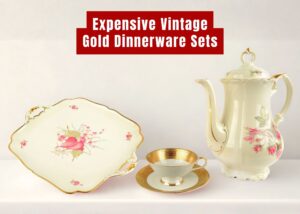
Once considered the ultimate expression of “Gilded Age” luxury, gold dinnerware sets still hold a strong place in the market. But this time, with a greater collector value. So, if you have old, vintage gold-trimmed china pieces in your cabinets, you could be in luck!
This list covers 11 of the most consistently valuable gold dinnerware patterns collectors seek out, along with some important things to look out for!
Luxurious Collectible Gold Dinnerware Sets Worth Money!
1. Royal Copenhagen’s “Flora Danica” Sets
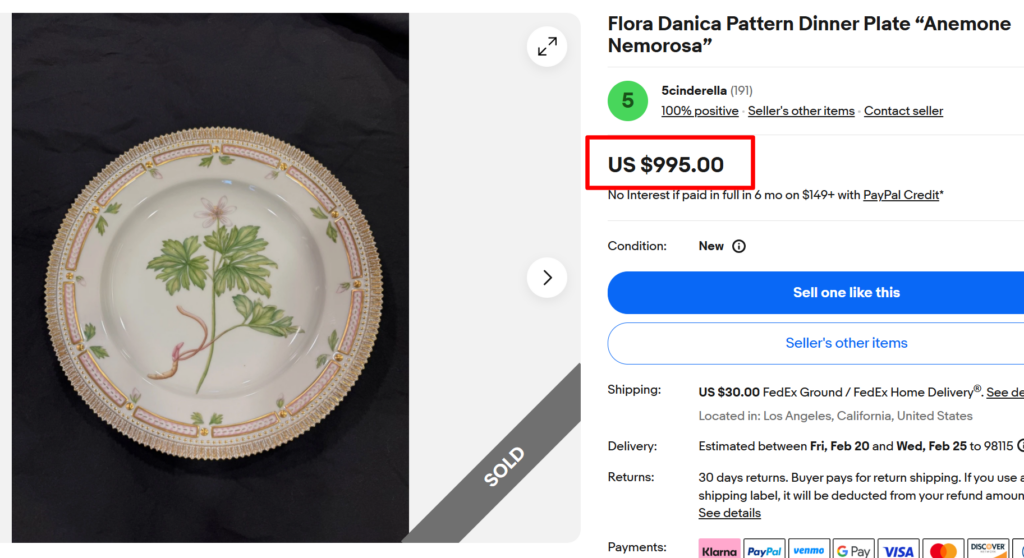
| Average Value | $15,000-$50,000+ (Full service) $500– $2,500 per plate |
| Brand | Royal Copenhagen (Denmark) |
| Manufacturing Period | 1790 – Present |
| Pattern/Theme | Botanical specimens from the “Flora Danica” encyclopedia with gold rims |
| Collector’s Note | Look for the Latin name of the plant on the back |
One of the most prestigious dinnerware designs, “Flora Danica,” was originally commissioned in 1790 as a gift for Empress Catherine the Great. While famous for its botanical illustrations, it is the heavy, hand-tooled 24k gold serrated edges that command astronomical prices.
Each piece is hand-molded and hand-painted, with botanical specimens from the “Flora Danica” encyclopedia, making each piece unique. Although the company still makes these, vintage mid-20th-century dinner sets or plates are prized.
2. Royal Crown Derby’s “Old Imari” Sets
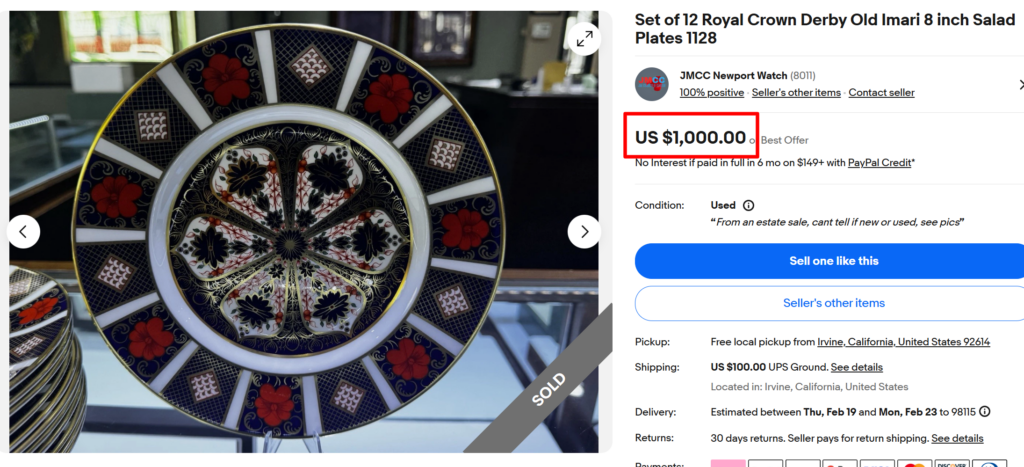
| Average Value | $1,000–$8,000 (service for 8–12) |
| Brand | Royal Crown Derby |
| Manufacturing Period | Late 1800s–present |
| Pattern/Theme | Japanese Imari-inspired design in red, blue, & 22-carat gold |
| Collector’s Note | Sets with matching date codes are more valuable |
Royal Crown Derby’s “Old Imari” is probably among the most popular gold dinnerware in the English fine bone china world. Each piece combines iron red, cobalt blue, and 22-carat gold in a bold floral-and-geometric design in 18th-century Japanese Imari style.
The pattern has been in production since the late 19th century at the Derby factory, but it’s primarily the early pieces that hold strong value. Small plate sets in pristine condition, like this example, generally go for $1,000+, and complete service can fetch even more!
3. Haviland Limoges’ “Marquis” Sets
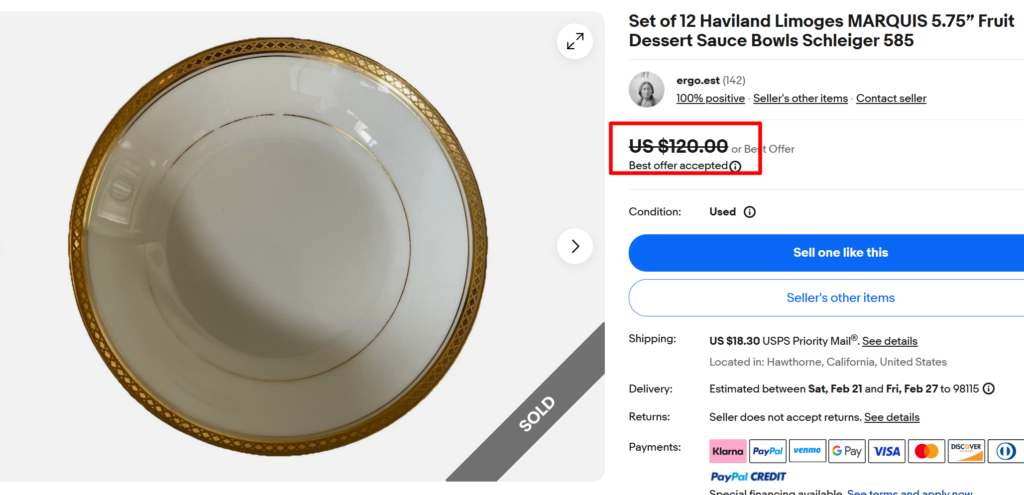
| Average Value | $1,500–$3,000 (Full service) $40–$150 (singles/small sets) |
| Brand | Lenox (Trenton, New Jersey |
| Manufacturing Period | 1894–1940s |
| Pattern/Theme | Gold-encrusted bands with foliate or scrolls on Limoges porcelain |
| Collector’s Note | Significant gold wear will significantly reduce the value |
Theodore Haviland and Haviland & Co.’s French porcelain gold-encrusted patterns, particularly the Marquis, are among the most sought-after. The design looks simple, a thin gold-encrusted band (with texture variation) with scrolls on porcelain!
As for the value, single sets of dinner or salad plates are moderately valuable, while extensive sets, like a 100+-piece set, can realize up to $2,000 at auction.
Note: Marquis pieces usually show two types of marks: an underglaze white-ware mark for the Limoges factory and an overglaze decorator mark. Pieces with “Haviland Limoges France” without “Theodore” are from the 1894–1931 period.
4. Lenox’s “Lowell” Sets
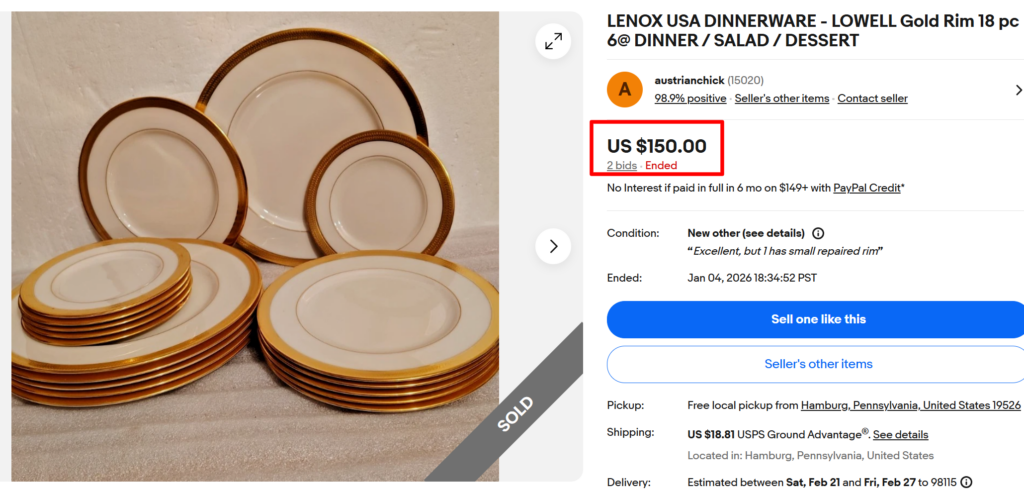
| Average Value | $1,500–$6,000 (Full service) $40–$150 (singles/small sets) |
| Brand | Lenox (Trenton, New Jersey |
| Manufacturing Period | 1917–1970s |
| Pattern/Theme | Gold-patterned rim border on ivory-colored bone china |
| Collector’s Note | Pieces with the green wreath mark (1906–1930) are sought-after |
Lenox china has been on the White House table since Woodrow Wilson commissioned 1,700 pieces in 1918. You can spot it by its sophisticated gold-patterned rim on an ivory ground.
Introduced in 1917, the Lowell pattern is one of Lenox’s most consistently valuable designs. Complete Lowell dinner services are far less common than individual pieces, which is what drives the price on full sets.
5. Minton’s Cobalt and Gold-Encrusted Dinner Sets
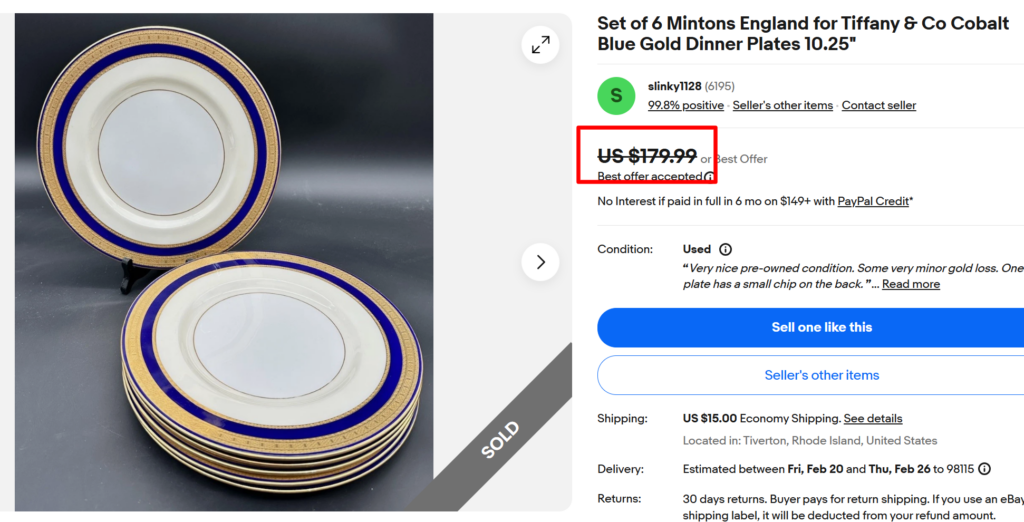
| Average Value | $700–$3,000 (complete service) $400–$1000 (12-plate sets) |
| Brand | Minton (Stoke-on-Trent, England) |
| Manufacturing Period | 1870s–1920s |
| Pattern/Theme | Cobalt blue collar with raised gold bands & foliate decoration |
| Collector’s Note | Pieces with the green wreath mark (1906–1930) are sought-after |
Minton’s gold-encrusted dinner services were released as commissioned pieces for mega retailers like Tiffany & Co. Their cobalt blue collar plates with raised 24-karat gold swags, medallions, and acid-etched banding are the most collected pieces.
You can spot the rare “Gold Crocus” pattern, made specifically for Tiffany, by its scalloped edges, gilt rims, and crocus flower center.
Note: The impressed “Minton” dates from around 1873. Post-1891 pieces show “England” marking per the McKinley Tariff Act, and post-1900 pieces show “Made in England.”
6. Royal Worcester’s “Evesham Gold” Sets
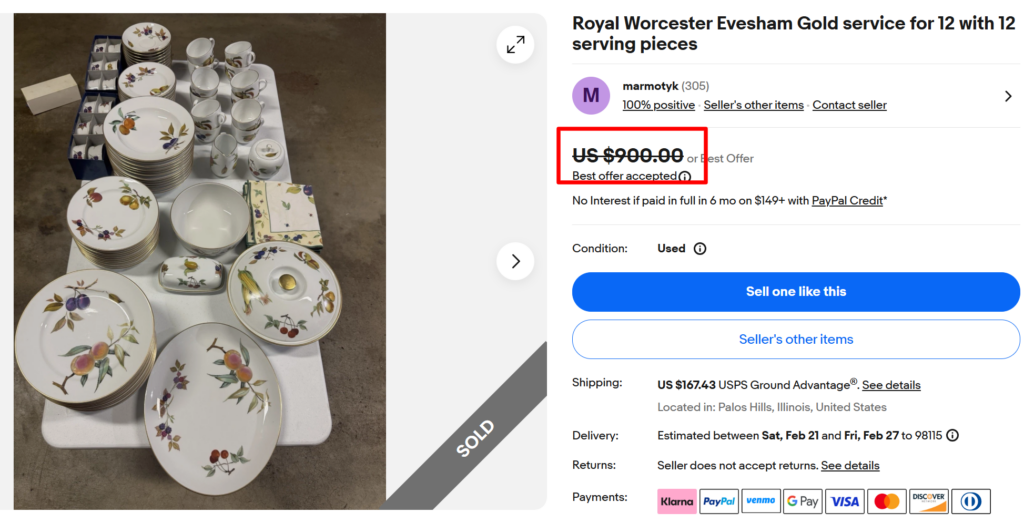
| Average Value | $400–$1,200 (Full service sets) $200–$500 (small sets) |
| Brand | Royal Worcester |
| Manufacturing Period | 1961–2014 |
| Pattern/Theme | Hand-painted harvest fruits & gold rim on ivory china |
| Collector’s Note | Sets with the Minton mark AND a retailer mark are worth more |
Royal Worcester’s “Evesham Gold” is a more “attainable” design than some museum-tier sets! This mid-century luxury design features vibrant illustrations of autumnal fruits, like pears, plums, apples, berries, etc., and a golden trim.
This line kick-started the “oven-to-table” porcelain trend while maintaining a high-fashion look with its thick, lustrous gold banding.
7. Wedgwood’s “Florentine Gold” Dinner Set
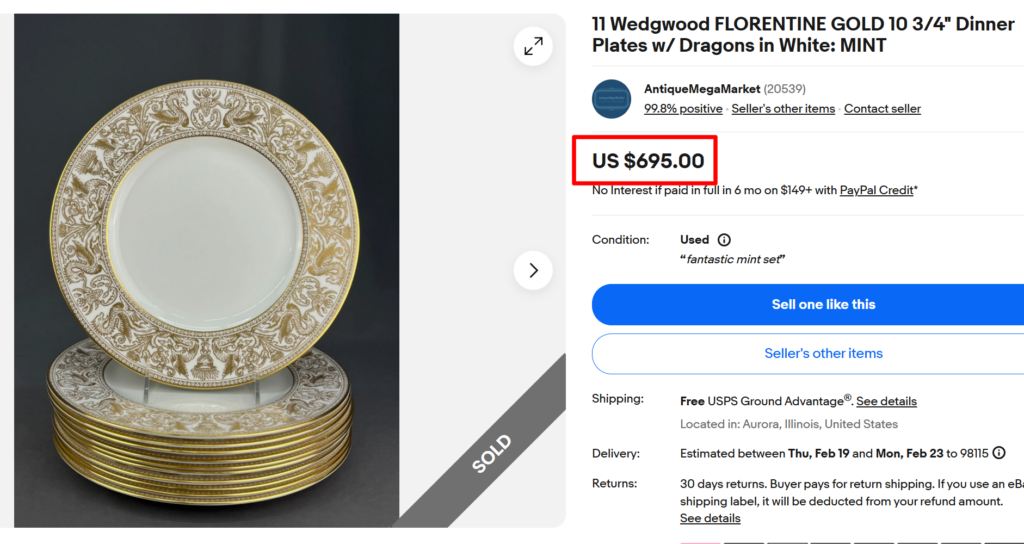
| Average Value | $400–$1,500 (full service for 8–12) |
| Brand | Wedgwood (Stoke-on-Trent, England) |
| Manufacturing Period | 1960s–1990s (Gold Florentine W4219) |
| Pattern/Theme | Mythological creatures and scrollwork in gold |
| Collector’s Note | The pattern number “W4219” appears on the backstamp in red |
The “Florentine” pattern is a Wedgwood masterpiece! Usually seen in turquoise, the Gold version, featuring a dark gold band with a dragon motif and scrolls, is collectors’ favorite. Large, complete service sets can sell for over $1,500!
The gold-on-white W4219 version of this pattern ran from the 1960s through the 1990s. And authentic pieces typically show the “W4219” pattern number on the base to verify them.
8. Royal Doulton’s Raised Gold Paste Sets
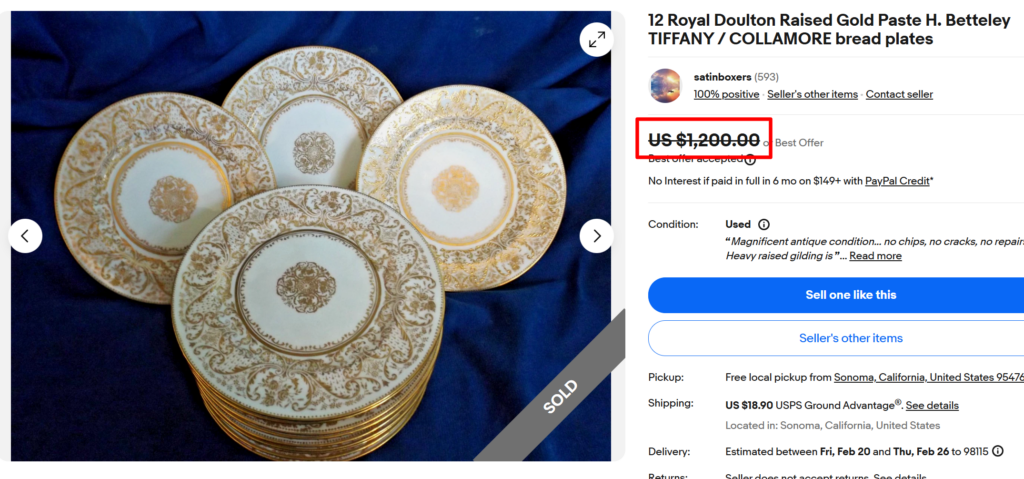
| Average Value | $700–$2,000 (set of 12 plates) $2,500–$4,500+ : (full service) |
| Brand | Royal Doulton – for Tiffany & Co. and Davis Collamore & Co. |
| Manufacturing Period | 1890s–1920s |
| Pattern/Theme | All-over raised gold paste scrollwork & medallions on ivory bone china |
| Collector’s Note | Pieces signed by H. Betteley are most desirable |
Royal Doulton made these raised gold paste sets as commissioned pieces for Tiffany & Co. and Davis Collamore & Co.! These pieces have a thick, raised gold paste built up directly on bone china, creating a 3D design with visible texture.
This design was created by Royal Doulton’s decorator, H. Betteley, whose signed pieces hold the highest value. Full services can easily fetch a few thousand dollars.
9. Noritake’s Azalea Sets
| Average Value | $100–$500 (Regular sets) $500+ (Comprehensive sets) |
| Brand | Noritake (Japan) |
| Manufacturing Period | 1916 – 1930s |
| Pattern/Theme | Pink hand-painted azaleas with heavy gold handles and rims. |
| Collector’s Note | Rare serving pieces (relish dishes or chocolate pots) are rare |
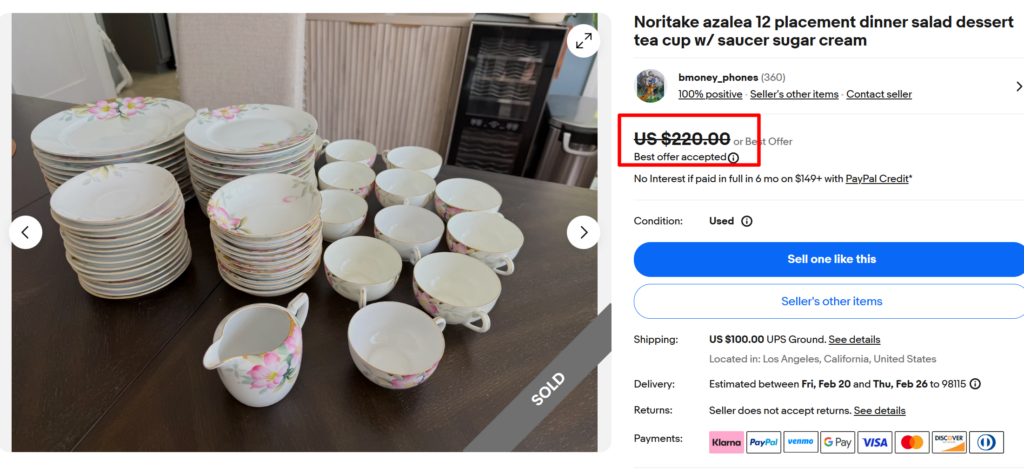
This is a complete dinner set featuring Noritake’s “Azalea” pattern, produced from 1918 through 1941 exclusively for distribution through the Larkin Company of Buffalo, New York.
The design is easily recognizable with the soft pink azalea motifs with gold accent trim. Since customers earned these Noritake pieces via Larkin product purchases, complete sets were genuinely difficult to assemble.
But overall, “Azalea” dishes are widely available, mid-range complete sets rarely exceed $300–$500 unless they include rare serving pieces like the covered casserole, sauce boat, etc.
10. Meissen “B-Form” Gold and Cobalt Blue Sets
| Average Value | $3,000–$15,000 (full services for 12) |
| Brand | Meissen Porcelain Manufactory |
| Manufacturing Period | 18th–19th century (Later 1930s, 1960s) |
| Pattern/Theme | Blue base with gold bordered panels, floral/Deutsche Blumen centers |
| Collector’s Note | Real pieces show hand-painted swords in underglaze blue |
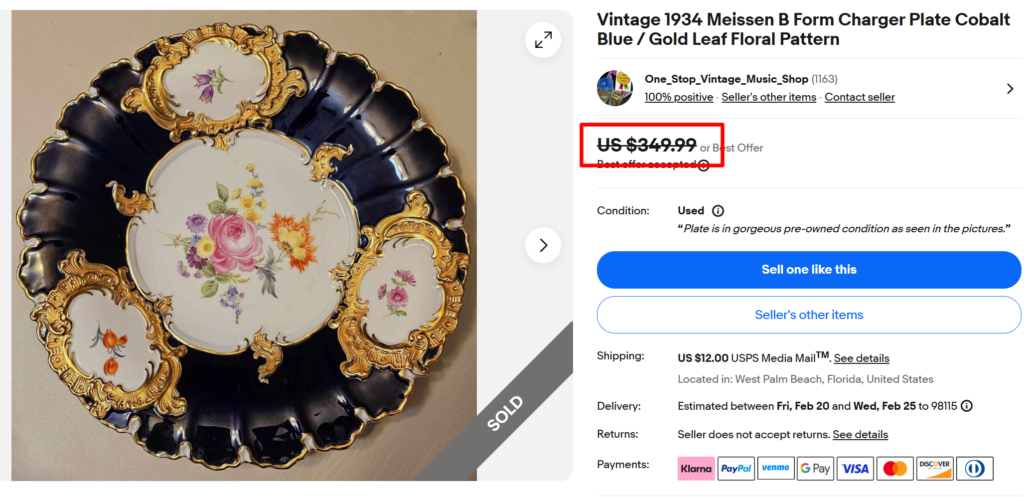
Meissen’s iconic B-Form is a unique design with cobalt blue ground, heavy gilt cartouche borders, and hand-painted floral centers on a scalloped shape. While the maker originally made this design between 1844 and 1855, it was made throughout the 20th century, especially in the 1930s.
Today, Meissen’s B-form pieces are highly sought after; single plates sell for a few hundred dollars, and large services fetch thousands!
Note: Pre-1924 Meissen pieces may also lack the “Germany” or “Made in Germany” export mark, as it was initiated after that date.
What to Look for in Vintage Gold Dinnerware Sets?
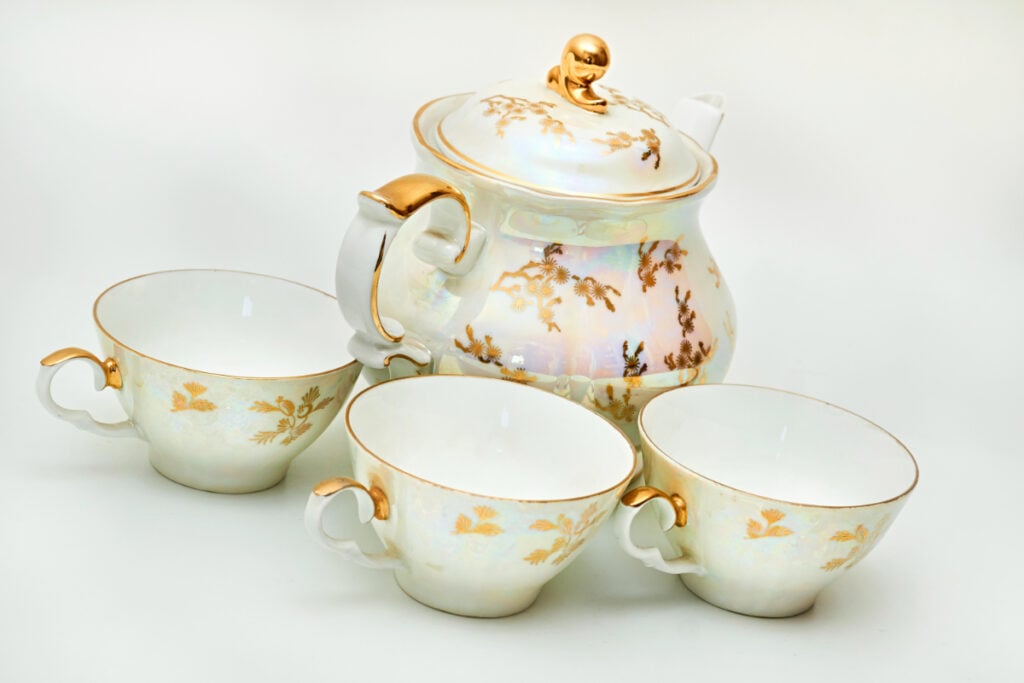
When evaluating gold dinnerware, not all glisten is equal. Here is how to distinguish a common set from true antique dinnerware.
The Method of Application (Gilt vs. Encrusted)
The first thing to check in vintage gold dinner sets is how the gold decoration is applied. Generally, three methods were used to gild the pieces:
- Acid-etched and Tooled Gold: This technique involves applying gold to the bisque-fired piece, engraving patterns while the gold is still soft, then refiring. The result is a 3D gold surface with texture you can feel with your fingers. Minton, Royal Crown Derby, and Pickard’s pieces use this method.
- Hand-applied Encrusted Gold: This is a mid-tier style, in which the artist applies a thick gold paste with a brush, producing a slightly raised surface but without the precision of acid etching. You’ll find this on Limoges and Lenox pieces of the early 20th century.
- Printed or Transfer Gold: Since it’s applied mechanically, this gold decoration looks flat and uniform, with no texture variation. It’s common in late-20th-century mass-produced china and holds the lowest value!
Maker’s Marks and Backstamps
The second most important thing to check is the backstamps on gold dinnerware. Every piece in a set should carry the maker’s mark on the base. For gold dinnerware, the marks help you identify not just who made it, but when.
Also, check for consistency of the marks across the set; ideally, all pieces must have the same (or similar, if it’s handmade) mark from the same production period.
If you see mixed-era marks on the pieces of a set, it suggests that the set was assembled from multiple sources, and is NOT an original set!
Translucency and Bone Ash
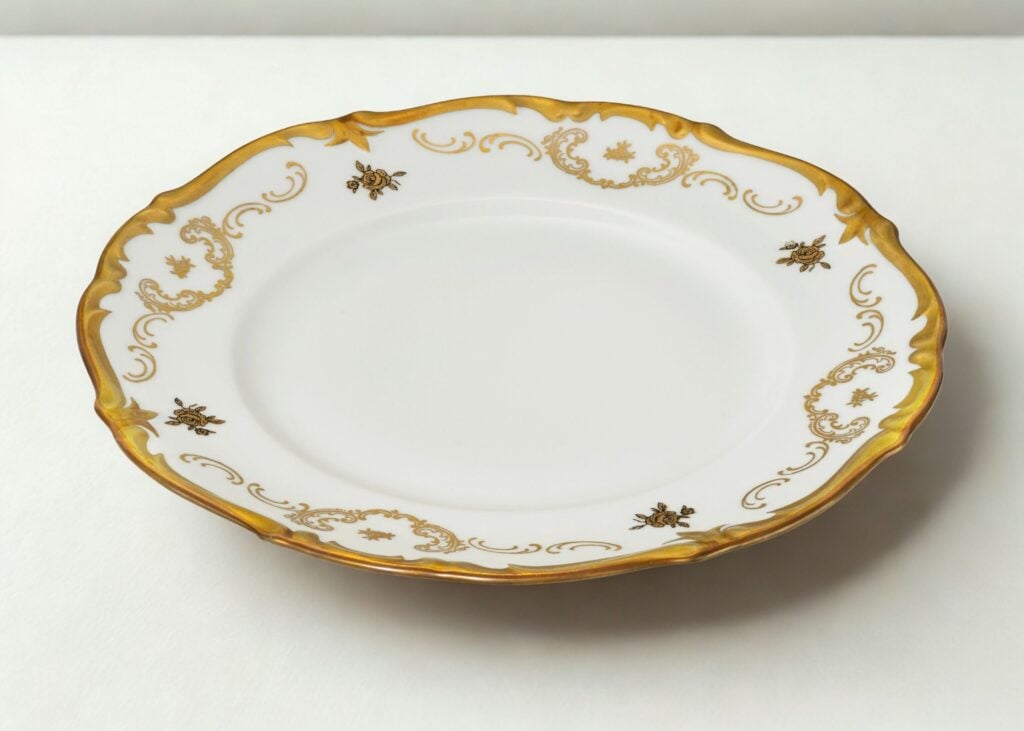
Next, check the material of your dinner set. For this, hold a piece up to a light source; if you can see the shadow of your hand through it, it’s likely Fine Bone China, which is durable and actually valuable.
If the piece is not translucent, it’s most likely stoneware or earthenware, which might have gold paint but isn’t as desirable as the porcelain pieces.
And, if the piece makes a clear, resonant ring when tapped lightly with a fingernail, it’s likely hard-paste porcelain, common in Meissen, Limoges! But gold decoration over low-quality porcelain is not worth much, regardless of the gold work.
Condition of the Gold Decoration
No matter the type of application, gold wear is inevitable, irreversible, and a huge value driver. So, make sure to check each piece in bright light; you will notice wear signs as dull patches against the reflective gold surface.
Now, minor wear on dining surfaces is expected and acceptable, but heavy gold loss on the decorative borders (more than 20%) can drop the value significantly.
Secondly, if the gold on the pieces has been touched up after original production, it is also easily detectable; modern gold is likely to have a brighter, more yellow tone than period gold. Repair and retouching also deduct the value.
And not to forget, the overall condition, like chips, cracks, and heavy crazing, of the dinnerware pieces also impacts the overall worth of the set.
Completeness of the Set
Lastly, count the pieces of a set! Generally, a complete service for 12 with all matching serving pieces, a covered tureen, a sauce boat, platters, and serving bowls, is worth considerably more than the sum of its individual pieces.
Serving pieces are almost always harder to find because they were used more heavily and broke more often.
Note: This article is intended for informational, educational, and entertainment purposes only. Some images are illustrative and may not represent actual brands, products, or related entities. All trademarks, product names, brand logos, packaging, and other intellectual property referenced remain the exclusive property of their respective owners. Any brand mentions or references are provided solely for descriptive and educational context and do not imply any formal or commercial association.