Antiques Know How Research
Vintage Jadeite Glassware Value
A detailed analysis of several eBay sales by our Antiques Know How team shows that vintage jadeite glassware usually ranges from $20–$150 for common pieces, with rarer forms and sets reaching $400–$1,500 or more. The most collectible jadeite pieces include Fire King’s teardrop nesting bowls, ball pitchers, and grill plates, Jeannette’s square canisters, McKee’s uranium shakers, and Laurel‑bordered dinnerware, L.E. Smith and Fenton’s Martha‑era pieces. The authenticity relies on maker marks, uranium‑glow on pre‑1945 pieces, and weight.
Antiques Know How
What is Jadeite Glass?
Jadeite is an opaque, milky green borosilicate glass that rose to popularity during the Great Depression. It was originally marketed as a durable, affordable alternative to delicate china that could withstand the heat of busy kitchens of restaurants as well as homes.
While companies like McKee and Jeannette pioneered the color in the 1930s, it was Fire-King who actually made jadeite glass a household staple in the 1940s. Its modern collectibility skyrocketed in the 1990s, fueled by Martha Stewart’s personal collection and a renewed love for vintage farmhouse aesthetics.
11 Collectible Milky Green Jadeite Glass Pieces
Below are listed some highly notable jadeite pieces that are actively selling on the secondary market. Each one is worth the money for different reasons.
1. Teardrop Nesting Bowls – Fire King
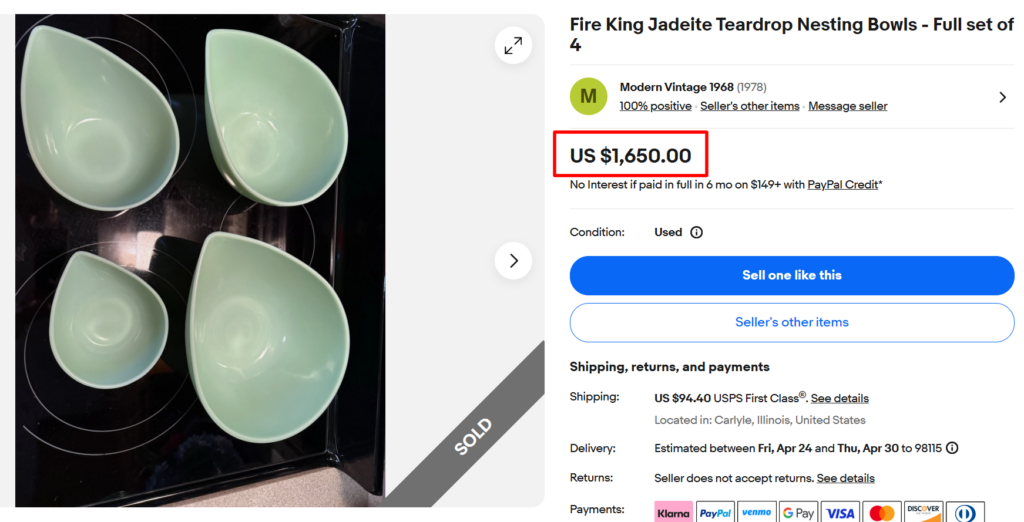
| Average Value | $1,200 – $1,700 (packed set of 4) |
| Time Period | 1940s – 1950s |
| Brand | Anchor Hocking (Fire-King) |
| Key Features | Pointed teardrop spout, nesting design |
| Collector’s Note | A complete, boxed set is a rare find |
Also known as Swedish Modern, these four teardrop-shaped bowls nest together in graduated sizes. Fire King made these during the 1940s and 1950s, and you can verify the attribution by the “Fire King / Ware / 12 / Pat. Pend.” stamp on the base of each piece.
The sizes run roughly 6½, 8, 9⅜, and 11 inches across. And since the second-smallest bowl was likely sold separately as a promotional item, complete sets of four bowls are very hard to find and, hence, highly valuable today.
2. Square Containers – Jeannette
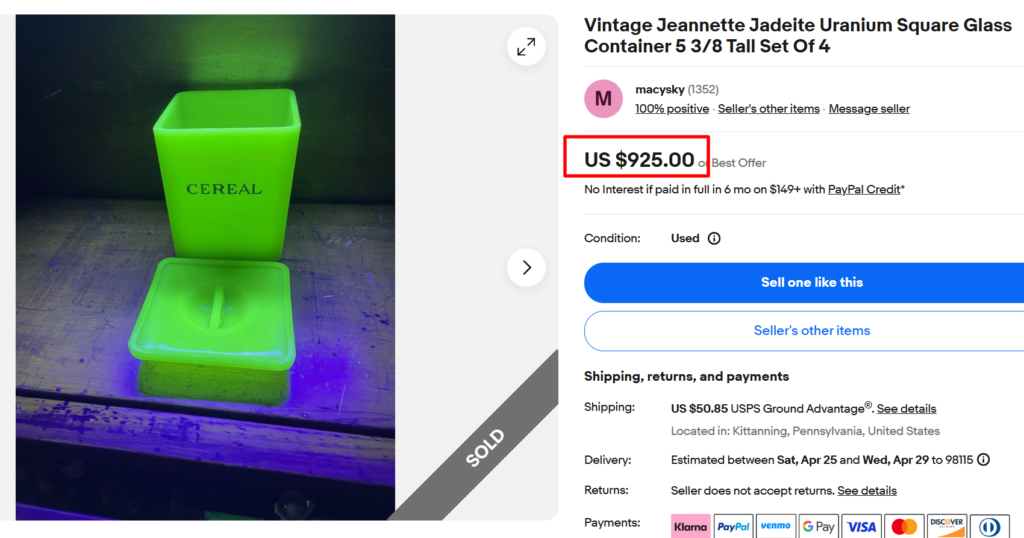
| Average Value | $850 – $1,100 (Set of 4) |
| Time Period | 1930s |
| Brand | Jeannette Glass Company |
| Key Features | Square shape, block lettering, intense UV glow |
| Collector’s Note | Canister sets are more valuable. |
Jeannette made these square kitchen canisters in the 1930s as part of their Poinsettia lid line. Each container is about 5⅜-inch tall and has raised lettering like CEREAL, COFFEE, TEA, or SUGAR on the front.
Besides, these contain uranium, so always make sure they glow bright green under a UV blacklight. Also, look for a “J” in a triangle on the base. But since many Jeannette canisters are unmarked, not finding a mark doesn’t directly mean it’s fake. But the uranium glow is a clear check.
The value of these canisters lies in completeness. A set of 4 or more canisters with matching lids in good condition can easily sell for $800 to $1,000 or more.
3. Ball Pitcher – Fire King
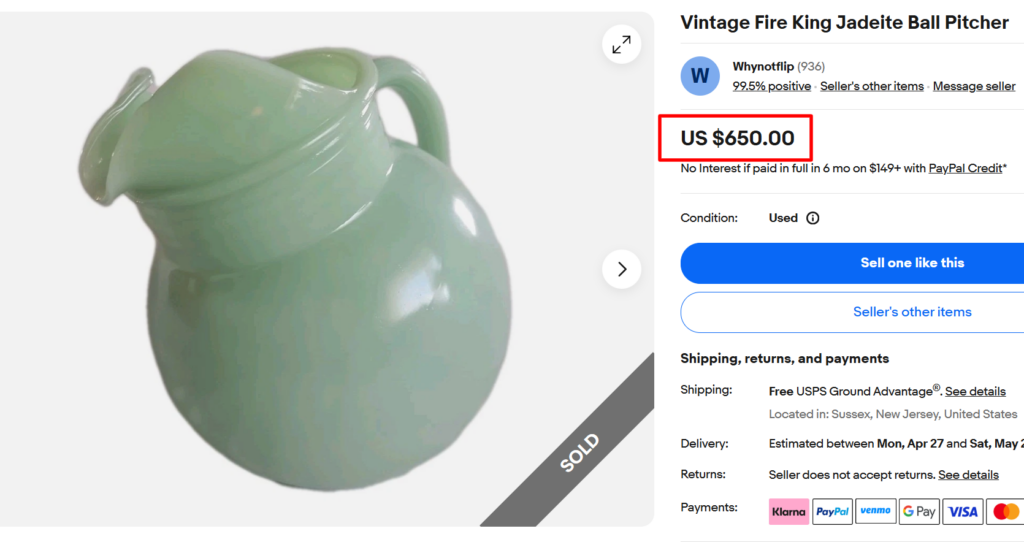
| Average Value | $400 – $700+ (pristine condition) |
| Time Period | 1940s – 1950s |
| Brand | Anchor Hocking (Fire-King) |
| Key Features | Round body, ice-retaining lip, ergonomic handle |
| Collector’s Note | Original Fire-King foil labels add value. |
This ball-shaped pitcher from Fire King is a collector’s dream. It belongs to the brand’s Restaurant Ware line, and features an iconic Art Deco shape with a spherical body and a tilted ice lip.
However, unlike other Restaurant Ware pieces, this piece is much thinner and prone to chipping and cracking. This is why “mint condition” examples command a significant price premium, often around $500 to $800.
Original pitchers carry no maker’s mark on the base, but feature the “Fire-King” foil label. Since these labels are usually lost, a pristine example with an intact label is a valuable find.
Quick Note: Check for a pucker or dimple where the handle meets the body. This is a common flaw on Gibson reproductions.
4. Hobnail Cake Stand – L.E. Smith
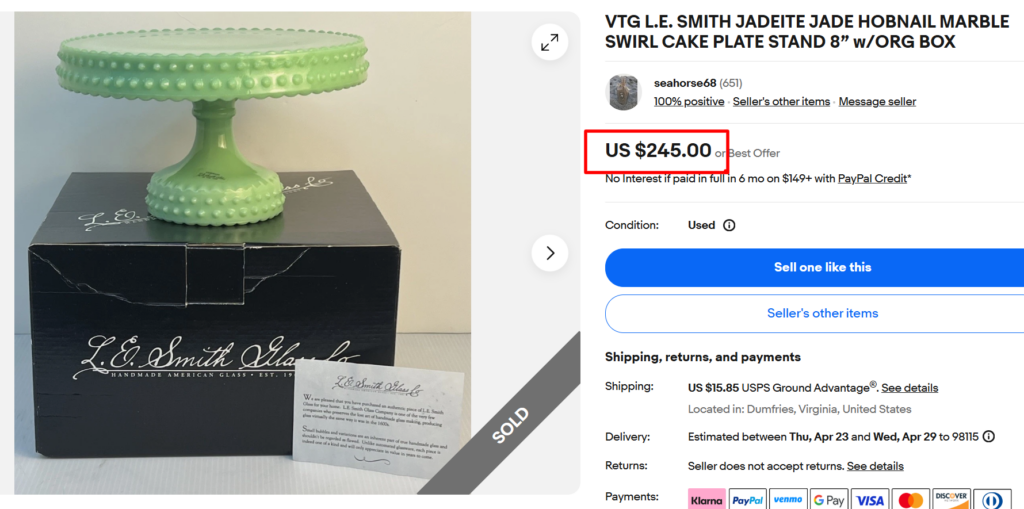
| Average Value | $100 – $250+ (with box) |
| Time Period | Late 1990s – early 2000s |
| Brand | L.E. Smith Glass Co. |
| Key Features | Raised hobnail studs, pedestal base, marbleized swirl |
| Collector’s Note | Original boxes are rare and add value. |
L.E. Smith produced hobnail jadeite pieces in the late 1990s and early 2000s, some for the Martha by Mail line. The raised bumps, called hobnails, cover the pedestal and edge of the 8-inch plate.
Having the original L.E. Smith box roughly doubles the value, since the boxes rarely survive, and ensures authenticity. If there’s no box, check for the “Handmade / LE Smith Glass” sticker on the piece itself to confirm the maker.
5. Deviled Egg Rabbit Dish – L.E. Smith
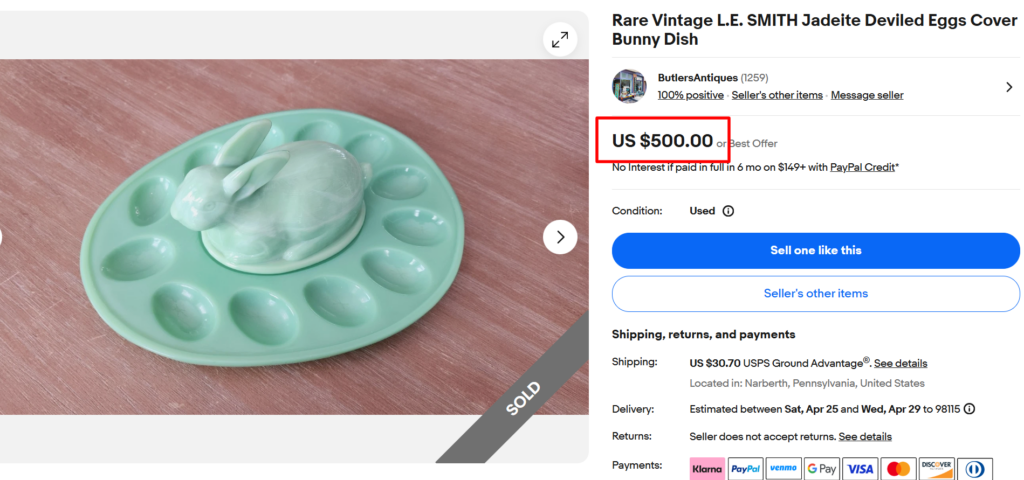
| Average Value | $250 – $650 |
| Time Period | Late 1990s – early 2000s |
| Brand | L.E. Smith (for Martha by Mail) |
| Key Features | Oval egg tray with 12 wells, bunny-shaped cover |
| Collector’s Note | “S” mark on base |
L.E. Smith made this covered deviled egg dish with a bunny-shaped lid sitting over twelve egg wells. The oval tray measures around 11 inches across. This piece was part of the Martha by Mail holiday glass lineup from the late 1990s.
Smith marked their jadeite with a small “S” molded on the base or a cursive or script letter S molded on the inside of the lid. These marks are often hard to spot without a loupe.
A complete set with the rabbit and the dish, both in good condition, can easily fetch around $500 today.
6. Uranium Jadeite Shakers – McKee
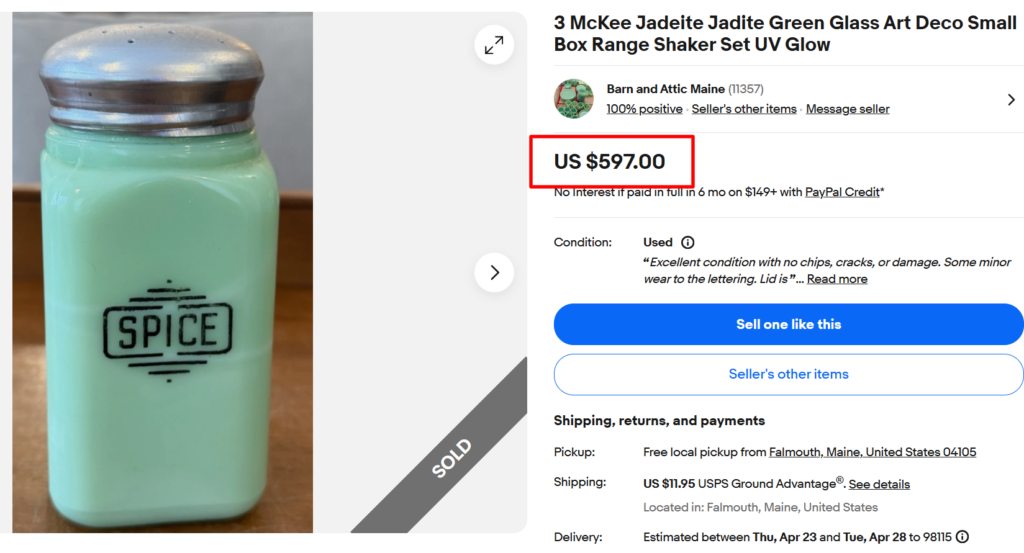
| Average Value | $70 – $100 per shaker $200 – $600+ (for set of 2+) |
| Time Period | 1930s – early 1940s |
| Brand | McKee Glass Company |
| Key Features | Art Deco square body, black text, aluminum lids |
| Collector’s Note | Most McKee shakers contain uranium. Check the blacklight glow. |
McKee made these Art Deco shakers in the 1930s using their Skokie Green glass. The square “Small Box” shape has stepped Art Deco lines and features a black-lettered label such as SPICE, FLOUR, or SUGAR.
Uranium in the early glass makes authentic pieces glow bright green under a UV blacklight. Spice, Cinnamon, Nutmeg, and Ginger are the hardest shakers to track down. And if these are found in a set of 2 or more (like this example), the value can go up to $500 to $900.
7. Divided Glass Grill Plates – Fire King
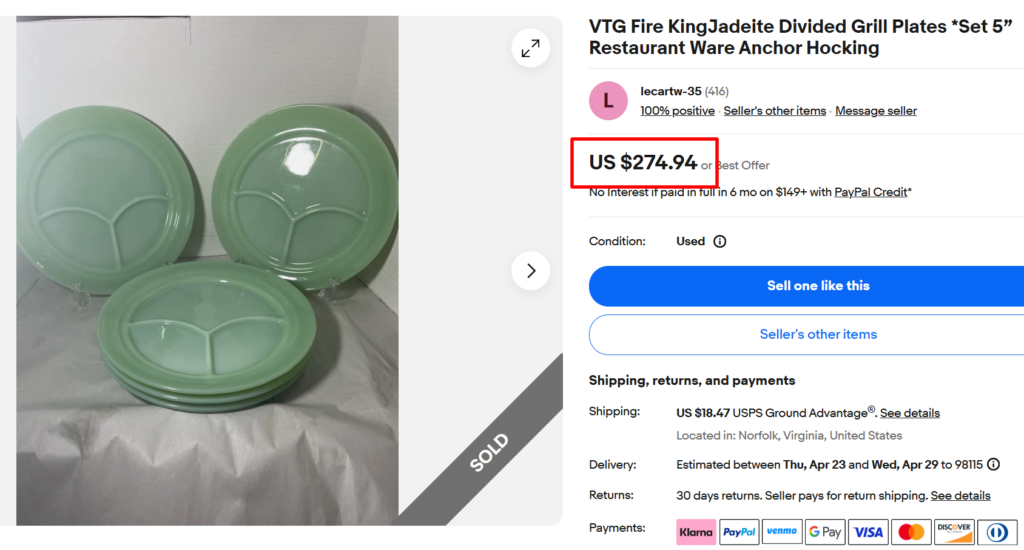
| Average Value | $50 – $75 (per plate) $200 – $300 (sets of 4-5) |
| Time Period | 1940s – 1950s |
| Brand | Anchor Hocking (Fire-King) |
| Key Features | 9½” round plate, three sections |
| Collector’s Note | Real Restaurant Ware is thick & heavy |
These three-section grill plates came from the Fire King Restaurant Ware line, made from the 1950s into the 1960s for diners and cafeterias. The three-part division was practical for separating meat, vegetables, and potatoes.
A quick test for authenticity is the weight. Because these were tools of the trade, they were made thicker and heavier than home dinnerware. Collectors often pay more for a set of four or five divided plates in clean condition, especially with the “Oven / Fire King / Ware” mark visible on the base.
8. Hen on Nest Covered Dish – Fenton (Martha Stewart by Mail)
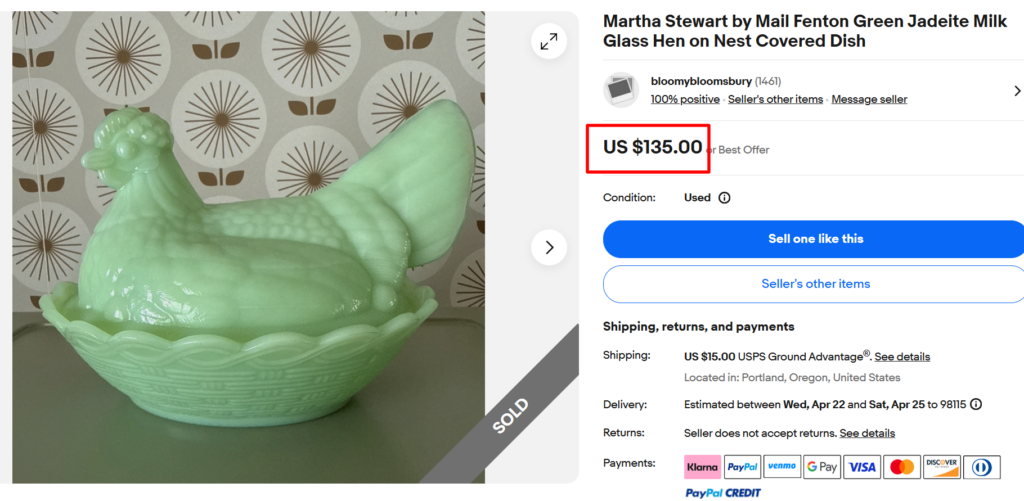
| Average Value | $90 – $250 |
| Time Period | Late 1990s to 2004 |
| Brand | Fenton (for Martha by Mail) |
| Key Features | 13″ platter base, 8″ hen lid |
| Collector’s Note | “Fenton” mark on the bottom or inside the lid |
This large covered dish came from Martha Stewart’s Martha by Mail catalog, made by Fenton between the late 1990s and 2004. It has a 13-inch base with an 8-inch hen lid, which together weigh around 7.5 pounds.
Look for a tiny “Fenton” oval mark with the number 9 molded inside the lid or at the bottom. Remember that original 1950s Fenton Chickenservers were milk glass, not jadeite. The green version is the Martha collaboration.
9. Sheaves of Wheat Tea Cup & Saucer – Fire King
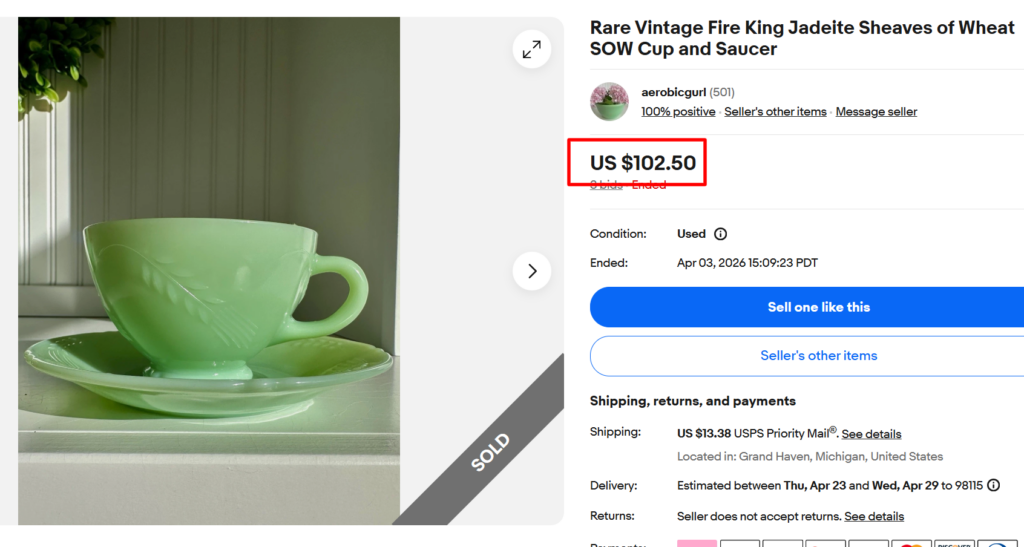
| Average Value | $80 – $150 (per set) |
| Time Period | 1957 – 1959 |
| Brand | Anchor Hocking (Fire-King) |
| Key Features | Raised wheat sheaf design, scalloped saucer |
| Collector’s Note | The snack tray in this pattern is a “museum quality” piece. |
This is a Fire-King teacup-saucer set featuring the “Sheaves of Wheat pattern.” The brand only produced this pattern in jadeite from 1957 to 1959. That two-year run is what makes these pieces so rare and collectible today.
You can identify these pieces by the raised wheat stalks curving around the outside of the cup and saucer. Only five Fire King pieces were ever made in jadeite for this pattern, and none carry a Fire King mark.
Besides, the snack tray is the hardest jadeite piece in this pattern to find today.
10. “Laurel Uranium” Jadeite Dishes – McKee
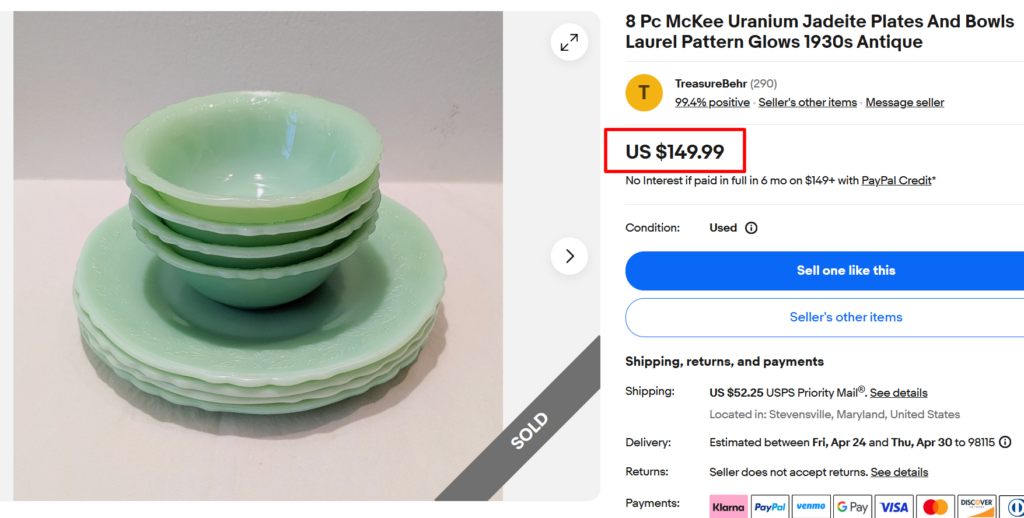
| Average Value | $125 – $200 (small sets) $200+ (larger groupings) |
| Time Period | 1930s |
| Brand | McKee Glass Company |
| Key Features | Embossed laurel leaf border, uranium glow under UV |
| Collector’s Note | Look for the “McK” in a circle logo on the bottom of the pieces. |
Laurel was the only complete jadeite dinnerware line McKee ever produced. It was released in the 1930s. You can spot these plates and bowls by the raised laurel-leaf and flower border.
Also, because early McKee glass had uranium content, authentic Laurel pieces should glow bright green under blacklight. Another check for originality is the “McK” mark inside a circle on the base. Full multi-piece sets like this example are rare and worth more together than sold piecemeal.
11. “Colonial Band” Mixing Bowl – Fire King
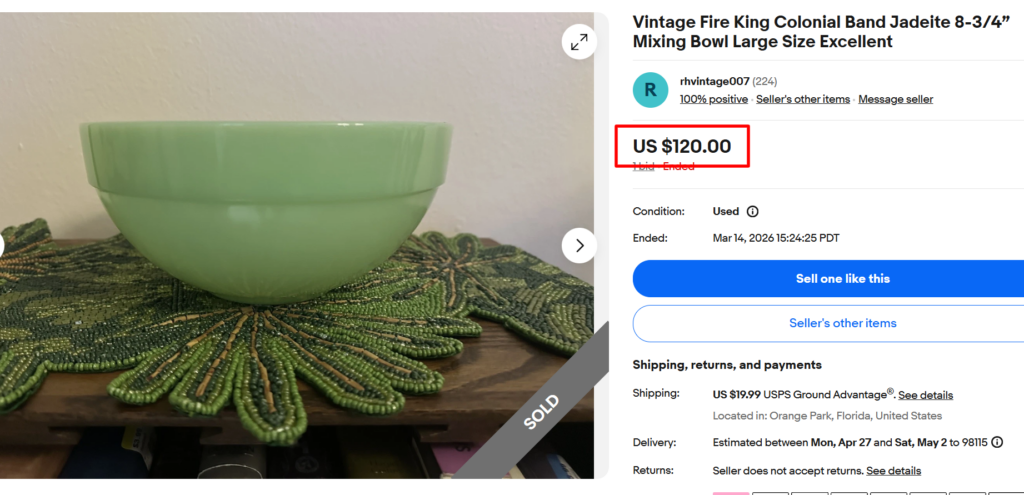
| Average Value | $80 – $150 (single) |
| Time Period | 1950s – 1960s |
| Brand | Anchor Hocking (Fire-King) |
| Key Features | 8-3/4″ wide, raised band, nesting design |
| Collector’s Note | Oven Ware stamp on the base. |
The Colonial Band mixing bowl has a raised ring on its edge, which sets it apart from smoother Fire King bowls. The 8¾-inch size means it’s the largest piece in the nesting set.
Fire King made these during the 1950s and 1960s for everyday home kitchens. So, you should see the Fire King Oven Ware stamp on the base of genuine pieces. Complete nesting sets of three or four bowls bring stronger prices than singles.
How to Tell if Jadeite Glass is Real & Valuable?
Authentic vintage jadeite is still affordable compared to Pyrex, but reproductions and mislabeled new pieces are quite common in the market. So, use these checks to separate real from fake and common from valuable jadeite ware.
Check the Marks
The first sign of authenticity is the maker’s mark. So, flip the piece over and look for a mark on the base or on the underside of the lid. Each of the three main jadeite glass makers used a different stamp.
- McKee: They added a small “McK” inside a circle on pieces from 1930 through the early 1950s.
- Jeannette: A capital “J” inside a triangle, used on shakers, canisters, and kitchenware from 1932 onward.
- Anchor Hocking Fire King: These pieces have the “Fire King Oven Ware” text, sometimes with “Made in USA” and mold numbers. Later pieces carry the full anchor logo.
However, it’s worth noting that not every vintage jadeite piece was marked, especially promotional giveaways and certain Fire King items. An unmarked piece is not automatically a fake; there are other authenticity checks.
Production Marks
Apart from the maker’s mark, pay attention to manufacturing marks on the piece. For example, genuine vintage jadeite has small imperfections from the 1930s and 1940s pressing techniques. These include straw marks (fine lines from the hot glass cooling), tiny bubbles inside the glass, slight shade variations, and mold seams.
A perfectly smooth, evenly colored piece is more likely a modern reproduction than an original.
Check the UV Light Glow
Many pre-World War II McKee and Jeannette jadeites contain small amounts of uranium oxide. So, if a jadeite piece glows bright green under the UV blacklight, you’re likely holding genuine 1930s to early-1940s jadeite.
Fire King jadeite was made after 1945 without uranium, so it will not glow. A glowing, unmarked piece is usually McKee or Jeannette.
Check the Weight
Older jadeite is notably heavier than modern reproductions. Fire King’s Restaurant Ware pieces especially have thick, substantial walls.
So, always check the weight of the piece. If it feels light or flimsy, it’s likely a modern reproduction from Gibson, Mosser, or a similar new maker. A vintage Fire King restaurant mug weighs around 320 to 340 grams; newer versions feel noticeably lighter.
Assess the Condition
Like any vintage glassware, jadeite glass’s value largely depends on the condition. Severe chips, cracks, and utensil marks all significantly reduce the value. Hairline cracks in pitcher handles and spouts are especially common.
Run your finger around every rim, handle joint, and base edge. Hold the piece up to a window to check for hairline cracks. Dishwasher damage is also something worth checking; it can cause a cloudy surface that can hurt the value.
Note: This article is intended for informational, educational, and entertainment purposes only. Some images are illustrative and may not represent actual brands, products, or related entities. All trademarks, product names, brand logos, packaging, and other intellectual property referenced remain the exclusive property of their respective owners. Any brand mentions or references are provided solely for descriptive and educational context and do not imply any formal or commercial association.