Antiques Know How Research
Johnson Brothers Dinnerware Patterns
Our Antiques Know How team’s in-depth analysis of eBay sales and auction results shows vintage Johnson Brothers dinnerware ranges from $150–$600+, with full sets in rare patterns reaching $1,000+. The most collectible patterns include Old Britain Castles ($400–$800), Christmas variant ($1,000–$2,000+ partials), Friendly Village ($250–$700), Rose Chintz ($300–$750), Tally Ho ($200–$800), and Coaching Scenes ($200–$550). Check the backstamps, material, production era, and pattern details to identify genuine pieces.
Antiques Know How
About Johnson Brothers Company
Johnson Brothers was established in 1883 in Hanley, Stoke-on-Trent, the heart of England’s Staffordshire pottery district. Alfred and Frederick Johnson started the company by buying a bankrupt pottery at auction.
By the 1890s, they had developed what they called “semi-porcelain” or “white granite,” a material that looked like fine china but was as durable as ironstone. The combination was a hit in the American market, and the company became a prominent name.
Over the decades, Johnson Bros. released hundreds of patterns, ranging from floral chintz to historical landscapes. Although production moved out of England in 2003, the original “Made in England” pieces remain collectible to date.
Most Collectible Johnson Brothers Patterns
Let’s take a look at some of the most popular and actively collected Johnson Brothers patterns today and how much they’re actually worth.
1. Old Britain Castles
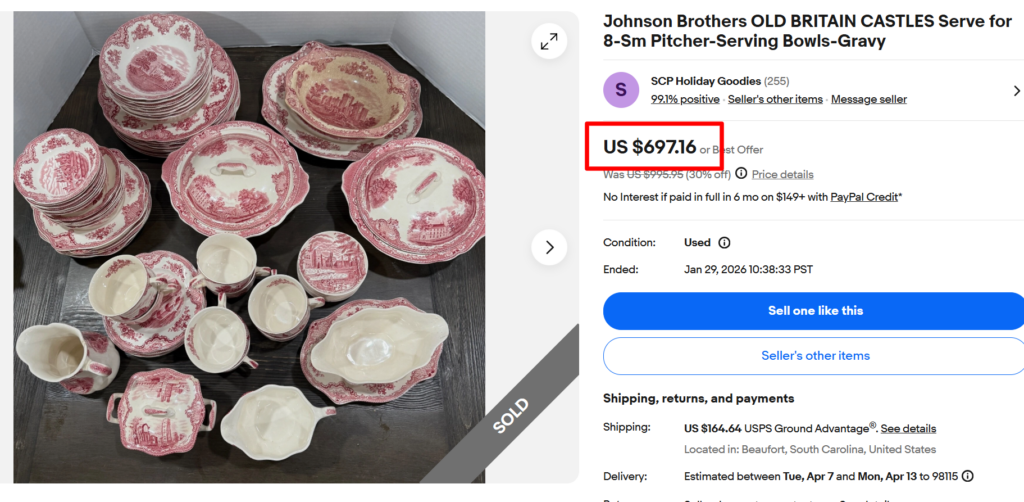
| Average Value | $400–$800 (sets) |
| Production Period | 1930–2015 (England only until 2003) |
| Pattern Details | Pink/red castle scenes |
| Collectibility | Very High |
| Collector Notes | Every castle name appears below the scene. |
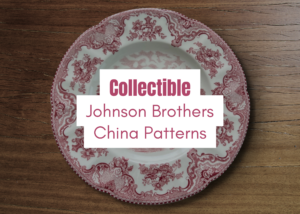
This line showcases famous British landmarks and 40+ different castle designs in intricate detail. It’s available in blue, pink, and brown colors. This is the pink/red variation, the most collectible form of this Johnson Brothers design.
Serving dishes in this style, such as pitchers, tureens, gravy boats, and serving bowls, will increase the value of a collection.
One notable characteristic of this design is that each castle has a name and date printed below the scene. If the label is missing or blurry, it needs attention.
Note that pieces made between the 1930s and the 1960s tend to have a slightly warmer, more saturated pink tone. Later production from the 1980s–90s runs cooler and more uniform. Both are collectible, but earlier pieces are more desirable.
2. Old Britain Castles Christmas
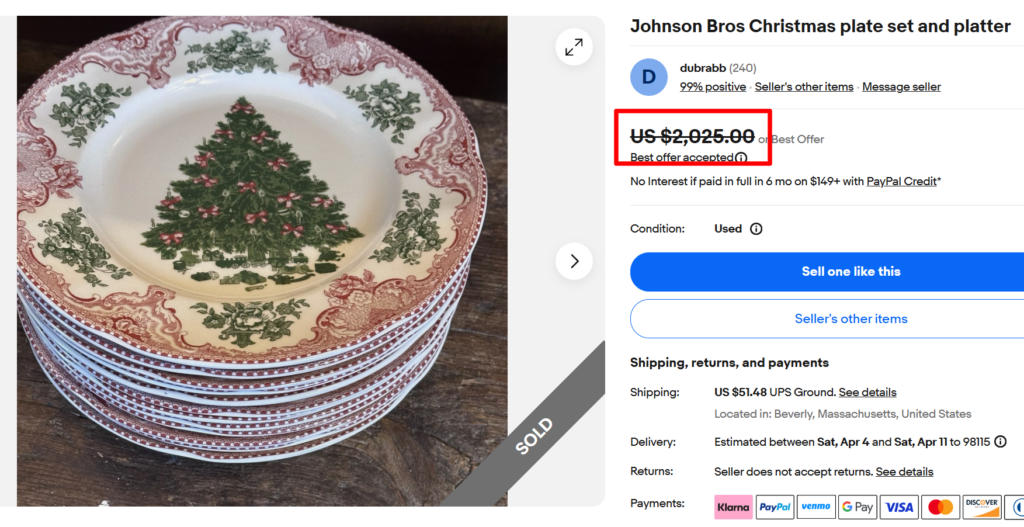
| Average Value | $1,000 – $2,000+ (partial sets) 50 – $300 (singles) |
| Production Period | 1990s |
| Pattern Details | Pink castle border with green Christmas tree |
| Collectibility | Extremely High |
| Collector Notes | Partial or full sets are the rarest. |
This is a rare and festive variation of the standard Old Britain Castles pattern. It combines the classic pink castle border with a vibrant, green Christmas tree in the center.
Because it was produced for a limited time and only for the holiday season, it is significantly more valuable than the standard versions. You can identify it by the “Johnson Brothers / Christmas Old Britain Castles” backstamp.
3. Friendly Village
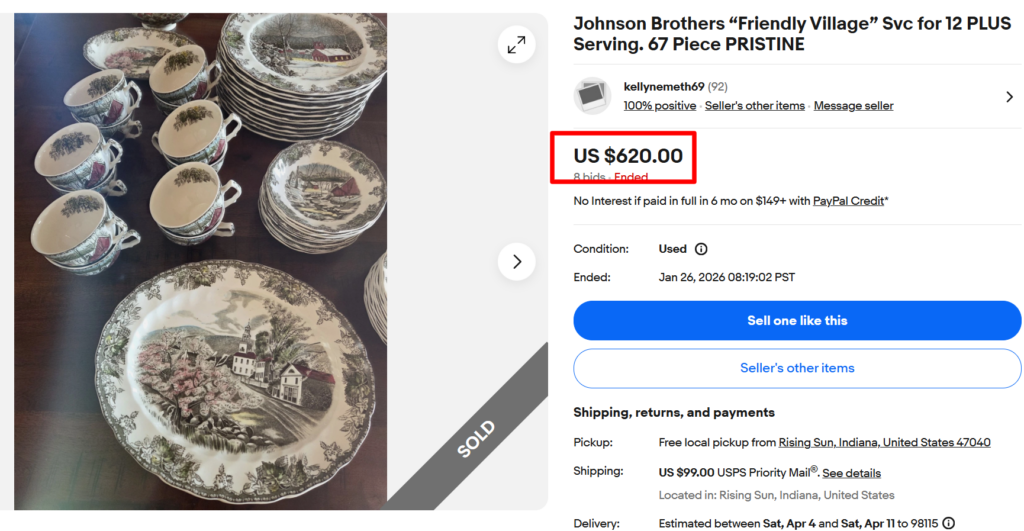
| Average Value | $250–$700 (full sets) |
| Production Period | 1953–2003 (England); continued in China through 2015 |
| Pattern Details | Brown/green engraved village scenes |
| Collectibility | Very High (Pre-2003) |
| Collector Notes | Large platters & serving pieces are rare. |
The Friendly Village is Johnson Brothers’ best-selling and most recognizable pattern. It was first introduced in 1953 and lasted until 2003 in England; in China, it was produced until 2015.
Each piece in this line depicts a different hand-engraved scene of a New England-style village, including a covered bridge, stone wall, old mill, hay field, and more, rendered in brown, green, and grey.
The turkey platter is the most sought-after single piece in the pattern. Also, English-made pieces (pre-2003) are more collectible and valuable than the China-made pieces.
4. Rose Chintz
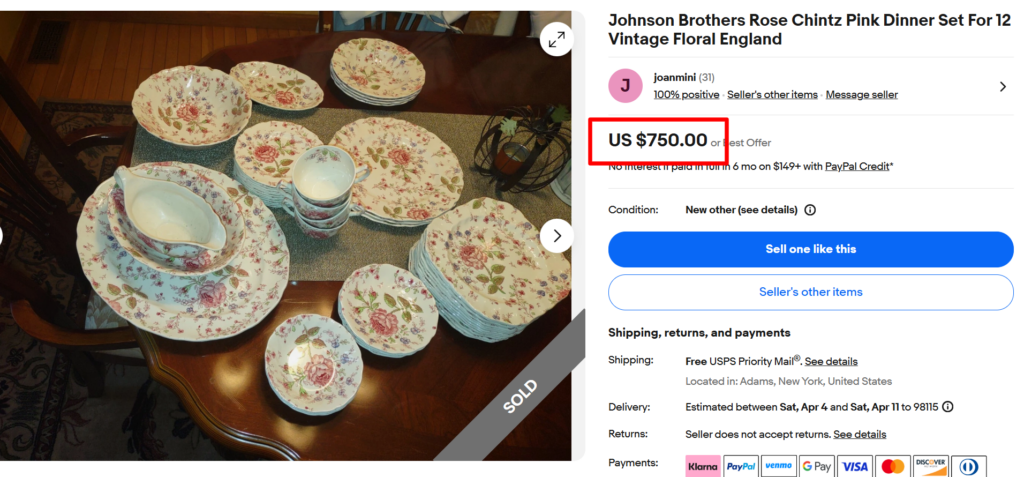
| Average Value | $300–$750 (Sets) |
| Production Period | c. 1930–2003 |
| Pattern Details | Pink roses, blue forget-me-nots, cream background |
| Collectibility | High |
| Collector Notes | Check the pink backstamp for earlier production. |
One of Johnson Brothers’ longest-running and most recognizable florals, Rose Chintz features large pink roses, blue forget-me-nots, and rose buds on a cream base.
Since this line was made for over 70 years, check the backstamp to trace the date; pieces produced before the late 1960s bear a pink backstamp, while those produced later bear a green one.
Both pieces are considered vintage, although those with the earliest marks, from before 1950, are most desirable.
5. Willow Blue
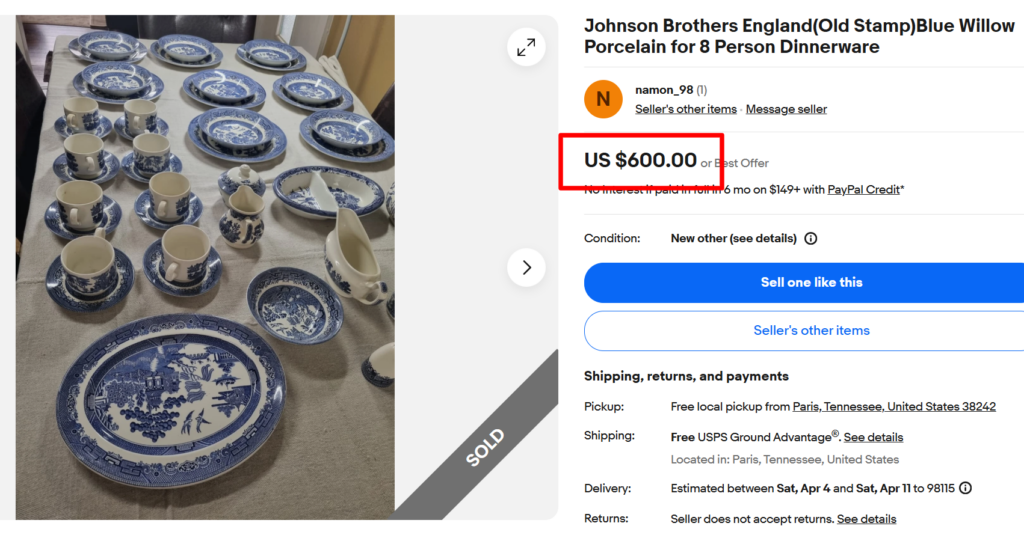
| Average Value | $200–$700 |
| Production Period | Mid-20th century–2003 (England) |
| Pattern Details | Classic blue/white Chinese-inspired landscape motif |
| Collectibility | Moderate to High |
| Collector Notes | Pre-2003 “Made in England” marks are most desirable |
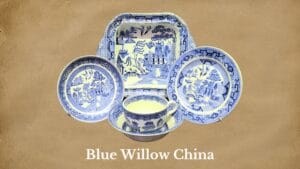
Although Blue Willow is one of pottery’s most replicated designs by hundreds of manufacturers since the late 1700s, it’s still highly collectible. The Johnson Brothers’ “Willow Blue” version appears on their durable ironstone/earthenware body.
Since it’s a common pattern, only pieces marked “Made in England” (pre-2003) are desirable; later China-made pieces marked “England 1883” hold less collector value.
6. Melody
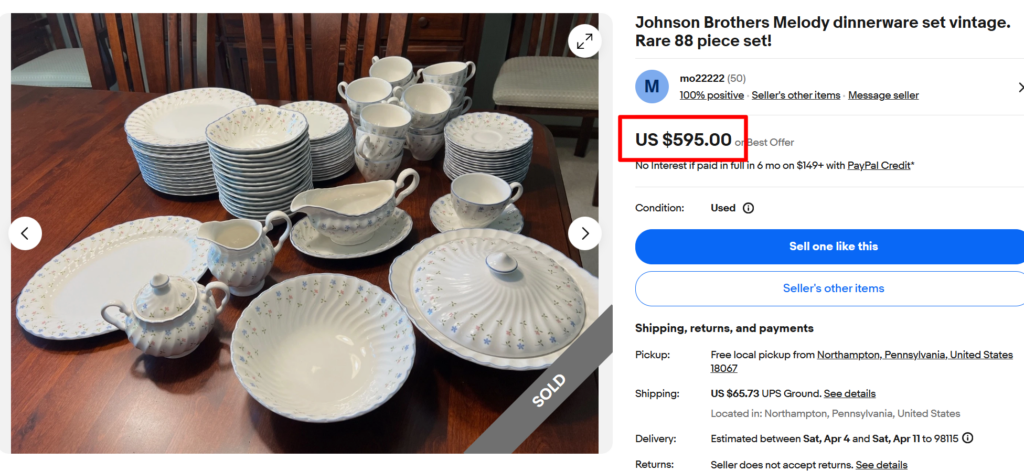
| Average Value | $200–$600 (Full sets) $10 – $40 (single) |
| Production Period | 1984–1991 |
| Pattern Details | Delicate blue flowers, embossed rims |
| Collectibility | Moderate |
| Collector Notes | Check the pattern name on the back. |
Just like the name, Melody is a delicate pattern featuring scattered tiny pink roses and blue flower sprigs on a ribbed body. This design was only made from 1984 to 1991, a short seven-year window that keeps supply limited.
The swirled ribbed shape on the earthenware body is a distinguishing feature that’s easy to recognize. This pattern is moderately collectible, but large sets like this 85+ piece set can sell for a few hundred dollars.
7. Tally Ho
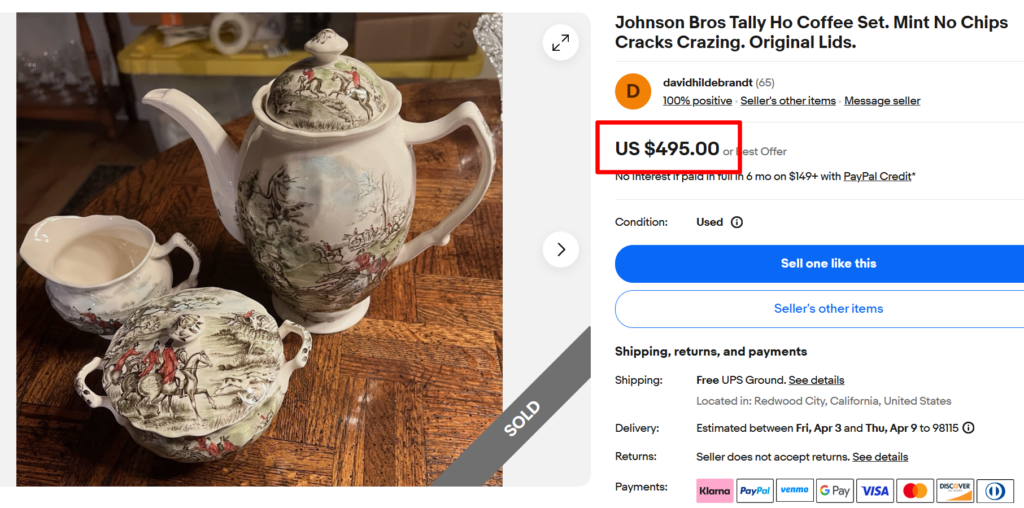
| Average Value | $200–$800 (partial to full sets) $20–$100 (singles) |
| Production Period | c. 1950s–1970s |
| Pattern Details | Multi-color Equestrian hunt scenes |
| Collectibility | Moderate to High |
| Collector Notes | Mugs and teapots are highly collectible. |
Tally Ho is a hunting scene transferware pattern. It shows English fox-hunting imagery, including riders, horses, hounds, and countryside landscapes, printed in green, brown, and red on a white background.
This design is closely related to the Coaching Scenes family (listed below) but has a more unique, colorful, multi-tone presentation.
Complete sets, especially coffee or tea sets in Tally Ho, are uncommon to find intact. Even partial sets can sell for $200 to $400 today.
8. Strawberry Fair
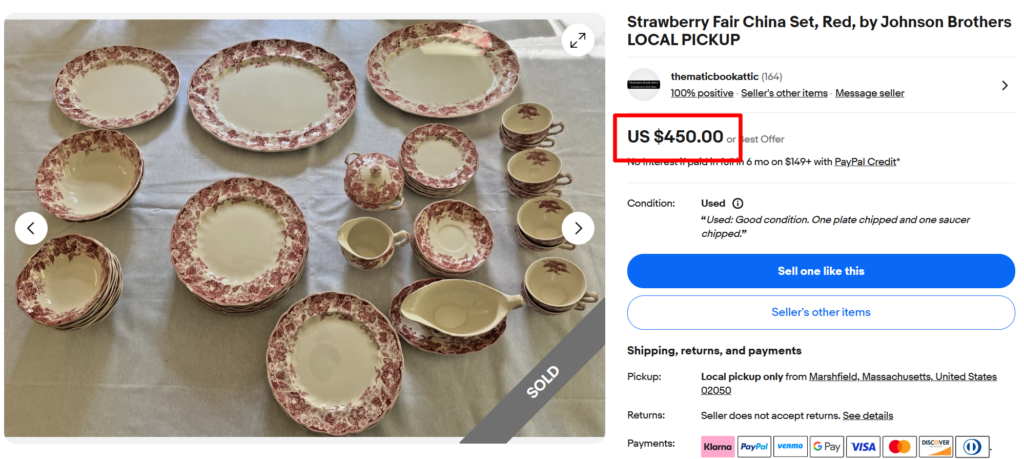
| Average Value | $200–$500 $20 – $80 (singles) |
| Production Period | 1959–1973 |
| Pattern Details | Pink/red transferware; strawberries, currants, scalloped edge |
| Collectibility | Moderate to High |
| Collector Notes | Check the |
Strawberry Fair is a pink/red transferware pattern with hand-engraved strawberries, currants, blossoms, and leaves on a cream ironstone. The design is registered under Patent No. 164.860 and was produced from 1959 to 1973.
The “Old Chelsea” scalloped shape is a defining feature of this pattern. Also, the pieces bear a bright pink “Strawberry Fair / by Johnson Brothers” backstamp, along with a declaration note and the patent date.
9. English Chippendale (Blue)
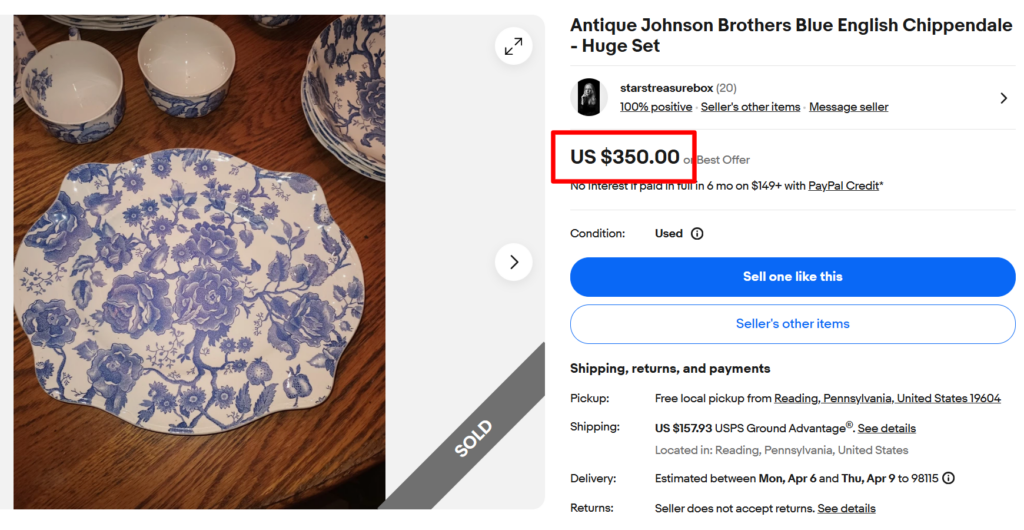
| Average Value | $150–$400 (partial to full sets) $15 – $60 (singles) |
| Production Period | 1935–1978 |
| Pattern Details | Blue all-over floral chintz on white ironstone |
| Collectibility | Moderate to High |
| Collector Notes | “Patent Pending” mark indicates pre-registration (1935) |
This pattern features an all-over floral chintz-style design with dense blue flowers, fruits, and vines on the entire surface. It was produced in four colorways: blue, brown, green, and red/pink. The blue version is the most widely sought; others are still collectible.
Authentic pieces bear the pattern name and the patent number in the backstamp. Because it ran for over 40 years, it’s easy to find these pieces in partial sets, but complete sets with matching serving pieces are harder to assemble.
10. Wild Turkeys
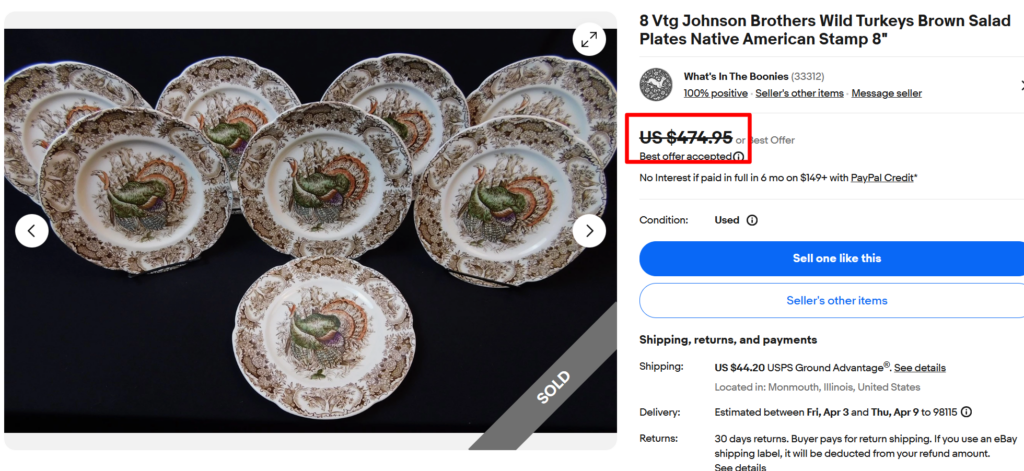
| Average Value | $30 – $150 per piece |
| Production Period | 1950s – 1970s |
| Pattern Details | Detailed wild turkey with floral borders |
| Collectibility | High (Seasonal Demand) |
| Collector Notes | Look for “Windsor Ware” backstamps |
The Wild Turkeys pattern was made specifically for the North American market and produced from 1951 to 1974 under the Windsor Ware line. The “Native American / Windsor Ware” backstamp is the easiest way to identify this line.
Pieces are made of ironstone, printed with a detailed brown transferware design of wild turkeys surrounded by fall foliage and Native American-inspired motifs.
Because it was discontinued in 1974 and made exclusively for the US market, it’s rarer than some other patterns, with platters being the hardest piece to find.
11. Coaching Scenes
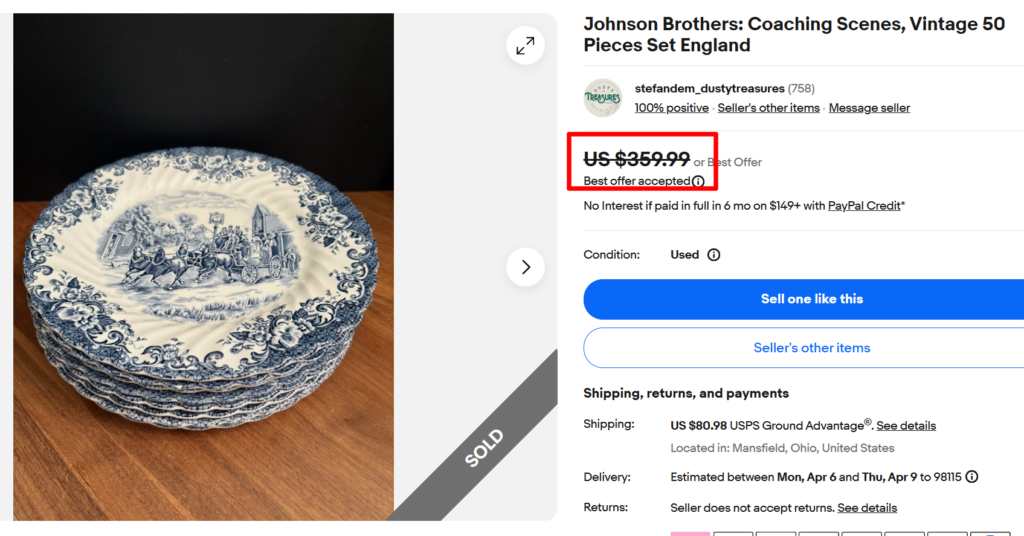
| Average Value | $200–$550 $20 – $80 (singles) |
| Production Period | 1963–1999 |
| Pattern Details | Horse-drawn carriage scenes |
| Collectibility | Moderately High |
| Collector Notes | Blue transferware is the most common version. |
This pattern features blue-and-white transferware scenes of horse-drawn carriages moving through English countryside landscapes. This line features an ironstone body, for which Johnson Brothers was known, with hand-engraved transfer designs applied under the glaze.
The blue colorway is the most popular and the most collected; a brown/red version also exists, but commands less interest today.
This pattern ran from 1963 to 1999, so you’ll find a solid range of pieces on the market. Larger full sets (50+ pieces) sell the strongest.
Tips to Identify Real Johnson Bros. Dinnerware
Authentic Johnson Brothers dinnerware features unique characteristics that set it apart from other companies. You must check these to make sure you’re looking at something genuine.
Check the Backstamp
The backstamp is the most reliable way to spot a genuine Johnson Bros. dinnerware. Every piece has a mark that reveals the brand name, pattern, and other details.
Apart from attribution, the marks can also help you date a piece. Here are some common stamps you should know.
- “Made in England”: This mark indicated a pre-2003 British production.
- “Johnson Bros” or “Johnson Brothers”: Both marks appear on genuine pieces, depending on the era.
- “England 1883”: This mark is common on post-2003 China-made pieces. It does NOT mean the piece is from 1883.
- Crown or Globe Device: This motif is common on mid-century pieces, but the style changed multiple times.
- Pattern Name: Many pieces have the name printed in the backstamp (e.g., “Old Britain Castles,” “Friendly Village,” “Liberty”). It helps in pattern attribution.
The backstamp color and device are the fastest way to estimate age. You can refer to official marking guides to compare the marks on your piece and identify it.
Check the Material
Johnson Brothers used two main materials for its dinnerware.
Semi-porcelain/ironstone, which is heavier, slightly off-white. This was used throughout most of the company’s history, including on US export pieces. The second one is Earthenware, a lighter weight used on some later patterns like Melody.
Run your finger along a ware’s unglazed base (the foot ring). Authentic older ironstone feels slightly gritty and dense. Chinese-made later pieces often feel smoother and lighter.
Pattern-Specific Identifiers
Certain Johnson Brothers patterns have specific details that can help you separate genuine pieces from misattributions or other makers’ work.
For example, in Old Britain Castles, each castle is labeled by name and date below the scene. For the Friendly Village line, each piece features the specific scene name printed in the backstamp.
In Wild Turkeys, the correct backstamp reads “Windsor Ware” and has a brown label. And for Rose Chintz, the backstamp appears in two colors: pink and green. Pin stamp means earlier production.
Get familiar with these pattern-specific characteristics for easier and clearer identification.
Watch for China-Made Pieces
After 2003, Johnson Brothers pieces were made in China under the “England 1883” mark. These are not “reproductions” as such; they’re genuine brand pieces, but they sell for significantly less than English-made examples.
The easiest way to spot these pieces is the backstamp: if it says “England 1883” without “Made in England,” it’s post-2003 Chinese production.
A clean, slightly rough foot ring base versus a very smooth, white-bright base is another quick sign of these pieces. Also, Chinese production pieces appear to be whiter and lighter.
Note: This article is intended for informational, educational, and entertainment purposes only. Some images are illustrative and may not represent actual brands, products, or related entities. All trademarks, product names, brand logos, packaging, and other intellectual property referenced remain the exclusive property of their respective owners. Any brand mentions or references are provided solely for descriptive and educational context and do not imply any formal or commercial association.