Antiques Know How Research
Twin Winton Cookie Jars Value
Our Antiques Know How team’s analysis of several eBay sales shows that Twin Winton cookie jars sell for $20–$150+, with rare designs fetching $85–$150. Most collectible jars are Elephant Sailor, Cow, Happy Pig, Smokey Bear, Lion King, Cookie Catcher, Friar Tuck Monk, Cookie Barn, and Castle. Check base marks (like “Twin Winton © / Calif. USA” with addresses from El Monte or San Juan Capistrano eras), classic wood-tone brown finish, hand-applied color accents, and painted eyes to identify real Twin Winton pieces.
Antiques Know How
About Twin Winton Company!
Founded in 1936 by brothers Don and Ross Winton, the Twin Winton Company was a staple of California pottery. The brother started selling ceramics while still in high school. After a break during World War II, the company reopened in 1946 and began expanding its product line.
In 1952, their older brother Bruce Winton bought out the twins and moved the company to El Monte, California. That’s when the signature wood-tone finish, a warm brown stain applied over slip-cast ceramic, was developed.
Cookie jar production began in earnest around 1951–1953, and the line grew significantly through the 1960s. In 1964, the company relocated again to San Juan Capistrano, where it operated until going out of business in the mid-to-late 1970s.
After the company closed, Treasure Craft purchased the molds and produced some of the same designs under their own name. Today, original TW jars are highly collectible, with certain pieces being so hard to find that they sell for hundreds.
Collectible Twin Winton Cookie Jars to Find!
Below are listed the most popular and actively collected cookie jars from Twin Winton. Some of these are rare to find today and hold high collector value!
1. Elephant Sailor Jar
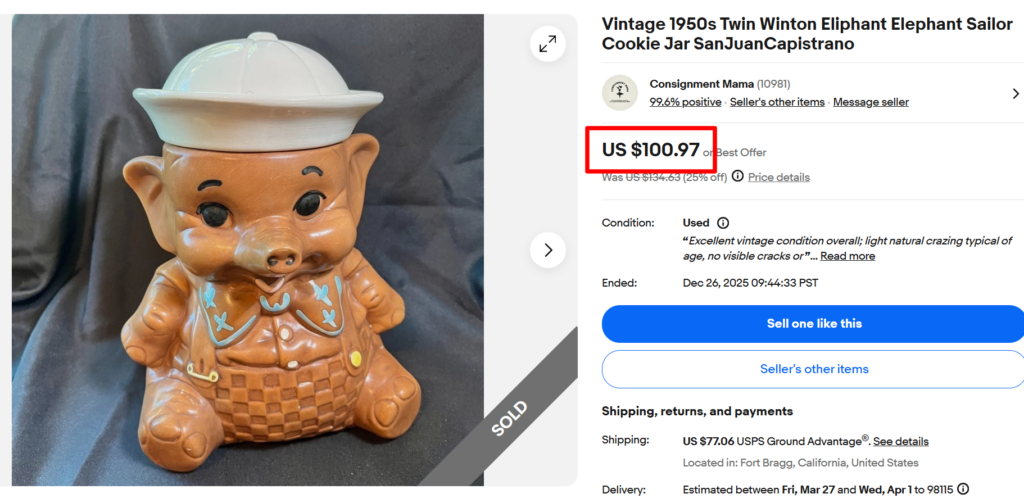
| Average Value | $75 – $130 |
| Production Period | Late 1950s – 1960s |
| Status | Standard Line |
| Collectibility | High |
| Collector Notes | Check the mark for authenticity & date. |
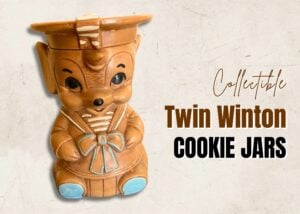
The Elephant Sailor is one of the most sought-after Twin Winton cookie jars. A 1950s–1960s design, it depicts a baby elephant in a sailor outfit with small blue and yellow accents on the collar and cuffs. The lid is a white sailor’s cap.
This piece can be marked with either the San Juan Capistrano or El Monte address, depending on when it was made. Early examples marked “El Monte” date to the 1953–1964 period, while post-1964 pieces may show the “Twin Winton © / San Juan Capistrano / Calif. USA” mark.
Check for intact paint, colored accents, and original white lids; they can boost the jar’s value.
2. Cow Cookie Jar
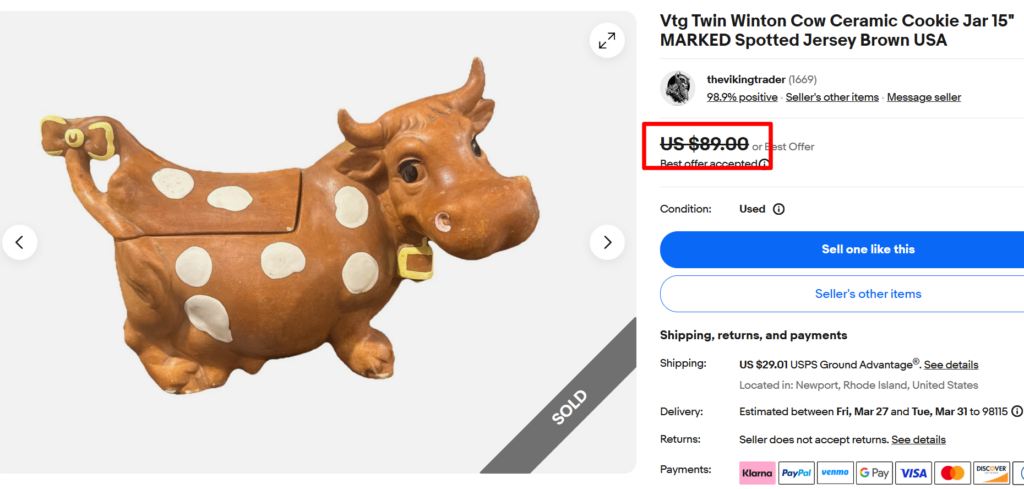
| Average Value | $65 – $100 |
| Production Period | 1960s |
| Status | Standard Line |
| Collectibility | Moderate-High |
| Collector Notes | Inspect the basemark & white spots. |
The Cow jar is a unique horizontal design, with the cow’s body making the jar and the back section making the lid. The piece measures about 15″ long and has white spots painted on the brown base glaze, a yellow bell, and a bow on one ear.
Authentic pieces will also have an impressed “Twin Winton © / Calif. USA” mark on the bottom. This jar is slightly more valuable than other animal-shaped jars due to its larger size.
Also, the white spot paint is an important value factor; pieces with heavy paint loss or touch-ups to the spots are worth less.
3. Happy Pig Cookie Jar
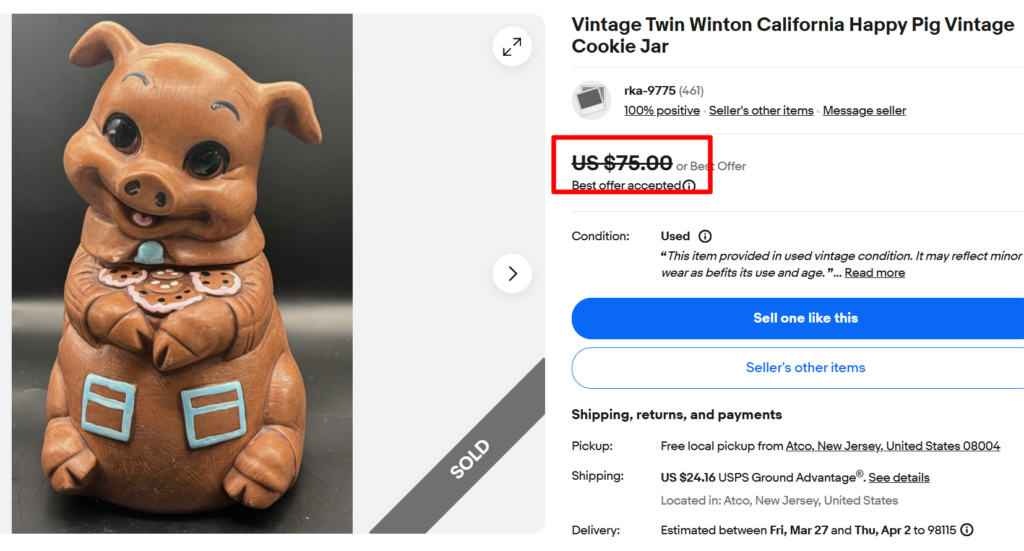
| Average Value | $55 – $90 |
| Production Period | 1960s |
| Status | Standard Line |
| Collectibility | Moderate-High |
| Collector Notes | Check the “Twin Winton©/Calif. USA” mark. |
This jar shows a round-bodied pig with cookies, with overalls painted on the lower body. It has the characteristic large black eyes, an upturned snout, and a slightly open mouth with a small pink detail on the tongue.
This design has been produced in both plain wood-tone and with more detailed hand-painted color accents, including blue pocket details on the overalls. The painted version is more desirable to collectors.
4. Smokey Bear Cookie Jar
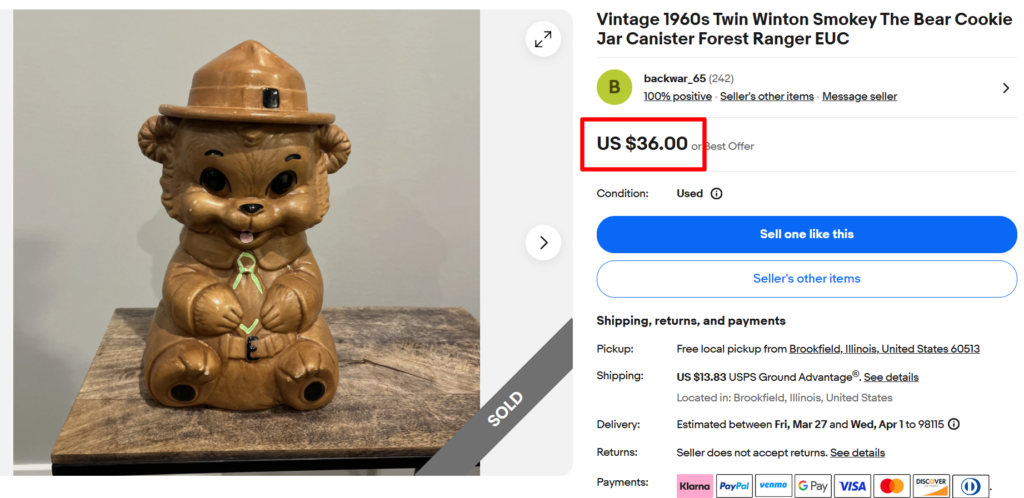
| Average Value | $20 – $70+ |
| Production Period | 1960s |
| Status | Standard Licensed Line |
| Collectibility | High |
| Collector Notes | Check the Twin Winton mark on the base. |
The Smokey the Bear jar is one of the most recognized Twin Winton designs. It depicts the famous forest ranger bear character (licensed), created by the U.S. Forest Service in 1944, in the company’s classic wood-tone finish.
Original jars feature small hand-painted color accents on the bow tie and badge details, and “Twin Winton © ’60 Made in USA” on the base.
Since it’s a common and popular design, pristine examples with no chips and intact paint accents usually fetch $20 to $70.
5. Lion King Cookie Jar
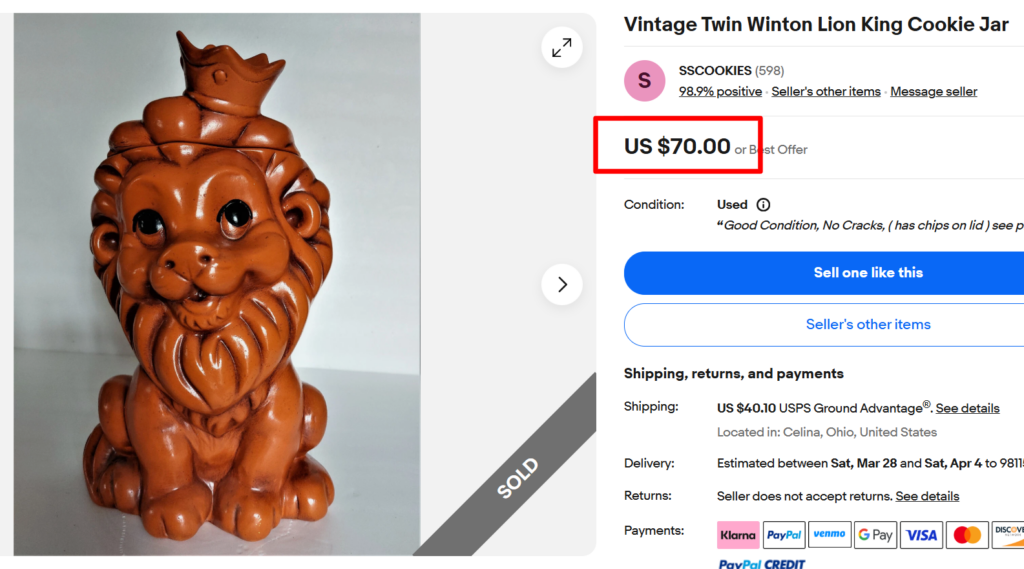
| Average Value | $50 – $90 |
| Production Period | 1960s |
| Status | Standard Line |
| Collectibility | Moderate-High |
| Collector Notes | Eyes are painted black, base is marked. |
The Lion King jar shows a seated lion wearing a small crown on the lid. It’s sculpted in the classic wood-tone finish, with glossy black glass eyes, a hallmark of Twin Winton’s 1960s animal designs. The lion’s mane and crown make the lid.
Although this is a straightforward wood-tone piece without much additional hand-painted color, it’s still collectible for its impressive size (13 to 14 inches) and texture. The value lies in the piece’s overall condition.
Original pieces should bear the “Twin Winton © / Calif. USA” mark on the bottom.
6. Cookie Catcher Jar
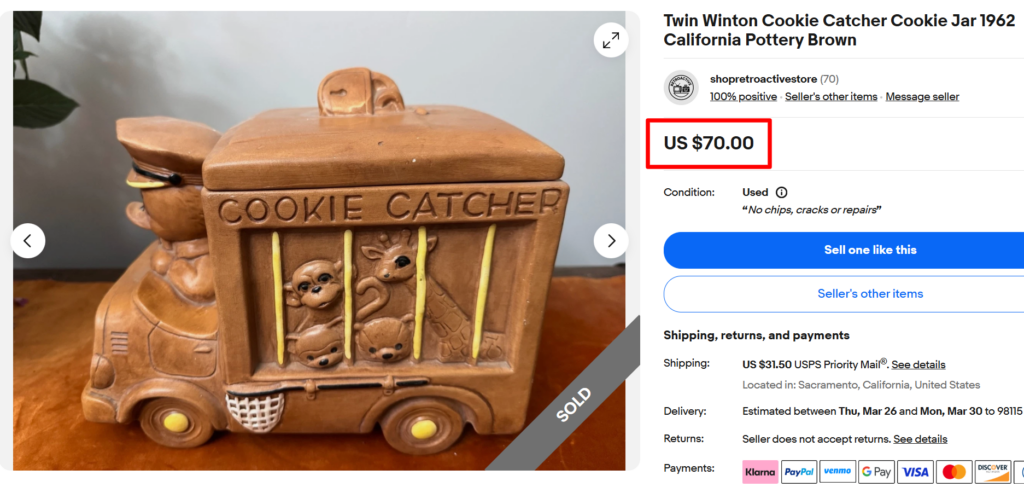
| Average Value | $50 – $100+ |
| Production Period | 1962 |
| Status | Standard Line |
| Collectibility | High (unique scene) |
| Collector Notes | Check the yellow accents & backstamp. |
This jar is an inventive design. It shows an animal control truck driven by a duck in a uniform with caged animals molded into the sides of the truck. You will also notice yellow accents on bars, wheel hubs, and the driver’s outfit.
These jars are clearly marked “Twin Winton Made in U.S.A. 1962” on the base, making them easily dateable pieces. Scene-based jars like this are generally more desirable than single-animal-shaped pieces.
7. Friar Tuck Monk Cookie Jar
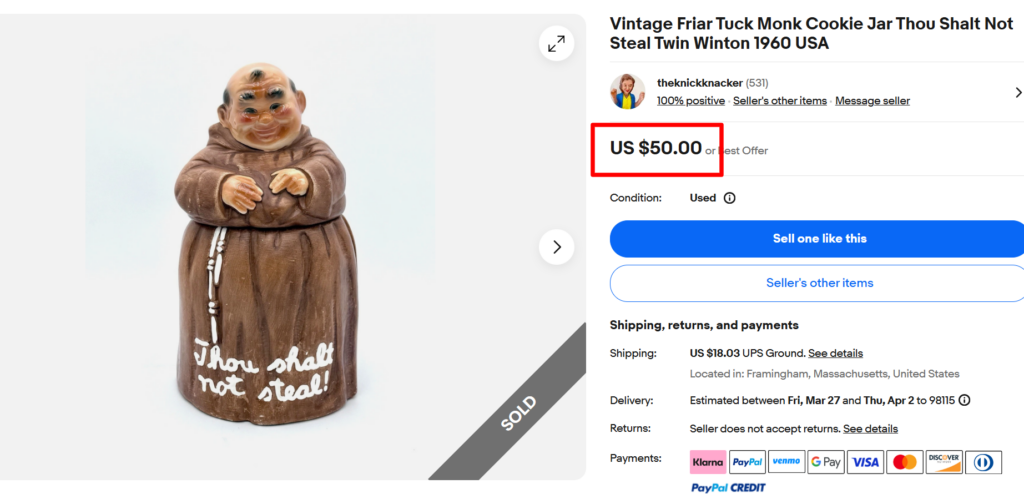
| Average Value | $45 – $65 |
| Production Period | 1960 – mid-1970s |
| Status | Standard Line |
| Collectibility | Moderate |
| Collector Notes | Basemark + left-hand two-finger sign confirms authenticity |
Friar Tuck is another highly popular Twin Winton design. It shows a smiling, round-faced monk in a brown robe with “Thou Shalt Not Steal!” written on the front.
Some examples are marked “Twin Winton © ’60 Made in USA” on the base and appeared in Twin Winton’s 1965 catalog alongside matching salt and pepper shakers.
Please note that this design was also produced by McCoy, Cumberland Ware, and Red Wing. You can spot the Twin Winton version by a specific detail: two fingers raised on the left hand. McCoy and other versions don’t have this feature.
Also, this jar comes in signed and unsigned versions; both are legitimate Twin Winton pieces.
8. Cookie Barn Jar
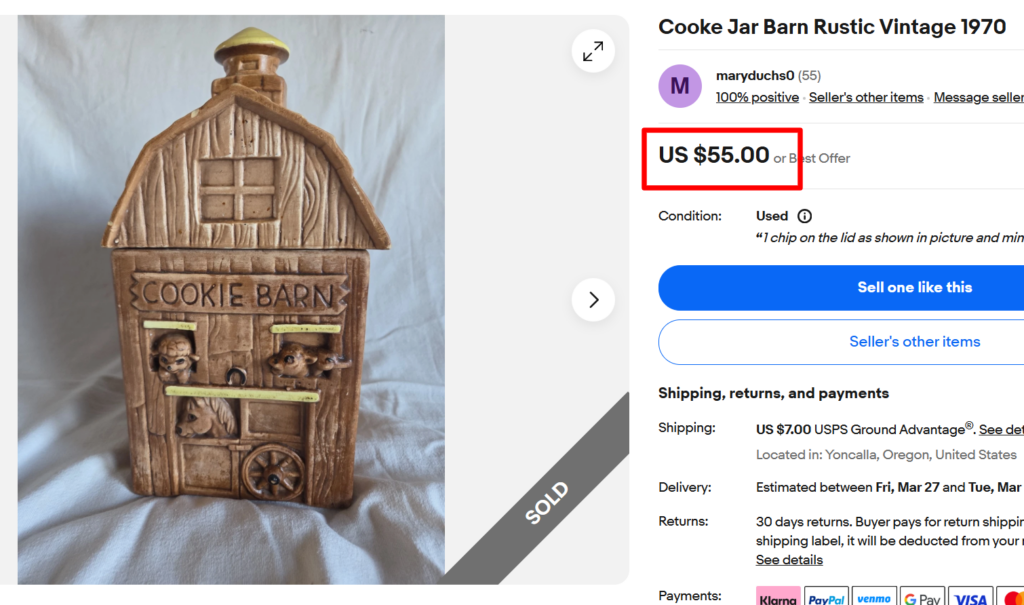
| Average Value | $40 – $65 |
| Production Period | Late 1960s – 1970s |
| Status | Standard Line |
| Collectibility | Moderate |
| Collector Notes | Check the basemark for authenticity. |
As the name suggests, this Twin Winton jar is shaped like a wooden barn with “Cookie Barn” raised on the front and small animals peeking out of the windows and the door.
While the entire design features the classic wood-tone finish, you’ll also see yellow accents on the window frames and the chimney. This Twin Winton jar is associated with the San Juan Capistrano production period, so you’ll see a “Twin Winton © / California, U.S.A.” mark on the base.
9. Police Chief Bear Jar
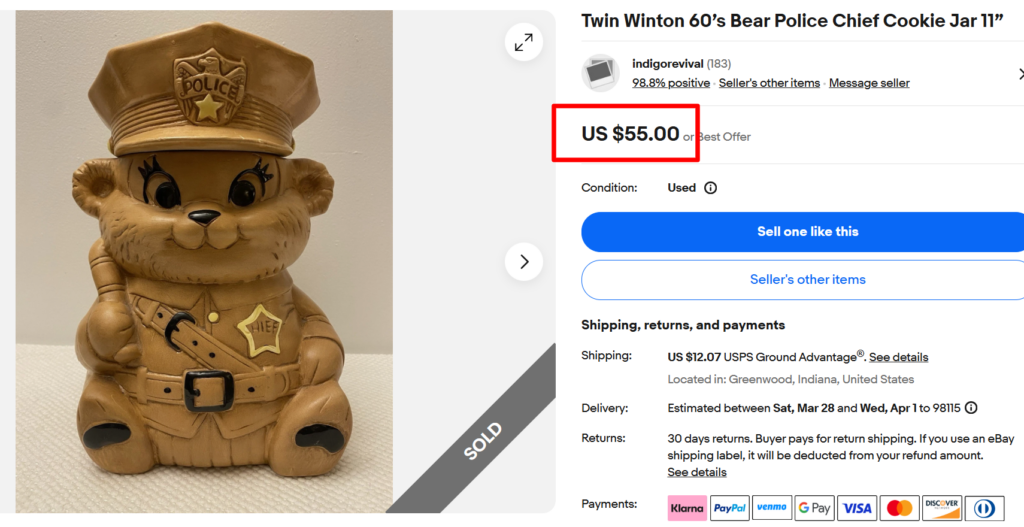
| Average Value | $85 – $150 |
| Production Period | 1960s – 1970s |
| Status | Collectors Series |
| Collectibility | Very High |
| Collector Notes | Check the basemark and accents. |
The Police Chief Jar is a part of Twin Winton’s Collector’s Series.” It’s about 11 inches tall and wears a police uniform with a star badge, a police hat with a “POLICE” label, and a shoulder strap across the chest.
The yellow/gold-painted star badge and hat details are key identifying features.
This design was produced in the 1960s and represents one of Twin Winton’s “character uniform” cookie jar sub-categories. It appears in the company’s San Juan Capistrano–era catalogs, and bears the “Twin Winton © / California, U.S.A.”
10. Castle Cookie Jar
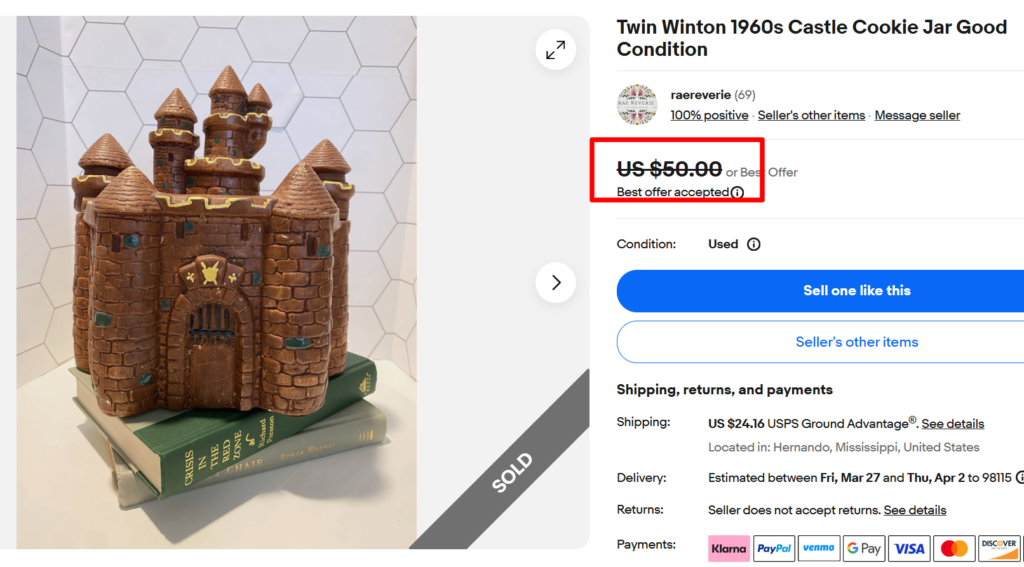
| Average Value | $45 – $80 |
| Production Period | 1960s |
| Status | Standard Line |
| Collectibility | Moderate-High |
| Collector Notes | Original accents and marks add value. |
The Castle jar is among the less common Twin Winton designs. It’s shaped like a detailed medieval castle with stone-like textures, towers, battlements, and a portcullis-style gate with gold and teal accent details.
Produced in the 1960s, this design is less common and harder to find than the animal-themed jars, adding to its desirability. In good condition, this jar can go for $30 to $80.
Don’t forget to check the base for the “W-> ©/The Twin Wintons” mark for authenticity.
How to Spot Real Twin Winton Cookie Jars?
While most Twin Winton cookie jars are molded brown, it’s not the only identification feature. While spotting the originals, the following details matter the most:
The Backstamp
Since most Twin Winton cookie jars were marked, the backstamp is the most reliable way to spot a genuine piece and date it.
- 1936–1941 (Pasadena era): Early pieces may be marked “Twin Winton Studios” or carry no mark at all. Pre-war production was small, and marks were inconsistent.
- 1946–1952 (Post-war Pasadena): Some pieces marked “Twin Winton, Pasadena, Calif.” Hillbilly line pieces from this period occasionally carry a year.
- 1952–1964 (El Monte era): This period saw the rise of the “Wood-Tone” finish. Common marks are “Twin Winton, El Monte, Calif., Made in U.S.A.” Some jars from this period also include a copyright year (e.g., “© ’60”).
- 1964–1977 (San Juan Capistrano era): Mark reads “Twin Winton, San Juan Capistrano, Calif., Made in U.S.A.” Some pieces from this period have decorator initials hand-painted near the mark.
Post-closure (Treasure Craft)
When Twin Winton closed, Treasure Craft purchased the original molds. They produced some of the same designs under the Treasure Craft name. These pieces usually bear the marks like “Treasure Craft” inside the lid rather than on the base.
If you see a familiar Twin Winton shape marked “Treasure Craft,” it’s not an original.
The Classic Wood-Tone Finish
Twin Winton cookie jars are known for their brown-stain finish, with a distinct depth and warmth. The finish was applied by dipping the fired piece in a brown stain, then drying and hand-painting color accents on top.
Genuine pieces have a slightly textured surface feel from the ceramic body beneath. If a jar is overly shiny or features modern, neon colors, it may be a later reproduction or a different manufacturer.
The Colored Accents
Hand-applied paint on the eyes, badges, bows, and uniform details is a defining Twin Winton feature. On authentic pieces, the color is applied over the brown stain and sits slightly above the surface.
If the paint appears to be underglaze, it’s not a genuine Twin Winton jar.
Also, repainted accents will look flat and even, often covering chips and cracks. So, turn the piece in good light and check the painted areas closely.
Painted Eyes
Real Twin Winton characters have molded ceramic eyes. The black pupils and occasional whites are hand-painted onto the ceramic surface. If the eyes are actual glass inserts, the jar is likely not an original Twin Winton.
Note: This article is intended for informational, educational, and entertainment purposes only. Some images are illustrative and may not represent actual brands, products, or related entities. All trademarks, product names, brand logos, packaging, and other intellectual property referenced remain the exclusive property of their respective owners. Any brand mentions or references are provided solely for descriptive and educational context and do not imply any formal or commercial association.