Antiques Know How Research
Collectible Porcelain Dinnerware
A deep analysis of eBay sales and auctions by Antiques Know How Team suggests that vintage porcelain dinnerware sets range from a few hundred to $5,000+, with rare designs and large sets fetching more. The most sought‑after sets include Lynn Chase’s Jaguar Jungle, Meduce by Versace-Rosenthal, Herend’s Queen Victoria VBO and Chinese Bouquet, KPM Berlin’s Arkadia, Faberge’s Imperial Heritage, Versace‑Rosenthal Medusa Red, Villeroy & Boch’s Petite Fleur and Holly, and Hutschenreuther’s 22k‑gold green set. Check the maker’s mark, porcelain quality, painting and decoration style, condition, and completeness for value.
Antiques Know How
Most people who own vintage dinnerware don’t realize they might own something genuinely valuable. A Herend Queen Victoria service, which is actually worth over $20,000, regularly appears at estate sales for a fraction of that price. Whereas, a Villeroy & Boch set gets donated to a thrift store because the owner didn’t know the Luxembourg factory that made it closed in 2010 and never reopened.
The value of porcelain dinnerware comes down to the mark on the base, the body material, and whether the right pieces are still together. This list covers the most valuable sets worth knowing, what makes each one collectible, and how to identify authentic production.
What Makes Porcelain Dinnerware Sets Valuable?
Old porcelain dinnerware holds value for reasons that go well beyond how old it is. Why? Because a 200-year-old set in poor condition will sell for less than a complete 80-year-old set from the right maker in the right pattern.
Understanding what actually drives value changes how you look at every piece.
The Mark on the Base
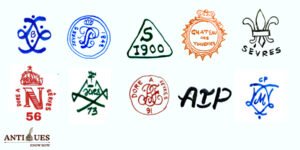
Turn the pieces of a set over before you assess anything else. The mark on the underfoot rim tells you who made it and sometimes where in the factory it came from. Meissen, Sèvres, Royal Copenhagen, and Spode all used marks that changed across different production periods.
For instance, a Meissen crossed swords mark from the 1740s reads differently from one used in the 1900s. And the difference in value between those two pieces can be significant.
Genuine Porcelain or Not?
This matters because a lot of what gets sold as old porcelain is not. Genuine hard-paste porcelain is made from kaolin clay fired at extremely high temperatures. That process produces a surface that is non-porous and translucent when held up to light.
Hold a plate up to a strong light source. If light passes through the body of the piece and you can see a faint glow, it’s likely true porcelain. Whereas, earthenware and stoneware will block the light entirely.
Rarity
A discontinued pattern or a shape that was difficult to produce at scale creates a kind of rarity that drives collectibility.
Certain Sèvres ground colors like the bleu nouveau or rose Pompadour, for example, were so rare that pieces carrying them in good condition command prices far above those of other Sèvres work from the same period.
Furthermore, a pattern produced in large quantities but designed for daily use will have far fewer intact survivors than a decorative range that sat in a cabinet for most of its life.
Hand Painted vs Transfer Printed
Transfer-printed decoration, which was a factory efficiency method introduced in the late 18th century, is worth less than handwork from the same period by the same maker.
The difference is visible under magnification. Hand-painted designs show natural variation in brushstroke weight and slight irregularities in line. On the other hand, Transfer printing produces a uniform dot pattern similar to that in a printed image.
Some pieces used both methods, with a transfer print as a base and hand-painting added for highlights or fine detail. Those pieces sit in between and need to be assessed individually.
Completeness of the Set
Naturally, full-plate settings with all original pieces intact are worth considerably more than the sum of their parts sold separately. But note that what counts as complete depends on the original service configuration.
Some formal European services were made with specific serving pieces, sauce boats, tureens, and platters that were produced in smaller quantities. If those pieces are present and in matching condition, the value of the entire set moves upward.
Condition
Hairline cracks are harder to spot on porcelain than on earthenware because the surface is so dense. Hold the piece up to a light source at an angle and move it slowly. Hairlines will catch the light differently from the surrounding glaze and become visible in a way they are not under direct overhead lighting.
Restoration is common on valuable pieces, and professional work can be difficult to detect with the naked eye. UV light will reveal most repairs because the materials used in restoration fluoresce differently from the original glaze.
Top 10 Collectible Porcelain Dinnerware Sets Worth Finding
Not every collectible dinnerware set looks the part. Some sit unrecognized at estate sales, while others surface in partial sets that get overlooked. The following ten sets are worth knowing:
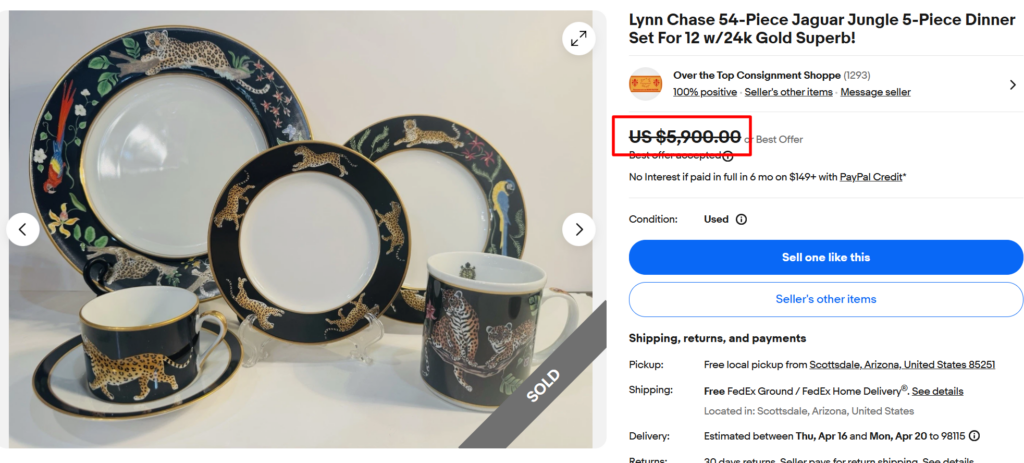
1. Jaguar Jungle Dinner Set – Lynn Chase
| Average Price Range | $2,500 to $6,500 (per set size) |
| Production Period | 1988 onwards |
| Status | Active |
| Design Details | Black border, hand-painted jaguars, tropical flora, 24k gold |
| Collector Notes | Not microwave safe due to 24k gold trim |
Lynn Chase launched “Jaguar Jungle” in 1988 after being told black dinnerware would never sell. It won Best Pattern and the Impact Award at the 1991 International Tabletop Association convention.
The design originated from a wildlife painting Chase completed in 1986. The border animals and tropical flora are hand-painted, so no two pieces are identical. Also, the 24-karat gold on the inner and outer rims was applied separately after painting.
Mid-1990s backstamps read “Chase Jaguar Jungle, Decorated with 24 Karat Gold, Lynn Chase Designs Inc” with the Chase crest. Earlier pieces from 1988 to 1990 carry a French origin mark, which collectors consider more desirable.
Gold trim condition is the biggest value factor for this set, as worn gold significantly lowers the price.
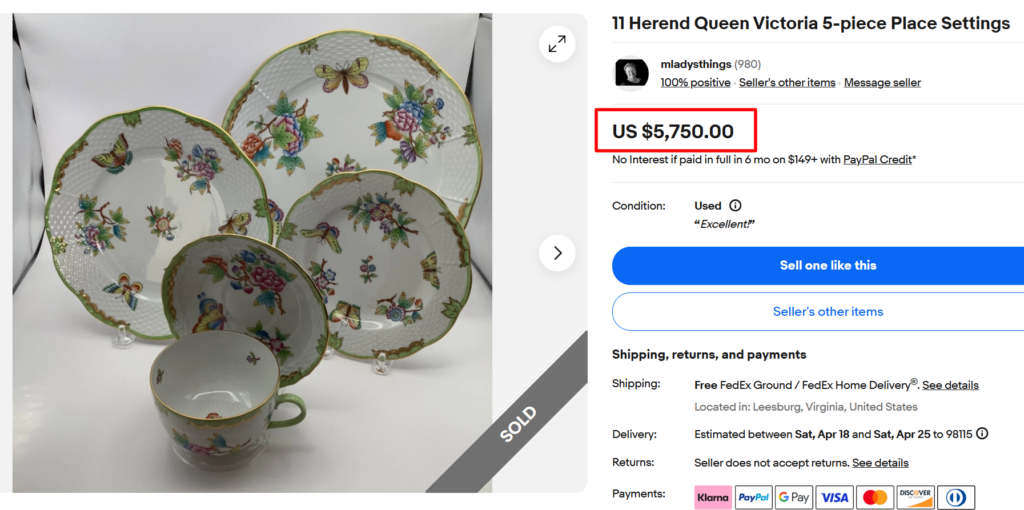
2. Queen Victoria VBO Place Setting – Herend
| Average Price Range | $500 to $7,000 |
| Production Period | 1851 onwards |
| Status | Active |
| Design Details | Hand-painted peonies, multicolor butterflies, gilt green border |
| Collector Notes | “VBO” translates to Victoria with a gold border |
Most people assume this pattern was made for Queen Victoria. It was not. The design was already complete when she saw it at the Great Exhibition in London in 1851, where it won a gold medal. Fischer Mór, one of the founders, named it after the Queen when she ordered a full set for herself.
The VBO, which stands for “Victoria avec Bord en or,” is a lighter, more gold-dominant interpretation of the original, which collectors call Museum Victoria.
To check its authenticity, you can flip the piece over. The backstamp must show the Herend name, a five-digit shape number, and the pattern code, separated by a slash. A dinner plate will read “524/VBO.”
Genuine hand painting leaves a slightly raised texture from the overglaze enamel. Also, reproductions rarely replicate Herend’s full marking system accurately.
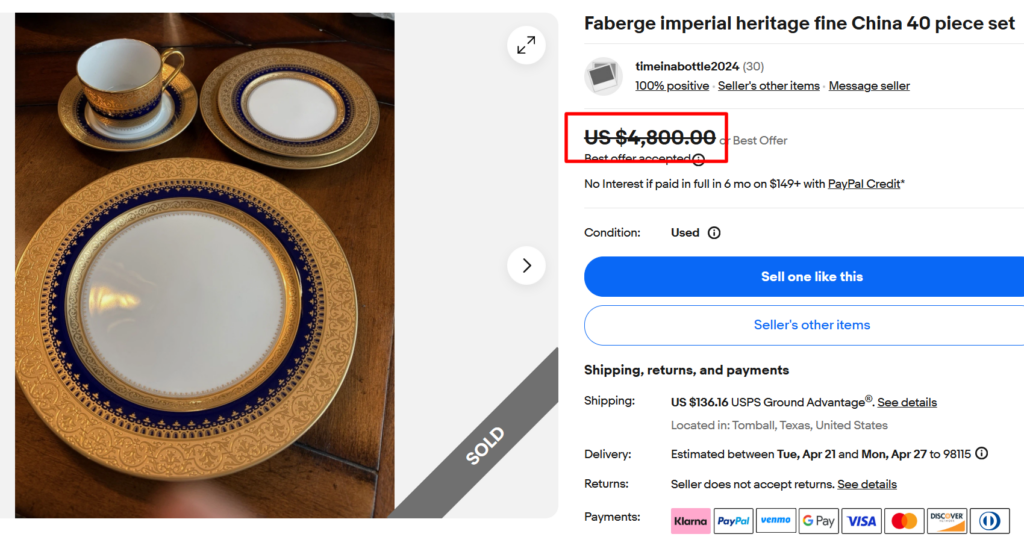
3. Imperial Heritage Cobalt Blue Dinner Set – Faberge
| Average Price Range | $1,800 to $5,500 |
| Production Period | 1993 to 2009 |
| Status | Discontinued |
| Design Details | Cobalt blue band, 24k gold encrustation, double eagle backstamp |
| Collector Notes | The gold is encrusted, not painted. |
This luxurious dinner set from Faberge features a heavy gold with a cobalt blue ground sitting beneath a scrolling gold border around the rim. Now, most collectors focus on the Faberge name and miss what makes this design hard to replace.
The gold decoration is not applied over the glaze; it is inlaid directly into the porcelain through gold encrustation. After production stopped, rising gold prices made replicating this process commercially impossible at that time.
This is why replacement pieces are genuinely difficult to source, and originals are getting rarer and more expensive. This set was manufactured in Japan, indicated by the “Made in Japan” label below the main backstamp.
For authentication, the backstamp must show “Faberge” in script, “Imperial Heritage” pattern name, and the double-eagle crest. The double-headed eagle backstamp references the original Faberge house emblem used under the Russian Imperial court.
4. Chinese Bouquet Apponyi Dinner Set – Herend
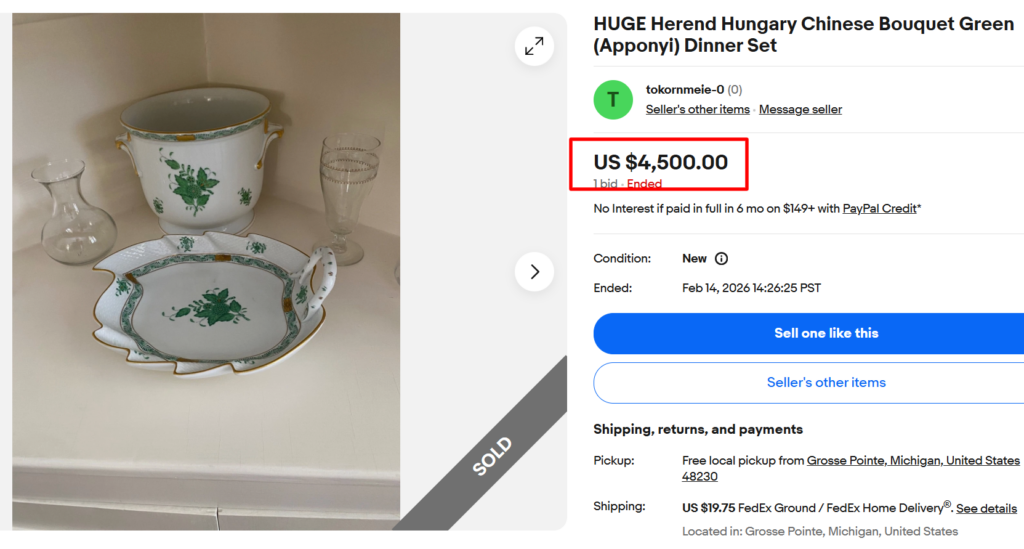
| Average Price Range | $1,000 to $5,500 |
| Production Period | 1930 |
| Status | Active |
| Design Details | Hand-painted green peony, scattered florals, 24k gold rim |
| Collector Notes | Pattern code is AV (Apponyi w/gold edge) |
Most people call this a “Chinese Bouquet.” In Hungary, it is called Apponyi, named after Count Albert Apponyi, a Hungarian statesman who commissioned it in 1930. The pattern itself was not created from scratch. Herend adapted it from an earlier design called Indian Basket.
One detail people overlook is the soup tureen in this set. The lemon and rose are recurring sculptural elements in Herend’s formal serving pieces. These were hand-modeled separately before firing and added before the piece is placed in the kiln.
Moreover, the backstamp on these pieces reads “Herend Hungary” inside a blue shield, with “Handpainted” printed below. Below the shield, you will find handwritten numbers, which are the shape and pattern codes. Any piece without handwritten numbers beneath the stamp should be examined carefully.
5. Arkadia White Porcelain Dinner Set – KPM Berlin
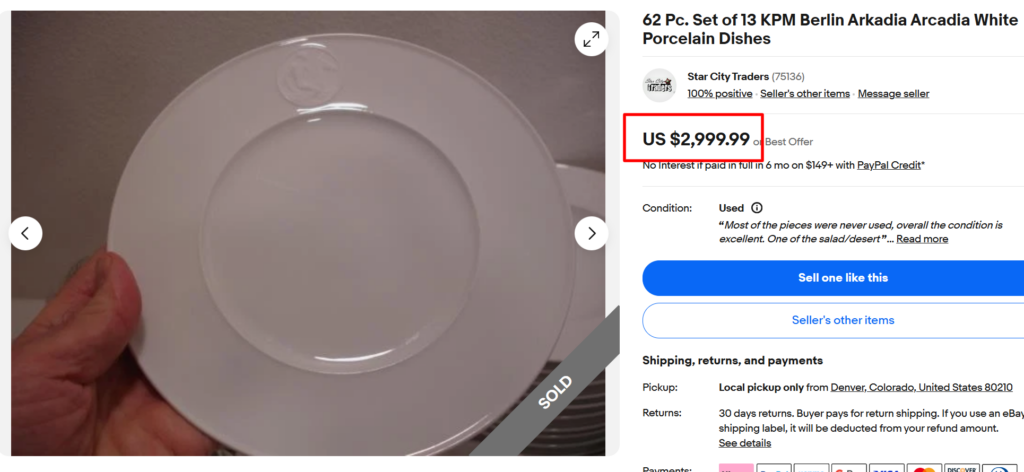
| Average Price Range | $800 to $3,500+ |
| Production Period | 1938 |
| Status | Active |
| Design Details | Bisque porcelain medallions, mythological figures |
| Collector Notes | Each piece carries a different medallion |
Arkadia was designed by Trude Petri in 1938 to mark KPM’s 175th anniversary. What makes this design unusual is the medallion technique. Each figure is modeled in unglazed bisque porcelain and set against the plate’s glazed white surface.
The contrast between the matte medallion and the glossy body is what gives the design its depth. Siegmund Schutz sculpted each figure individually, drawing from Greek mythology. The cylindrical form of the tableware was intentional, designed to make the medallions visible.
Make sure to check the sceptre stamp on the base. That sceptre has been KPM’s mark since Frederick the Great founded the manufactory in 1763. Pieces from this set show the painted cobalt-blue sceptre mark, confirming German manufacture.
6. Medusa Red Dinnerware Set – Versace by Rosenthal
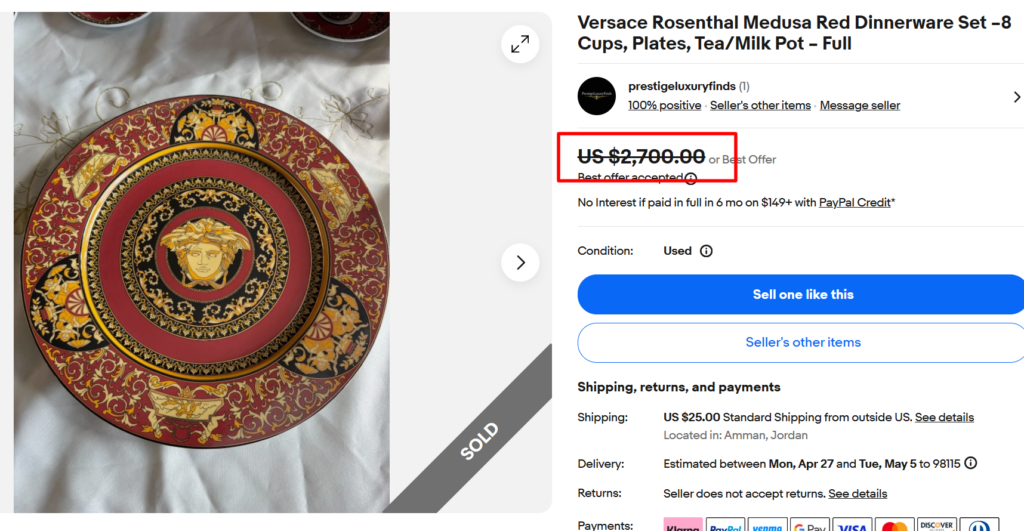
| Average Price Range | $1,500 to $5,000 |
| Production Period | 1993 |
| Status | Discontinued |
| Design Details | Red base, gold Medusa medallion, Greek key border |
| Collector Notes | Red Medusa colorway is most sought-after |
Most people recognize the Medusa face on this dinner set, but miss what is underneath it. Versace did not manufacture this porcelain; Rosenthal did, under its Studio-Linie division in Germany.
The collaboration began in 1992, with Rosenthal handling production to its exacting standards while Versace provided design direction. That is why the backstamp shows both names.
The red version is collectible because Versace discontinued it in favor of updated colorways. Full sets with serving pieces intact are genuinely hard to find.
The base carries a black circular label with a gold Medusa face at the center, “Rosenthal Studio-Linie Germany” above, and “Medusa” in gold script below. Any piece without this exact combination needs verification. Also, counterfeits feature a flat, printed Medusa face rather than the slightly raised, detailed original.
7. Petite Fleur Dinnerware Set – Villeroy & Boch
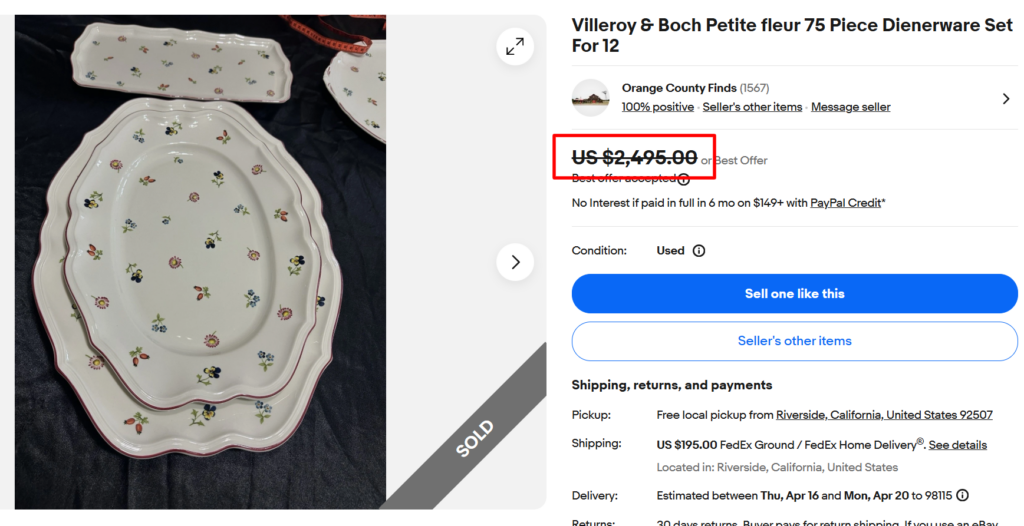
| Average Price Range | $800 to $3,800 |
| Production Period | 1970s |
| Status | Discontinued |
| Design Details | Scattered small florals, scalloped rim |
| Collector Notes | Contains a mix of Luxembourg and France-stamped pieces |
Petite Fleur is one of Villeroy & Boch’s most recognized discontinued patterns. What many collectors do not know is that the scattered floral motifs on this pattern were not randomly placed.
Each flower type was positioned differently across each piece’s shape, so a fully set table reads as a continuous garden rather than a repeated motif.
The material listed on the backstamp as Vitro-Porcelaine is specific to V&B’s Luxembourg factory production. The scalloped rim and burgundy edge trim on this set are hallmarks of the original Petite Fleur form and were dropped in later production runs.
The backstamp reads “Villeroy & Boch, Depuis 1748, Ancienne Manufacture Imperiale et Royale” followed by either Luxembourg or France, then “Petite Fleur” and “Vitro-Porcelaine”. If you don’t see the Vitro-Porcelaine designation, be suspicious.
8. 22k Gold-Encrusted Green Dinner Set – Hutschenreuther Selb LHS Bavaria
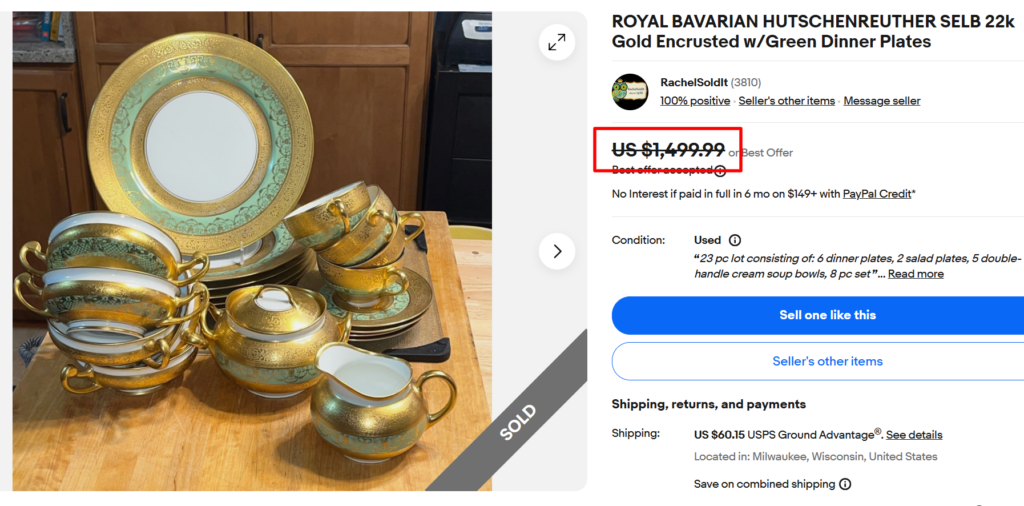
| Average Price Range | $800 to $2,500+ |
| Production Period | 1955 |
| Status | Discontinued |
| Design Details | Mint green ground, 22k gold-encrusted scrollwork |
| Collector Notes | Has secondary decorator mark with LHS factory mark |
Hutschenreuther Selb was founded separately from the original Hohenberg factory by Lorenz Hutschenreuther in 1857 in Selb, Bavaria. The two family companies competed for over a century before merging in 1969.
This set from Hutschenreuther Selb is known for its heavy acid-etched, gold-encrusted border on green. The encrustation technique requires multiple firing passes, which is why these sets hold up structurally over decades.
The LHS mark, which stands for Lorenz Hutschenreuther Selb, was used specifically by the Selb branch. The lion inside the oval is the consistent identifier for this factory across all production periods. And, the mark color helps date the piece; green marks are associated with the 1955 to 1969 period.
The backstamp shows “Hutschenreuther Selb” in script above an oval containing a lion in profile with “LHS” and “Bavaria” below. Any secondary decorator mark present in gold or a separate color identifies where the gold decoration was applied.
9. Holly Dinnerware Set – Villeroy & Boch
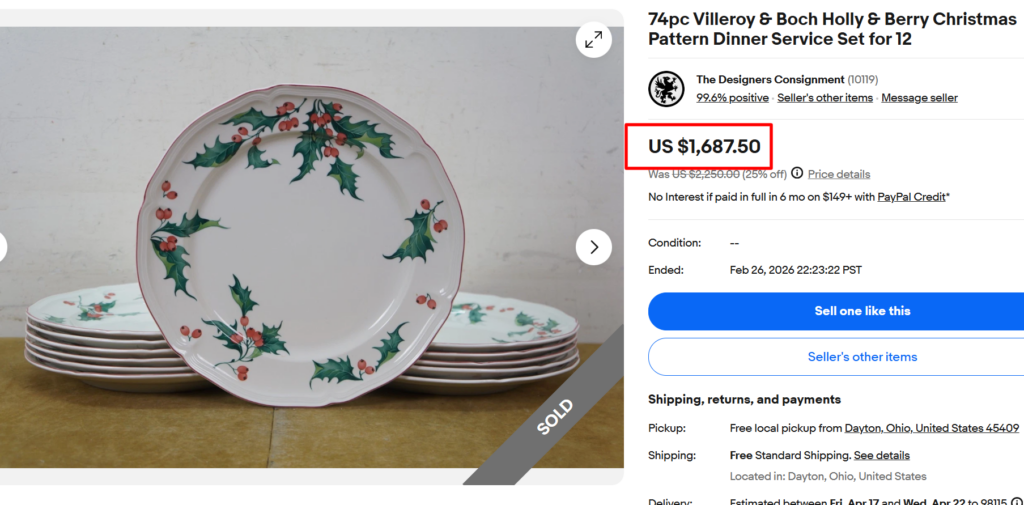
| Average Price Range | $800 to $2,200+ |
| Production Period | 1990s (1991 – 1994) |
| Status | Discontinued |
| Design Details | Hand-painted green holly leaves, red berries, white Vitro-Porcelaine body |
| Collector Notes | Seasonal pattern produced for a limited window |
This was a limited seasonal design from Villeroy & Boch in the 1970s. What most people overlook with this set is the material.
The backstamp confirms Vitro-Porcelaine, which was a porcelain formula developed specifically at V&B’s Luxembourg factory in Septfontaines. It produces a denser, harder body than standard porcelain with better resistance to thermal shock.
V&B switched away from Vitro-Porcelaine in later production to Premium Porcelain, which has a whiter, glossier finish. The two materials look and feel different side by side, which is worth knowing if you ever need to source replacement pieces.
Moreover, the Luxembourg origin confirms production before the factory closed in 2010 (the company is still active). Any Holly piece stamped with a different country of origin is from a different production run.
10. Blue Canton Dinnerware Set – Mottahedeh
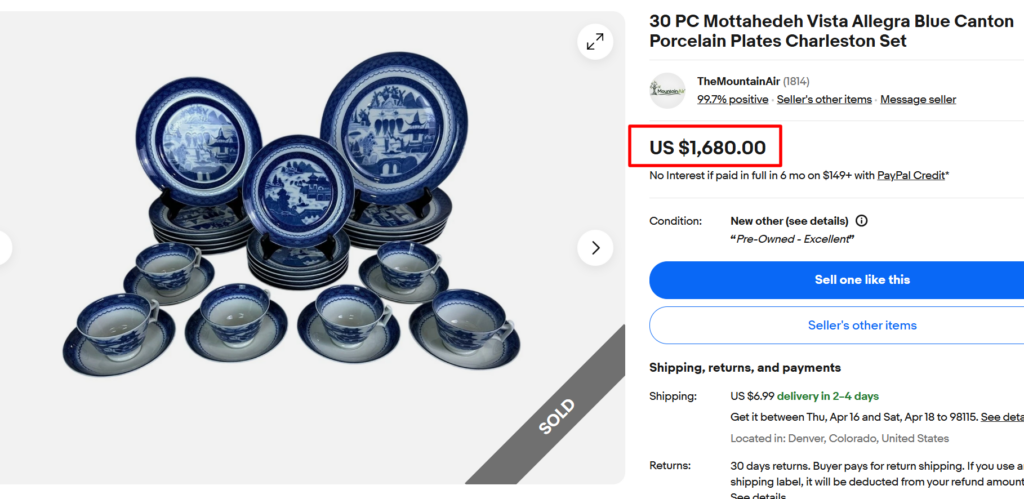
| Average Price Range | $350 to $650 |
| Production Period | 1970s |
| Status | Active |
| Design Details | Cobalt landscape, crosshatch lattice border |
| Collector Notes | Palm tree seal confirms authenticity |
The Historic Charleston Foundation licensed this pattern because Canton porcelain has a real, documented history with the city. Canton export porcelain was widely traded into American ports, including Charleston, in the late 18th century. That’s the trade this set references.
What makes it different from generic copies is the clay body. Mottahedeh uses a modern porcelain body designed to visually resemble antique Canton wares, giving the pieces a slightly aged appearance rather than a stark, modern white.
You can see the cobalt naturally occurring, which creates the uneven blue tone across landscape scenes that synthetic cobalt simply can’t reproduce. This set covers 6 place settings. Each piece carries a different landscape scene, just as the original Canton ware was made.
Porcelain value doesn’t announce itself. It sits quietly on the underside of a plate, in the texture of a gold rim, and in the specific gray cast of a clay body that only one factory ever got right. So, if you have a set in your cabinets, take it out and check the details. It might be a valuable find.
Note: This article is intended for informational, educational, and entertainment purposes only. Some images are illustrative and may not represent actual brands, products, or related entities. All trademarks, product names, brand logos, packaging, and other intellectual property referenced remain the exclusive property of their respective owners. Any brand mentions or references are provided solely for descriptive and educational context and do not imply any formal or commercial association.