Inherited gold jewelry from your grandma or found something at a garage sale? If so, you’re probably wondering if it’s the real thing now. Don’t worry. Vintage gold can confuse even experienced sellers, so you’re not alone.
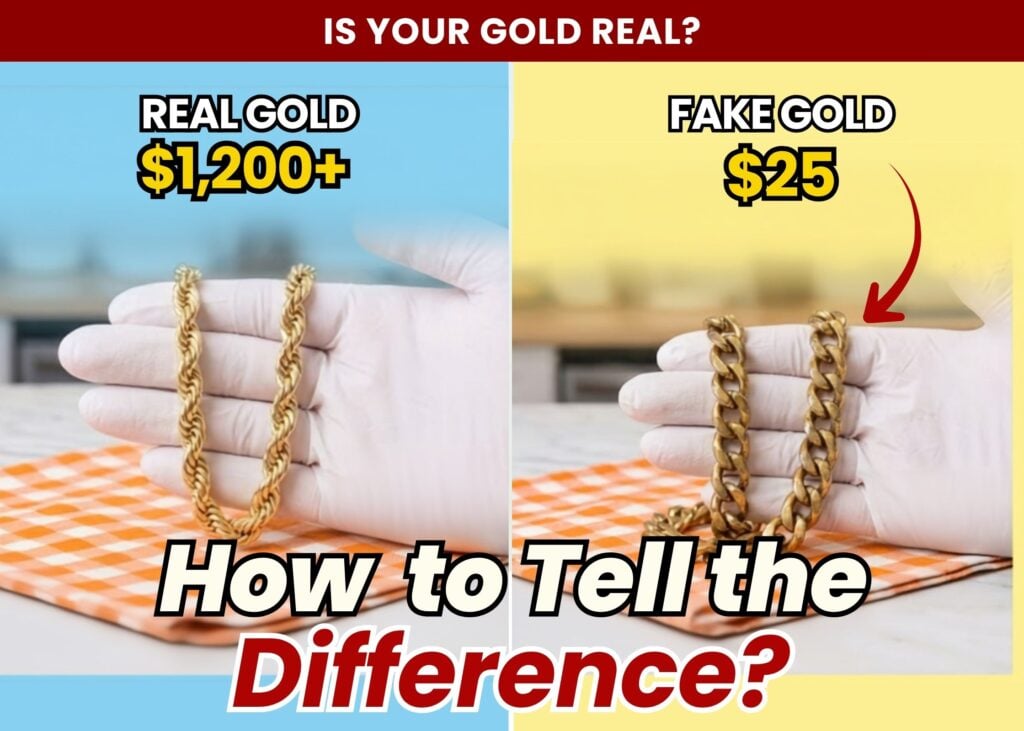
Older jewelry is trickier to identify than modern gold. Marks fade, hallmarks come from countries you may not recognize, and gold-plated pieces from the 1940s and 50s often look identical to solid gold at first glance.
That’s why a quick at-home routine matters. Here are the checks that actually tell if you have real gold, starting with the marks and working up to a proper acid test.
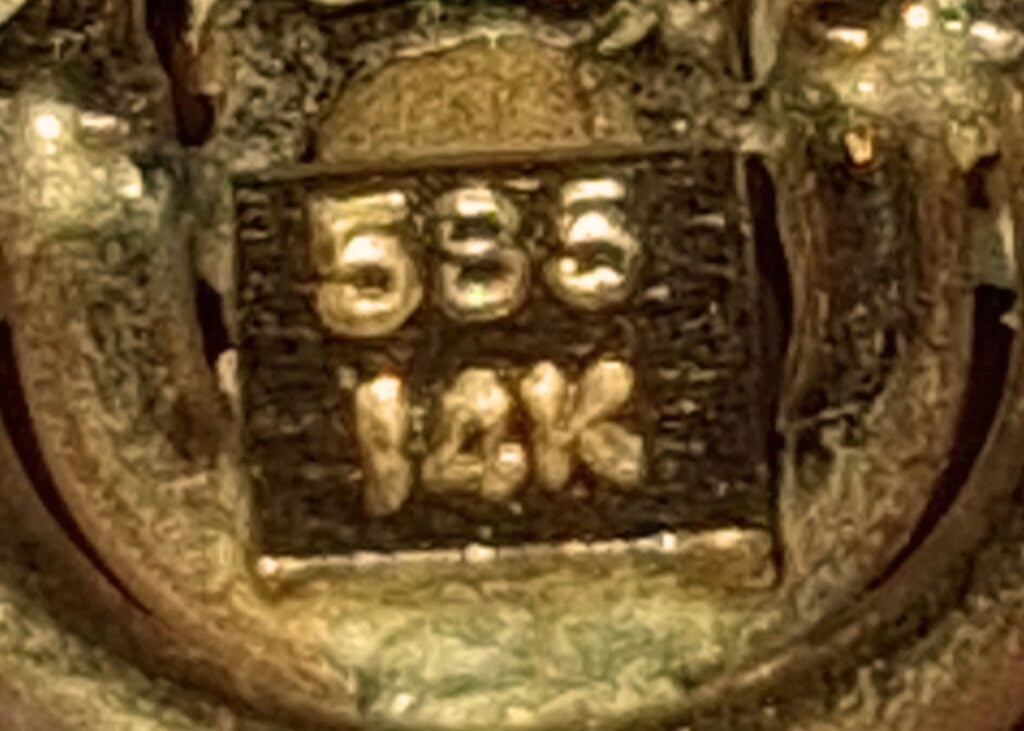
Start With the Hallmarks and Karat Stamps
Before doing any physical test, pull out a jeweler’s loupe or use your phone’s zoom camera. Hallmarks live in tiny spots. Look inside the ring shank, on the clasp, near the earring post, or on the back of a pendant.
Solid gold marks you can trust:
- 10K, 14K, 18K, 22K, 24K: the U.S. karat system
- 417, 585, 750, 916, 999: the European millesimal system, matching 10K through 24K
- 375: 9K, common on British and older European pieces
- 583: Soviet-era 14K, before Russia switched to 585 after 1991
Marks that mean the piece is NOT solid gold:
- GF or 1/20 14K GF means gold-filled. A thick gold layer bonded to base metal, but nowhere close to solid.
- GP means gold-plated. A thin gold coating over another metal.
- HGE means heavy gold electroplate. Still plating.
- RGP means rolled gold plate. Vintage plating method, still not solid.
- 925 with a gold color means vermeil. That’s sterling silver dipped in gold.
Whenever you find an unfamiliar stamp, particularly crowns, heads of animals, little letters enclosed in squares, or three-digit numbers that you’ve never seen before, take a picture of it and search for it using the image search on Google.
Stamps of Egypt, assay marks of Britain from Birmingham or London, and old German stamps appear often in estate sales.
Quick tip: Stamps are cheap to fake. A “14K” mark on its own is a starting point, not proof. Counterfeit pieces stamped with karat marks are common, so treat the hallmark as one ID feature among several.
When a Vintage Piece Has No Marks at All
Some real gold jewelry carries no stamp. Antique pieces made before hallmarking laws took hold in a country, artisan-made pieces from a studio class, and jewelry that’s been altered or resized can all end up unmarked. Rubbed-off stamps are common, too, especially on older rings.
An unmarked piece isn’t automatically fake. It just means that you can’t rely on marks to tell whether it’s real jewelry. That’s when physical tests below matter more.
1. The Visual Check (Never Skip!)
Look at the moving parts first. Clasps, earring levers, and spring rings constantly scratch against skin and other jewelry, so if the gold is only a coating, that’s where the base metal shows through first.
On earrings, check the post. A gold-colored post on a plated piece often has a stainless steel stem underneath that flashes silver at the tip. Real gold posts are gold on the inside and out.
Then look at high-wear spots on chains and rings. Watch for green or copper-colored patches peeking through, a dead giveaway of plating that’s worn down after years of use.
2. Weight and Feel
Don’t underestimate the way the jewelry feels in your hand. Real gold is dense. A 14K ring feels noticeably heavier in your hand than a hollow-plated piece of the same size.
With practice, you can pick up a chain at a garage sale and get a rough gut read on it before any test.
Another quick check you can do is by dropping the piece into a glass of water. Solid gold sinks fast and sits flat at the bottom; hollow or plated pieces sometimes hover or settle slowly.
2. The Magnet Test
For this test, I recommend using a strong magnet, like a small neodymium magnet from the hardware store, not just a fridge magnet.
Hold it close to the jewelry piece. Real gold has no magnetic pull at all. If the jewelry jumps toward the magnet or sticks, the base metal is iron, nickel, or steel, and the gold is at best a plating on top.
ID Tip: Some chains and bracelets use spring rings with tiny steel springs inside. The chain itself can be solid gold while the little spring inside the clasp pulls to the magnet. Test the main body of the piece, not just the closure.
3. The Foundation or Concealer Test
This is a quick test, so you can easily do it at an estate sale while going through old jewelry. Here’s what to do.
- Rub a small dab of liquid foundation or concealer on the back of your hand and let it dry completely.
- Once it’s dry, drag the jewelry firmly across the makeup.
Real gold leaves no mark, or the faintest gold-colored streak. Fake or plated gold leaves a clear black line where it reacts with the compounds in the makeup.
However, there’s a catch. This test only checks the surface. So, a gold-plated piece with a thick, unworn coating can also pass the makeup test but still fail an acid test underneath. Use it as a quick screen, not a verdict.
4. The Ceramic Streak Test
Turn over an unglazed coffee mug or a piece of plain white ceramic tile. Drag the jewelry across the rough underside.
Real gold leaves a gold-colored streak, whereas fake gold leaves a black one.
Remember: This test scratches the piece slightly, so use it only on jewelry you already suspect isn’t real; never on a signed piece or anything with a maker’s mark.
5. The Home Acid Test (with Kit)
For anyone selling vintage jewelry on eBay or Etsy, this is the test that settles the question.
A gold and silver acid testing kit runs $15 to $25 online and includes a small scratch stone plus separate acid bottles for 10K, 14K, 18K, and 22K, along with a silver acid.
Here’s how the test works:
- Rub the jewelry piece against the scratch stone in a hidden spot (the back of a clasp or the inside of a ring), leaving a short streak of metal on the stone.
- Start with the lowest acid, 10K. If the streak dissolves under the 10K acid, the piece isn’t solid gold. Stop there.
- If the streak stays put, move up to 14K. If it survives 14K but disappears under 18K, you’ve got a 14K piece. And so on up the ladder.
Silver gives a different result. When 18K acid hits sterling silver, the streak turns milky white or silvery gray instead of dissolving, which is how you confirm a 925-marked piece is real sterling.
Collector’s Note: The acid test can catch pieces with different metals in different parts. A vintage earring might have a solid 14K post with a gold-plated hoop. So, test each section separately.
When to Skip the Home Tests
Home tests are okay, but in some cases, they can do more damage than good.
If your piece is signed by a major maker like Tiffany, Cartier, Van Cleef, or a well-known vintage house, take it to a jeweler with an XRF gun. That’s a handheld X-ray tool that reads the exact metal content without touching the surface.
XRF testing is often free at pawn shops and jewelers. It also gives you the precise karat percentage, which matters for insurance appraisals and estate valuations.
A signed vintage 10K brooch can easily outvalue an unsigned 18K piece from the same era, so on anything with a maker’s mark or serious sentimental weight, professional testing is worth the trip.
In a nutshell, if you’re unsure about that gold ring or bracelet, start with the stamps, then the magnet, then the makeup or ceramic streak. If the piece still has you curious, use the acid kit. And if it’s signed, save it for the jeweler.
Note: This article is intended for informational, educational, and entertainment purposes only. Some images are illustrative and may not represent actual brands, products, or related entities. All trademarks, product names, brand logos, packaging, and other intellectual property referenced remain the exclusive property of their respective owners. Any brand mentions or references are provided solely for descriptive and educational context and do not imply any formal or commercial association.