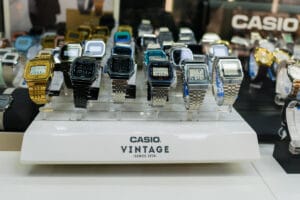
Antiques Know How Research
Valuable Vintage Watch Brands
Antiques Know How’s in‑depth review of eBay sales and auctions shows that most vintage wrist and pocket watches sell for under $200 at estate sales and flea markets, while rare models from notable brands can fetch up to $2,000 to $500,000+. Most collectible vintage watch brands include Rolex, Patek Philippe, Omega, Seiko, Hamilton, Tudor, Longines, Bulova, and Elgin, with the most valuable pieces including dress, diver, chronograph, moon‑landing, electric, railroad, and military‑issue models. The value is also driven by movement type, dial and crown originality, rarity, and clear markings and stamps.
Antiques Know How
Did you know that vintage watches can be worth as much as $500,000 today? And no, this is not an exaggeration. Old watches from certain brands can be worth serious money, and they do show up at thrift stores, estate sales, and flea markets.
The key is to know which brands and models are real treasures. This guide covers the 9 vintage watch brands and their most notable models you should know, what makes each one collectible, and exactly how to identify them.
What Makes Vintage Watches Valuable?
The value of vintage watches depends on several factors, including their age, condition, rarity, the movement type, and whether the original parts are intact. But the most crucial factor that comes before others is the maker.
The unmarked mechanical watch from the ’50s may cost $20, but the Omega Seamaster from the same period and in the same condition costs $500 – $2,000. Rolex from the ’50s is even worth several thousand more. It is all about the brand, as it speaks of the quality of movement (the inner mechanisms that make the watch work), and its collectibility.
Other than the brand name, these factors are also important:
- Movement type: Watches with mechanical and automatic movements are more desirable than quartz movements. Hand-wound Swiss and American watches are considered the most valuable.
- Originality: Original dials, hands, crowns, casebacks, these things matter a great deal to collectors. A watch with replaced components reduces substantially in value, regardless of its brand.
- Condition: Scratches and wear are usually expected and acceptable on a vintage piece. But severe cracks, water damage, or a non-running movement will drop the price significantly.
- Rarity: Low production numbers, discontinued models, and unique dial types (color and design) make watches rare. The scarcer the watch model, the higher the value.
9 Notable Vintage Watch Brands to Look For
Below are 9 iconic brands that made the highest-quality watches that are selling for hundreds and thousands today.
1
Rolex
Typically sells for $2,000 to $700,000+
Rolex started in London in 1905 and later moved to Geneva, Switzerland. The brand is well known for the Oyster case, the first waterproof wristwatch case that came out in 1926. Then, there is the Perpetual rotor, the first reliable self-winding mechanism introduced in 1931.
Rolex has been the most famous luxury watch brand for decades, and even their vintage watches have the highest value of any vintage watch.
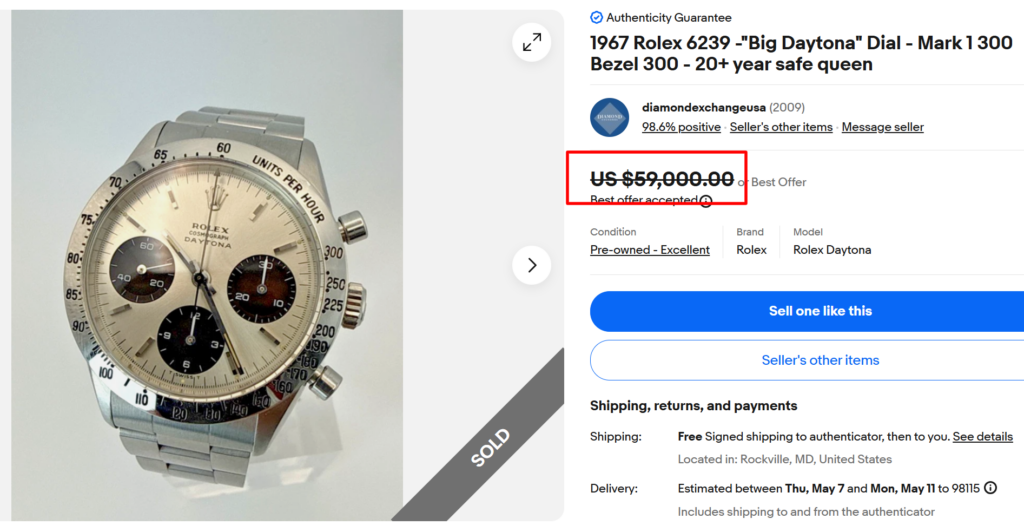
Any basic old Rolex watch would easily fetch between $2,000 to $4,000, while sport models like Submariner and GMT-Master can cost between $10,000 to $50,000.
Most Collectible Models:
- Submariner (Ref. 5513, 6538, 5508)
- Daytona / Cosmograph Daytona (Ref. 6239, 6263)
- GMT-Master (Ref. 1675, 6542)
- Explorer (Ref. 1016)
- Datejust (Ref. 1601, 1603)
- Air-King (Ref. 5500)
How to Identify a Vintage Rolex?
Authentic Rolex watches usually feature a polished flat back with no external engraving, except for the Sea-Dweller model. The serial number is engraved on the back of the watchcase between the lugs at 6 o’clock, behind the bracelet.
The model/reference number is engraved at the 12 o’clock position between the lugs. Note that some watches made post-1990s might have hologram stickers with a crown logo at the back of the watchcase.
The Rolex crown logo appears on the dial at 12 o’clock position and on the crystal at 6 o’clock in watches made after 2002. An original Rolex can be distinguished from a fake by examining the internal mechanism; authentic watches have excellent finishing with Rolex engraving on the rotor or bridges.
2
Patek Philippe
Typically sells for $5,000 to $100,000+
Patek Philippe is widely considered the most prestigious watch maker in the world. They only make about 60,000 watches each year, way less than Rolex, which makes over 1 million per year. The pieces are handmade with extraordinary finishing.
The brand also holds the record for the most expensive watch to be auctioned: the Grandmaster Chime, which went for $31 million in 2019.
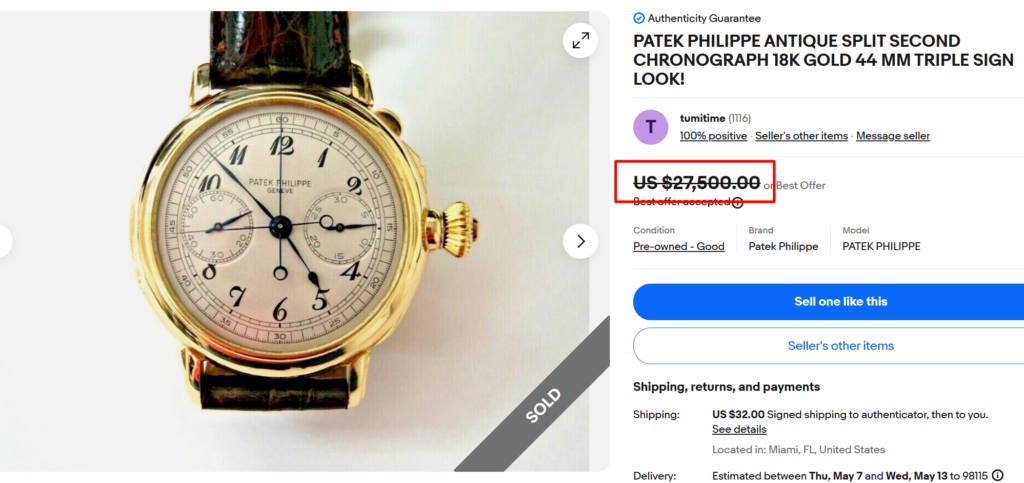
Today, even the most basic vintage Patek Philippe watches sell for $5,000 to $15,000. Complicated models and popular references like the Nautilus or Calatrava can range from $20,000 to well over $100,000. But finding a Patek Philippe at a thrift store is highly unlikely.
Highly Notable Models:
- Calatrava (Ref. 96, 3919, 5196)
- Nautilus (Ref. 3700, 5711)
- Perpetual Calendar (Ref. 1518, 3940)
- World Time (Ref. 1415, 5110)
- Chronograph (Ref. 1463, 5070)
How to Spot a Real Patek Philippe?
A genuine Patek Philippe watch will have engravings on the dial reading “Patek Philippe” and “Geneva.” You’ll also see the Calatrava cross emblem on the crown and occasionally on the dial and back plate.
When you open the back cover, you’ll find very fine finishing on the movement, with Geneva waves, beveled edges, and engravings stating “Patek Philippe & Co., Geneva, Switzerland.” The reference number is on the back cover, while the serial number is on the movement itself.
Each Patek Philippe watch also comes with an authentic extract from the archives certificate. This document states the year of manufacture, case type, and movement details. It’s an important addition that confirms the watch’s provenance.
3
Omega
Typically sells for $200 to $250,000
Founded in 1848 in La Chaux-de-Fonds, Switzerland, Omega became one of the most important Swiss watchmakers of the 20th century. It’s been serving as the official timekeeper for the Olympics since 1932.
Omega’s Speedmaster was reportedly the first watch worn on the moon during Apollo 11 in 1969, which shot the brand into fame.
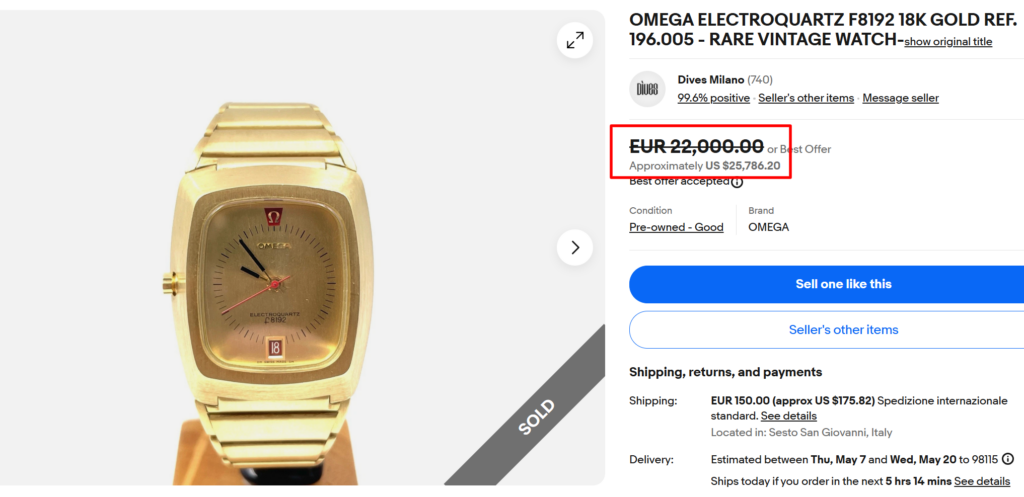
Most common vintage Omega watches today can be worth $200 and $2,000. Rare pre-moon Speedmasters or solid gold Constellations have reached $10,000 to a stunning $250,000 at auction.
Most Valuable Models:
- Speedmaster Professional “Moonwatch” (Ref. 105.012, 145.022)
- Seamaster 300 (Ref. 165.024, CK 2913)
- Constellation “Pie Pan” dial
- De Ville (especially 18K gold models from the 1960s)
- Railmaster
- Electroquartz
How to Spot Omega Watches?
Omega keeps its key information inside the watch. For example, the reference number is usually stamped or engraved on the inside of the caseback, while the serial number (7-8 digits) is engraved on a bridge of the internal movement.
Collector’s Tip: You can use the serial number to look up the approximate production year through Omega’s Vintage Database.
On the dial, genuine vintage Omegas have the Omega symbol (the Greek letter Ω) at 12 o’clock with “OMEGA” printed below it. Constellation models have a small star or observatory medallion on the caseback. Also, the Omega movement has clean engravings with the caliber number and “Omega Watch Co.” on the bridges.
4
Seiko
Typically sells for $50 to $6,000
The Japanese brand Seiko revolutionized watchmaking several times. First, when they created Japan’s first wristwatch in 1913. Second, when they launched the world’s first quartz wristwatch, the Astron, in 1969. Third, when they made the world’s first six-digit LCD display watch in 1973.
In addition, Seiko is one of the very few companies that manufacture all of their components internally, including movement, cases, and crystals.
Regarding the value, ordinary vintage Seikos are easily attainable for collectors at prices below $100. But certain models are worth a lot. For example, dive watches like the 6105 and 6159, Grand Seiko, and King Seiko models from the 1960s can reach $1,000 to $5,000+.
Notable Models:
- 6105 “Captain Willard” Diver
- 6159 Professional Diver (300m)
- 6139 Chronograph (“Pogue”)
- Grand Seiko 44GS and 45GS
- King Seiko (1960s models)
- Seiko 7A28 Quartz Chronograph
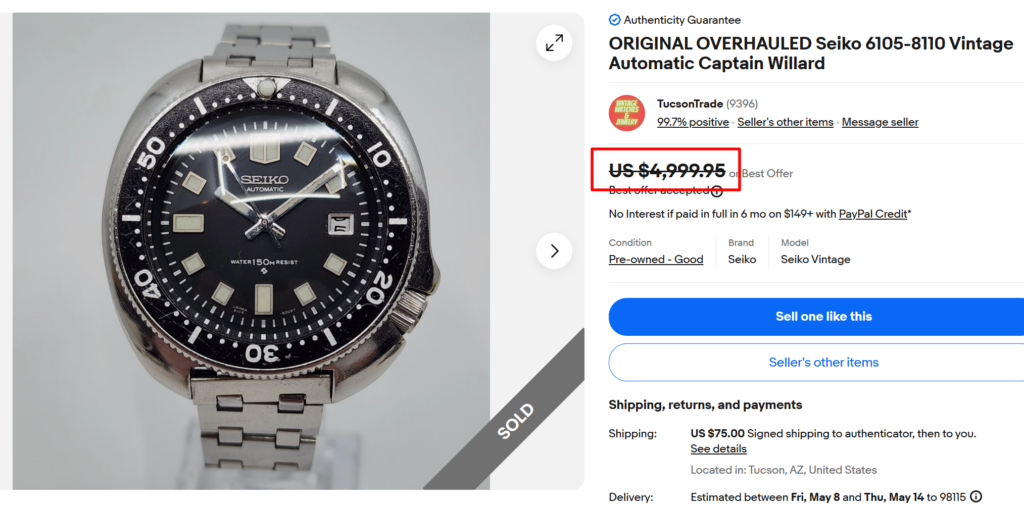
How to Identify Seiko Watches?
Identifying Seiko watches is relatively easier. You’ll find the movement caliber number and case code (separated by a hyphen, like 6139-6002) on the caseback. The back of the case also bears stamps such as “Stainless Steel,” “SGP” (Seiko Gold Plated), and “HI-BEAT” in watches designed with high frequencies.
The serial number appears below this. The first number refers to the unit’s year of manufacture, while the second digit/letter refers to the month. For instance, a serial beginning with “9D” would refer to September and December.
In addition, the SEIKO brand name always appears on the dial face at 12 o’clock. Most of these brands also specify the watch movement type (such as Automatic and Hi-Beat) on the dial face.
5
Hamilton
Typically sells for $100 to $7,000
Hamilton built its reputation on railroad-grade pocket watches. These models were so accurate that they became the standard for American railroad timekeeping. In 1914, the brand transitioned to wristwatches in 1914 and supplied military watches during both World Wars.
Hamilton also holds the record for the most movie appearances of any watchmaker; it has been worn in over 500 films. The most collectible Hamilton, the Ventura (the world’s first electric wristwatch, from 1957), regularly sells for $500 to $6,000+.
Common wristwatches typically sell for $100 to $500 for common models. Art Deco pieces from the 1930s and 1940s in 14K gold can also bring a few hundred dollars.
Most Notable Models:
- Ventura (1957, first electric watch)
- Pacer and Altair (asymmetric electrics from the 1950s-60s)
- 992B Railroad Pocket Watch
- Khaki Field (military models)
- Pan Europ Chronograph
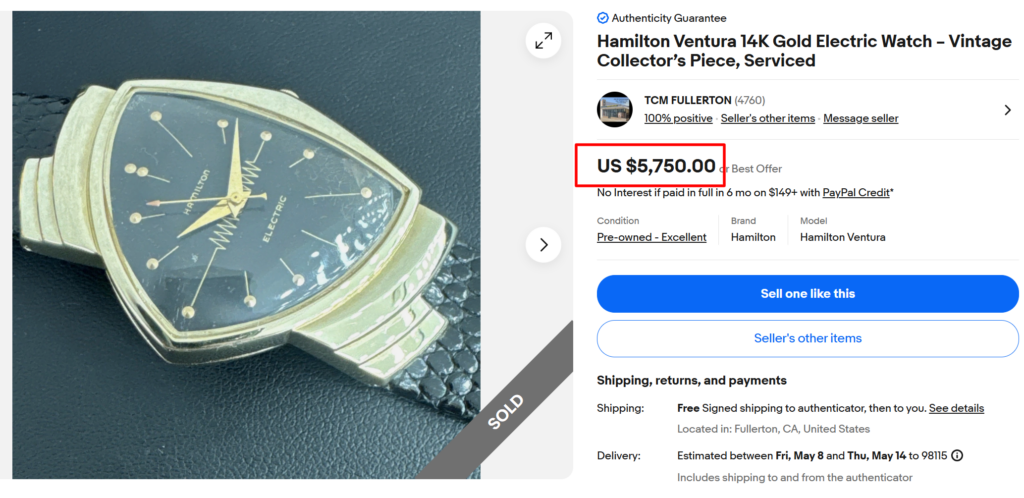
How to Spot an Original Hamilton Watch?
Before 1969, Hamilton wristwatches were made in America. These pieces are marked “Hamilton” on the dial and the movement. The movement will be marked “Hamilton Watch Co., Lancaster, Pa., U.S.A.” along with the grade and jewel rating.
Following the move of the manufacturing facility to Switzerland in 1969, the dial markings changed to “Swiss” or “Swiss Made”. The model number was engraved on the inside of the case back from the 1930s onwards. Serial numbers for pocket watches can be used to identify the exact grade and specifications of the watch.
6
Tudor
Typically sells for $1,000 to $50,000+
Tudor was created by Hans Wilsdorf, the founder of Rolex, in 1926. The brand was designed to offer Rolex-level quality at a lower price. Early Tudor watches used Rolex-made cases and crowns, but with less expensive third-party movements.
Tudor has since developed its own in-house movements. It’s popular among collectors as a more affordable alternative to Rolex. However, vintage pieces hold higher value.
For example, Oyster Prince watches can cost $1,000, but Submariner watches can reach $6,000 to $10,000. Also, Tudor Submariner watches issued to people in the military, like the French Marine Nationale, are hard to find and cost more.
Highly Collectible Models:
- Submariner (Ref. 7928, 7016, 79090)
- Oysterdate “Monte Carlo” Chronograph (Ref. 7159, 7169)
- Oyster Prince (1950s-60s)
- Ranger (Ref. 7995)
- “Big Block” Chronograph (Ref. 79180)
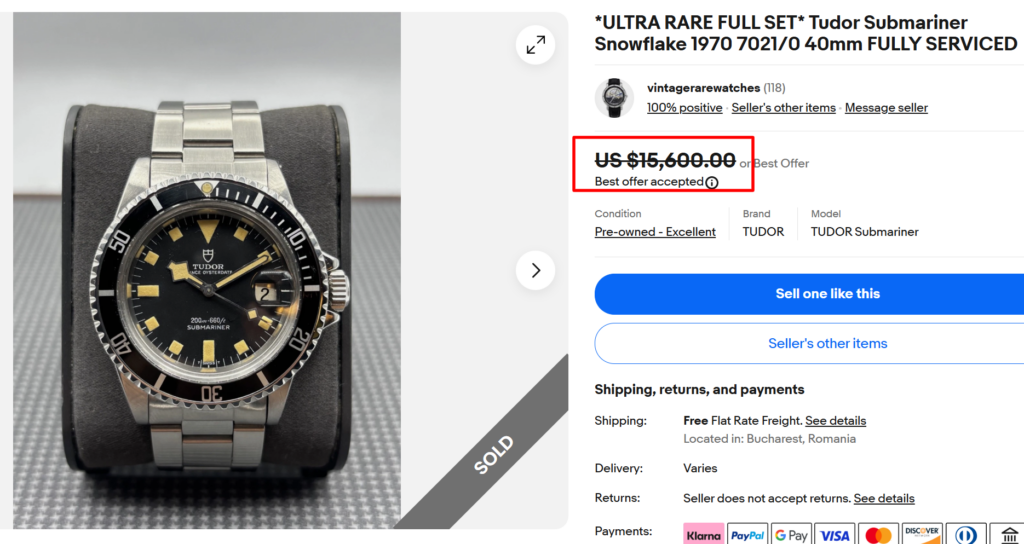
How to Identify a Vintage Tudor?
There is always a logo along with the Tudor brand name on the face of its watches. However, over the decades, the brand’s logo changed; there was no logo before the mid-1930s, rose within a shield from the mid-1930s to 1940s, rose alone from the 1940s to date, and shield alone from the 1940s to date.
Some vintage models have both “Tudor” and “Rolex” on the dial or caseback. The serial number is engraved between the lugs at 6 o’clock, matching Rolex’s placement (since Tudor used Rolex cases).
7
Longines
Typically sells for $150 to $30,000
One of the oldest watch brands in existence, Longines was established in 1832. They partnered with Charles Lindbergh to create the Hour Angle model in 1931 and served as official timekeepers for the Olympics for several years.
In addition, Longines developed some of the best chronograph movements throughout the 1940s and 1950s. The 13ZN and 30CH calibers are amongst the finest ever made.
Vintage Longines are usually fairly cheap. A typical vintage dress Longines in the 1950s to 1970s era can cost anywhere between $150-$500. However, vintage Longines chronographs featuring 13ZN or 30CH movement can cost $5,000-$30,000+.
Most Valuable Models:
- Conquest (launched 1954)
- Flagship (launched 1957)
- Legend Diver
- 13ZN and 30CH Chronographs
- Lindbergh Hour Angle
- Admiral (1960s-70s)
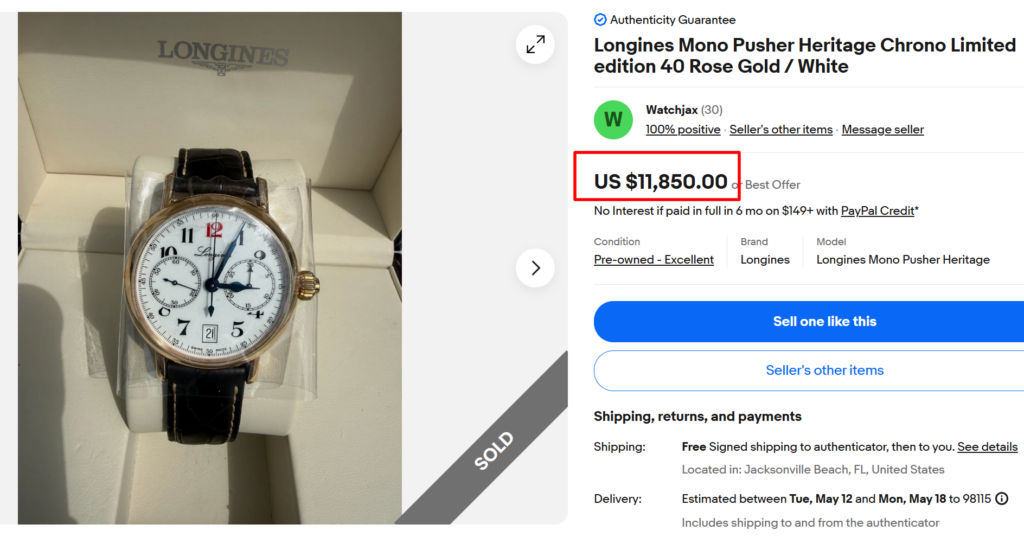
Identifying a Real Vintage Longines
Longines watches have the winged hourglass logo on the dial. It’s one of the oldest registered trademarks still in use, dating back to 1889. The caseback often has specific medallions.
For example, the Conquest Longines watches have a fish or a star in enamel on the back. The Flagship Longines watches have a picture of a sailing ship, which is called a caravel, engraved on the caseback.
The reference number and case material are stamped on the inside of the caseback. The movement will be engraved with “Longines” and the caliber number.
8
Bulova
Typically sells for $50 to $5,000
Bulova’s biggest contribution to watchmaking was the Accutron, released in 1960. It used a tuning fork instead of a traditional balance wheel, making it far more accurate than any mechanical watch at the time.
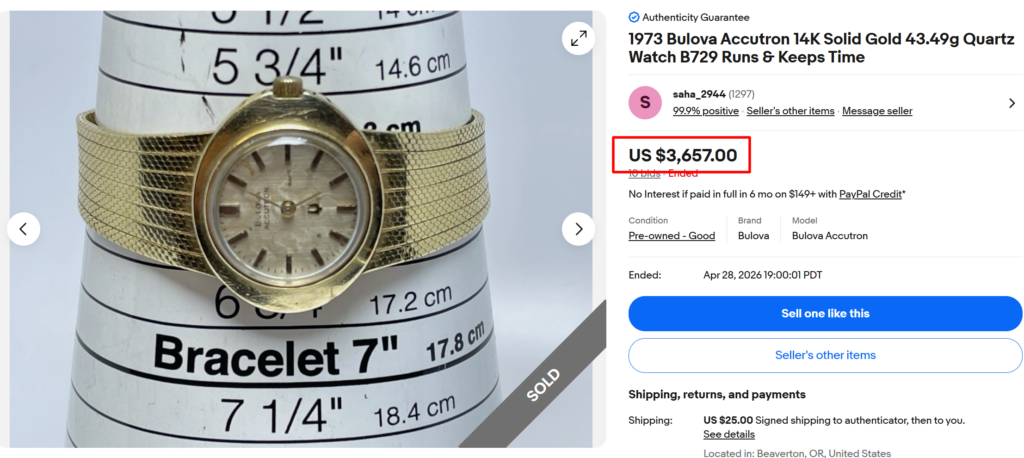
Also, a Bulova chronograph was worn on the moon during the Apollo 15 mission in 1971. It’s the only privately owned watch used on the lunar surface. Accutron Spaceview models are the most sought-after today. Art Deco models from the 1920s-1930s in solid gold or with diamonds can also bring $500 to $2,000+
Most Collectible Models:
- Accutron Spaceview (1960s-70s)
- Accutron Astronaut (GMT model)
- Lone Eagle (1927, Lindbergh commemorative)
- Devil Diver / Oceanographer (1960s-70s dive watches)
- Art Deco rectangular models (1920s-30s)
- Academy Award series (1950-54)
How to Spot a Vintage Bulova?
Bulova uses a date code system that makes dating easy. From 1950 onward, look for a two-character code on the caseback or inside the case.
The first character (a letter) tells you the decade: L = 1950s, M = 1960s, N = 1970s, P = 1980s. And the second character (a number) gives the specific year. So “M7” means 1967.
Pre-1950 watches use symbol-based codes stamped on the movement, for which you’ll need a reference chart. The dial reads “Bulova” on standard models, “Bulova Accutron” on tuning fork models, or just “Accutron” on later versions. Also, movements on pre-1923 watches are signed “Bulova W. Co.” and later ones just “Bulova.”
9
Elgin
Typically sells for $30 to $4,500
The Elgin National Watch Company became the largest watch manufacturer in the United States, producing over 55 million watches during its century of operation. Elgin’s focus was not on fancy watches, but reliable, affordable, machine-made timepieces that could be serviced easily with interchangeable parts.
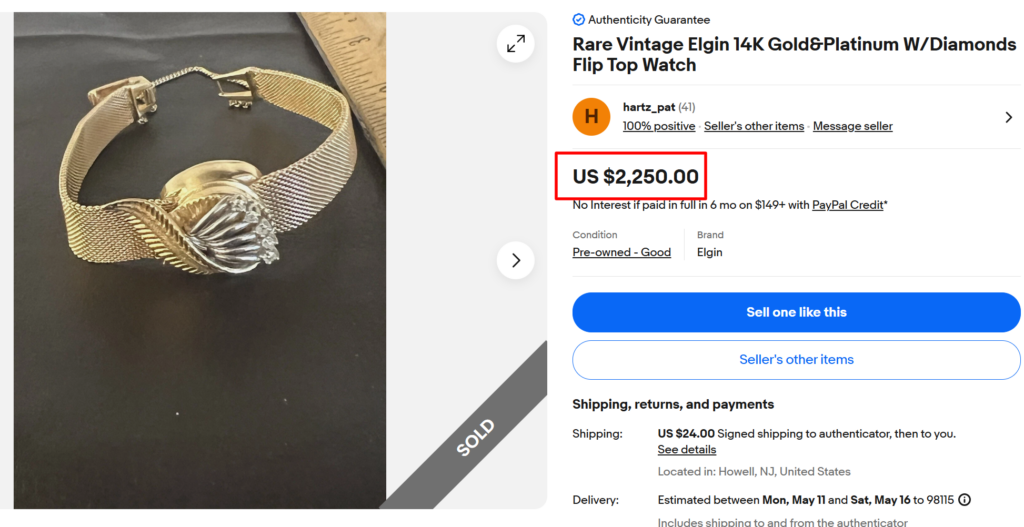
The company produced its first wristwatch around 1910 and made military watches during both World Wars. Today, most Elgin wristwatches sell for $30 to $150. The higher-end “Lord Elgin” and “Lady Elgin” lines can reach $200 to $800 for 14K gold examples.
Notable Models:
- B.W. Raymond Railroad Pocket Watch
- Lord Elgin (men’s premium line)
- Lady Elgin (women’s premium line)
- Military A-11 WWII Wristwatches
- Art Deco rectangular wristwatches (1930s-40s)
- Shockmaster models
How to Identify a Vintage Elgin?
Every genuine Elgin watch features the word “Elgin” on the dial. Some premium models read “Lord Elgin” or “Lady Elgin.” In the late 1960s, a few models reduced the branding to just the Elgin “E” logo.
Inside the caseback, pre-1960s watches are typically marked “Cased and Timed by the Elgin National Watch Co.” The movement is also a reliable identifier in itself; it will be engraved with “Elgin National Watch Co.” along with a serial number.
Collector’s Note: Be cautious of watches marked “Elgin Movement.” These are not Elgin watches, but third-party cases using Elgin parts.
Note: This article is intended for informational, educational, and entertainment purposes only. Some images are illustrative and may not represent actual brands, products, or related entities. All trademarks, product names, brand logos, packaging, and other intellectual property referenced remain the exclusive property of their respective owners. Any brand mentions or references are provided solely for descriptive and educational context and do not imply any formal or commercial association.