Antiques Know How Research
Blue Corelle Dishes & Patterns Value
According to our research of recent eBay sales at Antiques Know How, the value of vintage blue Corelle dishes can range from $5–$25 per piece to $50–$200+ for sets or rarer serving items. The most notable Blue Corelle patterns include Blue Cornflower, Old Town Blue, Blue Heather, Snowflake Garland, Provincial Blue, Colonial Mist, Morning Blue, and Blue Velvet, with short-run originals coordinating with Pyrex/CorningWare commanding the highest prices.
Antiques Know How
Corelle launched its Livingware line in 1970. Made from Vitrelle, a three-layer laminated glass developed by Corning, the dishes were marketed as lightweight, nearly unbreakable, and stackable.
Dozens of patterns came and went over the next few decades. Many are now discontinued and highly sought-after. The blue ones, from the classic Cornflower border to the rarer Blue Heather, are among the most actively collected today, especially for rarer dishes.
So, let’s explore with me some popular Blue Corelle dishes and patterns that collectors secretly look for, how to spot them, and what they’re actually worth!
9 Collectible Blue Corelle Patterns & Dishes to Know!
1. Blue Cornflower – Soup Pasta Bowls
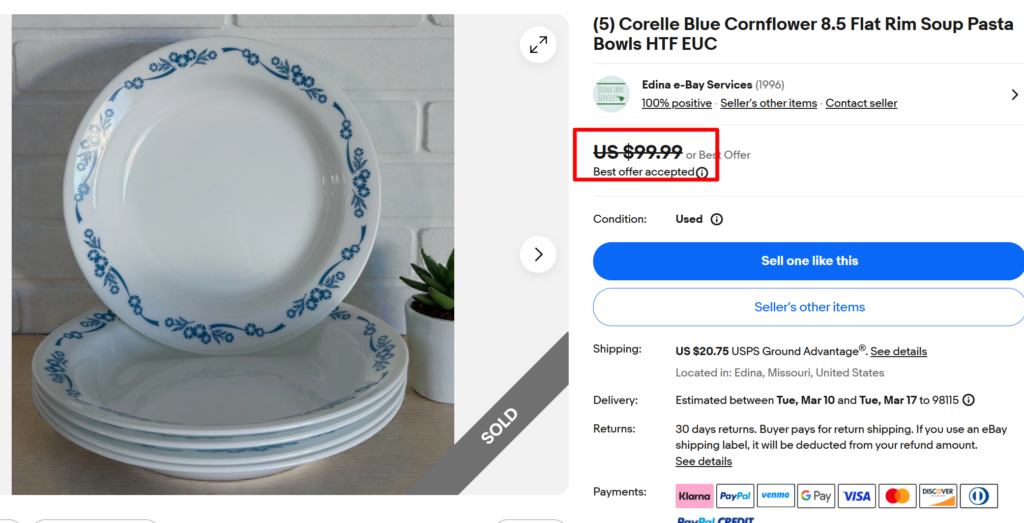
| Average Value | $15–$25 (single) $75–$100+ (set) |
| Production Period | 1970s – 1980s |
| Pattern Details | Blue cornflower border, rim only |
| Collectibility | Moderately Collectible |
These soup bowls feature the most recognized Corelle pattern, Blue Cornflower. It started on CorningWare in 1958, and became the brand’s signature look. When Corelle Livingware launched in 1970, the pattern came with it and became popular.
The design is a ring of small blue cornflowers and leafy stems around the rim on a plain white background.
Because these wide-rimmed bowls were often sold as “coordinates” rather than standard set pieces, they carry a premium over standard coupe-style cereal bowls.
2. Old Town Blue – Large Platters (10-12″)
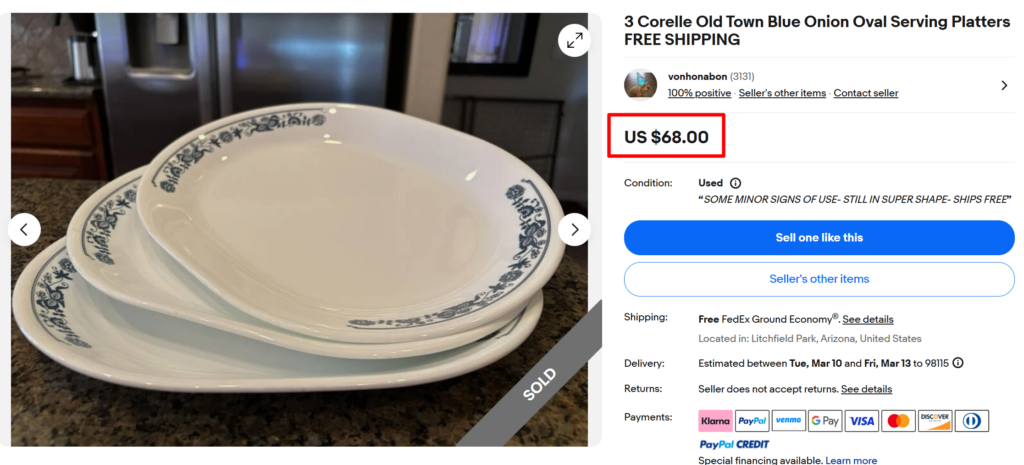
| Average Value | $5–$15 (single); $25–$90 (set size) |
| Production Period | 1972–approx. 1986 (original vintage run) |
| Pattern Details | Navy blue onion floral, rim border only |
| Collectibility | Moderate |
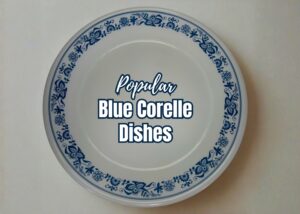
Designed by artist Cynthia Gerow, Old Town Blue was first sold in 1972 as part of Corelle’s original Livingware lineup. The navy blue border design of onion-like florals and foliage draws inspiration from the iconic German “blue onion” pattern.
Oval platters in this Corelle pattern are harder to find than dinner plates. The pattern coordinates with Pyrex Homestead, a bonus for collectors building full Corelle/Pyrex sets.
3. Blue Heather – Large Dinner Plates
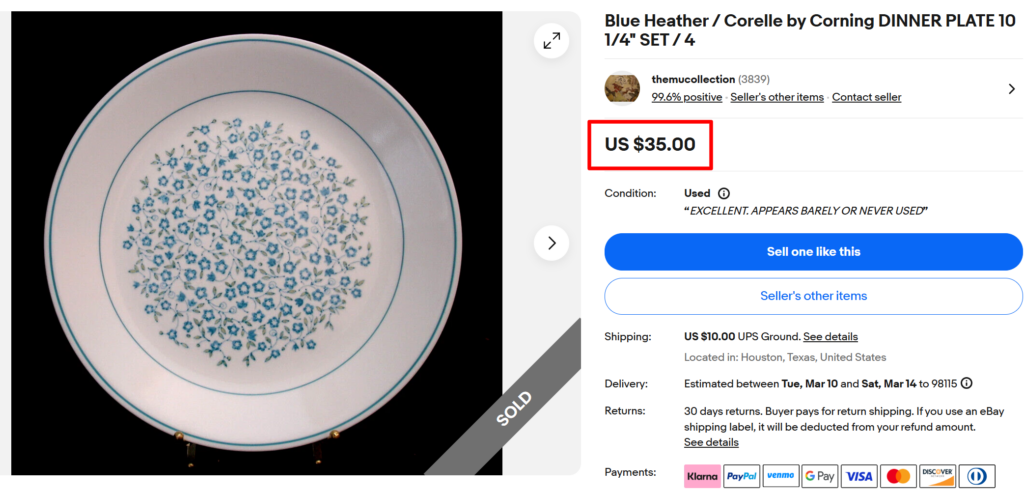
| Average Value | $10 – $18 per plate |
| Production Period | 1977-1981 |
| Pattern Details | Blue floral/vine design, (Expressions) |
| Collectibility | Moderate |
| Collector Notes | Often found in “Livingware” sets |
Blue Heather was a part of Corelle’s Expressions Livingware line launched in 1977. Unlike most Livingware patterns with rim border, Expressions designs appear on the plate’s center; this one shows small five-petal flowers, vine sprigs, and leaves.
Production ended around 1981, giving it roughly a four-year window. That short run makes pristine examples harder to find, adding a moderate value.
4. Blue Snowflake Garland – Serving Bowl
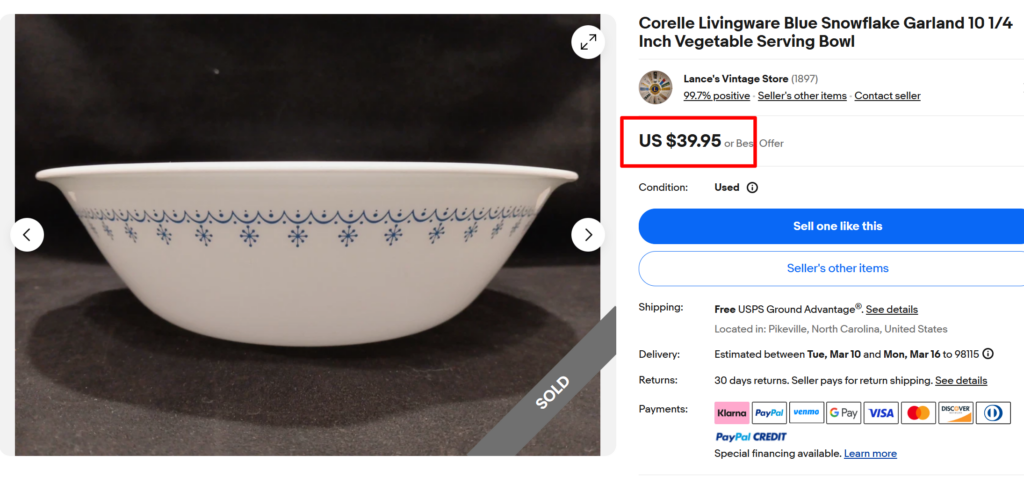
| Average Value | $20–$50 (single bowls) |
| Production Period | 1970–1976 |
| Pattern Details | Geometric snowflake garland on rim |
| Collectibility | Average |
| Collector Notes | Coordinates with Pyrex Snowflake Blue |
This large serving bowl features Snowflake Blue (the official name), one of Corelle’s original Livingware patterns that ran from 1970 to 1976. A short run of six years makes this one of the harder early Corelle patterns to find in good shape.
The design features small geometric snowflake shapes, curved swag lines, and blue dots on white (or white on blue, for some pieces). These large 10-inch serving bowls are collectible, as they’re made in fewer quantities than standard pieces.
The pattern also had matching Pyrex Compatibles released in 1972, adding appeal for Pyrex/Corelle collectors.
5. Provincial Blue – Fruit Bowls
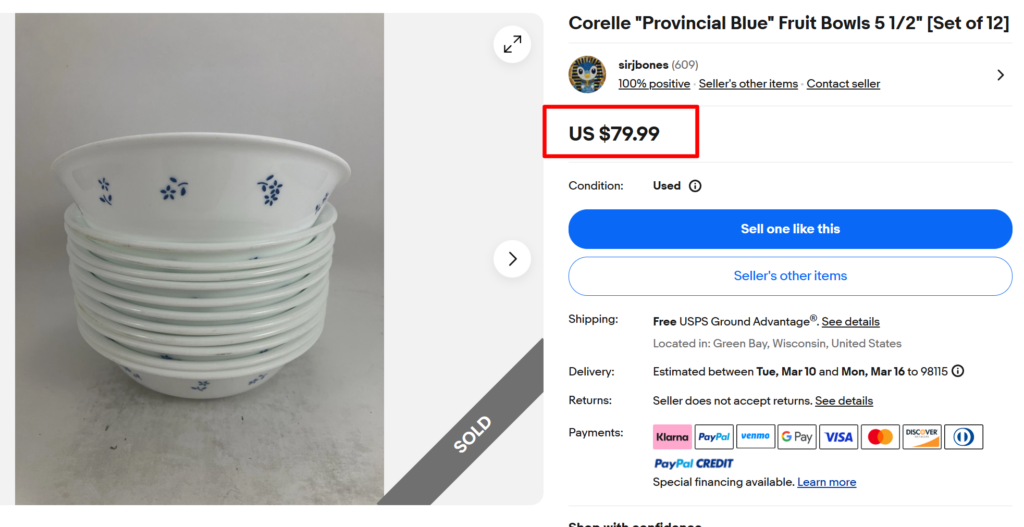
| Average Value | $5–$8 (per bowl); $60–$80 (set) |
| Production Period | 1992–2005; reissued 2014–2021 |
| Pattern Details | Small scattered blue floral (no border) |
| Collectibility | Moderately Collectible |
| Collector Notes | Pair with matching CorningWare bakeware |
Provincial Blue launched in 1992, later than most patterns on this list. Still, it’s popular among Corelle collectors. The design is scattered with small blue flowers and foliage on white, loosely inspired by an English country theme.
The pattern was retired in 2005, brought back in 2014, then retired again in 2021. Because of the two production runs, Provincial Blue is fairly easy to find in singles, but large sets of fruit bowls or plates are worth looking at, especially to pair with CorningWare Provincial Blue bakeware.
6. Colonial Mist – Dinner Plates
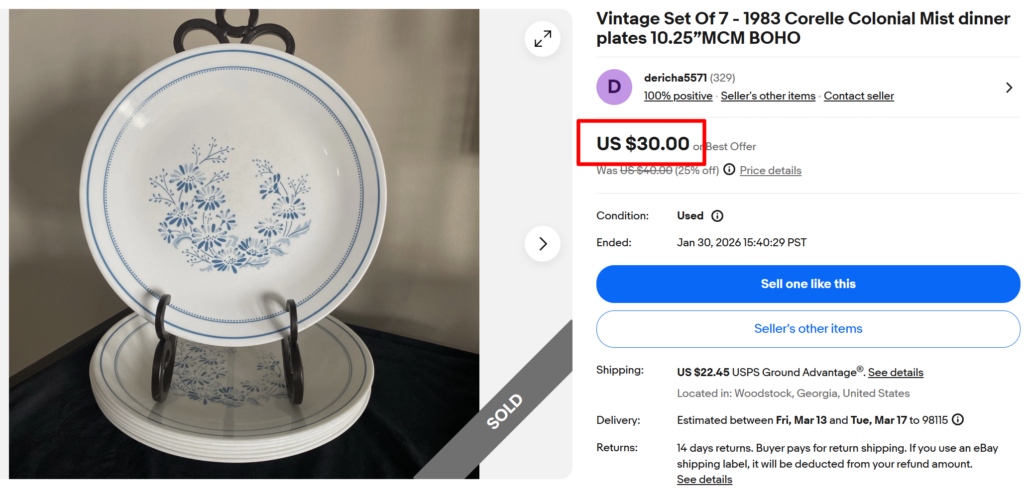
| Average Value | $4–$8 (single plate); $25–$40 (set) |
| Production Period | Approx. 1983–mid-1990s |
| Pattern Details | Daisy/spring flowers, double blue rim line |
| Collectibility | Moderately Collectible |
| Collector Notes | Pair with Pyrex Colonial Mist opal bowls |
Colonial Mist launched in 1983 as a Corelle Livingware pattern. It’s known for its “gradient” or stippled blue floral design. Unlike the solid lines of earlier patterns, this one has a softer, almost airbrushed quality that was very popular in the early 1980s.
Pyrex released a matching opal Colonial Mist series the same year as this Corelle pattern. And it was the last standard opal Pyrex line before production ended in 1986. This link boosts Corelle pieces’ collector appeal.
Dinner plates in this pattern are quite collectible, often sought after by those who want to complete a large Corelle-Pyrex set!
7. Morning Blue – Super Soup/Cereal Bowls
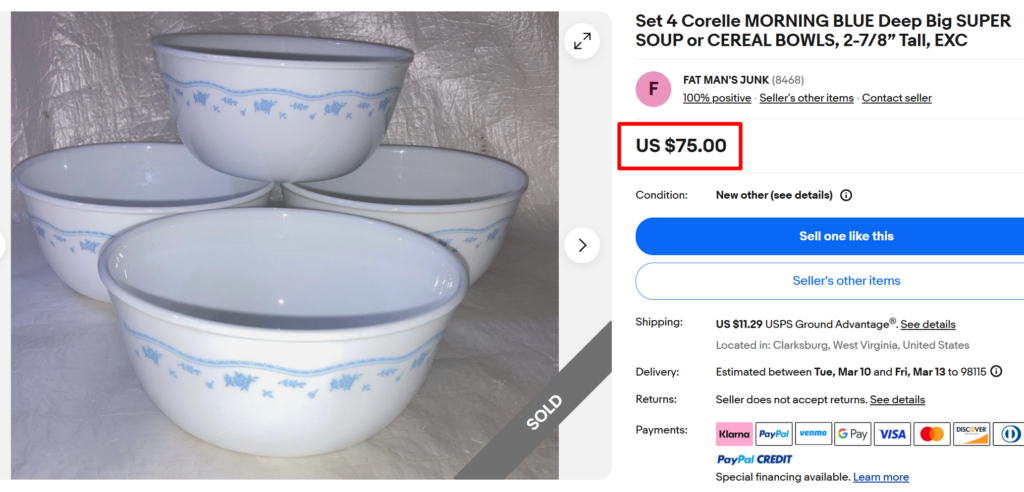
| Average Value | $10–$20 (per bowl); $40–$80 (set) |
| Production Period | 1982-1990 (Reissued – 2015-2019) |
| Pattern Details | Soft blue scattered floral, scalloped rim line |
| Collectibility | Moderate |
| Collector Notes | The 1980s pieces have “Corelle by Corning” mark |
Morning Blue is like the “little sibling” to Old Town Blue, featuring soft, scattered blue flowers and foliage sprigs on the rim with a thin, scalloped border. It’s an early 1980s pattern from Corelle’s Traditions Livingware line.
Super “coupe” soup and cereal bowls (2-7/8″ tall) in this pattern are more collectible; they’re wider and deeper than a standard 18-oz cereal bowl.
Remember that the two-run history means some pieces are newer reissues. You can spot the difference by the backstamp; the original 1980s pieces carry a “Corelle by Corning” backstamp, while the reissued version is marked differently!
8. Blue Velvet – Dinner Plates
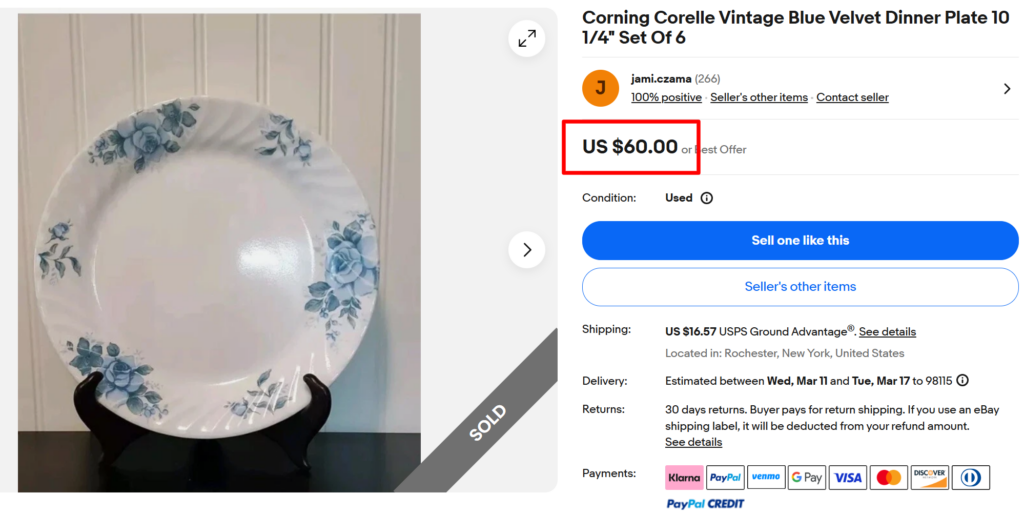
| Average Value | $8–$15 (per plate); $45–$75 (set) |
| Production Period | 1997–2006 |
| Pattern Details | Large blue roses, swirl rim, center-placed motif |
| Collectibility | Moderately Collectible |
| Collector Notes | Pairs with Corelle Coordinates flatware |
Part of the “Impressions” line, Blue Velvet features a sophisticated swirl design with delicate blue roses and an embossed swirl rim, a distinct change from the simple borders of earlier Corelle patterns.
These 10.25-inch plates feel slightly more modern and “upscale” than the earlier 1970s patterns. Still, Rose Velvet dinnerware holds a genuine collector base as it coordinates with CorningWare bakeware and Corelle Coordinates flatware!
9. Blueberry – Dinner & Salad Plates
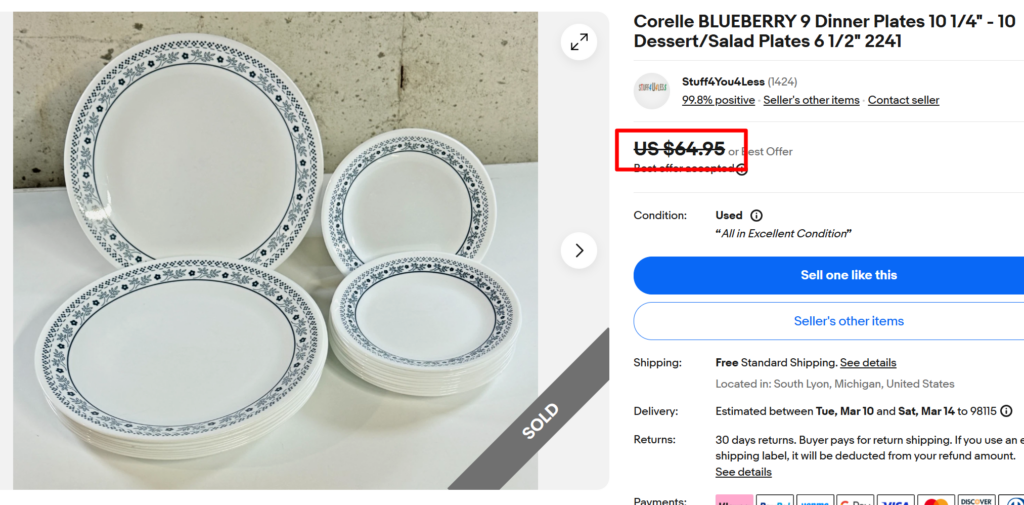
| Average Value | $5–$10 (per plate); $50–$70 (sets) |
| Production Period | 1983 to 1984 |
| Pattern Details | Blue flower/berry sprig rim border |
| Collectibility | Moderate to High |
The Blueberry pattern (often from the “Summer Impressions” line) features lush clusters of berries and leaves, along with a thin border band. It was released in 1983 and discontinued the very next year.
The short one-year production window makes this pattern desirable. Salad plates in this pattern are particularly popular for summer-themed brunch settings!
Things to Check While Looking at Blue Corelle Dishes!
Blue Corelle dishes are popular among collectors for their vibrant hue and “sheen,” as well as unique designs. But not every Blue Corelle dinnerware piece will be worth the same. Here are a few things you should consider:
Pattern Fading
Corelle’s printed designs sit on the outer glass layer, and repeated dishwasher cycles fade them over time.
So, hold the piece high in natural light and observe the applied design. The pattern should look crisp and fully saturated. If the blue looks washed out or the details are blurry, the piece has been heavily washed and might be worth a discount.
For lighter blue shades, like Morning Blue & Snowflake Blue, you may need to pay closer attention to notice the fading.
Metal Rub-Off (Silvering)
Blue-banded Corelle is usually susceptible to “silvering.” This happens when metal utensils rub against the blue pigment, leaving a shiny, metallic-looking streak that looks like a scratch but is actually a transfer of metal.
Unlike white Corelle, where these marks are gray, on blue patterns, they can appear bright silver and are much more distracting to the eye, impacting value.
Backstamp and Reissues
Corelle marked its dishes as “Corelle by Corning” on early pieces, transitioning to “Corelle Livingware” and eventually just “Corelle” as the decades progressed.
For example, all original blue Livingware patterns (Blue Cornflower, Old Town Blue, Snowflake Blue) will have these backstamps.
Several blue patterns were brought back after their original runs ended. Old Town Blue, Morning Blue, and Provincial Blue all had reissue periods. And the reissued versions are not the same as the originals!
In this case, the backstamp is your best tool for telling an original 1970s–80s piece from a 2010s reprint. The distinction is crucial since reissued versions usually sell for less.
Completeness and Matching
True for all Corelle patterns, Blue Corelle dishes are also worth more in a complete set rather than as individual pieces. But singles are desirable for completing a set, though they’re worth relatively less.
Now, of course, the pattern should match across all the pieces of the set, but the color saturation, backstamp era, and overall condition should also be consistent across the set to be valuable.
For Blue Corelle dishes, there are also possibilities of matching them with CorningWare or Pyrex opal bakeware. This adds to their collector appeal.
Note: This article is intended for informational, educational, and entertainment purposes only. Some images are illustrative and may not represent actual brands, products, or related entities. All trademarks, product names, brand logos, packaging, and other intellectual property referenced remain the exclusive property of their respective owners. Any brand mentions or references are provided solely for descriptive and educational context and do not imply any formal or commercial association.