Antiques Know How Research
Brush Pottery Cookie Jars Value
A detailed analysis of multiple eBay sales at Antiques Know How suggests that Brush Pottery cookie jars usually sell for $50–$350+, with rare jars selling for $400+. The most collectible jars include Formal Pig (W7), Granny (W19), Elsie Cow, Peter Pan (K23), Circus Horse, Davy Crockett, Happy Bunny (W25), and Puppy Police (W39). Authentic pieces show “Brush USA” or “W/K” prefix marks on the base, heavy stoneware weight, unglazed gray/buff bottoms, airbrushed glazes with cold-paint details.
Antiques Know How
About Brush Pottery & Its Cookie Jars
Located in Zanesville, Ohio, Brush Pottery Company is credited with producing the first American ceramic cookie jar in 1929. It was a plain green cylinder with “Cookies” embossed on the front.
The company had roots in the earlier Brush-McCoy Pottery partnership formed in 1911, but the McCoy family sold their interest in 1918, and by late 1925, the company became Brush Pottery. It continued operating until it finally closed in 1982.
What made Brush cookie jars especially collectable was their partnership with freelance designers Don and Ross Winton (of Twin Winton ceramics fame) in the 1950s.
The brothers designed many of Brush’s most iconic figural jars, the ones with the “W” prefix numbers. These airbrushed, heavy stoneware designs are what collectors hunt the most today.
Quick Note: There is no such thing as a “Brush-McCoy” cookie jar. The two companies separated before cookie jars were made. Any jar marked “Brush-McCoy” (with or without a hyphen) is a reproduction or fake.
High-Value Brush Pottery Cookie Jars Worth Money
From animal figurals and rare characters like Humpty Dumpty to household items, Brush Pottery released a wide range of cookie jar designs during its lifespan. Below are some of the most collectible and valuable designs today.
1. Formal Pig Cookie Jar – W7
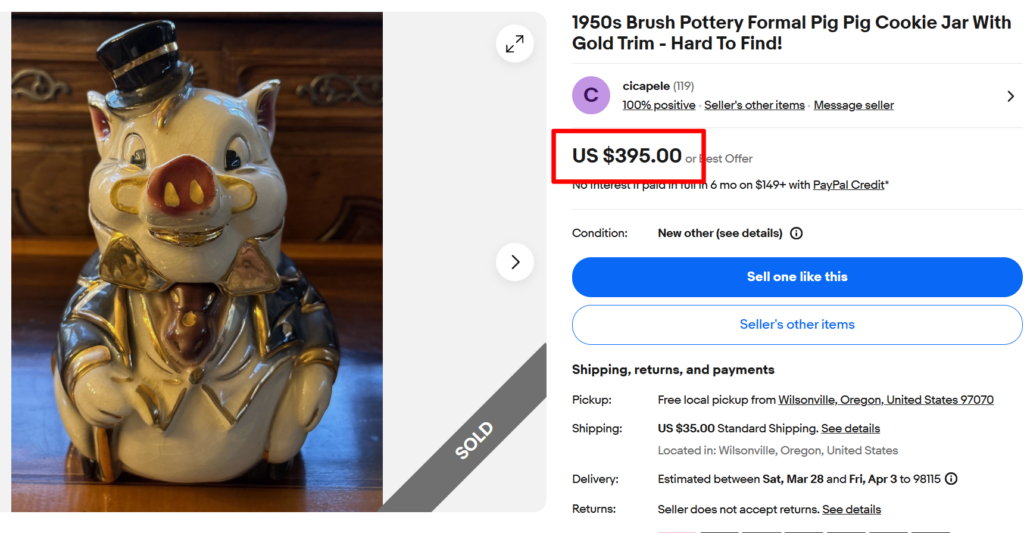
| Average Value | $150 – $450 |
| Production Period | 1950s |
| Status | Premium Line |
| Collectibility | Very High |
| Collector Notes | Check the “W7” mark and the gold trim. |
Dressed in a tuxedo, top hat, and gold-trimmed bow tie, this “Pig in a Suit” is one of the Brush’s most coveted jars. It stands about 11.5 inches tall and bears the “W7 USA” mark on the base.
Multiple color variants of this jar exist: the most common has a black coat, but green- and gold-trimmed versions are also known. The black tuxedo version was produced until around 1956.
As one of the earliest Brush jars designed by Don and Ross Winton, this jar is quite collectible today. Pieces in excellent condition with intact cold-paint gold trim on the buttons and tie command the highest prices.
2. Granny with Rolling Pin – W19
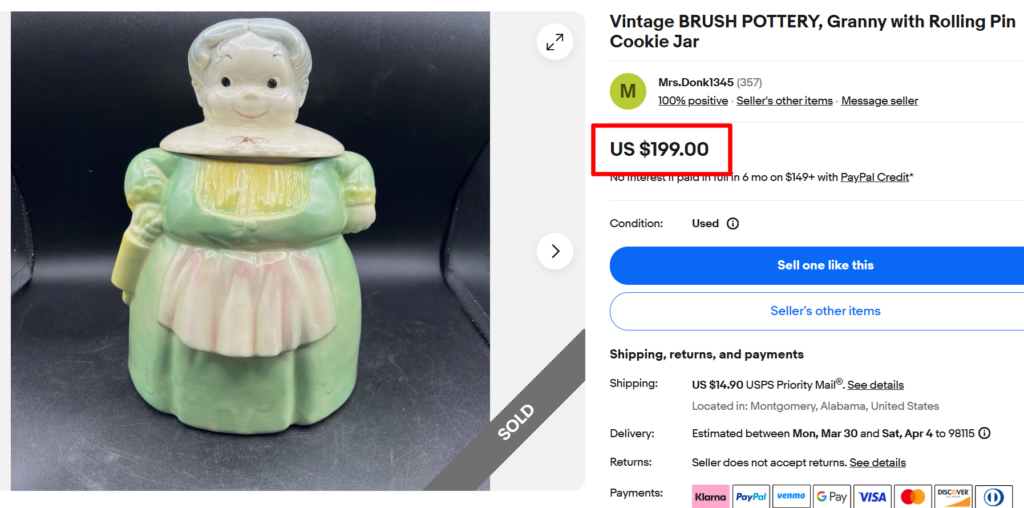
| Average Value | $150 – $225 |
| Production Period | 1956 – 1957 |
| Status | Standard Line / Style Variants |
| Collectibility | Very High |
| Collector Notes | Look for the “W19” mark on the base. |
This jar depicts a stout grandmother in a green dress holding a rolling pin, with her hat forming the lid. Standing about 11 inches tall, these jars are marked “W19 Brush USA” on the bottom.
Most of these jars have a yellow-and-green or blue color scheme, while rare 1957 versions feature a polka-dot skirt. The latter one usually fetches more.
3. Peter Pan Cookie Jar
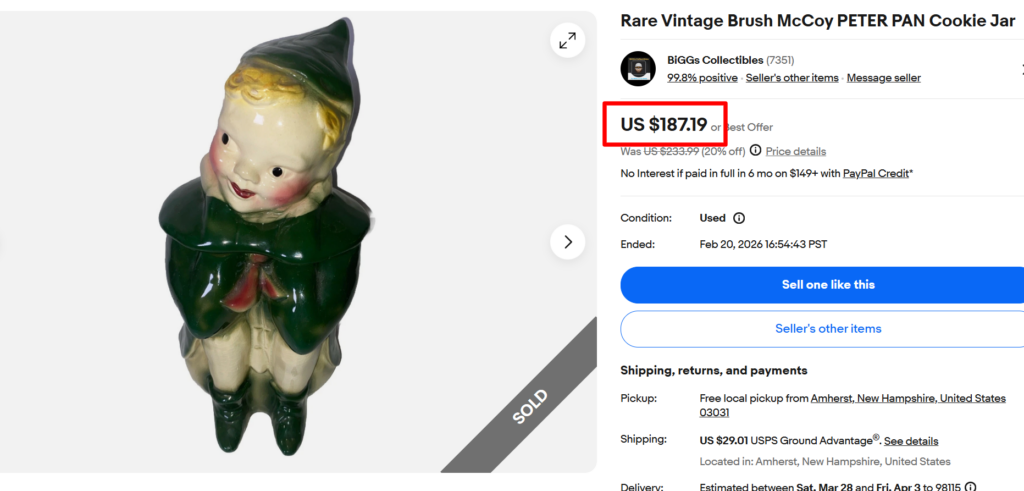
| Average Value | $120–$250 |
| Production Period | Mid-1950s |
| Status | Standard Line |
| Collectibility | Highly Collectible |
| Collector Notes | Check the “K23 Brush USA” mark. |
Brush’s Peter Pan jar dates to around 1956 and is one of the few human figure jars in the line. It shows a full-length Peter Pan figure in a dark green tunic and a pointed cap as its lid.
Brush made this jar in both a smaller and a larger (around 11 inches) version; the larger one is the more sought-after of the two. Both variants bear the “K23” Brush mark on the base.
4. Circus Horse
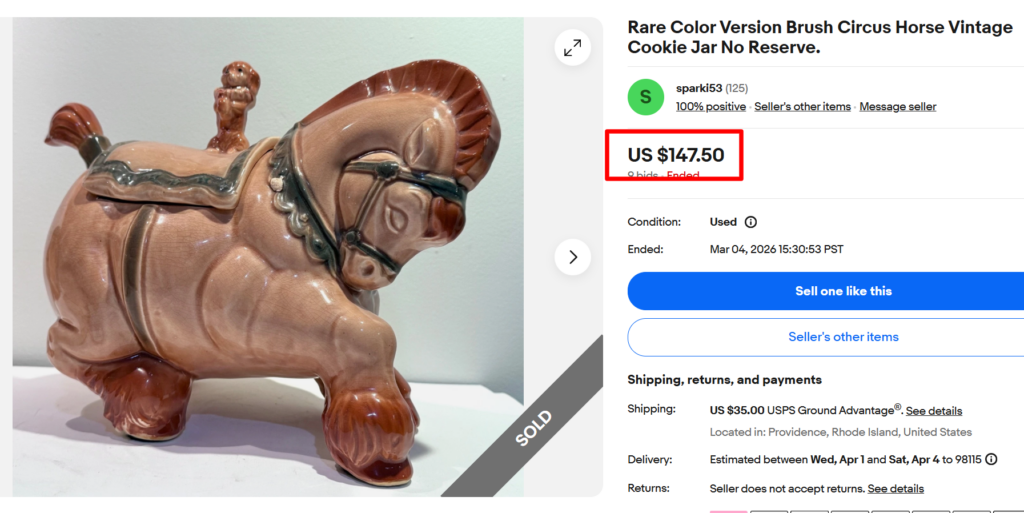
| Average Value | $130–$250+ |
| Production Period | Early 1950s |
| Status | Standard Line |
| Collectibility | Highly Collectible (rare colors) |
| Collector Notes | Most versions are unmarked. |
The Circus Horse is among the more unusual Brush designs and one of the harder ones to find. The jar is shaped like a stocky horse in a circus pose, with the horse’s back and saddle forming the lid, and a small rider figure at the top as the finial.
The jar measures roughly 12 inches long and 9–11 inches tall and comes in a warm brown/tan glaze. The green and brown version shown here is common; a blue and pink pastel and a brown and green pastel version also exist and are highly valuable.
Quick Note: This cookie jar is mostly found without an impressed mark on the bottom. You can identify it by the size, glaze, and color combinations.
5. Panda Bear – W21
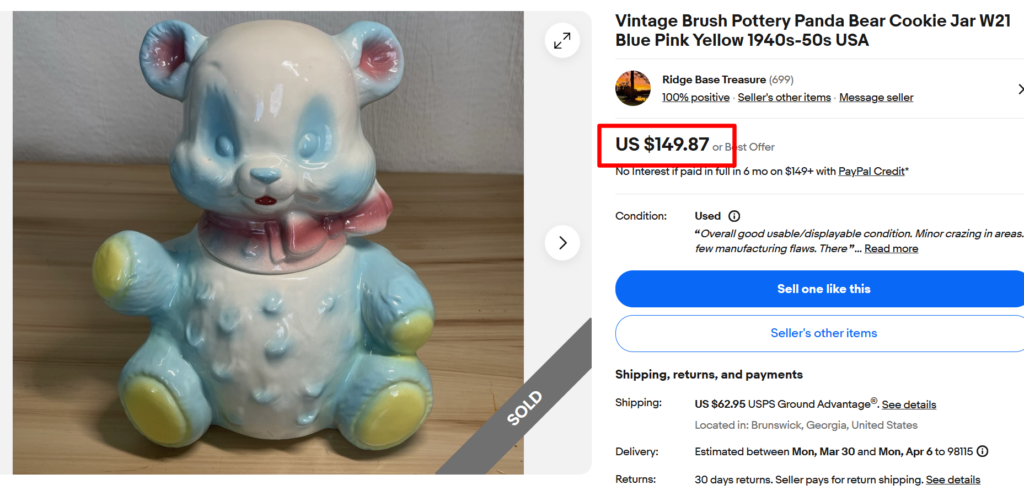
| Average Value | $120 – $160 (rare colors) |
| Production Period | 1950s |
| Status | Standard Line |
| Collectibility | High (rare colors) |
| Collector Notes | Check the number “W21” on the base |
The adorable cookie jar, dating back to the 1950s, depicts a cute panda sitting upright with a bow tied around the neck. While the common ones are in black and white, pastel colors like the blue one in the picture or pink are rarer and collectible.
These jars are sometimes listed with incorrect model numbers, so the physical mark “W21” on the base is what matters for authenticity.
6. Davy Crockett Cookie Jar
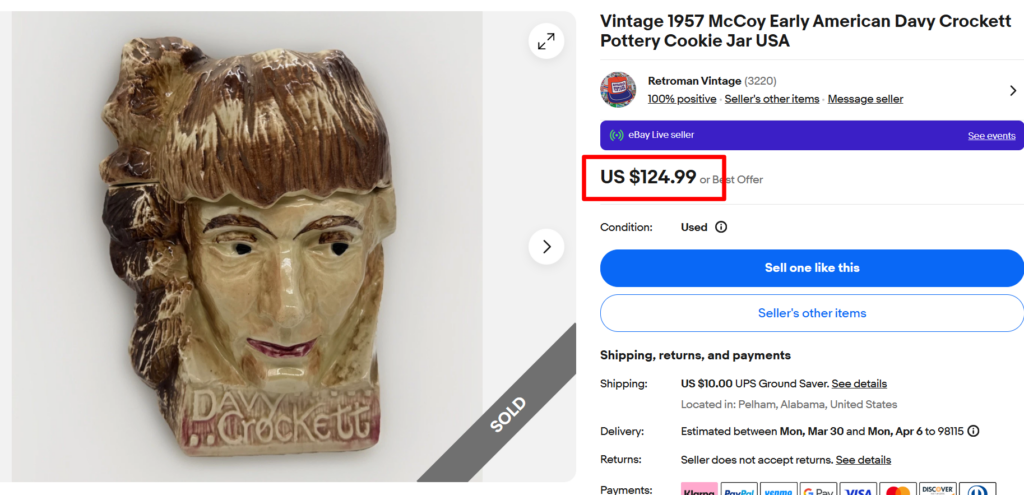
| Average Value | $100–$225 |
| Production Period | 1956 |
| Status | Standard Line |
| Collectibility | Highly Collectible |
| Collector Notes | Many examples are unmarked or only marked “USA.” |
Released to capitalize on the Davy Crockett craze after the 1954–1955 Disney TV miniseries, this jar features a sculpted bust of Davy Crockett’s face with a coonskin cap. The base is lettered “Davy Crockett” in relief.
The jar stands about 10–10.5 inches tall and dates to 1956. Also, it was made without the typical “W” prefix; most examples are marked “USA” or are unmarked.
As one of the more distinctive pieces in the Brush line, this jar consistently sells for around $100 today.
7. Young Davy Crockett Jar
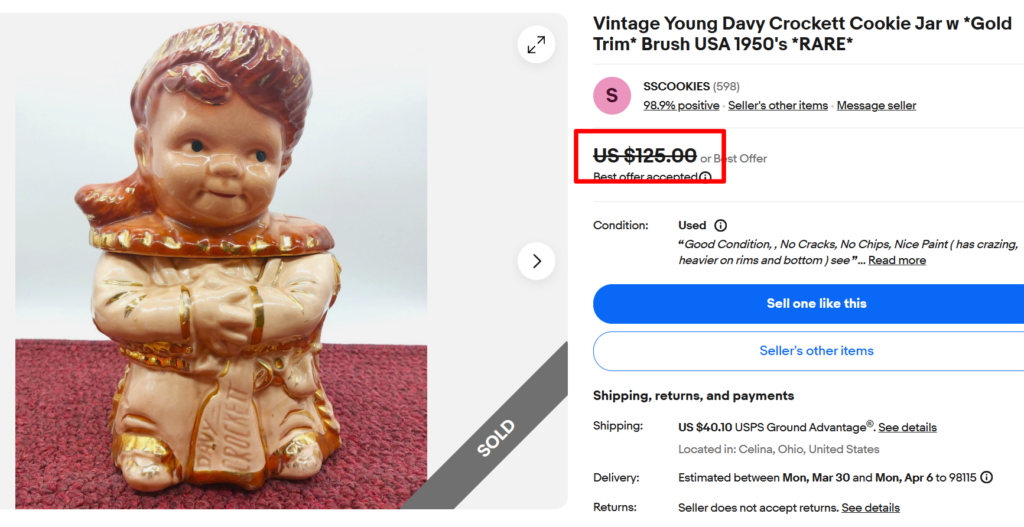
| Average Value | $100–$175 |
| Production Period | Mid-1950s |
| Status | Standard Line (gold trim variant rarer) |
| Collectibility | Highly Collectible |
| Collector Notes | Check the “USA” mark on the bottom. |
This mid-1950s Brush jar shows a child-sized Davy Crockett figure in a fringed jacket with the coonskin cap forming the lid. It also features “DAVY CROCKETT” lettered on the front and a “USA” mark on the base.
The example shown here is a gold trim version, featuring gold decoration on the fringe, collar, and lettering. The gold trim versions are rarer and command a premium over the plain versions.
8. Puppy Police – W39
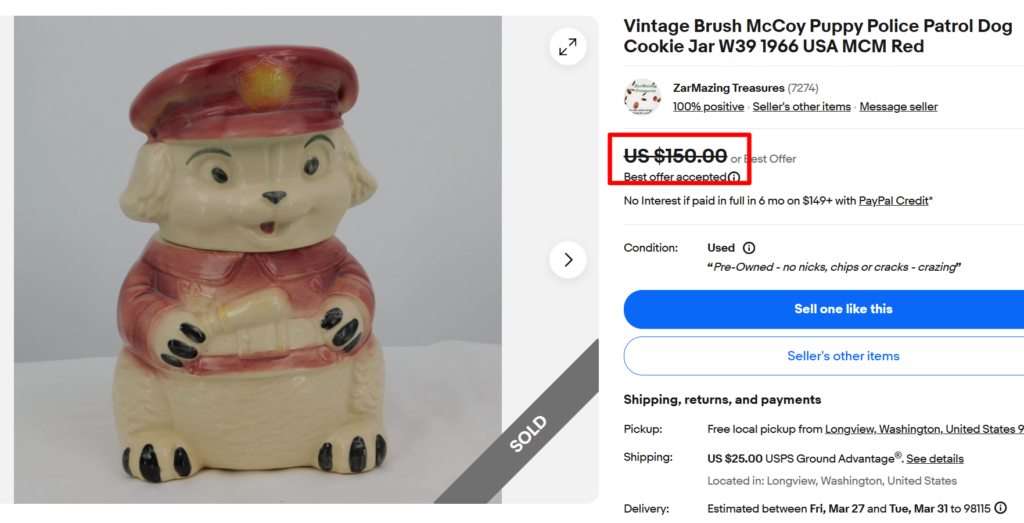
| Average Value | $60–$175 |
| Production Period | 1966 |
| Status | Standard Line |
| Collectibility | Moderately Collectible |
| Collector Notes | Check the “W39 Brush USA” mark. |
Released in the mid-1960s, this jar shows a rounded, cartoonish puppy in a red police uniform and hat. This is a later-era Brush design, featuring bolder colors and a slightly more “cartoonish” style than earlier 1950s models.
Authentic Puppy Police jars marked with the model number on the bottom. The value of these pieces lies in their intact red uniform paint and black details, and in their fair condition.
9. Elsie Cow – W10
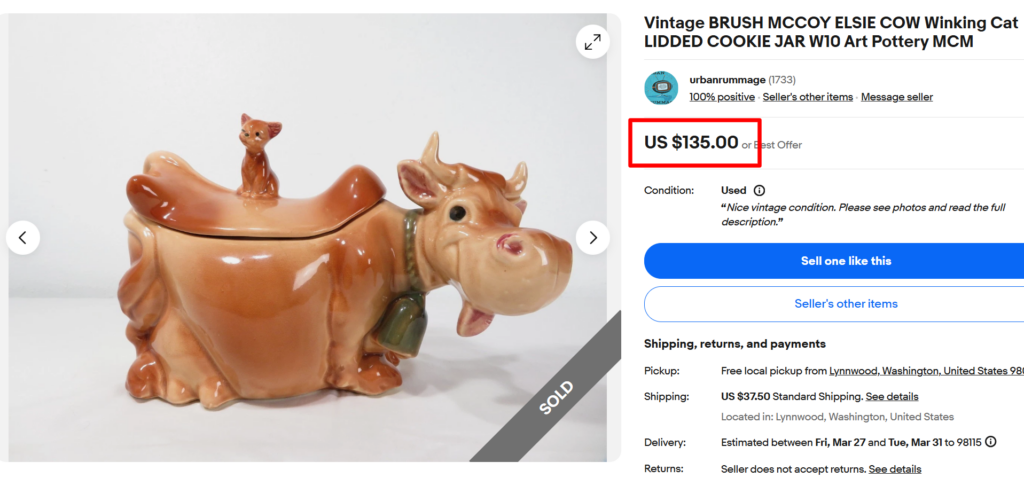
| Average Value | $80–$175 |
| Production Period | Late 1940s–early 1950s |
| Status | Standard Line |
| Collectibility | Highly Collectible |
| Collector Notes | Check the “Brush USA / W10” stamp. |
The Elsie Cow is one of the most recognized Brush designs and likely the most widely reproduced. The jar is shaped like a reclining cow, with a winking cat figurine as the finial on her back.
The jar measures about 9 inches tall, 13 inches long, and 7 inches deep, and is heavier than it looks. All examples show a consistent overall warm brown glaze, with some possibly having a slight variation in the green bell color.
Because it’s one of the most copied Brush designs, it’s important to authenticate these. Genuine pieces bear the “Brush USA / W10” (the company name and USA mark appear in a curved shape).
10. Happy Bunny Chef – W25
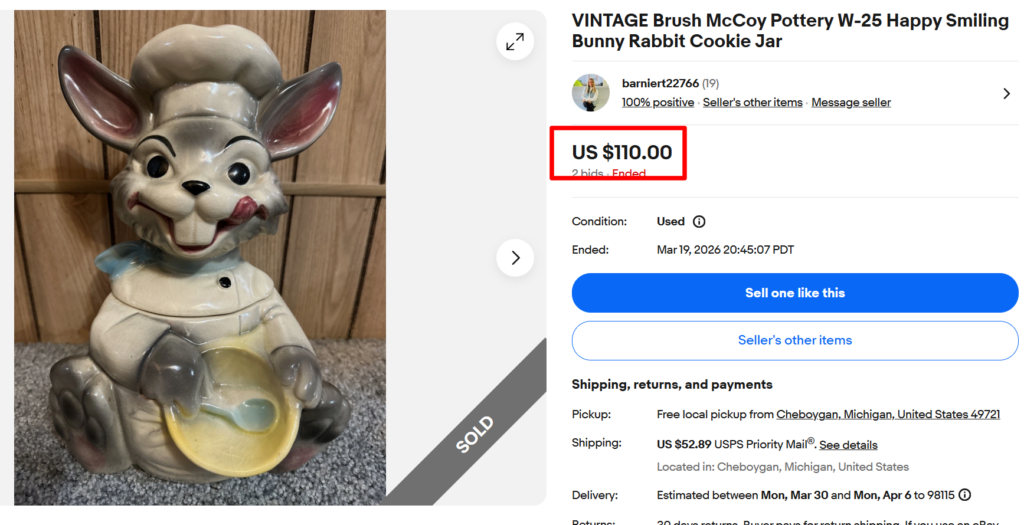
| Average Value | $100 – $130 |
| Production Period | 1960 |
| Status | Standard Line |
| Collectibility | High |
| Collector Notes | Check the “W25 / Brush / USA” mark |
The Happy Bunny Chef is one of the more recognizable Brush designs. It shows a smiling rabbit dressed in a chef’s hat and apron, holding a yellow bowl. The jar stands around 13 inches tall and is fairly heavy for its size.
The company released two color versions: a gray rabbit and a white rabbit. The gray version, with a cream hat, an aqua neck sash, and a yellow bowl, shows up more often, while the white one is harder to find.
Since this jar was sculpted by Don Winton, you’ll find the “W25 USA” mark on the base.
11. Squirrel on a Log – W26
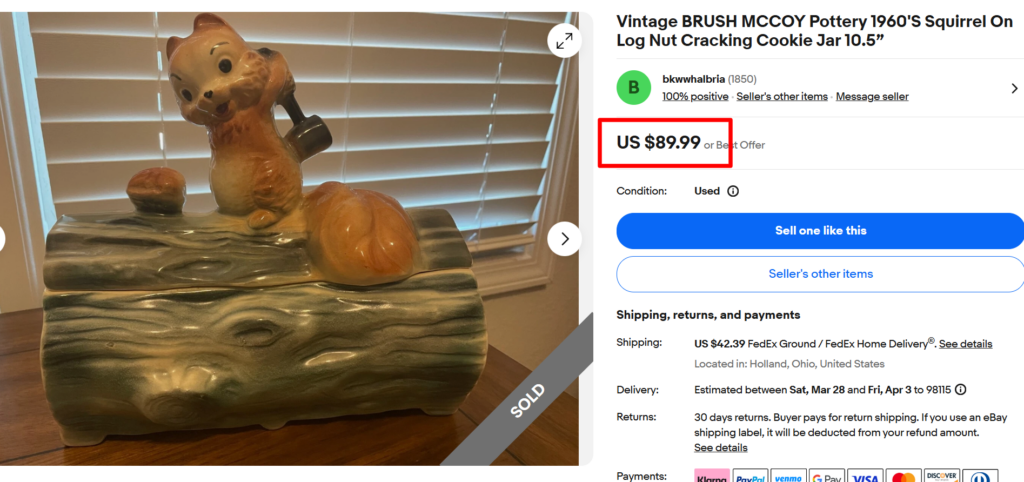
| Average Value | $80 – $110 |
| Production Period | 1960s (1962) |
| Status | Standard Line |
| Collectibility | Moderate |
| Collector Notes | Check the “USA” mark on the log foot. |
This horizontal cookie jar features a realistic squirrel sitting atop a textured log, holding a nutcracker. It is one of Brush’s more detailed naturalistic designs, utilizing a wood-grain glaze effect.
This jar dates to around 1962 and is typically marked only “USA” on the bottom, with no model number. Some examples are fully unmarked. Also, check and compare the size and weight with documented examples for authenticity.
12. Red Riding Hood – K24
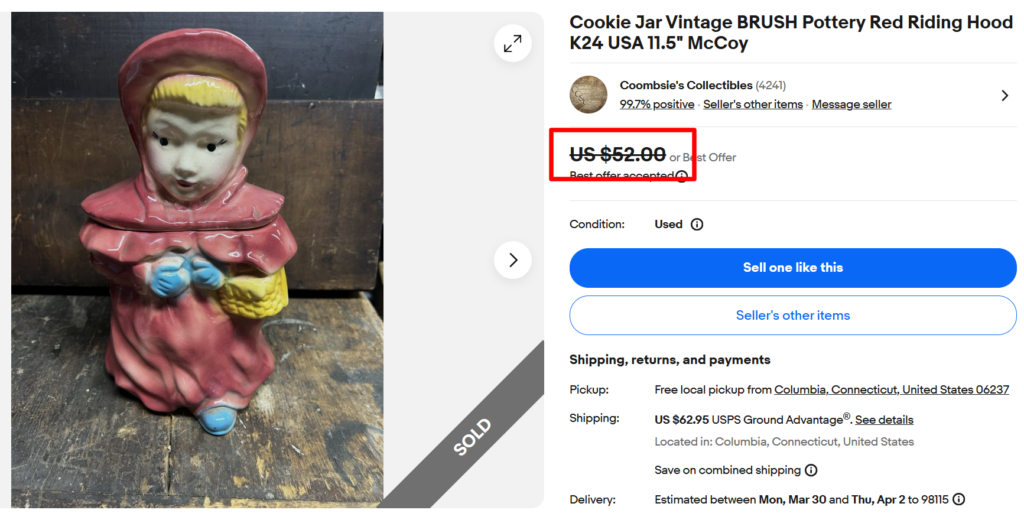
| Average Value | $50–$120 |
| Production Period | Mid-1950s (1956) |
| Status | Standard Line |
| Collectibility | Moderately Collectible |
| Collector Notes | Check the “K24 USA Brush” mark. |
While the Red Riding Hood cookie jar is primarily related to Hull Pottery, Brush also made its own version (K24) in 1956. The version shows Red Riding Hood in a rose-colored cloak holding a basket, with simple hand-painted details compared to the Hull version.
Also, the Brush jar is clearly marked “K24 USA Brush” on the base, dating to around 1956. It is found in two sizes: a smaller 10.5-inch version and a larger 11.5-inch version; both have moderate collector value.
How to Tell Authentic Brush Cookie Jars?
Brush jars have been reproduced, and some reproductions are convincing enough to fool you. Here are the key things to check to spot a genuine Brush jar.
Bottom Mark
Although not all Brush cookie jars are marked on the base, most are. Genuine pieces from the 1950s–1960s are usually marked with the word “Brush” (not “Brush-McCoy”), a model number, and “USA” in impressed or molded lettering.
The W-series numbers indicate that a jar is Winton-designed. K-series numbers are also genuine Brush.
Any jar marked “Brush-McCoy” on a figural cookie jar design is a reproduction; the real Brush-McCoy partnership ended in 1925, before cookie jars even appeared.
Physical Features
Apart from the marks, certain physical characteristics can also help you spot authentic brush cookie jars:
- Weight: Genuine Brush jars are made of stoneware and are quite heavy. If the jar looks like Brush Pottery but is light in weight, then it is probably a reproduction made of earthenware.
- Size: Reproductions are cast copies of the original Brush jar. This means that the pottery has shrunk during firing.
- Size: Reproductions are usually made by casting from an original jar, which means the pottery shrinks when fired. This makes reproductions smaller than originals. So, make sure to compare the measurements with documented examples.
- Unglazed Bottom: On authentic Brush pieces, the unglazed bottom will fire to a gray, buff, or brown color. On reproductions made with earthenware or modern ceramics, the unglazed bottom may be white or chalk-colored.
Cold Paint vs. Glaze
Brush jars may have both airbrushed glaze color as well as applied cold paint for details. Cold paint will flake off, while glaze color is fused permanently to the surface.
On genuine used vintage pieces, you will notice some cold paint loss in details like buttons, ties, and facial features. If the piece is too perfect and pristine for its claimed age, check for repaint. Repaints and repairs may hurt the collector value of the piece.
Reproductions Vs. Original Designs
Several Brush designs have been reproduced, most notably the Humpty Dumpty (W18), the Elsie Cow (W10), and the Formal Pig (W7).
For these jars, always check the entire base attentively. Some reproductions add “American Retro Inc.” or similar text alongside the original Brush marks. Any raised or added markings alongside the original stamp are a red flag.
Note: This article is intended for informational, educational, and entertainment purposes only. Some images are illustrative and may not represent actual brands, products, or related entities. All trademarks, product names, brand logos, packaging, and other intellectual property referenced remain the exclusive property of their respective owners. Any brand mentions or references are provided solely for descriptive and educational context and do not imply any formal or commercial association.