Antiques Know How Research
Valuable Charger Plates
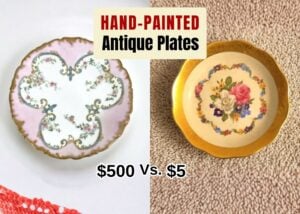
A detailed review of several eBay sales by Antiques Know How shows that most antique charger plates sell for under $100, while hand-painted, signed, or rare antiques from top makers can range from $90–$3,500+. Most valuable chargers include Royal Copenhagen Flora Danica, Tiffany sterling, Meiji Arita, Royal Vienna portraits, Wedgwood Majolica, artist-signed Limoges, Imari, Hadley, Meigh, and Castleton. The value depends on maker prestige, pre-1914 age, hand-painted decoration, size, and condition with authentic backstamps.
Antiques Know How
A charger plate is a decorative disc that sits under the dinner plate. Antique pieces are 12 to 16 inches across, made from porcelain, majolica, sterling silver, or hand-painted earthenware.
Most antique charger plates were never meant to hold food. They were status pieces. Display objects. The expensive bit of the table setting that signaled the host’s status. And these pieces are luxurious even today, selling for up to $2,500+.
Below are some rare antique and vintage chargers that are actively collected today, along with how to identify them and where the real value lies.
How to Spot a Real Antique Charger?
Size is the first tell for a charger plate. It is an oversized service plate, usually 11 to 16 inches in diameter, sometimes wider, that sat under the dinner plate during formal meals. Antique chargers are from 100+ years old, while vintage chargers are 40 to 99 years old.
Apart from the size, the following are key identifiers of a genuine antique charger plate:
- Hand-painted vs Transfer: Check the design. Hand-painted brushwork shows slight asymmetry and tiny variations between identical motifs. Transfer prints are perfectly uniform and sometimes show seam lines where the paper joined.
- The Backstamps: Maker’s marks live on the back. A clear stamp, hallmark, or impressed mark almost always means a real maker is behind it.
- Read the “Made in” Rule: A country name alone (like “Germany” or “France”) usually dates a piece to after 1891, when the US McKinley Tariff Act required country-of-origin marking. “Made in [country]” usually means after 1914.
- Check the Weight: Real porcelain and ironstone chargers are heavy. Plastic and resin reproductions sold as “antique-style” feel light and hollow.
- Look at the Footrim: Antique pieces have unglazed footrims, tiny kiln spur marks, and small imperfections from being fired on stilts. Modern reproductions have perfectly smooth, uniform bases.
11 Highly Valuable Charger Plates to Add to Your Collection
1
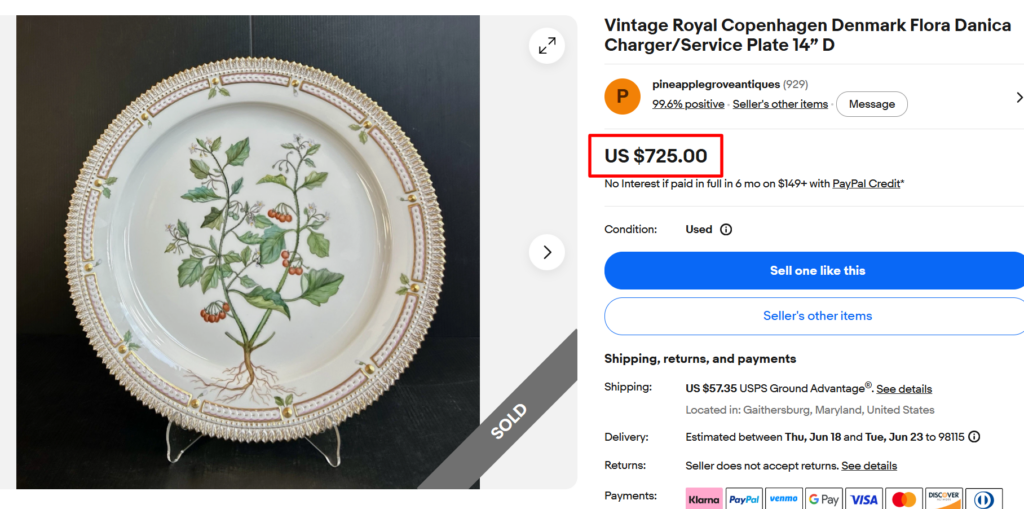
Royal Copenhagen Flora Danica Charger
Typically sells for $500 to $1,200+ per plate
| Production Period | 1790 to present (still hand-made) |
| Brand & Maker | Royal Copenhagen, Denmark |
| Key Features | Hand-painted botanical, pierced rim, 24k gold beads |
| Collector Notes | Latin plant name on the back identifies the specimen |
Flora Danica is the oldest line of luxury porcelain. It was originally designed in 1790 by Royal Copenhagen for Queen Catherine of Russia upon her personal request. Flora Danica pieces are hand-painted in Denmark to this day.
Each piece is hand-painted with an individual botanical image from the Flora Danica encyclopedia and is marked with the plant’s Latin name on the back. The other key features are a pierced gold beading edge, three wavy blue lines, the Royal Copenhagen mark, and the initials of the painter.
A standard new Flora Danica plate costs between $500 and $700; so, vintage chargers would cost even more.
2
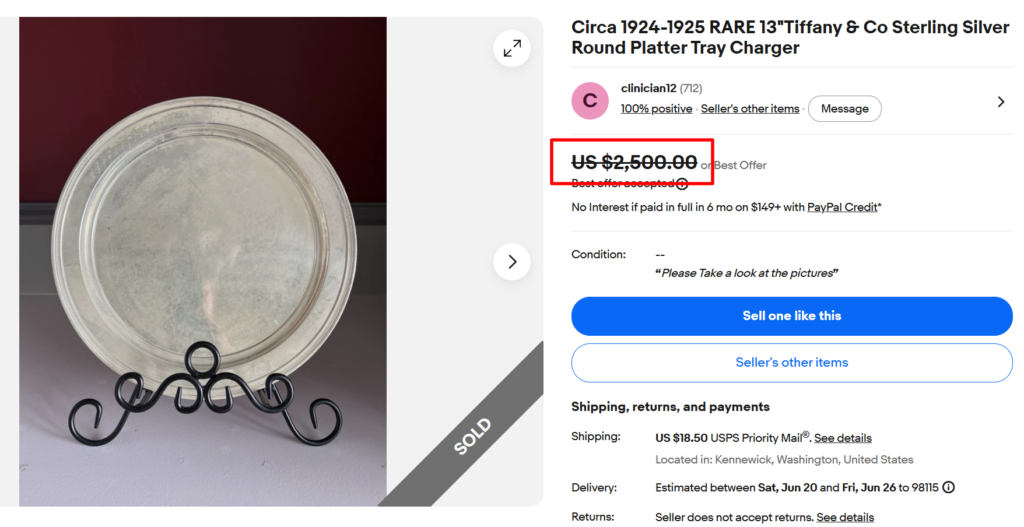
Tiffany & Co Sterling Silver Charger Plate
Typically sells for $1,500 to $3,500
| Production Period | 1924 to 1925 (year-inventory marked) |
| Brand & Maker | Tiffany & Co., New York |
| Key Features | Solid sterling, 13 inches, plain Art Deco rim |
| Collector Notes | Tiffany year-inventory marks date pieces exactly |
Solid sterling silver chargers from Tiffany are among the most expensive. The metal alone carries real value, with roughly 25 to 30 troy ounces of silver for a 13-inch piece. Add the Tiffany name, and it becomes more valuable.
This charger plate is a simple design with a plain border. Tiffany used a year-inventory hallmark system that lets you date pieces to within a year or two. The order and pattern numbers on this piece date it to “1924-1925.”
Also, look for the full Tiffany mark stamped as “TIFFANY & CO” with “STERLING SILVER” and a four-digit pattern number.
3
Japanese Meiji Period Arita Charger Plate
Typically sells for $1,000 to $2,500+
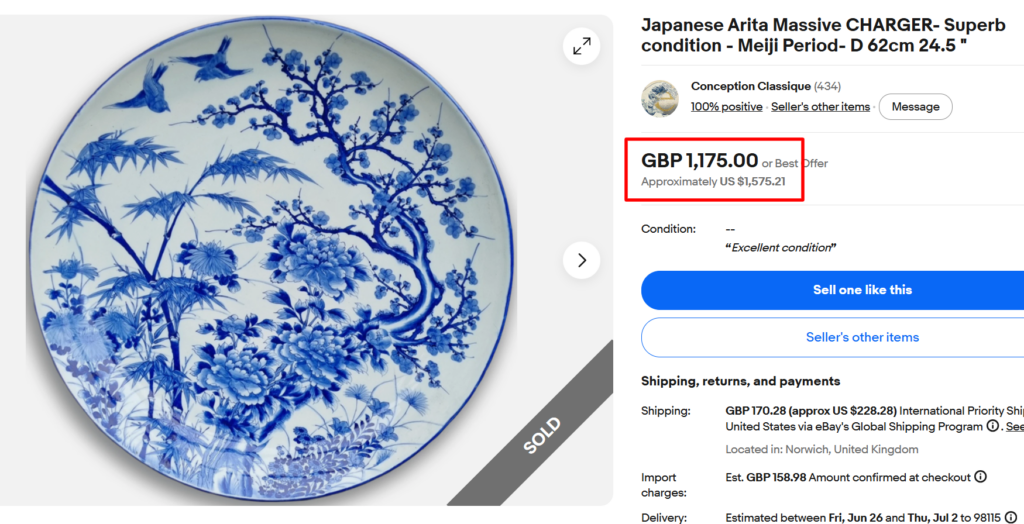
| Production Period | Meiji Period (1868 to 1912) |
| Brand & Maker | Arita kilns, Japan |
| Key Features | Underglaze cobalt only, prunus, bamboo, peony, birds |
| Collector Notes | Size above 20 inches drives value sharply upward |
Japanese porcelain reached its height of export during the Meiji Period. Chargers made in the sometsuke style (blue and white underglaze cobalt pigments on white porcelain) were among the finest wares, and used primarily as wall display pieces.
The size is by far the most important determinant of price. The 24.5-inch charger shown here is a prime example since very few chargers measuring more than 20 inches across were successfully fired.
A 12-inch charger could be expected to fetch about $200. Also, be sure to check the factory mark on the foot, the scroll floral motif on the reverse side, and the characteristic celadon-tinted white ground.
4
Royal Vienna Portrait Charger Plate
Typically sells for $250 to $800
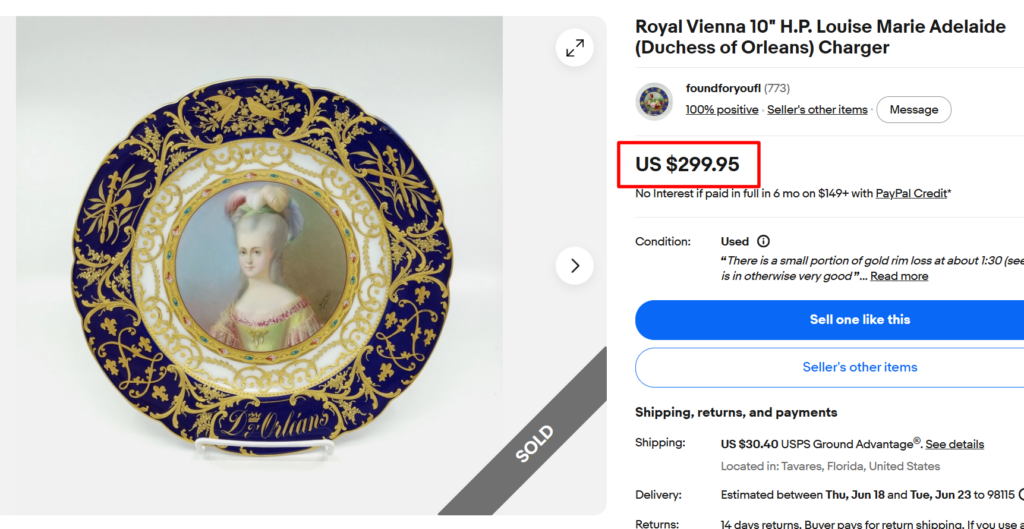
| Production Period | 1864 to 1920s (post-factory pieces) |
| Brand & Maker | Various German and Austrian successors |
| Key Features | Cobalt and gilt border, hand-painted central portrait |
| Collector Notes | Real beehive mark looks like an upside-down shield |
Royal Vienna’s hand-painted portrait china is among the most collectible today. The Louise Marie Adelaide piece pictured is typical of the genre. A cobalt-and-gilt border surrounds a hand-painted portrait of a historical European noblewoman, with the title (in this case “D. d’Orleans”) inscribed at the bottom.
All pieces of Royal Vienna that you will find bear post-produced copies from factories of Germany and Austria with the well-known beehive logo, which is actually a Bindenschild emblem seen upside down.
Look out for any piece bearing the inscription “Made in Germany” or “Made in Austria,” along with a beehive, to know it is a commercial copy of Royal Vienna. Real signature wear and minor gold rim loss are expected and don’t hurt value much.
5
Ralph Lauren Wedgwood Pocketwatch Charger Plate
Typically sells for $150 to $300
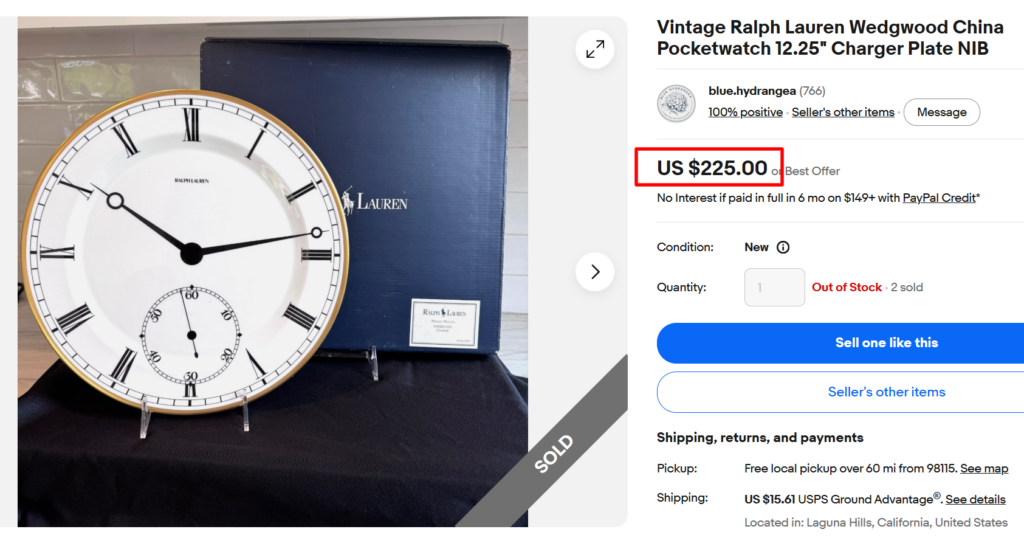
| Production Period | 1989 (discontinued) |
| Brand & Maker | Wedgwood for Ralph Lauren Home |
| Key Features | Bone china, Roman numeral clock face, 12.25 inches |
| Collector Notes | New-in-box examples with sticker double the value |
The Pocketwatch charger was created by Wedgwood for Ralph Lauren Home beginning in 1989. The plate consists of bone china from England and features an imitation pocket watch with its dial decorated in black and gold Roman numerals.
This series was shortly discontinued after its introduction, so it is quite collectible. To verify the authenticity of this series, check that the Wedgwood and Ralph Lauren backstamps are present on the bottom. Those in their navy presentation boxes with the sticker unaltered may command even higher prices.
6
Japanese Imari Chargers
Typically sells for $500 to $1,500 per pair
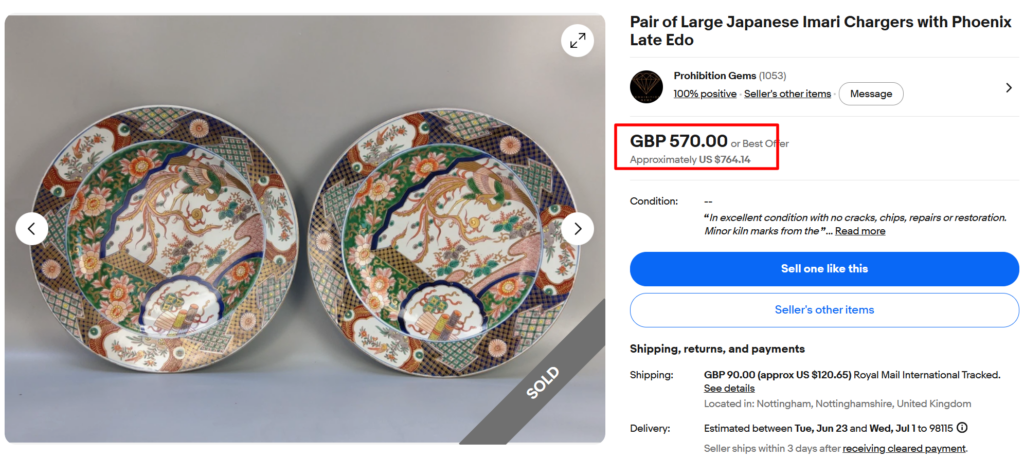
| Production Period | Late Edo (1820s to 1868) |
| Brand & Maker | Arita kilns, Saga Prefecture, Japan |
| Key Features | Cobalt, iron red, gold palette, phoenix and floral panels |
| Collector Notes | Pairs sell for more than 2x what singles bring |
Imari charger plates from the late Edo period are most collectible as they show a mature color scheme of cobalt underglaze, iron red overglaze, green enamel, and gold.
“Imari ware” isn’t a style. It refers to porcelain from the Arita area, exported through the port of Imari, dating back to the 17th century. Another one of the higher-value motifs is the Phoenix Bird (Hoho).
The indicators of this type of collectible include kiln spurs on the bottom and some accumulation of glaze around the bottom. Even single Japanese Imari charger plates can be worth $300-$400.
7
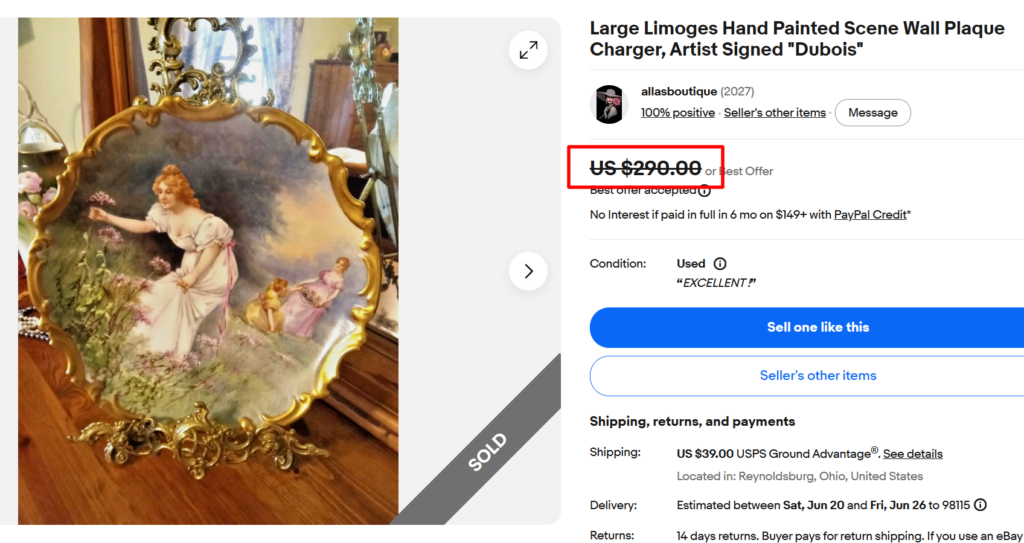
Limoges Hand-Painted Charger
Typically sells for $250 to $600 (artist-signed)
| Production Period | 1890 to 1914 |
| Brand & Maker | Various Limoges factories (LR&L, Flambeau, B&H) |
| Key Features | Hand-painted scene, scalloped gilt rim, signature on front |
| Collector Notes | Real Dubois signature is on the front, not the back |
Limoges is a region in France where numerous factories manufactured porcelain in the last decade of the 19th century. Collectors seek Limoges charger plates that are hand-painted and bear the signature of artist Dubois.
However, research indicates that Dubois was probably a signature for many factories. The signature appears on the front, usually along the lower rim. The back will carry a factory mark such as “Limoges France” with initials like LR&L, T&V, or Flambeau.
Pieces featuring romantic figural themes (not bird games or flowers) sell on the high end of the spectrum. Estimates for top-of-the-line chargers by Dubois can be from $2,500 to $3,500, but rarely fetch these prices at auction.
8
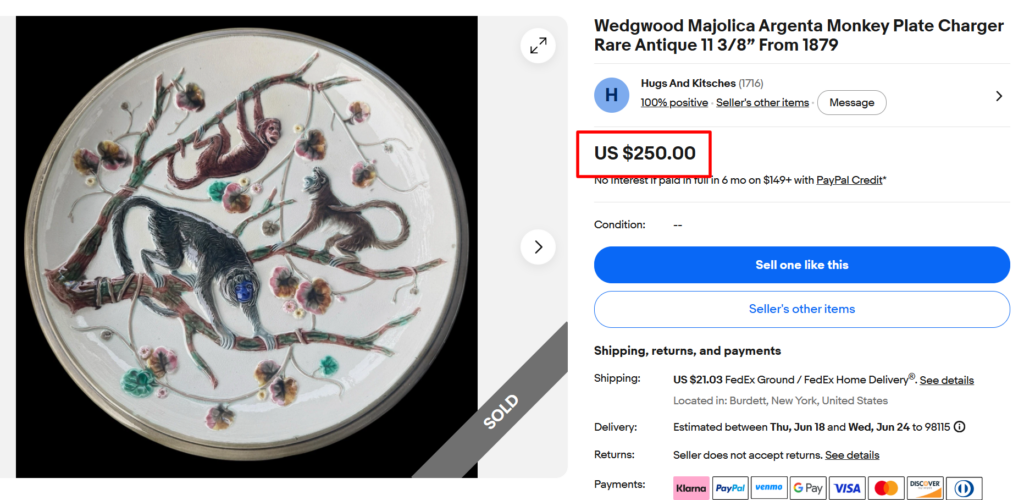
Wedgwood Majolica Charger Plate
Typically sells for $200 to $500
| Production Period | 1878 to mid-1880s |
| Brand & Maker | Josiah Wedgwood, Etruria, England |
| Key Features | Cream “Argenta” ground, modeled monkeys, prunus blossoms |
| Collector Notes | The three-letter date code on the base dates it exactly |
The Argenta line was introduced by Wedgwood in 1878 as a reaction to an overcrowded market of Victorian majolica. Argenta means “silver” in Latin.
Unlike most of the previous majolica wares with brightly colored blue or turquoise backgrounds, Argenta featured a light cream or white background. The Blue-faced monkey decoration is one of the Argenta patterns.
Wedgwood started using the three-letter dating system after 1860, and as such, this charger is definitely in its prime Argenta era because of the date stamp of 1879 seen. The mark of “WEDGWOOD” seen in small print letters is the key authentication sign.
9
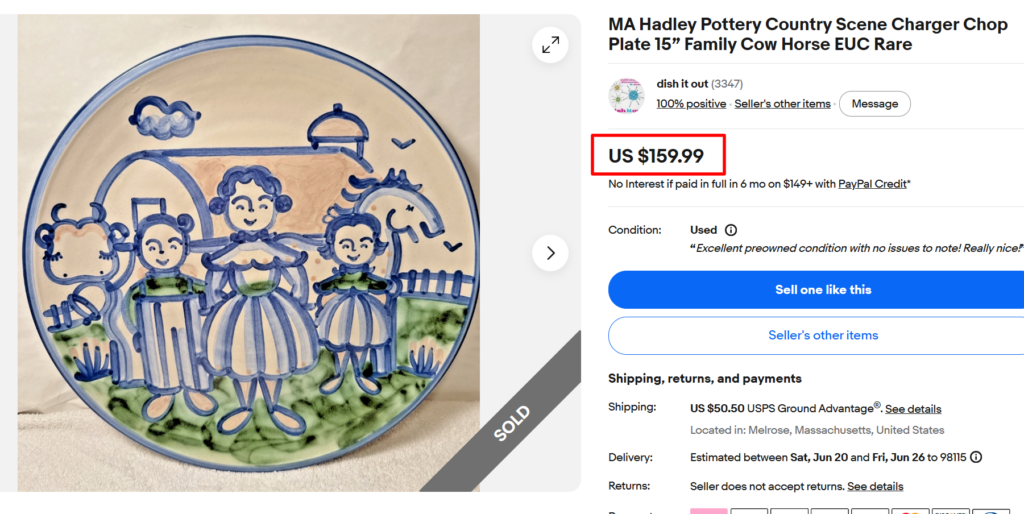
MA Hadley Pottery Country Scene Charger Plate
Typically sells for $100- $200
| Production Period | 1940s to 2022 (pattern discontinued) |
| Brand & Maker | M.A. Hadley Pottery, Louisville, Kentucky |
| Key Features | Folk-art figures, cobalt brushwork, “The End” on base |
| Collector Notes | Hand-signed pieces dated before 1965 command more |
Mary Alice Hadley’s most famous pottery series was Country Scene Blue, with farm animals painted using cobalt blue brush strokes on white or cream stoneware.
In 2022, Hadley Pottery ceased production on the Country Scene line prior to its acquisition and resurrection, driving up values in the secondary market. The chop plate, also called a charger, at 15 inches, is the largest piece in the series.
10
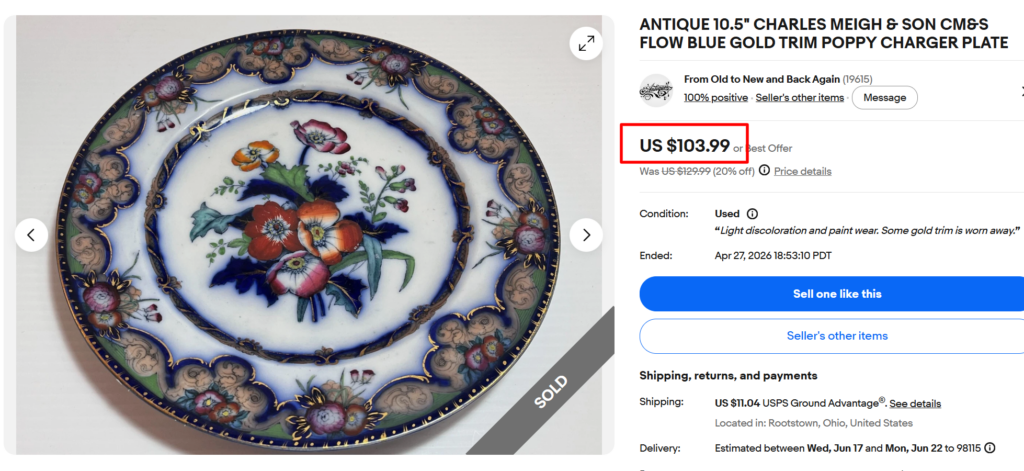
Charles Meigh & Son Flow Blue Gold Trim Charger
Typically sells for $90 to $250
| Production Period | 1851 to 1861 |
| Brand & Maker | Charles Meigh & Son, Hanley, Staffordshire |
| Key Features | Cobalt “bleed” effect, hand-tinted flowers, gold trim |
| Collector Notes | Look for “C.M. & S.” impressed mark plus pattern name |
Charles Meigh & Son operated from about 1851 to 1861, only a decade long, which makes anything produced in that short period interesting for collectors. Their specialty was flow blue ironstone china, which is created by allowing cobalt oxide to bleed through the glaze.
The pattern seen on this charger is the familiar poppy design, hand-painted with orange and red enamel on the blue transfer print.
Some gold trim wear is normal for the period and rarely affects value much. The “C.M. & S.” impressed mark on the back is what confirms the maker, since the same shapes were also produced by competitors.
11
Hotel Chargers
Typically sells for $100 to $200+
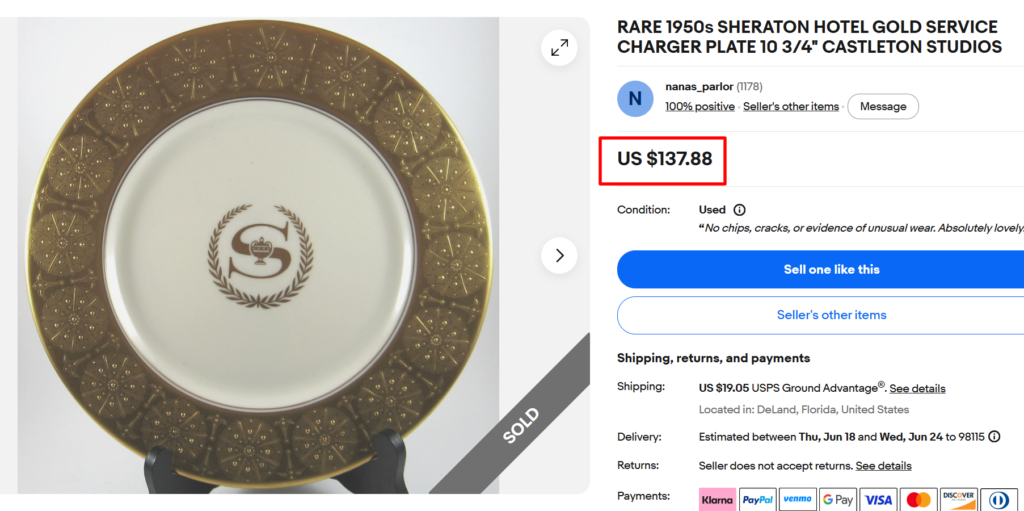
| Production Period | 1950s |
| Brand & Maker | Castleton Studios for Sheraton Hotels |
| Key Features | 22k gold floral border, central “S” laurel monogram |
| Collector Notes | Backstamp confirms hotel-commissioned hotel ware |
The Castleton China was a luxury brand from Shenango China that was located in New Castle, Pennsylvania. The firm supplied special-order dinnerware for some of the best hotels in the United States from the 1950s to the 1960s.
The Sheraton line is considered quite rare as the gold border is 22k gold. You can spot a legitimate piece by the Castleton backstamp combined with the Sheraton “S” laurel monogram in the center.
Plates without the backstamp are often modern reproductions sold as “hotel style” decor. Pristine examples without dishwasher fade hold their value best.
The Value of Old Charger Plates
The above examples make one thing clear: the value of an antique charger plate doesn’t depend on any one feature, but multiple.
The maker is the biggest single price driver. The $103 Charles Meigh and the $2,500 Tiffany are both authentic antique chargers in good condition. The huge price gap comes down to brand reputation and material.
Pre-1914 dating is another valuable feature. Pieces dated before WWI consistently sell for more than their 1920s and 1930s equivalents from the same maker, even when quality looks similar.
Then, it’s the printing style – hand-painted vs. transfer-printed. Every charger above $250 on this list has hand-painted decoration. Transfer-printed pieces, even from good makers, sit in the lower tier.
And lastly, condition tolerance varies by category. Light gilt wear on a Limoges or Royal Vienna piece barely affects value. A hairline crack on any of them can cut the price by 60% or more.
Note: This article is intended for informational, educational, and entertainment purposes only. Some images are illustrative and may not represent actual brands, products, or related entities. All trademarks, product names, brand logos, packaging, and other intellectual property referenced remain the exclusive property of their respective owners. Any brand mentions or references are provided solely for descriptive and educational context and do not imply any formal or commercial association.