Antiques Know How Research
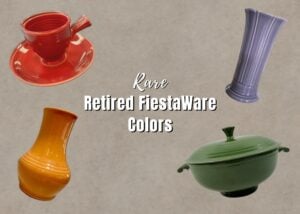
Retired Fiestaware Colors
An in-depth research by the Antiques Know How team on several eBay sales and auctions suggests that vintage Fiestaware pieces usually trade from under $20 to $350, with retired colors in rare forms reaching thousands. The most sought‑after retired shades include Medium Green, Radioactive Red, Lilac, Chartreuse, Rose, Gray, Forest Green, Cobalt Blue, Turquoise, Ivory, Sapphire, and Marigold. The value depends on the rarity and lifespan of color, the rarity of the shapes, the uranium‑glaze features, and the overall condition of the piece.
Antiques Know How
Most people who grew up in American homes ate off Fiestaware without ever knowing it. These solid-colored plates and bowls from Homer Laughlin have been common kitchenware since 1936.
However, due to their simplistic design, these pieces go unnoticed, no matter what their color is. Very few people know that some Fiesta colors are very rare and valuable, as they were discontinued and are hard to find now.
This guide will help you discover these retired Fiesta colors that collectors actually chase, what makes each one valuable, and how to identify genuine shades.
Why Some Fiestaware Colors Are Worth More Than Others?
Fiestaware first appeared in America in 1936. The line was launched by Frederick Hurten Rhead, the art director at the Homer Laughlin China Company, in five solid colors.
But over the decades, the tastes of their customers changed. So, new colors came in, and older ones got canceled. Some were made for a short period, some ran until 1973, when the line retired, while others were introduced at the line’s relaunch in 1986.
That long, color-shifting history makes certain colors more interesting and desirable than others, and also affects their values.
Short Runs
The shorter a color’s production run, the fewer pieces exist, and the rarer they are. For example, a color produced for 15 years would definitely have more pieces left in the world than a color made for just 3 years.
Red (Radioactive) is a perfect example. Its production ended within only seven years of its launch, and it is now rarely encountered in estate sales.
Number of Available Shapes
Just like colors, Fiesta ware also came in several shapes; some ended shortly, while others ran until the end. And, some colors were introduced after certain shapes had already been cut from the line.
This makes certain Fiesta Ware color and shape combinations rare. Medium Green, for example, only came in 23 of the original shapes. That means a cream soup bowl or 4¾” fruit bowl in Medium Green is genuinely hard to find.
Other colors came in the full range of 70+ forms, so they are easily available and common.
Glaze Characteristics
Some glaze colors were harder to produce, more expensive to fire, or sometimes, inconsistent from batch to batch.
Specifically, the Original Red required more precise firing controls because of its uranium oxide content. And Medium Green almost always has this “orange peel” texture, an uneven glaze surface that happened during production but is now considered one of its defining characteristics.
Such chemical composition and production factors also affect the colors’ popularity and value.
Top 12 Most Valuable Retired Fiestaware Colors
Below are listed some of the most valuable and collectible retired Fiesta Ware colors, the real values, and the most desirable shapes to look out for.
1. Medium Green
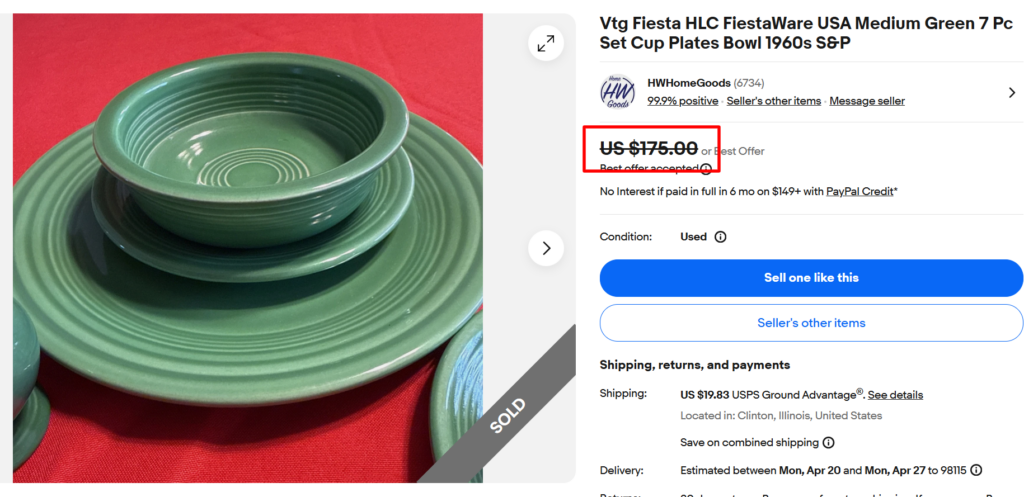
| Average Value | $300 – $2,500 ($5,000+ for rare forms) |
| Manufacturing Period | 1959 |
| Status | Retired |
| Notable Pieces | Coffee pot, serving carafes, butter dishes, tripod candle holders |
| Collector’s Notes | The “orange peel” texture is normal. |
Medium Green is the 11th and final color added to the original vintage Fiesta line. It was introduced in 1959, but by then, Fiesta sales had slowed, bold patterns were in fashion, and the solid-color dinnerware was losing its popularity.
Besides, within a few months of its debut, several shapes were discontinued, leaving about only 23 forms in Medium Green. This is what makes this one of the rarest colors in the original line. Some pieces in this color have sold for tens of thousands of dollars.
It’s also often called “John Deere green” for its bright Kelly green tone. But colorwise, it lies somewhere between Fiesta’s darker Forest Green and the pale Chartreuse.
Large authentic pieces, like platters, plates, etc., carry the impressed or underglaze “GENUINE fiesta” mark. Smaller items may not have it, or may only show a mold number.
2. Radioactive Red (Uranium Oxide Glaze)
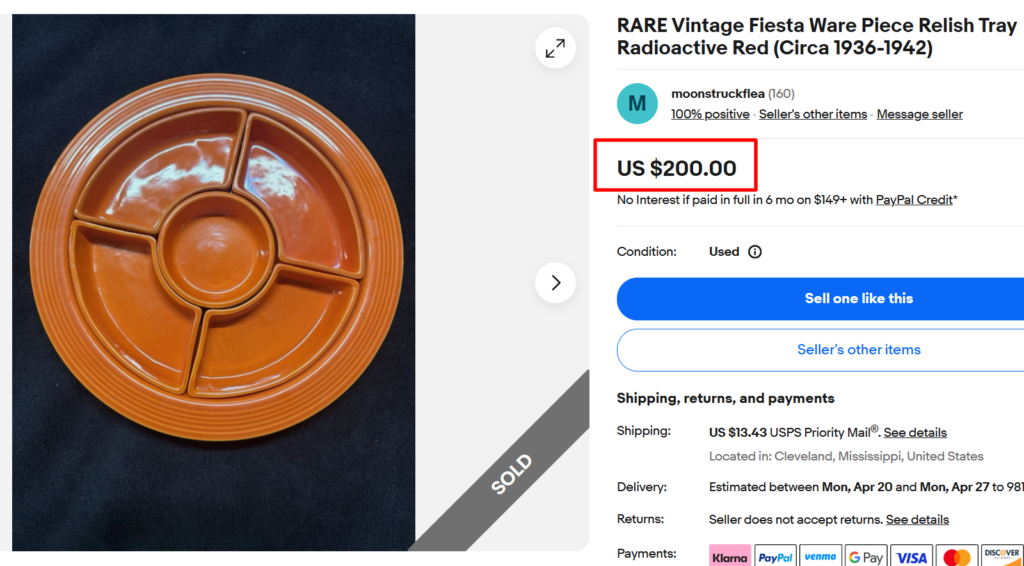
| Average Value | $30 – $150+ |
| Manufacturing Period | 1936–1943 (natural uranium) 1959–1969 (depleted uranium) 1969–1973 (Ironstone version) |
| Status | Retired |
| Notable Pieces | Pre-war carafe, covered onion soup bowl, flower vase |
| Collector’s Notes | Pre-1943 pieces carry natural uranium. |
This was the first color chosen for the Fiesta line and the most expensive to produce. Although it’s named Red, it actually appears vibrant orange-red due to its uranium oxide content.
Fiesta Red was part of the original lineup until 1943. But after that, the company had to stop producing it because the U.S. government seized uranium supplies for the Manhattan Project.
In 1959, Homer Laughlin relaunched the Red color, but it was made with a reformulated, depleted-uranium glaze that appears slightly different from the original Red under close observation. Also, by 1959, many unusual shapes were long gone, making pre-war Red versions of those pieces very rare.
3. Cobalt Blue
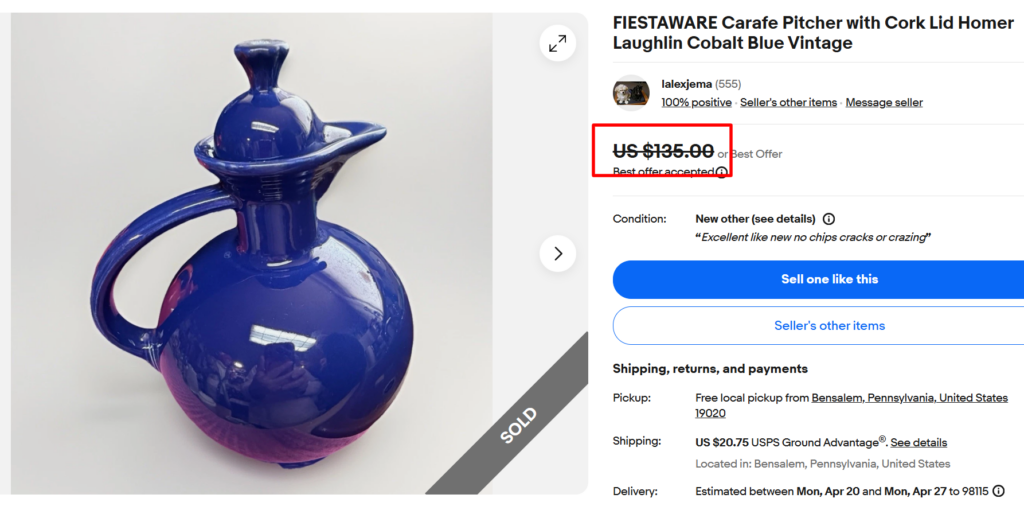
| Average Price Range | $35–$80 (common items) $150–$600+ (rare, large pieces) |
| Manufacturing Period | 1936–1951 (original) 1986 onward (reissued) |
| Status | Retired |
| Notable/Valuable Pieces | Demitasse coffeepot, covered onion soup bowl, mixing bowl set No. 7 |
| Collector Notes | Spot the backstamp for vintage pieces |
Cobalt Blue was the second glaze developed for Fiesta, which launched alongside Red at the line’s debut. It ran as an original color from 1936 to 1951, covering the full range of vintage shapes.
The company brought back a version in 1986 under the same name. The vintage version is a deep navy with a slightly more muted quality than the brighter post-1986 reissue. Put them side by side to see the difference.
Another identifier is the backstamp. Vintage Cobalt Blue pieces carry the impressed “FIESTA HLC USA” mark and have concentric rings on the base underside. Post-86 pieces usually have “LEAD FREE” stamped on the bottom and also feel lighter.
4. Old Ivory
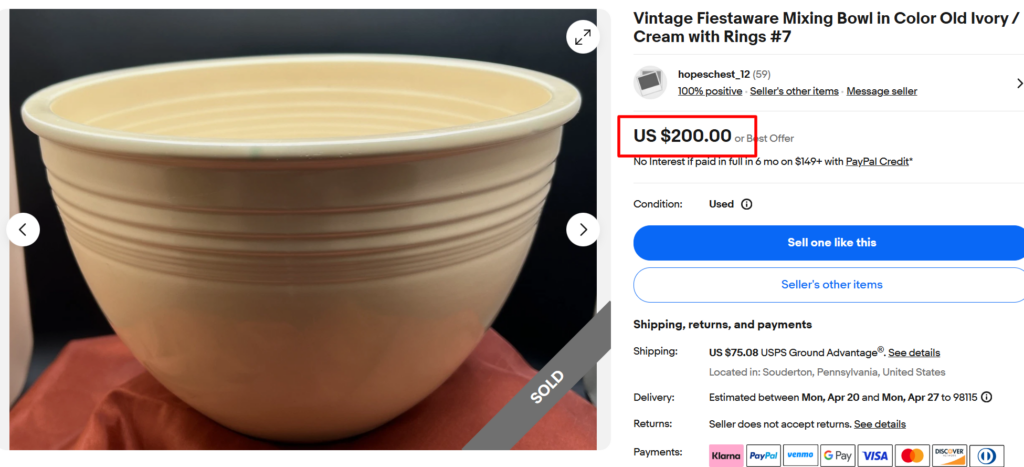
| Average Price Range | $20–$65 (small, common items) $100–$400+ (rare, large pieces) |
| Manufacturing Period | 1936–1951 (original) 2008–2024 (modern) |
| Status | Retired |
| Notable/Valuable Pieces | Covered onion soup bowl, tall vase, mixing bowls, coffeepot |
| Collector Notes | Old Ivory is warmer than the Post-86 version |
This color was launched as one of the original five colors. But the creamy off-white tone was already part of Homer Laughlin’s catalog even before Fiesta launched. In the Fiesta line, this color was often used to balance the brighter colors in a place setting.
Also, an interesting fact is that Old Ivory also contains trace amounts of uranium, but at very low levels compared to Red. Homer Laughlin also reissued Ivory in Post-86 production from 2008 to 2024.
To differentiate, check the basestamp and the color tone; the vintage version is warmer and richer, the reissued version is lighter, almost white. Larger serving items and specialty forms in vintage Ivory are highly collectible.
5. Turquoise
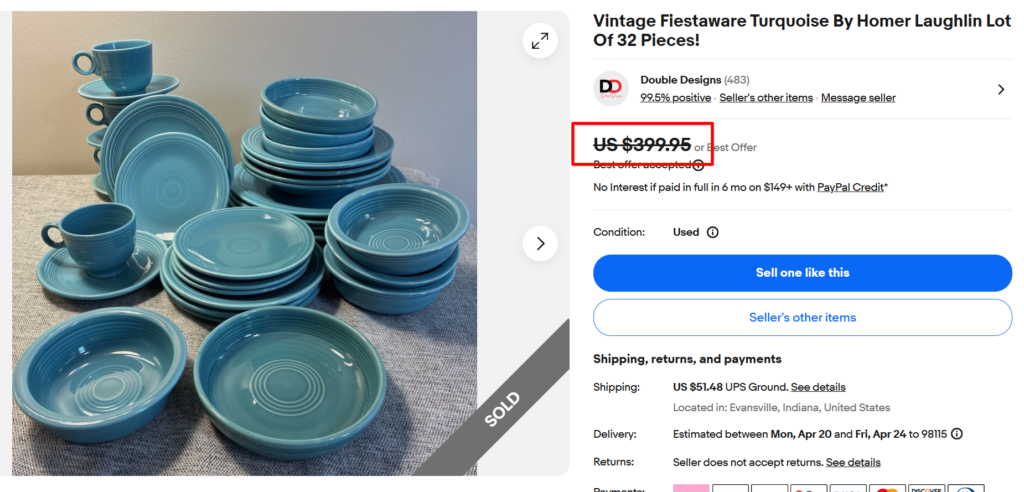
| Average Price Range | $25–$60 (singles) $200–$785+ (rare pieces) |
| Manufacturing Period | 1937–1969 (vintage) 1988 to present (reissued) |
| Status | Retired (vintage) |
| Notable/Valuable Pieces | Covered onion soup bowl, divided plates, tall vase |
| Collector Notes | Backstamp, weight tell b/w old & Post-86 pieces. |
Turquoise wasn’t part of the original five colors. It joined the line just one year after the line’s launch and became one of the most popular Fiesta glazes before retiring in 1969. The long span of about 32 years means it is easily available and common.
Besides, several shapes, such as the 12-inch divided plates and early mixing bowl lids, were discontinued before turquoise glaze was included in the Fiesta line. So, today collectors go after these vintage forms plus other large serving pieces rather than the color itself.
6. Forest Green (1950s)
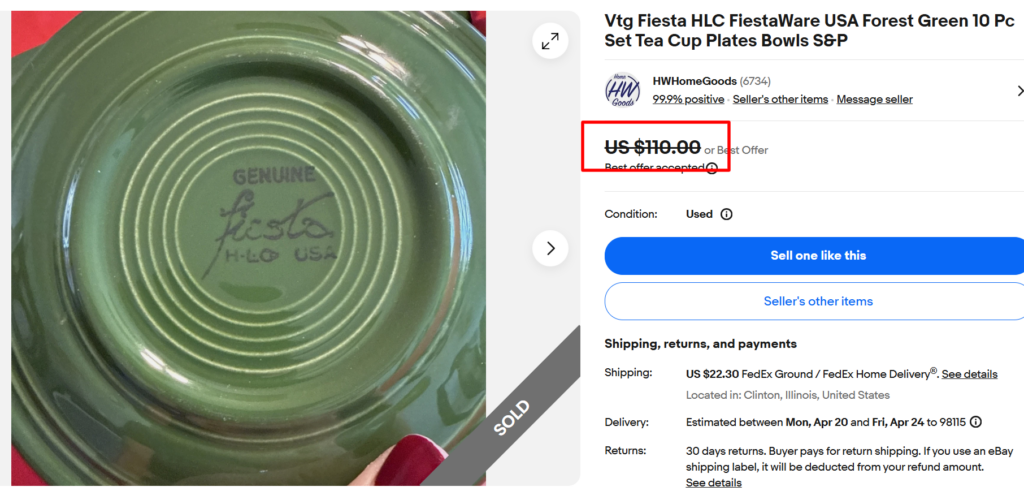
| Average Price Range | $25–$75 (common pieces) $80–$300+ (rare, large pieces) |
| Manufacturing Period | 1951–1959 |
| Status | Retired (original vintage line) |
| Notable/Valuable Pieces | Coffeepot, covered sugar bowl, disk pitcher, egg cup |
| Collector Notes | Check for pooled color in the rings. |
Forest Green came in as part of the 1950s color overhaul in 1951 and replaced the original colors that retired that year. It ran for eight years until 1959, but by then, production had already declined, so fewer pieces were made in this color.
This is the darkest green in the Fiesta range; it’s much deeper than Medium Green or Original Light Green. However, they might look similar in photos and different lights, so always check the color, pooled rings, and the backstamp personally.
You may find smaller pieces in Forest Green easily, but the large serving and vintage shapes in excellent condition are very rare and collectible.
7. Chartreuse (1950s)
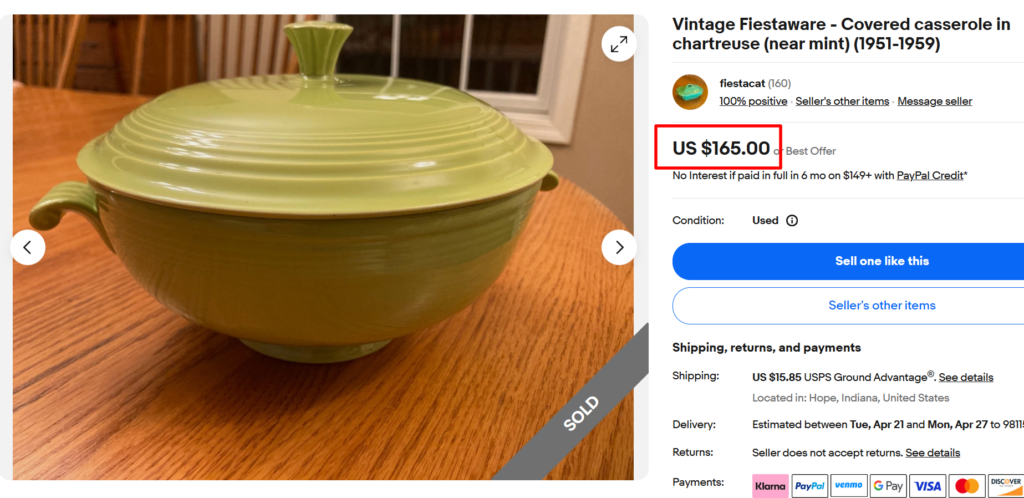
| Average Price Range | $30–$70 (common pieces) $100–$400+ (rare pieces) |
| Manufacturing Period | 1951–1959 (vintage) 1997–1999 (Post-86) |
| Status | Retired |
| Notable/Valuable Pieces | Coffeepot, covered casserole, egg cup, teapot |
| Collector Notes | Post-86 Chartreuse also holds value. |
This was another one of the four new colors introduced in 1951. Chartreuse is a bright yellow-green shade. Homer Laughlin later released a Post-86 Chartreuse from 1997 to 1999, but the two versions are distinctly different in tone. The vintage one is slightly more muted.
Like all the 1950s colors, vintage Chartreuse ran only until 1959, during declining sales. That means fewer pieces were made. Some shapes, like the coffeepot and egg cups, in vintage Chartreuse are highly rare in perfect condition.
Since the post-86 Chartreuse only lasted for a limited two years, it also has some secondary value among collectors.
8. Rose (1950s)
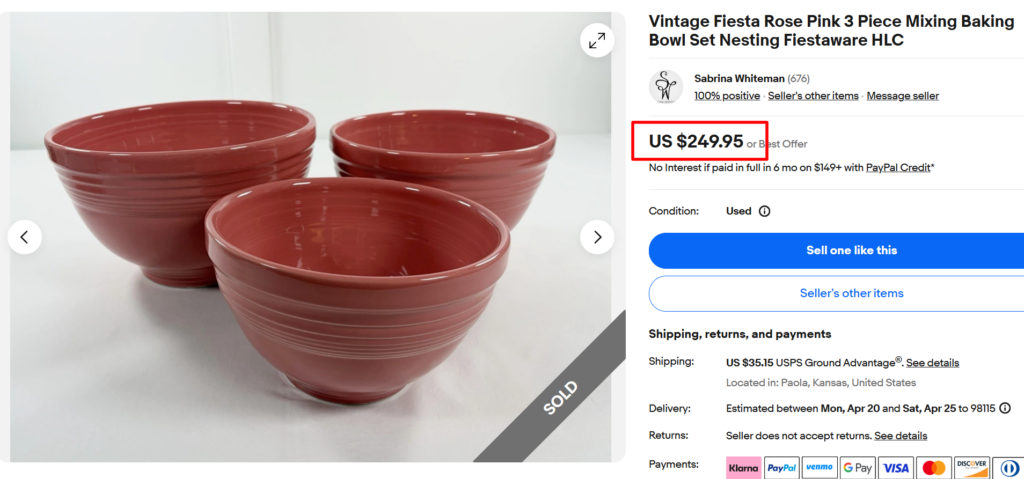
| Average Price Range | $20–$60 (common pieces) $80–$250+ (rare, large pieces) |
| Manufacturing Period | 1951–1959 (original) 1986–2005 (reissue) |
| Status | Retired |
| Notable/Valuable Pieces | Casseroles, Baking Bowls, Syrup dispensers, coffeepot |
| Collector Notes | Vintage Rose is more muted & dusty. |
Original Rose Fiesta is a dusty, muted pink with gray undertones. The distinction of this color is important because Homer Laughlin reissued it in 1986 and made it until 2005. So, there are abundant Post-86 Rose pieces, which often confuse collectors.
But the shapes, the tone, and the backstamp can help you identify genuine vintage pieces, which are more valuable and collectible than the reissues.
9. Pearl Gray
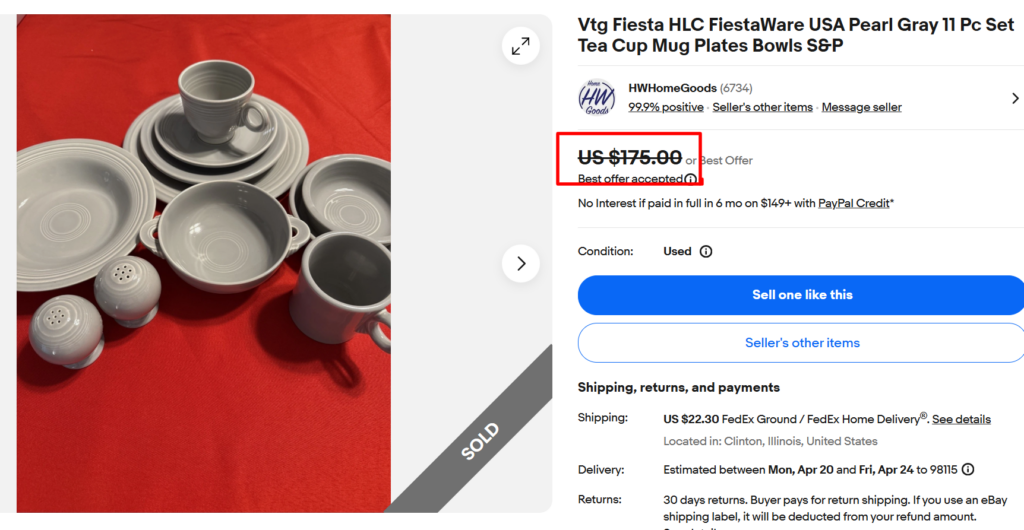
| Average Price Range | $25–$70 (common pieces) $100–$350+ (rare, serveware) |
| Manufacturing Period | 1951–1959 (original) 1999–2001 (reissue – Pearl Gray) |
| Status | Retired |
| Notable/Valuable Pieces | Coffeepot, covered casserole, 15″ chop plate |
| Collector Notes | Damage is easily visible. |
Gray was released along with Rose, Chartreuse, and Forest Green in the 1950s refresh phrase. It’s an unusual color choice for dinnerware, so it received a mixed reception when it was launched.
But today, Original Gray is one of the more desirable but harder 1950s colors to find in excellent condition, especially on large pieces. The Gray coffeepot is particularly scarce.
10. Lilac
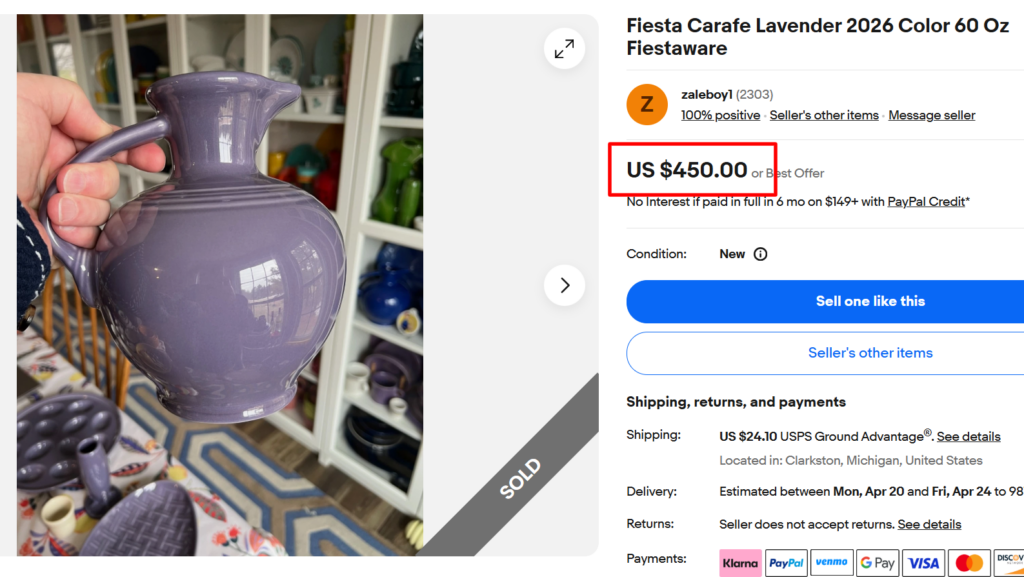
| Average Price Range | $30–$80 (singles) $130–$500+ (rare pieces, sets) |
| Manufacturing Period | 1993–1995 |
| Status | Retired (Post-86 limited run) |
| Notable/Valuable Pieces | Pyramid candlestick holders, carafe pitcher |
| Collector Notes | A two-year run makes it rare. |
Lilac was the first limited-run color in the Post-86 line, produced from 1993 to 1995 only. The two years of production make it one of the hardest Post-86 colors to find in complete sets.
One of the reasons for its limited run is that it didn’t sell well, because people felt the food looked less appealing against the purple tone. Today, it’s considered the most sought-after Post-86 color.
A five-piece place setting can range from $130 to $250 today, while rarer pieces like pyramid candlestick holders and carafe pitchers can go even higher.
11. Sapphire (Bloomingdale’s Exclusive)
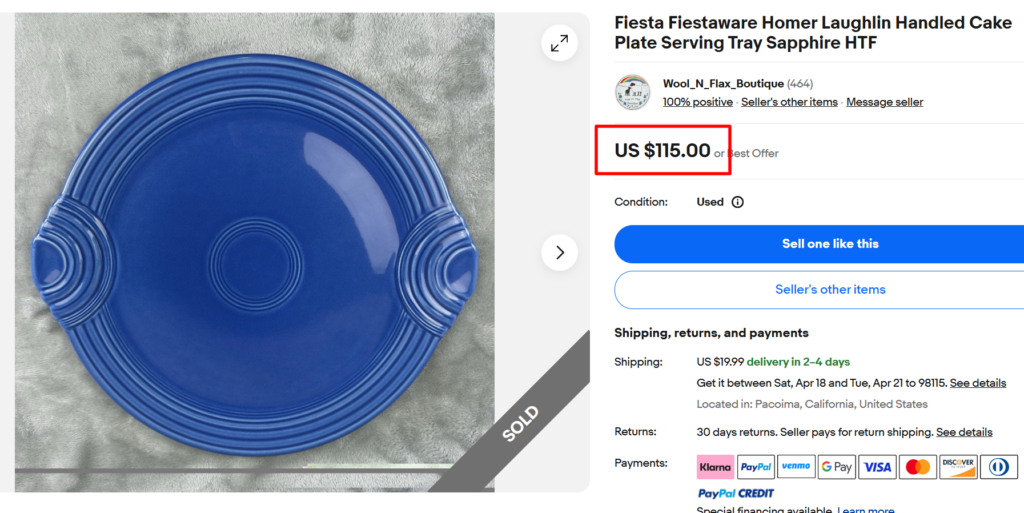
| Average Price Range | $30–$60 (singles) $150-$500 (place settings, rare forms) |
| Manufacturing Period | 1996–1997 (around 180 days) |
| Status | Retired (Promotional) |
| Notable/Valuable Pieces | Disk pitcher, jumbo cup and saucer, dinner plates in original Bloomingdale’s packaging |
| Collector Notes | No sugar, creamer, or shakers exist. |
Homer Laughlin made the Sapphire Fiesta in 1996 and 1997 exclusively for Bloomingdale’s for only about 180 days. That shortest run and limited retail channel is the main reason it’s scarce and desirable today.
The glaze looks very close to vintage Cobalt Blue, which can make it difficult to separate the two. However, the backstamp is the easy giveaway; Sapphire pieces show the modern Fiesta marks, including the “Lead-Free” stamp.
Also, this color was only made in very limited shapes (about nine). No salt and pepper shakers or sugar and creamer sets were ever made in Sapphire, which limits what a complete collection can include.
12. Marigold (75th Anniversary)
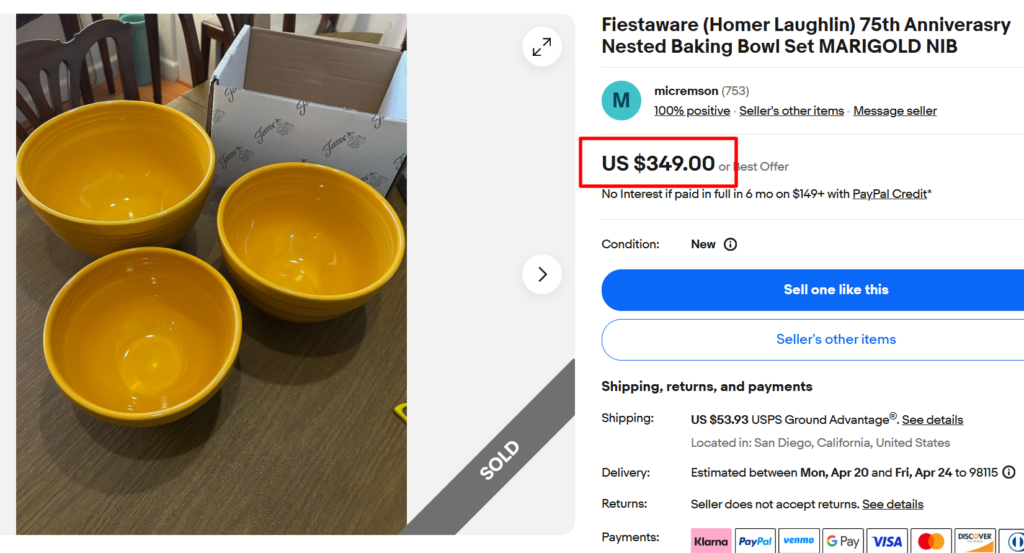
| Average Price Range | $15–$40 (singles) $75–$250+ (anniversary-specifics) |
| Manufacturing Period | 2008–2012 2010–2011 (select pieces) |
| Status | Retired (Post-86) |
| Notable/Valuable Pieces | Numbered soup tureen, prep baking bowl set, large disk pitcher |
| Collector Notes | Check the “Anniversary” backstamp. |
Homer Laughlin released Marigold in 2011 to mark Fiestaware’s 75th anniversary. It was produced with a unique “75th Fiesta Anniversary” backstamp. Its special occasion status and short production life make it one of the most collectible 2000s Fiesta colors.
The most collectible pieces in the line are the numbered 3-quart soup tureen, limited to 10,000 numbered pieces, and the prep baking bowl sets produced for exactly 75 weeks. Common pieces like mugs and plates are easy to find.
Note: This article is intended for informational, educational, and entertainment purposes only. Some images are illustrative and may not represent actual brands, products, or related entities. All trademarks, product names, brand logos, packaging, and other intellectual property referenced remain the exclusive property of their respective owners. Any brand mentions or references are provided solely for descriptive and educational context and do not imply any formal or commercial association.