Antiques Know How Research
Collectible French Plates
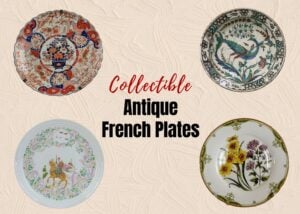
Our analysis at Antiques Know How of several eBay sales and auction records suggests that old French plates range from $60 for common Quimper folk art to $2,500 for rare Haviland Presidential oysters, with desirable Sèvres and Gien sets fetching $1,000–$8,000. Top collectible patterns include Gien Artichoke, Sèvres Bleu Céleste, Haviland Schleiger 478, Quimper Petit Breton, and Rambouillet hunting scenes!
Antiques Know How
Ever come across old plates that are translucent when held up to light, with raised figures or glazed prints? Maybe hand-painted scenery or portraits of those from the royal family, or perhaps a Breton folk figure in traditional lace and stripes?
If so, you probably noticed rare antique French plates from famous manufacturers such as Sèvres, Haviland, and Quimper. And trust me, these are not just plates, they are collectors’ gold!
In this guide, I will show you some of the most valuable antique and vintage French plates, as well as some tips on how to identify the real ones!
10 Valuable Antique French Plates Worth Collecting & Why?
1. Quimper Plate with Petit Breton Art
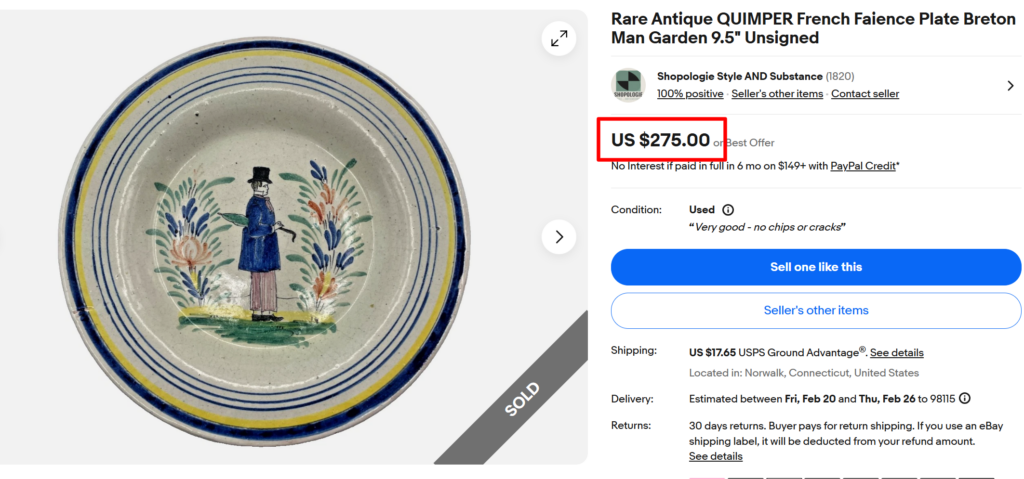
| Average Price | $60 – $600 (Single plates) |
| Manufacturing Period | 1870-1930 (Some from 1910-1940s & 1980s) |
| Brand/Region | Unsigned, Originated from Quimper |
| Pattern/Style & Material | Petit Breton on Faience |
“Petit Breton” is a signature pattern originating in Quimper, France, featuring a hand-painted figure of a Breton man or woman in traditional Breton attire. Produced by several manufacturers in Brittany, it is a global symbol of French Folk Art, collected as a souvenir by tourists.
These figures are often surrounded by classic blue-and-yellow striped borders or sponge-dabbed patterns, flanked by flowers or small trees. Some plates may also have scalloped edges.
Note: Generally, collectors look for makers’ signatures, such as “HB Quimper” or “HB-Henriot.” But most of the Pre-1870 Quimper plates are unsigned yet valuable.
2. Haviland’s Commercial Presidential Oyster Plate
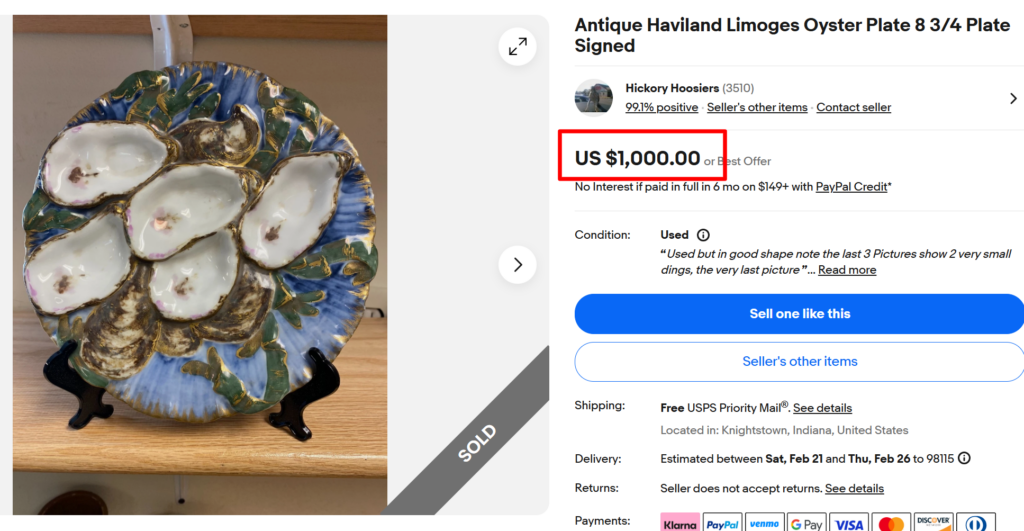
| Average Price | $1,000-$2,500 (single plates) |
| Manufacturing Period | 1879–1880 |
| Brand/Region | Haviland & Co., Limoges |
| Pattern/Style | Oyster plates with flora and fauna |
| Material | Porcelain |
| Collector Notes | Originals may not show the patent date. |
This rare oyster plate is a commercial version from Haviland & Co. replicating a limited 562-piece service set designed for the President Rutherford B. Hayes White House service.
It is known for its realistic depiction of North American flora and fauna, as suggested by Theodore Russell Davis. You can spot these plates by the American eagle motif at the rim on the back, Davis’s signature, and “H&Co./L” stamp!
3. Gien Faience Majolica Artichoke Plates
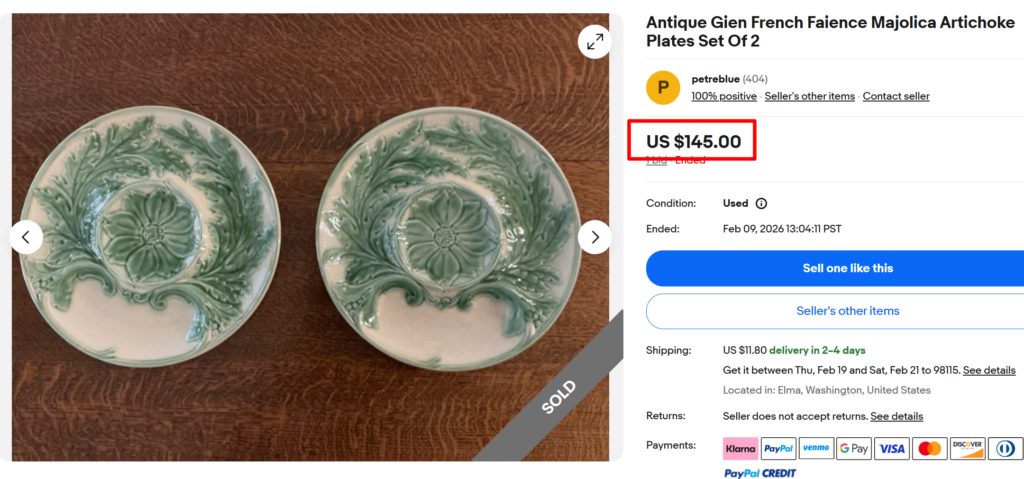
| Average Price | $100 – $300 |
| Manufacturing Period | 1930s, 1960s-1970s |
| Brand/Region | GIEN; Gien, France |
| Pattern/Style | Artichoke (Barbotine relief) |
| Material | Faience |
| Collector Notes | Gien bee mark on base |
These specialized serving plates, made by the famous Gien factory in France, are intended for consuming whole, steamed artichokes.
The plate has a rosette (center well) to contain the artichoke heart and a smaller sauce well at the bottom for dipping. The design shows high relief barbotine, scroll acanthus leaves, and an impressed basketweave pattern in the traditional two-tone sage green & cream glaze.
During the late 19th and early 20th century, Asparagus & Artichoke Patterns were highly collectible relics, peak 1960s Gien versions; these can be used as wall decor or display pieces.
4. Sèvres Chateau des Tuileries Cabinet Plate
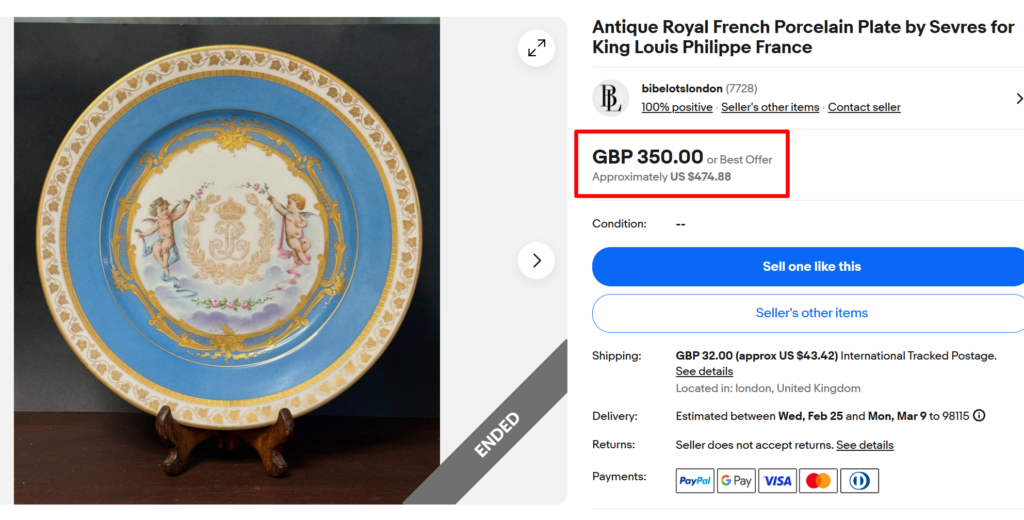
| Average Price | $300 – $600 |
| Manufacturing Period | Mid-19th century (Louis Philippe era) |
| Brand/Region | Royal Sèvres |
| Pattern/Style | Royal Cypher “LP” (Bleu Céleste ground) |
| Material | Porcelain |
This Sèvres-style Porcelain Cabinet Plate features the Royal Cypher “LP” at the center, intricately gilded & crowned. Many similar services were popular during the reign of Louis Philippe I.
The cypher is flanked by two cherubs, resting on clouds and holding floral garlands as offerings. The base ground is painted in the Sèvres’ famous Blue Céleste color. The border is heavily adorned with fine gold vines and framed by delicate golden rims.
These are a rare find, especially as a set. If found in good condition with no damage, these are a collector’s treasure.
5. Charles Field Haviland’s Pink Sconce Plates
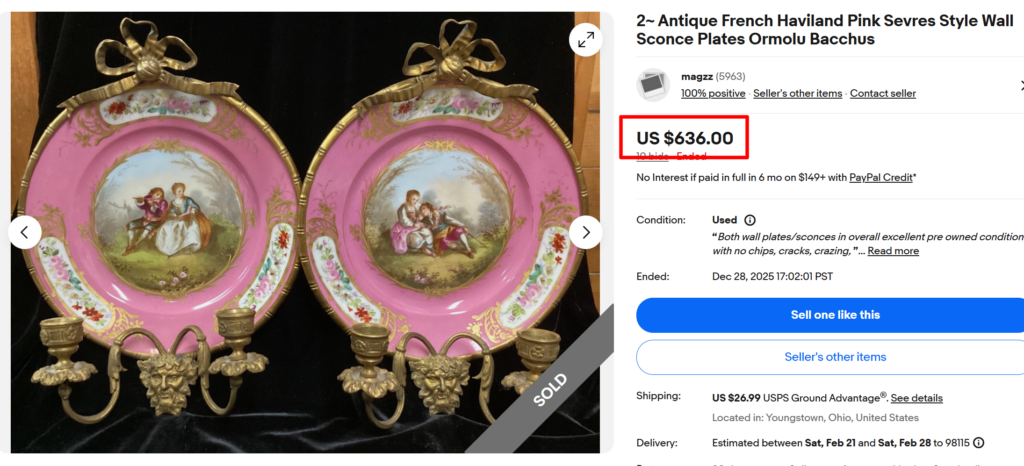
| Average Price | $500 – $1,200 (sets) |
| Manufacturing Period | Late 19th century |
| Brand/Region | CFH, Haviland & Co. |
| Pattern/Style | Sevres-style pink ground pastoral |
| Material | Porcelain |
| Collector Notes | CFH/GDM marks & ormolu sconce mounts with Bacchus mask |
This pair of antique Haviland porcelain sconce plates features hand-painted 18th-century pastoral scenes of lovers in gardens on a vibrant pink ground with floral garlands and heavily gilded gold scrolls.
Integrated into elaborate gilded bronze (ormolu) mounts, this Sèvres style design includes a ribbon-and-bow top hanger and a two-arm candelabra bracket with the mask of Bacchus, the Roman God of Wine!
Rare ormolu pairings are more valuable than plates alone because of their dual display/food-service potential.
6. GIEN Rambouillet Plates
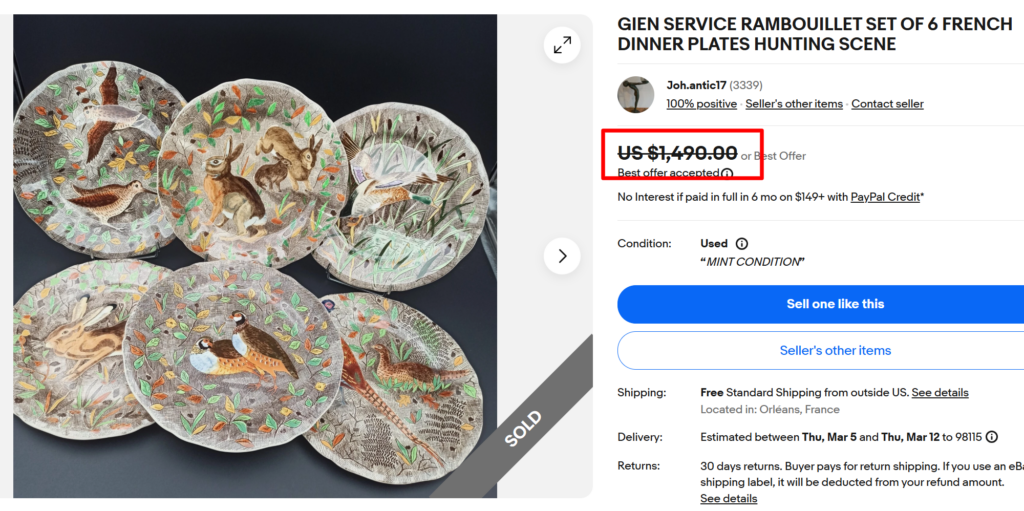
| Average Price | $1,000-$3,000 (for set) $200-$500 each |
| Manufacturing Period | 1955 (limited edition) |
| Brand/Region | GIEN; Gien, France |
| Pattern/Style | Rambouillet Hunting Scene |
| Material | Faience |
| Collector Notes | Jean Bertholle sign, numbered limited edition & Gien marks |
Designed by the celebrated artist Jean Bertholle, these limited-edition Gien Faience dinner plates celebrate the hunting traditions of the Chateau de Rambouillet, a historic hunting lodge near Paris.
The design was commissioned in 1955 specifically for use at state hunting estates. Each plate is hand-painted and features various illustrations of prey, such as hares, pheasants, woodcocks & partridges, on an autumn foliage background.
The rarity and historical context make these plates valuable, especially in a full set.
7. Gien “Oiseaux de Paradis” (Birds of Paradise)
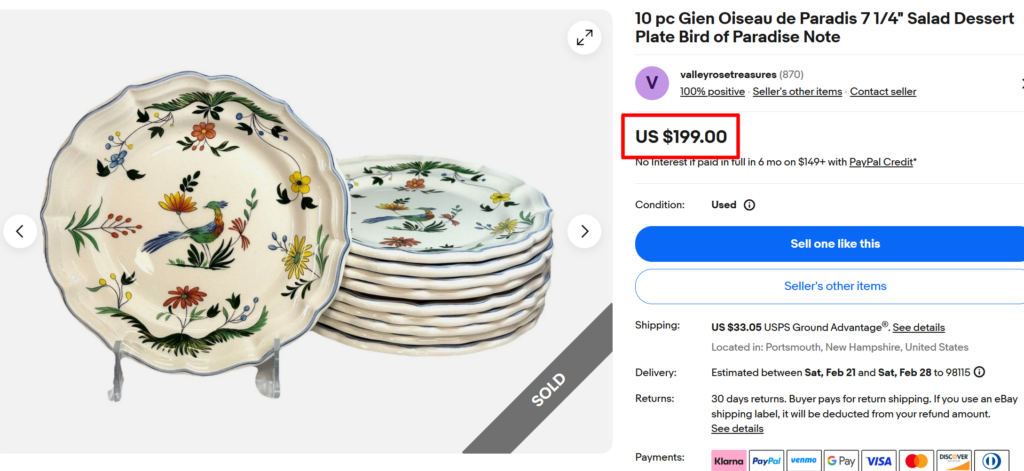
| Average Price | $150 – $400 |
| Manufacturing Period | Mid-20th century |
| Brand/Region | GIEN; Gien, France |
| Pattern/Style | Oiseaux de Paradis |
| Material | Faience |
| Collector Notes | Gien double-bee mark, hand-painted signature |
These stunning Gien plates showcase the iconic “Birds of Paradise” pattern with flamboyant tropical birds surrounded by exotic foliage and blooms in deep jewel tones.
The hand-painted design depicts intricate feather details and flowing palm motifs against Gien’s signature creamy faience body. Prized for their vibrant mid-century design, complete sets with matching serving pieces are worth the most!
8. Charles Ahrenfeldt Portrait Plate
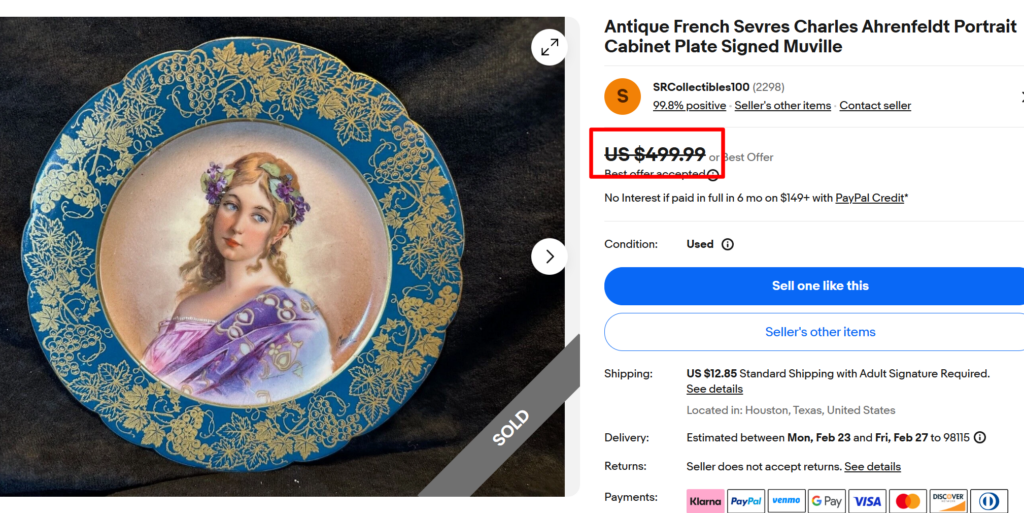
| Average Price | $200-$500 (single plate) $500-$1,000+ (sets) |
| Manufacturing Period | Late 19th century |
| Brand/Region | Charles Ahrenfeldt, Limoges |
| Pattern/Style | Portrait lady (blue ground) |
| Material | Faience |
| Collector Notes | “CA” artist initials and Ahrenfeldt mark |
Enchanting, isn’t she? This beautiful Antique French Plate was painted by Charles Ahrenfeldt, the artist behind the portrait of the lady at the center, rendered in pink, purple, and brown hues. The border of the plate shows delicate grape vines gilded in gold over a deep blue ground.
The back of the plate bears the mark of the artist, “CA”, his initials. You may come across many such Antique French Plates that do not bear a mark or backstamp of the manufacturer, but instead bear the initials of the artist and the year of production, engraved on them.
9. Haviland Limoges “Pink Roses” Plates
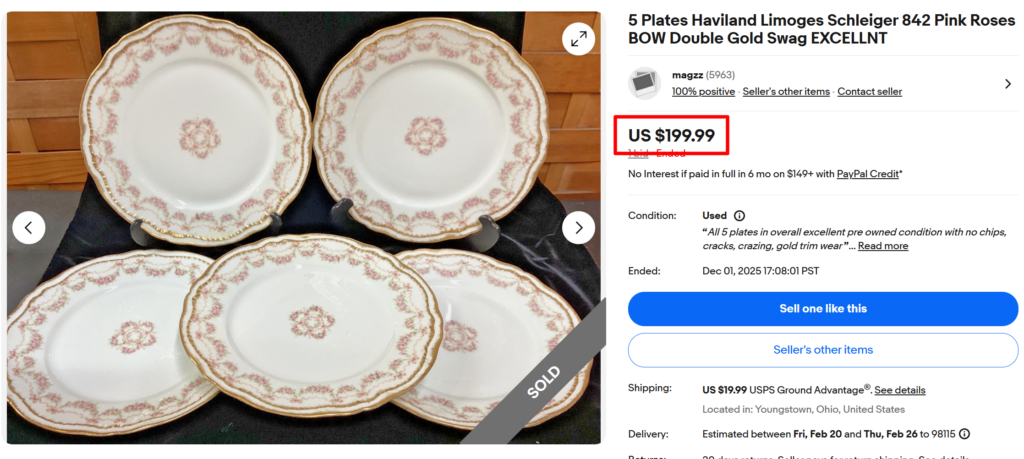
| Average Price | $80 – $250 |
| Manufacturing Period | 1880s-1910s |
| Brand/Region | Haviland & Co.; Limoges, France |
| Pattern/Style | Pink Roses (Schleiger-adjacent floral) |
| Material | Porcelain |
| Collector Notes | “Theodore Haviland, Patent applied for” mark |
These classic Haviland export plates feature the beloved “Pink Roses” pattern with delicately painted loose roses, buds, and green leaves floating across a white background.
The plates usually have scalloped edges with gold-trimmed rims, perfect for elegant table settings. These late Victorian/Edwardian pieces are hugely popular today; sets of 12 or more in mint condition can sell for $500 or more!
10. Gien Majolica Oyster Plates
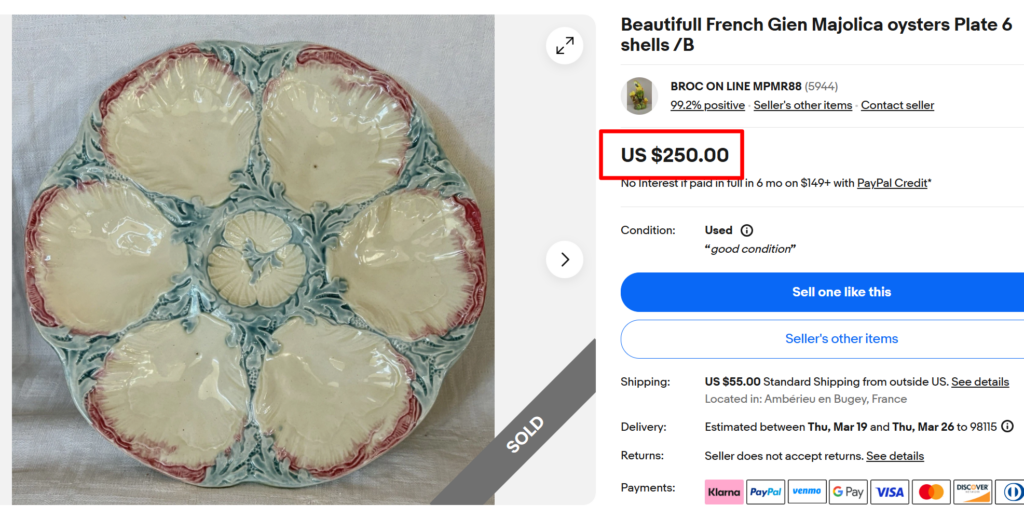
| Average Price | $100-$300 (up to $500-700 rare 19th C.) |
| Manufacturing Period | Victorian mid-19th C. to 1950s |
| Brand/Region | Gien; Gien, France |
| Pattern/Style | 6-Shell Oyster |
| Material | Majolica/Faience |
| Collector Notes | Early Gien marks add value |
Yet another example of antique French oyster plates, produced by Gien, France. This plate shows six shell-shaped compartments arranged around the rosette.
It is decorated in the naturalistic style of the Victorian era, with folded coral & seaweed motifs separating the wells. Gien’s signature vibrant glazing is evident from the off-white shells with red accents and an aqua-green weed background.
While mid-century versions (1950s) often sell for $125 to $300, rare 19th-century Gien examples in excellent condition can reach $500 to $680 or more per plate.
Key Identification Features of Antique French Plates!
Antique French plates displayed unique, impressive designs that set them apart. Many authentic designs from renowned makers were copied and reproduced by local potters and even internationally!
That’s why you need to know the key signature features of antique French plates to know what’s authentic and what’s not! Let’s understand it all in detail:
Place of Origin
Antique French Plates were made by small artisans as well as large manufacturers in various states and regions.
Limoges, a city in France, became a major industrial hub after the discovery of Kaolin clay, an important ingredient for hard-paste porcelain. So, some of the most famous manufacturers, like H & Co., Jean Pouyat, etc., had factories in Limoges.
The Royal Sèvres manufactory, a major name in the French porcelain industry, is located at the Sèvres, Gien factory, famous for its faience, which originated in the Loire Valley in central France.
All these manufacturers and artists can be identified by their distinct marks, logos, and backstamps.
Maker’s Marks
A maker’s mark on an old French plate identifies who made the piece and when. These marks can be an engraving, a hand-painted symbol, or a stamp on the back of the plate that may hold the factory’s name, logo, or initials, or the potter’s signature or initials.
You may also find date codes, specific patterns, or line names on certain pieces.
Some commonly seen maker’s marks on Valuable Antique French Plates are given below:
- ROYAL Sèvres: Mostly have two interlaced blue ‘L’s. A letter inside the ‘L’s tells the exact year. “A” stands for 1753, “B” stands for 1754, and so on. Double letters were used after 1777.
- HAVILAND & CO.: Haviland pieces often feature “H&Co” over ‘L’ for Limoges or ‘France’.
- JEAN POUYAT: Known for a wreath logo with “J.P./L.France” inscribed within the wreath.
- GIEN: The mark typically contains the name “Gien”.
One important thing to note is that early faience pieces often lacked formal marks or stampings. Instead, they have signs of individual master potters or unique symbols, for example, Antonie Pavie, with initials as the mark!
Collector’s Tip: No country name was included before 1891, but under the McKinley Tariff Act, pieces produced during 1891-1920 would include “France” in their mark. Post-1920, it was changed to “Made in France”.
Type of Material Used
As porcelain was not available from the start, French makers made earthenware using other materials, such as majolica and faience. Below are some important materials you should know:
- Faience: A mix of sand, local clay, and magnesium-rich minerals, faience is one of the most common materials in early French plates. It’s porous, thicker, and heavier, and the pieces have a warm, ivory-white, opaque background of tin-glazed lead enamel with vivid hand-painted designs.
- Porcelain: The “White Gold”, prized for its translucency and finish. It is a mixture of kaolin, petuntse, and quartz, fired at extremely high temperatures. You can spot it by its lightweight body and a high “ping” ring when tapped with a fingernail.
- Majolica/Barbotine: It is composed of a porous earthenware clay, often terra-cotta, and the glaze is lead-based, instead of tin. It’s recognizable by its thicker, porous clay body (visible at edges and in chips) and relief-molded designs.
Quick Tip: To distinguish porcelain from faience, hold the piece up to a light. You should see a glow or shadow through the material, which is absent in faience because it is opaque.
Design Style
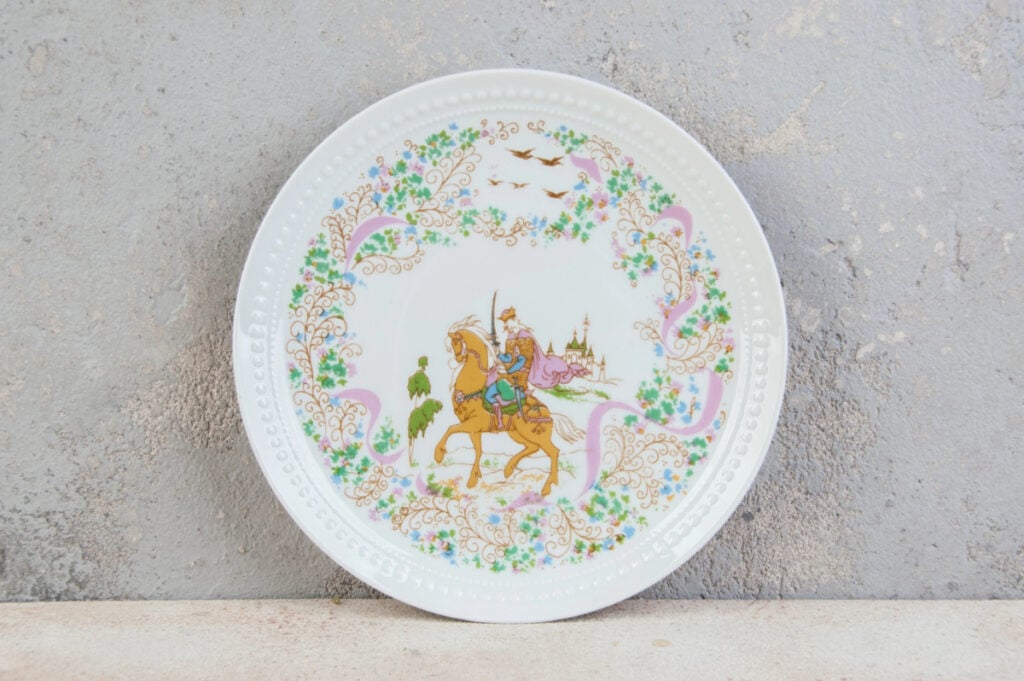
Style refers to the vibe of a specific era, reflected in the patterns produced during that time. French plate styles are classified based on the time period, as well as the changing tastes of the monarchy and artistic movements of that time.
1. Baroque
Visible in the patterns of Louis XIV’s time (1643-1715), it is characterized by grandeur, symmetry, heavy ornamentation, sunburst rays or mythological gods. Mostly seen on faience, the style often adorns large, formal service pieces.
2. Rococco
This style is from Louis XV’s era. You can identify it by S-shaped curves, scrolling shells, asymmetrical rocks, and foliage in pastel shades, especially pinks and blues. Rose Pompadour or Bleu Céleste on Sèvres porcelain are perfect examples of Rococo French plates.
3. Empire Style
This style was in vogue during the reign of Napoleon from 1804 to 1815, known for bold, deep greens or reds with thick gold borders. Popular elements include imperial eagles, bees, sphinxes, laurel wreaths, and crowns, symbolizing the power of men and their victories.
4. Art Nouveau
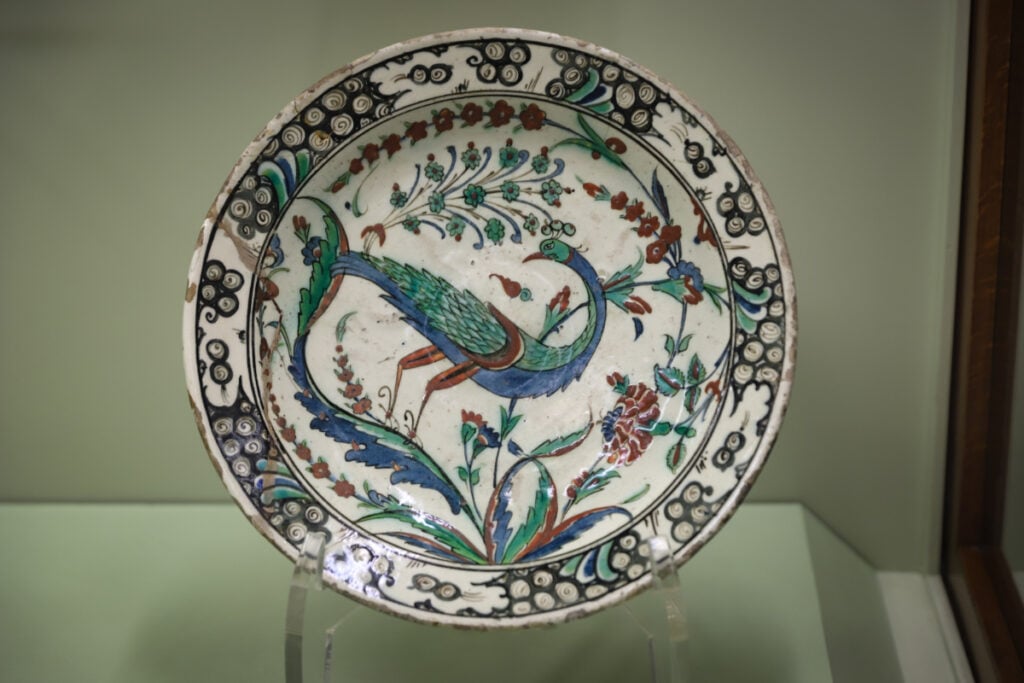
The hallmark of this style was long, stem-like lines, like vine tendrils, that often swept around the rim of the plates. Common motifs are flowers like irises, lilies, and orchids; insects like dragonflies and butterflies; and birds like peacocks, in dream-like exaggerated forms.
Rim Shapes
Although this isn’t a standalone identification feature, you can identify antique French plates by their rims. Authentic French pieces exhibit a certain style of rim shapes that evolve alongside different styles and time periods, as well as significant cultural or artistic movements.
Some commonly observed rim shapes are:
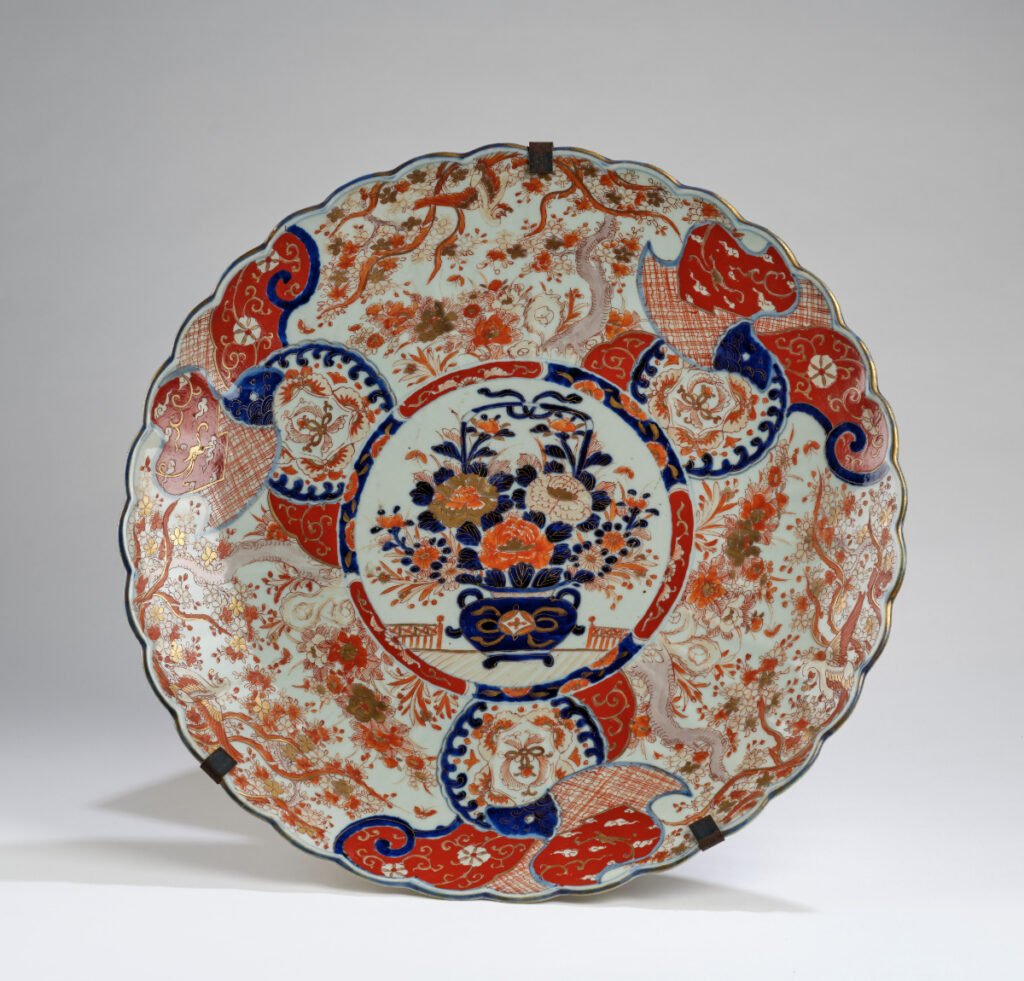
- Scalloped rims (Rococo Sèvres, Haviland Schleiger 478)
- Embossed or relief rims (Empire Style Napoleon, Majolica game plates)
- Shaped or Irregular rims (Art Nouveau vine plates, Palissy rustic platters)
- Plain Rims ((Baroque faience pieces, early Limoges plates)
What Impacts the Value?
The value of old French plates largely depends on the condition. Light crazing (fine hair-like checked lines) is acceptable if it doesn’t blur designs, but heavy crazing, front chips, cracks, faded gilding, or browning (brown/black stains due to bacterial growth in porous faience) can seriously hurt the value.
Also, minor back nicks are okay on rare pieces, as long as they are used for display; these shouldn’t be used for food, due to toxic lead/tin glazes and bacterial-trapping fissures.
Apart from this, an artist’s signature or a painter’s mark can significantly increase the value of plates. Rare period designs and vivid enamel colors are also valuable features.
Rare, limited services like Hayes Presidential or Sèvres Egyptian, matching sets (4+ pieces), and desirable provenances like royal/monarchy can also greatly increase the value!
Note: This article is intended for informational, educational, and entertainment purposes only. Some images are illustrative and may not represent actual brands, products, or related entities. All trademarks, product names, brand logos, packaging, and other intellectual property referenced remain the exclusive property of their respective owners. Any brand mentions or references are provided solely for descriptive and educational context and do not imply any formal or commercial association.