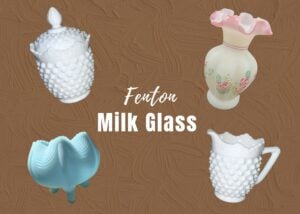
When it comes to milk glass antiques, one name that is at the top of every list is Fenton! The company began in 1905 in West Virginia by two brothers who decorated glass from other companies.
However, it wasn’t long before they began producing their own glasswork. They tried to revive the milk glass from the Victorian era in the 1940s. Opaque milk glass hadn’t been in style for decades; but, Fenton made it a housewares product.
Note: Milk glass was made by adding opacifying agents (bone ash or tin oxide) to molten glass.
During the 1940s and ’60s, Fenton released numerous patterns, including “Hobnail” and “Silver Crest.” At one point, they were even making dinnerware. In the later years, Fenton released hand-painted series and limited-edition runs that turned milk glass into fine art.
After the factory closed in 2011, Fenton pieces went from being nice household items to legitimate collectibles!
11 High-Value Fenton Milk Glassware Items!
Let’s take a look at some valuable vintage milk glass pieces from Fenton, featuring the brand’s iconic patterns and shapes!
1. “Hobnail” Milk Glass Punch Bowl Set
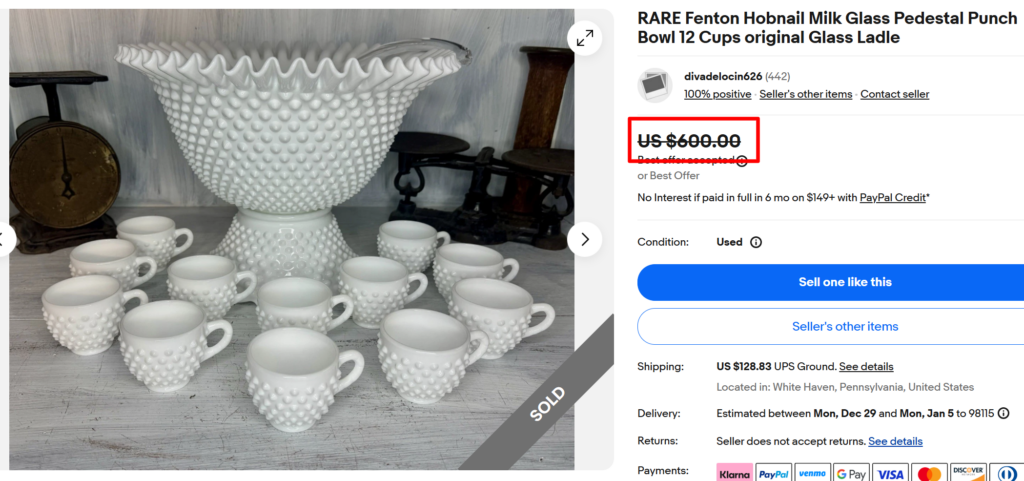
Although Fenton’s “Hobnail” pattern is quite common, finding a complete milk glass punch bowl set with a pedestal and a ladle is super scarce today. This design simply features round, raised “hobs” across the surface.
| Average Value | $400 to $600 (full set); $50 to $150 (singles) |
| Pattern | Hobnail |
| Color | White Milk Glass |
| Item Type | Punch Bowl Set |
| Production | 1939 |
2. “Silver Crest” Milk Glass Epergne
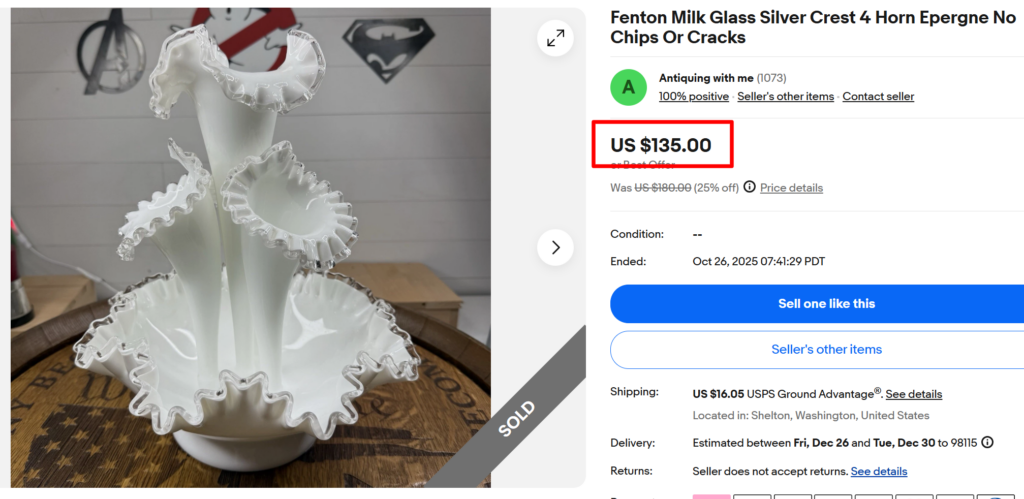
“Silver Crest” is probably Fenton’s most recognized pattern, after Hobnail, of course. You can spot it by the milky white glass body with a ruffled, clear glass edge.
This “Silver Crest” epergne is the showstopper, with its big, ruffled bowl and four removable trumpet-shaped vases sticking up from the center. A set with all the trumpets intact can be worth $100 to $400!
| Average Value | $100 to $400 |
| Pattern | Silver Crest |
| Color | Silver & White Milk Glass |
| Item Type | Epergne |
| Production | 1941 to the 1980s |
3. Turquoise “Spanish Lace” Cake Stand
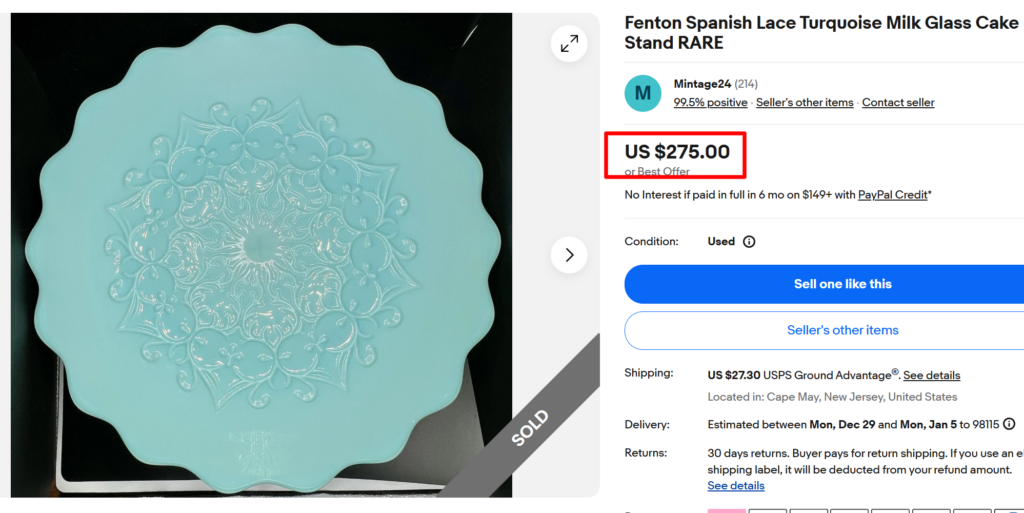
This is a stylish cake stand featuring Fenton’s “Spanish Lace” pattern, in a rare turquoise blue color. It shows an embossed design of old-fashioned lacework.
Fenton made many pieces in this pattern, but the pedestal cake stand is the most sought-after among collectors, particular to the turquoise-blue cake stand with the ruffled rim.
White milk glass variant of this piece is quite common, selling for $20 to $80, while the light pink version can go for $100 to $220.
| Average Value | $150-$300 |
| Pattern | Spanish Lace |
| Color | Turquoise Milk Glass |
| Item Type | Cake Stand |
| Production | 1960s & 1970s |
4. Blue “Hobnail” Swung Vase
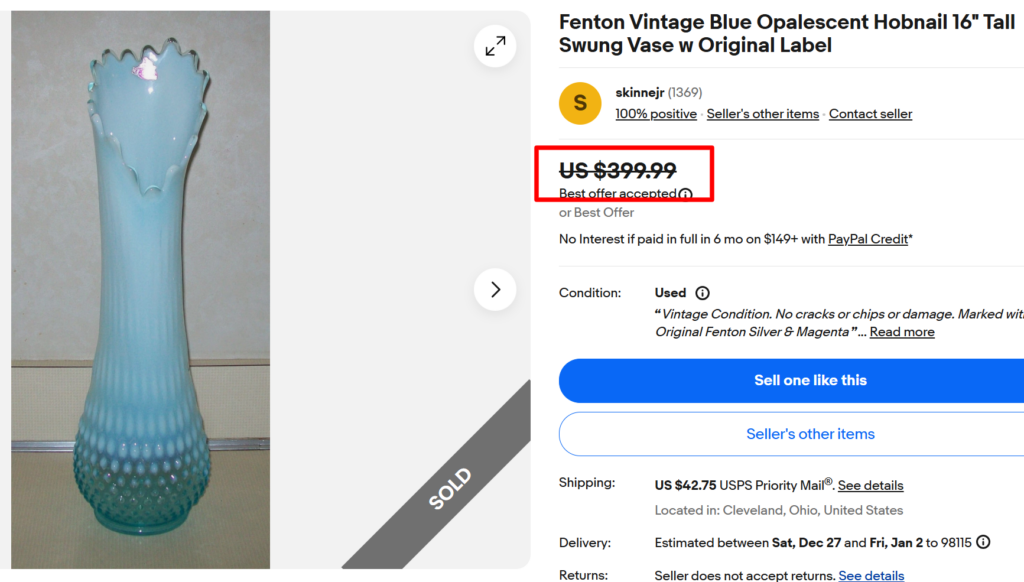
A Fenton “swung” vase in its “Hobnail” pattern and a rare color, like this blue opalescent example, is a collector’s dream. These vases were made by taking the hot glass and literally swinging it around to stretch the neck way up, sometimes lopsided on purpose.
White milk glass swung vases are common, but the really tall ones or the opalescent colors, such as blue, yellow, plum, and green, are rare and valuable.
| Average Value | $200 to $450 |
| Pattern | Hobnail |
| Color | Blue Opalescent |
| Item Type | “Swung” Vase |
| Production | 1950s to the 1980s |
5. “Emerald Crest” Cake Stand
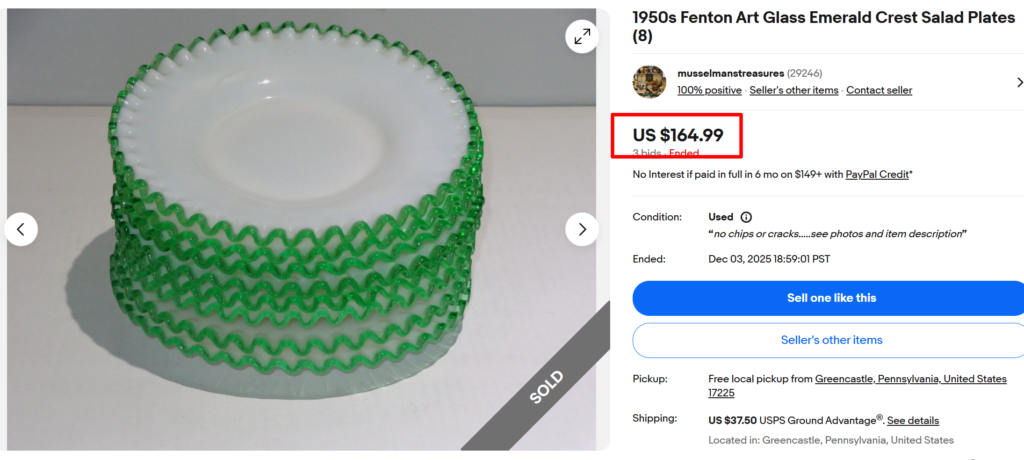
Similar to “Silver Crest,” these pieces have a milk glass body with a deep-green ruffled rim. While the pattern is ordinary, finding dinner plates or salad plates in this pattern is rare since Fenton only made them from 1948 to the early 1950s.
A complete set of 6 to 10 plates with no damage can be worth good money.
| Average Value | $50 to $170 (based on no. of plates) |
| Pattern | Emerald Crest |
| Color | Milk White & Emerald Green |
| Item Type | Dinnerware (Plates) |
| Production | 1948 to 1952 (Dinnerware) |
6. “Alley Cat” Figurine
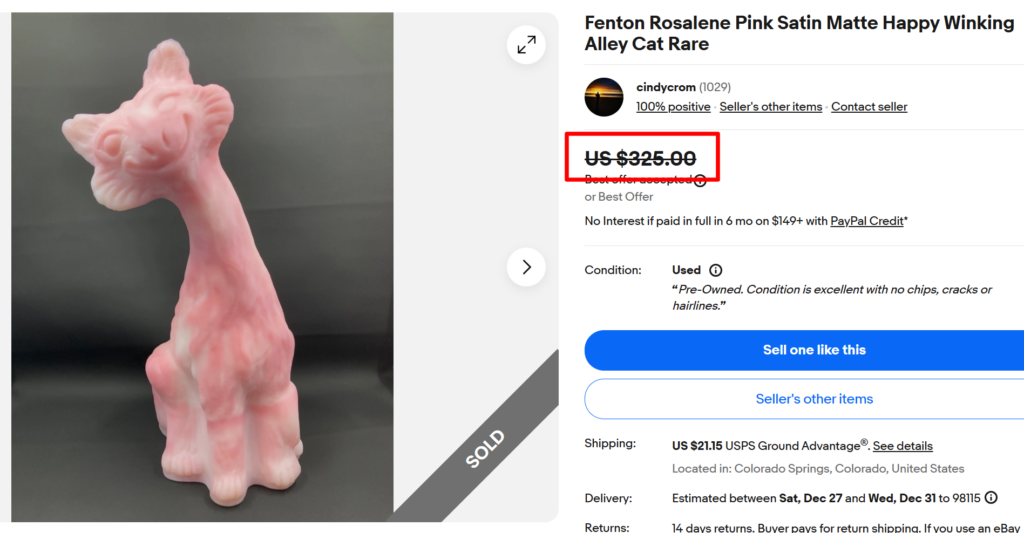
One of the most popular Fenton pieces, this is an 11-inch cat with kind of a scraggly, mischievous look. Came out in 1970 using a mold bought from another glass company, Fenton released this figurine in almost every color, including milk glass.
The hand-painted ones or the swirled “slag” glass versions are the most valuable, but even plain white ones can sell for a reasonable price.
| Average Value | $100 to $500+ |
| Pattern | “Alley Cat” |
| Color | White, Pink, Snow Blue, Yellow, Green, Etc. |
| Item Type | Cat Figurine |
| Production | 1970s |
7. Violets in the Snow (Spanish Lace) Candy Dish
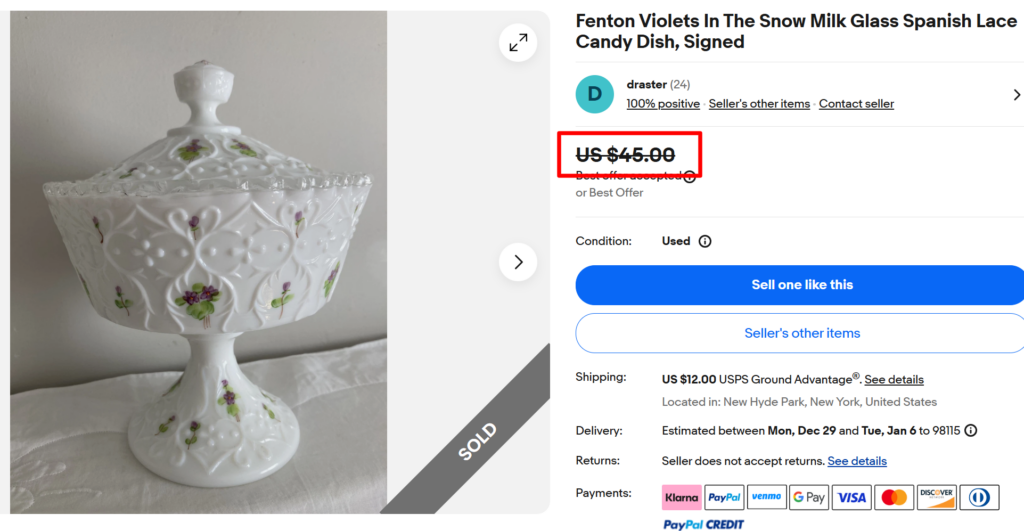
This design isn’t really a specific pattern from Fenton; it’s simply hand-painted purple violets with green foliage on top of Spanish Lace or Silver Crest pieces.
What’s special about these pieces is that they are mostly signed by the artist underneath. The pattern is commonly found in various shapes, but large compotes and candy jars are most popular!
| Average Value | $12 to $70 |
| Pattern | Violet In the Snow (Spanish Lace) |
| Color | Milk White, Cream |
| Item Type | Candy Dish |
| Production | 1974 to the Early 1980s |
8. “Cabbage Rose” Milk Glass Gone With The Wind Lamp
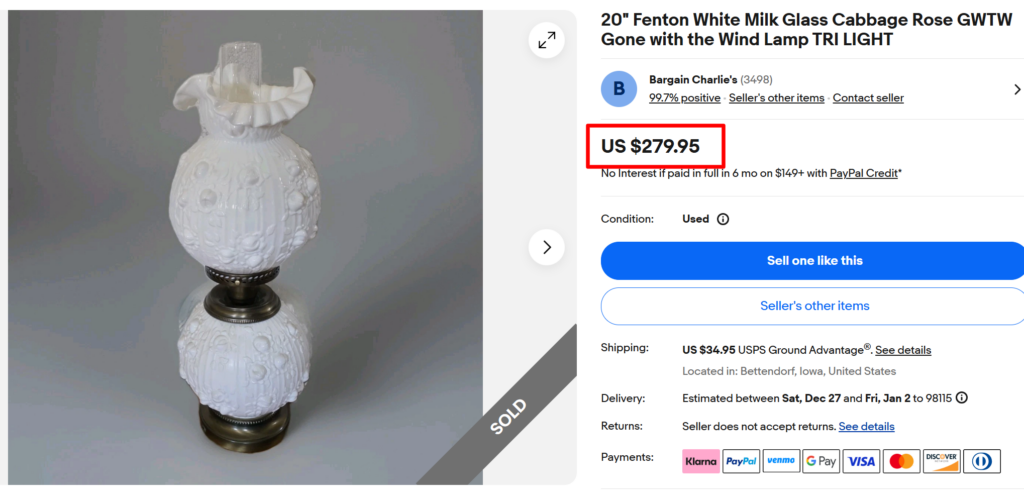
“Cabbage Rose” is a pressed pattern with big, dense flowers all over the piece, which Fenton made from 1967 to 1976. One of the most collectible milk glass pieces in this pattern is the ‘Gone with the Wind’ lamp.
It’s a highly decorative Victorian-style parlor lamp, featuring the classic two-globe design, one globe at the base and another as the shade. Because these lamps are large and easily damaged, finding one with both globes in perfect condition is rare.
Also, white milk glass GWTW lamps are moderately priced, but rare colors like yellow, Shelley Green, cranberry, and honey amber can fetch up to $1,000.
| Average Value | $200 to $500 |
| Pattern | Cabbage Rose |
| Color | White, Yellow, Blue, Green |
| Item Type | Gone with The Wind Lamp |
| Production | 1967 to 1976 |
9. “Rosalene” Burmese Garden Basket
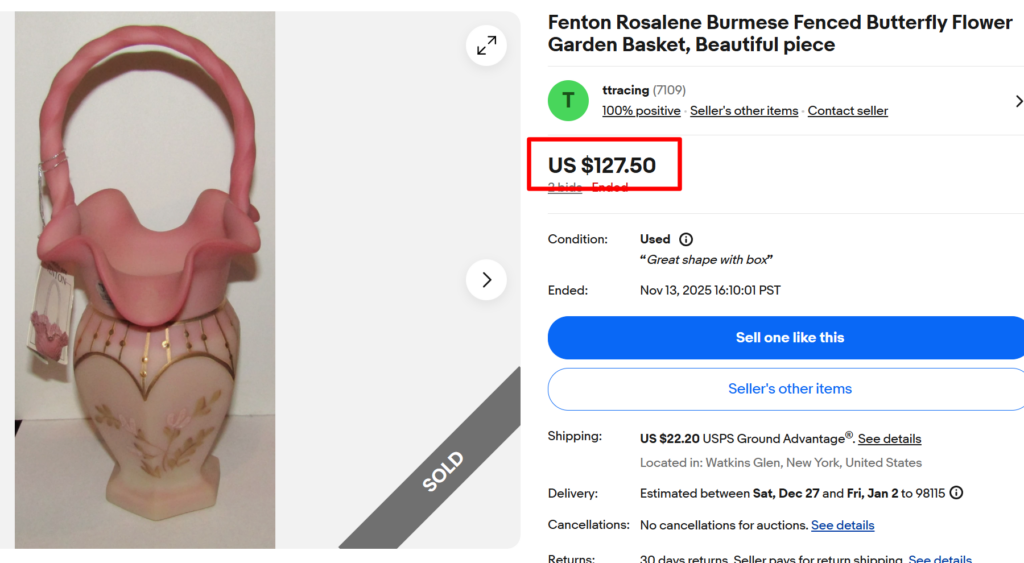
“Rosalene” is one of Fenton’s most popular opaque glass lines. It’s heat-sensitive glass that goes from creamy white at the bottom to sunset pink at the top. It’s technically “Burmese” style glass, but that pink-to-white fade looks like milk glass.
A large Rosalene vase or garden basket, like this example, with hand-painted flowers and golden fence decorations, is the most collectible style!
| Average Value | $80 to $200 |
| Pattern | Hand-Painted Florals & Golden Decoration |
| Color | Milk white to Sunset Pink, Burmese Glass |
| Item Type | Garden Basket/Vase |
| Production | 1970s |
10. “Daisy & Button” Fruit Compote
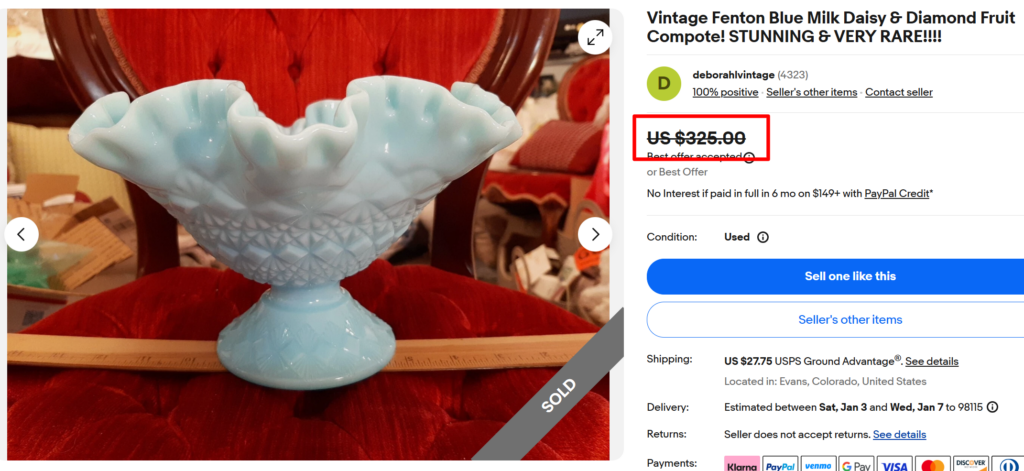
“Daisy and Button,” also known as “Daisy & Diamond,” is an old geometric pattern that Fenton brought back between 1953 and 1974. It’s a pressed-glass design featuring stylized floral (daisy) motifs and diamond-shaped buttons.
Compotes, which are basically stemmed bowls with a lid, and fan vases are the signature pieces in this pattern, especially in pastel colors.
| Average Value | $200 to $400 (based on condition) |
| Pattern | Daisy & Button |
| Color | Pastels – Blue, Green, Pink Milk Glass |
| Item Type | Compote |
| Production | 1950s to 1960s (Late into 1970s) |
11. “Poppy” Gone With The Wind Lamp
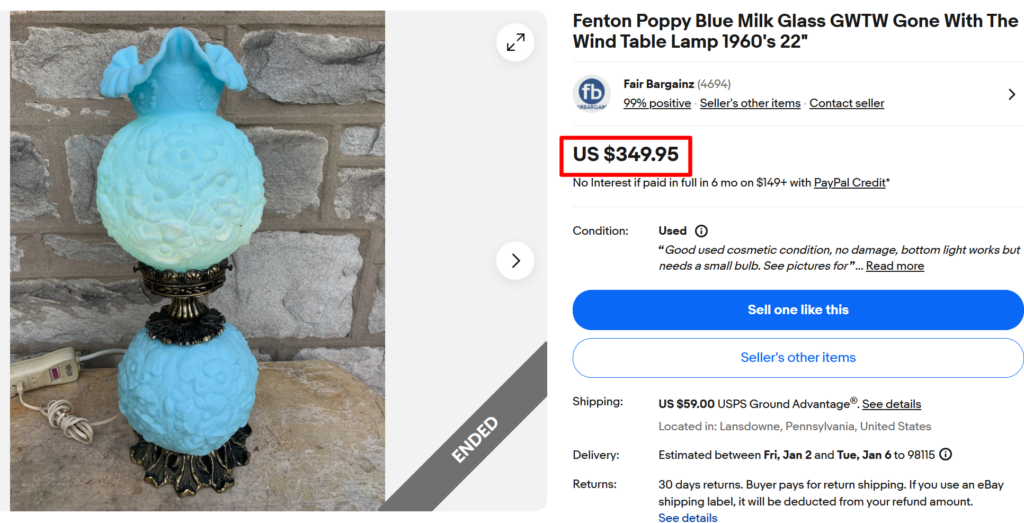
Like “Cabbage Rose,” Fenton’s “Poppy” pattern is also popular for its GWTW lamps. This design shows large, moled poppy flowers on the surface. These pieces were also released in various colors, like blue, pink, and, of course, milk white.
Like the “Cabbage Rose” lamps, you need both globes intact and undamaged for it to be worth anything substantial.
| Average Value | $150 to $400 |
| Pattern | Poppy |
| Color | Blue, Pink, White |
| Item Type | Gone with the Wind Lamp |
| Production | 1960s to 1980s |
How to Tell If Fenton Milk Glass Is Real?
To know whether a piece is genuine milk glass from Fenton, you need to check three things: how it’s made, the maker’s mark, and its unique patterns.
1. Soft Glow in the Material
The first step is to spot real old milk glass, which has minerals like bone ash or tin dioxide in it. So, when you hold it up to a bright light, you’ll see a glow around the edges with hints of orange, red, or blue. It’s a kind of iridescent.
If it looks flat white, like a dinner plate, with no glow at all, it’s probably fake white glass or ceramic, not milk glass.
2. The Fenton Mark (The “F” in an Oval)
While marks are quite reliable proof of authenticity, the fact is that Fenton didn’t start permanently marking their pieces until 1970. So, not all Fenton milk glass pieces have a mark.
Before 1970, they only used paper labels, which were highly likely to fall off. Once they’re gone, it gets difficult to authenticate a piece.
Pieces from 1970 to 1979 show the embossed word “Fenton” inside an oval on the bottom. And 1980s and onward, the company added a number to indicate the decade it was made in, like an “8” for the ’80s, a “9” for the ’90s, and so on.
3. The Weight & Feel of It
In case of no markings or labels, use your senses to spot real Fenton milk glass. Here’s what you need to do:
- Feel the Surface: When you run your hand on a real Fenton milk glass, you’ll find a smooth, almost silky surface. If it’s rough, chalky, or you can feel sharp seams from the mold, it’s probably not Fenton.
- Check the Bottom: Most genuine Fenton pieces have a nice flat, polished bottom or a clean base. A rough or broken spot on the bottom (aka, pontil mark) means it’s probably hand-blown, not factory-made Fenton.
4. Tally the Pattern & Color
Lastly, observe the pattern on the milk glass and verify it via Fenton’s pattern guides, catalogues, or databases. This is also crucial because the company made specific patterns in certain colors or shapes.
This means that if you find a piece in a color that Fenton never really released, you’d know it’s a fake or reproduction.
Note: This article is intended for informational, educational, and entertainment purposes only. Some images are illustrative and may not represent actual brands, products, or related entities. All trademarks, product names, brand logos, packaging, and other intellectual property referenced remain the exclusive property of their respective owners. Any brand mentions or references are provided solely for descriptive and educational context and do not imply any formal or commercial association.