Antiques Know How Research
Collectible Vintage Lamps
Antiques Know How team’s close look at recent auctions and eBay sales shows that vintage lamps can vary from basic $50 fixtures to rare pieces worth up to $10,000 or more. The most collectible, notable pieces are Tiffany Studios’ leaded glass and “Adam” lamps, GWTW lamps, Raoul Larche’s Loïe Fuller dancer lamp, Pairpoint Puffy glass lamps, and Handel slag‑glass panel lamps. The main value factors are maker and brand, material quality, design era, provenance, originality, and condition.
Antiques Know How
While every house has an old, sturdy metal lamp sitting in a corner, most people have no idea that that old lamp could be worth hundreds, or even thousands of dollars. These vintage lighting pieces get overlooked at state sales, too.
But once you know the things that can turn your lamp into a piece for fortune, like the right maker’s mark, the right glass, or the right design, everything changes.
Here’s a helpful guide to introduce you to some of the most collectible and expensive vintage lamps, their real value, and tips on whether yours can be worth something.
Most Sought-After Vintage Lamps Worth Knowing
Vintage lamps are undoubtedly hot collectibles these days, with certain top-notch brand pieces fetching thousands of dollars at auctions. The following are some of the most popular and valuable old lamps worth a lot of money.
1. Tiffany Studios – Swirling Leaves Bronze Lamp
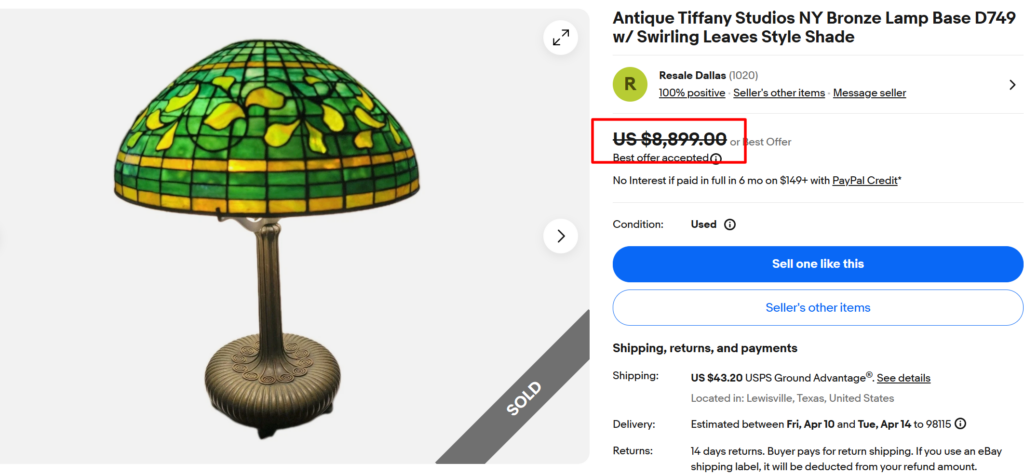
| Average Value | $7,000 – $15,000+ |
| Brand & Type | Tiffany Studios Table Lamp |
| Production Period | c. 1900–1920 |
| Key Features | Leaded glass, patinated bronze base |
| Collectibility | Extremely High |
| Collector Notes | Check the Tiffany sign & model numbers. |
This iconic Tiffany Studios piece features a leaded glass shape in mottled greens and yellows on a geometric base, with a patinated bronze base. The shade model on this lamp is #1073, while the base is D794.
Clara Driscoll, who led Tiffany’s Women’s Glass Cutting Department, is credited with its design. Pieces in excellent condition have gone for $8,000 to $9,000, with auction results going higher.
The value lies in the glass selection; Tiffany used opalescent and “confetti” glass to create depth, making each handmade shade unique. Since many Tiffany reproductions exist, check the base for a “Tiffany Studios” marking and the base model number for authenticity.
2. Raoul Larche – Loïe Fuller Art Nouveau Lamp
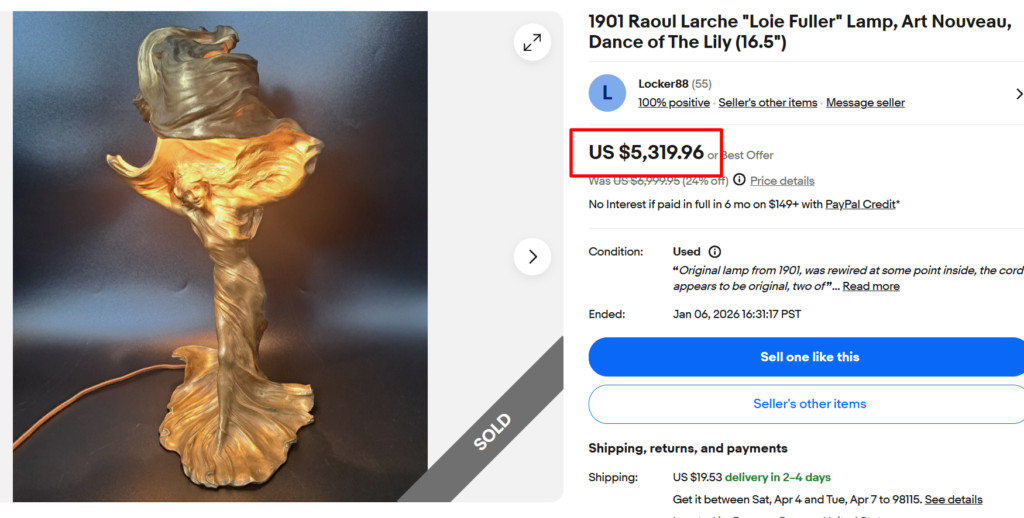
| Average Value | $5,000 – $25,000+ |
| Brand & Type | Larche Gilt Bronze Sculpture Lamp |
| Production Period | c. 1900–1907 |
| Key Features | Gilt bronze, figural dancer form |
| Collectibility | Museum-Level |
| Collector Notes | Verify Siot-Decauville foundry mark and edition number |
Created by the French sculptor François-Raoul Larche (1860–1912), this gilt-bronze lamp depicts the dancer Loïe Fuller, enveloped in her swirling, voluminous silk robes.
This lamp was sold at Fuller’s own Paris studio and exhibited at the 1900 Exposition Universelle, giving it a strong provenance and value. Also, its rarity and the artist’s ability to capture fluid motion in heavy metal are other prized characteristics.
To identify authentic examples, look for impressed “Raoul Larche / Siot-Decauville Fondeurs Paris” with a series number. While this example sold for over $5,300, mint-condition pieces have sold for tens of thousands of dollars in auction.
3. Franz Bergmann – Slag Glass House Lamp
| Average Value | $3,500 – $10,000 |
| Brand & Type | Bergmann Bronze House Lamp |
| Production Period | c. 1890–1930 |
| Key Features | Cold-painted bronze, multi-color slag glass |
| Collectibility | Very High |
| Collector Notes | B-in-urn foundry mark on base or back |
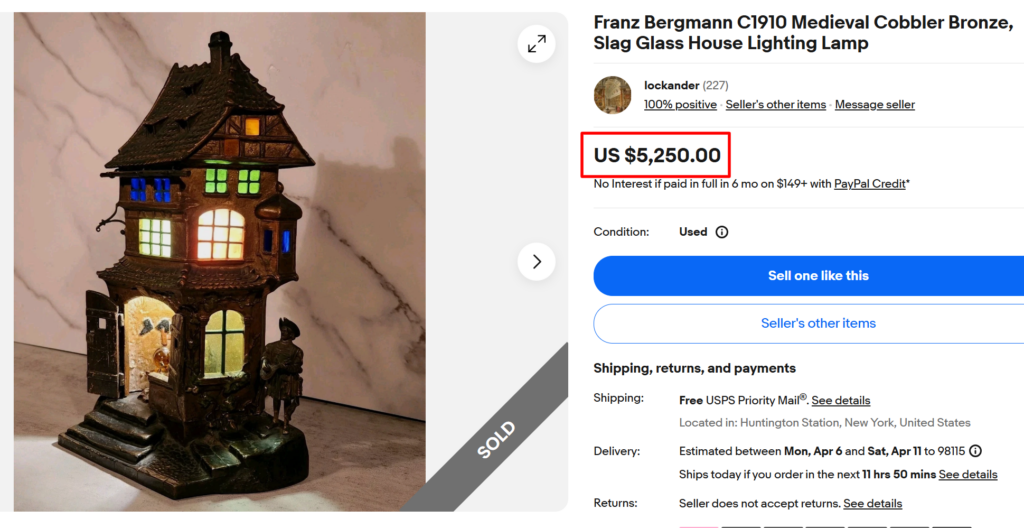
Franz Xaver Bergmann ran a Vienna foundry producing cold-painted bronze figures and lamps. The house lamps are among his most sought-after pieces. This one is shaped like a medieval cobbler’s shop, with fine architectural details and glowing slag-glass windows.
When lit, the interior scenes come to life. These “storytelling” lamps are super collectible and extremely valuable today thanks to their metal bodies, multi-colored finishes, and the nostalgic vibe they evoke.
Make sure to verify authenticity by checking for a “B” inside an amphora (urn) stamped on the back or base, along with “Made in Austria” or “Geschutzt.”
Note: Reproductions of this lamp exist. On originals, the cold painting (applied with oil paints, not chemically patinated) shows fine detail with natural wear. A fresh, uniform color is a red flag.
4. Tiffany Studios – “Adam” Desk Lamp
| Average Value | $4,000 – $8,000+ |
| Brand & Type | Tiffany Studios Desk Lamp |
| Production Period | c. 1895–1933 |
| Key Features | Pierced bronze shade, caramel glass |
| Collectibility | Extremely High |
| Collector Notes | Check both shade and base for stamps |
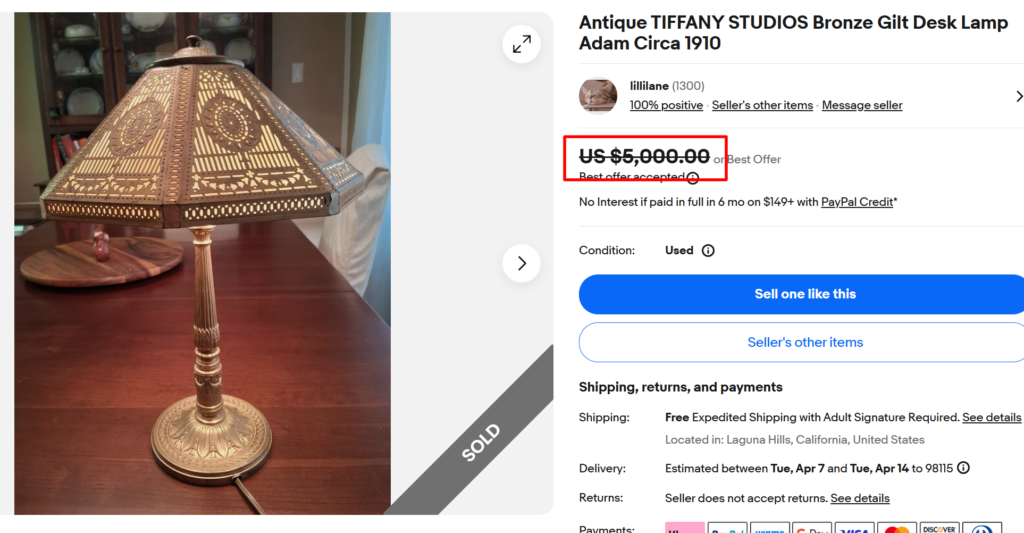
This lamp in the “Adam” pattern is a classic example of Tiffany Studios’ etched metalwork. It features a pierced dore (gold) bronze shade with caramel glass backing on a matching Adam base in gold patina.
These lamps are among the company’s most exquisite pieces and are worth thousands today in pristine condition, with some examples reaching $8,000 or more.
Ensure that both the shade (model #1412) and the base (model #539) are stamped “Tiffany Studios New York”; this is the key sign of authentic pieces.
5. Dugdills – 3-Arm Bankers Lamp
| Average Value | $1,000 – $3,500 |
| Brand & Type | Dugdills Industrial Anglepoise Lamp |
| Production Period | c. 1920–1939 |
| Key Features | Articulating arms, Vitreous enamel shade, cog joints |
| Collectibility | High (multi-arm versions) |
| Collector Notes | “Dugdills Patent” stamp on base required |
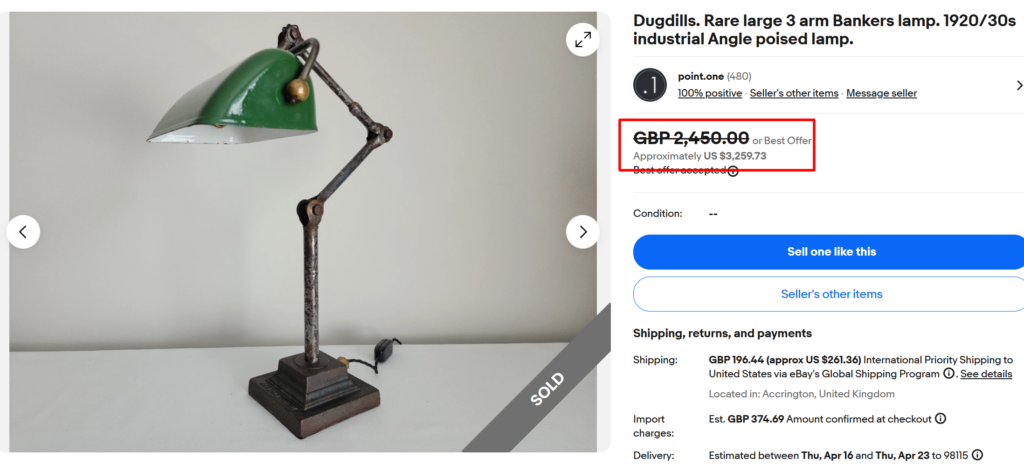
John Dugdill was a pioneer of British industrial lighting, and his patented “daisy” cog joints are quite popular among collectors. The company’s industrial anglepoise lamps feature articulating arms with cast daisy rosette joints, iron construction, and enamel shades.
This unique banker lamp features three arms, a green vitreous enamel shade, and a heavy cast-iron base. Designed especially for workshops and offices, the articulated arms allow for precise positioning.
The most valuable pieces are the ones with original enamel shades and multiple arms, like this example, and the iconic “Dugdills Patent” stamp on the pedestal step.
6. Mario Lopez Torres – Wicker Monkey Floor Lamp
| Average Value | $1,800 – $6,000 |
| Brand & Type | Torres Woven Monkey Floor Lamp |
| Production Period | c. 1974–present |
| Key Features | Hand-woven wicker, brass monkey form |
| Collectibility | High / Trendy |
| Collector Notes | Signed/tagged examples worth significantly more |
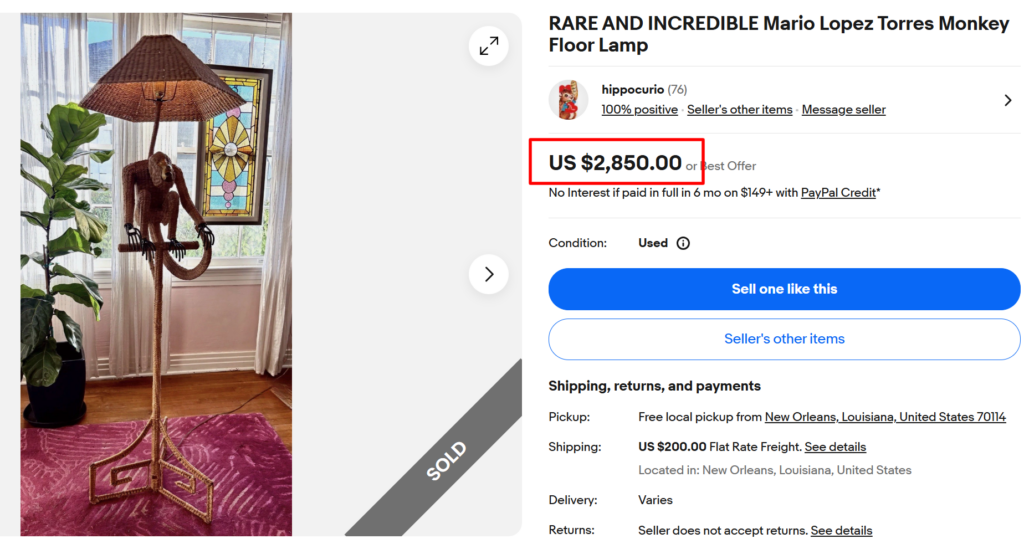
Mario Lopez Torres has been making hand-woven animal sculptures and lamps since 1974. His monkey floor lamps are the most iconic and collectible pieces today.
These lamps use iron frames wrapped in hand-woven chuspata (a natural fiber) with brass accents and a matching woven shade. This one features a life-sized monkey perched on a stylized branch, all meticulously hand-woven.
Authentic Mario monkey lamps bear a stamped brass medallion reading “Mario Lopez Torres, Tzumindi, Hecho en Mexico.” A blend of fine folk art and mid-century design, these lamps are among the trendiest pieces today.
7. Handel – Slag Glass Overlay Lamp
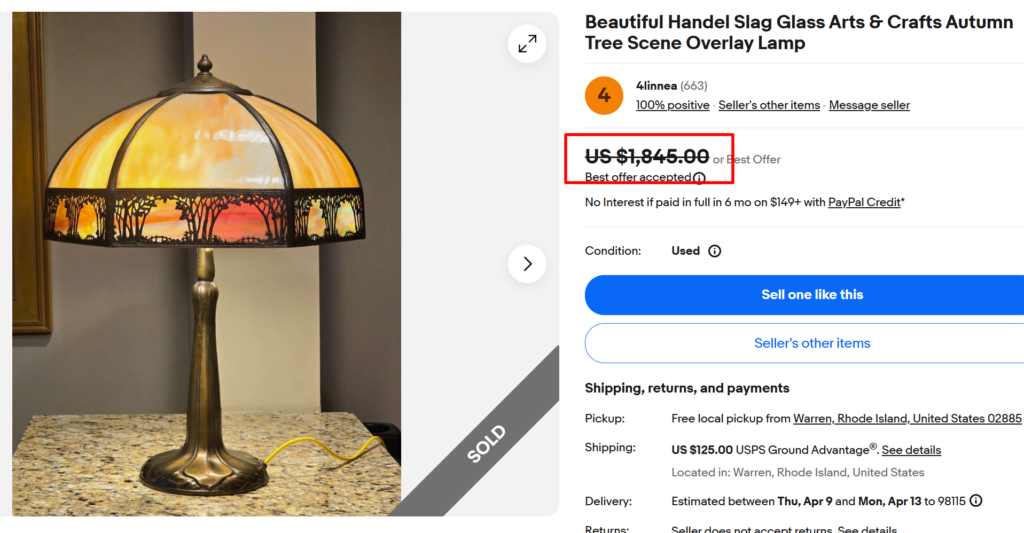
| Average Value | $1,500 – $2,500 |
| Brand & Type | Handel Slag Glass Overlay |
| Production Period | 1910–1920 |
| Key Features | Metal silhouette overlay, slag glass |
| Collectibility | Moderate to High |
| Collector Notes | Check for the “Handel” cloth tag/stamp. |
Handel was famous for its “teroma” glass and intricate metal overlays. This specific model features a scenic “Autumn Tree” silhouette over warm, sunset-colored slag glass.
The metal filigree creates a detailed landscape of trees and fences against the colorful, glowing background. Authentic examples are stamped “HANDEL” or “HANDEL / Lamps” on the shade rim, often with patent number 979664.
Signed Handel slag glass overlay lamps in good condition easily go over $1,500 today.
8. Dale Tiffany – Wisteria in Bloom Glass Lamp
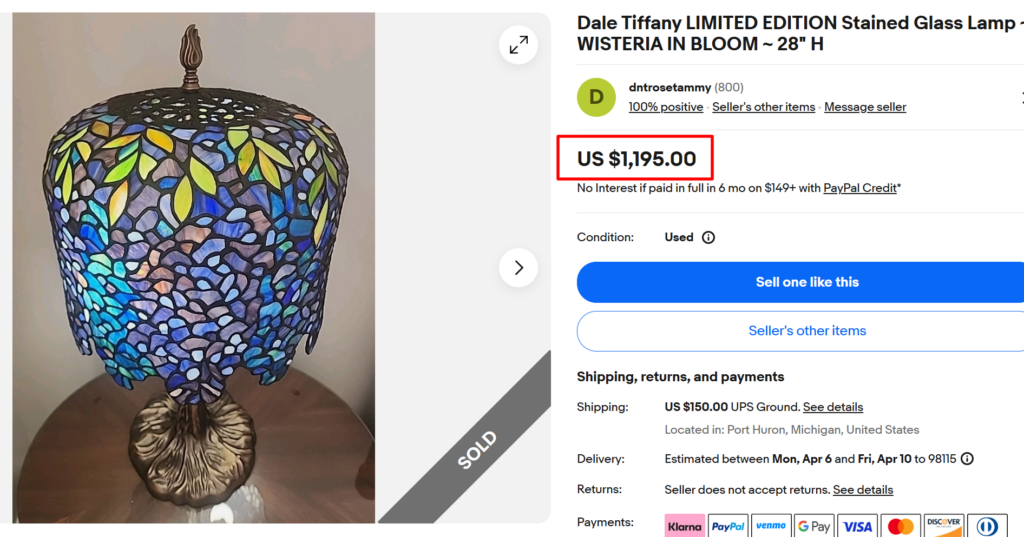
| Average Value | $400 – $1,500 |
| Brand & Type | Dale Tiffany Stained Glass Lamp |
| Production Period | c. 1986–present |
| Key Features | Hand-cut art glass, limited edition |
| Collectibility | Moderate |
| Collector Notes | Check the raised “Dale” mark & tag for attribution. |
Dale Tiffany is a modern manufacturer (not to be confused with the historic Tiffany Studios) that reproduces iconic Tiffany-style stained glass lamps using hand-rolled art glass.
This limited edition Wisteria lamp is inspired by Tiffany’s original 1901 design and features thousands of hand-cut glass pieces in shades of blue, lavender, and green, cascading from a “tree-trunk” bronze base.
While Dale Tiffany produces modern reproductions, their “Limited Edition” series remains collectible as accessible Tiffany-style lamps. Some rare pieces can go well over $1,500.
9. Fenton – Gone with the Wind Hurricane Lamp
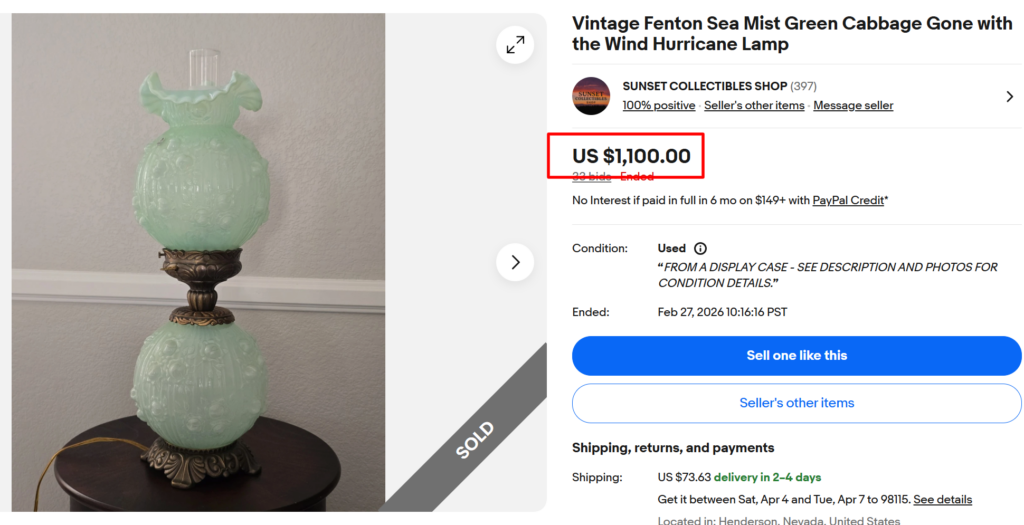
| Average Value | $400 – $1,200 |
| Brand & Type | Fenton GWTW Hurricane Lamp |
| Production Period | c. 1950s–2000s |
| Key Features | Double globe, hobnail texture, art glass |
| Collectibility | Moderate to High |
| Collector Notes | Added Fenton paper label is a plus. |
A Gone with the Wind lamp is known for its large, dual-globe glass design. This example is a Fenton GWTW lamp featuring the company’s iconic “Cabbage Rose” (or floral relief pattern) design and a delicate Sea Mist Green satin finish.
Unlike leaded glass, these lamps use molded milk glass or frosted glass to create a soft, romantic glow.
The Sea Mist Green design with hobnail texture is one of the more sought-after Fenton color-and-pattern combinations. Common Fenton GWTW patterns in white or pink usually go for $150–$400.
10. Lightolier Gerald Thurston Tripod Lamp
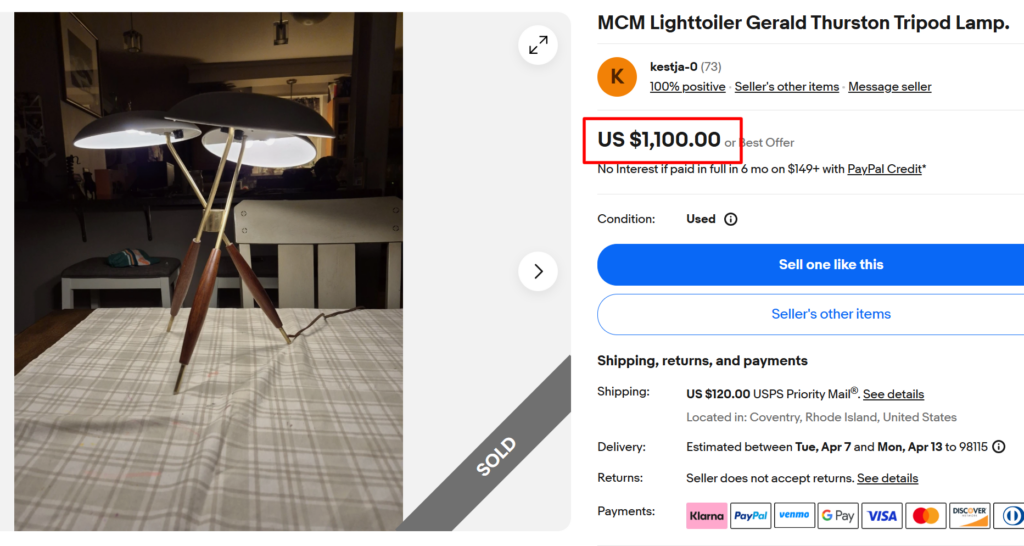
| Average Value | $750 – $2,500 |
| Brand & Type | Lightolier Thurston Tripod Lamp |
| Production Period | c. 1950–1965 |
| Key Features | Brass/walnut tripod, perforated diffuser |
| Collectibility | High (Mid-Century Modern) |
| Collector Notes | Look for the “Lightolier” stamp inside the lamp shade. |
Gerald Thurston, their lead designer of Lightolier, designed this mid-century modern lamp. It features a distinctive three-headed “mushroom” design with walnut accents and an adjustable brass tripod base.
With its simple design, this lamp represents the transition from heavy lighting pieces to sleek, minimalist lighting in the 1950s. Pieces with original wiring and paint are most desirable.
11. Pairpoint – Reverse Painted Puffy Glass Lamp
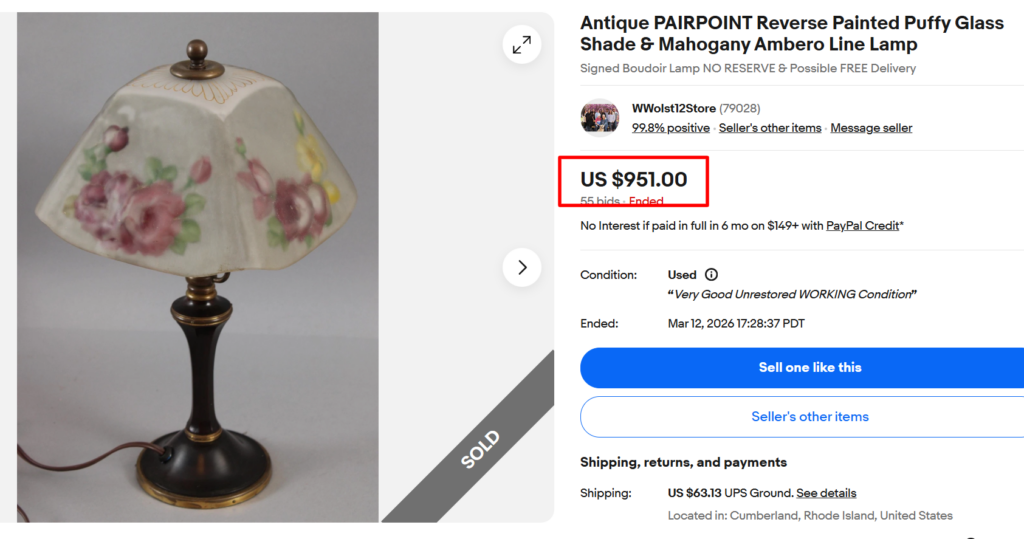
| Average Value | $950 – $7,500 |
| Brand & Type | Pairpoint Puffy Table Lamp |
| Production Period | c. 1907–1929 |
| Key Features | Mold-blown glass, reverse-painted interior |
| Collectibility | Very High |
| Collector Notes | Check for “Pairpoint” on the base rim. |
Pairpoint’s ‘Puffy’ shades are mold-blown glass with raised decoration on the outside. They are then frosted with acid and hand-painted on the inside and kiln-fired to seal the paint. This method was patented on July 9, 1907.
This particular boudoir lamp has a mahogany finish base and a rose-patterned shade. Floral motifs such as ‘Devonshire’ and ‘Marlborough’ are the most collectible.
Authentic pieces carry an engraved “Pairpoint” mark, along with the model number, on the metal base.
12. Bradley and Hubbard – Slag Glass Panel Lamp
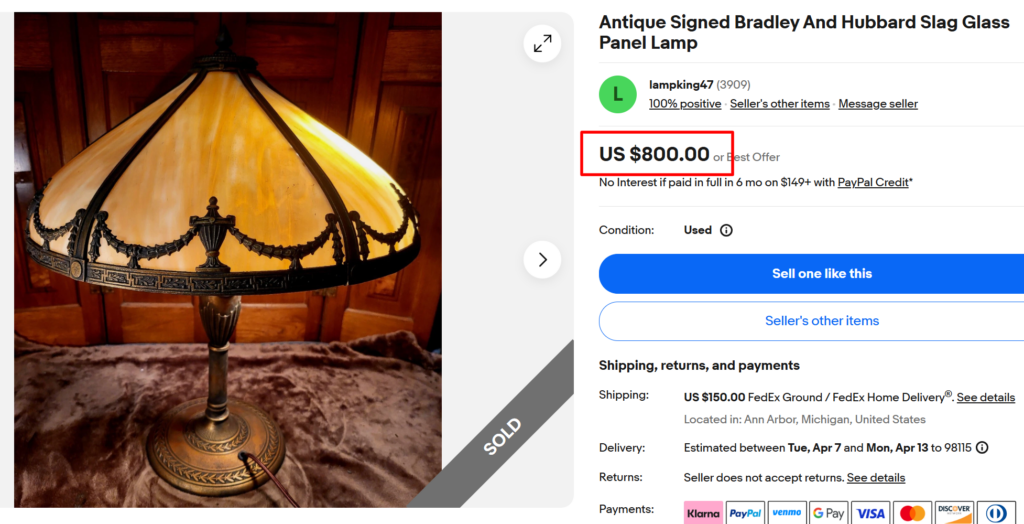
| Average Value | $650 – $1,200 |
| Brand & Type | Bradley & Hubbard Slag Panel Lamp |
| Production Period | c. 1900–1940s |
| Key Features | Caramel slag glass, ornate cast frame |
| Collectibility | Moderate to High |
| Collector Notes | B&H triangle mark on socket cluster confirms authenticity |
The Bradley & Hubbard company was famous for its high-quality, ornate “slag glass” lamps, produced through 1940. This example features curved caramel or green glass panels held in place by an intricate cast-metal filigree frame.
The heavy base often displays a “verdigris” or bronze-toned finish, commonly seen on Arts and Crafts-era pieces. The socket cluster on authentic pieces bears the “Bradley & Hubbard” or “B&H” mark. And signed pieces are usually more desirable.
Things to Check in Old Lamps: Value Factors
Identifying a vintage lamp’s worth needs a lot of attention. Even a small stamp or the weight of the metal can mean the difference between a $50 lamp and a museum-quality $5,000 piece.
Materials (Shades & Bases)
The quality of the materials used is the first indicator of the value of the vintage lamp.
Good quality antique high-end lamps almost invariably use heavy, solid bronze or brass in the frames or bases rather than cheap pot metal. Spelter, a cheaper zinc alloy, tends to be lighter and less detailed, and may also display silvery or powdery corrosion rather than the even black patina of real bronze.
As for the glass shades, slag glass was used extensively from the 1880s to the 1930s in the panel lamps of Bradley & Hubbard, Handel, and Miller.
Leaded glass lamps (individually cut pieces soldered with lead) were more labor-intensive pieces and command higher prices today, especially from brands like Tiffany Studios.
Handmade vs. Mass-Produced
The difference is significant because handmade or assembled lamps are more valuable than those made later in mass quantities.
For instance, authentic Tiffany and Pairpoint Puffy shades were assembled by hand, with each glass piece individually cut, soldered, or painted. This is why these lamps often command premium prices.
For slag glass lamps, check whether the individual panels vary slightly. In all genuine period pieces, there are no two panels exactly alike in terms of color swirling.
Also, genuine antique glass has slight irregularities: bubbles, varying thickness, uneven color, and hand-soldered lines. Machine-pressed glass, on the other hand, looks perfectly uniform. So, if an alleged early-20th-century antique lamp looks too uniform, it’s a red flag.
Designer or Brand Recognition
Maker’s mark is a crucial value factor. A signed lamp from a known maker is always worth more than an unsigned one, even if they look nearly identical. For instance, “Tiffany Studios New York” stamped on both the shade and base can make the difference between a lamp worth $500 and one worth $5,000.
Some of the most collectible makers and brands of vintage lamps are:
- Tiffany Studios
- Louis Comfort Tiffany
- Handel Company
- Pairpoint
- Bradley & Hubbard
- Aladdin Industries
- Stiffel
- Lightolier
Always check the base of a lamp, the fittings, and the shade rims to spot the maker’s mark. Later pieces often carry a paper label, like the Fenton GWTW and the Lightolier lamps.
That said, marks can be forged, too. On metal shade rims, stamps should be slightly impressed into the metal, not applied as a sticker or painted on. On bronze bases, the stamp should be part of the original casting. Pay attention!
Historical or Stylistic Significance
Lamps tied to a specific design movement, such as Art Nouveau, Arts & Crafts, Art Deco, Mid-Century Modern, generally hold value better than generic decorative pieces.
The Raoul Larche Loïe Fuller lamp, for example, was exhibited at the 1900 Paris Exposition Universelle. That documented history makes it a museum-quality object, not just a lamp.
Provenance is another crucial value factor. Knowing who owned a piece and where it came from adds value, particularly for high-end examples where marks alone can’t confirm authenticity.
So, apart from spotting the marks, try to dig into the history of an old lamp before buying or selling.
Condition and Originality
Any serious damage is a value killer for any vintage lamp, especially in the shade. For leaded glass shades, even minor cracks and chips on the edges can significantly reduce the price. Full cracks or missing painted sections are far worse.
Also, collectors usually prefer “honest” wear over bad restorations. The original patina (the aged finish on metal) should never be polished away, as this destroys the value.
As for the base and frame, originality is more desirable. While safety might require new wiring, collectors love pieces with original sockets, switches, and finials.
Note: This article is intended for informational, educational, and entertainment purposes only. Some images are illustrative and may not represent actual brands, products, or related entities. All trademarks, product names, brand logos, packaging, and other intellectual property referenced remain the exclusive property of their respective owners. Any brand mentions or references are provided solely for descriptive and educational context and do not imply any formal or commercial association.