Antiques Know How Research
Vintage Quilts Value
Our Antiques Know How team’s in‑depth analysis of eBay sales and auction results shows that vintage quilts usually sell for under $50 at yard sales but can reach $500–$10,000+ for early‑made, hand‑stitched, and rare designs. The most collectible quilts are Broderie Perse chintz, Rose appliqué, Amish Ocean Waves, 28‑point Mariner’s Compass, Double Wedding Ring, Grandmother’s Flower Garden, Log Cabin, Carpenter’s Square, Feathered Star, and branded hotel pieces like the Asprey‑made Beverly Hills Hotel quilt. The value depends on age, quilting technique, fabrics, design complexity, provenance, and condition.
Antiques Know How
Vintage quilts are usually either packed away in attics or old and sold at yard sales for $20 or less. The reason is that many people don’t know the true worth of old quilts. The truth is that certain patterns, fabrics, and construction methods push the value up to some into the $500 to $10,000+ range.
The difference between a cheap quilt and a valuable one usually comes down to a handful of factors. In this guide, I’ll tell you what to look for on your old quilts to see if it’s worth the money and reveal some highly collectible designs and pieces.
What Makes an Old Quilt Valuable?
The value of antique and vintage quilts can range widely from a few hundred dollars to tens of thousands of dollars today. To find out whether your old quilt is worth the money, there are several factors you must assess:
Age & Provenance
For vintage texture, age matters a lot for value. Quilts made before 1940 are generally more collectible and valuable. Pre-Civil War quilts (before 1865) command the highest prices, especially in decent condition.
You can estimate age by looking at the fabrics.Certain designs and dye formulas were available in certain eras. Turkey red material, for instance, is usually from the mid-1800s.
However, it isn’t just about the age but also about its provenance. An old quilt with documented history is generally worth more. Signed quilts, dated quilts, or quilts with a known maker add value because they can be placed in a specific time and place. Even a simple inked name and date on the backing can boost value.
Handmade vs. Machine-Made
Handmade quilts have greater value most of the time. Examine the stitching very closely. Hand-stitching has minute differences in stitch lengths, while machine stitching is uniformly consistent throughout the material.
Also, check the seams on the quilt top. Hand-joined seams look slightly uneven compared to the straight, locked stitches of a sewing machine.
Fabric & Materials
The type of quilt fabric will tell you about both age and quality. For example, early American quilts used homespun linen and cotton. By the mid-1800s, printed calico was common.
Old quilts often used raw cotton or wool batting. If the filling feels flat and thin, that’s typical of antique construction. Synthetic fabrics like polyester batting are puffier and usually indicate a modern piece with lower antique value.
So, before valuing an old quilt, check the fabric. If unsure, take expert help to identify the fabric type, as it’s a major value factor.
Design Complexity
The more complex the design, the more valuable the quilt is. Basic designs such as those found in nine-patch or four-patch quilts are relatively simple to make and thus relatively inexpensive.
On the other hand, complex patterns with many small pieces, curved seams, or fine appliqué work take more skill, which drives up value.
Some of these patterns include Feathered Star, Mariner’s Compass, and Broderie Perse. These are all complex patterns that needed special skills that not all quilt makers possessed. The scarcity of such skills made these patterns rare and highly sought after.
Condition
Condition is crucial for the value of old quilts. A well-preserved example with no stains, tears, or fabric loss is worth far more than the same pattern in rough shape.
The damage signs that kill the most value are:
- Water staining
- Heavy fading
- Tears on the edges
- Large holes
- Missing sections
Also, while small, stable repairs from the same era don’t hurt the value much, major repairs or extended stitches are usually not acceptable.
10 Rare Antique & Vintage Quilts Worth Finding Today
Let’s explore some of the most collectible antique and vintage quilts and designs that have recently sold for thousands of dollars, and understand what makes them valuable.
1. Broderie Perse Chintz Quilt
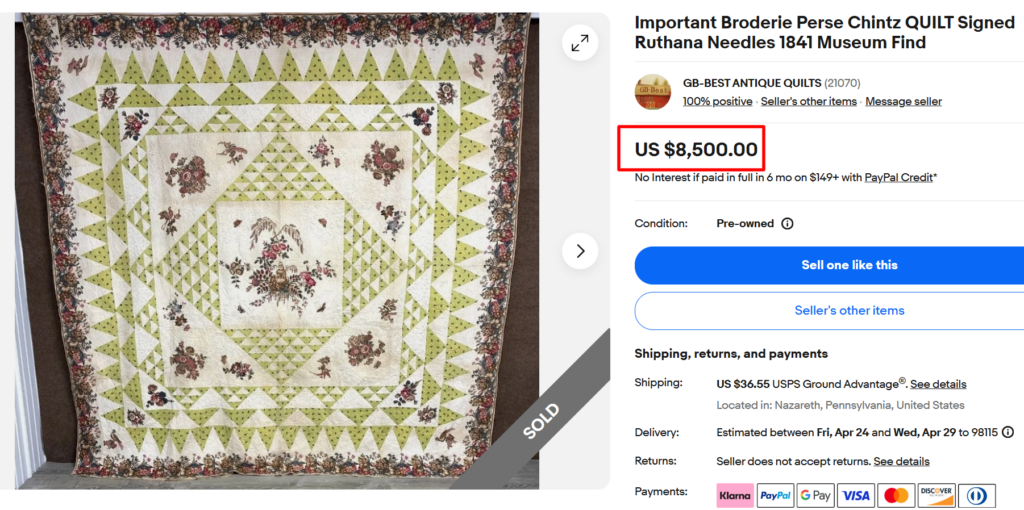
| Average Value | $2,000 – $10,000+ |
| Time Period | Late 1700s – 1850s |
| Key Features | Cut-out chintz motifs appliquéd onto plain ground |
| Collector’s Note | Signed/documented pieces are worth the most. |
Broderie Perse means “Persian embroidery” in French. These quilts showcase a rare 19th-century technique that involves cutting motifs from printed chintz fabric and appliquéing them onto a solid background. It was a high-status craft, which means antique pieces are extremely valuable.
Chintz was expensive and not easily available, so quilt makers made the most of a yard by removing flowers and birds one by one. They include medallions in the middle and floral sprays in other parts.
Due to their fragility and the meticulous work involved, they are considered museum-quality specimens in today’s time.
2. Rose Appliqué Quilts
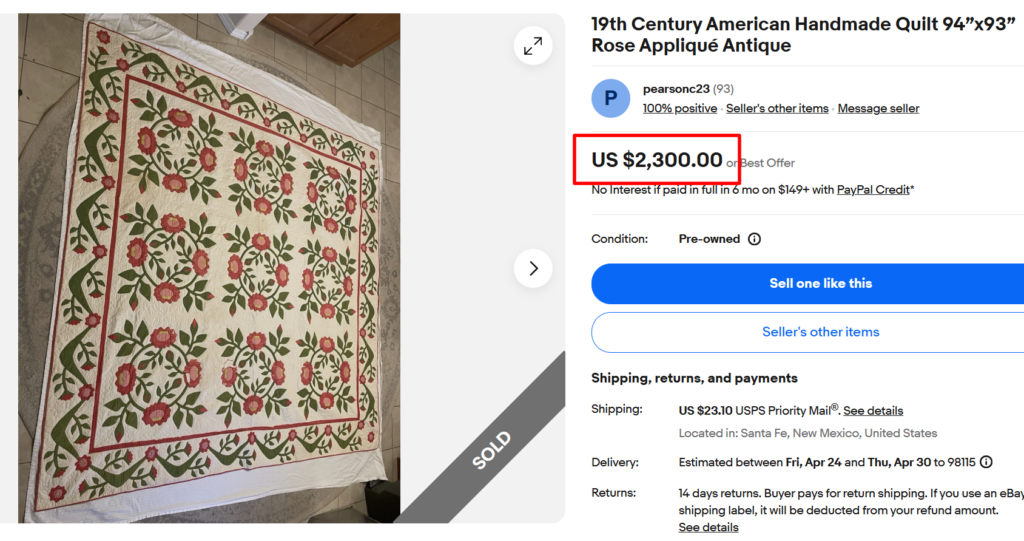
| Average Value | $800 – $3,000 |
| Time Period | 1840s – 1880s |
| Manufacturer | Individually Handmade |
| Key Features | Hand-appliquéd roses & leaves |
| Collector’s Note | Rose Appliqué on “turkey red” fabric is desirable. |
Appliqué is a needlework technique in which smaller fabrics (shapes) are stitched onto a base fabric to create designs.
Rose applique quilts were extremely popular during the 19th century in America and were mostly used for best weddings or other celebrations. These quilts had roses and foliage applied by hand on white or off-white fabric.
The red, green, and white background is highly desirable for its visual contrast. These antique quilts with tight, even appliqué stitches and well-preserved original colors can sell for over $2,000.
3. Amish Ocean Waves Quilts
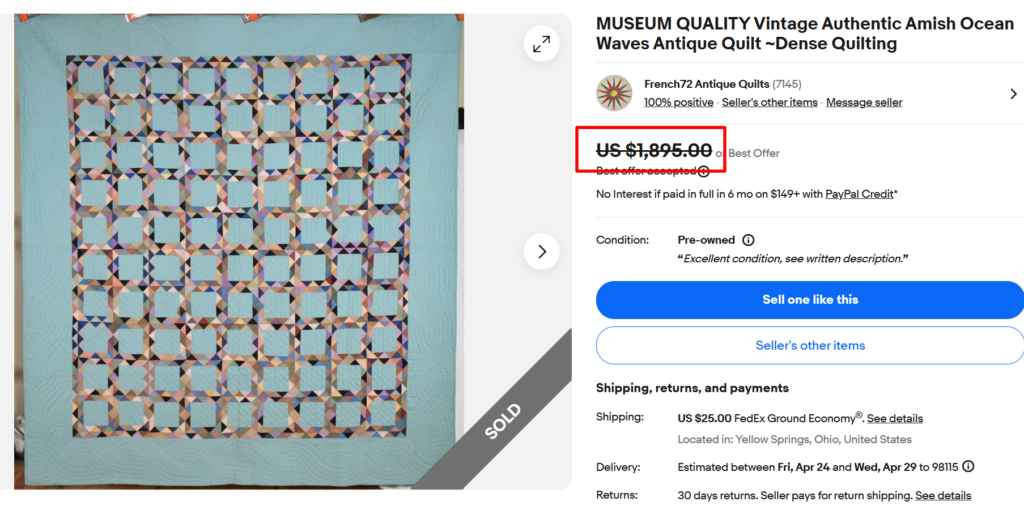
| Average Value | $1,000 – $3,000 |
| Time Period | 1880s – 1940s |
| Key Features | Hundreds of small triangles, dense hand quilting, solid-color fabrics |
| Collector’s Note | Documented Amish provenance adds value. |
The Ocean Waves quilt uses hundreds of small half-square triangles arranged to create a rhythmic, wave-like effect across the quilt. Amish versions are particularly valued for their dense hand quilting, sometimes 12+ stitches per inch.
The Amish only used solid colors of fabric for creating waves because there are no prints. Their use of dark background colors with jewel-toned triangles is unique to the Amish craft.
These antique quilts with documented Amish provenance can be worth a lot today. So, check for signatures on the fabric.
4. 28-Point Mariner’s Compass Quilt
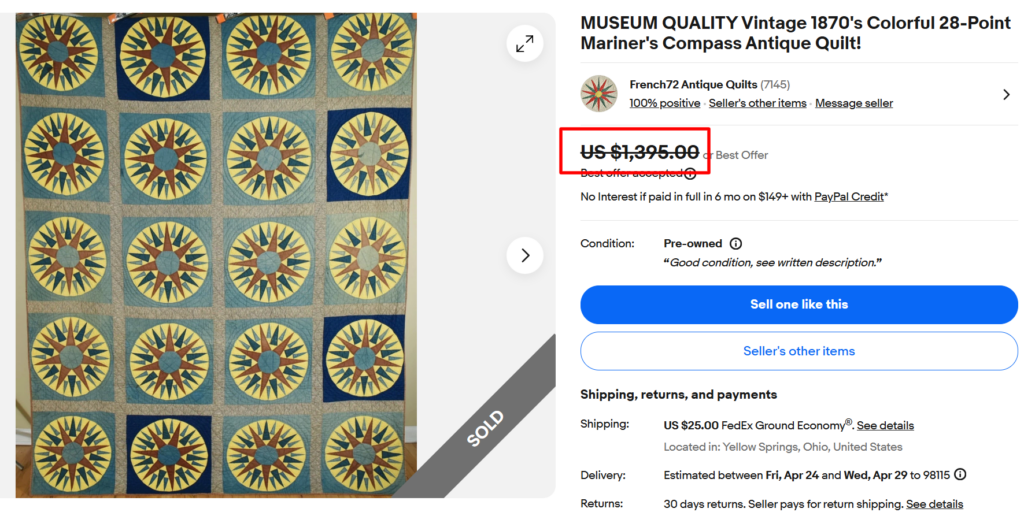
| Average Value | $800 – $2,500 |
| Time Period | 1830s – 1890s (most common in 1860s–1880s) |
| Key Features | 28 narrow radiating points per block, circular design |
| Collector’s Note | Even slight misalignment can impact value. |
The Mariner’s Compass is among the most difficult patterns for quilt-making due to its intricate lines and points. The 28-pointed star pattern is extremely rare. Its distinguishing feature is the narrow lines radiating from the center point of a circle, with all lines perfectly cut and lined up.
This pattern dates to the early 1800s but peaked in popularity during the 1860s–1880s. And these pieces were often “show” quilts, made to display a quilter’s highest skill level.
Multicolor versions with strong contrast are most collectible today. Besides, the more points the “compass” has, the more valuable the quilt.
5. Double Wedding Ring Quilts
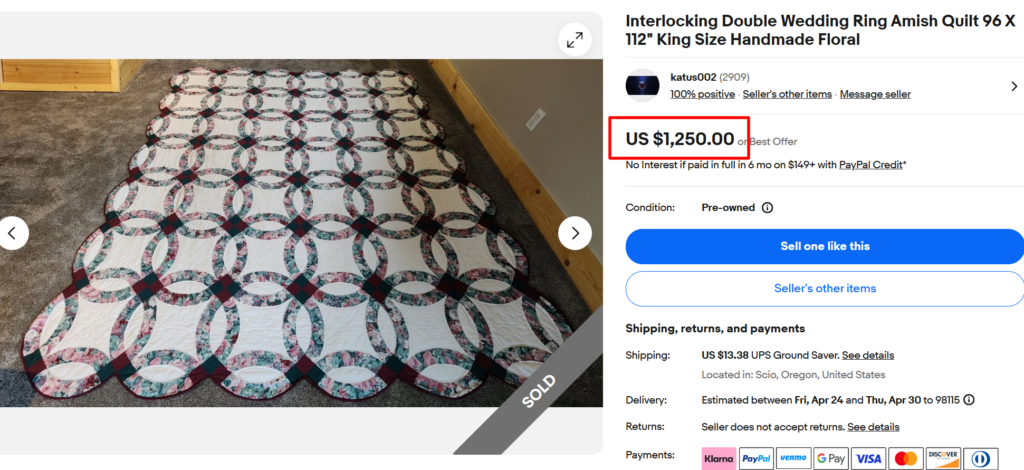
| Average Value | $400 – $1,500 |
| Time Period | 1920s – present (peak in 1930s–1940s) |
| Key Features | Interlocking curved rings, often in scrap fabrics, curved piecing |
| Collector’s Note | Handmade dense-quilted Amish pieces are worth the most. |
The Double Wedding Ring uses curved pieces that interlock to form overlapping rings across the entire quilt. The overlapping rings were a symbol of love and union, which is why this design became widely popular in the 1930s as a marriage gift.
Also, curved piecing is one of the most difficult patterns to sew by hand. So, well-executed examples show real skill and hold the maximum value. Amish-made versions with solid fabrics and dense hand quilting are especially collectible.
6. Grandmother’s Flower Garden Quilts
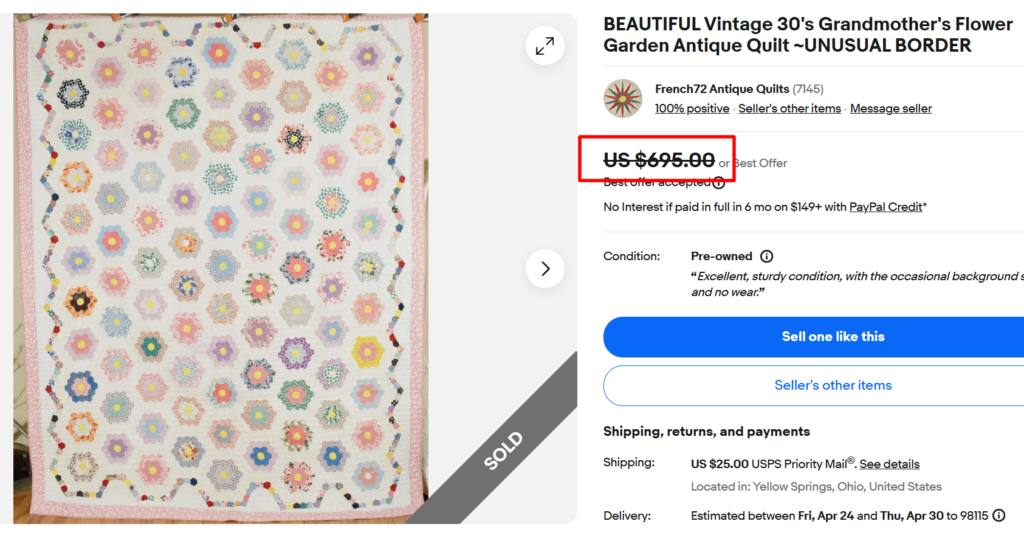
| Average Value | $400 – $1,200 |
| Time Period | 1920s – 1940s (peak in 1930s) |
| Key Features | Small hexagon rosettes, 1930s pastel print fabrics, English paper-pieced |
| Collector’s Note | Unusual borders & non-standard colors add value |
Grandmother’s Flower Garden is one of the “big three” Depression-era quilt patterns, alongside the Double Wedding Ring and Dresden Plate. It features hundreds of tiny hexagonal pieces hand-pieced (using English paper piecing) in rosette clusters, using up tiny fabric scraps.
While this design is quite common, quilts with unusual borders or exceptional color arrangements are especially collectible. Similarly, examples with 1930s pastel fabrics and small-scale prints also fetch premiums.
7. Log Cabin Quilts (Patchwork)
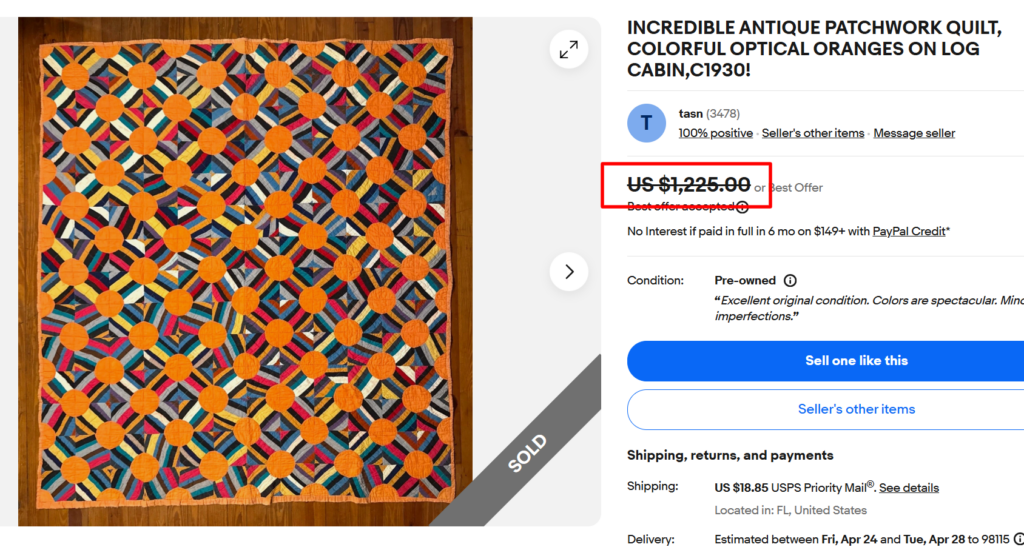
| Average Value | $500 – $1,800 |
| Time Period | 1860s – 1940s |
| Key Features | Strips arranged around the square, light-to-dark shading |
| Collector’s Note | A red center square (symbolizing the hearth) is traditional and adds appeal |
Log Cabin quilts use individual blocks constructed of strips of fabric arranged around a center square with variations from light to dark strips. The position of the light and dark stripes results in a three-dimensional pattern.
This design dates to at least the 1860s and stayed popular through the early 1900s. This 1930s version uses bold, eclectic fabrics to create a kaleidoscopic look.
Although the Log Cabin is among the most famous American quilt patterns, the “Optical,” “Pineapple,” and “Barn Raising” variations are more valuable.
8. Carpenter’s Square Quilts
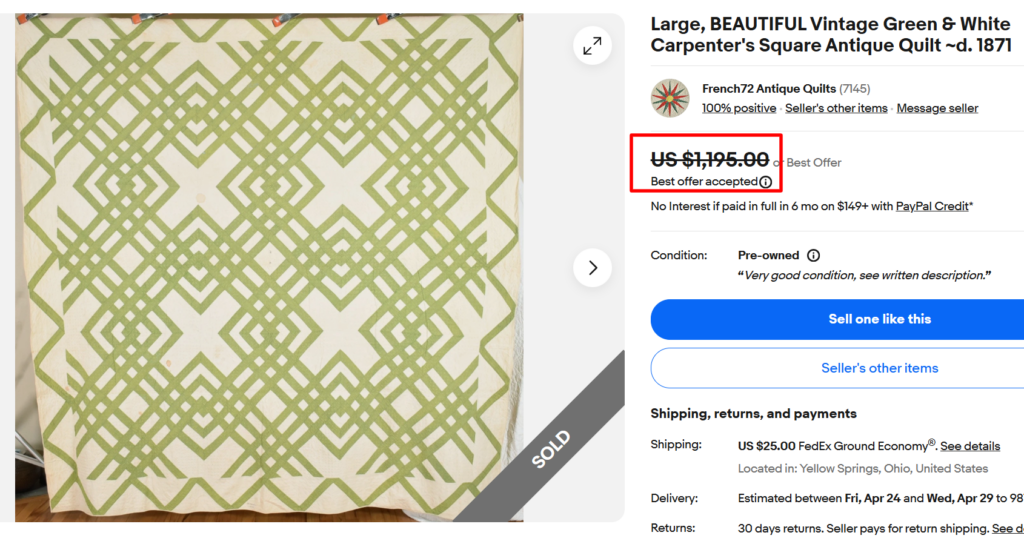
| Average Value | $600 – $1,500 |
| Time Period | 1860s – 1890s |
| Key Features | Interlocking diagonal bars forming square frames, bold two-color contrast |
| Collector’s Note | Pristine white base is rare and valuable. |
The Carpenter’s Square design creates a bold geometric design using interlocking diagonal lines and right angles. The name comes from its interlocking lines that resemble a tool used by builders.
It became popular during the 1860s–1870s and required careful cutting for the angles to align correctly. The color combination is a major value factor for these quilts, apart from condition. Two-color versions are the most collectible, especially green and white or red and white.
9. Feathered Star Quilts
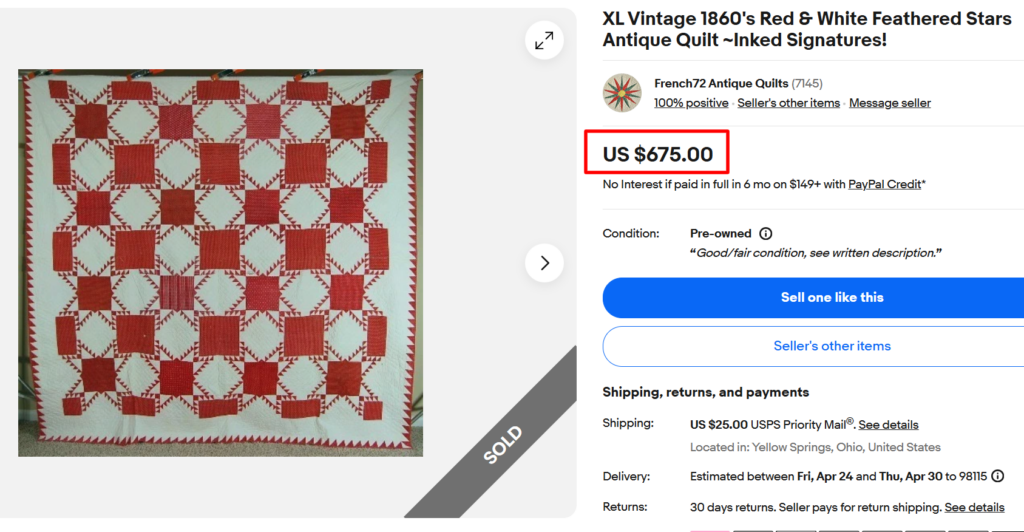
| Average Value | $500 – $1,500 |
| Time Period | 1830s – 1880s (peak popularity) |
| Key Features | Tiny sawtooth triangles around each star point, often paper-pieced |
| Collector’s Note | Inked signatures or dates on the blocks add value. |
The Feathered Star dates to the 1830s and is one of America’s earliest named quilt patterns. The design features a block-style appearance, where each block has dozens of tiny triangles surrounding the star points.
The placement of triangles needed serious precision, which makes this design labor-intensive. Many 19th-century quilters paper-pieced these using newspaper scraps.
Today, red and white versions from the 1850s–1860s are especially popular with collectors. In good conditions, these can fetch up to $1,500 or more.
10. Asprey Beverly Hills Hotel Quilt
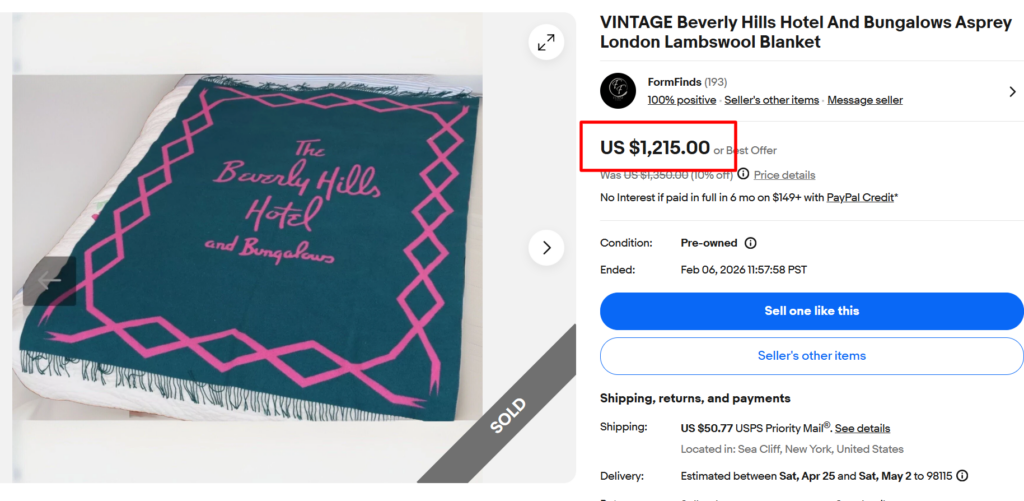
| Average Value | $800 – $4,000 |
| Time Period | 2000s |
| Brand | Asprey London / Beverly Hills Hotel |
| Key Features | 100% lambswool, made in Scotland, hotel branding with geometric border |
| Collector’s Note | Check for the Asprey label. |
This isn’t a traditional quilt, but it’s a collectible textile. It was produced by the famous London jeweler Asprey from 100% lambswood for the iconic Beverly Hills Hotel.
Most available examples date from the early 2000s. Its value comes from the “brand” association and its status as a piece of Hollywood history; pristine examples can fetch up to $4,000 at auction.
To ensure authenticity, check for “Asprey London” and “100% Lambswood / Made in Scotland” fabric labels on a corner of the underside.
Note: This article is intended for informational, educational, and entertainment purposes only. Some images are illustrative and may not represent actual brands, products, or related entities. All trademarks, product names, brand logos, packaging, and other intellectual property referenced remain the exclusive property of their respective owners. Any brand mentions or references are provided solely for descriptive and educational context and do not imply any formal or commercial association.