That bangle in vibrant colors hiding in your grandma’s jewelry box may be worth a lot more than you imagine. Collectible Art Deco-era Bakelite jewelry (about 1920s-1940s) belongs to the most popular categories in vintage costume jewelry.
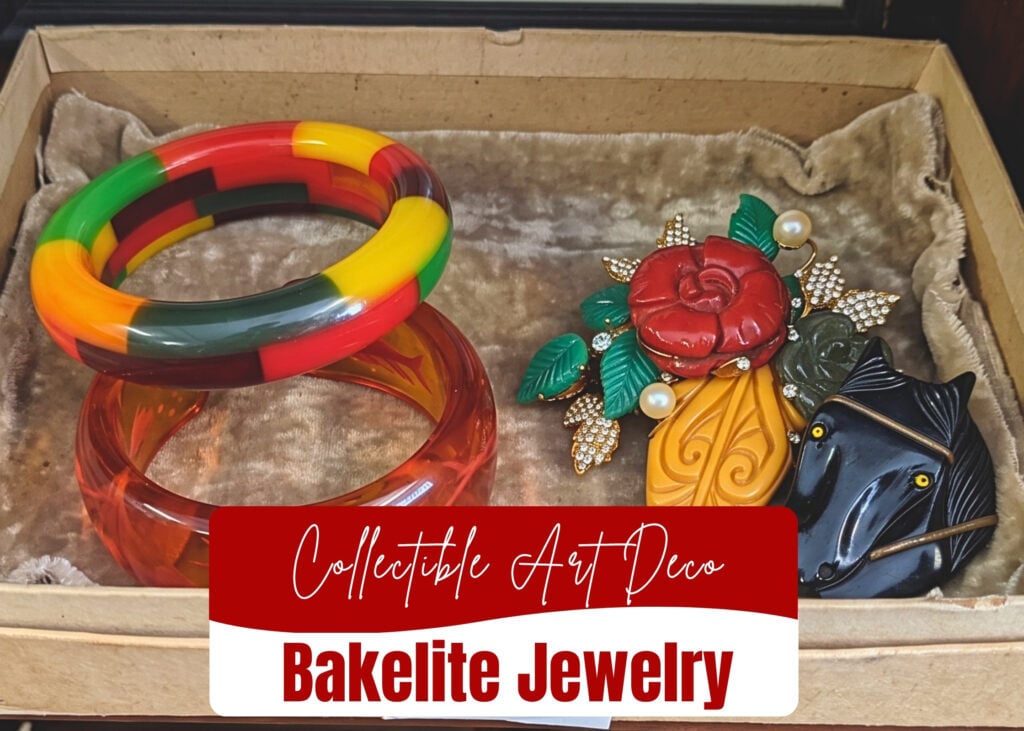
If you want to know whether your old Bakelite jewelry is worth money, this guide will help you. Find out how to identify genuine Art Deco Bakelite jewelry, what determines its value, and which designs collectors hunt today at estate sales.
What Bakelite Is and Why Art Deco Pieces Matter
Bakelite is the world’s first artificial thermosetting plastic. Belgian chemist Leo Baekeland invented it in 1907 and also received a U.S. patent for it in 1909.
Originally, Bakelite was designed as an industrially useful material due to its thermal resistance and durability. But in the 1920s, people found out that this material could be carved, polished, and shaped to make affordable costume jewelry. And Art Deco was the time when Bakelite got its heyday.
Its hallmark features were geometric shapes, contrasts, hand-carved decorations, as well as designers Coco Chanel and Elsa Schiaparelli.
In 1927, the Catalin Corporation created 15 new colors of phenol formaldehyde resins. In fact, almost all “Bakelite jewelry” that exists now is actually Catalin – a more colorful version of this material.
Production of these items stopped during the Second World War and came to a complete halt in the early 1950s due to cheaper injection-molded plastics. This is one of the reasons why vintage Bakelite jewelry can be so expensive.
How to Identify Genuine Art Deco Bakelite?
It can be difficult to tell real Bakelite apart from Lucite, celluloid, or plastic reproductions just by looking at the piece. However, there are some easy methods that can give you a definite answer without damaging the piece.
The Hot Water Method
Dip the object in hot tap water for around 30 seconds, and then smell it right away. Real Bakelite will emit a very distinctive chemical smell coming from the formaldehyde in its phenolic resin.
How to differentiate? Well, Celluloid emits a camphor smell, while modern plastics have no smell at all.
The Friction Method
If you do not have access to hot water, then rub a smooth part of the piece against your thumb vigorously until it heats up a little. The same idea and smell. It is best to use the inner sides of the pieces.
The Simichrome Polish Test
Pour a little bit of Simichrome polish, a type of polish for metal available at most hardware stores, on a cotton swab and apply it to an unnoticeable (interior) area. If the swab turns yellow or yellow-brown, it’s Bakelite. This is the best test to perform.
Exception: Black Bakelite will not show a yellow color change since the carbon black color will mask the oxidation. For this, use the hot water test.
The Sound Test
Gently tap two Bakelite items against each other, and you will hear a deep and dull sound. Lucite and acrylic items sound higher-pitched and make a clicking noise.
While this test is quick and easy, it cannot be performed if there is only one item; it is useful when shopping at flea markets where bangles are collected in boxes.
How to Spot a Fake?
Fake resin pieces made to resemble vintage Bakelite have been around for some time now. In most cases, they are a bit lighter in weight, and the carving (which is usually molding) looks too perfect compared to original hand-carved items.
Also, when you run a finger over a genuine Bakelite piece, there will usually be slight imperfections from the hand-finished nature of the piece.
Easy Tip: Whenever you see a Bakelite item priced below $50 in an online store, test it before believing what is stated.
Art Deco Bakelite Jewelry Designs That Bring the Most Money
1
Deeply Carved Bangles and Cuffs
$75 to $400; complex multi-layer $400 to $800+
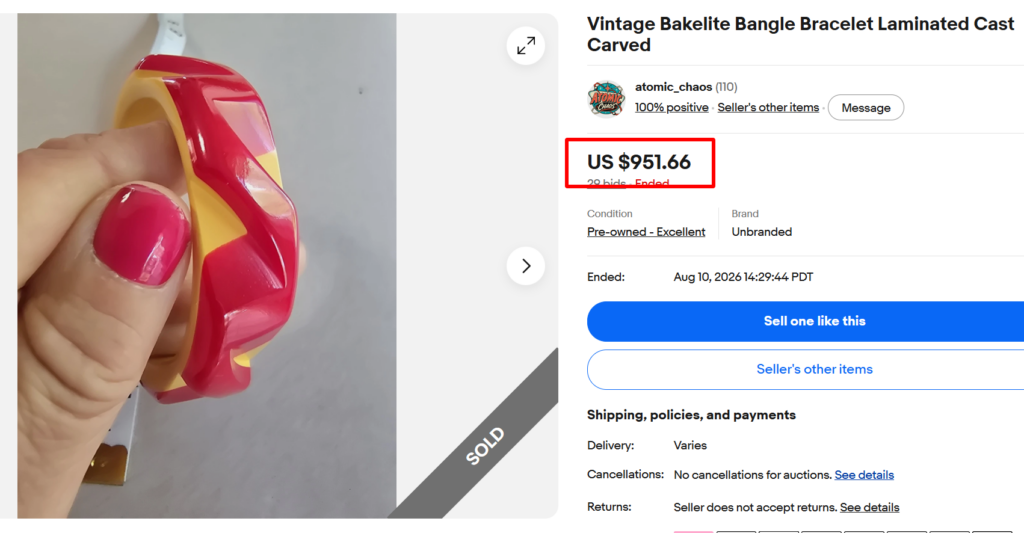
Bangles and cuffs with deep carvings are definitely the must-have items in any Bakelite jewelry collection. The value of these pieces depends on the carving; the more complex the carvings on the bangles, the more the value of the piece.
Cuff bracelets featuring floral or geometric Art Deco patterns can easily cost anywhere between $200-$500 on eBay, and some even go above $800.
2
Multi-Color Laminated Pieces
$150 to $600; complex layering $800 to $1,800+
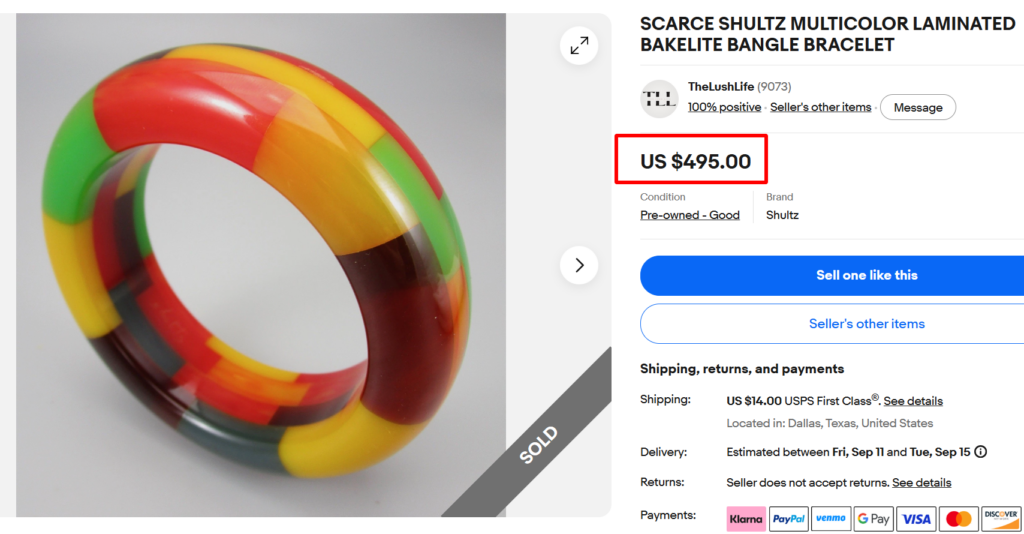
Some examples of Art Deco Bakelite jewelry were made using various colored layers of the plastic, often carving through them to expose the other layers underneath.
Some pieces are made by connecting different colored segments, like this example. The pieces that feature the striped or stacked colors are always worth more than single-colored ones.
3
Figural Brooches and Pins
$100 to $500; rare, articulated items $1,500 to $2,500
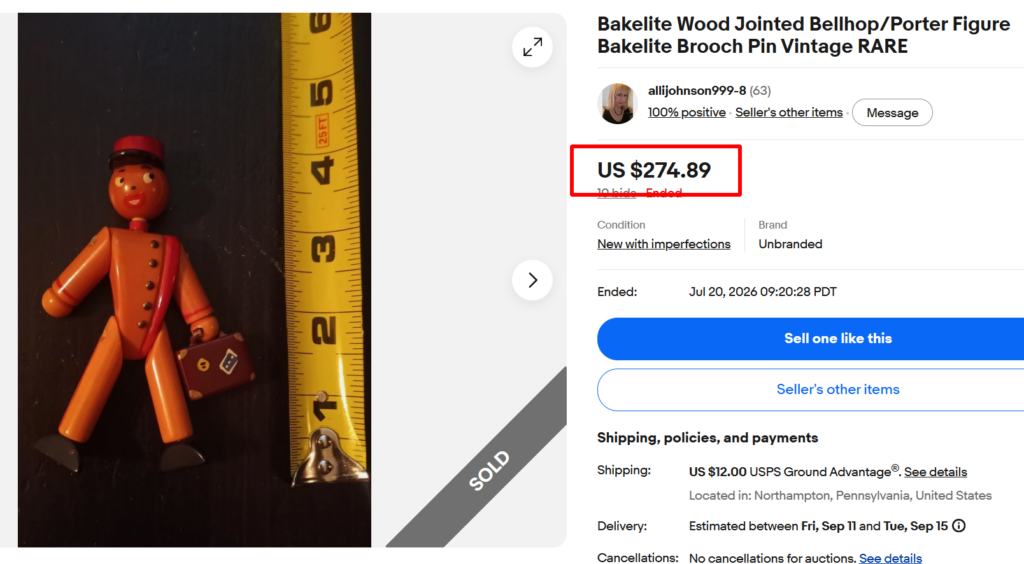
Brooches in animal shapes, human figures, fruit clusters, and whimsical designs are highly sought after. For example, a carved Scotty dog clamper bracelet or a figural horse brooch from the 1930s can sell for several hundred dollars.
Rare figural pieces like carousel horse necklaces and articulated Uncle Sam brooches have been listed at $1,500 to $2,500.
4
Reverse-Carved Pieces
$100 to $800; museum-quality, signed pieces $800 to $1,500+.
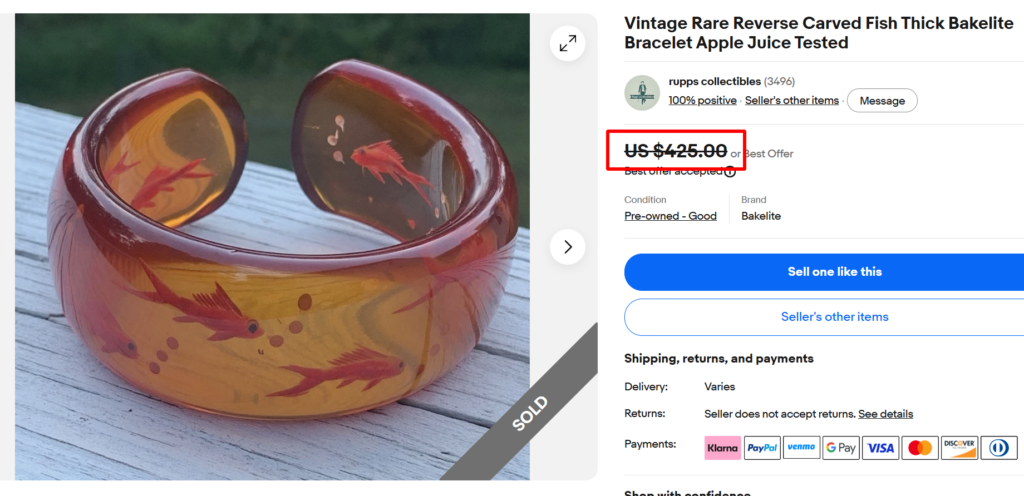
Reverse carving involves carving a design into the back of transparent or translucent Bakelite, and then painting it. The result is an image that appears to float inside the material.
These pieces required significant skill to produce and are among the rarest Art Deco Bakelite designs you’ll find. Expect to pay a premium whenever one surfaces.
5
Openwork / Pierced Bakelite Pieces
$95 to $400; detailed piercing $400 to $700
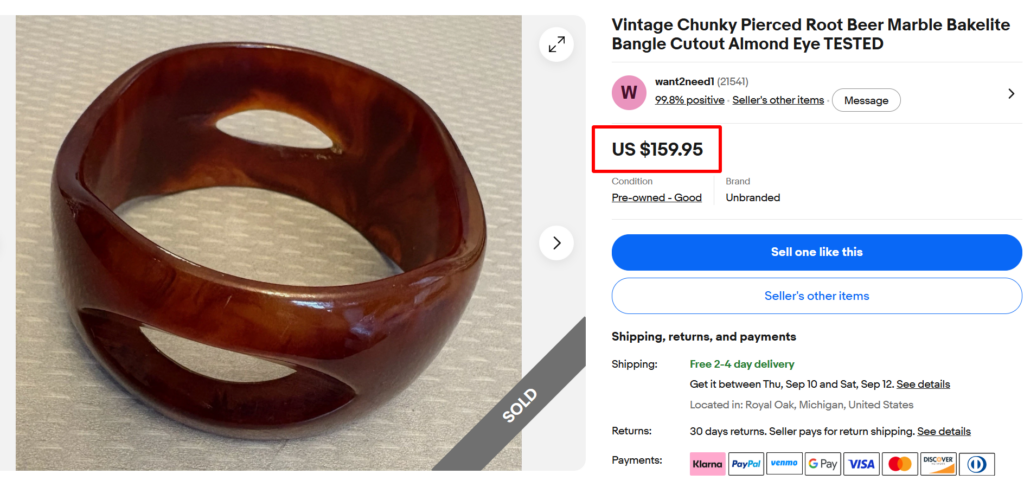
These pieces have small sections of material cut away to create see-through patterns, almost like lace or lattice work in plastic. The technique required careful hand-carving because Bakelite is brittle and cracks easily if pushed too hard. That’s why pierced bangles are rare.
6
Bakelite Dangle Pieces
$50 to $300; complex multi-element dangles $800 to $1,500+
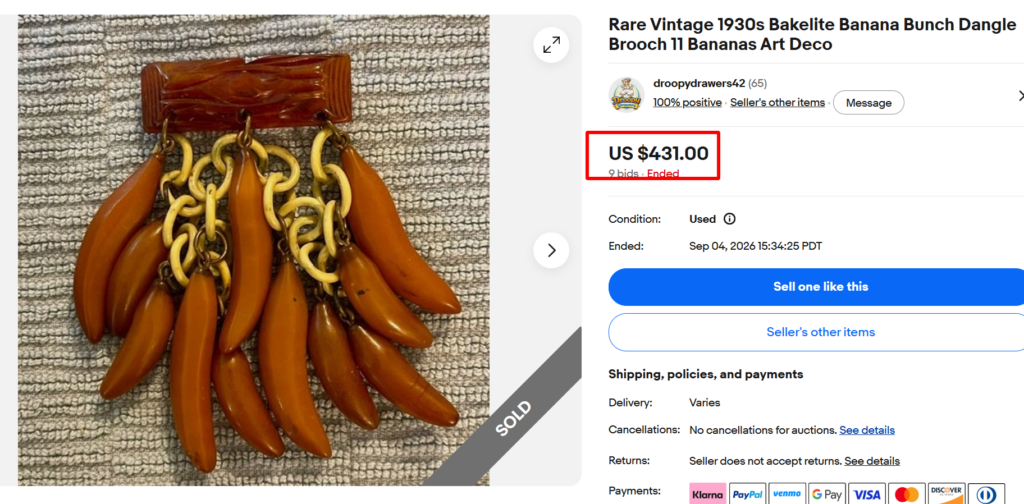
The Dangle brooch and pins have a bar pin design on top and carved Bakelite designs attached to chains or links below. Classic Dangle designs include fruits like cherries and bananas, horseshoes, hearts, and baby shoes. Their playful nature was their appeal in the 1930s and 1940s.
7
Butterscotch Bakelite Bangles
$150 to $600; unusual colors, signed makers $800 to $1,500+
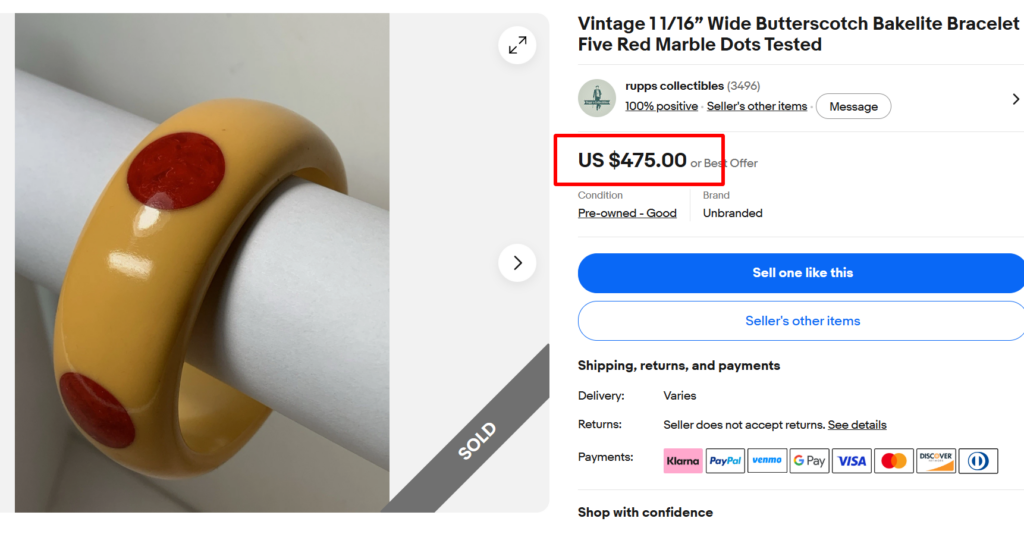
Polka dot Bakelite is known for contrasting color dots that have been embedded in the surface of the bangle itself. These dots were created by drilling holes and filling them in with contrasting Bakelite by hand.
One of the most famous designs among all of Bakelite collectibles is that of butterscotch bangles with jet-black or red polka dots.
How Much Is Your Art Deco Bakelite Jewelry Worth?
Vintage Art Deco Bakelite jewelry that’s not carved usually sells for $20 to $60 today. This is the minimum amount. Beyond that, the value increases according to three main aspects:
- Complexity of carving
- Scarcity of color
- Type of design
Simple carved bangles in standard colors like butterscotch or root beer sell for about $60 to $200. Carving that is more intricate may increase this worth by 100 percent.
Earrings may cost between $30 and $150. A beaded necklace in cherry red has been known to fetch more than $1,000 at auction.
Color plays a bigger role in determining value. Browns, blacks, and common ambers are worth the least, while cherry red, apple juice (translucent pale yellow), marbled green, and true blue are rarer, and dark purple and dark blue are the rarest and most valuable colors.
Condition is also important. Bakelite cannot be recast or repaired easily. A small crack, chip, or large scratch permanently devalues the piece. A bangle that is worth $300 if perfect will fetch less than $100 if there is an observable crack.
And lastly, completeness. A parure, a matching set consisting of a bracelet, a necklace, a brooch, and earrings, greatly increases the value of the jewelry because so few have survived in this form. Individual items are lost over time.
Note: This article is intended for informational, educational, and entertainment purposes only. Some images are illustrative and may not represent actual brands, products, or related entities. All trademarks, product names, brand logos, packaging, and other intellectual property referenced remain the exclusive property of their respective owners. Any brand mentions or references are provided solely for descriptive and educational context and do not imply any formal or commercial association.