Do you know that buttons were ornamental items that symbolized status and wealth before the 1900s? And as time passed, they became everyday items. But every avid collector knows those tiny everyday items can cost more than $5000 today!
That’s right! Antique buttons are a valuable collectible for antique freaks because of their age, design, and texture. But you don’t need to study an entire book to pick a valuable button; this little guide will show you the most valuable buttons available and how you can identify them! Let’s start!
KEY TAKEAWAYS
- Luxury buttons made from diamond, ruby, and gold may cost up to $15,000 or more.
- Special features like micro mosaics made of stone or shell pieces or colorful enamel increase the button’s value.
- Antique buttons created by early manufacturers like Firmin, Gaunt, and Armfield are worth a lot of money.
- Buttons with historical context and significance are precious as they were likely manufactured in limited numbers.
What Really Makes Old Buttons Valuable?

There are some easy yet significant ways to tell whether an antique button is worth your money or not. Check them out below.
- Crafted before the 1920s
- Hand-made without mold lines (indicating machine work)
- Exhibits styles like Art Deco or Art Nouveau
- No signs of uniform back texture
- Made from non-plastic materials like porcelain, wood, bone, gemstone, jet, glass, metal, mother of pearl and shell, etc.
- Back stamps and hallmarks on the backside
- Hand-painted pieces displaying countryside, flowers, animals, faces, etc.
- Hand-carved pieces lacking uniformity and dissimilarity in texture
18 Rare Antique & Vintage Buttons Worth Money to Find Now!
There is an ocean of antique buttons available in the market. So make sure to buy or sell only the ones that are worth good money, like those mentioned in this list.
1
Civil War Confederate Staff Officer’s Coat Button (Albert CS-4-A)
Typically sells for $1,200 to $2,500
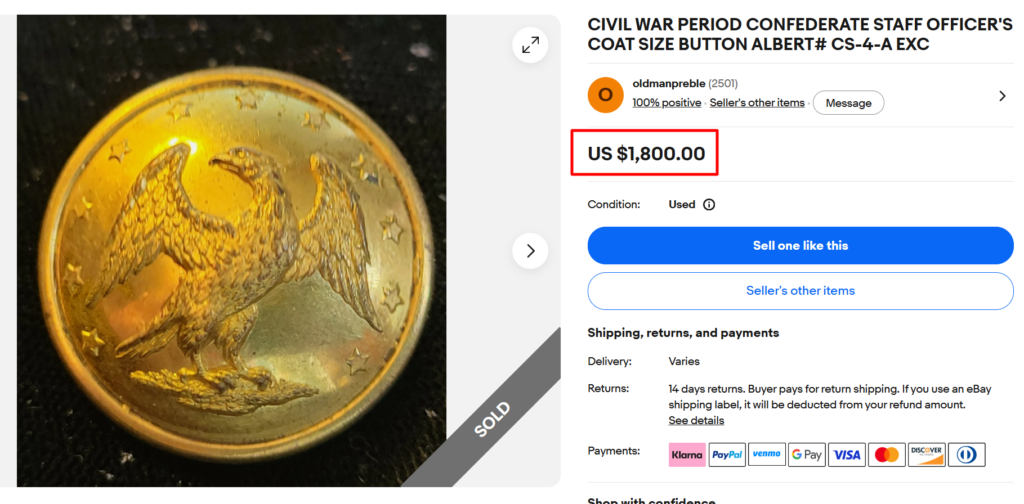
This is a rare example of Confederate Civil War buttons. The Confederate staff officers wore eagle buttons like this one during the Civil War; CS-4-A is the catalog number from Alan Albert’s standard reference.
The design shows a spread-wing eagle ringed by stars, plus a raised “HT & B/Manchester” marking on the back. Because fakes are common, the backstamp and shank are the keys to identification.
| Making Period | 1861 to 1865 |
| Style | Confederate military, coat size |
| Key Features | Spread eagle with stars |
| Collectors’ Notes | Always check backmark for authenticity |
2
18k Gold Quartz Buttons
Typically sells for $1,000 to $2,200 (lot)
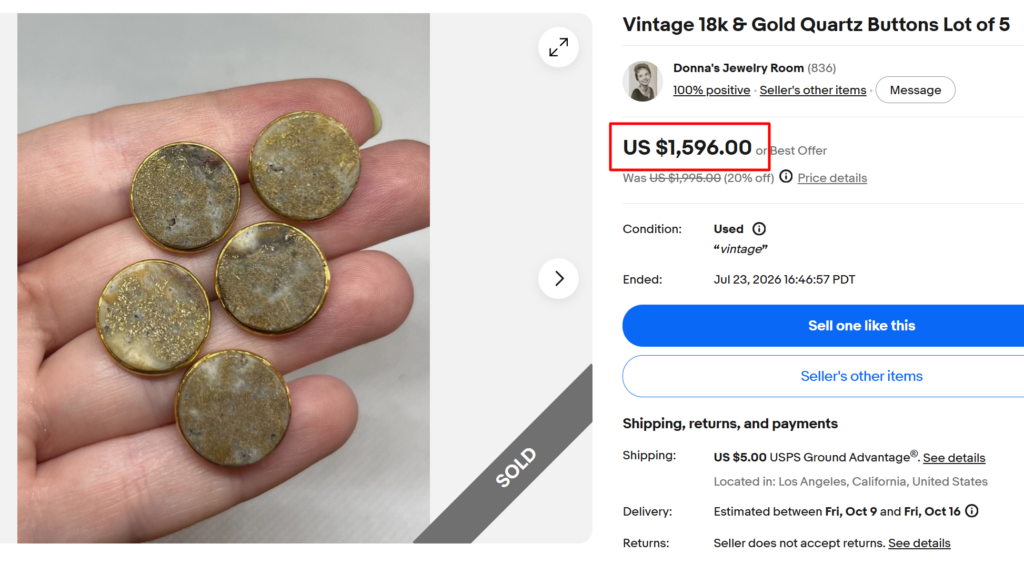
These buttons belong to the Gold-in-quartz jewelry that became quite popular after the California Gold Rush. Each piece features a polished slice of white quartz, veined with gold, in an 18k gold bezel.
Because of the gold content, these buttons are worth a fortune even in worn condition. And the value depends on gold weight, how much visible gold the quartz shows, and how well the set matches.
| Manufacturing Years | Mid-1900s, vintage |
| Style | Gold-in-quartz jewelry buttons |
| Key Features | 18k gold bezels |
3
Theordor Fahner Silver Enamel Buttons
Typically sells for $1,200 to $2,500 (cased set)
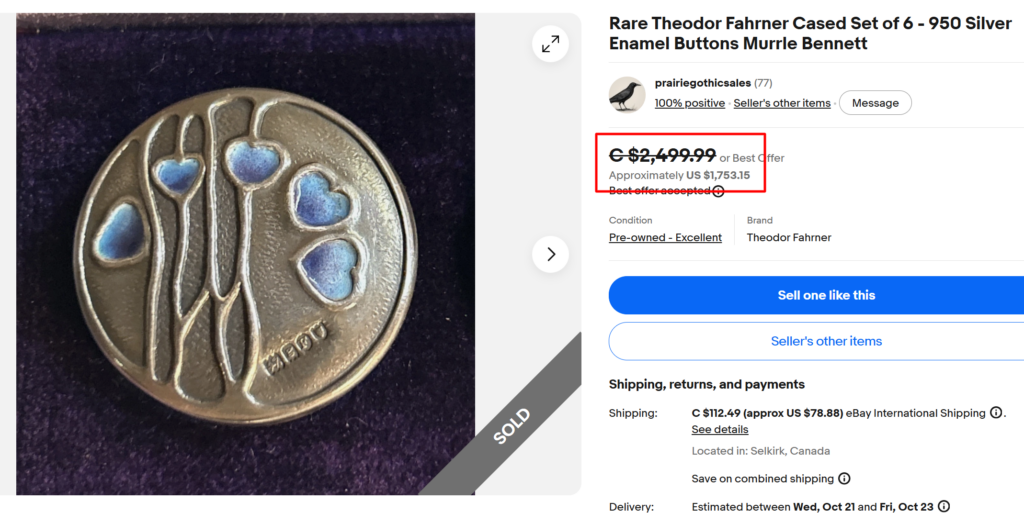
Theodor Fahrner of Pforzheim made some of the finest German Jugendstil silver around 1900, and London’s Murrle Bennett & Co. retailed his work in Britain. These 950 silver buttons show stylized stems ending in blue enamel hearts.
A complete, cased set is rare, so you can expect a premium price, often well into four figures.
| Making Years | Circa 1900 to 1910 |
| Style | Jugendstil, Arts and Crafts |
| Key Features | 950 silver, blue enamel |
| Collectors’ Notes | Original case adds value |
4
Cheshire Jewel Buttons
Typically sells for $350 to $700 (set)
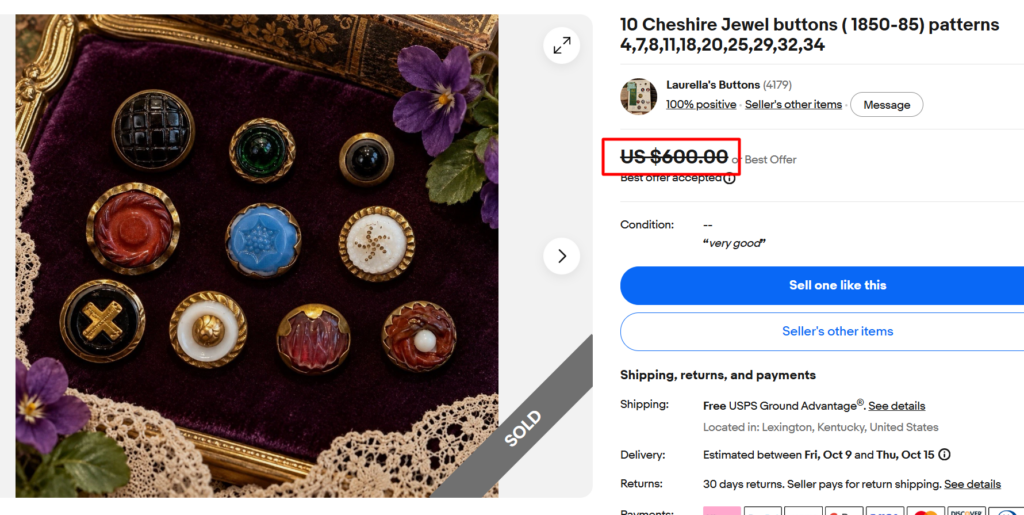
These Cheshire jewel buttons are some of the most cherished types of Victorian glass buttons. Each button has a mold- or facet-cut glass jewel in a stamped brass setting in shades of black, green, red, blue, and milky white.
The patterns on these buttons are numbered, and they are collected based on that. A set of multiple patterns is truly valuable.
| Manufacturing Years | Circa 1850 to 1885 |
| Style | Victorian glass jewel |
| Key Features | Glass jewels, brass frames |
| Notes | Numbered patterns add value |
5
Antique Metal Relief Picture Button (Cat Head)
Typically sells for $350 to $750
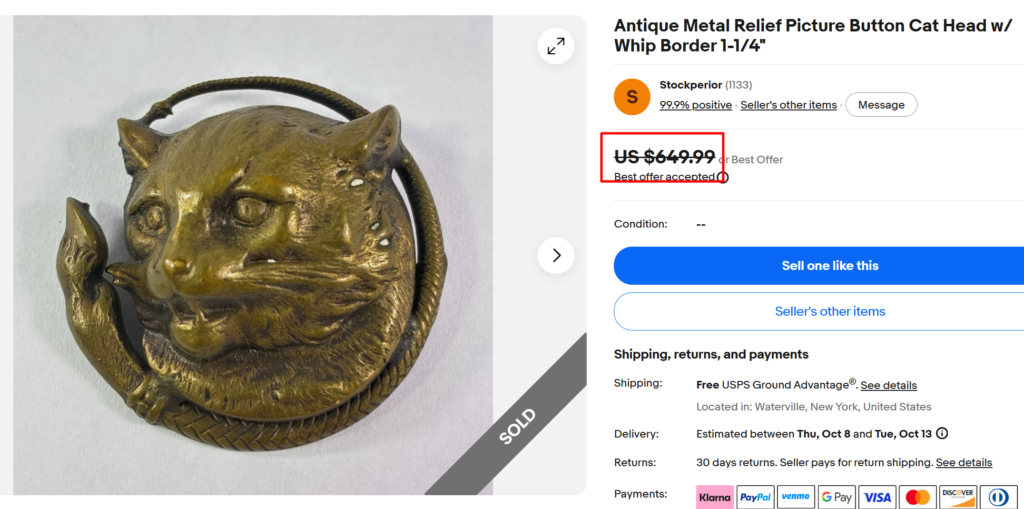
Large brass picture buttons were a common Victorian type. These were made of high-quality brass with high-relief carving designs, usually inspired by fables, opera, and daily life. Animal-head buttons are a rare category.
This large snarling cat button, wrapped by a braided whip that ends in a curled lash, is a perfect example.
| Manufacturing Years | Circa 1870s to 1890s |
| Style | Victorian brass picture button |
| Key Features | High-relief picture, whip border |
6
Toshikane Art Comics Buttons
Typically sells for $250 to $450 (carded set)
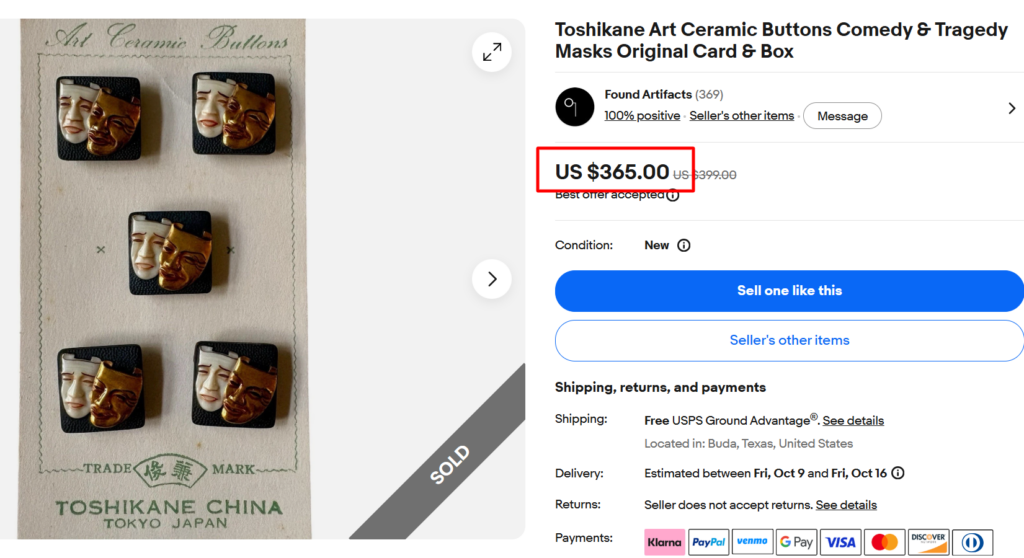
After World War II, Toshikane China (Tokyo) made hand-painted porcelain buttons, which are now highly sought after, especially the theater mask designs. Each square button pairs a white mask with a gold one on a dark ground.
These buttons originally came with the company card; finding all five on the original card, with the box, is the real deal.
| Manufacturing Years | Circa 1950s to 1960s |
| Style | Japanese hand-painted porcelain |
| Key Features | Comedy and tragedy masks |
| Collectors’ Notes | Original card and box |
7
Bethlehem Pearl Buttons
Typically sells for $300 to $550 (set)
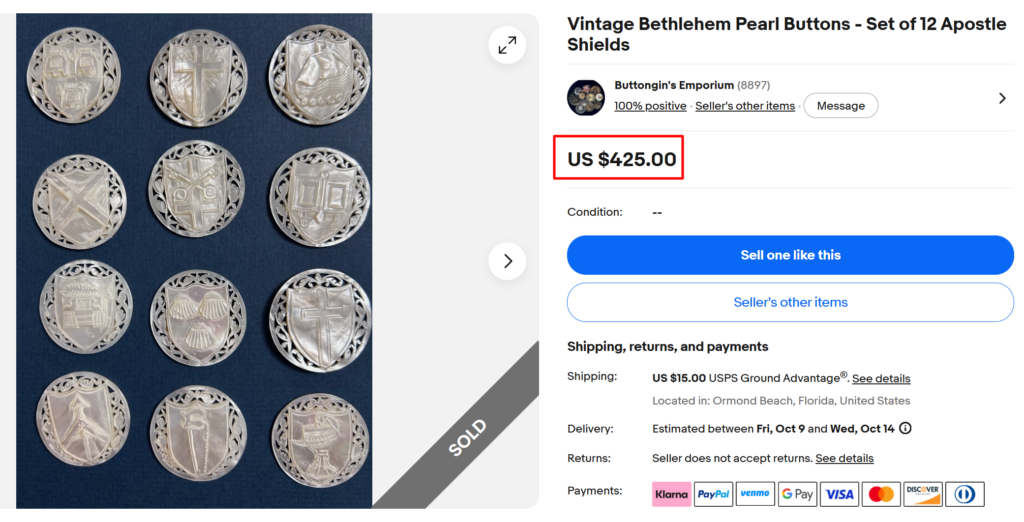
Craftsmen in Bethlehem have carved mother-of-pearl for centuries, and apostle shield sets are among their most collectible button work.
Each of these twelve pierced discs carries a shield with an apostle’s symbol, like crossed keys for Peter or scallop shells for James. Full sets are hard to find and drive premium value.
| Manufacturing Years | Early to mid-1900s |
| Style | Hand-carved Bethlehem pearl |
| Features | Pierced borders, apostle symbols |
8
Royal Hawaiian King Kalakaua Firmin & Sons Military Button
Typically sells for $200 – $400
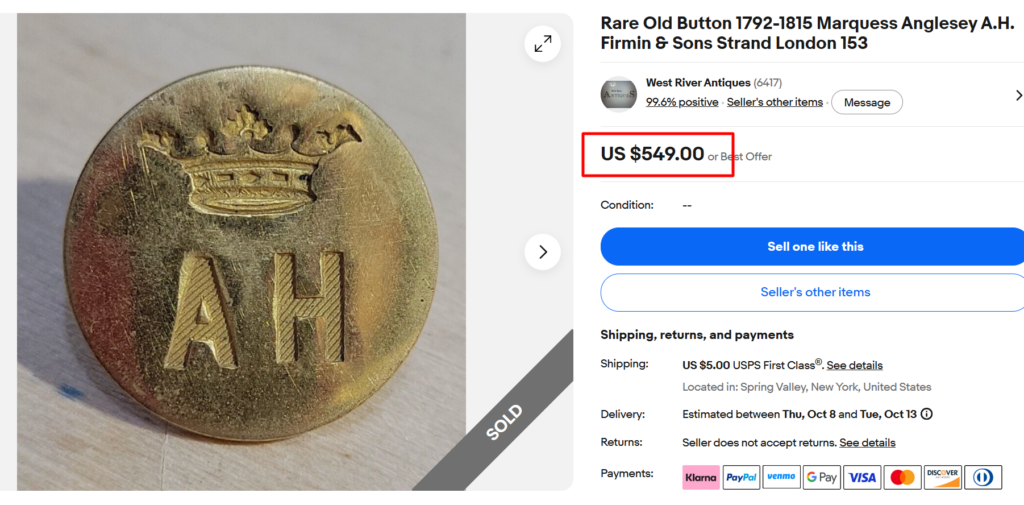
Georgian livery buttons show a noble household’s identity on the coats of its servants. These are made of brass and often have family crests, monograms, or rank coronets.
This gilt example is attributed to the Marquess of Anglesey’s household. It has a finely detailed raised coronet above bold hatched initials “AH.” You’ll also find the London makers Firmin & Sons of the Strand stamp on the back.
Key Features to Spot:
- Gold-colored brass construction
- A crown and AH initials on the front
- “Firmin & Sons, Strand London” marked on the back
- A small loop at the back
| Manufacturing Year | Pre-1930s |
| Brand/Maker | Firmin & Sons |
| Button Size (Diameter) | 27.27mm |
9
Pink Gold Cipher Stuart Crystal Button
Typically sells for $100–$400 (common); $500+ (gold mount/pairs)
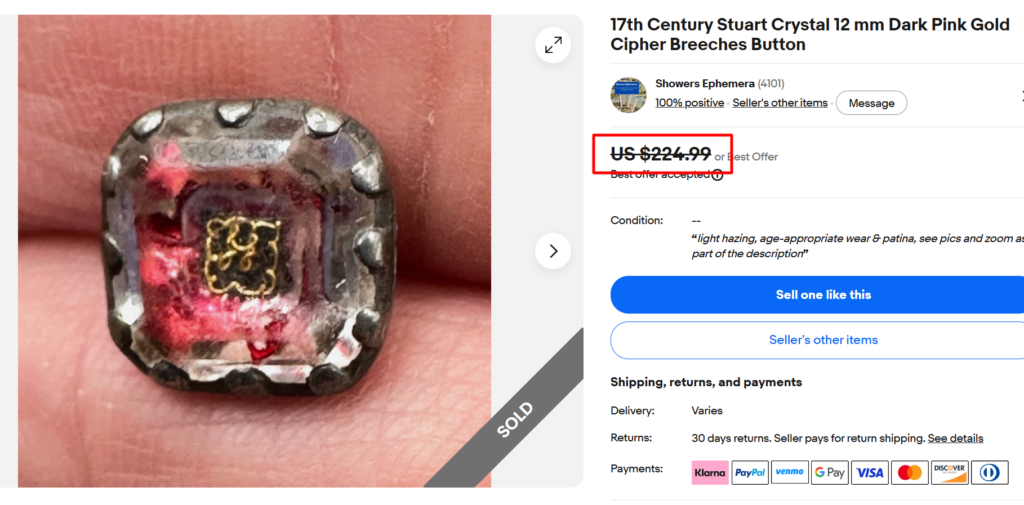
It is a tested square-cut rock crystal whose beauty is enhanced by the gold wirework cipher gracing the center. This antique button resembles a sparkling diamond ring at first glance and is difficult to find today!
Key Features to Verify:
- Faceted rock crystal dome
- Gold-wire motif
- Small hook at the back in silver
- Crimped or claw-set edge (Silver/gold)
| Manufacturing Year | 1650s–1720s |
| Style | Gothic Era |
| Collectors’ Notes | Chips in the crystal hurts value. |
10
English Silver Maiden Figural Button Set
Typically sells for $40-$60 (single); $80 to $500+ (with box)
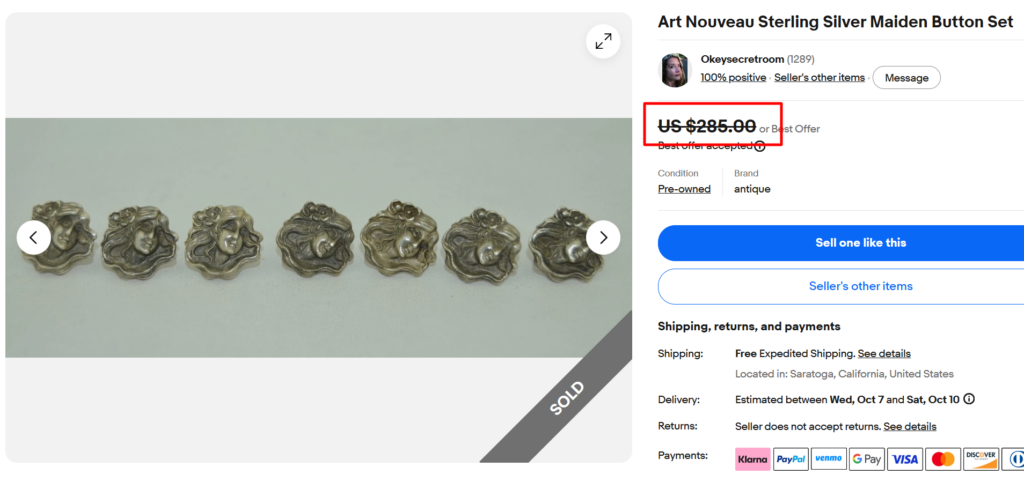
A finely designed set of English Sterling Silver maiden figural buttons that have stood the test of time! All buttons have the same maiden design displaying side faces with uniquely curled hair, all silver.
Attractive Features:
- Fully hallmarked ‘STERLING’ on the back
- Pretty faces on the front
- Small loop at the back
| Manufacturing Year | 1890 to 1910 |
| Style | Art Nouveau |
| Material Used | Sterling Silver, 925 Sterling Silver, Silver, etc. |
11
Bakelite Carnival Glass Button
Typically sells for $50 to $110
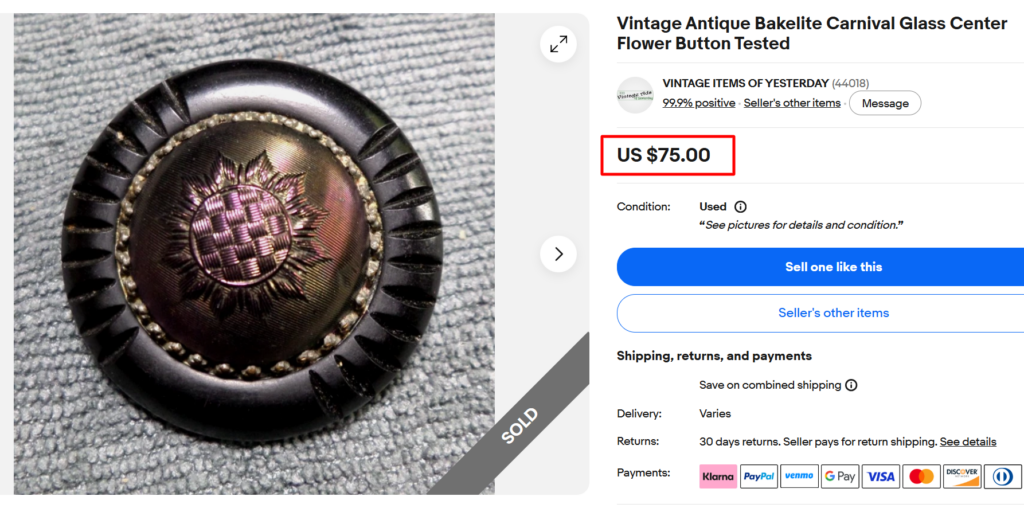
The value of these vintage buttons comes from the rare combination of Bakelite and carnival glass. It shows a black Bakelite rim with carved notches encircling an iridescent glass center with a pressed sunburst flower and basketweave pattern.
Makers made these combination buttons mostly in the 1930s and 1940s. Make sure to test the Bakelite and carnival glass.
| Manufacturing Years | 1930s to 1940s |
| Style | Bakelite and carnival glass |
| Key Features | Carved rim, iridescent center |
| Notes | Tested Bakelite brings more |
12
Bakelite Layered Disc Butterscotch Buttons
Typically sells for $100 to $200 (set)
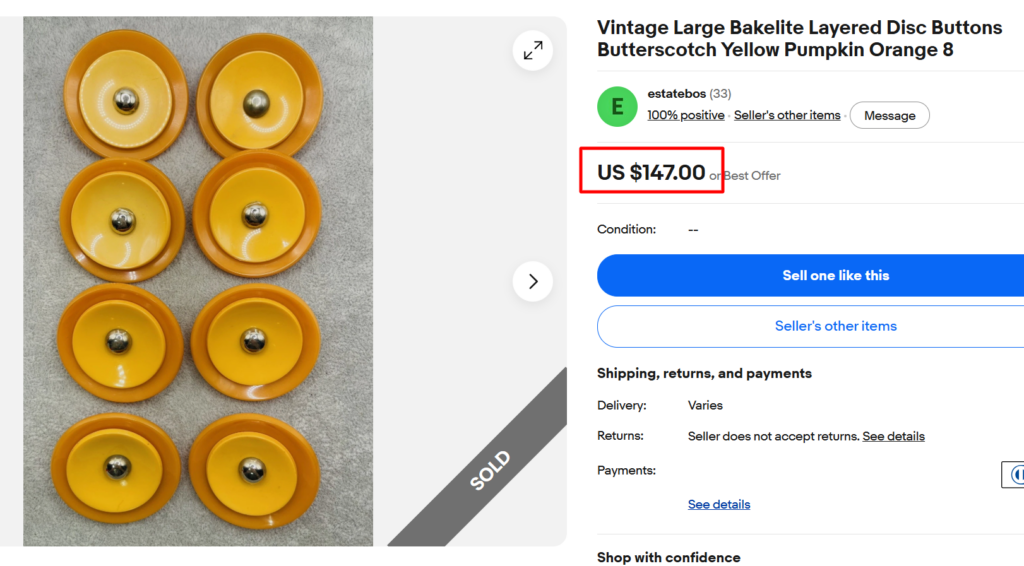
Large layered Bakelite buttons were quite popular in the 1930s and 1940s. These usually feature stacking colors for a bold Art Deco look. This set of butterscotch yellow buttons is shaped like discs with pumpkin orange bases and metal centers.
Matching sets of large Bakelite usually sell in the low hundreds. Always confirm the material with a Simichrome or 409 test.
| Making Years | 1930s to 1940s |
| Style | Art Deco layered Bakelite |
| Key Features | Two-tone discs, metal centers |
| Collectors’ Notes | Test to confirm Bakelite |
13
Victorian “Gay Nineties” jeweled/art-glass buttons
Typically sells for $20 to $50
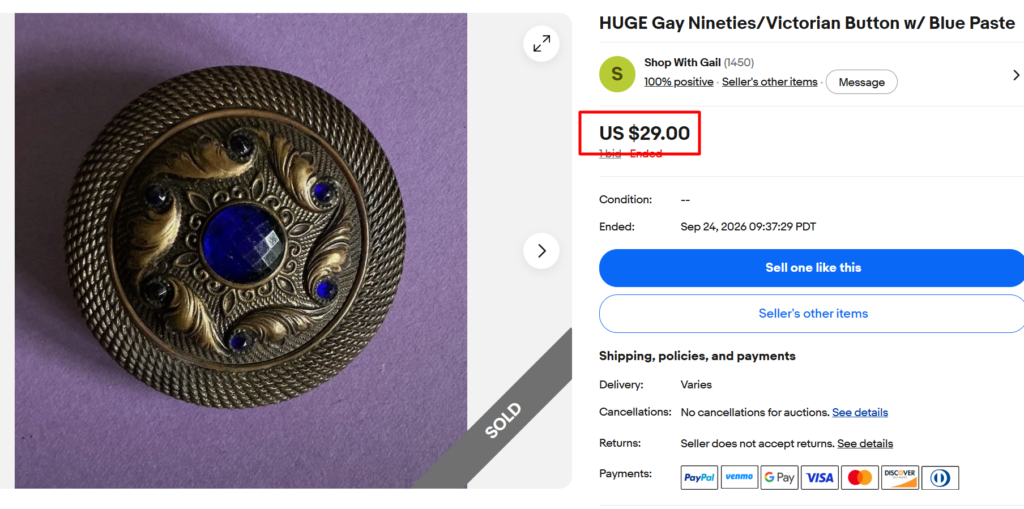
Big, showy Victorian buttons were popular in the 1890s. This example features a deep blue faceted paste stone that sits at the center of a stamped brass face, framed by scrolls, smaller blue stones, and a rope-twist border.
Size is the biggest value driver for these, but collectors also want every stone intact and the brass free of dents.
| Making Years | Circa 1890s |
| Style | Gay Nineties Victorian |
| Key Features | Blue paste, rope border |
| Collectors’ Notes | All stones should be intact |
14
Antique Reverse-intaglio Rock-crystal Button
Typically sells for $25 to $60
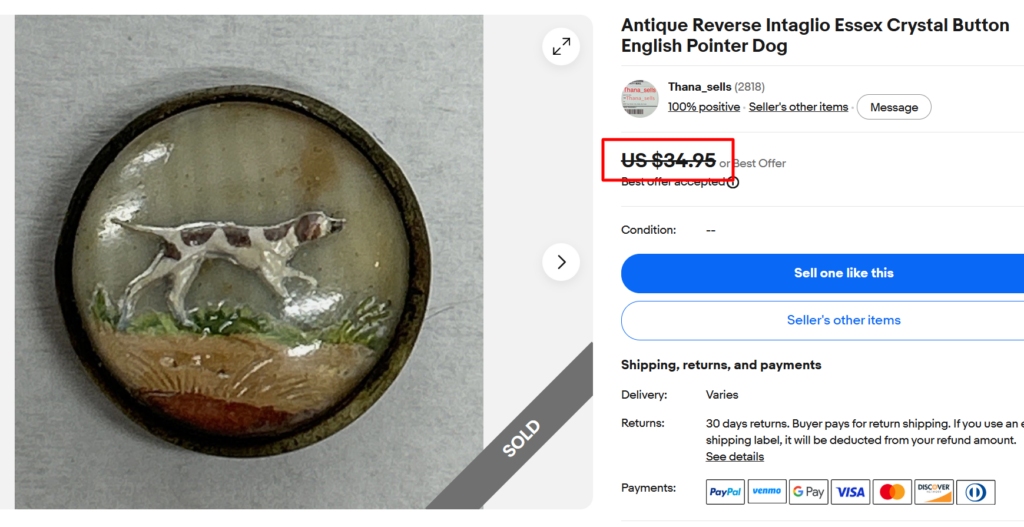
These pieces were made by carving Essex crystal buttons from behind. Makers would carve the scene into a clear glass or rock crystal dome and paint it so it seems to float.
Sporting dogs were a favorite Victorian subject, and this pointer mid-stride is a classic example.
| Manufacturing Years | Late 1800s to early 1900s |
| Style | Victorian reverse intaglio |
| Features | Hand-painted floating designs |
| Collectors’ Notes | Check for chips, paint loss |
15
Meiji Era Hand-Painted Geisha Satsuma Buttons
Typically sells for $50 – $200 (set)
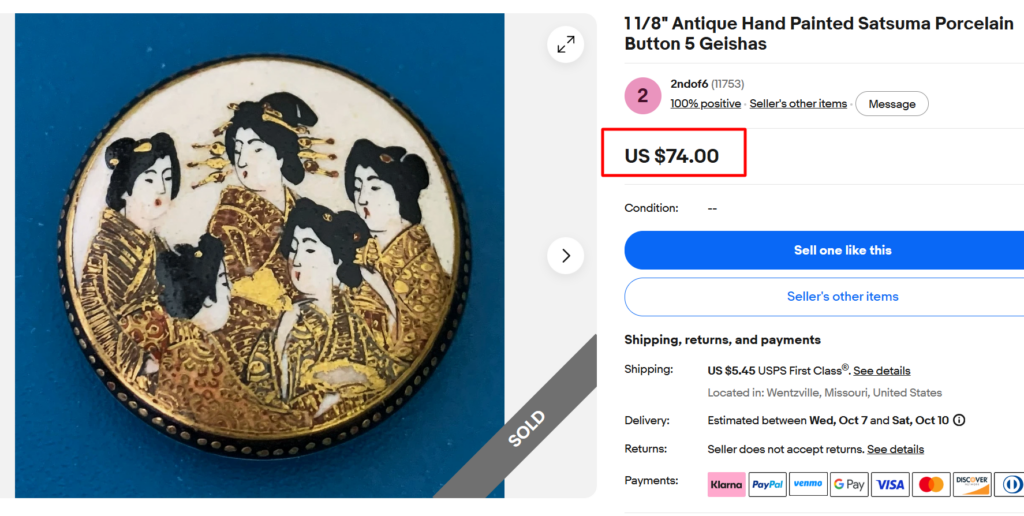
This button features a stunning portrait of Japanese ladies conversing in a group of two or four on each button. The highlight of this hand-painted Satsuma button collection is the gilded kimono adorned by beautiful geishas. A set of 6-7 buttons can fetch a few hundred dollars.
Collectible Features:
- Black edges decorated with golden dots
- Golden rim inside the edges
- Creamy white background with small golden specks
| Manufacturing Year | 1890s |
| Style | Late Meiji Era |
| Material | Ceramic |
| Features | Gold rim, gold specks on kimono |
16
William Spratling Sterling Silver Buttons Set
Typically sells for $30 to $330 (set)
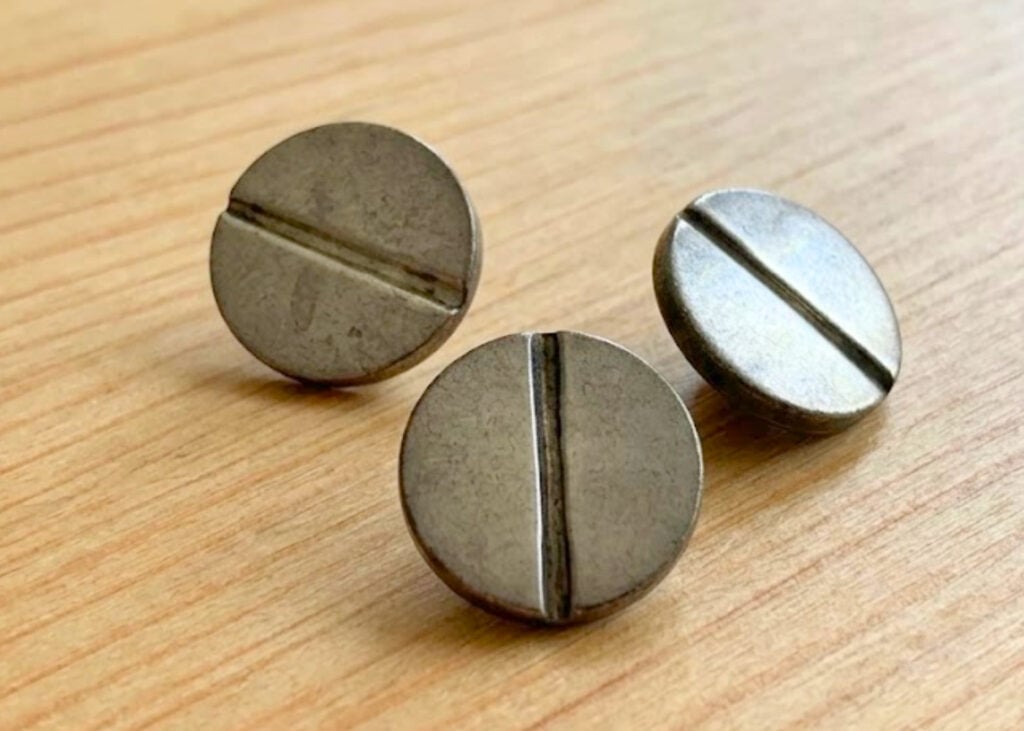
The set of 7 William Spratling Sterling Silver buttons is a one-of-a-kind addition to your antique allure. The maker of the buttons, William Spratling, is known as the father of contemporary Mexican silver.
Besides, these buttons are unique for their rare flat-head screw and aesthetically pleasing patina, making them rare. Always check the ‘Spratling Made In Mexico’ backstamp.
| Manufacturing Year | 1920s |
| Brand | William Spratling |
| Features | Screw slot design, loop shank |
17
Antique Enamel Hand-Painted Butterfly Buttons
Typically sells for $25 to $250+ (single)
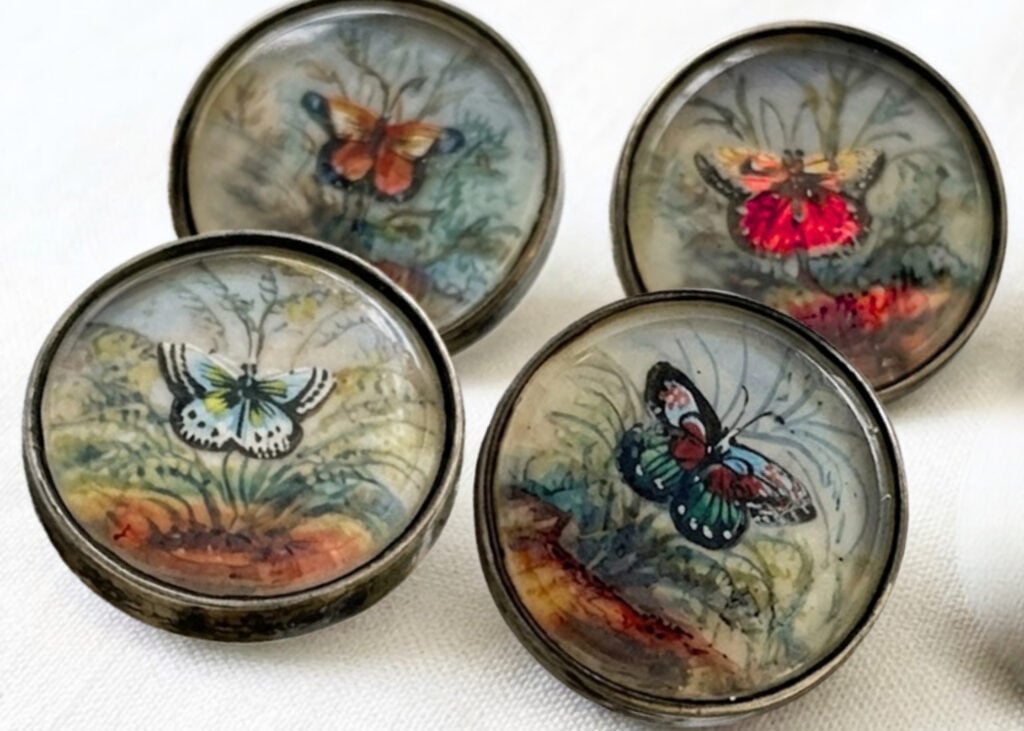
Featuring ornate hand-painted butterflies, this beautiful set of 6 Sterling silver buttons is the perfect collector’s item. Each piece is flanked by a unique, deeply colored butterfly image protected by an edge of glass from the front.
| Manufacturing Year | 1900s |
| Style | Edwardian Era |
| Features | Sterling body, enamel painting |
18
Jewel Paste Reticulated Silver Button
Typically sells for $15 to $80 (more for rare, hallmarked)
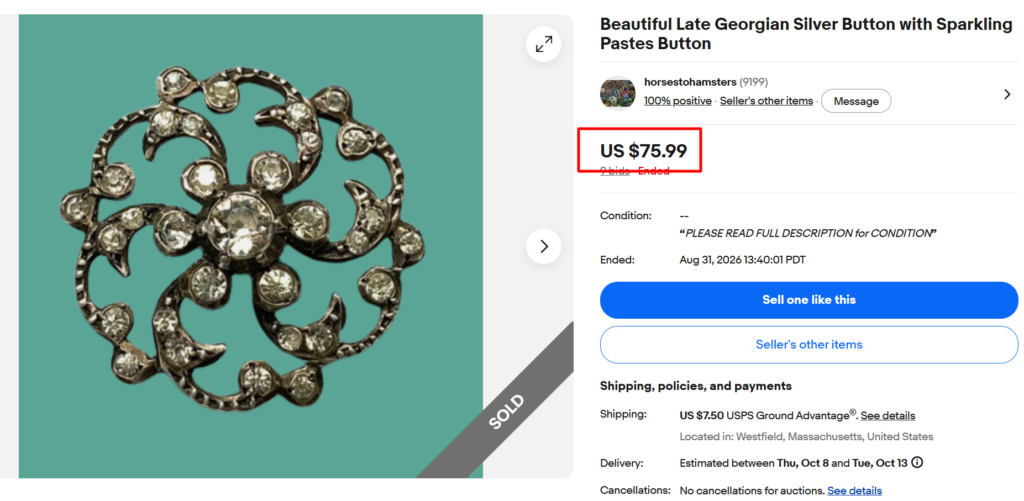
A very rare jewel silver button that is subtle on the base but blasts into shiny stones on the surface. These buttons glitter with hand-cut leaded glass stones set into silver mounts, and are often foil-backed to create that contrasting sparkle.
These pieces often came in matching sets for gentlemen’s coats, waistcoats, and knee breeches.
Unique Features:
- Silver settings/base
- Decorated with Hand-cut leaded glass (paste) stones
- Intricate motifs like Rosette, starburst, and scrolling openwork design
- Foil-backed stones, often in closed settings
| Manufacturing Year | 1800s |
| Material | Silver, Stones |
| Diameter | 1 1/2 inches |
19
14K Victorian Era Micro Mosaic Button
Typically sells for $50–$250 (common); $300+ (large)
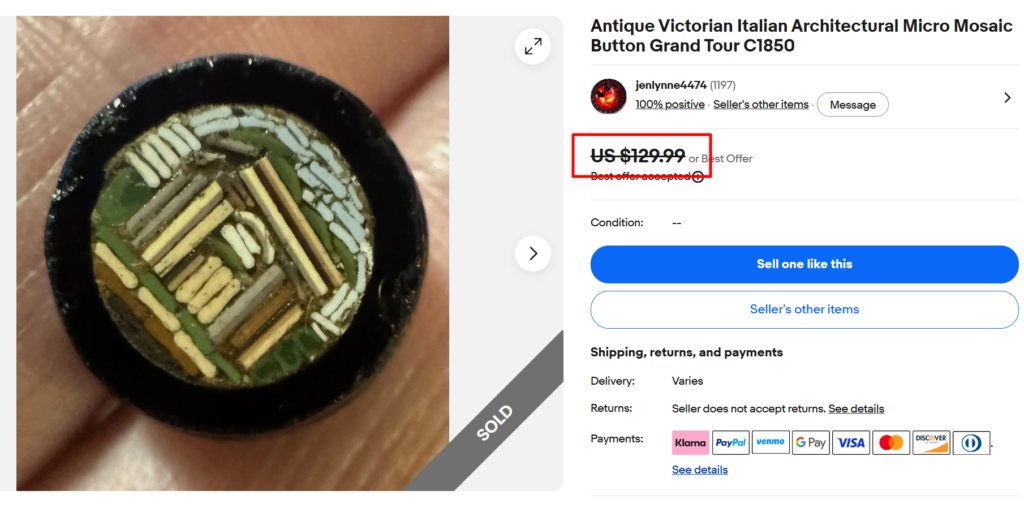
These Victorian buttons feature the iconic Italian craft of setting tiny slivers of colored glass (aka tesserae) into a black glass or metal base, creating pictures. These were popular as Grand Tour souvenirs and typically show flowers, birds, ruins, or geometric motifs.
| Manufacturing Years | 1840s–1890s |
| Style | Victorian |
| Features | Micro-mosaic paintings |
| Place of Origin | United Kingdom |
All you need is a good eye and a little knowledge to spot the rarest and most valuable antique buttons, and we hope this article helps you with it. So, head to a thrift store soon and grab a pricey button today. If you want to learn about identifying antique buttons and cufflinks, check out my detailed guides now!
Note: This article is intended for informational, educational, and entertainment purposes only. Some images are illustrative and may not represent actual brands, products, or related entities. All trademarks, product names, brand logos, packaging, and other intellectual property referenced remain the exclusive property of their respective owners. Any brand mentions or references are provided solely for descriptive and educational context and do not imply any formal or commercial association.