Antiques Know How Research
Vintage Egg Cups Value
Our research at Antiques Know How of more than 100 sold eBay listings and several auction results shows that vintage egg cups range from $10 for common patterns up to $600+ for rare silver sets and pieces. The most collectible pieces are Solid silver cups, Meissen porcelain cups, Fire-King Jadeite cups, Shelley cups, Clarice Cliff Bizarre cups, and Wedgwood Jasperware cups. Value depends on condition, maker, material, and pattern rarity!
Antiques Know How
Egg cups have been one of the most overlooked kitchenware pieces, partly because boiled eggs never quite caught on the same way they did in Britain and Europe.
And that goes for vintage egg cups as collectibles, too. What many don’t know is that while mostly overlooked, the right cup, from the right maker, in the right pattern, can sell for anywhere from $40 to several hundred dollars today!
This guide covers some collectible vintage egg cup examples from top makers, what makes each one worth money, and what to look for if you come across one at a sale!
High-Value Collectible Egg Cups to Look for!
Over time, a variety of companies have produced egg cups, from top-notch porcelain makers to local silversmiths and potters. And these have been made using a variety of materials, including sterling silver, porcelain, and colorful glass!
Today, these small tableware items have become collectibles because they showcase the evolution of design and materials over centuries.
Below are listed some valuable vintage egg cups that every collector must know!
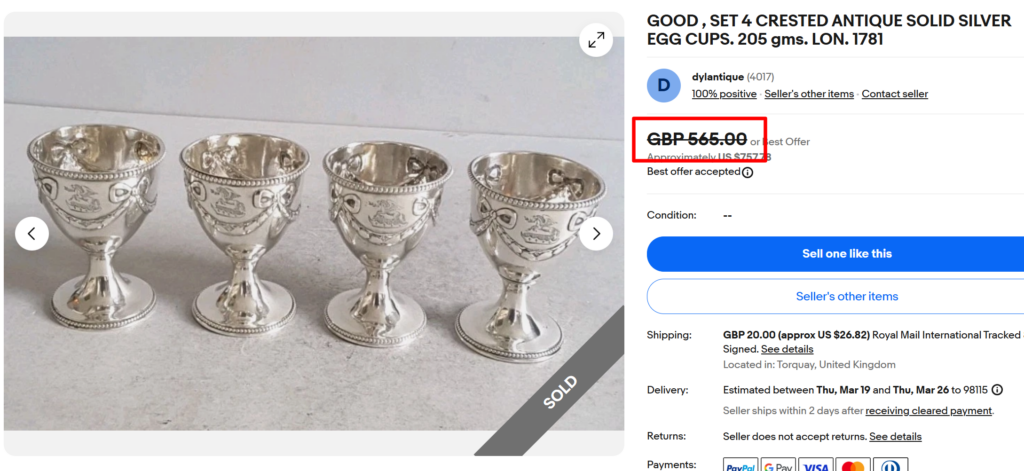
1. Robert Hannell Solid Silver Egg Cups
| Average Value | $500–$900 (set) |
| Production Period | Late 18th Century (circa 1781) |
| Brand/Pattern | Robert Hannell |
| Collectibility | High |
| Collector Notes | Check for hallmarks on the base. |
Antique sterling silver egg cups are among the most valuable in this category. This particular set of four from Robert Hannell was made in 1781 during the George III period and bears full hallmarks of London silver marks.
Each cup is chased with a crested design, featuring swag and bow decorations, as well as jumping winged-horse motifs.
The value of silver egg cups lies in the “hallmarks” found near the rim or base and in the completeness of the set.
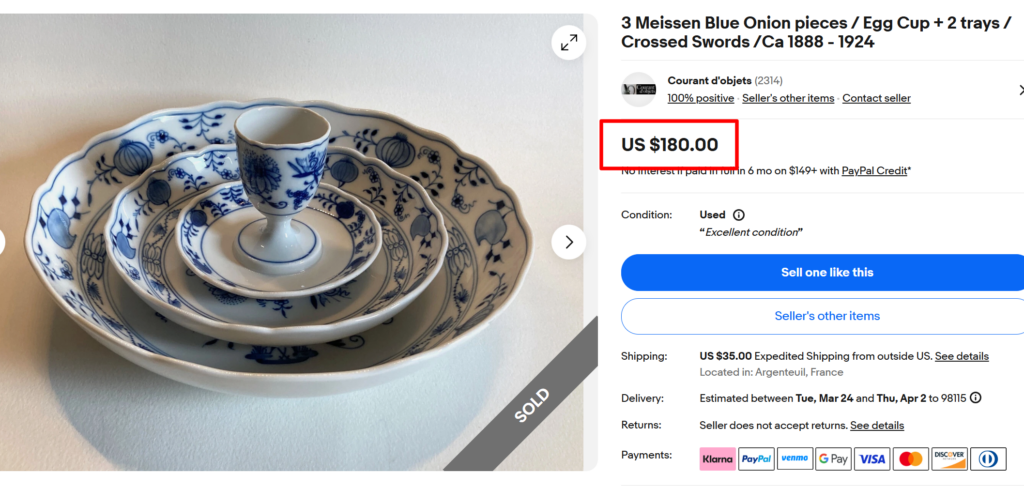
2. Meissen “Blue Onion” Egg Cup
| Average Value | $40-$60 (for cup) |
| Production Period | c.1888–1924 |
| Brand/Pattern | Meissen – Blue Onion (Zwiebelmuster) |
| Collectibility | High |
| Collector Notes | Check the crossed swords mark in light |
This Meissen set contains an egg cup and trays, all in its most popular “Blue Onion” (Zwiebelmuster) pattern, featuring florals and onion-like motifs. Sets like this were produced for formal breakfast service.
Since this is a legendary pattern, even single Blue Onion egg cups can be quite desirable. Make sure to check the crossed swords backstamp, as several makers have imitated the pattern since its introduction in 1739.
3. Fire-King “Jadeite” Double Egg Cups
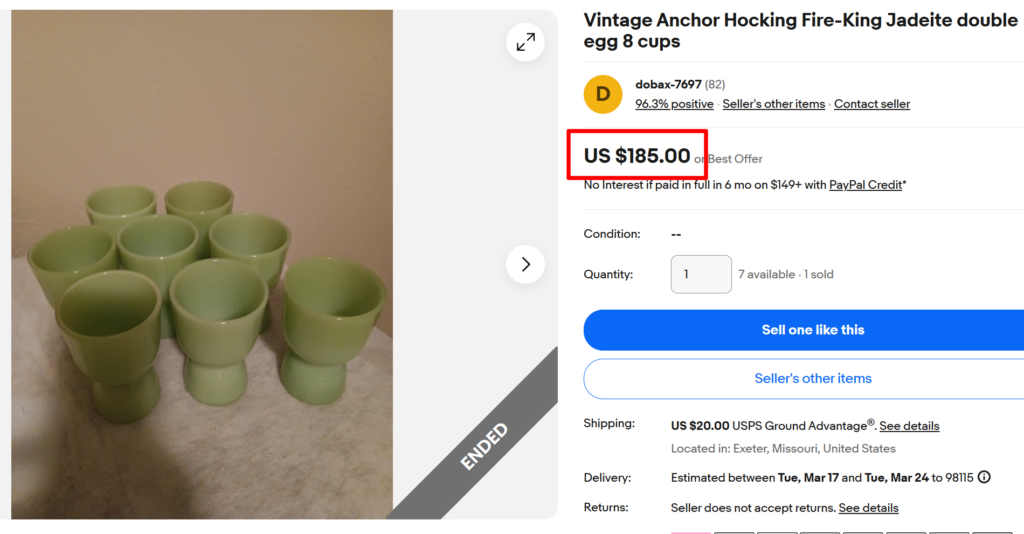
| Average Value | $20–$35 (single) $70-$200+ (set of 8) |
| Production Period | 1954–1956 |
| Brand/Pattern | Anchor Hocking – Fire-King Jadeite |
| Collectibility | High (short production) |
These double egg cups were part of Fire-King’s 1700 Line Breakfast Set, produced by Anchor Hocking from 1954 to 1956. As a part of one of the shortest production runs in the entire Jadeite lineup, these egg cups are super collectible today!
The cup is molded from Anchor Hocking’s signature jade-green opaque glass. The double-ended design lets you use the smaller opening for a soft-boiled egg and the larger one for a poached egg.
Remember that egg cups from this set are not marked on the base, which is normal and doesn’t mean it’s a reproduction. But check other signs to verify.
4. Shelley “Black Garland of Flowers” Egg Cup
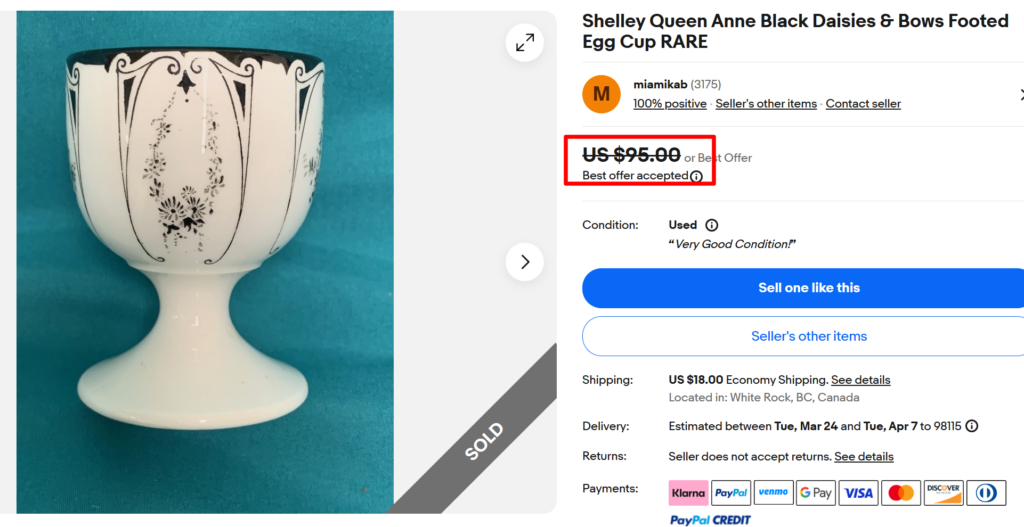
| Average Value | $60–$130 |
| Production Period | 1926–c.1933 |
| Brand/Pattern | Shelley/Black Garland of Flowers |
| Collectibility | High (popular pattern) |
| Collector Notes | Check for “Shelley” stamp on the back |
This egg cup from Shelley features the rare 1920s Art Deco pattern, “Garland of Flowers” in black. You can spot it by stylized floral sprays, scrolls, and a black band on a white base.
Black-decorated pieces tend to carry a premium over common florals. Also, because egg cups were included in Shelley breakfast sets but sold in smaller numbers than teacups or plates, they’re harder to find!
5. J.P. Pouyat Limoges “Chicks & Wheat” Egg Cup & Tray
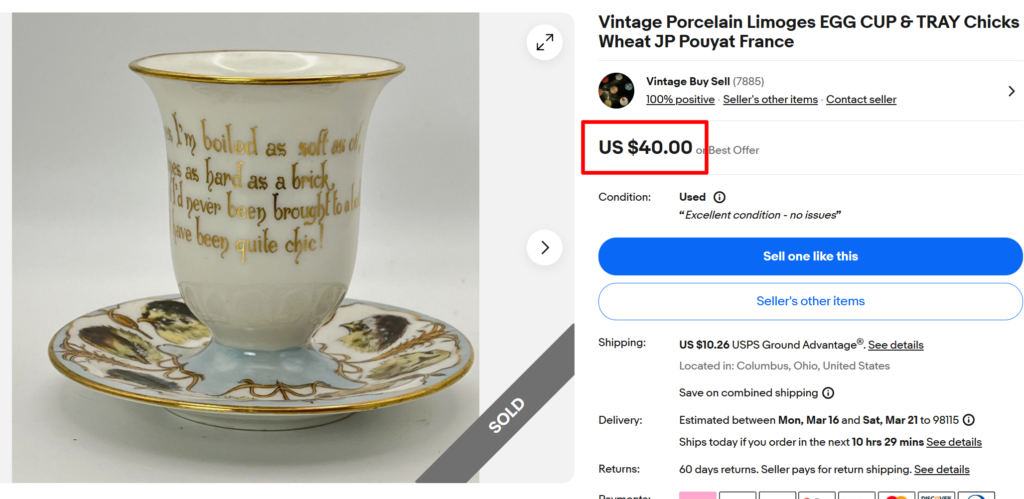
| Average Value | $30–$60 (set with tray) |
| Production Period | 1891–1932 |
| Brand/Pattern | Jean Pouyat Limoges – Chick & Wheat |
| Collectibility | Moderate to High |
| Collector Notes | Look for two marks: a white ware mark (JPL) and a decoration mark. |
This porcelain egg cup and tray set comes from Jean Pouyat Limoges, one of Limoges’ most respected porcelain factories from the late 19th century. It features a tall flute-shaped cup with a gold-scripted verse about boiled eggs and a tray with transfer-printed chick and wheat imagery.
Authentic pieces also show the “JPL France” backstamp (J.P. over L, with France below), which places these to the 1891–1932 era.
6. Royal Crown Derby “Kings Imari” Egg Cup
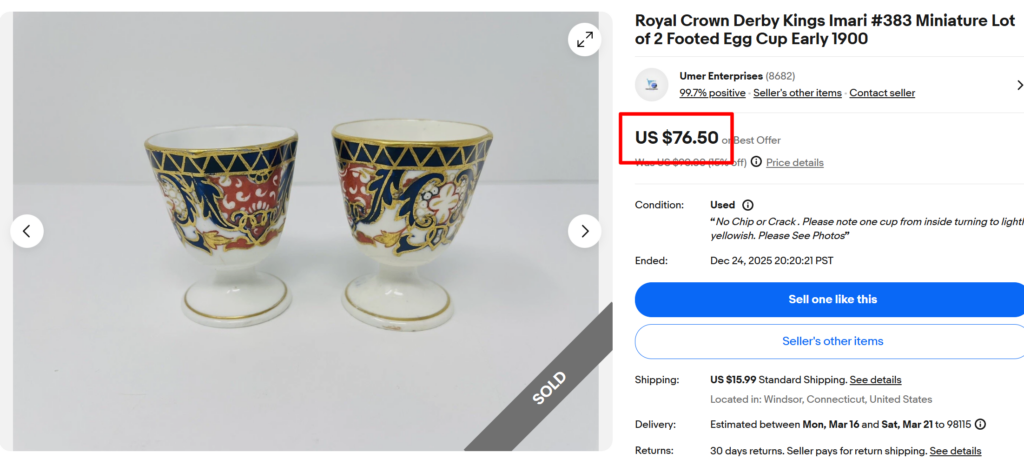
| Average Value | $35–$80 (single) $75–$120 (pair, more for set) |
| Production Period | Early 1900s |
| Brand/Pattern | Royal Crown Derby – Kings Imari #383 |
| Collectibility | High |
| Collector Notes | Check the backstamp for authenticity |
Royal Crown Derby is synonymous with the opulent “Imari” style, known for its rich cobalt blue, iron red, and 22-karat gold gilding. These miniature footed egg cups feature the “Kings” pattern (#383, marked on the base), a quite notable design.
Because of the heavy gold work, these pieces look regal. Individual early-1900s RCD egg cups in the Imari pattern sell in the $35–$75 range, depending on condition, with sets bringing more.
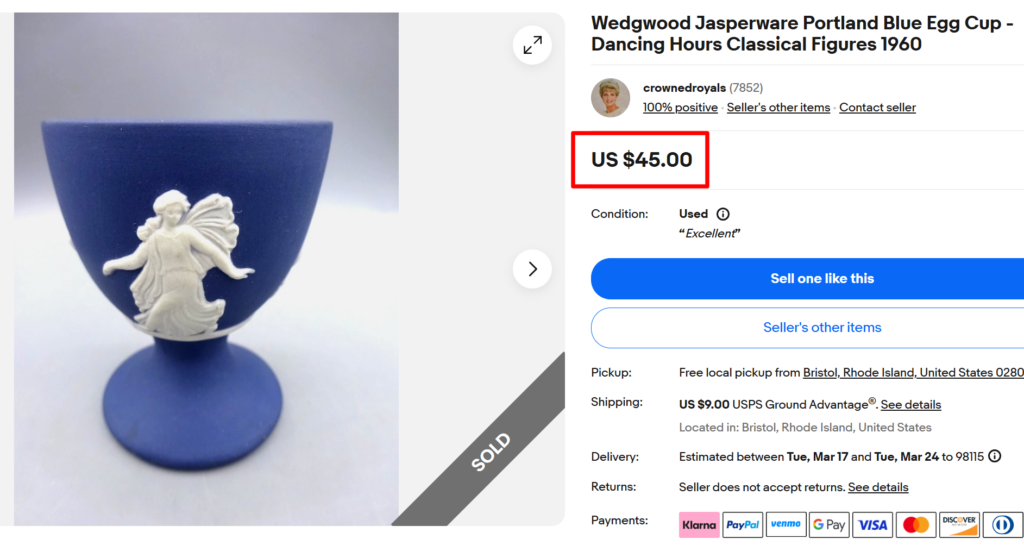
7. Wedgwood Portland Blue “Dancing Hours” Cups
| Average Value | $30–$50 (singles) |
| Production Period | Mid-19th century–present; pre-1891 pieces most valuable |
| Brand/Pattern | Wedgwood – Dancing Hours |
| Collectibility | Moderate |
| Collector Notes | Check the “Wedgwood England” mark |
This elegant egg cup from Wedgwood features the Dancing Hours motif, one of Wedgwood’s most recognized Jasperware designs. It features a classical dancing figure inspired by John Flaxman’s sculptures.
This is a classic Portland Blue (deep navy) example with white applied relief. Since the Portland Blue is the most widely produced Jasperware color, these egg cups are quite accessible, worth $30 to $50 in excellent condition!
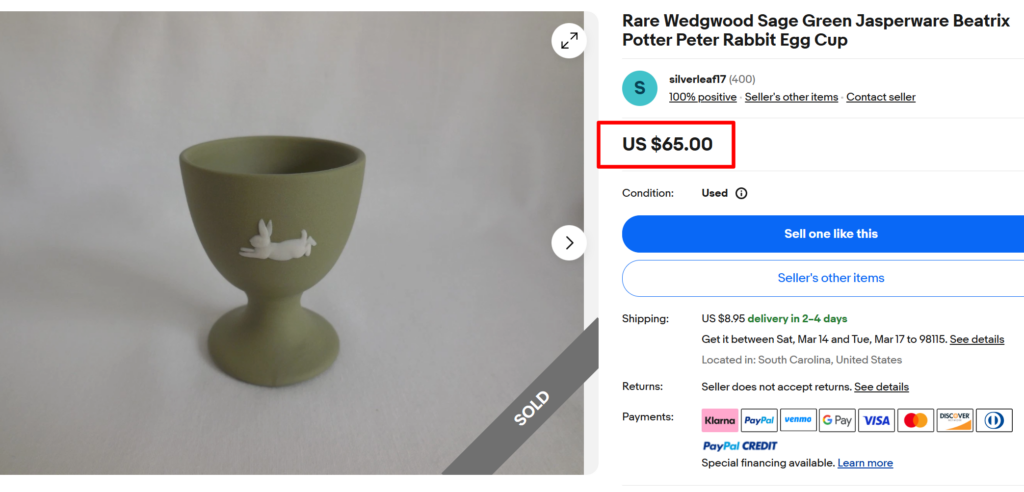
8. Wedgwood Jasperware “Rabbit” Egg Cup
| Average Value | $40–$80 (single) |
| Production Period | c.1980s–2000s |
| Brand/Pattern | Wedgwood – Sage Green Peter Rabbit |
| Collectibility | Moderate-High (rarer color) |
| Collector Notes | “Wedgwood Made in England” mark on the base. |
This egg cup by Wedgwood is a sage green color, which is less common than the famous Portland Blue. Also, it features Beatrix Potter’s bas-relief Peter Rabbit design, which was created for the children’s gift market from the 1980s onwards.
The company has created this Peter Rabbit design in a range of colors, but the Sage Green is a classic!
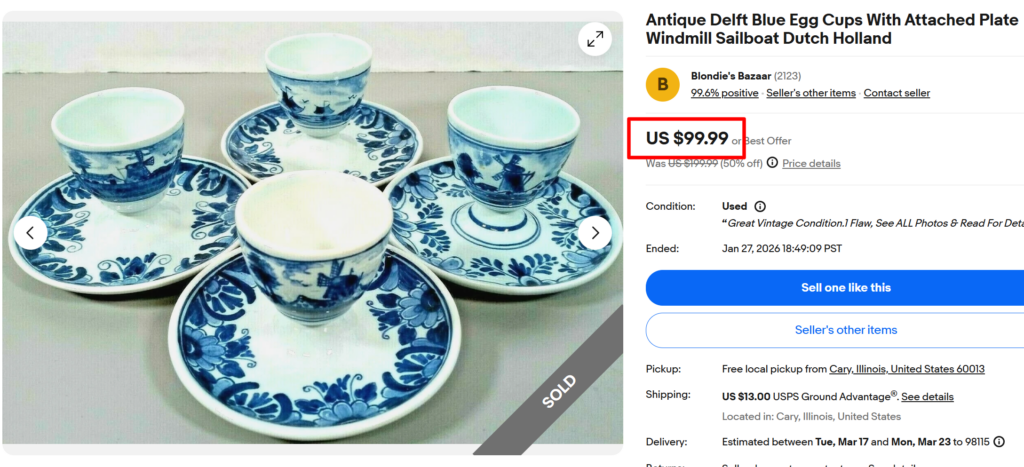
9. Delft Blue “Windmill Sailboat” Egg Cups with Plate
| Average Value | $60–$120 (set) |
| Production Period | c.1880–present |
| Brand/Pattern | Dutch Delft – Windmill and Sailboat |
| Collectibility | Moderate to High (pre-1960) |
| Collector Notes | Check blue handpainted marks on base |
These Delftware antique egg cups are unique because they are permanently attached to their own small saucers. They feature scenes of windmills or sailboats in a deep cobalt blue color.
This form of egg cups was made for formal breakfast tables and is harder to find than standalone cups.
Note that post-1970s souvenir-grade Delft uses a brighter, more uniform blue transfer and thinner ceramic. Older pieces have a slightly heavier feel, and the blue decoration shows greater tonal variation.
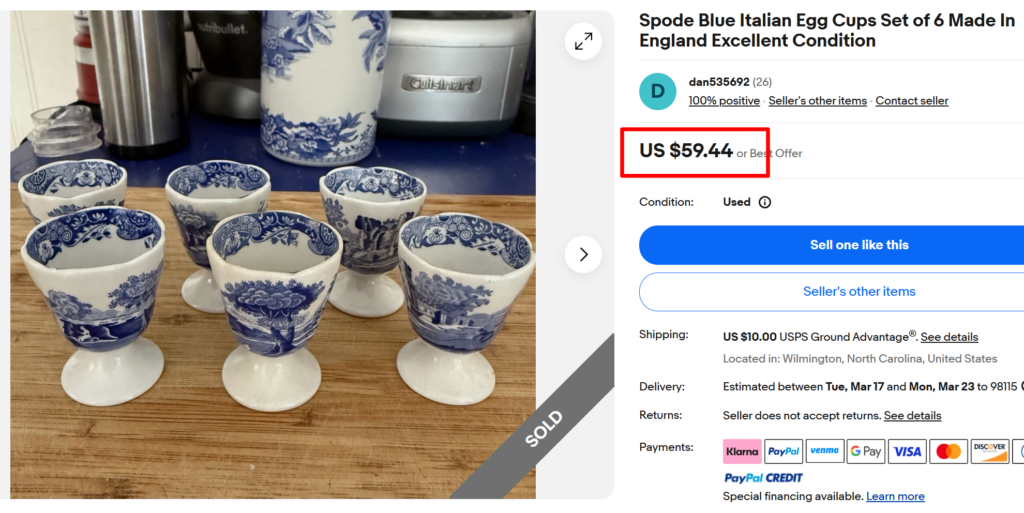
10. Spode “Blue Italian” Egg Cups
| Average Value | $10–$15 (single) $50–$70 (set) |
| Production Period | 1816–present |
| Brand/Pattern | Spode – Blue Italian |
| Collectibility | Moderate to High (pre-2009 pieces) |
| Collector Notes | Spode England mark on the base. |
This set of six egg cups features Spode’s “Blue Italian” pattern (1816), which is one of the longest-running transferware patterns in English ceramic history.
The design features a finely detailed Italian countryside scene on the outside and an 18th-century Imari-style border on the inside of the cup, all in deep cobalt blue.
Since the pattern is still in production, older “Made in England” marked Spode Blue Italian egg cups are more desirable among collectors.
11. Carlton Ware “Walking Ware” Egg Cups
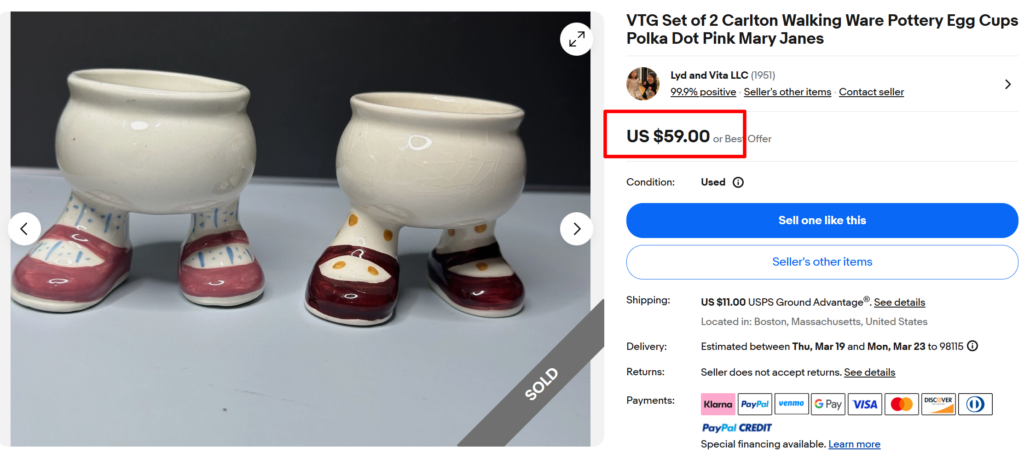
Source: eBay – Lyd and Vita LLC
| Average Value | $25–$60 (single) $80–$120 (matched set) |
| Production Period | 1973–early 1980s |
| Brand/Pattern | Carlton Ware – Walking Ware |
| Collectibility | High |
| Collector Notes | Check the backstamp for authenticity. |
Carlton Ware’s Walking Ware line is a highly recognizable English novelty pottery series designed by Lustre Pottery in the 1970s. A part of this line, these egg cups feature on a pair of ceramic legs wearing Mary Jane shoes!
Such unique Walking Ware pieces remain highly collectible for their humor. And their value lies in their completeness and original bright paint.
Authentic pieces, from 1973 or 1976, bear the “Carlton Ware England, Lustre Pottery” stamp on the base, along with the date!
12. Clarice Cliff “Bizarre” Egg Cup
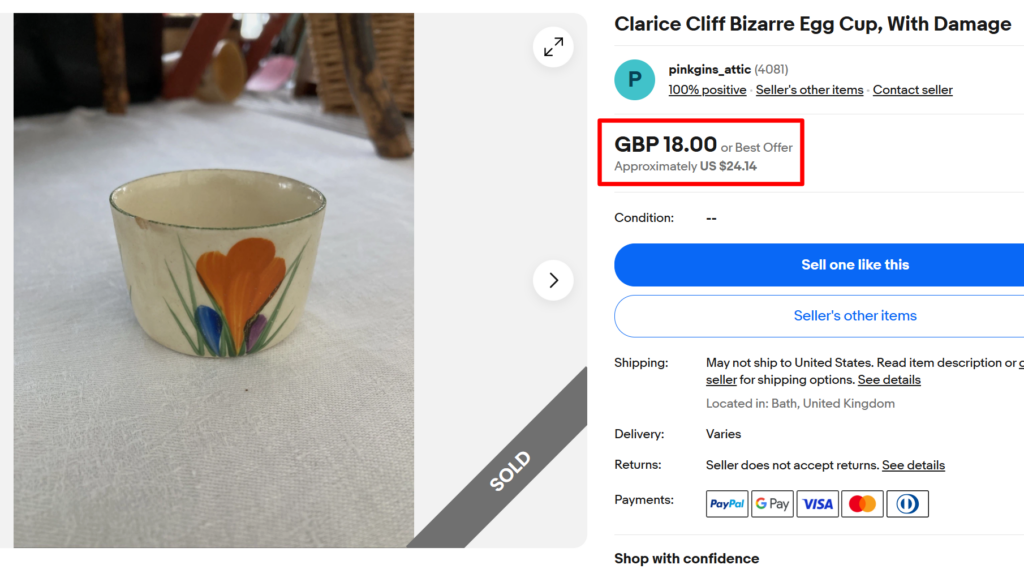
| Average Value | $25–$50 (good condition) |
| Production Period | 1927–late 1930s |
| Brand/Pattern | Newport Pottery – Clarice Cliff Bizarre |
| Collectibility | High |
| Collector Notes | Look for “Bizarre by Clarice Cliff” stamp |
Clarice Cliff revolutionized Art Deco ceramics with her “Bizarre” line, known for bold, hand-painted geometric and floral shapes. These egg cups from the line feature her most famous “Crocus” pattern – vibrant and thick orange, blue, and purple flowers on a cream base.
Even single Crocus cups are valuable today! Because these were hand-painted, every cup (with the same pattern) has slight variations. To verify a genuine piece, look for the “Bizarre by Clarice Cliff” backstamp in black or gold!
What to Check When Collecting Old Egg Cups?
Whether you’re collecting or selling old egg cups, there are a few things you need to check to identify and evaluate the piece correctly. Pay attention to the following:
The Maker’s Mark
Flip the cup and try to trace a mark on the base. These marks can tell you the maker, the country of origin, and often the production period of your piece. Simply note the mark and do your research to identify it.
Also, remember that not all vintage egg cups will be marked. And unmarked egg cups from known makers (like Fire-King Jadeite) don’t necessarily mean they are not authentic.
But unmarked egg cups from makers who always marked their work are a red flag.
Material Quality
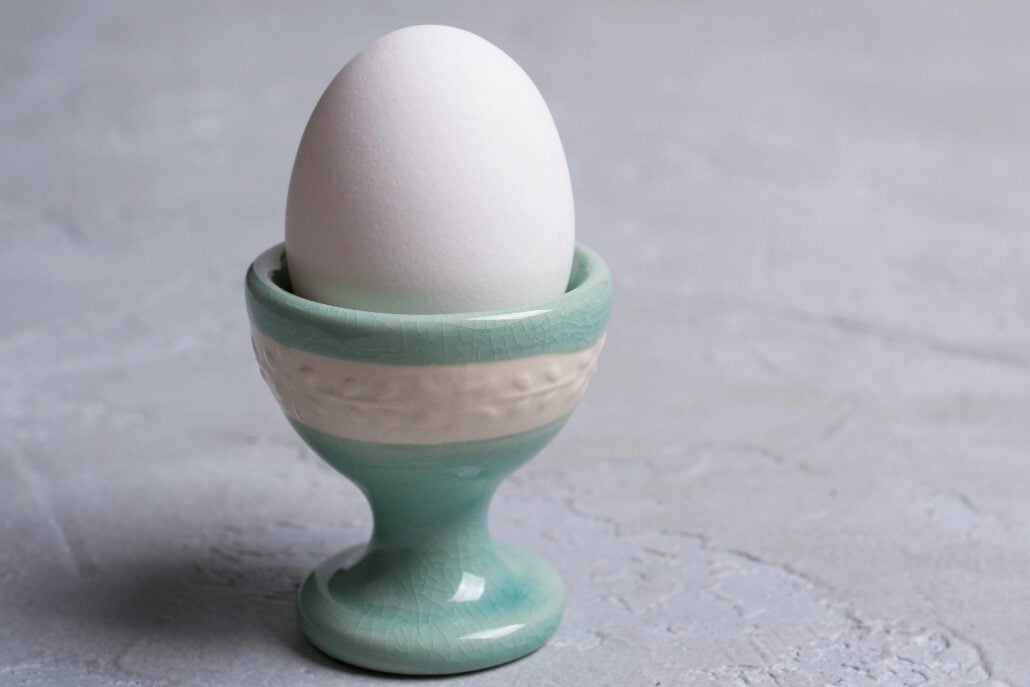
Feel the weight and texture of your cup; it should match the feel of the authentic pieces. For example, fine bone china (Shelley) should be translucent, Jasperware (Wedgwood) should feel matte like a stone, and Jadeite (Fire-King) should have a smooth, glass-like finish.
Also, original Sterling Silver cups must be heavy and have appropriate hallmarks on them.
Condition (Of Piece & Paint)
The rim and inside of the cup take the most damage. So, check for chips on the rim edge, which may be small and difficult to notice, inside staining, and hairline cracks from the base to the top. This reduces the item’s worth considerably.
Also, examine the pattern. On a piece with a transferred pattern, such as Spode, Delft, and Meissen, make sure the pattern is completely transferred and has not worn off.
On a piece with a hand-painted pattern, such as Clarice Cliff and Royal Crown Derby Imari, examine for signs of paint wear. This is important because paint loss on key motifs is hard to restore and reduces value!
Completeness
Matched sets of four or more egg cups, same maker, same pattern, same period, are worth considerably more than individual cups added up separately. Completeness matters, especially for silver sets and Royal Crown Derby Imari.
Note: This article is intended for informational, educational, and entertainment purposes only. Some images are illustrative and may not represent actual brands, products, or related entities. All trademarks, product names, brand logos, packaging, and other intellectual property referenced remain the exclusive property of their respective owners. Any brand mentions or references are provided solely for descriptive and educational context and do not imply any formal or commercial association.