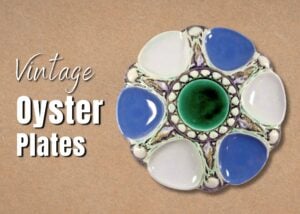
Antiques Know How Research
Vintage Oyster Plates Value
Our Antiques Know How team’s in-depth analysis of several eBay sales and auction results suggests that vintage oyster plates can range anywhere from $80–$2,000+, with high-end pieces from Minton and Haviland fetching the premiums. Most collectible plate designs are Mintons’ cobalt-turquoise Majolica, Haviland turkey-tail plates, George & Jones Co. shell plates, Theodore floral gilded plates, and Orchies multi-well servers. Value depends on makers, marks, unique glazes, rare patterns, well counts, and condition.
Antiques Know How
Oyster Plates & Their Popularity
Oyster plates, primarily made between 1860 and 1910, were designed specifically for serving oysters on the half shell and had five or six wells and sometimes a center well for serving sauces.
They can be divided into two categories: porcelain, such as the French style known as Limoges, decorated in either painted or transfer prints, and majolica, or earthenware, characterized by raised reliefs and colored lead glazes, popular in England.
Today, both styles are popular among collectors for their artistic look rather than functionality, since they make for interesting wall decor.
Top Vintage Oyster Plates from Notable Makers
Below are listed some of the most notable oyster plate designs from renowned brands that are actively collected today.
Mintons Oyster Plates
Mintons oyster plates are among the most collected in the category. Most features the classic design of six oyster wells separated by modeled shells and coral, surrounding a central sauce well.
Mintons made these in turquoise, cobalt, pink, and other solid colors, as well as mottled and malachite-effect glazes.
You can spot these plates by their unique colors and Mintons’ date cyphers impressed into the clay (usually a symbol-based code). For example, pieces marked “MINTON” predate 1873; after that year, the mark reads “MINTONS” (with an “s”).
1. Cobalt & Turquoise Majolica Plate
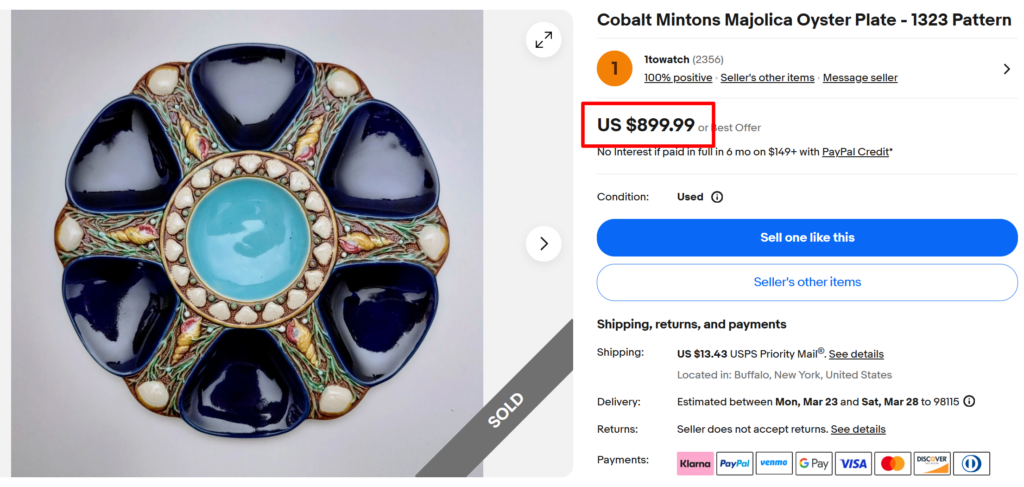
| Average Value | $600 – $1,200 per plate |
| Production Period | c. 1870s – 1890s |
| Collectibility | Very High |
| Collector Notes | Pattern no. & Minton mark on the back. |
The cobalt-dominant glaze with a turquoise center is among the more sought-after Mintons color combinations. This piece shows this palette with a raised border of shells, corals, and sea forms in cream and multi-color detail.
Mintons numbered their designs systematically, and the 1323 pattern number can sometimes be found alongside the maker’s mark on the reverse.
2. Cobalt Turquoise Oyster Cracker Plate
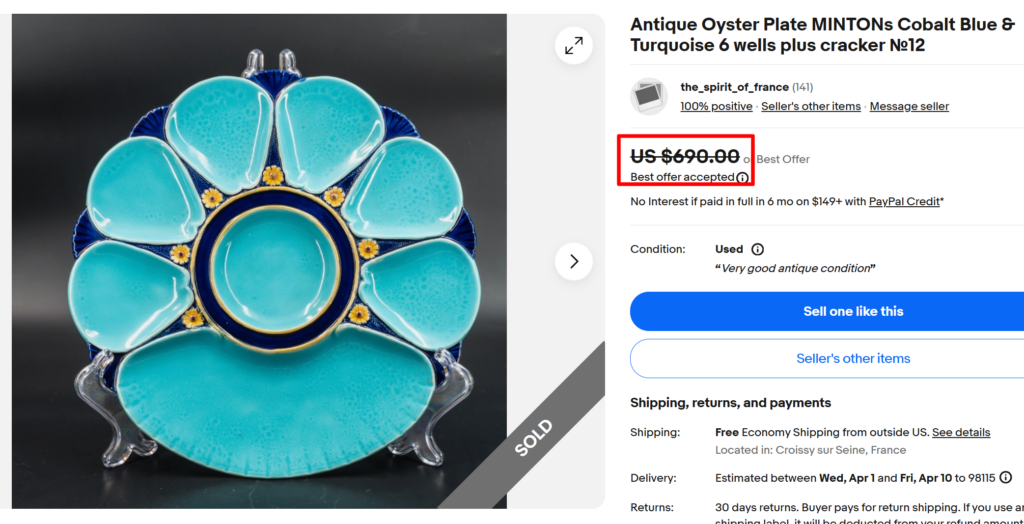
| Average Value | $500 – $800 per plate |
| Production Period | c. 1860s – 1900s |
| Collectibility | Very High |
| Collector Notes | Check for the Mintons mark & date cypher. |
This Minton piece features a unique design with six turquoise oyster wells set against a cobalt blue ground, with an elongated cracker well. You’ll also see small yellow daisy-style flowers at the joins between wells. This piece is desirable for its design and Minton’s iconic sea palette.
3. Flagship Yacht Club Oyster Plate
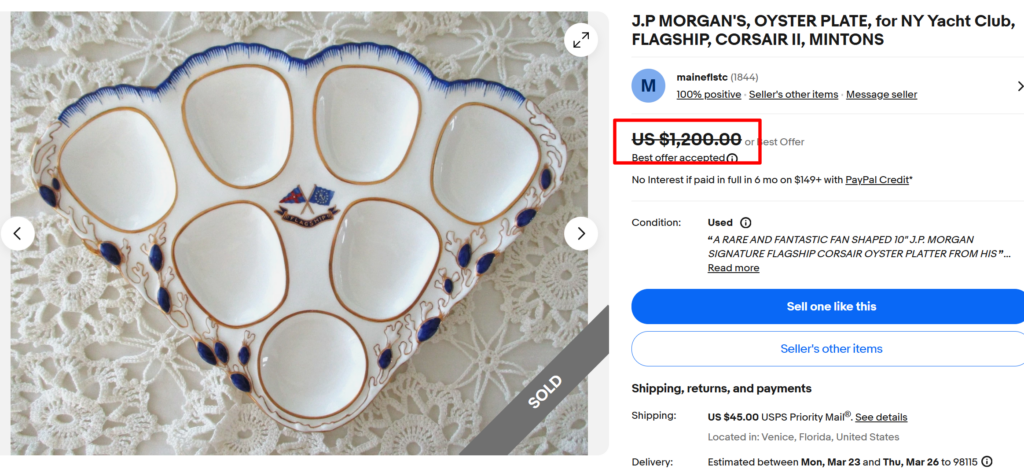
| Average Value | $800 – $2,000+ per plate |
| Production Period | c. 1890 |
| Collectibility | Extremely High |
| Collector Notes | Check Mintons mark, NYYC burgee, the house flag. |
Commissioned in 1890, this fan-shaped plate was made by Mintons exclusively for J. Pierpont Morgan’s steam yacht Corsair II. Morgan was Commodore of the New York Yacht Club from 1897 to 1899.
The plate features the NYYC burgee and crossed Commodore flags in hand-painted enamel, along with a blue banner reading “Flagship,” in white porcelain with navy blue trim and gold accents.
Thanks to their limited production and commissioned status, these oyster plates can be highly valuable.
Haviland & Co.
Based in France, Haviland revolutionized the oyster plates manufacturing with delicate porcelain and “turkey” styles. Their pieces were made in large quantities and decorated with everything from simple gold trim to elaborate hand-painted sea life.
4. Limoges Haviland & Co. Turkey Oyster Plate
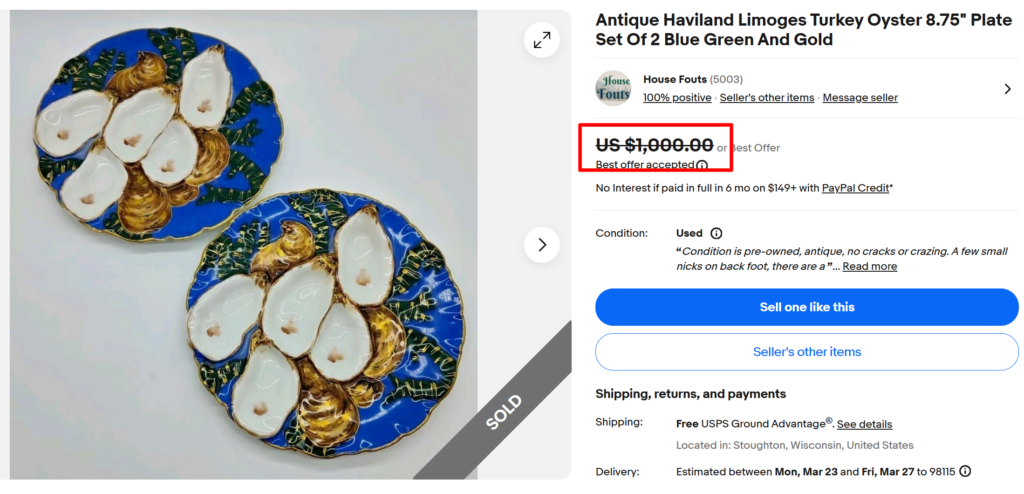
| Average Value | $300 – $600 (single) $800 – $1,500+ (pairs/set) |
| Production Period | c. 1880s – 1900s |
| Collectibility | High |
| Collector Notes | Pairs are worth more. |
The “Turkey” style describes a pattern of shells that resembles a turkey’s tail. This Haviland piece has a striking blue background with gold seaweed designs. The white oyster wells are set against a dark porcelain background.
These plates are often found in pairs or sets, which increases their value. The authenticity of these plates can be confirmed by the hand-painted designs and the “Haviland France” backstamp.
5. Gilt Thistle Flower Plates
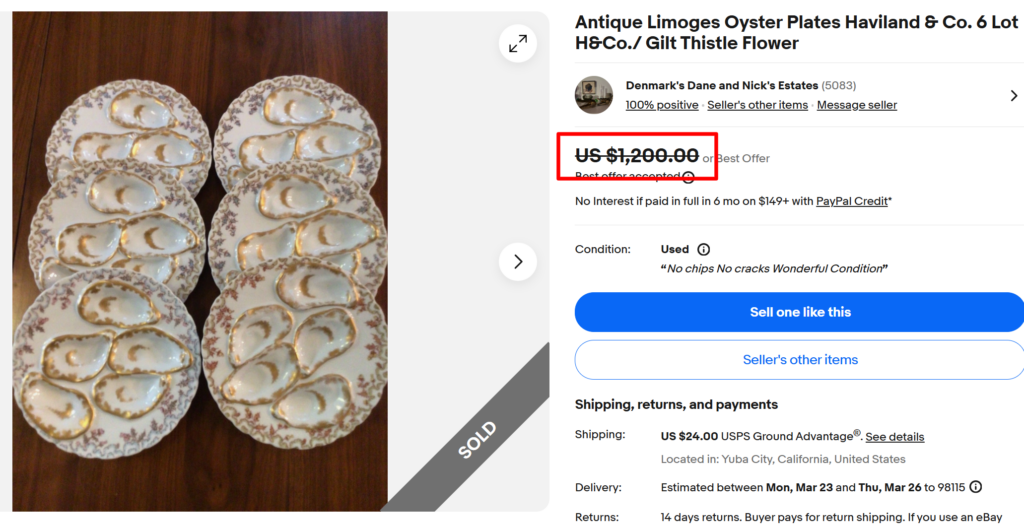
| Average Value | $120 – $200 (single) $900 – $1,500 (set) |
| Production Period | c. 1880s – 1900s |
| Collectibility | High (Set Premium) |
| Collector Notes | Check the “H&Co/L” green mark, the “Haviland & Co Limoges” red mark |
This set of six Haviland & Co. porcelain plates features the five gold-outlined well design with soft pink floral sprays and “thistle” motifs. A scalloped edge is another defining feature.
Each of these plates is marked twice on the reverse: a green underglaze factory mark and a red overglaze decoration mark, both Haviland & Co. While sets are worth more, even single plates can fetch $100 to $200+.
George & Jones Co.
George Jones was a premier producer of English majolica, often rivaling Minton in quality. In fact, some of his designs, especially the naturalistic flora and fauna patterns, are even more desirable than Mintons’.
GJ oyster plates are among the rarest and most actively sought pieces in the majolica category, often featuring 3D elements like relief-molded seaweed, snails, or small fish.
6. Turquoise Shell Plate
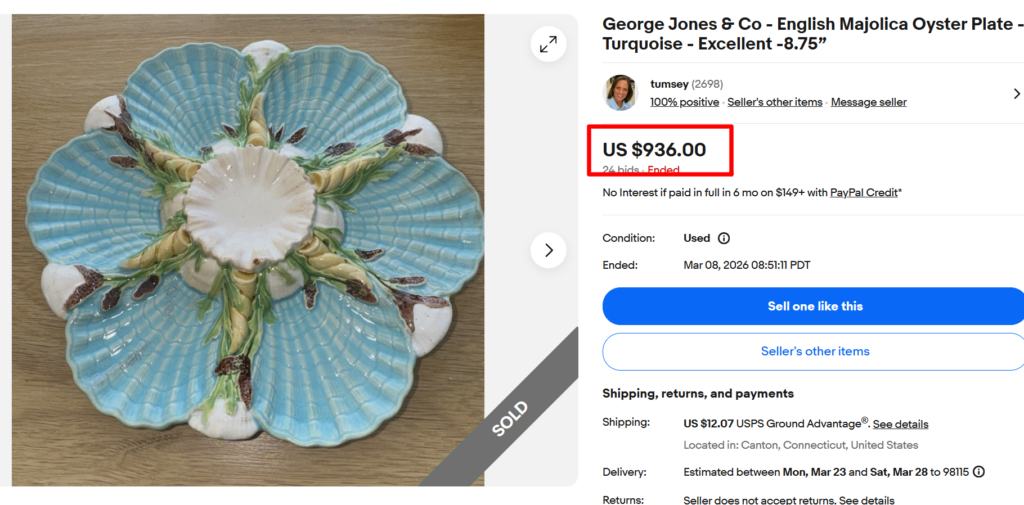
| Average Value | $600 – $1,200 (single) |
| Production Period | c. 1870s – 1890s |
| Collectibility | Extremely High |
| Collector Notes | A mottled brown-green glaze on the base |
This George Jones piece features large, overlapping pecten shells in a soft turquoise hue. A central raised shell acts as the sauce reservoir, surrounded by intricately molded seaweed and small shells.
The scallop shell motifs at the edge are a Jones design feature that appears across several of his oyster plate patterns. Also, you’ll see a small “thumbprint” area on the back with an ink pattern number.
7. Brown Aquatic Porcelain Plate
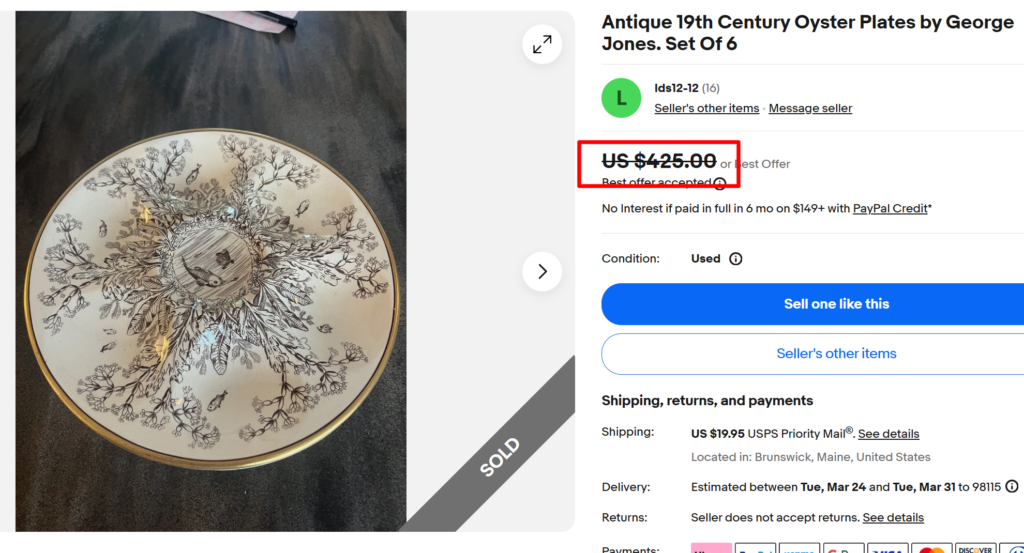
| Average Value | $300 – $600 (single) $500 – $1,000+ (set) |
| Production Period | c. 1870s – 1890s |
| Collectibility | Very High |
| Collector Notes | Check the GJ mark for authenticity. |
Unlike the vibrant majolica, this George Jones plate features a sophisticated black/brown-on-white transfer design; a distinction from the colorful shell-shaped plates. It shows various fish and aquatic plants in a scientific, “naturalist” style.
George Jones produced a range of naturalistic marine designs for his dining wares. Complete sets of these plates are a rare find and fetch a lot more.
8. Theodore Pink Flower Oyster Plates
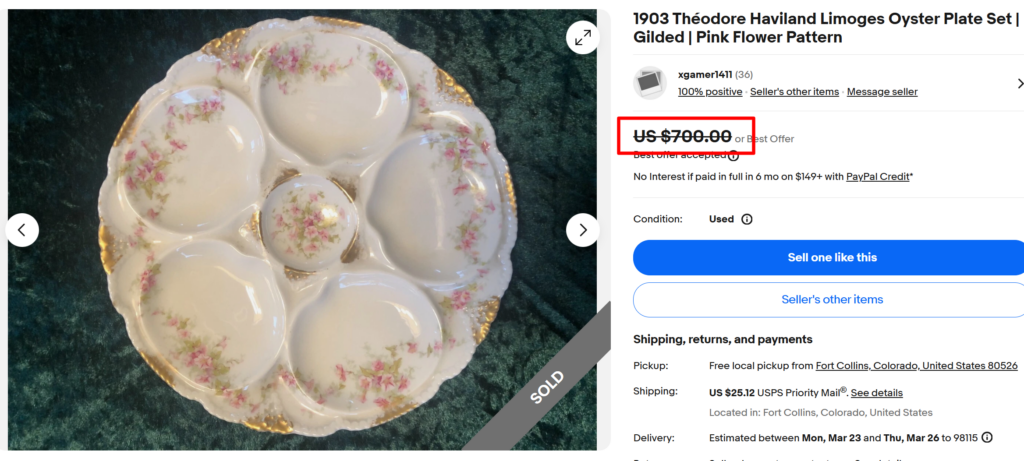
| Average Value | $400 – $700 per plate |
| Production Period | c. 1892 – 1910s |
| Collectibility | High |
| Collector Notes | Check the backstamp to confirm the date. |
This 1903 Theodore plate is a classic example of the “wedding-gift” style of oyster plates. It features six soft, shell-shaped wells decorated with dainty pink flowers. The heavy gold encrustation on the scalloped edges gives it a regal look.
Since these floral patterns are often reproduced, check for the “Theodore Haviland, Limoges, France” mark for authenticity and to date the piece.
9. Charles Field Haviland Blue Floral Oyster Plates
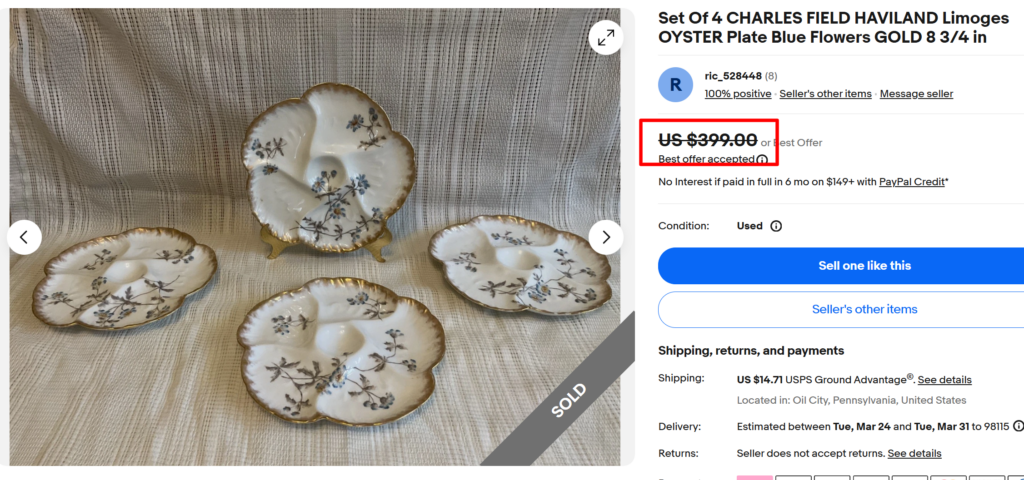
| Average Value | $80 – $150 (single) $300 – $600 (set) |
| Production Period | c. 1870s – 1910s |
| Collectibility | Moderate to High |
| Collector Notes | Check for the CFH/GDM backstamp. |
This scalloped-edge porcelain plate has five overlapping oyster wells arranged around a central sauce well. The design features painted blue floral sprigs and gold trim throughout the rim.
Plates with this blue floral pattern often show several backstamp variations depending on production date. The “CFH/GDM” mark dates these to post-1882.
Individual plates in this pattern are modestly priced; intact matched sets of four or more in good condition are worth more.
10. Adams & Bromley Majolica Oyster Plate
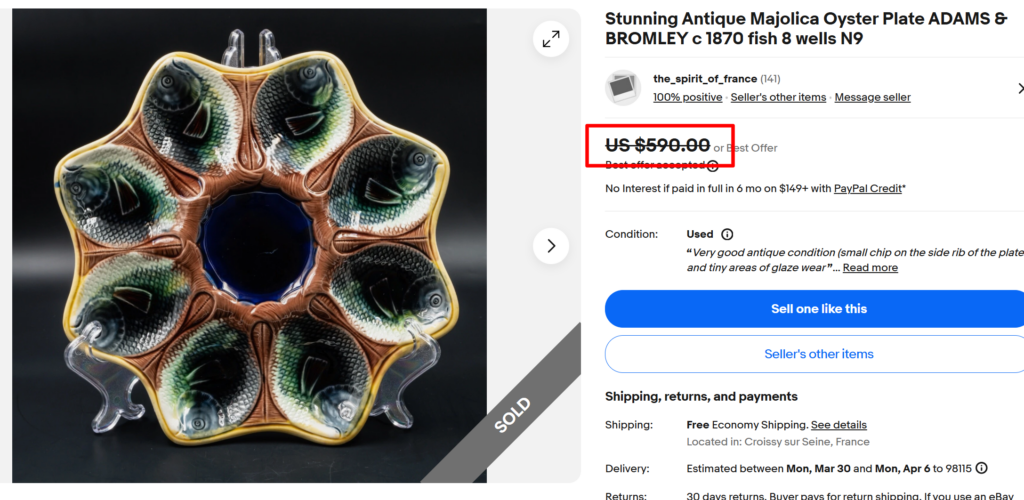
| Average Value | $450 – $700 per plate |
| Production Period | 1870 |
| Collectibility | Very High |
| Collector Notes | Most pieces were left unmarked. |
This English maker is famous for some of the most creative and colorful 19th-century majolica. They often used “trompe l’oeil” techniques to make their ceramics look like real objects, such as wicker or actual fish.
Adams & Bromley created five distinct oyster plate designs, all in majolica. Their most recognized is the fish-themed design, where each oyster well is modeled as a fish surrounding a central cobalt well. The “mottled” brown-and-green glaze was a signature of the Adams & Bromley pieces.
Most Adams & Bromley majolica were unmarked, making it hard to identify. But the fish design is a standout.
11. Orchies (Moulin des Loups) Oyster Plate
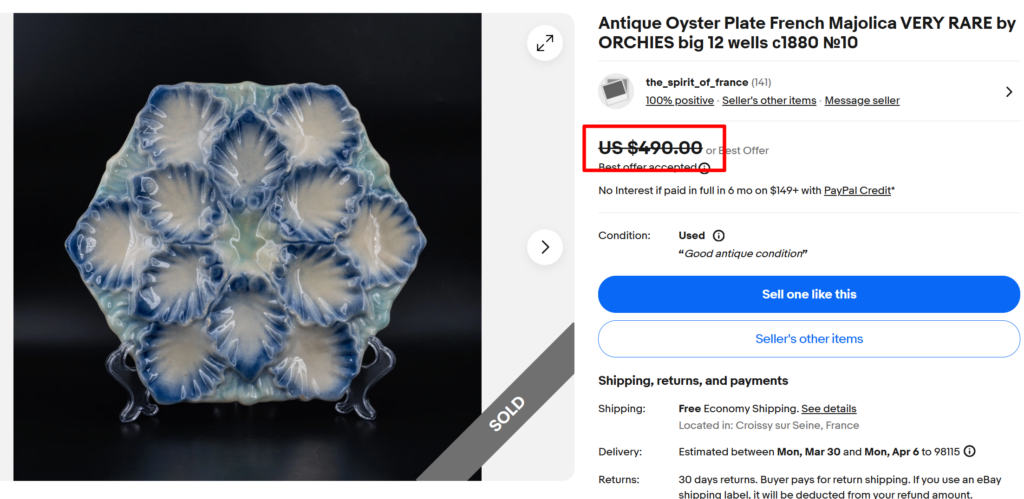
| Average Value | $300 – $600 per plate |
| Production Period | c. 1880s – 1950s |
| Collectibility | Moderate to High |
| Collector Notes | 12-well design is rarer than 6-well design. |
Orchies French majolica is famous for its “shell on shell” style. These wares usually do not have a central reservoir; instead, they have a geometric arrangement of realistic oyster shells that cover the entire plate.
This rare hexagonal plate has twelve wells shaped as oyster shells with a naturalistic wavy rim, glazed in blue-to-cream ombre. Twelve-well Orchies servers are less common than the standard 6-well plates, making them more desirable, too.
Note that some pieces may show the “Orchies” mark in blue or green on the back, often with a pattern number.
12. Marx & Gutherz Triangle Oyster Plates
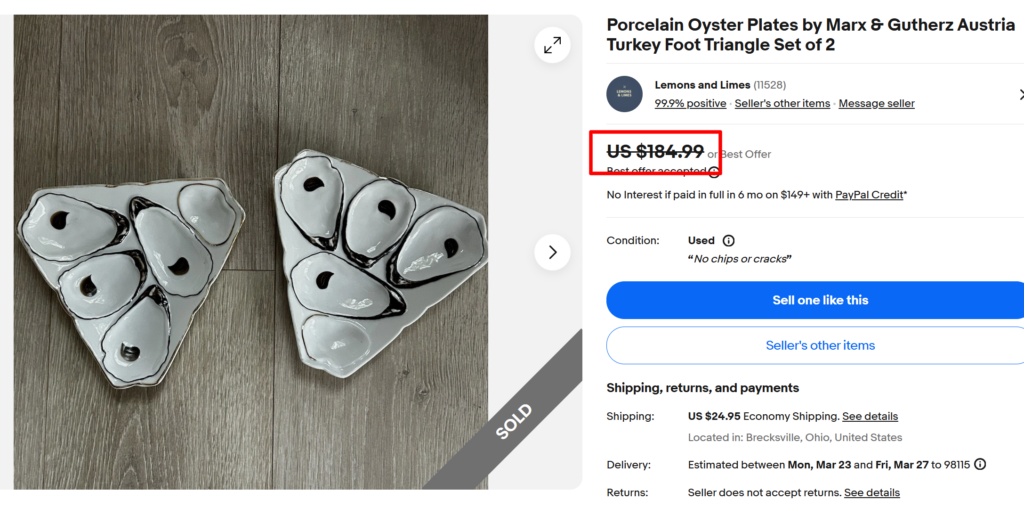
| Average Value | $80 – $120 (single) $150 – $250+ (pair/set) |
| Production Period | c. 1890 – 1910 |
| Collectibility | Moderate |
| Collector Notes | Look for a hand-painted number or mark. |
Marx & Gutherz’s oyster plates stand out with their unique shapes, often square or fan-shaped, in white porcelain. This triangular plate features a “Turkey Foot” arrangement, with three shell wells converging toward a point.
The white porcelain is accented with realistic, dark-pigmented details around the shell hinges. Although moderately valuable, such a rare shape makes these Marx & Gutherz plates collectible.
What Makes Old Oyster Plates Valuable?
As we saw, the value of vintage ranges from $50 to $1,000 or more. The following factors separate a low-value plate from a high-value plate:
- Maker and Mark: Plates made by top English manufacturers (Mintons, George Jones) and important French manufacturers (Haviland, Charles Field Haviland) can be worth substantially more than those that are not marked. Always check the underside for marks.
- Material: Oyster plates mostly appear in Majolica and porcelain. Majolica pieces, with their three-dimensional molded designs and colored lead glazes, are usually more valuable than porcelain examples. Mintons and George Jones majolica pieces are the most valuable.
- Design and Rarity: Not all similar designs are worth the same. For example, cobalt-and-turquoise color combinations from Mintons, the cracker-well design, and the fish-head wells from Adams & Bromley; specific designs are rarer than the standard designs.
- Number of Wells: Standard oyster plates have five or six wells. Plates with four, nine, or twelve wells are rarer and often command a premium price. More wells also sometimes indicate an earlier production period.
- Condition: Either Majolica or porcelain, glaze chips to the raised modeling, crazing (fine surface cracking), and significant gold loss all reduce value. A George Jones plate with intact shells and no chips will sell for 2-3 times what the same plate with a chipped border might bring.
Note: This article is intended for informational, educational, and entertainment purposes only. Some images are illustrative and may not represent actual brands, products, or related entities. All trademarks, product names, brand logos, packaging, and other intellectual property referenced remain the exclusive property of their respective owners. Any brand mentions or references are provided solely for descriptive and educational context and do not imply any formal or commercial association.