Antiques Know How Research
Pyrex Cinderella Bowls
According to the Antiques Know How team’s detailed review of several eBay sales, vintage Pyrex Cinderella bowl sets sell for $30–$150, while rare patterns and colorways commonly range from $200–$1,500+. Most collectible Pyrex Cinderella Bows include Pumpkin Orange Amish Butterprint, British Robin Egg Blue Gooseberry, Pink Gooseberry, Hot Air Balloon chip-and-dip bowls, Turquoise Scroll, and Colonial Mist (NIB). The value depends on completeness, pattern rarity, original boxes, and condition.
Antiques Know How
Pyrex Cinderella bowls are a very common vintage kitchenware piece that you’ll see at thrift stores or garage sales. Most bowls sell for $30 to $150 for a four-piece set.
But what many collectors don’t know is that certain patterns and colorways, like Pink Gooseberry, Pumpkin Butterprint, or the British JAJ Duck Egg Gooseberry, can actually be worth $500 and sometimes $1,000.
If you’re planning to buy or sell vintage Pyrex Cinderella bowls, save this guide to learn about the most collectible patterns, rarity, and other things that determine value.
What Makes a Pyrex Bowl a “Cinderella”?
Corning introduced the Cinderella mixing bowls in 1957, designed by John Phillip Johnson. You can tell them apart instantly by the shape. Cinderella bowls have two opposing flares at the rim. One side acts as a pour spout, the other as a grippable tab handle.
Although these sit alongside the older round 400-series bowls, the round bowls have no spout or handle. The name reportedly came from the era’s enthusiasm for the Cinderella story, which was running on Broadway and in film. The “slipper” silhouette of the flared rim made the nickname stick.
Cinderella bowls were sold as four-piece nesting sets and reused most of the popular Pyrex patterns of the era. That overlap is what makes complete, matching sets the most valuable form to find today.
The 441-444 Cinderella Bowls Sizing System
Every Cinderella nesting set uses four sizes, marked on the bottom of each bowl along with the PYREX MADE IN USA stamp.
| Model | Capacity | Diameter (tab to tab) | Typical Role |
| 441 | 1.5 pint | About 7.5 in | Prep, dip, small mixing |
| 442 | 1.5 quart | About 9.25 in | Mixing, serving |
| 443 | 2.5 quart | About 10.75 in | Larger mixing |
| 444 | 4 quart | About 13 in | Batter, big batches, chip bowl |
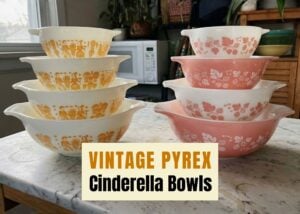
Generally, 441 & 443 have a common coloring scheme, whereas 442 & 444 alternate the other way around. The Pink Gooseberry pattern is pink on white for 441 & 443, and white on pink for 442 & 444. If your “set” of bowls does not alternate in this fashion, then you have mismatched bowls.
Collector’s Tip: If you have a whole set of 441, 442, 443, 444 that matches in design, it can be worth two to three times the price of them separately.
How to Identify Authentic Vintage Cinderella Bowls?
A few details separate real vintage Pyrex Cinderella bowls from reproductions and modern Pyrex.
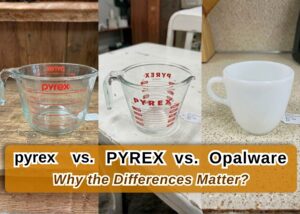
- Bottom Stamp: First of all, check for the PYREX logo written in all caps, with the phrase “MADE IN USA” below the model number. The lowercase “pyrex” indicates newer glass made in other countries since 1998.
- Silk-screen Paint: Original patterns were silk-screened and fired on. Run your finger across the design. You should feel almost nothing because the pattern sits flush with the glass. Reproductions and re-decorated pieces feel raised or sticky.
- Glass Color: Genuine Pyrex opalware should glow milky white when held up to a strong light. Solid-color bowls (the turquoise of Butterprint, the pink of Gooseberry) have color throughout the glass, not painted on top.
- Pattern Application: On alternating bowls, the smaller two (441, 443) normally have the design with a white background, while the larger two (442, 444) have the design with a solid background.
10 Most Valuable & Rare Pyrex Cinderella Bowls Patterns
1
Pink Gooseberry Bowls
Typically sells for $300 to $700+
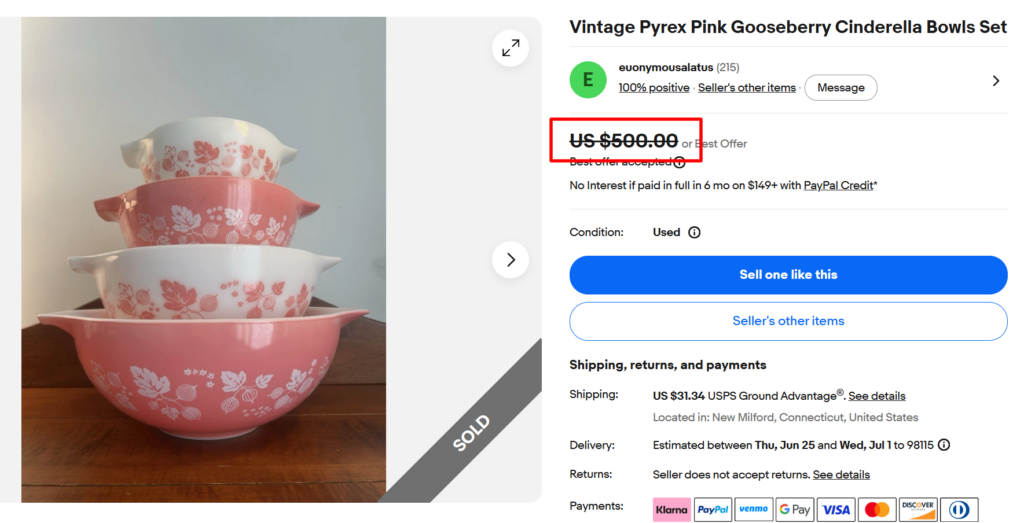
Pattern Years: 1957 to 1966
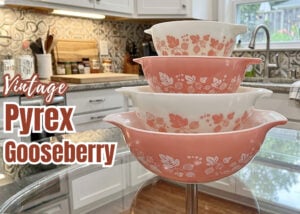
One of Pyrex’s most popular patterns, Gooseberry features the leaves, flowers, and fruits of the gooseberries in alternating pink and white on all four bowls.
The Gooseberry in pink garners more attention than the other two, black on white and black on yellow, because of the nostalgia attached to the pink kitchenware from the mid-century.
A complete set of four bowls can easily fetch $500, even more if found new in the box.
2
Pumpkin Orange Amish Butterprint Bowls
Typically sells for $800 to $1,500+
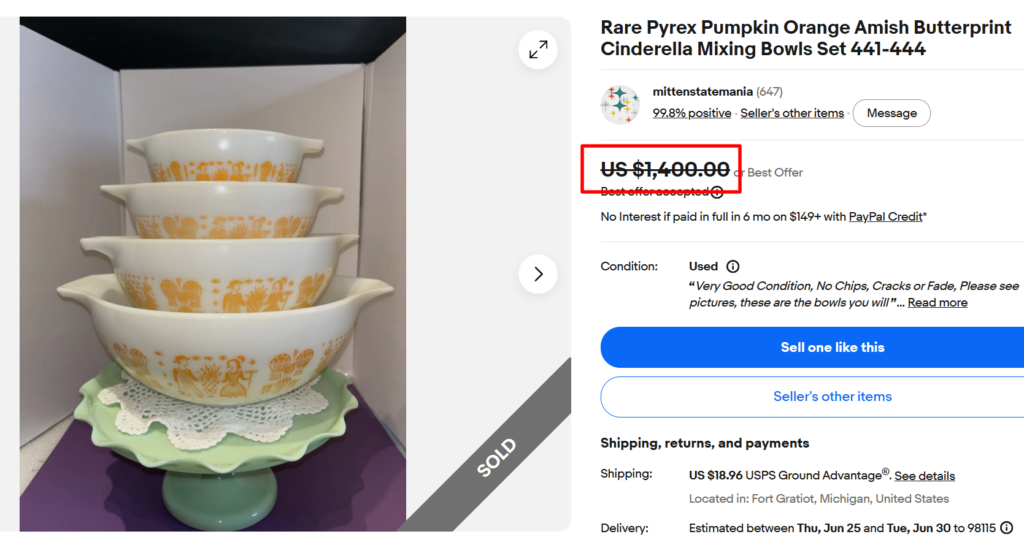
Pattern Years: 1957 to 1968 (standard turquoise); Pumpkin Orange offered 1965 to 1967
Butterprint features the Amish farmer and wife holding crops, surrounded by corn, roosters, and wheat sheaves. Turquoise on white is the most common color for this pattern.
The Pumpkin Orange variation, like the one shown, was a short-run S&H Green Stamp promotional set redeemable only with a completed stamp book in 1965 to 1967.
That’s why complete orange Butterprint Cinderella Bowls usually sell for $800 to $1,500 today.
3
Town & Country Bowls
Typically sells for $120 to $300
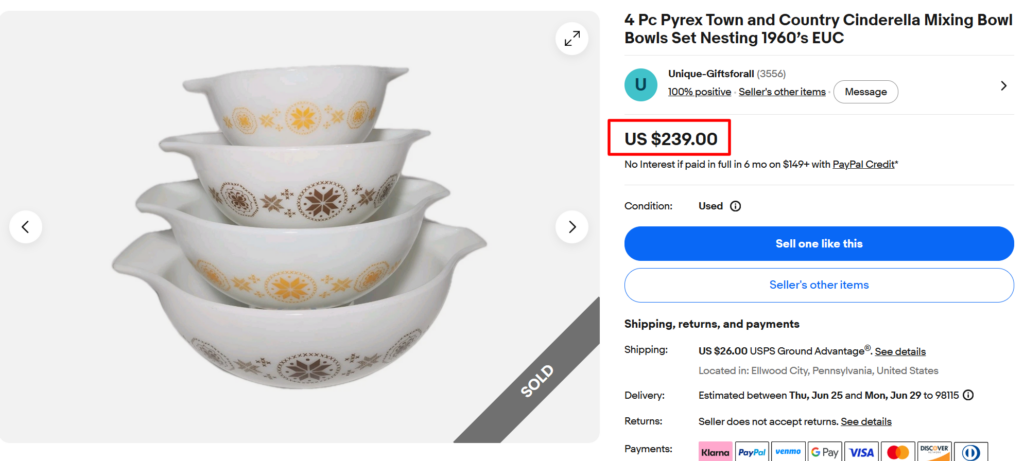
Pattern Years: 1963 to 1967
Town & Country uses a geometric Penn Dutch cross-stitch pattern that hints at hex sign symbolism. The full four-piece Cinderella set typically alternates: solid brown, solid orange, solid yellow, and one decorated white 444 with both brown and orange motifs.
Because Pyrex sold this in a few configurations (and one entirely solid-color variation), mismatched “sets” are common. Original matched sets can reach up to $300.
4
Spring Blossom Green / Crazy Daisy Bowls
Typically sells for $80 to $500+ (NIB)
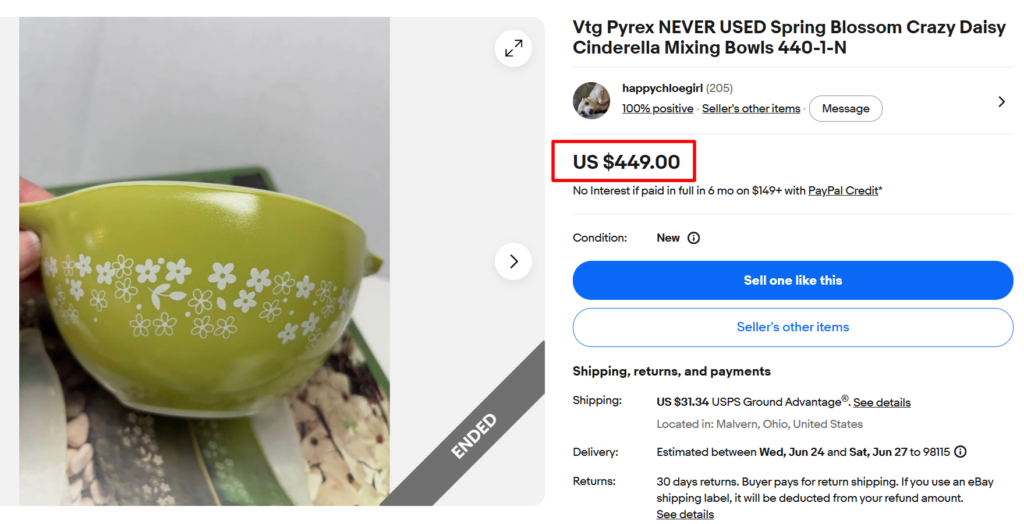
Pattern Years: 1972 to 1979
Spring Blossom Green, often called Crazy Daisy, was part of the Pyrex Compatibles line designed to coordinate with Corelle Livingware. It ran for seven years, which makes the standard set relatively easy to find.
What drives the price is the condition. Mint, unused, complete Pyrex Spring Blossom Cinderella bowl sets are genuinely scarce and can sell for up to $500.
5
Homestead Bowls
Typically sells for $90 to $250
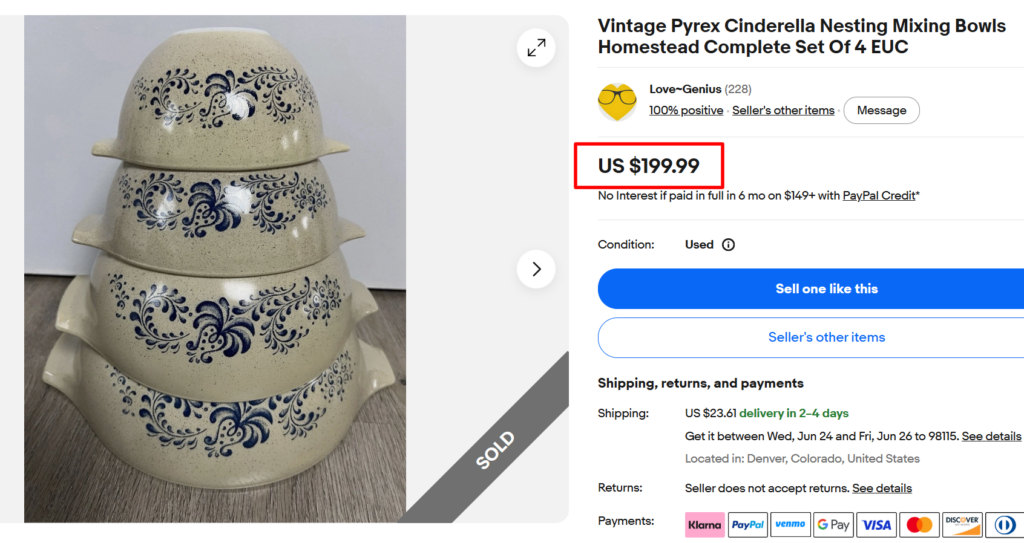
Pattern Years: 1976 to 1980
Homestead was Corning’s answer to the ‘seventies ’70s trend of country living, inspired by Pfaltzgraff stoneware. It features a mottled cream body with swirling blue motifs that look almost like hand-painted folk pottery.
Homestead coordinated with the Old Town Blue dinnerware line made by Corelle, making it highly collectible.
6
Blue White Colonial Mist Bowls
Typically sells for $00 to $600 (NIB)
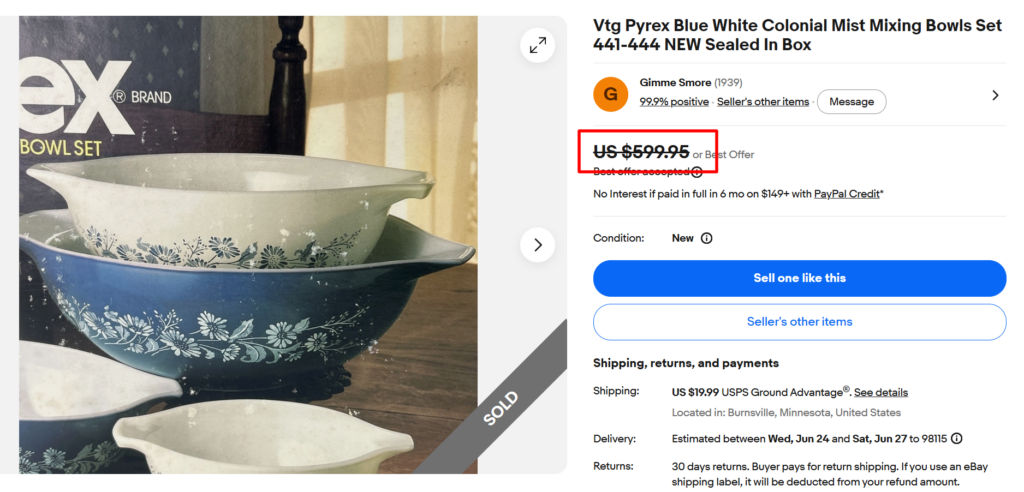
Pattern Years: 1983 to 1986
Colonial Mist was the final standard Pyrex pattern collection introduced before opal production wound down. It coordinated with Corelle’s Colonial Mist dinnerware. You can spot it by a floral pattern of large-petal daisies around the bowl.
Sealed-in-box examples like this 441–444 set are particularly hard to find and sell the highest, because most were opened and used.
7
Robin Egg Blue Gooseberry Bowls
Typically sells for $700 to $1,500+
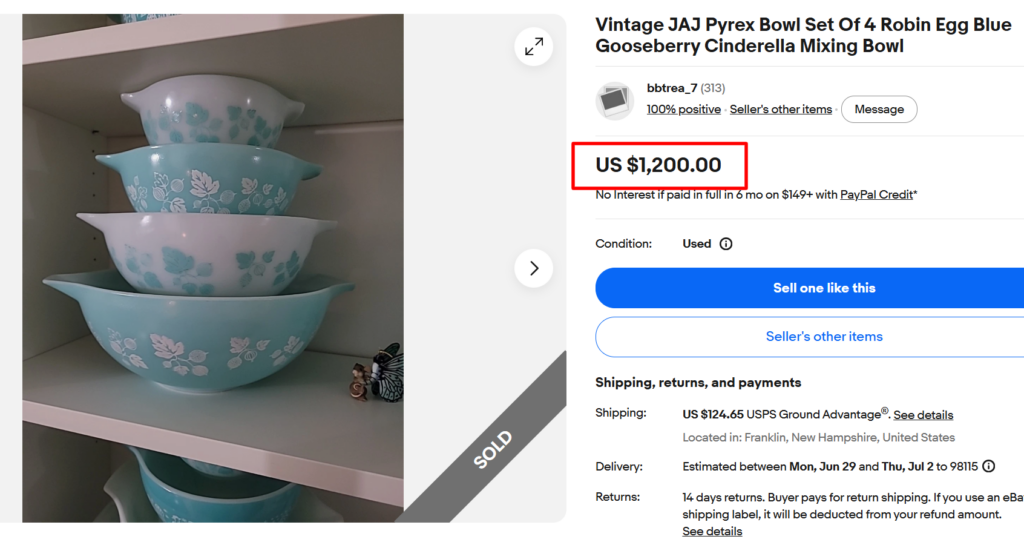
Pattern Years: 1960 to 1962
The JAJ Pyrex line of Corning’s Pyrex products is a British version of Corning’s Pyrex that was licensed to James A. Jobling. The colorway of Gooseberry in Duck Egg Blue (Robin Egg Blue) was manufactured exclusively in England and not in the USA.
Also, bottom markings include a tiny crown and not “MADE IN USA” on the original Pyrex. Complete matching four-bowl sets like this one are far rarer than the American Pink Gooseberry.
8
Turquoise Scroll Bowl
Typically sells for $50 to $200
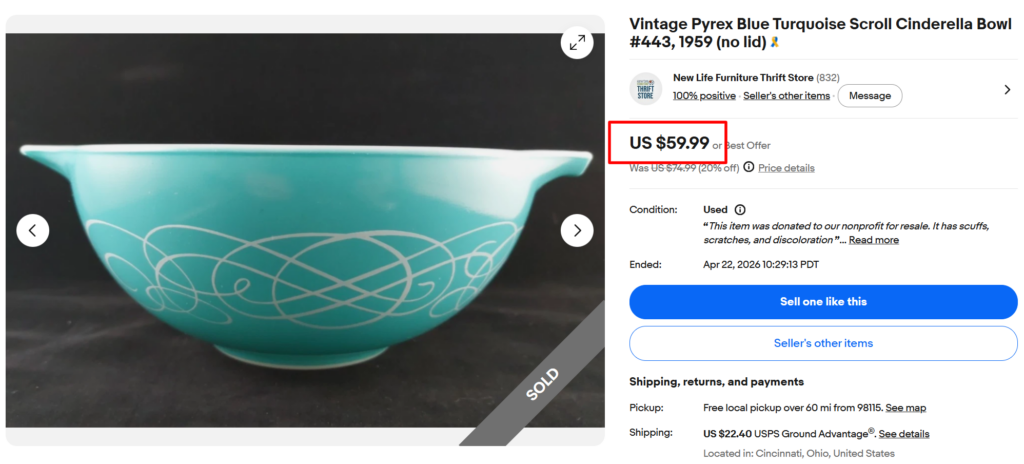
Pattern Years: 1959 only
Turquoise Scroll was a one-year 1959 promotional pattern, and it was only ever made in the 2.5-quart 443 size. There is no full nesting set to find. That single-size, single-year production is exactly why the bowl gets collector attention.
The design, just like the name, features smooth, white scrolls on a turquoise body. Since it’s a single piece, the value lies in the condition; a clean bowl with the original cradle and lid can easily clear $200.
9
Hot Air Balloon Chip & Dip Bowls
Typically sells for $300 to $700+
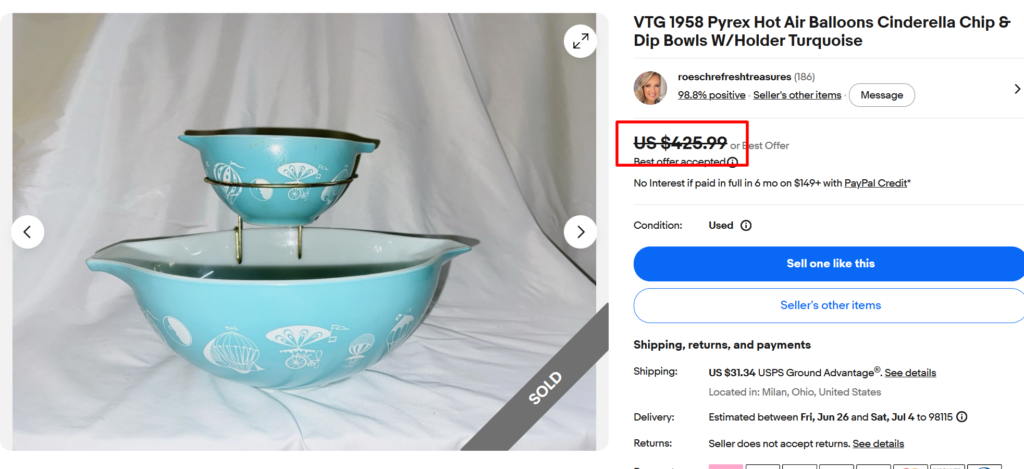
Pattern Years: 1958 only
Officially unnamed by Corning and nicknamed “Balloons” by collectors, this set pairs a 444 turquoise chip bowl with a 441 dip bowl on a brass cradle. It was the very first patterned promotional chip-and-dip Pyrex offered, and the entire production was a single year in 1958.
The two bowls were never sold separately at retail, so loose 441s or 444s in this pattern came from broken-up sets. A complete set with the original cradle can fetch up to $500 or more.
10
Snowflake Garland Bowls
Typically sells for $150 to $400+
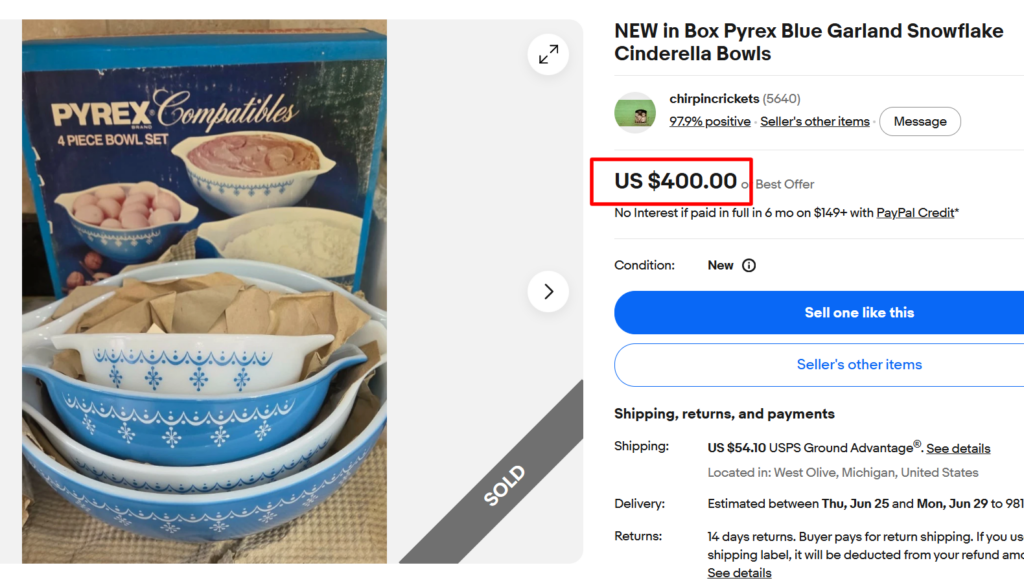
Pattern Years: 1972 to 1976
Snowflake Blue is unofficially called “Garland” because of the swag-like chains of snowflakes and dots, though the original Pyrex Compatibles ads always called it Snowflake Blue.
It was one of the three launch patterns of the Compatibles line, alongside Butterfly Gold and Spring Blossom Green. New-in-Box sets with the original Pyrex Compatibles carton are quite collectible.
What Drives Cinderella Bowl Values?
As you can see above, the value of Pyrex Cinderella bowls can range from tens to a thousand dollars or more. Apart from the pattern, here are the other factors that determine the value:
- Dishwasher Fade: Fading due to dishwasher use is by far the largest devaluing factor. The original silk-screened paint starts to lose its vibrancy and definition after a couple of passes through the dishwasher, and once it’s gone, it’s gone.
- Completeness: Four matching bowls in the same pattern with no chips, all the original alternating colors intact, beats two cherry-picked bowls every time. Also, original boxes are crucial for top value as they can add 30 to 50 percent.
- Condition: Condition is mainly what separates a $40 set from a $400 set in the same pattern. Crazing, chips, and cracks decrease the value significantly, especially since they occur most frequently on the spout and handle areas. Run your fingernail along the rim and tab area to find hairline cracks.
- Pattern Rarity and Production Length: One-year promotionals (Hot Air Balloons, Turquoise Scroll, Lucky in Love) and short-run color variations (Pumpkin Butterprint, Duck Egg Gooseberry) will always sit at the top.
Caring Tips for Pyrex Bowls to Protect Value
First and most important tip. Always hand-wash Pyrex bowls, even if you intend to use them. Next, do not put old Pyrex in the microwave. And do not place hot bowls on a cold countertop or vice versa; this is what causes crazing.
If you plan on stacking a set, put some felt or paper between the bowls in order to prevent the tab handles from damaging the paint on the body of the bowls.
When selling your set, make sure to take pictures of the stamps on the bottom and write down the model numbers of your bowls. Buyers who know Cinderella bowls will appreciate it.
Note: This article is intended for informational, educational, and entertainment purposes only. Some images are illustrative and may not represent actual brands, products, or related entities. All trademarks, product names, brand logos, packaging, and other intellectual property referenced remain the exclusive property of their respective owners. Any brand mentions or references are provided solely for descriptive and educational context and do not imply any formal or commercial association.