A 1931 Lincoln penny is a key-date coin many collectors look for in old jars and pocket change today. Despite a total mintage of over 24 million, this coin has sold for impressive prices; a San Francisco strike sold for $43,200 at Heritage Auctions.
Understanding what makes a 1931 wheat penny valuable, how to spot the genuine examples, and which varieties are rare will save you from overlooking a rare find.
| 1931 Wheat Penny | Specification |
| Coin Composition | 95% copper, 5% tin and zinc (bronze) |
| Minting Location | Philadelphia, Denver, San Francisco |
| Year of Minting | 1931 |
| Face Value | $0.01 (one cent) |
| Weight | 3.11 grams |
| Diameter | 19 mm |
| Thickness | 1.52 mm |
| Edge | Plain |
| Designer | Victor David Brenner |
| Mint Marks & Mintage | No mint mark (Philadelphia): 19,396,000 · D (Denver): 4,480,000 · S (San Francisco): 866,000 |
| Total Mintage | 24,742,000 |
How to Identify an Authentic 1931 Wheat Penny?
A genuine 1931 Lincoln wheat penny is easy to spot when you know the original design details, mint marks, and physical features. Check the following details one at a time to verify your coin:
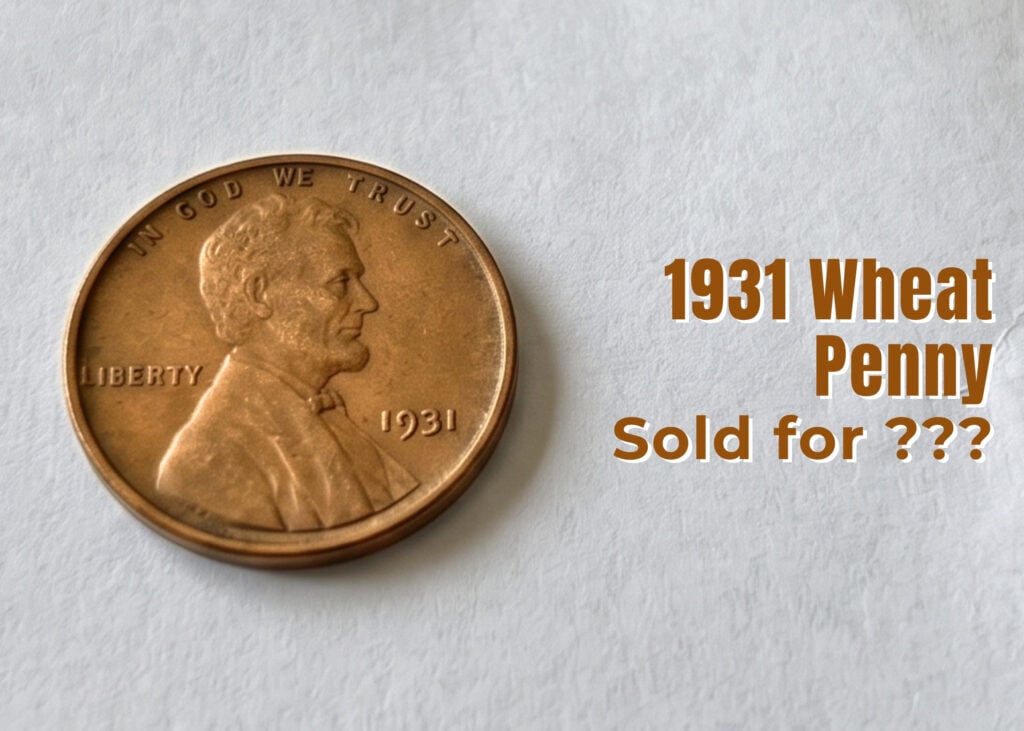
1931 Penny Obverse:
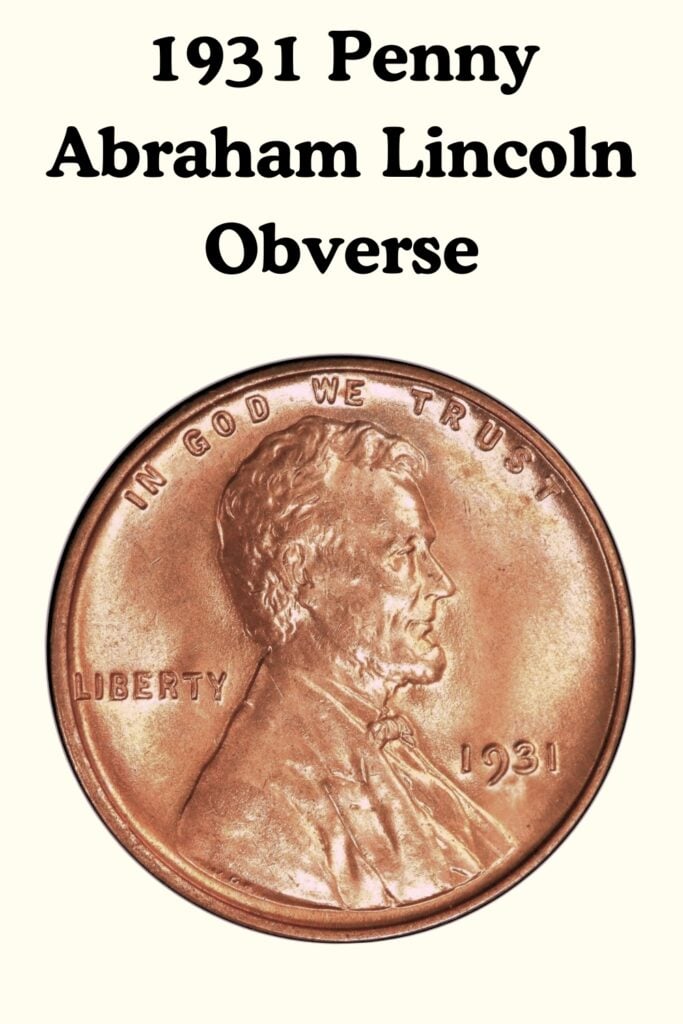
- Portrait: Abraham Lincoln faces right, shown from the shoulders up.
- Motto: “IN GOD WE TRUST” arcs across the top.
- LIBERTY: Sits to the left of Lincoln’s bust.
- Date: “1931” appears on the right, near the rim.
- Mint mark: A small D or S below the date. No letter means Philadelphia.
- Designer’s initials: A tiny “VDB” sits on the lower edge of Lincoln’s shoulder, where it has appeared since 1918.
1931 Penny Reverse:
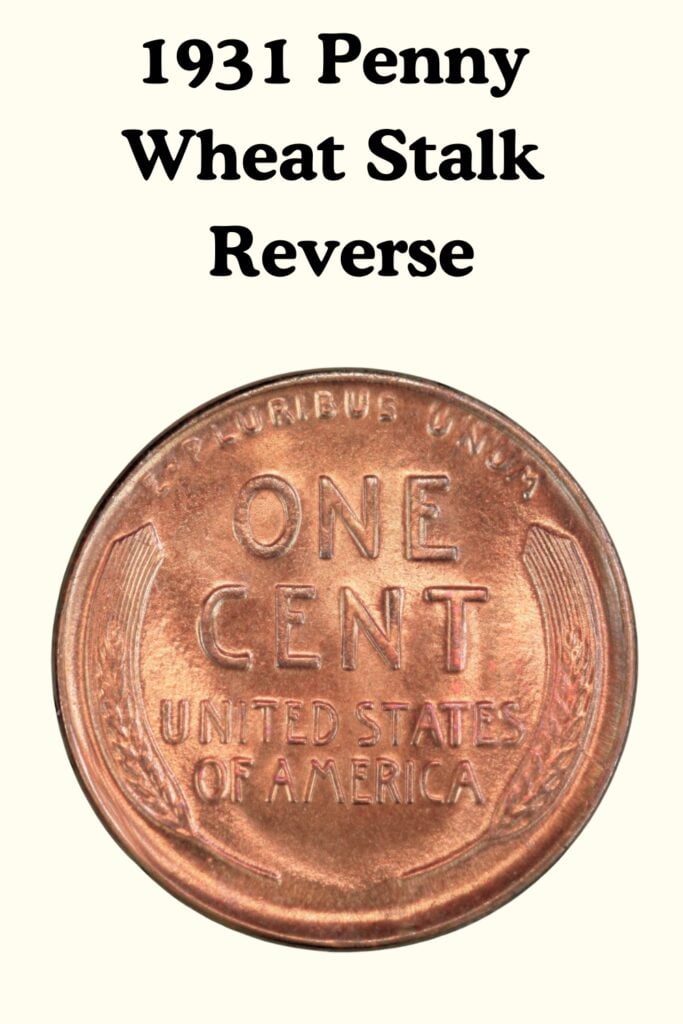
- ONE CENT: Large letters in the center.
- Wheat ears: Two stalks curve along the edges, which gives these coins the “wheat back” nickname.
- E PLURIBUS UNUM: Runs across the top in small letters.
- UNITED STATES OF AMERICA: Sits directly below ONE CENT.
Weight & Metal
Real 1931 Lincoln cents consist of bronze material, which is 95% copper alloyed with 5% zinc and tin. Additionally, each coin must weigh 3.11 grams and measure 19 mm wide.
Use a scale to weigh yours down to two decimal places. Weighing too low indicates damage, plating, or forgery.
Since bronze does not attract magnets, a magnetic 1931 bronze penny is fake. Also, bronze takes on a brown hue over time; new bronze has a deep orange-red appearance.
1931 Lincoln Wheat Penny Price Guide
A 1931 Lincoln penny can be worth $1 to $30 for completely worn Philadelphia examples, and $10,000 to $50,000 for fully Red Mint State condition and rare San Francisco varieties.
Clearly, three things set the value of a 1931 penny: the mint mark, the grade, and how much original red color is left on the surface.
Raw coins, meaning ones not graded by a service, usually sell for less. Each range runs from brown coins at the low end to full red coins at the top.
Coin Grades & Colors
Old coins are assessed using Sheldon’s grading system, which goes from 1 to 70. Lower numbers mean highly worn coins, whereas coins graded MS60 or above are considered to have no wear and toning at all.
Most 1931 pennies you will find in old jars at garage sales today usually fall into Good to Very Fine grades. Coins showing minimal wear on their highest points alone can qualify as About Uncirculated, grades AU50–AU58.
The chart below uses PCGS Price Guide values for certified, graded coins.
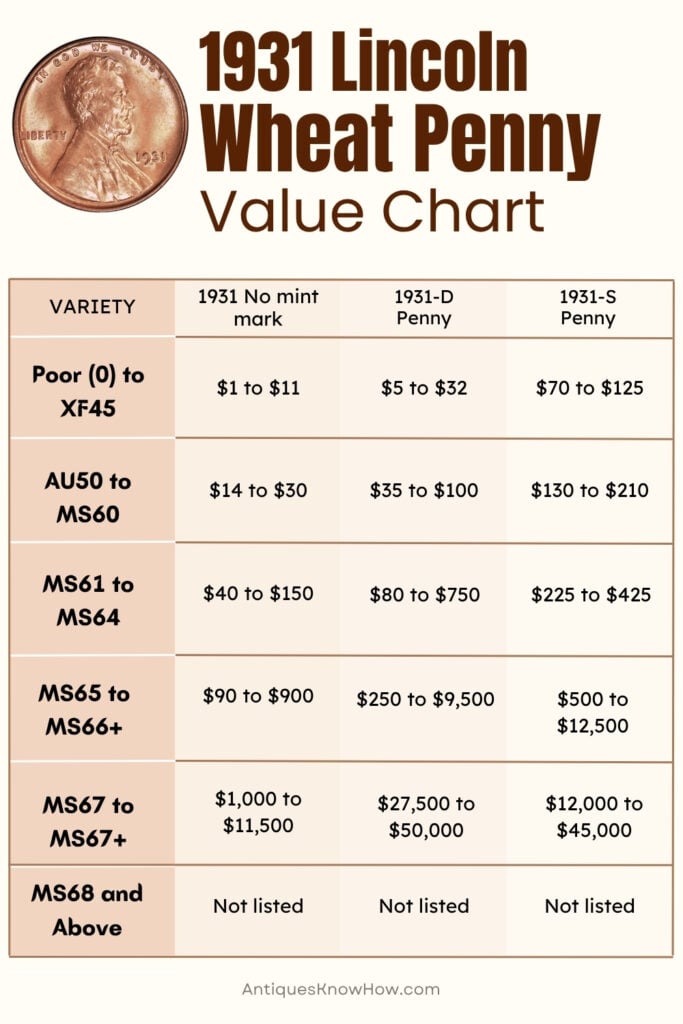
For copper Lincoln cents, there is also a color designation, sometimes worth even more than the grades:
- BN (Brown): Less than 5% original red. Most 1931 cents are brown and are worth the least.
- RB (Red-Brown): Between 5% and 95% original red. These are mid-range coins.
- RD (Red): More than 95% original red. These bring the strongest prices.
Here’s how the color can impact the value: a 1931-D in MS66 is worth about $950 in Red-Brown but can fetch up to $7,000 in full Red.
Mint Marks & Mintage
The mint mark sits just below the date and tells you where your 1931 penny was struck. This small detail can turn a $50 worth cent into a $500 or higher one, so never miss it.
Quick Tip: Use a magnifier to check mint marks, since a worn S or D can blend into the surface around it.
Here’s a breakdown of the total mintage of a 1931 Lincoln cent:
- 1931 No Mint Mark (Philadelphia) – 19,396,000: With the highest mintage, this is the most common 1931 penny. Circulated coins sell for $1 to $11; the real money sits in the top condition. A MS67+ RD coin can fetch up to $11,500.
- 1931-D (Denver) – 4,480,000 minted: Denver struck about a quarter of Philadelphia’s total, and many of its coins show a soft strike. Worn examples sell for $5 to $32, but the price can reach up to and over $25,000 at MS67 RD.
- 1931-S (San Francisco) – 866,000 minted: With the lowest mintage, this is the key date of the year. Even a heavily worn 1931-S sells for around $70. An estimated total of 80,000 pieces are still left today, as per PCGS.
Does a 1931 Proof Penny Exist?
No, it doesn’t. You might occasionally see “1931 proof penny” listed online, but it never existed, since no Mint ever struck any proof Lincoln cents from 1917 through 1935.
Most Valuable 1931 Wheat Penny Errors & Varieties
1
1931-S Lincoln Cent in Full Red
Typically sells for $675 to $45,000
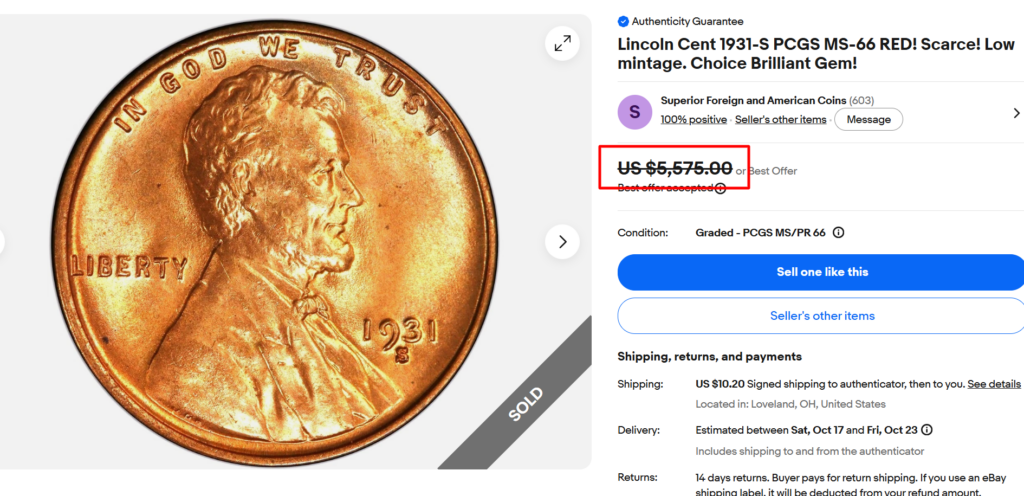
Since most 1931-S cents have toned to red-brown or brown after 90 years, any 1931-S cent retaining more than 95% of its original red color is highly prized today.
Look for well-defined wheat lines and smooth surfaces. Carbon spots (little dark spots) on old copper coins quickly lower grades and value.
1
1931-S Key Date in Circulated Grades G4 to XF45
Typically sells for $70 to $180
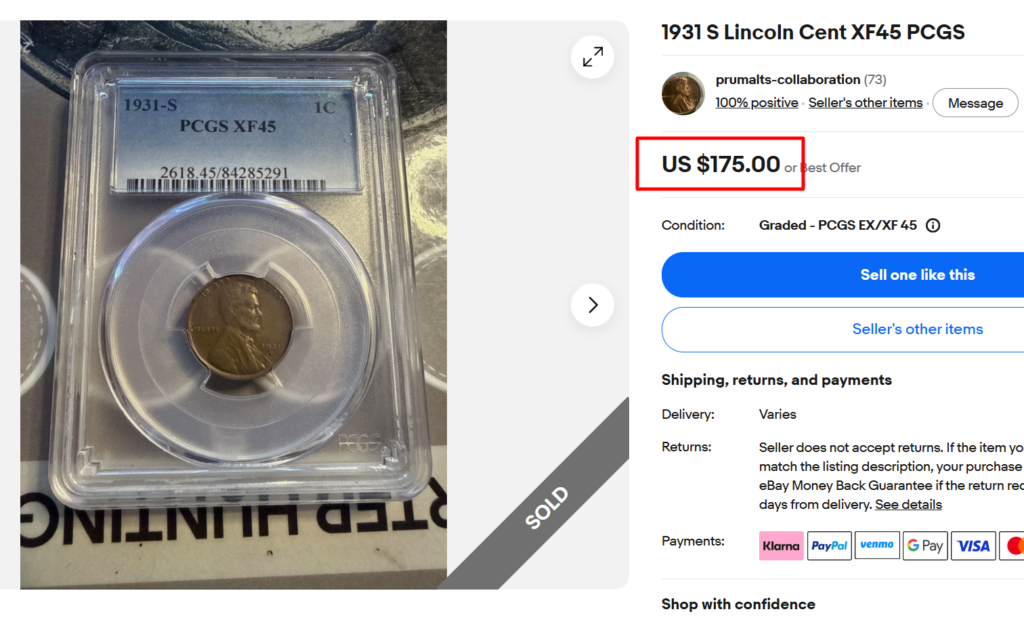
Any genuine 1931-S is worth keeping, even one worn nearly flat. Its low mintage makes it a key date and one of the most valuable wheat pennies for coin collectors. But check the S carefully. Worn coins can be altered, too, so it’s best to compare the mint mark with a certified example.
1
1931-D in Gem Red and Red-Brown
Typically sells for $80 to $750 (Up to MS65+)
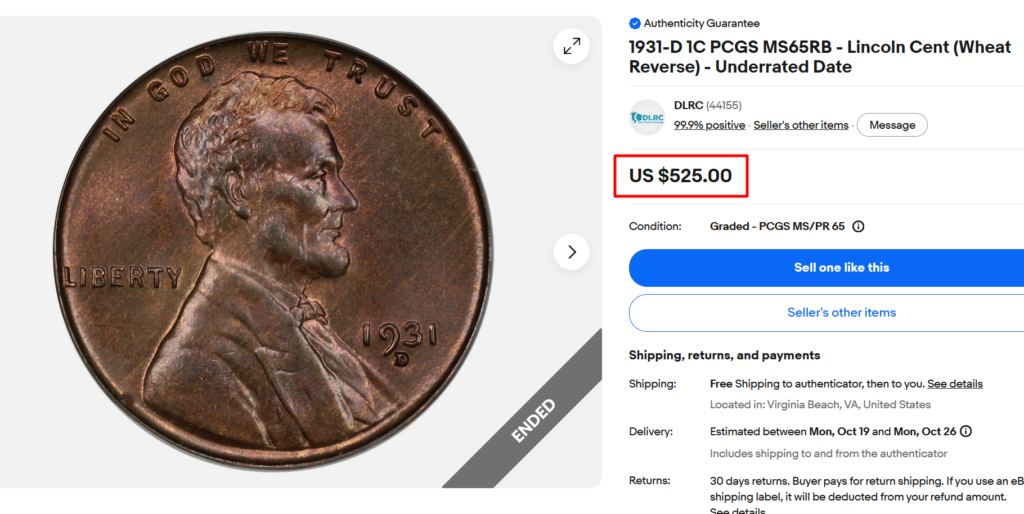
The Denver Mint struck its 1931 pennies with worn dies, which softened details like Lincoln’s hair and the wheat stalks. That’s why a well-struck 1931-D in Mint State with its original red color is a rare find today. Worn and ungraded 1931-D cents only go for $5 to $25, despite a lower mintage.
1
1931 No Mint Mark Penny in Superb Gem Red
Typically sells for $90 to $900 (Up to MS66+)
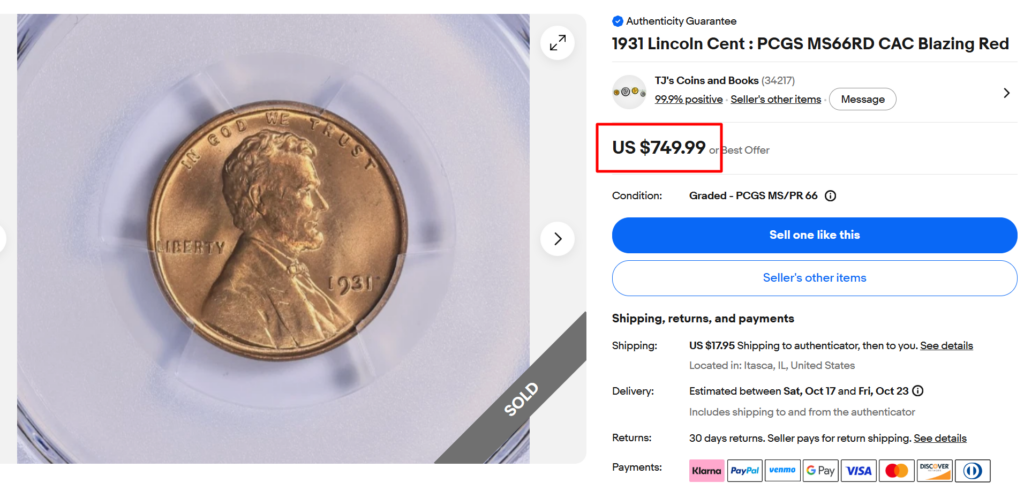
Although it’s the most common variety, a 1931 No Mint Mark in Superb Gem condition is still valuable. Not many examples survived at PCGS MS65 or higher grade with full red color and no carbon spots; that is what trades at major auctions.
1
1931-D Repunched Mint Mark (D/D/D)
Typically sells for $15 (XF40) to $1,340 (Gem BU)
This variety features the letter D being struck more than once on the die, resulting in faint doubling of the D mint mark on the penny. You will notice an additional vertical line and upper serif extending northeast from the D.
The later die states have less doubling, so you’ll need a 10x magnifying glass to spot this error.
1
1931 Doubled Die Reverse
Typically sells for $25 (XF40) to $170 (Gem BU)
This variety shows distended hub doubling, a rare type that adds thickness to design elements rather than making distinct images. Notice the dots, the motto, and the outside wheat stems. The effect is subtle, which makes it easy to miss.
Note: This article is intended for informational, educational, and entertainment purposes only. Some images are illustrative and may not represent actual brands, products, or related entities. All trademarks, product names, brand logos, packaging, and other intellectual property referenced remain the exclusive property of their respective owners. Any brand mentions or references are provided solely for descriptive and educational context and do not imply any formal or commercial association.