Antiques Know How Research
Metlox Cookie Jars Value
Antiques Know How’s in-depth study of hundreds of eBay sales found that vintage Metlox cookie jars sell for $50 to $450+, with rare limited editions and pairs fetching $400 or more. Most collectible jars are Bubbles the Hippo, Beulah Borden Cow, Candy Boy, Brownie Girl Scout, Flamingo jars, Raggedy Andy jars, and Disney Pinocchio. Value depends on design rarity, production era, condition, original marks, and foils.
Antiques Know How
About Metlox Company!
Founded in 1927 by the Prouty family, Metlox Manufacturing Company originally made ceramic outdoor signs. The name itself is a combination of “metal oxide,” referring to the pigments of their vibrant glazes.
By the 1930s, the company started making colorful dinnerware and eventually came up with its iconic figural cookie jars. Metlox became a leader in the “California Pottery” movement, especially under Evan K. Shaw’s leadership, who bought the company from Proutys in 1946.
Their lines, like Poppytrail, are famous for their durable and whimsical cookie jar designs. Today, these pieces are highly collectible due to their nostalgic appeal and the company’s closure in 1989!
Collectible Metlox Cookie Jars Worth Money!
Here’s a look at some highly collectible Metlox cookie jars that regularly attract collector interest, with key details to help you identify and value each one!
1. Poppytrail “Bubbles The Hippo” Jar

| Average Value | $200–$450 |
| Production Period | 1970s (limited run) |
| Collectibility | Very High |
| Collector Notes | Check the label for value & verification. |
Bubbles the Hippo is one of the rarest jars in the Metlox lineup. You can easily recognize this jar by its bright yellow body with a green lily pad and a white water lily lid.
The jar production problems, including a top-heavy lid flower that caused structural issues, as per the records. So, it never entered full production due to low consumer interest.
Because so few were made, Bubbles commands some of the highest prices in Metlox’s Poppytrail cookie jar series!
2. Beulah Cow Cookie Jar
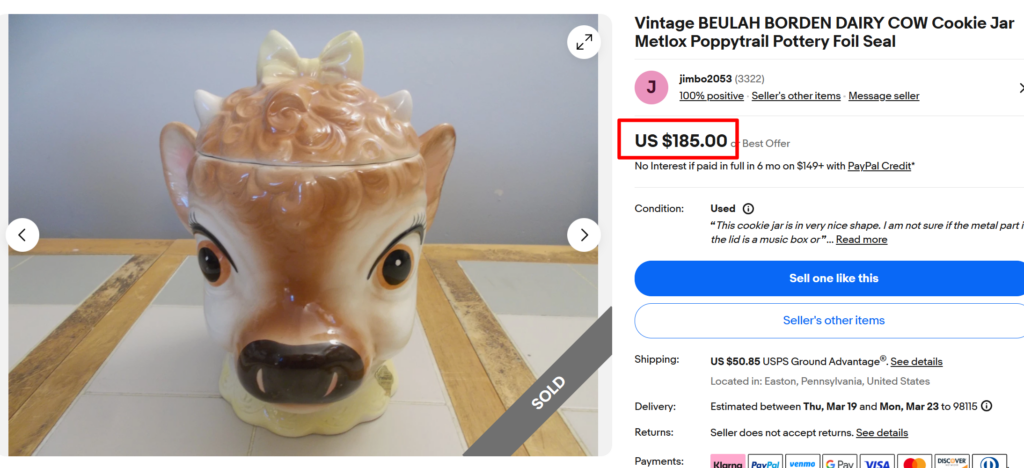
| Average Value | $150–$350 |
| Production Period | 1940s-1950s |
| Collectibility | High |
| Collector Notes | Noisemaker adds significant value |
This jar shows the cute Beulah cow, the daughter of Borden’s “Elsie the Cow.” The jar stands around 11 inches tall, and some versions even have a metal “moo” noisemaker or “cryer” inside the lid that turns on when you open it.
This small element is a big value driver; examples with a working moo mechanism can sell for more than identical jars without one! Also, genuine pieces had the golden foil label on the base or bottom edge, which can also add value!
3. Candy Boy Cookie Jar
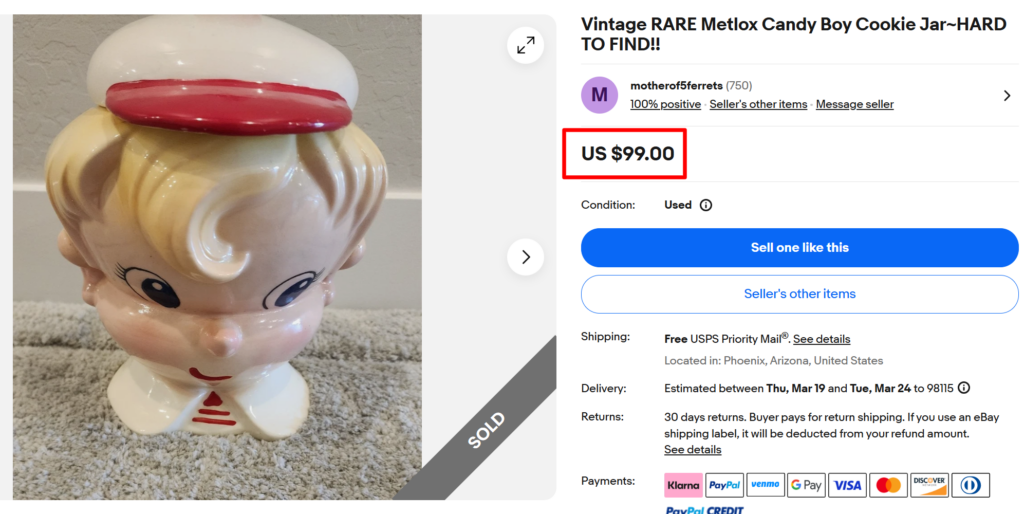
| Average Value | $50–$150 |
| Production Period | 1950s–1960s |
| Collectibility | Moderate to High (as a pair) |
| Collector Notes | Check the “Metlox” foil label. |
The Candy Boy jar has a child’s face with blonde hair and a flat red beret-style cap that serves as the lid. It came out as a companion to the Metlox Candy Girl jar, which is slightly easier to find.
Because the pair is rarely found together, collectors who already have one jar often pay a premium to complete the pair.
Also, check the original by the golden foil reading “Metlox Manufacturing Co.” If the label is missing, compare the size and weight of the original documented examples to authenticate.
4. Poppytrail Brownie Girl Scout Cookie Jar
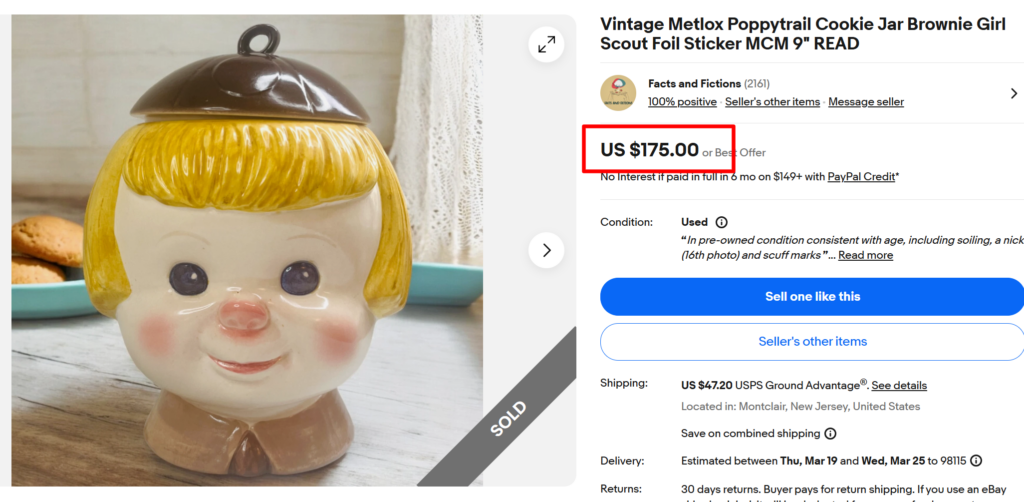
| Average Value | $150–$400 |
| Production Period | 1950s to 1970s |
| Collectibility | High (as a pair) |
| Collector Notes | Check the golden “Metlox” label. |
This cookie jar is made like a cute girl character, with short blonde hair, pink cheeks and nose, and a brown beret-style lid with a loop handle. In good condition, this is one of the higher-value pieces in the Poppytrail line.
Like the previous example, this cookie jar also came with a companion, known as the Cub Scout (1960s). And a pair of these two jars can be significantly valuable today.
5. Metlox Flamingo Cookie Jar
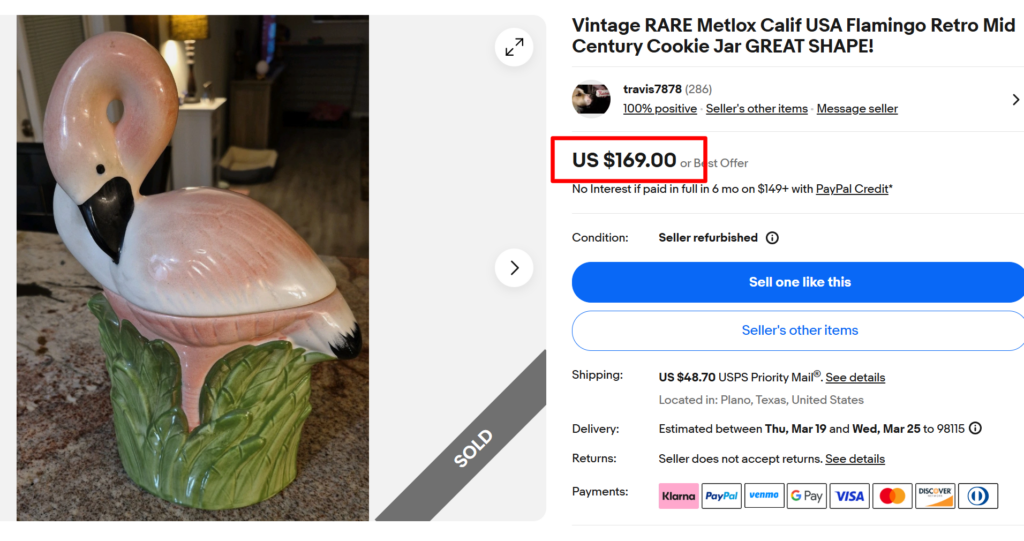
| Average Value | $150–$350 |
| Production Period | 1950s–1960s |
| Collectibility | High |
| Collector Notes | Check the impressed mark on the base. |
This cookie jar features a vibrant pink flamingo against a tropical backdrop, often with a bamboo-style texture on the base. The flamingo’s body forms the jar, and the neck and head area lifts as the lid.
It’s one of the best examples of the Tiki and tropical trends of the 1960s. Besides, this piece is one of the harder Metlox figural jars to find. The tall, twisted-neck shape was not a high-volume production piece, making intact examples valuable.
6. Basset Hound Cookie Jar
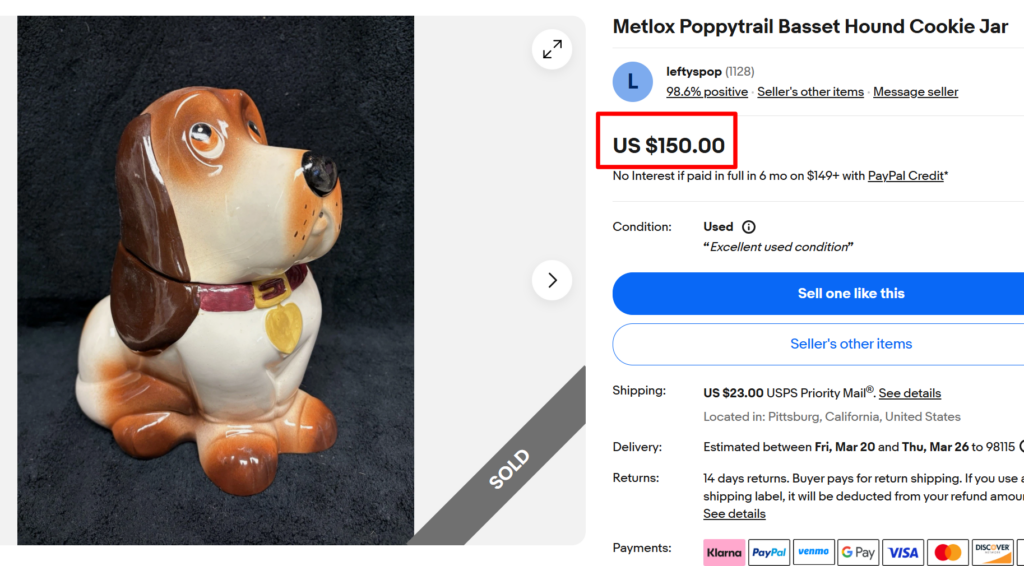
| Average Value | $80–$200 (mint condition) |
| Production Period | 1950s to 1960s |
| Collectibility | Moderate–High |
| Collector Notes | Check the backstamp for verification. |
This is one of Metlox’s more recognizable animal jars from their Poppytrail line. It’s designed to look like a sitting Basset Hound with long, floppy ears, a white chest, and a red-brown collar with a gold tag. The head lifts off as the lid.
It appeals to both cookie jar collectors and dog lovers and is beloved for its realistic “sad” expression and those “puppy eyes.” Make sure to check the impressed “Metlox Calif USA” mark on the base to recognize an authentic Metlox original jar.
7. Cali Orange Cookie Jar
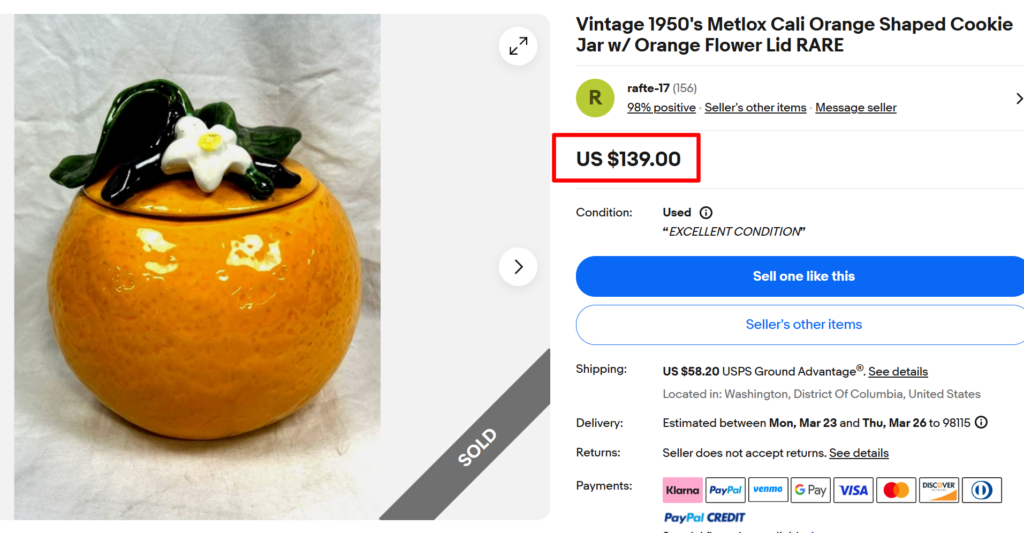
| Average Value | $100–$200 |
| Production Period | 1950s |
| Collectibility | Moderate–High |
| Collector Notes | Check the “MADE IN USA” backstamp. |
This jar takes the form of a giant orange fruit with a textured rind glaze in deep amber-orange. The delicate orange blossom and green foliage make up the lid handle.
It’s part of Metlox’s fruit-themed production from the 1950s, which also included variations such as strawberries and lemons. The orange jar with the flower lid is a slightly rarer piece.
8. Pescado Cookie Jar
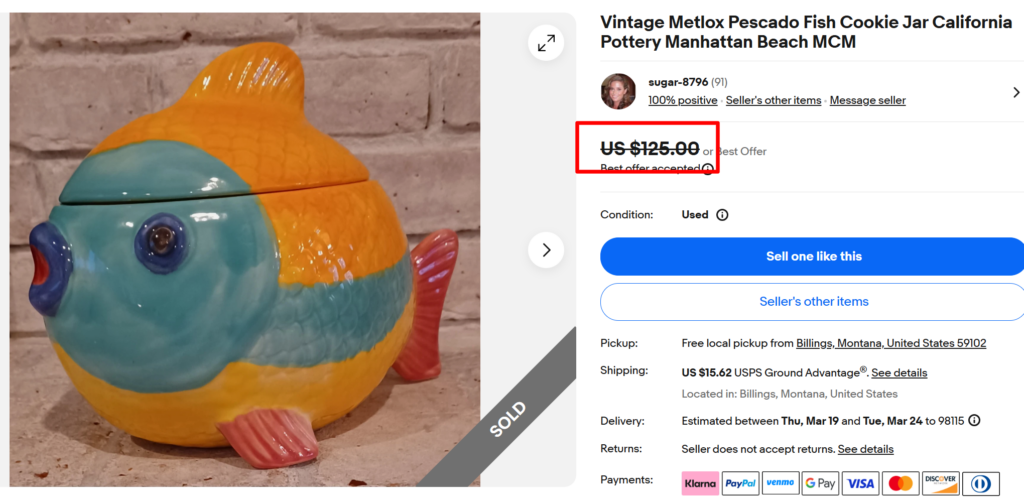
Source: eBay – sugar-8796
| Average Value | $100–$175 |
| Production Period | 1950s to Pre-1970s |
| Collectibility | Moderate to High |
| Collector Notes | Check the “Pescado by Metlox” backstamp. |
This one is one of Metlox’s more graphic, color-forward designs. “Pescado” means fish in Spanish, and this Metlox jar is shaped like a round, plump tropical fish in bright teal, orange, and yellow, with bold painted fin and scale details.
The upper part with part of the teal face and dorsal fin lifts as the lid. While production records are limited, this jar is often available in the market, often with a high-end price tag.
To spot the original, check the painted “Pescado by Metlox/California Pottery/Manhattan Beach” mark on the base.
9. Drummer Boy Poppytrail Cookie Jar
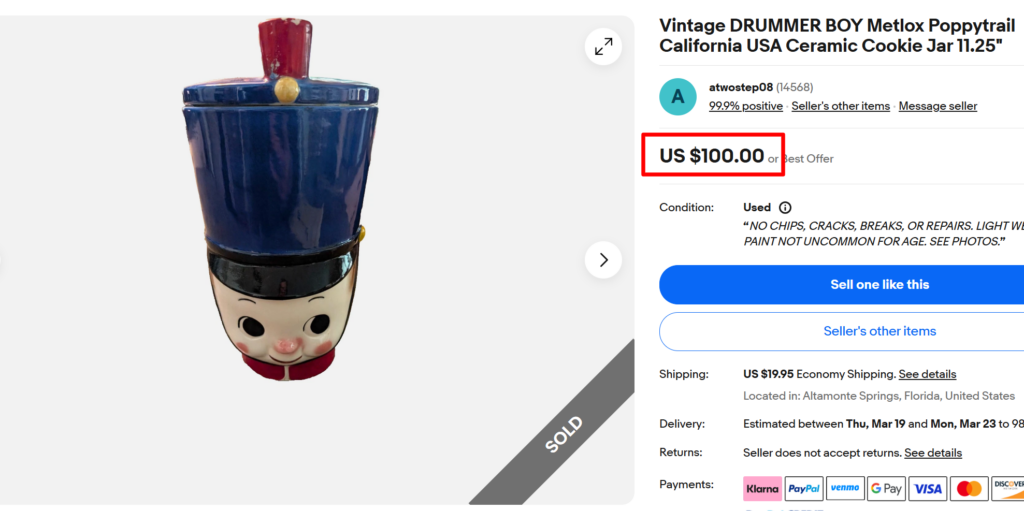
| Average Value | $75–$175 |
| Production Period | 1970s |
| Collectibility | Moderate |
| Collector Notes | “Made in Calif/USA/Poppytrain” stamp |
The Drummer Boy is a tall jar featuring a soldier’s head wearing a red-and-blue hat (shako). Part of the Poppytrail line, this jar looks upside-down; the body is a tall, blue, military-style hat, and the soldier’s face peers out just below the base. The top cobalt-blue part, with gold trim and a red finial, makes the lid.
Due to its “cold paint” often used for the red and gold accents, finding one without heavy paint loss is a challenge. Also, it’s prone to breaking easily because of its height, making pristine examples like these valuable.
10. Raggedy Andy Cookie Jar
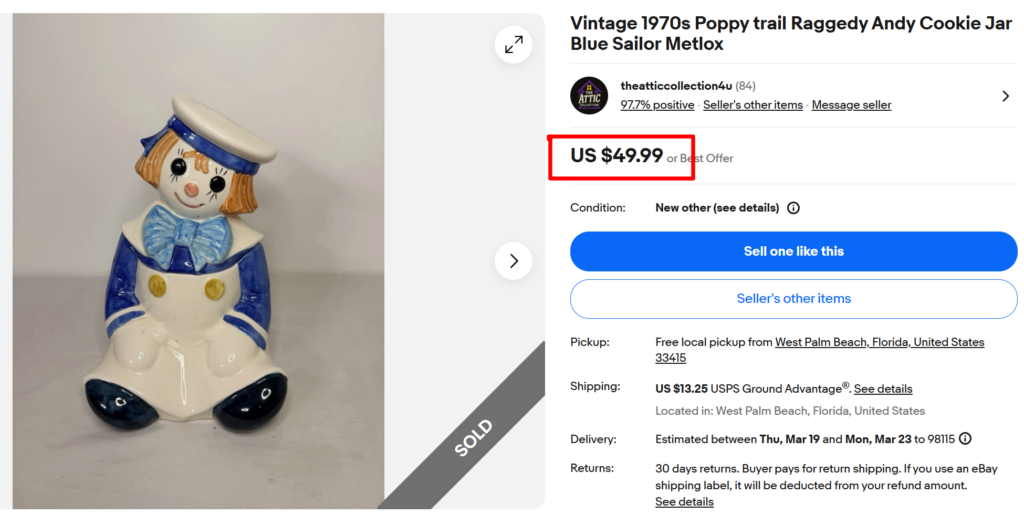
| Average Value | $50–$175 |
| Production Period | 1970s–1980s |
| Collectibility | Moderate (high for pair) |
| Collector Notes | “Andy” and “Ann” jars in pairs are rarer. |
Inspired by the classic American rag doll, Raggedy Ann, Metlox made both a Raggedy Ann and a Raggedy Andy version for its Poppytrail line. The “Andy” jar shown here has a blue sailor outfit with a white cap, round black button eyes, and the classic yarn-style hair in orange.
The character is seated, with the hat forming the lid. Both versions are commonly seen in the market today. The Ann and Andy jars together are worth more than the single jars.
11. Disney Pinocchio Cookie Jar
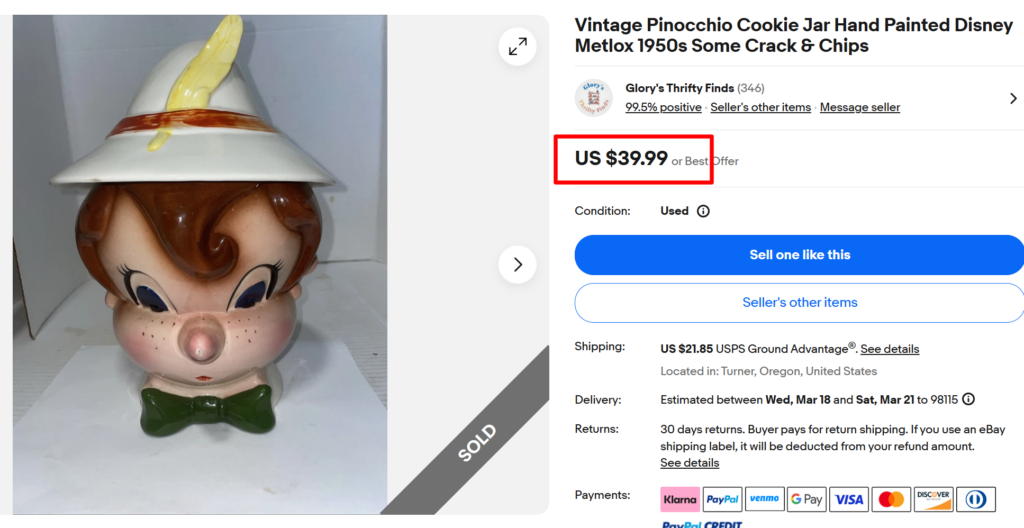
| Average Value | $100–$350 |
| Production Period | Late 1940s–early 1950s |
| Collectibility | High (in good condition) |
| Collector Notes | Painted “Made in Calif/Poppytrail” mark |
Metlox held a Disney license from 1946 to 1956, and the Pinocchio cookie jar is one of the most sought-after pieces from that collaboration. The jar shows Pinocchio’s face, with his pointed nose, and his Bavarian white with a yellow feather makes up the lid.
Each jar was hand-painted, meaning no two were identical. Also, originals had the “Made in Calif/USA/Poppytrail” backstamp. While this example sold for a reasonable price, pieces with a visible stamp and minimum damage can fetch $200–$350!
Spotting Real (& Valuable) Metlox Cookie Jars
As you saw above, the value of vintage Metlox cookie jars lies largely in their condition, rarity, and originality. So, whether you want to collect or sell your Metlox jar, these steps will help you make the best deal.
Check the Base Mark
This is the most reliable way of verifying a Metlox jar’s authenticity. Most Metlox jars carry one of several impressed or stamped marks:
- “Poppytrail / Made in Calif. U.S.A.” with a California state outline,
- A circular “Poppy Trail / Made in California / By Metlox” mark
- “Metlox Calif USA.”
Generally, older pieces from the 1940s and early 1950s tend to have incised (pressed-in) marks rather than stamped ones. Also, while unmarked pieces need not be reproductions or fakes, they typically have lower collector interest.
Some Metlox pieces might have retained their original foil “Metlox Poppytrail” or “Metlox Manufacturing Co.” foil labels on the side or bottom. These labels can also help you confirm authenticity and increase value.
Verify the Lid Fits
Authentic Metlox lids seat flush and feel substantial, whereas replacements or damaged lids often sit slightly off-center, rock, or show obvious glaze mismatches. The lid is the most commonly replaced part on cookie jars, so checking this is crucial.
Look for Hand-Painting Designs
Metlox cookie jars were mostly hand-painted, not machine-applied. So, under close inspection, you should notice slight variations in brushstrokes, especially in facial details and decorative highlights.
Also, Metlox used high-fire glazes that made their paint look thick and often gave the jars a “creamy” look. While crazing (tiny surface cracks) is common in vintage jars, the colors on them should still look vibrant, not “faded” or printed.
Check the Weight & Dimensions
Metlox jars were made with thick, high-quality clay, so they feel heavy and substantial here. If a jar feels light or “thin” like modern cheap imports, it is likely a reproduction or a different brand.
Also, check the jar’s size. Since reproductions are often made from a mold of an original jar, the clay shrinks during firing, resulting in a piece that’s about 5% to 10% smaller than the original jar.
Use authentic references to determine the actual weight and size of the specific Metlox jar, and then compare your own piece for authentication.
Assess the Overall Condition
Most Metlox jars hold moderate value unless they are a very rare design. So, condition plays a huge role in the value of common jars. A chip, crack, or repair can cut value by 40–60% or more. Even the rarest piece can lose significant value because of damage.
Crazing (a fine network of glaze cracks) is generally accepted as it’s a natural aging sign and has less impact than chips.
Note: This article is intended for informational, educational, and entertainment purposes only. Some images are illustrative and may not represent actual brands, products, or related entities. All trademarks, product names, brand logos, packaging, and other intellectual property referenced remain the exclusive property of their respective owners. Any brand mentions or references are provided solely for descriptive and educational context and do not imply any formal or commercial association.