Antiques Know How Research
Collectible Cambridge Glass Patterns
Our analysis at Antiques Know How of several eBay listings and auction results suggests that vintage Cambridge Glass usually sells for $15 to $150 for common items, with rare pieces and sets reaching $500 to $1,000+. Most collectible Cambridge patterns include Rose Point, Caprice, Statuesque (Nude Stems), Portia, Gloria, Crown Tuscan glass, Diane, and Mt. Vernon. Check the “C” inside a triangle mark, glass quality, finish, pattern, and lines to identify!
Antiques Know How
About Cambridge Glass Company
The Cambridge Glass Company started in May 1902 in Cambridge, Ohio, under Arthur J. Bennett. It quickly became a leader in the “Elegant Glass” movement, known for handmade pieces of both crystal and colored glass.
Unlike mass-produced Depression glass, Cambridge focused on high-quality, hand-finished pieces known for their clarity, intricate etchings, and unique colors. Caprice, Rose Point, and Nude Stem are some of its most recognizable lines.
Cambridge was closed for a brief time in 1954, reopened in 1955, and closed for good in 1958. In 1960, Imperial Glass acquired the molds. Today, Cambridge Glass is considered one of the most collected and sought-after elegant glassware brands.
Notable Cambridge Glass Patterns to Know
The company made thousands of unique patterns, lines, and colors from 1902 to 1958. Below are some of its most popular designs that are worth collecting today!
1. Rose Point
Rose Point is Cambridge’s most famous etching and its single most collected pattern. Introduced in 1935, it features lace-like roses and vines acid-etched across the glass surface.
Cambridge used it on almost every blank they had, keeping it in production until the factory closed in 1958, making it readily available. The most common is the crystal, with the most expensive varieties being the gold-encrusted and colored blanks, like the Carmen (ruby red).
| Average Value | $25 – $500+ (as per item) |
| Production Period | 1934 – 1958 |
| Value Factors | Gold encrustation, colored blanks, rare shapes. |
| Collectibility | Extremely High |
| Collector Notes | Look for the “C” in a triangle mark |
Gold-Encrusted Rose Point Hurricane Lamps
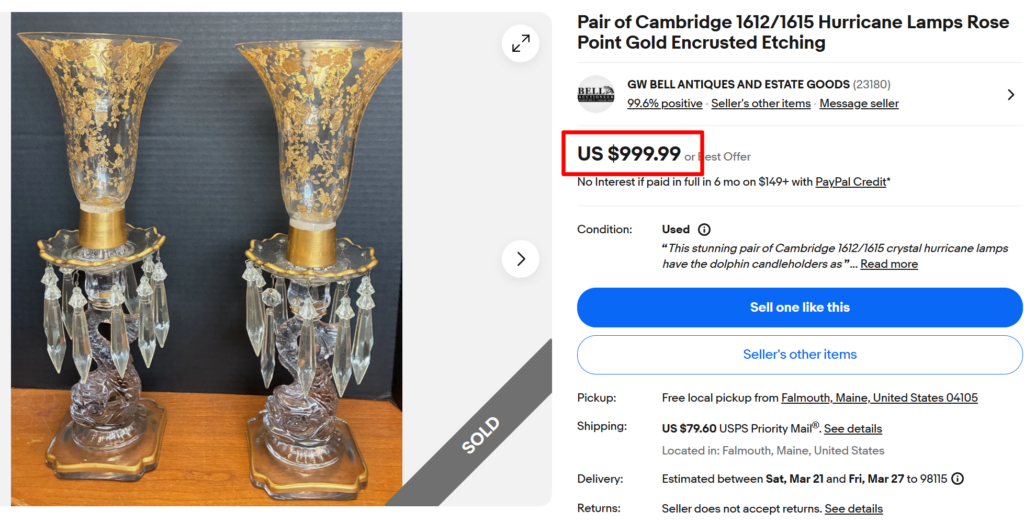
These lamps with Dolphin candleholder bases are a perfect example of Rose Point etching in gold encrustation. Pairs of hurricane lamps are harder to find intact than individual stemware, especially if gold-encrusted!
2. Statuesque (The “Nude” Stems)
The Statuesque line (#3011) was introduced in 1931 and features a nude female figure as the stem of the glassware. These “Nude Stems” were used for cocktails, wines, and compotes, often paired with vibrant tops like Mandarin Gold, Carmen (red), or Royal Blue.
Heatherbloom and Windsor Blue are the hardest standard colors to find. Any piece with an etching on a Statuesque blank is collectible.
| Average Value | $75–$250 (single) $200-$1,000 (sets, rare colors) |
| Production Period | 1931–1958 |
| Value Factors | Rare colors, rare forms |
| Collectibility | Very High |
Statuesque Pistachio Crackle Glass Nude Stem Glass
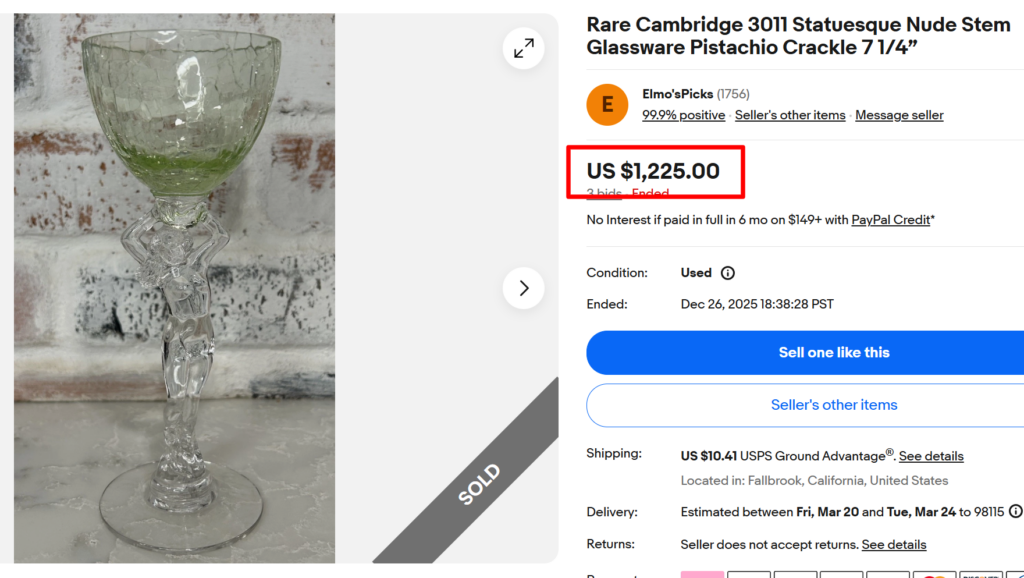
Pistachio crackle is among the rarest Statuesque color-finish combinations. Cambridge applied the crackle treatment to only four colors: Mandarin Gold, smoke, Pistachio, and Carmen, making this one of the premium pieces in the entire line.
Statuesque Mandarin Gold Nude Stems Compote
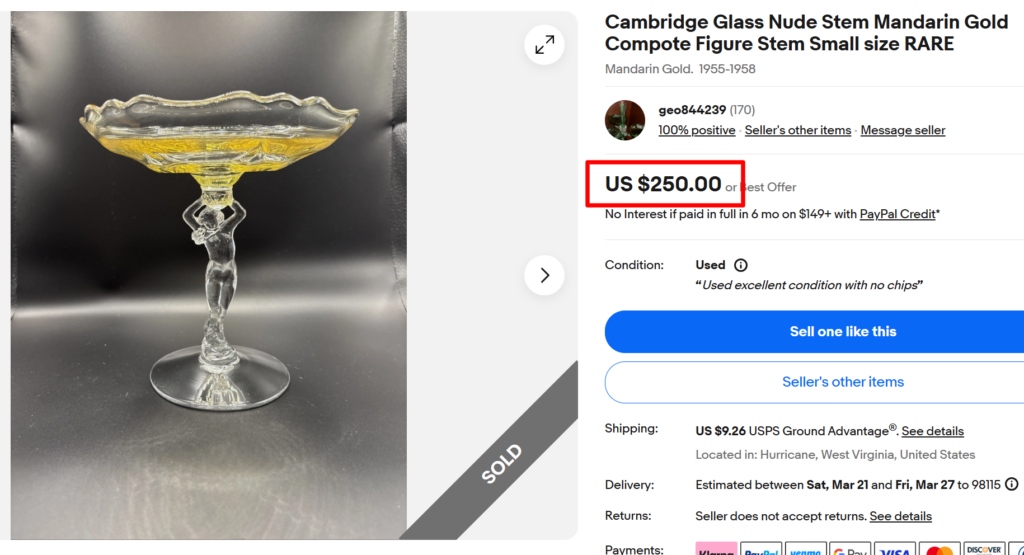
Small Mandarin Gold compotes with a crystal nude figure are rarer than the larger all-Mandarin Gold version. This was a late-production piece made only in the final years before closing.
3. Caprice
Caprice is Cambridge’s most extensive single-pattern line, covering around 250 different pieces. Introduced in 1936, it features a pressed ripple, wave-like design with radiating scallops.
This pattern covered a full range of stemware, dinnerware, and accessories and was available in various colors (apart from crystal), like Moonlight Blue, Emerald Green, and pastel colors like La Rosa pink, Pistachio green, and Mocha amber.
Note: Watch for Summit Art Glass reproductions made after 1984 in Sky Blue and cobalt. Original Cambridge Moonlight Blue is clear with fewer bubbles.
| Average Value | $15–$150 (single) $100-$800 (rare forms, sets) |
| Production Period | 1936–1958 (Moonlight Blue: 1936–c.1953) |
| Value Factors | Rare colors, Alpine (frosted) finish, rare forms |
| Collectibility | Very High |
Caprice Moonlight Blue Alpine Frosted Ball Pitcher
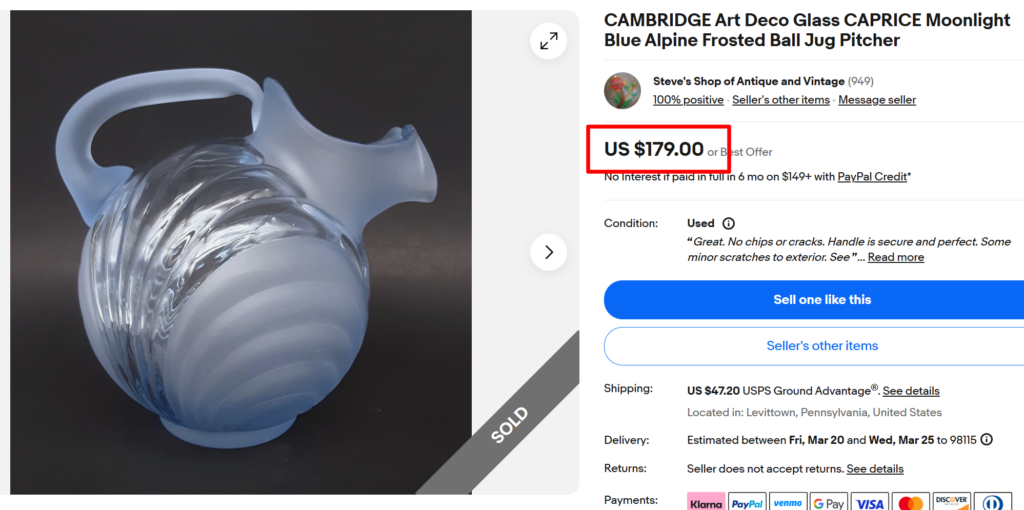
This Caprice ball pitcher in Moonlight Blue carries the iconic Alpine acid-frosted finish. Ball pitchers in Moonlight Blue are a sought-after bar set piece, especially the less common Alpine variations.
4. Portia (Etching #754)
Cambridge introduced Portia in early 1932 and made it for about 20 years. It’s a “lace on glass” etching featuring a flat-topped urn (or baskets) overflowing with flowers and vines, unique enough to identify once you know it easily.
Most Portia is on crystal, but colored versions exist in Heatherbloom, Gold Krystol, Forest Green, Royal Blue, and Carmen. And the most common stemware blank it’s seen on is #3121 (colored bowls with crystal stems).
| Average Value | $20–$120 (single) $150–$400+ (rare pieces, sets) |
| Production Period | 1932–c. early 1950s |
| Value Factors | Rare colors & forms, gold encrustation |
| Collectibility | Moderate to High |
| Collector Notes | Portia on Heatherbloom is rare. |
Portia Heatherbloom Purple Tilt Ball Pitcher
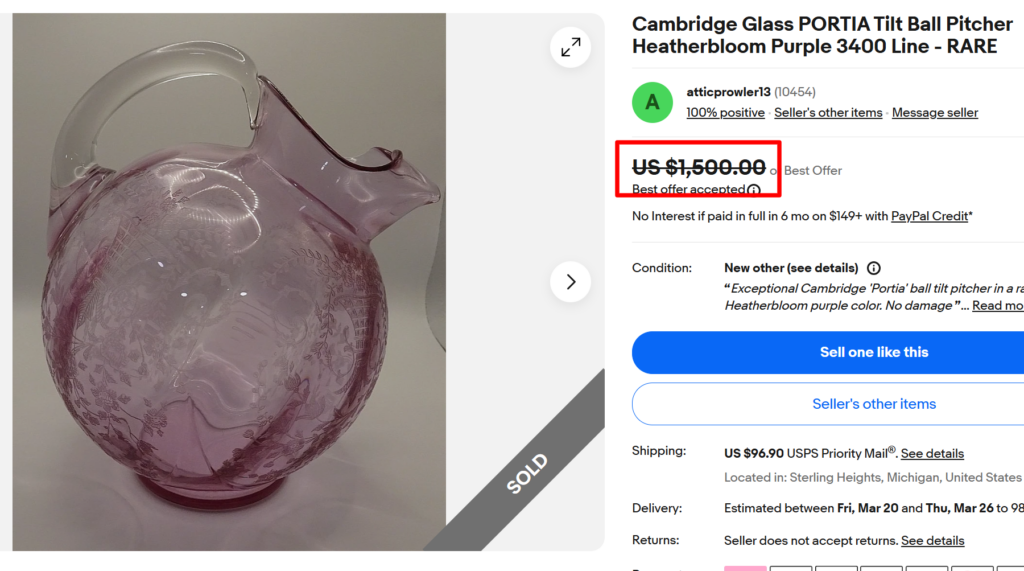
The Portia etching on a Heatherbloom tilt ball pitcher is an extremely rare find. Heatherbloom Portia is far less documented than Crystal, and the tilt ball pitcher is one of the most sought-after forms in any etching!
5. Gloria (Etching #746)
The Gloria etching includes floral designs and sweeping curves on the glass surface. It was created in the late 1930s and discontinued before 1940. This gives the Gloria etching a nine-year production run, making it harder to find.
It was made in Gold Krystol, Amber, Emerald, Peach-Blo, Forest Green, Heatherbloom, Willow Blue, and crystal. Exceptionally, you can also occasionally find it on the Nude (#3011) stem blank.
| Average Value | $25–$150 (singles) $75–$300+ (colored, sets) |
| Production Period | 1930 – 1939 |
| Value Factors | Rare colors, gold or silver encrustation |
| Collectibility | Moderate |
Gloria Etching Gold Krystol Cordials
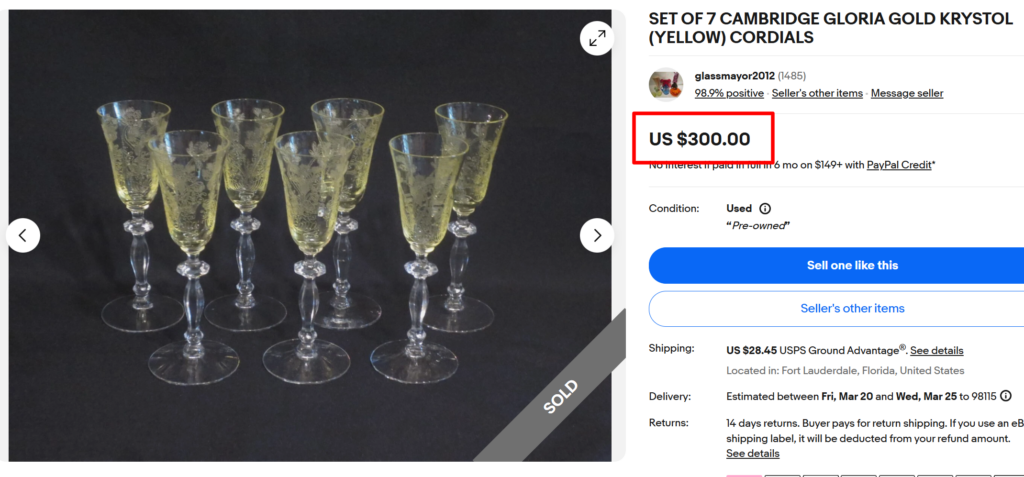
This cordial set is an excellent example of Gloria etching on a colored blank. Also, most Gloria stemware surfaces as individual pieces today, making complete sets like this valuable!
6. Inverted Feather or Featherline
Inverted Feather (numbered #2651 in the catalog) is part of Cambridge’s early “Near Cut” pressed glass era, c. 1902–1920. It features vertical feathers topped with hobstars.
While originally clear, it is most famous in “Carnival Glass” finishes like Marigold or Amethyst. The glass imitates the look of hand-cut glass using precision molds, and you may often find pieces with the “NEAR CUT” mark pressed into the base or handle.
| Average Value | $30–$100 (Non-carnival) $50–$500+ (rare Carnival glass) |
| Production Period | 1902 to 1920 |
| Value Factors | Carnival glass, rare colors |
| Collectibility | Moderate to High |
| Collector Notes | The feathers should point downward. |
Inverted Feather Carnival Glass Jar
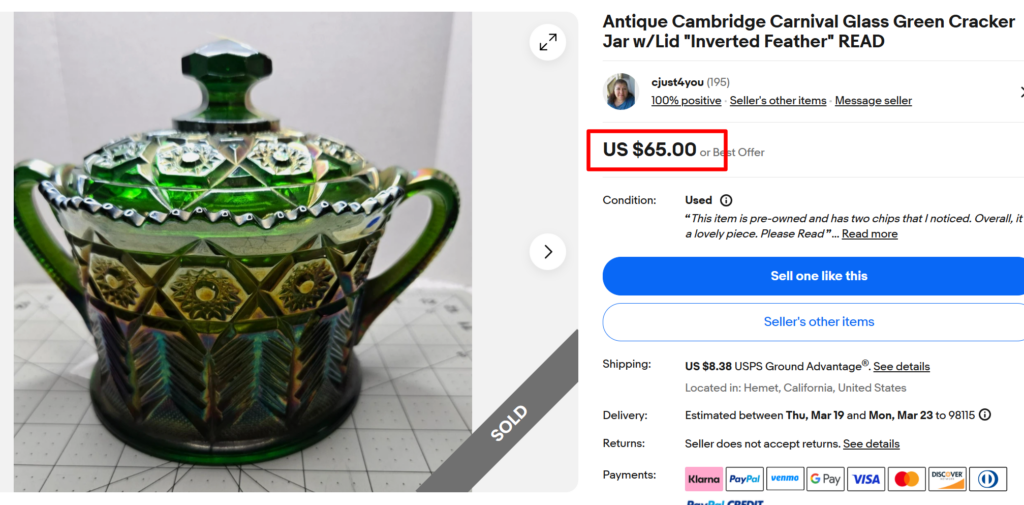
This Inverted Feather Carnival Glass Jar shows the deep iridescence and sharp “feather” molding typical of Cambridge’s early high-pressure pressed glass.
7. Honeycomb
Honeycomb is a classic geometric optic pattern with soft-edged hexagonal “cells” covering the glass body. While this is a common pattern, one of its most valuable variations is “Rubina,” a unique glass that transitions from deep red to light green.
Rubina was introduced in early 1925 but had a troubled commercial run, and many retailers returned them to the company. That poor reception led to limited production, making Honeycomb Rubina pieces rarer today.
| Average Value | $75–$300 (singles) $200–$600+ (large pieces, stemware) |
| Production Period | 1920s – 1930s |
| Value Factors | Rare colors, rare forms |
| Collectibility | High |
| Collector Notes | Look for the C-in-triangle mark. |
Honeycomb Rubina Compote Bowl
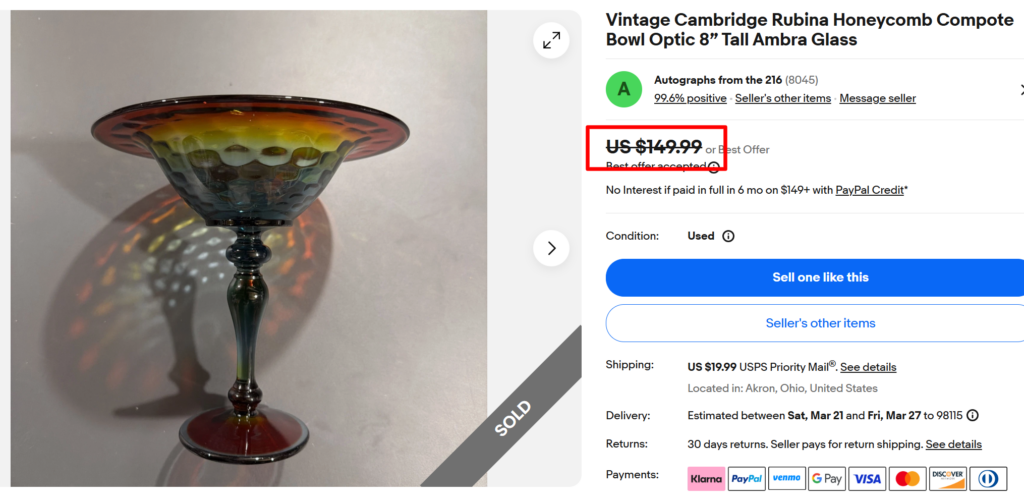
This footed compote shows the beauty of the Rubina glass paired with the Honeycomb pattern. Compotes and bowls are the most common forms, while covered jars, baskets, and stemware are rarer!
8. Diane (Etching #752)
Introduced in fall 1931, the Diane etch pattern remained in the Cambridge line until the factory’s first closing in 1954. The design features a horseshoe-shaped motif with inward-pointing “legs” and flowers.
While most Diane pieces are found in crystal, some early pieces may appear in colors like Willow Blue, Amber, and Peach-Blo. Also, this etching covered four stemware lines, with #3122 being the most common.
Quick Note: This pattern is easily confused with New Martinsville’s “Florentine.” Diane’s horseshoe legs point inward, while those of Florentine point outward.
| Average Value | $20–$100 (singles) $75–$250+ (rare, colored pieces) |
| Production Period | 1931–1954 |
| Value Factors | Rare colors & forms, gold-encrusted |
| Collectibility | Moderate to High |
Cambridge Diane Water Goblets
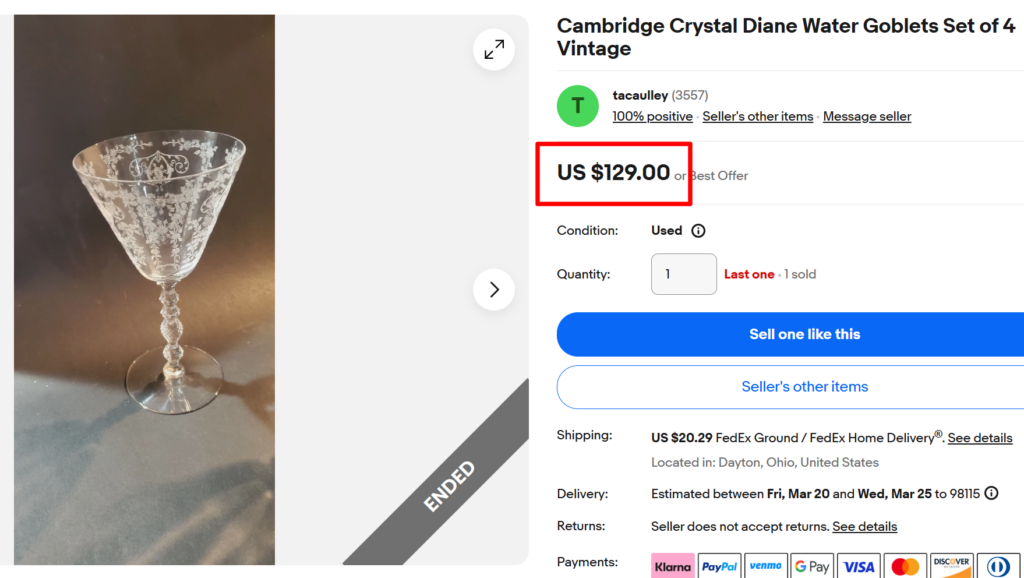
Four-piece crystal Diane sets on the #3122 line are the most common form on the market. Rare single forms, like a footed bowl, a cheese-and-cracker set, and a covered candy box, are more collectible.
9. Crown Tuscan (Color)
While Crown Tuscan is not an etching pattern, it’s worth mentioning as one of the most recognizable Cambridge signatures. It’s primarily an opaque, shell-pink glass color, ranging from nearly translucent to fully opaque.
Introduced in September 1932, Crown Tuscan glass was produced until the 1954 closing and not revived during the 1955–1958 reopening. It was often used with “Sea Shell” shapes or “Nude” stems.
Since several other companies (Fenton, Fostoria, Westmoreland) made similar pink glass, shape recognition is the key to identifying original Cambridge pieces.
| Average Value | $30–$150 (plain) $150–$500+ (decorated) |
| Production Period | 1932–1954 |
| Value Factors | Charleton decoration, rare forms |
| Collectibility | High |
Crown Tuscan Shell Dish
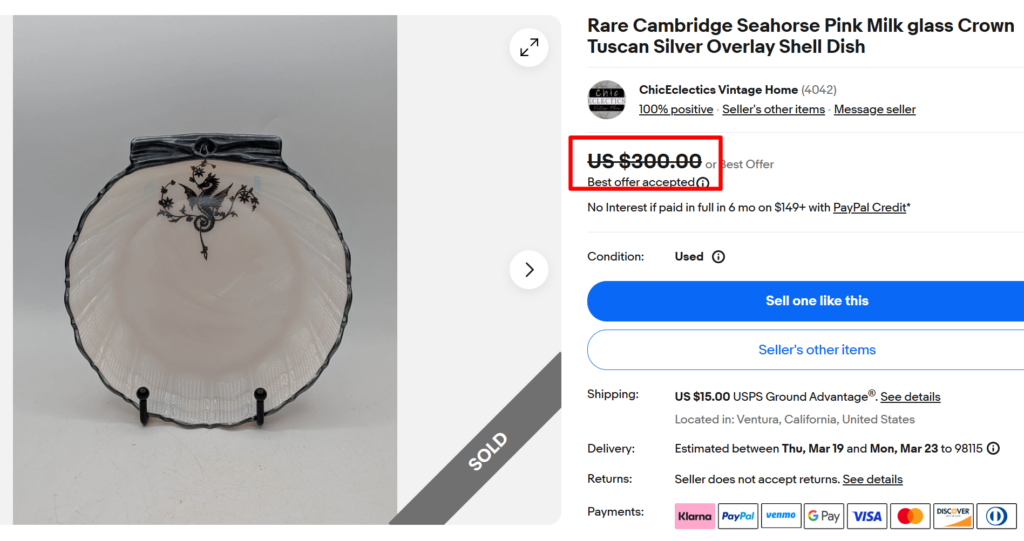
Silver overlay decoration on a Crown Tuscan piece is a rare sight; most pieces carry Charleton enamel or gold trim instead. The Seahorse motif on a shell-form dish from the Sea Shell line is another value addition to this piece.
10. Elaine
Running from 1933 to 1954, Elaine is one of the few Cambridge etchings made exclusively in crystal. This means there are no colored versions of Elaine. Also, Most pieces are on the #3500 Gadroon line.
The design features large diagonal scrolls, with floral bouquets and ornate borders. The scroll direction is the easiest way to tell it from Chantilly (horizontal scrolls) or Roselyn (similar diagonal lines but later and rarer).
| Average Value | $20–$80 (singles) $100–$250+ (large forms) |
| Production Period | 1933–1954 |
| Value Factors | Rare, Large pieces |
| Collectibility | Moderate |
Elaine Goblets
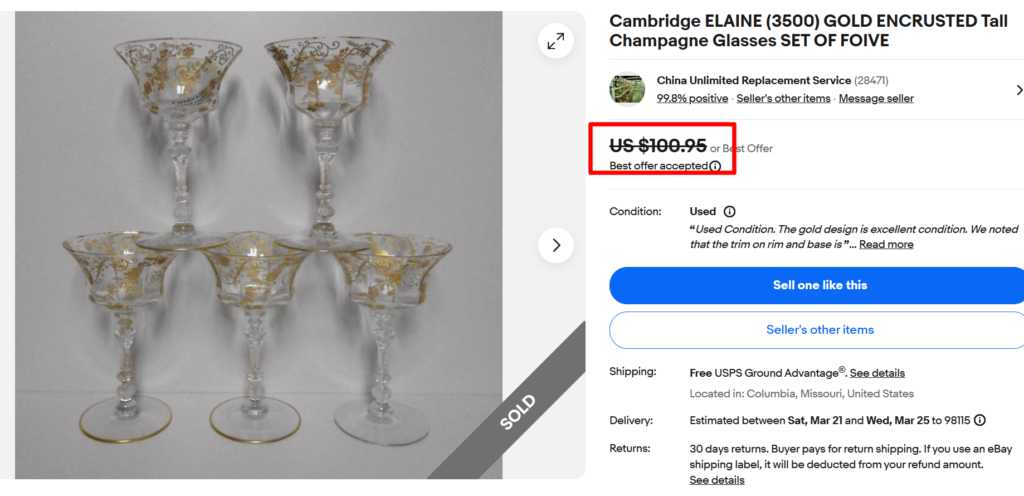
While crystal Elaine glasses are common today, 22-karat gold-encrusted versions are rarer and more valuable, especially if found in a set. The value lies in the intact gold decoration and overall condition.
11. Wildflower (Etching)
The Wildflower pattern features stylized stems, leaves, and flowers with a satin-textured background. It was introduced in 1937 and produced in the Cambridge line until the early 1950s.
Nearly all Wildflower is on crystal, but a very few Amber and Gold Krystol pieces also exist and are rarely seen. Ebony-blank Wildflower with gold encrustation is another extremely rare find.
| Average Value | $20–$80 (singles) $75–$200+ (rare pieces, sets) |
| Production Period | 1937–c. early 1950s |
| Value Factors | Gold encrustation, Ebony blank with gold, rare colors |
| Collectibility | Moderate |
Wildflower Etch Footed Candy Dish
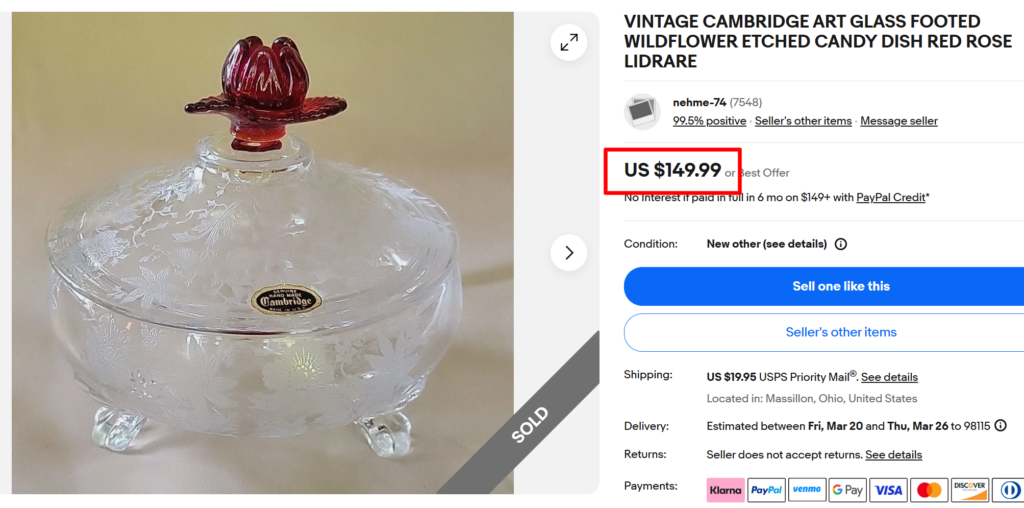
This rare candy dish displays an unusual combination of the Wildflower etching with a Carmen-colored rose-shaped finial. Such rare variations are always more collectible and valuable than standard versions!
12. Mt. Vernon
Mt. Vernon is Cambridge’s longest-running pressed pattern, evolving from the earlier “Stratford” Near Cut line introduced in the early 1920s. It was relaunched as “Mount Vernon” in the early 1930s and produced until 1954.
Unlike the etched patterns, Mt. Vernon is a colonial-style molded design with “Diamond Point” design paired with ribbed and paneled elements. It was made in a wide range of colors, like Uranium, Carmen, Heatherbloom, Blue, Crown Tuscan, and violet.
| Average Value | $15–$60 (singles) $75–$300+ (rare colors) |
| Production Period | Early 1920s (as Stratford)–1954 |
| Value Factors | Rare colors, unusual forms |
| Collectibility | Moderate to High |
Mt. Vernon Dolphin/Koi Uranium Candlesticks
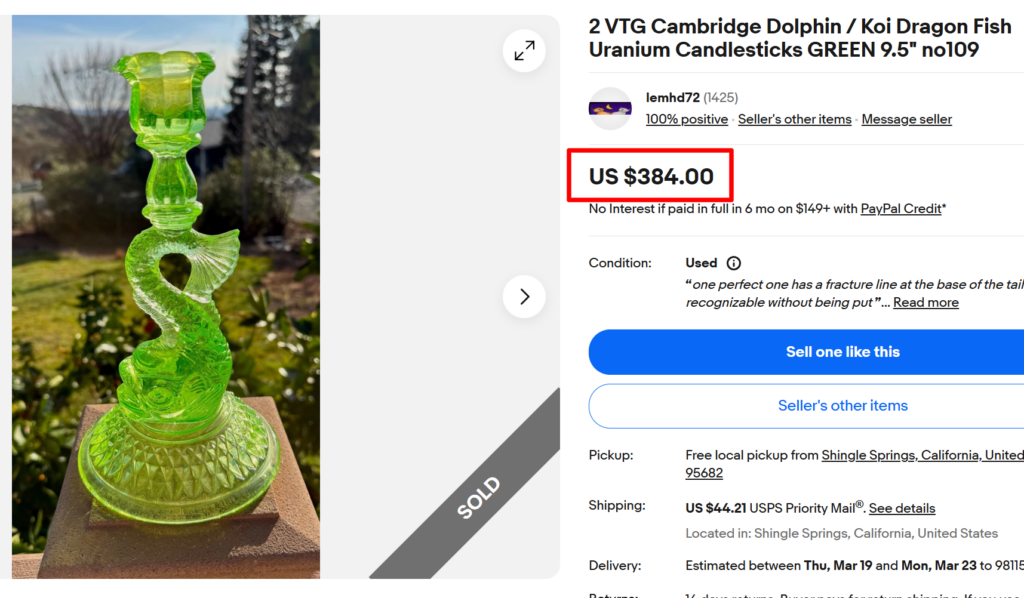
These Dolphin (Koi) Vaseline Candlesticks in the Mt. Vernon style are quite collectible today. They are loved for their dramatic figural design and glowing vaseline glass! (Check the glow under UV light for authenticity.)
How to Identify Authentic Cambridge Glass
Cambridge Glass can be a little challenging to identify since not every piece was marked, and several companies made similar glass. Here are some clues that can make it easier:
Markings
Check your glass thoroughly to spot the C-in-triangle mark. From the 1920s onward, Cambridge Glass Company pressed a “C” inside a triangle into the base (or stem) of many pieces.
While it’s the most reliable mark, the problem is that it’s absent on a lot of stemware. In that case, you may turn to the patterns and colors for identification.
The earlu pressed glass pieces from 1902–1920s may also show the “NEAR CUT” mark inside the base or on the handle. It confirms the Cambridge origin of Near Cut-era patterns like Inverted Feather.
Glassware Lines & Colors
When there are no markings, collectors rely on the forms, line numbers, and colors to identify Cambridge pieces.
Lines like #3121, #3400, #3500, and #3011 have specific stem shapes. To identify your piece, learn the line numbers and match a worn piece to a known line to confirm attribution. You can also use reference books to learn about the patterns.
Also, familiarize yourself with signature colors like Rubina, Heatherbloom (color-shifting), Crown Tuscan (opaque pink), and Gold Krystol. Some rarities can instantly differentiate a real Cambridge piece.
Since Cambridge used specific colors on specific patterns, if a color seems off for a pattern, it needs more attention and scrutiny.
Finish & Quality
Cambridge fire-polished its glass, giving it a higher gloss than most pressed glass competitors. Bowl and plate bases were typically ground flat. If you feel a rough or sharp “seam” on the rim, it’s most likely a reproduction.
Also, high-quality Cambridge stems were often lead crystal. So, they should produce a clear, sustained musical “ring” when tapped gently; a dull sound is a red flag.
Note: This article is intended for informational, educational, and entertainment purposes only. Some images are illustrative and may not represent actual brands, products, or related entities. All trademarks, product names, brand logos, packaging, and other intellectual property referenced remain the exclusive property of their respective owners. Any brand mentions or references are provided solely for descriptive and educational context and do not imply any formal or commercial association.