Antiques Know How Research
Vintage Spode Dinnerware Value
Our Antiques Know How team’s research into recent eBay and auction sales reveals that vintage Spode dinnerware usually ranges from under $25 per single piece to several thousand dollars for rare, full sets. Most collectible patterns include Lancaster ($1,800–$2,500+), Upland Game ($1,500–$2,400+), Indian Tree ($800–$1,200), Stafford Flowers ($1,400–$1,800), and Stafford Blue Leaf ($700–$1,000). Other desirable lines are Blue Italian, Christmas Tree, Primrose Rose, Blue Colonel, and Woodland. Check the backstamp, pattern numbers, printing and gilt quality, and material for authenticity.
Antiques Know How
About Spode Dinnerware
Spode is one of the most historic English pottery companies, known for its high-quality bone china and unmatched blue transfer-printing on earthenware. It was established by Josiah Spode in 1770 in Stoke-on-Trent, England.
After he died in 1797, his son, Josiah Spode II, carried on the legacy with the iconic Blue Italian pattern. The company was later taken over by the Copeland family in 1833.
The factory operated from the same Stoke-on-Trent premises until 2008, when it was forced to close due to monetary problems. In 2009, the Portmeirion Group acquired the Spode trademark and continues to manufacture several patterns to this day.
The original Spode bone china tableware is among the most sought-after bone china dinnerware in the world, with a few patterns selling for thousands at auctions.
Most Valuable Spode Dinnerware Patterns to Know
Let’s take a look at some of the most popular and collectible vintage Spode dinnerware patterns, their actual value, and other key things you should know.
1. Lancaster Cobalt Blue
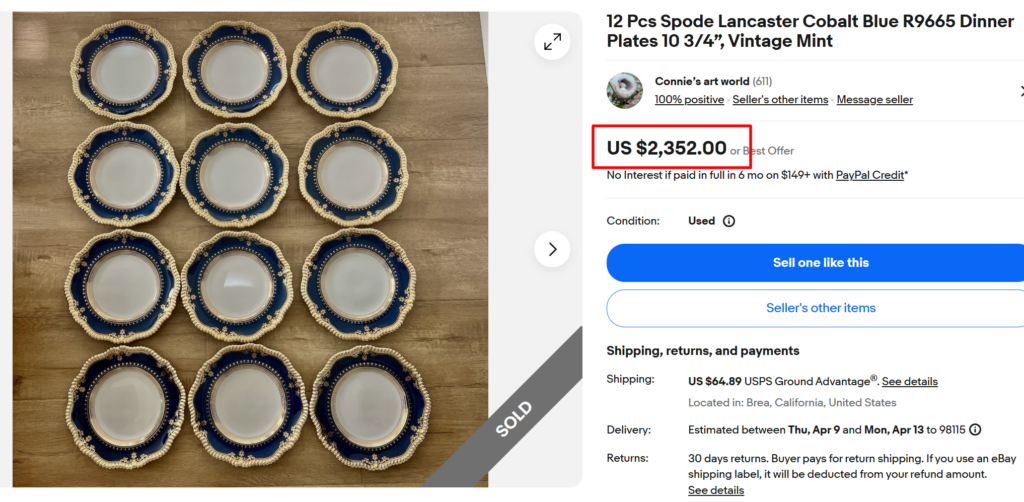
| Average Value | $1,800–$2,500 (partial sets) $2,500+ (full sets) |
| Production Period | 1925–2009 |
| Status | Discontinued |
| Key Features | Cobalt band, raised gold dots, 22-carat gold trim, bone china |
| Collector Notes | Rare serving pieces are expensive. |
This one is a highly luxurious china pattern from Spode. It was often made of high-quality bone china and intended for formal dining.
The design is recognizable for its deep, rich cobalt blue band with hand-applied raised gold dots and filigree, and heavy 22-carat gold trim on a scalloped white body.
Lancaster Blue was first introduced in 1925 and remained in production until the factory closed in 2009. It rarely appears in the market in full dinner sets, making them hard to find and extremely valuable.
Sister patterns Lancaster Crimson and Lancaster Green were also produced, but are even less common.
2. Upland Game
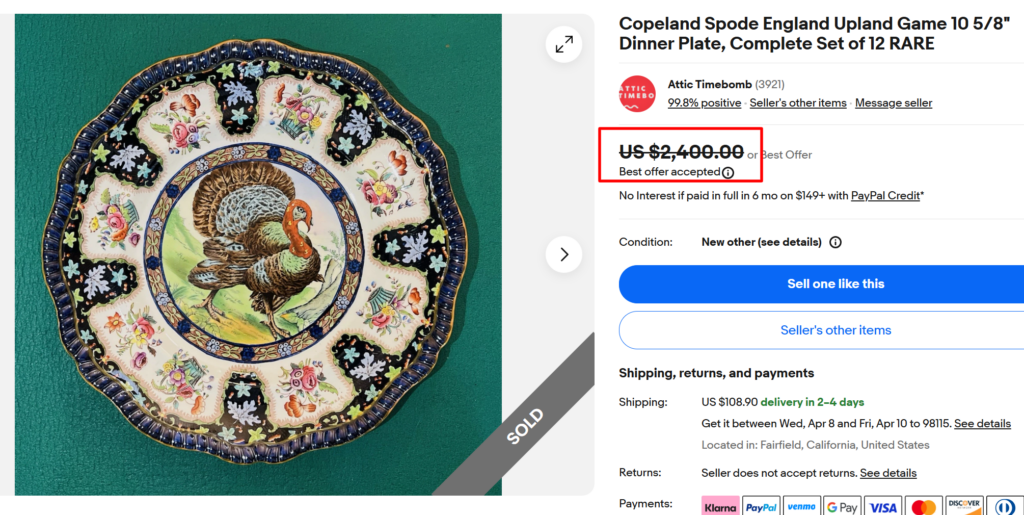
| Average Value | $1,500–$2,400+ (sets) $100 – $250 (singles) |
| Production Period | c. 1900s–1950s |
| Status | Discontinued |
| Key Features | 12 named game birds, cobalt gadroon edge, hand-colored |
| Collector Notes | Artist signatures can boost value. |
The series includes twelve different game birds from Britain and America, such as wild duck, woodcock, turkey, grouse, and pheasant. Each piece is hand-colored and labeled on the back side.
Another distinguishing characteristic of this pattern is the cobalt gadroon (rope-edge) border decorated with blue-green and rusty red accents, as well as the lively floral panels surrounding the bird center.
The value of this pattern lies in the fact that many pieces were commissioned for high-end stores and not mass-manufactured or distributed through regular lines. It is very rare to come across an intact piece of this pattern.
3. Stafford Flowers
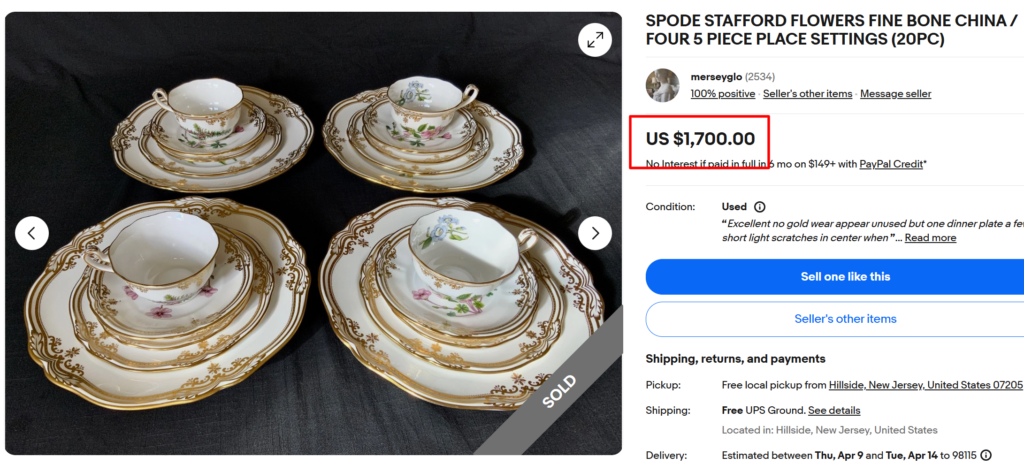
| Average Value | $80 – $350 per piece $1,400–$1,800 (large sets) |
| Production Period | 1989 – 2015 |
| Status | Discontinued |
| Key Features | Botanical motifs, 22-carat gold trim |
| Collector Notes | Check gold for wear/rubbing. |
Stafford Flowers is a premium Spode bone china pattern popular for its botanical illustration. Each piece typically features a different, scientifically accurate floral motif from around 1790, drawn from the Spode archive, and is edged with a luxurious 22-carat gold scalloped rim.
Since each piece features a different botanical design, a complete dinnerware set in this pattern is truly a rare find for you. Also, its high production quality and gold detailing make it one of the more expensive Spode patterns to collect today.
4. Indian Tree
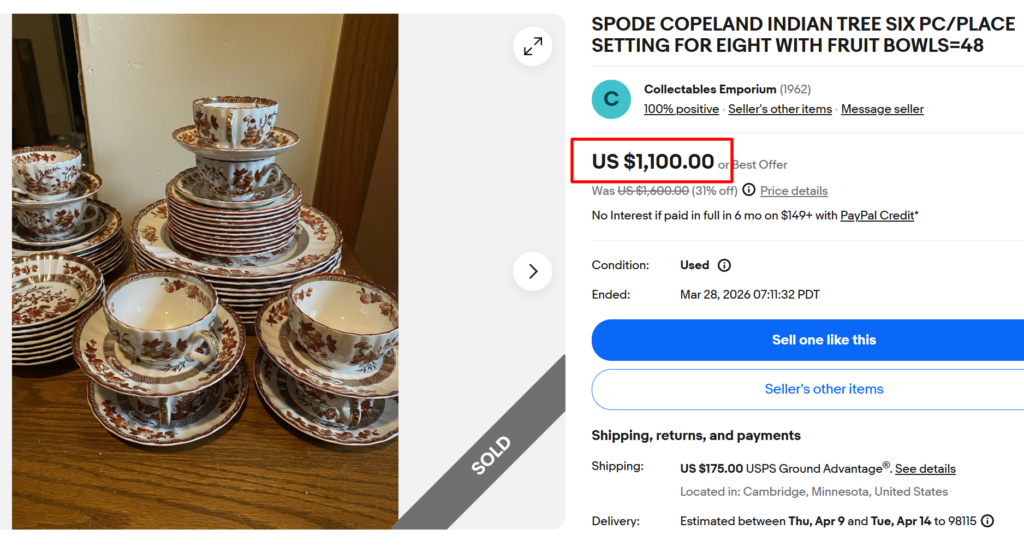
| Average Value | $800–$1,200 (Large sets) |
| Production Period | 1867–c. early 1990s |
| Status | Discontinued |
| Key Features | Rust, brown & gilt flowering tree, scalloped rims |
| Collector Notes | Earlier Copeland-marked sets fetch more. |
The Indian Tree is Spode’s most recognized and widely produced pattern. The design originated from a Chinese pattern of the Yung-Cheng period (1725–35), recognized by a flowering tree with coral-like branches, blooms, and exotic foliage in rust, brown, and gilt.
Spode’s earliest recorded version dates to 1867, though variations were produced across more than 20 different color schemes and shapes through the early 1990s.
Many potteries also produced this pattern, but Spode’s earliest version is highly collected for its detail and quality.
5. Stafford Blue Leaf
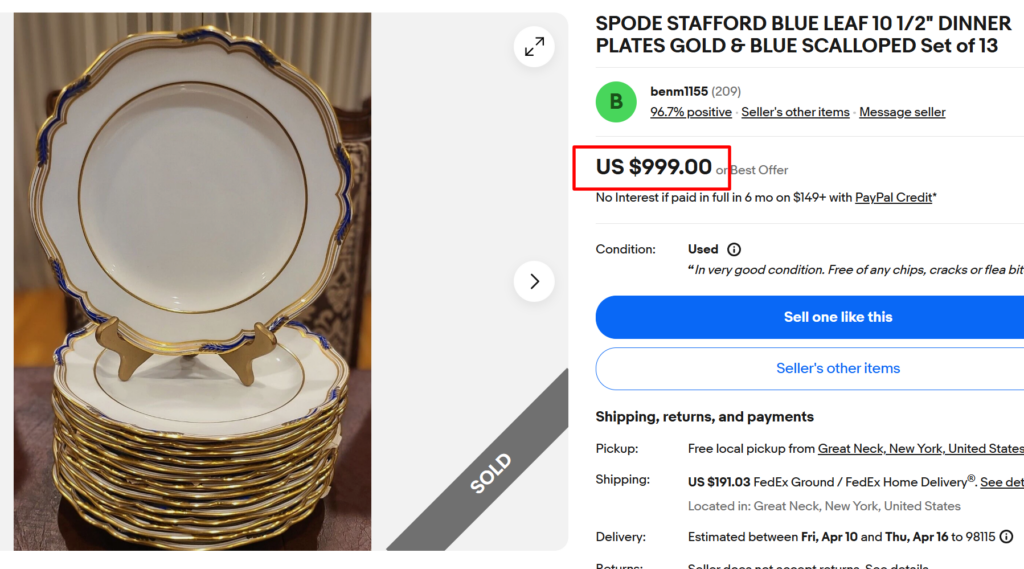
| Average Value | $700 – $1,000 (partial/full sets) $70 – $150 (single) |
| Production Period | 1966 – 1971 |
| Status | Discontinued |
| Key Features | Cobalt blue leaf motifs on the rim |
| Collector Notes | Extremely rare; verify the backstamp. |
The Stafford Blue Leaf pattern is a less commonly known Spode pattern. It features a striking, gold-accented cobalt-blue leaf motif around the scalloped edge, along with thick gold trim on the rims.
Collectors love this pattern for its elegant yet luxurious look. The condition of the gilt is the most important value factor, apart from overall condition, along with the size of the set.
6. Blue Colonel
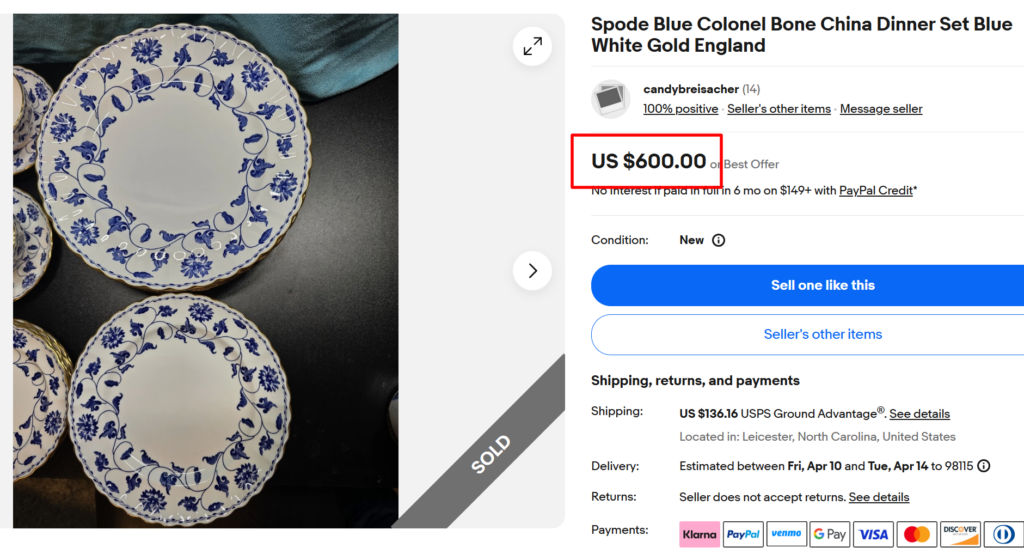
| Average Value | $25 – $90 (single/small sets) $400 – $700 (partial/full set) |
| Production Period | Mid-to-late 20th century |
| Status | Discontinued |
| Key Features | Blue cornflower vine, scalloped edge, gold trim |
| Collector Notes | Pattern name & no. on the backstamp. |
Blue Colonel is a formal, more delicate spin on Spode’s blue-and-white designs. Unlike the busy patterns, this one features a simple, continuous cobalt blue floral vine with cornflowers and trailing leaves across a scalloped white ground, plus a gold trim.
Although simpler and more streamlined than Lancaster or other heavy-gilt patterns, Blue Colonel dinner sets and partial sets like dinner plates, salad plates, or tea sets can fetch a few hundred dollars today.
7. Christmas Tree
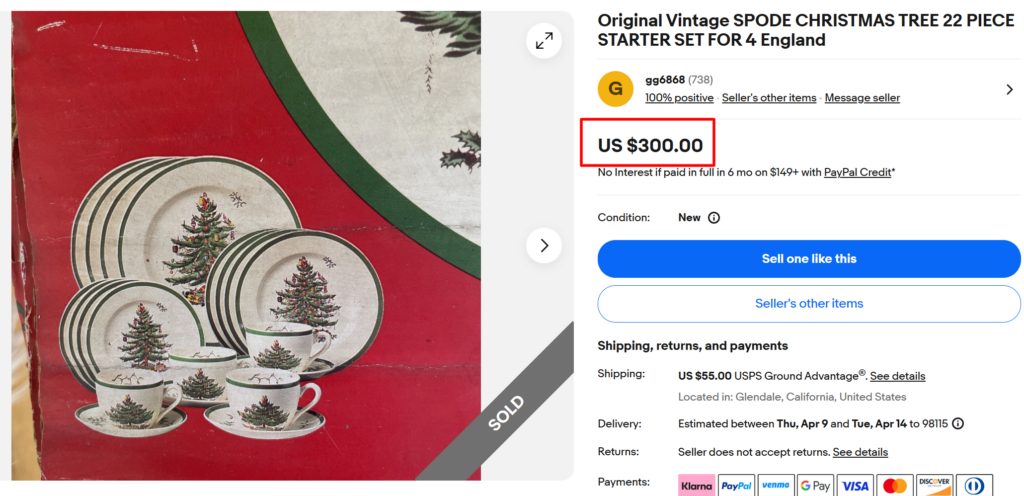
| Average Value | $250–$350 |
| Production Period | 1938–2009 (continued by Portmeirion) |
| Status | Continued (currently in production) |
| Key Features | Santa-topped tree, hand-colored (pre-1962), green or red band |
| Collector Notes | Pre-war pieces and original Copeland backstamps are rare. |
The Christmas Tree is probably Spode’s most famous holiday dinnerware ever created. It was designed by Harold Holdway in 1938 and features a decorated evergreen topped with Santa Claus, gifts beneath the tree, and a holly-and-mistletoe border.
The pattern was hand-colored until 1962, then produced via transfer printing. By 1999, it was the largest-selling casual dinnerware pattern in the U.S. Pre-war pieces (1938–1942). Today, original hand-colored examples are the most desirable.
8. Primrose Rose
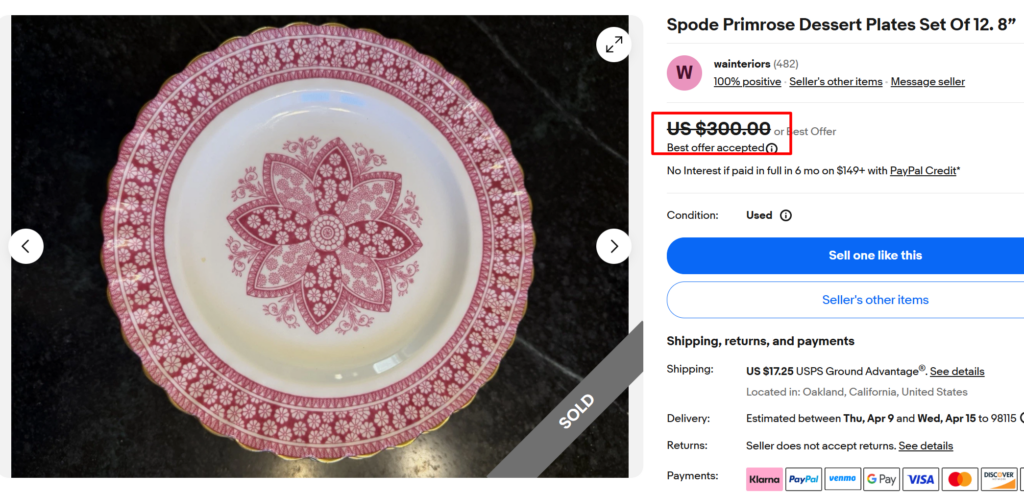
| Average Value | $200–$350 (small/partial sets) |
| Production Period | 1881–1965 |
| Status | Discontinued |
| Key Features | Pink starflower, scalloped edge |
| Collector Notes | Check the backstamp & pattern name. |
This is one of Spode’s longest-running Victorian floral patterns, produced from 1881 to 1965. The design features a large raspberry-pink starflower motif medallion in the center and a matching wide floral border printed on earthenware with a scalloped edge.
The scalloped edges are often highlighted with gold. This design was part of a group of pink transferware patterns that Spode produced from the Copeland period into the 20th century, and is quite collectible today.
9. Blue Italian
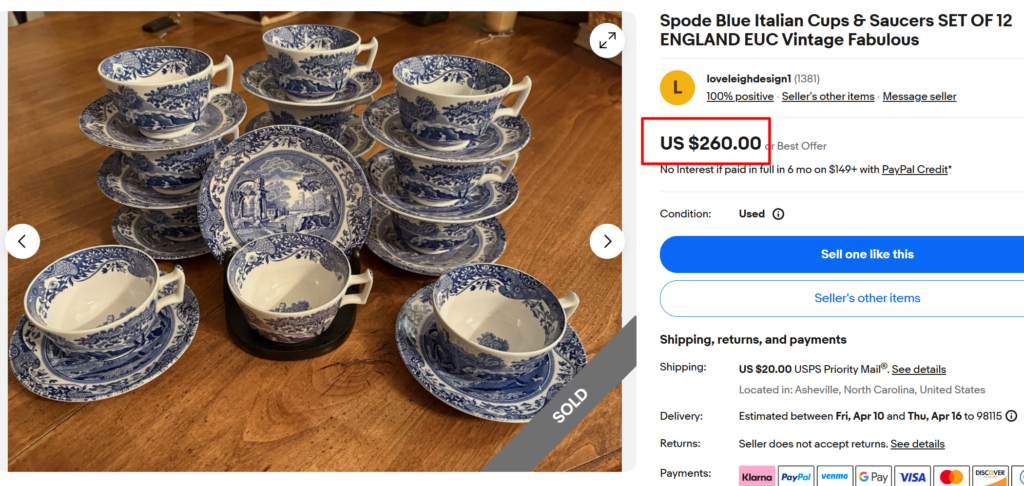
| Average Value | $25 – $60 per piece $200–$700 (sets) |
| Production Period | 1816 – Present |
| Status | Continued |
| Key Features | Italian ruins, Imari border |
| Collector Notes | Look for older English backstamps. |
Blue Italian is one of the most popular patterns introduced way back in 1816.
The design consists of a breathtaking picture, which resembles the Italian landscape, with figures and ruins, surrounded by an ornamental Chinese Imari-style 18th-century border painted in deep cobalt blue transfer print.
Blue Italian is also known as the oldest English dinnerware line still in production since 1816, thus making it the oldest existing dinnerware pattern in the world. Dinnerware pieces made before 1970, especially those marked Copeland or W.T. Copeland, are highly collectible.
10. Chelsea Garden
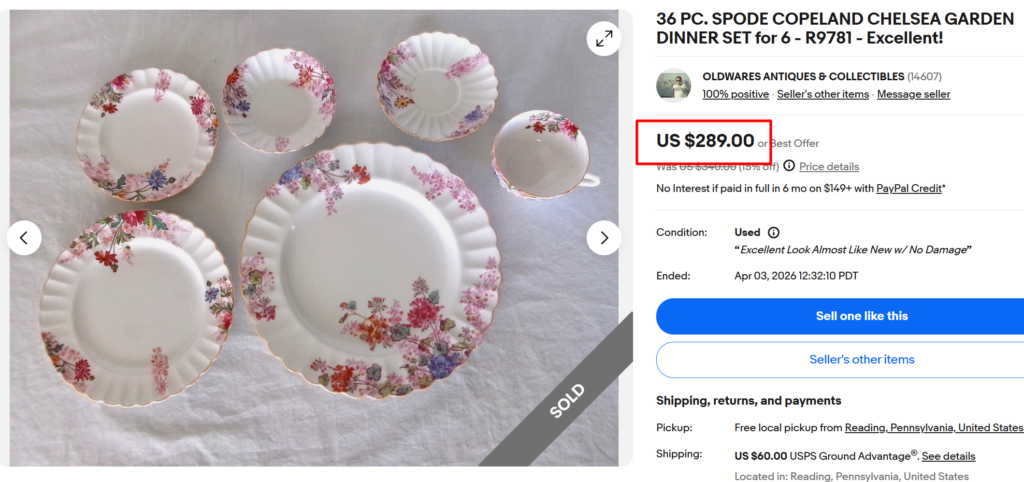
| Average Value | $250 – $350 (full sets) $20 – $55 per piece |
| Production Period | 1952–1988 |
| Status | Discontinued |
| Key Features | Fluted Chelsea shape, multicolor florals, gold trim, bone china |
| Collector Notes | Pattern names painted on the back. |
This cheerful and bold pattern was produced from 1952 to 1988 on Spode’s classic fluted Chelsea shape.
The white bone china is decorated with cascading multicolor floral sprays around the rim, finished with a gold or a distinctive mustard-yellow or brown trim on scalloped borders.
It’s a mid-century pattern that reads as traditional and has still been sold to American buyers for decades. While single pieces or partial sets have low value, full sets like this example can fetch a decent value.
11. Woodland
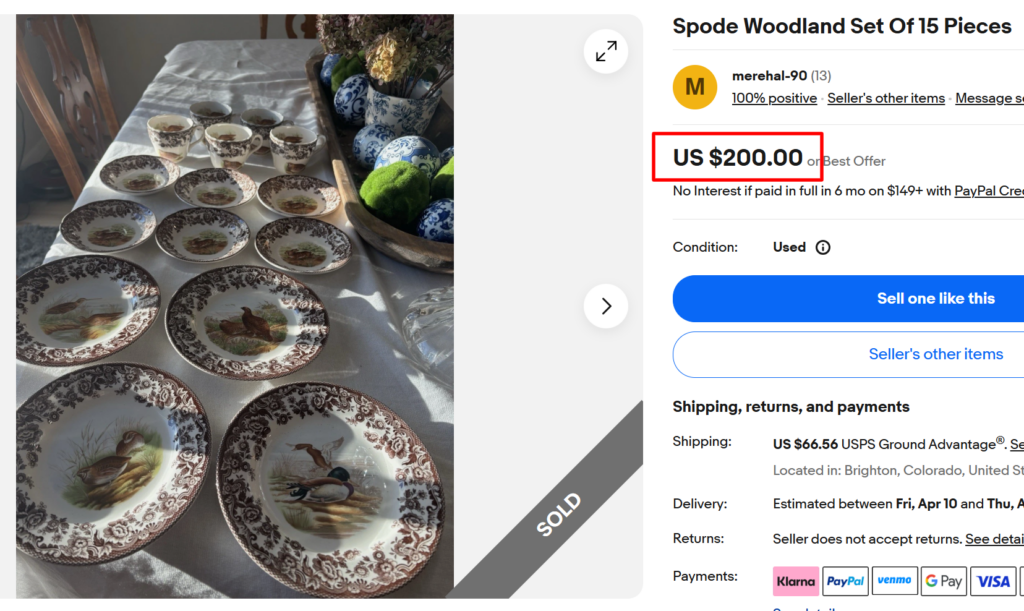
| Average Value | $40 – $130 (singles) $350 – $960 (sets) |
| Production Period | 1990 – Present |
| Status | Continued |
| Key Features | Brown transferware, wildlife motifs, floral border |
| Collector Notes | Specific animal motifs drive value. |
Woodland is one of Spode’s most recognized transferware lines. The pattern pairs detailed game-bird and animal illustrations with Spode’s 1828 British Flowers border, printed in sepia/brown on earthenware.
It sits in the same English sporting tradition as Copeland’s game plate series, but was developed as a modern production line. Portmeirion continues to produce it today, but vintage pieces marked under the Copeland or pre-2009 Spode name are more collectible than current production.
Spotting Real Spode Dinnerware: Signs to Check
Many of Spode’s designs and shapes have been copied over the years. Collectors often misidentify the genuine pieces and confuse them with similar transferware. Here are a few things to check to spot authentic Spode.
The Backstamp
The most reliable and easiest way to identify a genuine Spode dinnerware piece is the backstamp. The company marked almost all its productions from the beginning. And over time, the marks changed, which also helps in dating the pieces.
- Pre-1833: These pieces are marked “Spode” only, often in red paint or impressed into the clay. You may occasionally find pattern numbers without a maker name.
- 1833 – 1847: Pieces from this period carried the Marked “Copeland & Garrett” mark, often with “Late Spode.” This tells you the piece was made under new ownership but kept the Spode brand equity.
- 1847 – 1970: These pieces bear a “W.T. Copeland” or “W.T. Copeland & Sons” mark. The brand name often appears alongside. Most pieces (flat) from this era also carry impressed date codes; a month and year pressed into the clay.
- 1970 – 2009: The company reverted to the name “Spode Ltd.” A date-letter system was used from 1976 onward: letters A through N for 1976–1989, then P through W for 1990–1997, and then Y and Z for 1998–1999. In 2000, a new system began: A0 for 2000, A1 for 2001, and so on through A9 for 2009.
- Post-2009: These pieces were made under Portmeirion ownership. Some pieces are still marked Spode but are identifiable by different production methods and backstamp style.
The Pattern Numbers & Names
Spode recorded approximately 75,000 patterns in their pattern books, starting around 1800. And until 1850, the company also added a hand-painted pattern number (often in red) on the base, in addition to the brand name.
This mark is a strong indicator of a pre-1850 piece. Besides, if you can cross-reference the number against published Spode references, you can date your piece precisely.
Printing Quality
In genuine Spode, the transfer prints’ lines must be sharp, even, and consistent throughout the ware. However, in reproductions, the lines may appear blurred or even misaligned in the overlapping area.
For hand-tinted patterns like Upland Game, check the painted color. It should sit cleanly within the printed outlines, not bleed outside them.
Gilt Quality
Gold trim is another common feature of Spode dinnerware, which is often copied. But you can identify it. The trim on Spode is applied over the glaze.
And genuine 22-carat gold (like on Lancaster Cobalt and Stafford Flowers) has a slightly warm, rich tone compared to cheaper metallic paints.
Run your fingernail lightly across the trim. Original gold on older pieces may feel very slightly raised, especially on patterns with hand-applied raised dots. Worn gilt that shows gray or silvery underneath indicates heavy use. They may be a sign of authenticity, but they may reduce value.
Material (Bone China Vs. Earthenware)
Spode made both. Bone china is whiter, more translucent, and lighter. Hold a thin piece up to light, and genuine bone china shows a slight glow. Lancaster, Stafford Flowers, and most formal dinner services are bone china.
Earthenware, on the other hand, is heavier, more opaque, and often has a cream or off-white body rather than a pure white one. Patterns like Blue Italian and Woodland are earthenware.
Knowing which body a pattern was made on is a useful check. If you find a design originally made on Bone china on earthenware, it’s a clear sign of reproduction.
Note: This article is intended for informational, educational, and entertainment purposes only. Some images are illustrative and may not represent actual brands, products, or related entities. All trademarks, product names, brand logos, packaging, and other intellectual property referenced remain the exclusive property of their respective owners. Any brand mentions or references are provided solely for descriptive and educational context and do not imply any formal or commercial association.