Antiques Know How Research
Vintage Jelly Belly Brooches
Our detailed analysis of several eBay sales at Antiques Know How shows that most vintage Jelly Belly brooches sell for $50 to $100, while marked wartime pieces from top brands can reach up to 5,000+. Some top‑end pieces include Trifari poodle, heron, butterfly, and seal designs, Corocraft fruit‑basket, Coro spider, and Duette angelfish, and smaller Elzac ducks. Maker’s marks, original Lucite, construction, setting material, and designs confirm authenticity, while condition, maker, and size heavily influence price.
Antiques Know How
A Brief History of Jelly Belly Brooches
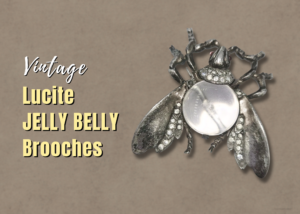
The Jelly Belly jewelry began with the legendary firm Trifari. The term is a collector’s nickname. The manufacturers actually called them “clear belly” jewelry. These figural brooches feature a polished piece of clear Lucite (an acrylic plastic) forming the body or belly of an animal, insect, or other figure.
Trifari’s main designer, Alfred Philippe, perfected this style and made it popular in the 1940s. The timing wasn’t accidental. During World War II, European crystals were hard to source. Lucite, already used in military aircraft windows, was available and affordable.
After the war, Coro, Corocraft, Elzac, and other manufacturers also produced their own versions.
Identifying Authentic & Valuable Jelly Belly Brooches
Because that clear Lucite is easy to replace with glass or modern plastics, knowing how to identify genuine Jelly Belly brooches is important for authenticity as well as valuation.
Genuine 1940s Jelly Bellies have certain telltale details you can easily check:
The “Jelly Belly” Center
The key feature to look for is the Lucite cabochon that makes the figural’s (animal) body. On genuine vintage pieces, the Lucite is clear and smooth. Plus, if you touch it, it should feel a bit warm; glass pieces feel cool to the touch.
Besides, Lucite is also much lighter than glass.
Hold the piece up and look closely. Original Lucite from the 1940s usually has a yellowish color because of its age. You might also see scratches on the surface from years of wear and tear. Modern reproductions often use plastic that’s perfectly clear with no aging.
Some Jelly Bellies have rhinestones embedded inside the Lucite, while others are plain and polished. A few designs use colored Lucite, most commonly red and blue, but clear is the standard.
Figural Designs
Jelly Belly pins are usually figural, like animals, birds, or sea creatures. The Lucite part is the belly of the figural, and the rest, like the head, legs, wings, and tail, are made of metal with rhinestones or colored enamel on them.
You can find Jelly Bellies that look like frogs, poodles, birds, fish, spiders, seals, or elephants, and a lot of figurals. A few pins that are not animals also exist, like flowers or baskets of fruit, but mostly you will find animals.
Among these, common designs like small birds or fish are relatively affordable. Unusual animals (poodles, elephants, seals) or complex multi-element pieces like Duettes are worth more because fewer were made.
Maker’s Marks
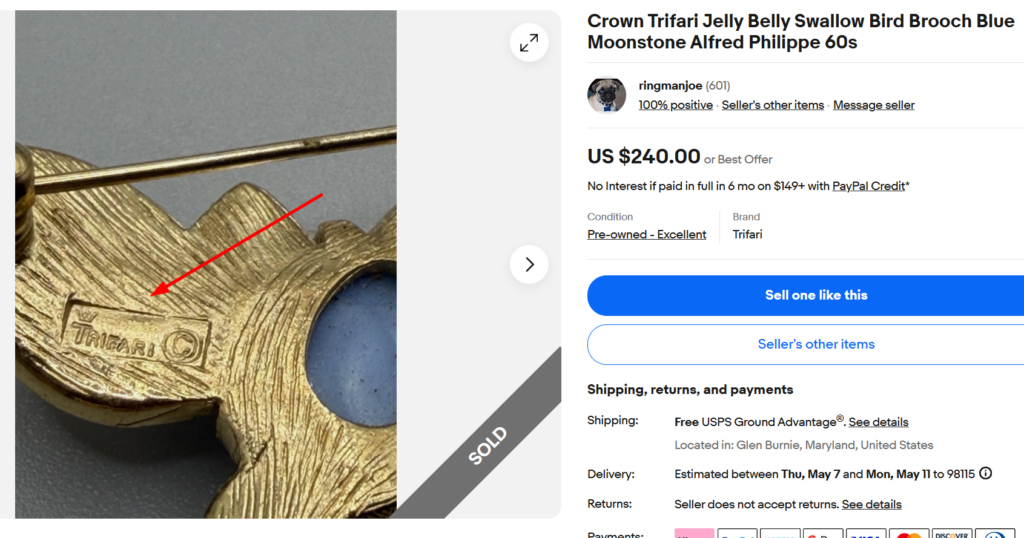
Most authentic vintage Jelly Belly brooches have some kind of identifying marks on them. The maker mark is the key factor that differentiates a common $5 Jelly Belly brooch from a rare $1,000 one. Here’s what to look for:
- Trifari: Trifari’s Jelly Bellies are easily worth the most. Look for “Trifari©” with a crown above the “T” (called the Crown Trifari mark), plus “Sterling” and often a design patent number like “Des Pat No. 135172.” The patent number helps date the exact design.
- Coro / Corocraft: These brooches are marked with the name “Coro” or “Corocraft Sterling”. Sometimes you will see a logo of a horse with wings (Pegasus). Some pieces have patents, with the name Adolph Katz on them, although the person who really designed them was Gene Verri.
- Elzac: Elzac made Jelly Bellies, but they are less popular. These pieces are sometimes unmarked or carry only a “Sterling” stamp.
- Unsigned pieces: Some genuine vintage Lucite pins carry no brand mark, just “Sterling.” These are harder to attribute but can still be authentic. In such a case, the value lies in genuine Sterling silver and authentic Lucite.
Materials
The Jelly Bellies from the 1940s were mostly made of sterling silver. Sometimes they had a gold wash on them, which is called vermeil. This is because they did not have base metals to use during the war.
So, if you see the “Sterling” mark on a Jelly Belly brooch, that is a sign it is from the wartime era.
In the late 1940s and the 1950s, they started making jelly bellies with gold-plated base metals. Both kinds of Jelly Bellies are collectible today, but sterling pieces are usually worth more than the gold-plated jelly bellies.
Clasps and Construction
Original 1940s Jelly Bellies use either a pin back with a safety catch or a double-pronged pin clip (collectors call these “fur clips”). The Lucite is attached to the metal with a set-screw that you can see on the back. This screw is important to check if the Jelly Belly is real.
On genuine pieces, the back shows fine detailing and finishing, not just the front. Reproductions often have rough, unfinished backs. Check the pin mechanism too: vintage pins feel different. They’re usually heavier than the new spring-loaded pins.
Size & Condition
Bigger designs usually mean more value. Small scatter pins are more affordable, while larger Jelly Bellies with more detail and more rhinestones, like dress clips with full figural designs, tend to bring stronger prices.
Regardless of size or design, condition is critical for value. Scratches, cloudiness, or yellowing on the Lucite can cut value significantly. Besides, missing rhinestones, damaged enamel, worn gold wash, and broken clasps all hurt prices. The closer to the original condition, the higher the value.
Examples of Valuable Lucite Jelly Belly Brooches
Here are eight examples of vintage Jelly Belly brooches that collectors actively seek. Each one shows what makes a specific design valuable and worth finding today.
1
Trifari A. Philippe Poodle Brooch
Typically sells for $1,500 – $5,000+
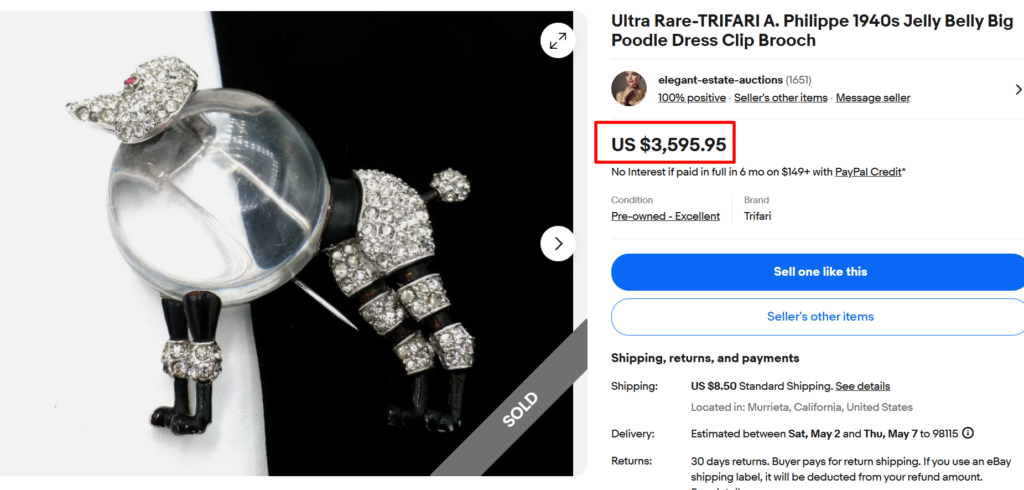
| Average Value | $1,500 – $5,000+ |
| Brand | Trifari (Alfred Philippe) |
| Production Period | Early 1940s |
| Key Features | Lucite body, pave rhinestones, enamel |
| Collector Notes | Larger version commands top prices |
The Trifari poodle is one of the most valuable Jelly Belly designs ever produced. Philippe’s original features a large, clear Lucite body with pave-set rhinestones and black enamel accents on the legs, feet, and tail.
The large “Big Poodle” dress clip version is much harder to find than the smaller scatter pin Trifari made in the 1950s. Enamel loss on the feet is common and lowers value; pristine pieces can reach $ 4,000-$5,000+ at auction.
2
Trifari Heron Bird Brooch
Typically sells for $400 – $1,000
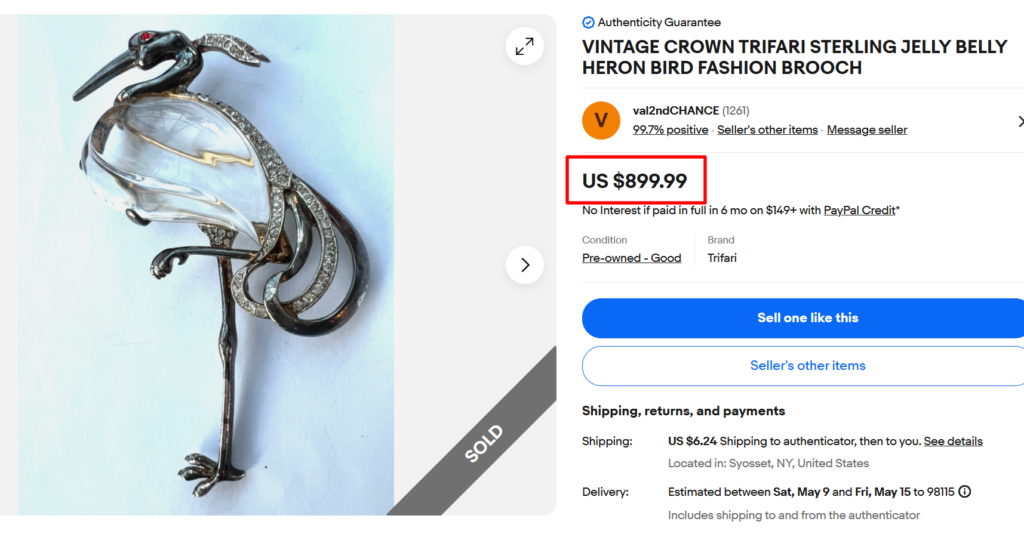
| Average Value | $400 – $1,000 |
| Brand | Crown Trifari |
| Production Period | 1940s |
| Key Features | Tall profile, clear Lucite body, rhinestones |
| Collector Notes | Missing red cabochon eye hurts value. |
This tall heron stands out because of its vertical profile. It’s one of the more distinctive Jelly Belly shapes. The clear Lucite forms the bird’s body, while the long neck, legs, and beak are sterling silver with pavé rhinestones.
A small red cabochon stone makes up the eye. The value of the brooch can drop noticeably if the eye stone is missing or the Lucite is scratched.
3
Corocraft Enamel Fruit Basket Brooch
Typically sells for $500 – $1,000
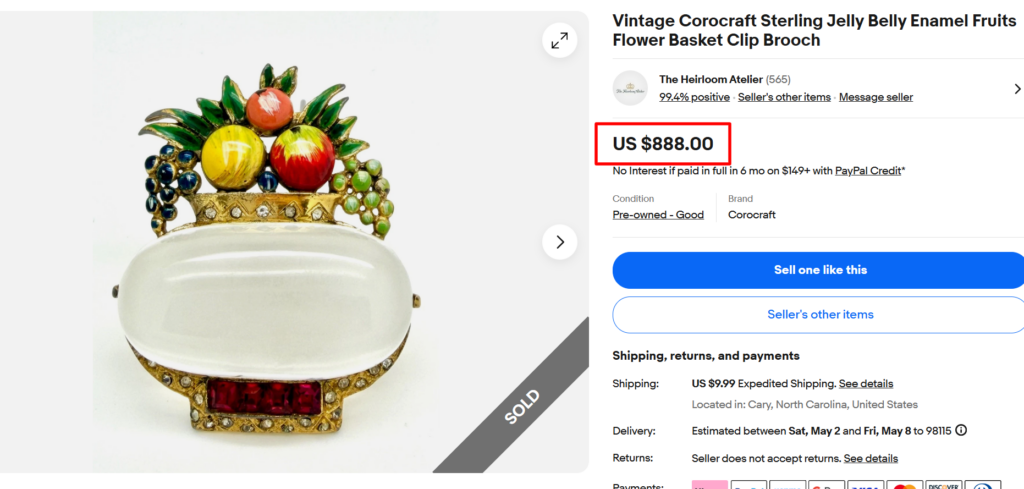
| Average Value | $500 – $1,000 |
| Brand | Corocraft |
| Production Period | 1940s |
| Key Features | Enamel fruit, large Lucite basket body, rhinestone accents |
| Collector Notes | Enamel condition is the biggest value factor |
This is one of Coro’s most coveted Jelly Belly designs. The large, clear Lucite forms the basket, topped with colorfully enameled fruits, like cherries, grapes, and pears, in green, blue, red, and yellow. Red and clear rhinestones accent the basket.
The enamel from the fruits on these pieces chips over time, which can significantly reduce value. Intact, vibrant enamel is the biggest price driver. The rhinestones are equally crucial for overall value.
4
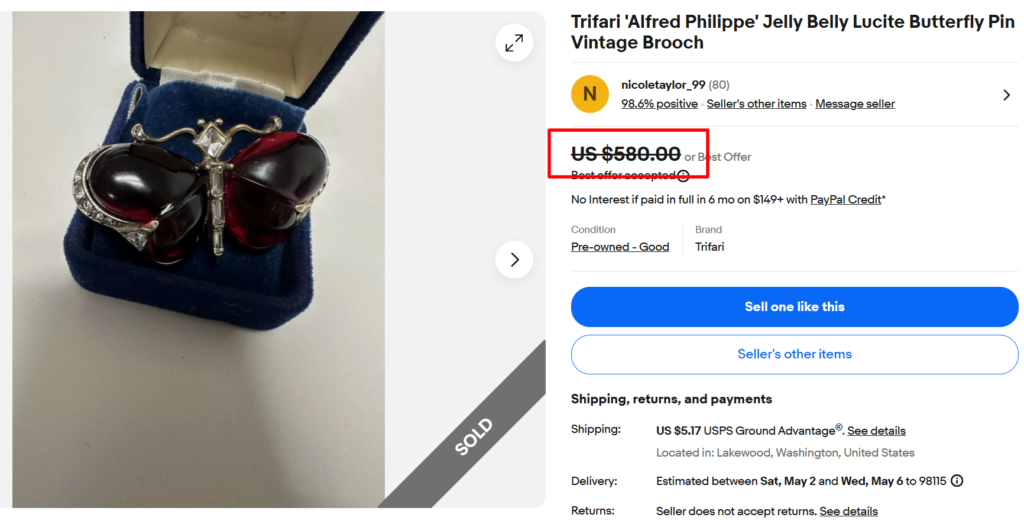
Trifari Red Lucite Butterfly Brooch
Typically sells for $350 – $700
| Average Value | $350 – $700 |
| Brand | Trifari (Alfred Philippe) |
| Production Period | 1940s |
| Key Features | Red/dark Lucite wings, baguette rhinestones |
| Collector Notes | Colored Lucite rarer than clear versions |
This butterfly is really different from other Jelly Bellies because it has deep red Lucite wings. The part between the wings is decorated with a baguette and round rhinestones set in sterling silver.
Most Jelly Belly pins have clear Lucite, so colored Lucite Jelly Bellies are rarer. But reproductions of colored pieces are very common. So, always look for the Trifari mark and patent number on the back to confirm authenticity.
5
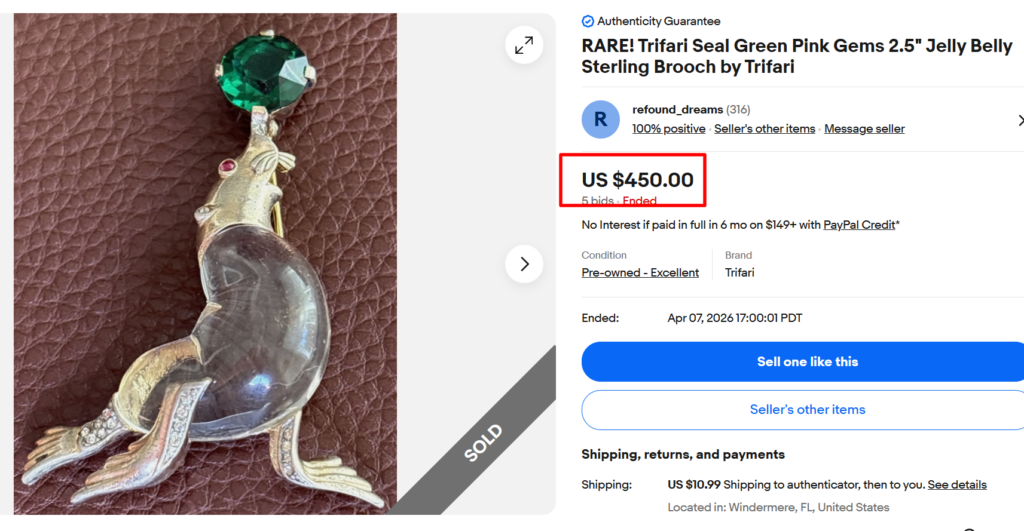
Trifari Jelly Belly Seal Brooch
Typically sells for $300 – $600
| Average Value | $300 – $600 |
| Brand | Trifari |
| Production Period | 1940s |
| Key Features | Green cabochon on nose, rhinestone accents |
| Collector Notes | Verify Lucite clarity and stone color |
The Trifari Jelly Belly seal sits upright and balances a large colored cabochon stone on its nose. The body is a smooth, clear Lucite dome, with flippers and tail set in rhinestone-accented sterling silver.
Green is the most common color for cabochon stone. You’ll also find a small red cabochon in the eye of authentic pieces. Examples with crystal-clear Lucite and all stones intact bring the strongest prices.
6
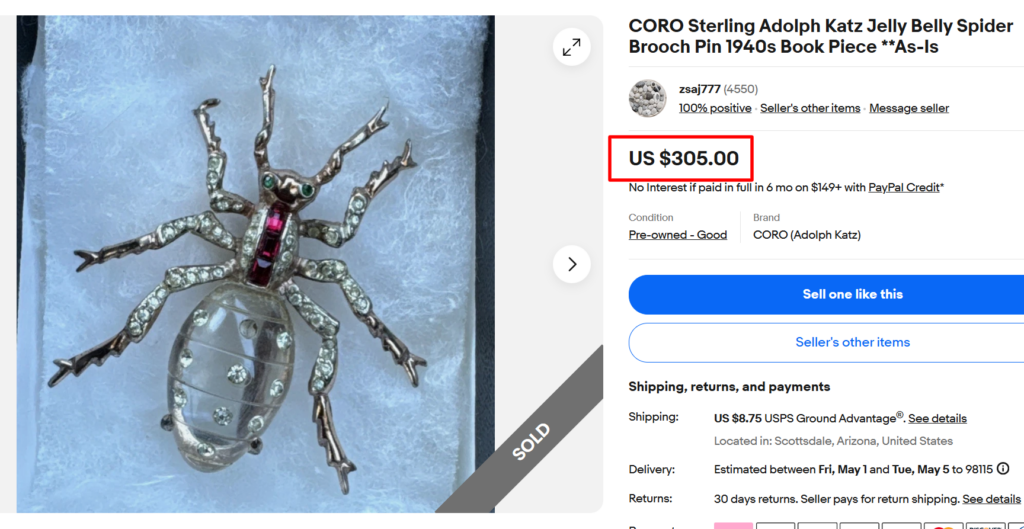
Coro Adolph Katz Jelly Belly Spider Brooch
Typically sells for $200 – $450
| Average Value | $200 – $450 |
| Brand | Coro (Adolph Katz patent) |
| Production Period | 1940s |
| Key Features | Eight legs, rhinestone body, Lucite abdomen |
| Collector Notes | Missing stones in legs reduce value |
The Coro spider features a round, clear Lucite abdomen with eight sterling silver legs set with rhinestones. Small green cabochon eyes and red baguettes along the body add color.
This one is a recognized “book piece” as it has appeared in published reference guides. The thin legs are fragile and often show bends or missing stones, so a spider with all eight legs intact and straight is worth notably more.
Trifari’s spider Jelly Bellies are worth way more than Coro’s.
7
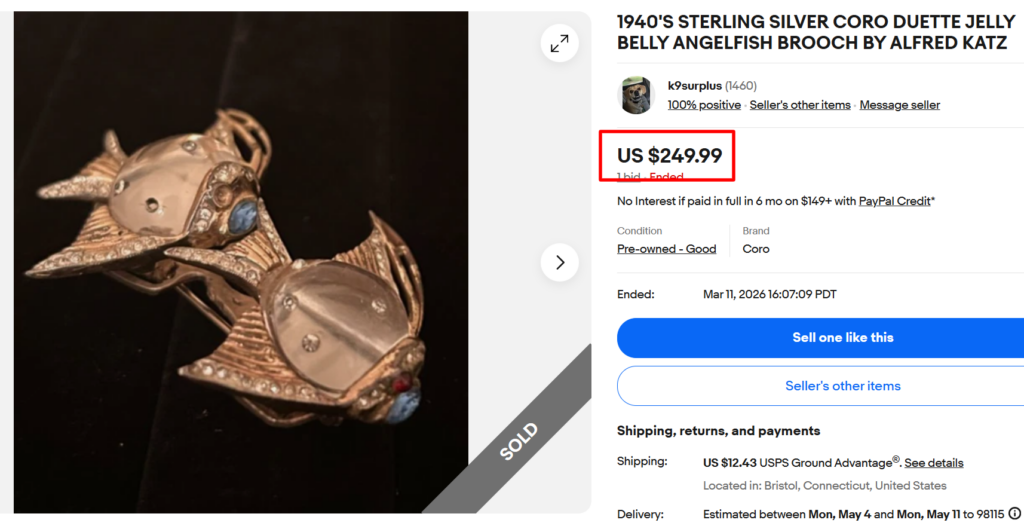
Coro Angelfish Jelly Belly Duette
Typically sells for $200 – $400
| Average Value | $200 – $400 |
| Brand | Coro |
| Production Period | 1944 (patented) |
| Key Features | Separable Duette design, two angelfish |
| Collector Notes | Check for the patent number on back. |
The Coro angelfish Duette is two pin clips that fit together into a single brooch frame. Each clip shows an angelfish with a clear Lucite belly, rhinestones on the fins, and colored cabochon eyes.
The design patent was filed by Adolph Katz in 1944, and authentic pieces must show the patent number engraved on the back, alongside “Coro” and “Sterling” marks. A complete Duette with both clips and the frame is worth significantly more than a single clip sold alone.
8
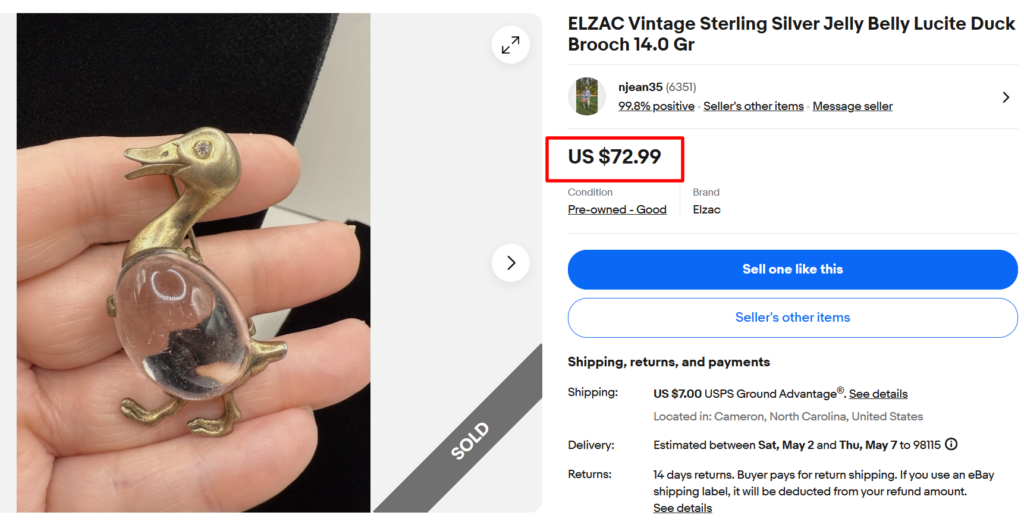
Elzac Sterling Jelly Belly Duck Brooch
Typically sells for $50 – $150
| Average Value | $50 – $150 |
| Brand | Elzac |
| Production Period | Mid-1940s |
| Key Features | Small size, sterling body, round Lucite belly |
| Collector Notes | Elzac pieces are less common than Trifari/Coro |
Elzac was a smaller manufacturer, and their Jelly Belly designs are less frequently found than Trifari or Coro pieces. This compact duck features a simple sterling silver body with a round, clear Lucite belly and a small rhinestone eye. Elzac pieces are among the most affordable pieces in the Jelly Belly brooch market.
The key to collecting vintage Jelly Belly brooches is learning to check the details: Lucite quality, maker’s mark, clasp type, and back finishing. Once you know what a genuine 1940s piece looks and feels like, spotting them gets easier.
Note: This article is intended for informational, educational, and entertainment purposes only. Some images are illustrative and may not represent actual brands, products, or related entities. All trademarks, product names, brand logos, packaging, and other intellectual property referenced remain the exclusive property of their respective owners. Any brand mentions or references are provided solely for descriptive and educational context and do not imply any formal or commercial association.