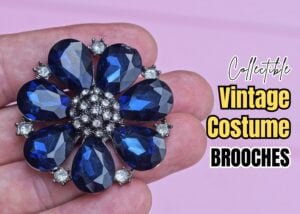
Antiques Know How Research
Vintage Costume Brooches Value
Antiques Know How team’s in‑depth review of several eBay sales shows that most vintage costume brooches sell for $10-$70, while rare designer pieces can fetch up to $150–$4,500+. The most valuable costume brooches include Trifari Jelly Belly animals, Schreiner ruffle and Maltese‑Cross brooches, Dior and Chanel Gripoix glass pins, Haskell filigree pins, Boucher figural animal pins, Coro Duette clips, Weiss Christmas tree and rhinestone designs, and Eisenberg Ice brooches. Check makers’ mark, materials, original boxes, rarity, and condition for value.
Antiques Know How
If you think old costume jewelry brooches with rhinestones, glass beads, and fake pearls are worthless today, you are not alone. Most people ignore these jewelry pieces in their inherited jewelry boxes or at estate sales without giving them a thought.
The truth is that some costume pieces from the right designer in the right style can sell for hundreds, even thousands of dollars, today.
This guide covers popular vintage costume brooch styles from top costume designers and brands that people are looking for today, and explains what makes them valuable.
Vintage Costume Brooches That Are Actually Worth Money
Many companies made brooches in the 20th century, but only a few brands made pieces that people really want to collect. The 10 styles below come from the makers whose brooches regularly sell for a lot of money.
1
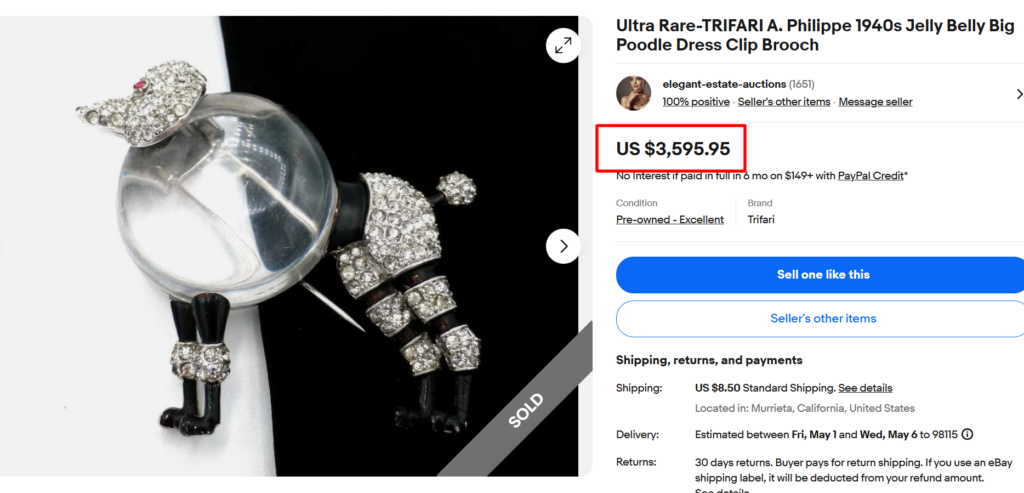
Trifari Jelly Belly Animal Brooch
Typically sells for $800 – $4,000+
| Average Value | $800 – $4,000+ |
| Production Period | 1943 – 1947 |
| Key Features | Lucite belly, sterling silver, figural animal |
| Collector Notes | Sterling mark confirms WWII-era production |
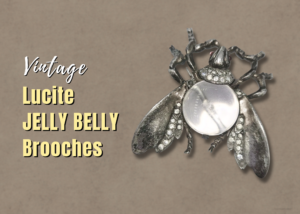
Trifari’s Jelly Belly brooches are among the most valuable costume jewelry pieces. The figural animal pins feature a large Lucite “belly,” a clear or translucent cabochon that gives the piece its name.
Alfred Philippe designed these during World War II, when base metals were rationed, and Trifari used sterling silver instead. Plus, the Lucite came from rejected airplane window material.
Authentic Jelly Bellies have clear or frosted Lucite bellies, not colored ones. The poodle, rooster, and fish designs are among the rarest and most expensive.
2
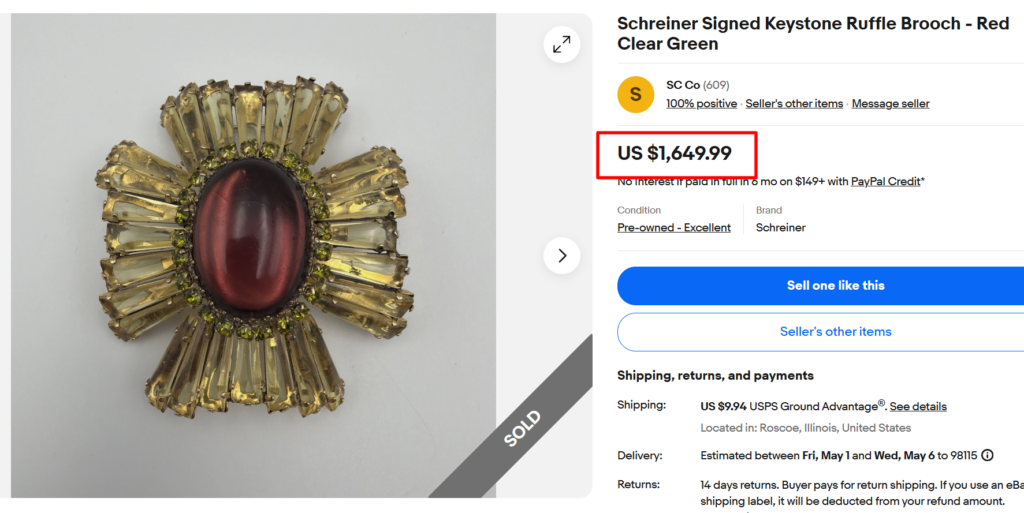
Schreiner Ruffle Rhinestone Brooch
Typically sells for $800 – $3,500+
| Average Value | $800 – $3,500+ |
| Production Period | 1950s – 1970s |
| Key Features | Keystone rhinestones, layered 3D design |
| Collector Notes | Many pieces are unsigned; check construction clues |
Schreiner’s most collectible design is the “Ruffle” brooch, built with exclusive elongated keystone-shaped rhinestones arranged in radiating tiers around a large central cabochon. These keystone stones were made exclusively for Schreiner.
A lot of Schreiner pieces do not have a signature. You can still identify them by how they are made; they have hook-and-eye closures, inverted rhinestones, and layered three-dimensional designs. The Maltese Cross ruffle variation is the hardest to find and most valuable type in this category.
3
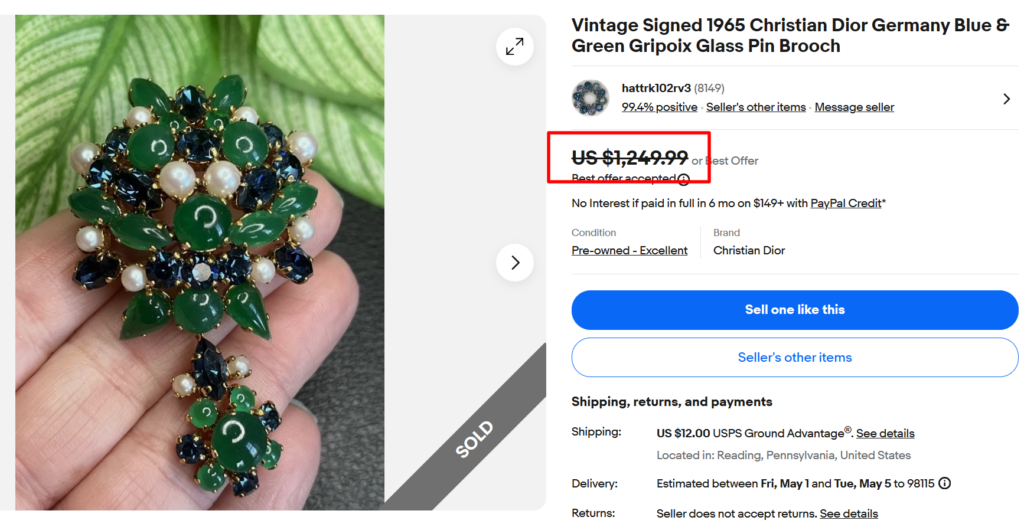
Christian Dior Gripoix Glass Brooch
Typically sells for $300 – $4,500+
| Average Value | $300 – $4,500+ |
| Production Period | Late 1940s – 1970s |
| Key Features | Gripoix glass, gold-plated |
| Collector Notes | Check the year stamp, “Chr. Dior” sign in on back |
Christian Dior’s first costume jewelry collection was produced by Maison Gripoix in the late 1940s. From the mid-1950s onward, German firm Henkel & Grosse manufactured most Dior costume jewelry under license.
The German-made pieces are usually marked “Chr. Dior” with a year stamp, which makes dating them easy. But, Gripoix-made Dior pieces from the 1940s-50s are often unsigned and harder to attribute.
Brooches with green and blue glass cabochons, faux pearls, and rhinestones in gold-plated settings bring strong prices, especially pieces with a confirmed date stamp from the 1960s.
4
Chanel Gripoix Glass Brooch
Typically sells for $400 – $4,000+
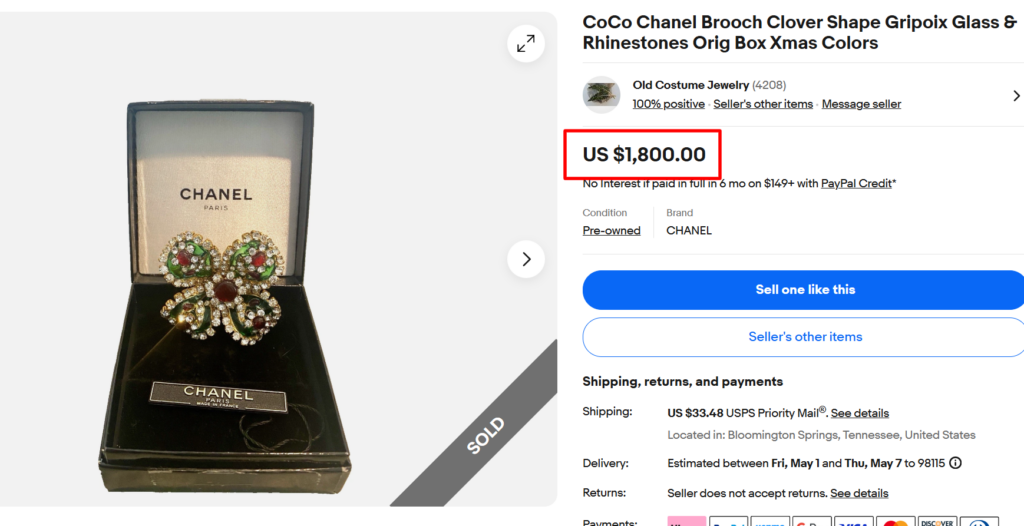
| Average Value | $400 – $4,000+ |
| Production Period | 1920s – present |
| Key Features | Poured glass cabochons, gold-tone metal |
| Collector Notes | Look for “Chanel Made in France” stamp, Crown Trifari mark |
These brooches are part of Chanel’s partnership with Maison Gripoix from the 1920s. Gripoix pieces use poured glass (also called pâte de verre), where molten glass is poured into molds to create rich, jewel-toned cabochons with great depth.
Vintage Chanel Gripoix brooches usually have red glass along with rhinestones and fake pearls, all set in gold-tone settings. Pieces from the 1930s through the 1960s are the most valuable, but even 1980s-90s examples from the Karl Lagerfeld era sell well.
5
Crown Trifari Fruit Salad Tutti Frutti Brooch
Typically sells for $125 – $2,000+
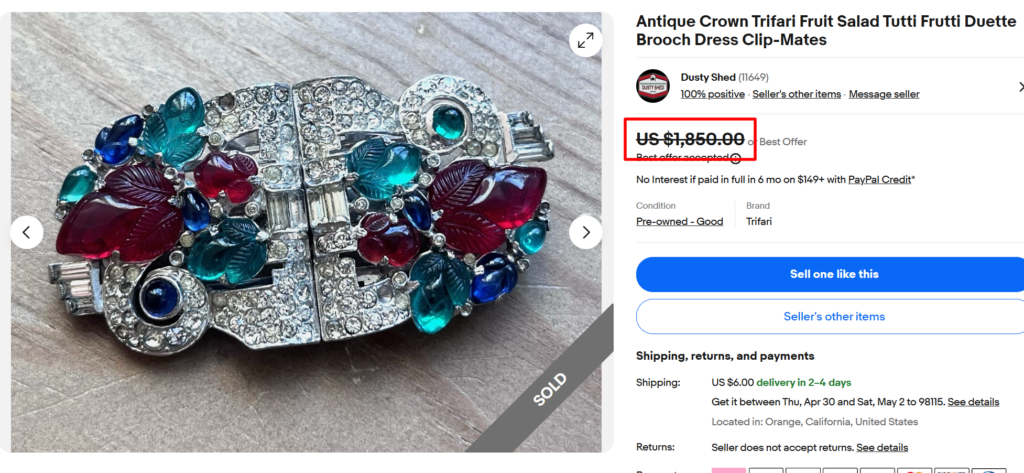
| Average Value | $125 – $2,000+ |
| Production Period | 1930s – 1940s |
| Key Features | Molded glass fruit/leaf stones, rhinestones |
| Collector Notes | KTF mark = earlier, more valuable |
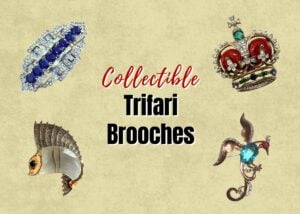
These Trifari brooches feature molded glass stones shaped like tiny fruits, leaves, and flowers in red, blue, and green. Designer Alfred Philippe created them in the 1930s, drawing from his earlier work at Cartier.
The stones aren’t carved. They’re pressed glass imitating carved gemstones. Early pieces are marked “KTF” (for Trifari, Krussman, and Fishel), while later versions carry the Crown Trifari mark. The Duette clip-mate versions, which split into two separate dress clips, are especially sought after by collectors.
6
Miriam Haskell Filigree & Glass Brooch
Typically sells for $75 – $650+
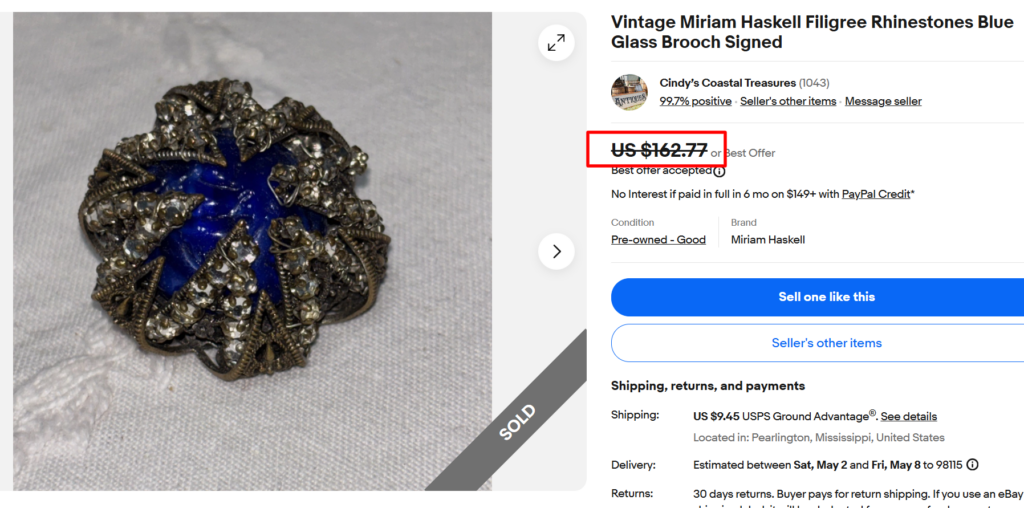
| Average Value | $75 – $650+ |
| Production Period | 1926 – 1970s |
| Key Features | Filigree backing, hand-wired construction |
| Collector Notes | Unsigned pieces pre-date 1947 mark |
Miriam Haskell founded her company in New York in 1926, with designer Frank Hess creating most of the early pieces. Haskell brooches are entirely handmade; components are wired together individually onto stamped filigree metal backings.
The company used imported Czech glass beads, faux baroque pearls, and small flat-backed rhinestones called rose montées. The signature finish is “Russian Gold,” a proprietary plating formula containing real 24-karat gold.
Early pieces before 1947 are most valuable, but these are mostly unsigned, which makes them harder to identify. Later pieces show a clear “Miriam Haskell” embossing on the back.
7
Boucher Figural Animal Brooch
Typically sells for $75 – $500+
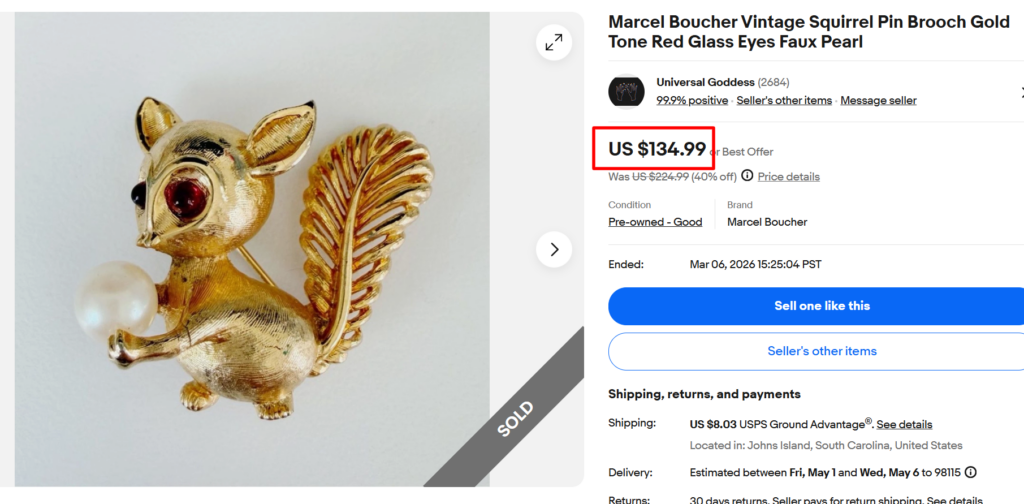
| Average Value | $75 – $500+ |
| Production Period | 1937 – 1970s |
| Key Features | Pearlized enamel, rhodium plating, figurals |
| Collector Notes | Inventory number helps date the piece |
Marcel Boucher’s figural animal brooches, including birds, frogs, squirrels, and insects, are some of the finest in costume jewelry. He used luminous pearlized enamel, heavy rhodium plating, and proprietary rhinestones that were made exclusively for his firm.
The enameled figurals from the 1940s bring the highest prices. You can identify the early pieces from the late 1930s-40s by the Phrygian cap symbol or “MB” mark. Later pieces say “Boucher” with a design inventory number.
8
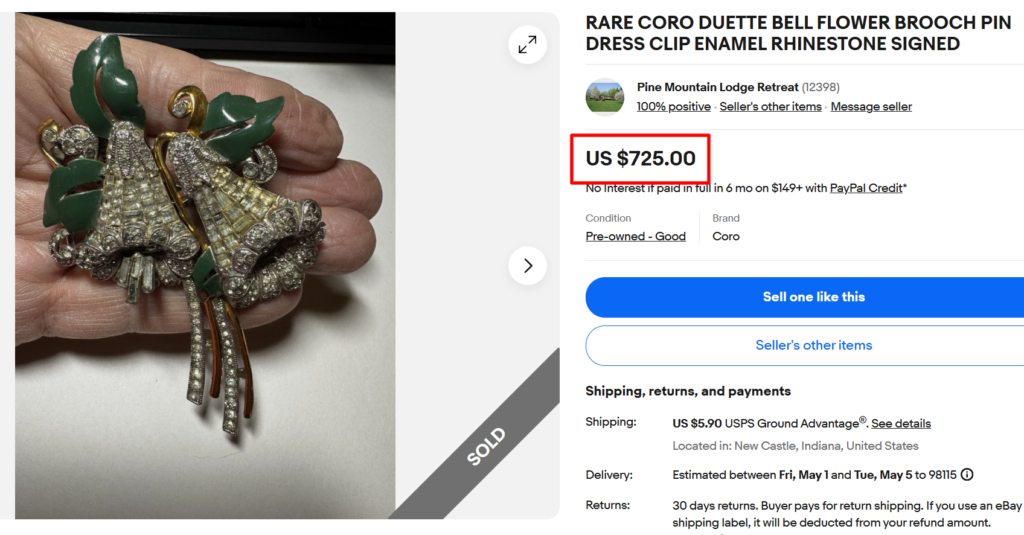
Coro “Duette” Convertible Brooch
Typically sells for $200 – $725+
| Average Value | $200 – $725+ |
| Production Period | 1935 – 1950s |
| Key Features | Convertible clip/brooch, patented mechanism |
| Collector Notes | Working frame mechanism adds value |
The Coro Duette is a clever two-in-one piece. It’s a brooch that splits into two matching dress clips, each fitting into a removable frame. Coro patented the Duette mechanism in 1933 and began producing them in 1935.
Designer Adolph Katz created many of the most collectible versions, including the trembler Camellia and the paired bird designs. Figural Duettes with enamel work and colored stones bring the highest prices, especially when the frame mechanism still works smoothly.
Check the “Coro Duette” stamp for authenticity. Some pieces may also bear the engraved patent number.
9
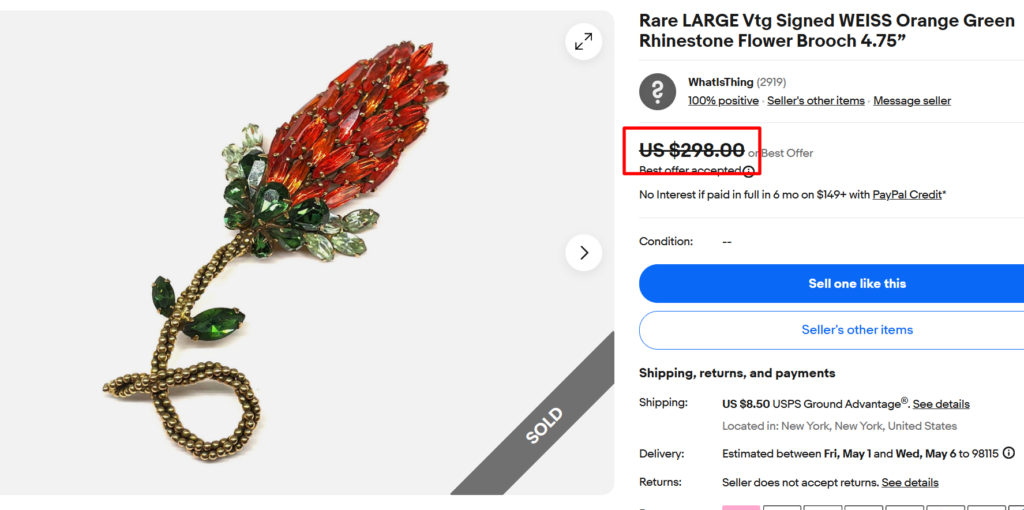
Weiss Rhinestone Brooch
Typically sells for $30 – $625+
| Average Value | $30 – $625+ |
| Production Period | 1942 – 1971 |
| Key Features | Colorful Austrian rhinestones, prong-set |
| Collector Notes | Christmas tree pins are highly collectible |
Albert Weiss is famous for making high-quality rhinestone brooches that people can actually afford. They used rhinestones from Austria in lots of bright colors, like orange, green, and black, and also these pretty aurora borealis finishes.
Albert Weiss Christmas tree brooches are some of the popular holiday pins that people like to collect.
Weiss pieces are almost always signed, which makes them easy to identify for collectors. The value of these pieces lies in large, colorful floral designs and multi-layered dimensional pieces, especially when signed.
10
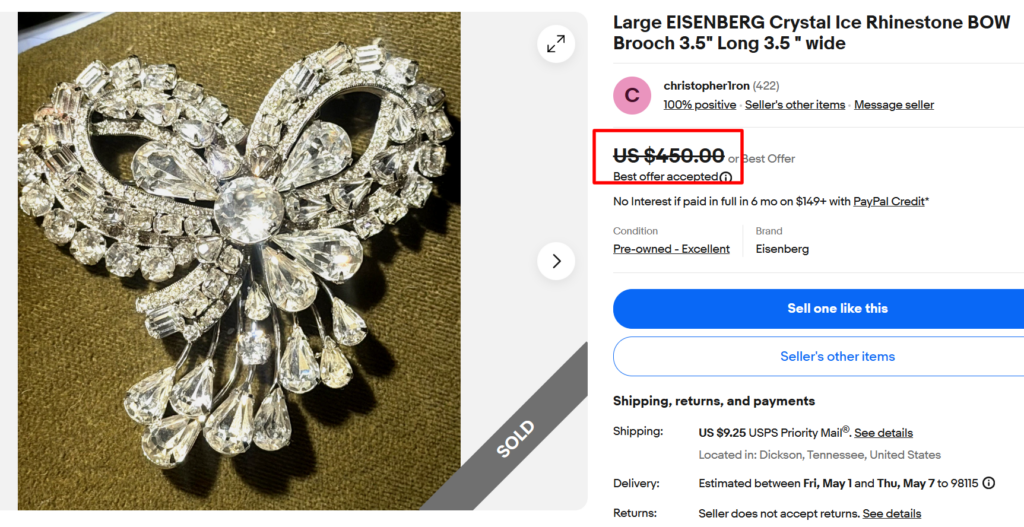
Eisenberg Ice Rhinestone Brooch
Typically sells for $150 – $450+
| Average Value | $150 – $450+ |
| Production Period | 1930s – 1970s |
| Key Features | Large Swarovski rhinestones, heavy metal |
| Collector Notes | “Eisenberg Original” mark = pre-1945 pieces |
Eisenberg didn’t make brooches initially. It was a clothing company in Chicago that sewn brooches onto their dresses as embellishments. But customers loved them so much that the company started selling them separately.
The early “Eisenberg Original” pieces from the 1930s-40s used heavy pot metal and large Austrian Swarovski rhinestones that almost look like real diamonds. The “Eisenberg Ice” line launched in the late 1940s with rhodium-plated settings and clear faceted Swarovski crystals.
Large, bold designs with all-clear rhinestones in excellent condition are the most collectible. Authentic versions are typically signed, though early pieces may only bear a certain stock number.
What Makes Costume Jewerly Brooches Valuable?
As you saw above, certain designer vintage costume brooches can actually fetch thousands today. If you want to know whether your piece is valuable or not, here are the things to check first.
- Brand & Designer: If a brooch is signed by a designer like Trifari, Eisenberg, Chanel, or Boucher, it is usually worth more than one that looks the same but has no mark. Always check the back of the brooch to see if it has the designer’s name, logo, or patent number.
- Condition: The better the condition, the more valuable the brooch. Missing rhinestones, replaced stones, worn plating, and broken clasps all reduce value significantly. Even one missing stone can cut the price by 30-50%.
- Age. While age doesn’t automatically make a brooch valuable, it’s still crucial. A 1930s KTF-marked Trifari Fruit Salad brooch is worth far more than most generic 1920s rhinestone pins. Age works for value along with a specific designer, design, and production era.
- Materials: High-quality materials add value. For example, Sterling silver pieces from wartime production are highly valuable. Heavy rhodium plating, poured Gripoix glass, and hand-set prong-mounted stones all signal higher-quality construction.
- Rarity: Short production runs, discontinued designs, and early production all make a brooch rarer. For example, Trifari’s Jelly Bellies were only made for about four years, which is why they command high prices.
- Designs: The more complex the design, the more collectible the brooch. Generally, animal brooches, Christmas trees, and whimsical figurals sell for more than generic floral or geometric patterns from the same maker.
- Provenance: If you can match a brooch to a known patent number, vintage advertisement, or reference book illustration (called a “book piece”), it can push the price higher. Original boxes and packaging also boost the value.
Note: This article is intended for informational, educational, and entertainment purposes only. Some images are illustrative and may not represent actual brands, products, or related entities. All trademarks, product names, brand logos, packaging, and other intellectual property referenced remain the exclusive property of their respective owners. Any brand mentions or references are provided solely for descriptive and educational context and do not imply any formal or commercial association.