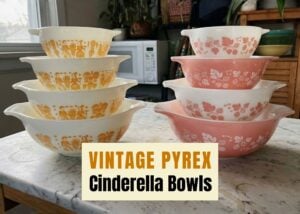
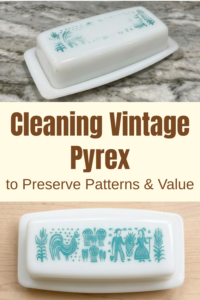
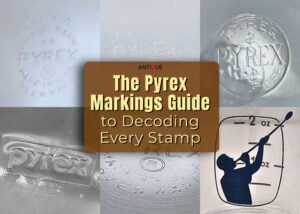
Imagine this. You see two Pyrex bowls sitting side by side on a table at an estate sale. One is priced at $8, the other at $80. Could you tell the difference?
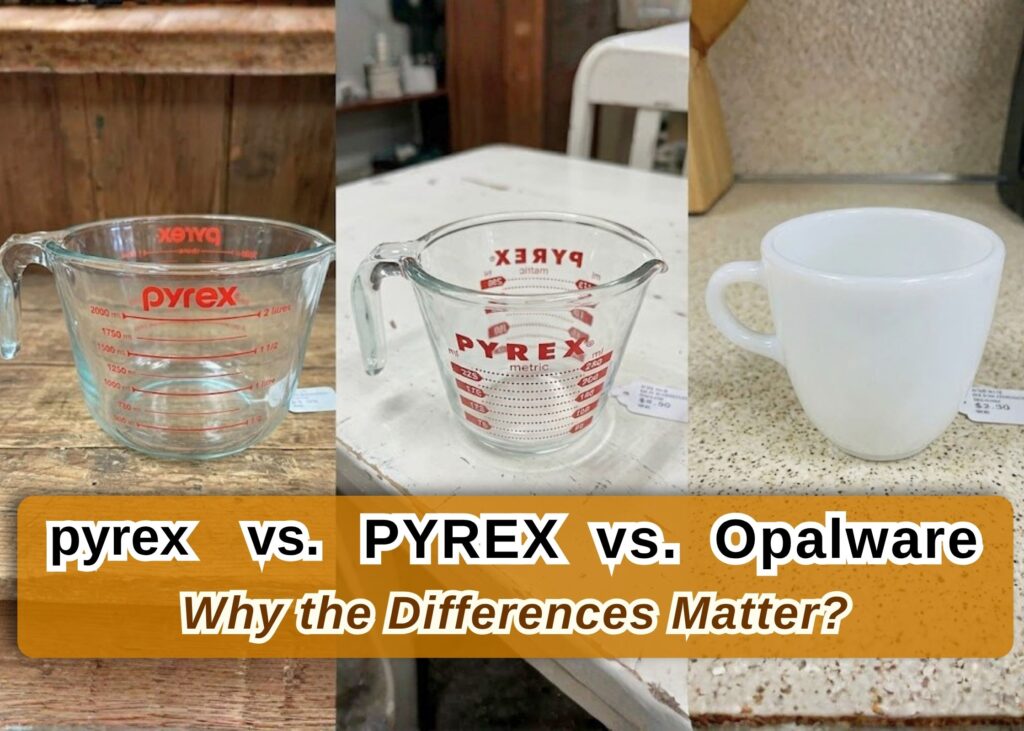
The same brand, same shape, and sometimes even the same pattern can have huge differences in value. But it’s not just the value; one of the two Pyrex dishes may be way more durable than the other.
If you’ve ever flipped a bowl over, hoping the mark on the bottom would tell you something useful, this guide is for you.
History of the 3 Versions of Pyrex
Corning Glass Works launched Pyrex in 1915. The original pieces were made of borosilicate glass, which was a hard, low-expansion material that could go from the fridge to a hot oven without cracking.
This single property made Pyrex what it became in the later years.
After Corning’s borosilicate patent expired in 1936, it bought Macbeth-Evans Glass in Charleroi, Pennsylvania, and created a second glass recipe: opal glass. It’s a tempered soda-lime formulation that was white and opaque instead of clear.
These are the Pyrex bowls and casseroles that collectors chase today.
However, unlike what is widely believed, Corning didn’t wait until 1998 to start using soda-lime glass in clear Pyrex. According to Corning’s own records, some clear Pyrex was being made from tempered soda-lime as far back as the 1940s and 50s.
The 1998 date matters because that’s when Corning sold its consumer division to World Kitchen (now Corelle Brands), and the branding officially split into two logos.
Is All PYREX Borosilicate Glass?
The fastest method to tell a vintage Pyrex dish from a modern Pyrex is the capitalization of the brand name. But before we explore that, it’s worth noting that all-caps PYREX does not guarantee borosilicate glass.
Corning itself confirmed that the change from uppercase to lowercase “Pyrex” was a trademark rebranding in the late 1970s; it’s not a reliable way to identify the glass formulation.
The Corning Museum of Glass has said the same, noting that some pre-1998 clear Pyrex was already made from tempered soda-lime.
So how can you tell the difference between Borosilicate Pyrex and soda lime Pyrex?
Most collectors use this method as a simple distinction.
The idea is that since borosilicate glass has a refractive index close to that of mineral oil. So, a borosilicate piece usually appears to vanish when dipped into a bowl of mineral oil. Soda lime glass doesn’t.
However, modern soda-lime Pyrex can also sometimes appear to disappear in the oil. So this isn’t a reliable method. Use it as a soft clue, not proof.
Identification Tip: European Pyrex, still in production in France by International Cookware, is real borosilicate glass. If a piece is stamped “Made in France,” it’s the old formula regardless of when it was made.
Clear PYREX vs Clear pyrex: What the Capitalization Tells You?
In simple terms, the capitalization (or not) tells you the era a Pyrex dish was made in, not necessarily the material. The era is valuable information if you’re collecting vintage Pyrex.
Clear PYREX (All Caps)
This is the classic American clear Pyrex most people know, including measuring cups with red lettering, ribbed loaf pans, pie plates, refrigerator dishes, and plain clear mixing bowls.
You can identify it by the following signs:
- The stamp reads PYREX in all capital letters, usually inside a circular border with “Corning, NY” or “Made in USA”
- A very faint blue-green tint at the thick base or rim, easier to see if you hold the piece against a white sheet of paper
- Weight that feels a bit heavier than a modern piece of the same size
- Model numbers are pressed into the mold, often three or four digits
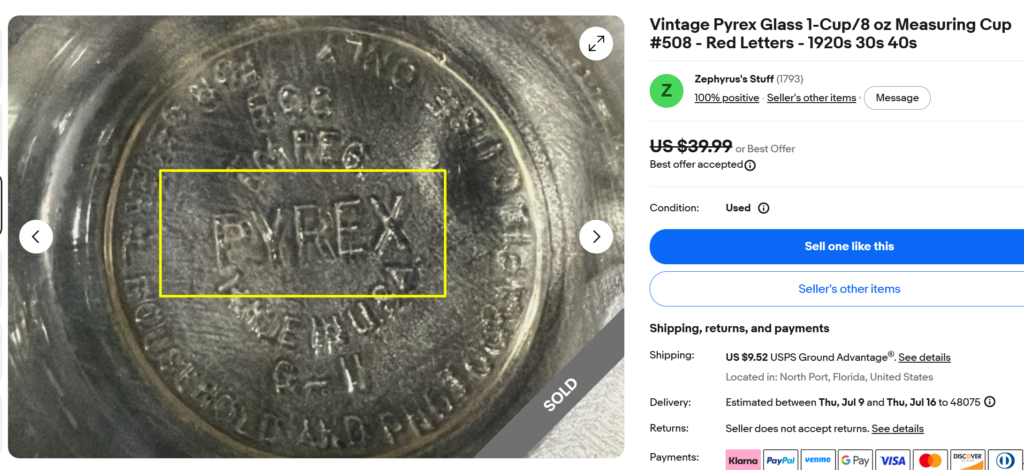
Circular backstamps generally mean earlier production, roughly the 1920s through the late 1960s. From the late 1960s onward, Corning switched to a simple layout: PYREX in larger letters with the capacity and “MADE IN U.S.A.” below it.
Metric measurements (like “1.5 L”) started appearing in the mid-1970s, so any piece showing both cups and liters is later than that.
Clear pyrex (Lowercase)
Modern clear pyrex has a lowercase logo and no tint at all. The glass is truly colorless, feels slightly lighter than a same-size vintage piece, and the stamp is often printed on the surface rather than pressed into the mold.
You’ll usually see the word “pyrex” alongside a model number and “Made in USA.”
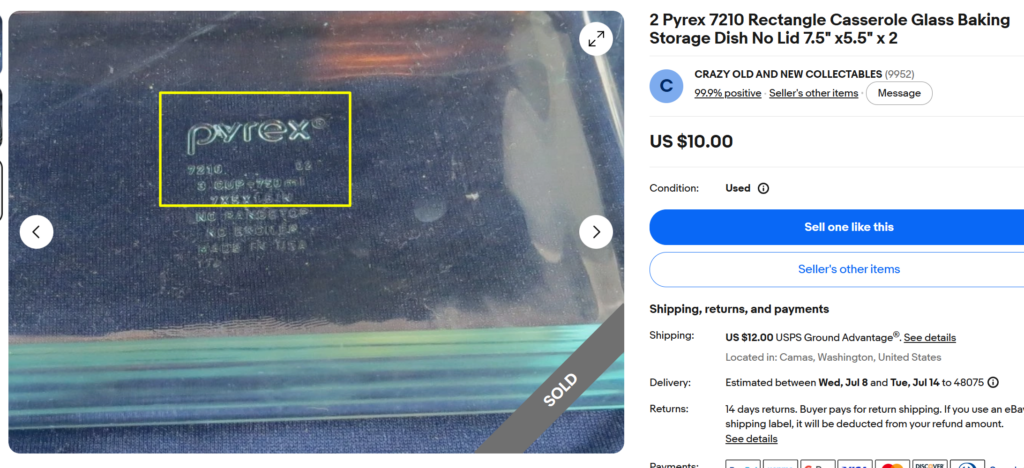
Corelle Brands, the current licensee, calls the recipe a proprietary tempered glass formula. Independent testing and Corning’s own history make clear it is not borosilicate.
Tempered soda-lime is stronger against impact, but it handles thermal shock (a sudden temperature change) far worse than borosilicate.
| Feature | PYREX (Vintage) | pyrex (Modern) |
| Logo | ALL CAPS | lowercase |
| Era | 1915 to late 1970s branding | Rebranded late 1970s, licensed 1998 |
| Glass type | Borosilicate on most early pieces, soda-lime on some later pieces | Tempered soda-lime |
| Tint | Faint blue-green at thick edges | None, fully colorless |
| Stamp style | Molded into the glass, often circular | Often printed, simpler layout |
| Thermal shock | Excellent on borosilicate pieces | Limited |
| Typical value | 2 to 5 times higher for equivalent shapes | Retail-adjacent |
Opalware PYREX (Uppercase)
Opalware is the most exciting category, especially for collectors. Instead of clear, it’s a white, opaque tempered glass that Corning started and perfected in 1936. The first run was the indestructible mess hall dishes for the military during World War II in the form of nearly.
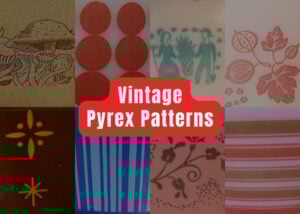
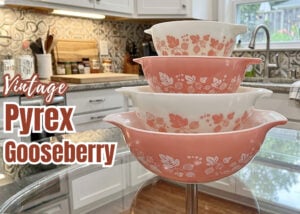
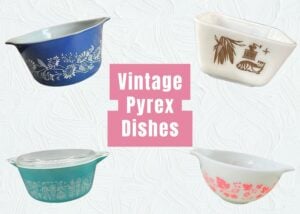
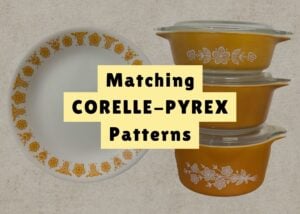
The colored versions everyone knows came in 1945, with the Primary Colors mixing bowl set. Over the next four decades, Corning produced more than 150 patterns on opal glass, including Butterprint, Gooseberry, Butterfly Gold, and many others.
- The body is solid white or off-white, never see-through, even when held to a strong light.
- Colored patterns are printed on the outside of the piece, not fired into the glass itself.
- Chips reveal a white glass interior, not the clean fracture of clear glass.
- Backstamps are usually circular “PYREX” from the 1940s through the 1960s, then move to a rectangular block layout in the 1970s.
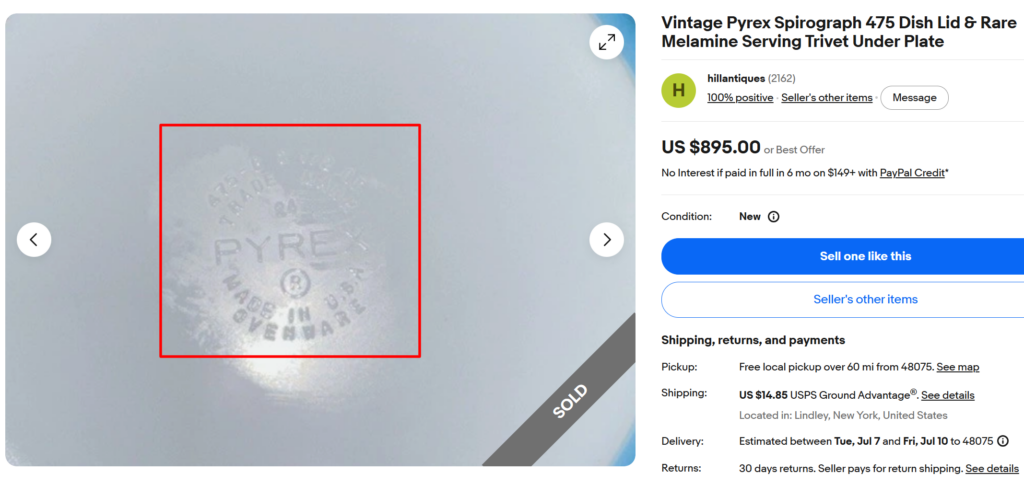
You can easily spot Pyrex opalware by these key signs:
US opalware production wound down through the mid-1980s and was essentially finished by 1986. No new Pyrex opalware is being made, unlike clear Pyrex. And that’s why well-preserved pieces hold value.
Why the Difference Actually Matters
For collectors and buyers, knowing the difference is the key to value. An all-caps PYREX refrigerator dish in a common shape usually sells for 2-5 times what its lowercase version may bring.
Opalware in rare patterns can multiply that again. Learning to read a backstamp in five seconds is the difference between paying flea market prices and paying eBay prices at the flea market.
For home cooks, the difference matters for safety. Borosilicate PYREX handles direct oven-to-counter transfers without drama. Modern lowercase pyrex does not, and the manufacturer’s own instructions now warn against sudden temperature changes.
If you want a vintage piece you can actually bake with confidently, look for the “Made in France” stamp at thrift stores. French Pyrex is still borosilicate, and it turns up more often than you’d expect.
Still, some collectors skip clear Pyrex for cooking altogether and use vintage Corningware instead, which was made from Pyroceram and handles freezer-to-broiler swings that no Pyrex ever could.
Note: This article is intended for informational, educational, and entertainment purposes only. Some images are illustrative and may not represent actual brands, products, or related entities. All trademarks, product names, brand logos, packaging, and other intellectual property referenced remain the exclusive property of their respective owners. Any brand mentions or references are provided solely for descriptive and educational context and do not imply any formal or commercial association.