The best way to trace the age of a Wagner cast iron skillet is not by the size number, the heat ring, or the handle style. The key is the brand name found on the bottom of the skillet.
Wagner Manufacturing Company made modifications to its logo at least twelve times from 1891 until 1959, and each change will help narrow down the years of manufacture to a relatively small time frame.
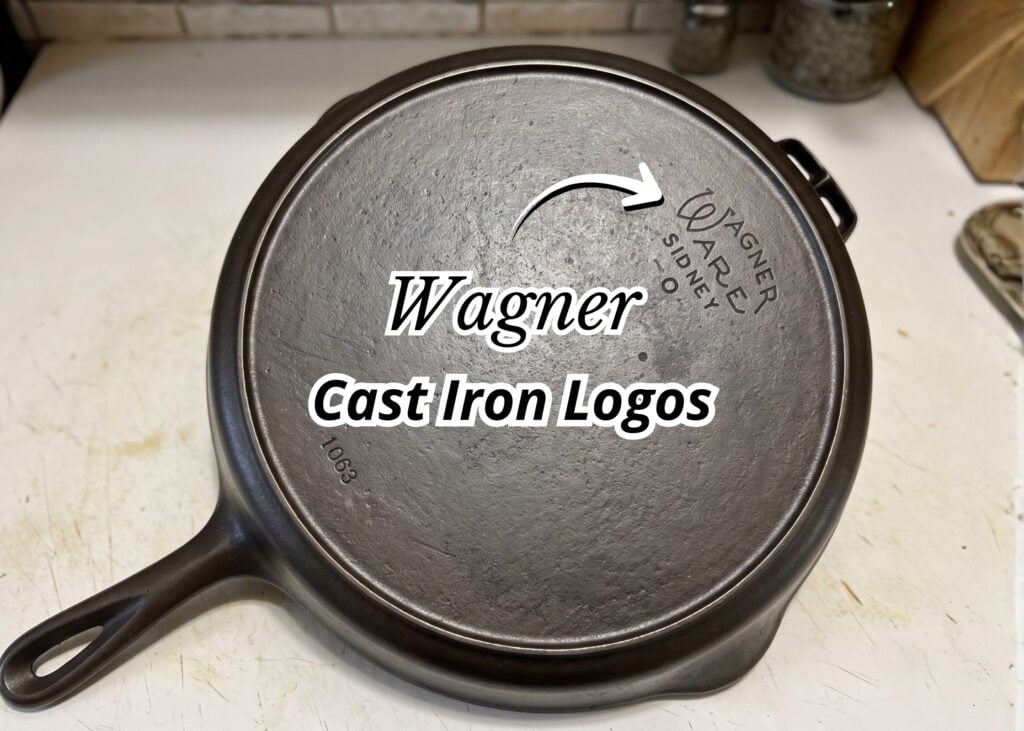
This guide details all of the logos, lettering styles, and stamps found on a Wagner piece.
A Wagner Timeline for Mark Identification
The firm was founded by Milton and Bernard Wagner in Sidney, Ohio, in 1891. William Wagner followed soon and managed the foundry. In 1903, he merged with its neighbor, the Sidney Hollow Ware Company; that is why the name “Sidney” appears in the marks.
Then Wagner bought Griswold Manufacturing in 1957, combining both firms’ stamps for a short time. After that, the Randall Company purchased Wagner in 1959; this merger is usually considered the end of the era of “true” Wagner.
All the changes of ownership caused changes on the bottom of the pan. That is why the logo is such a good dating tool.
The Wagner Logo Eras from 1891 to 1959
1. Wagner Block (1890s)
The oldest known mark is the basic straight-line mark “WAGNER” with no arch to the lettering, no “WARE,” and no mention of Sidney. Pots from this period can have just the size mark on the handle with nothing else on the bottom of the pan.
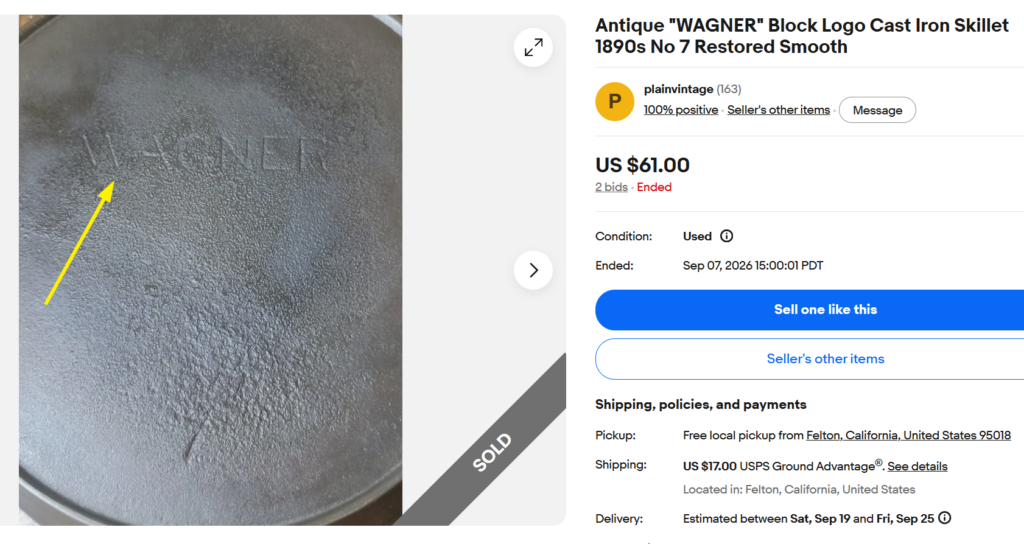
Easy Tip: If your pot has a gate mark, a rough slash on the base because of the old casting technique from the bottom up, it is probably pre-1890 or older and is seldom marked with a maker’s name.
2. Wagner Arc (1891 – 1910)
After its establishment, Wagner used the arc trademark with “WAGNER” printed in an arc on the bottom of the pan. The design lasted for about twenty years and could include a heat ring and a number at the six o’clock mark.
3. Wagner Sidney O Markings (1895 – 1920)
Once the name “Sidney” got added to Wagner cookware, the designs grew in number. There are several combinations of where you will find “WAGNER” arched over “SIDNEY O.”
The variations are where the lines will appear, whether “WAGNER” and “SIDNEY O.” are arched, straight, or otherwise.
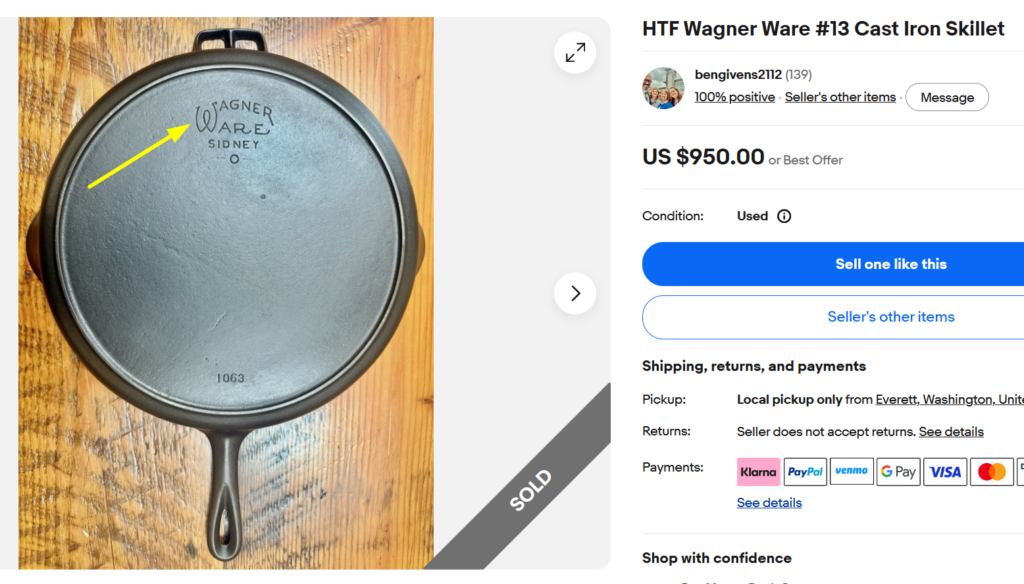
This period saw the greatest diversity in the design of all the Wagner eras. So, check these three things: whether the Wagner text is arched or straight, whether Sidney is arched or straight, and whether a heat ring is present or not.
4. Wagner Ware Sidney -O- Stylized Logo (1922 – 1959)
This is the Wagner logo everyone knows. It uses just one huge stylized letter “W,” with “WAGNER WARE” encircling it, “SIDNEY” below it, and “-O-” below that. The looped letter is unique enough to recognize right away.
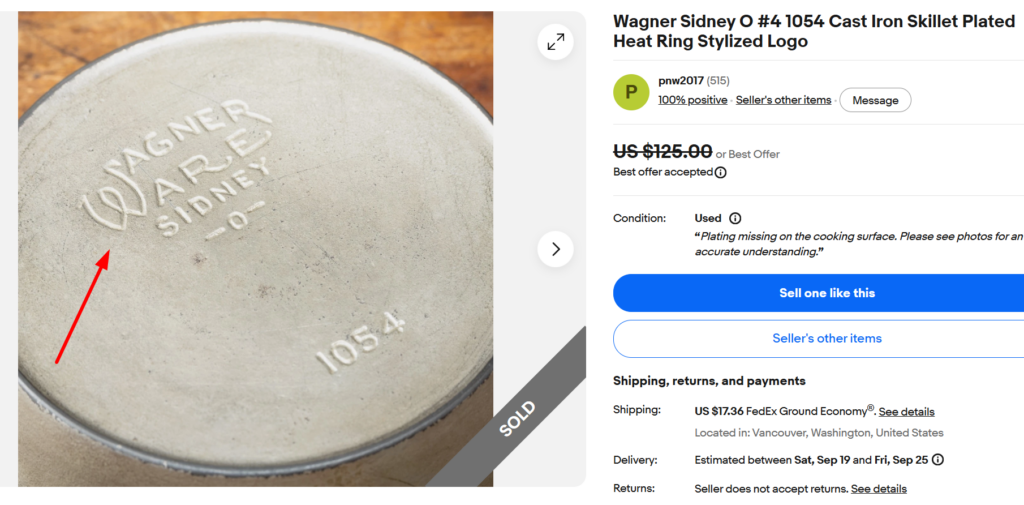
Dating of this stylized logo period relies on two other identifiers, since the logo period covers nearly forty years:
- Heating ring plus four-digit catalog number: circa 1924 to 1935
- Bottom smoothed, no heating ring: circa 1935 to 1959
- Stylized logo centered at the bottom rather than at the 12 o’clock position: sizes 4 to 8 from approximately 1924 to 1935
Most Wagner pieces you will come across today will have this stylized logo. Smooth-bottom logos are the most common logos found.
5. The Pie Logo (1924-1934)
This kind of logo was used for nearly ten years, with the stylized logo enclosed in a wedge-shaped border and the words “CAST IRON SKILLET” appearing at the bottom of the border in a curved manner.
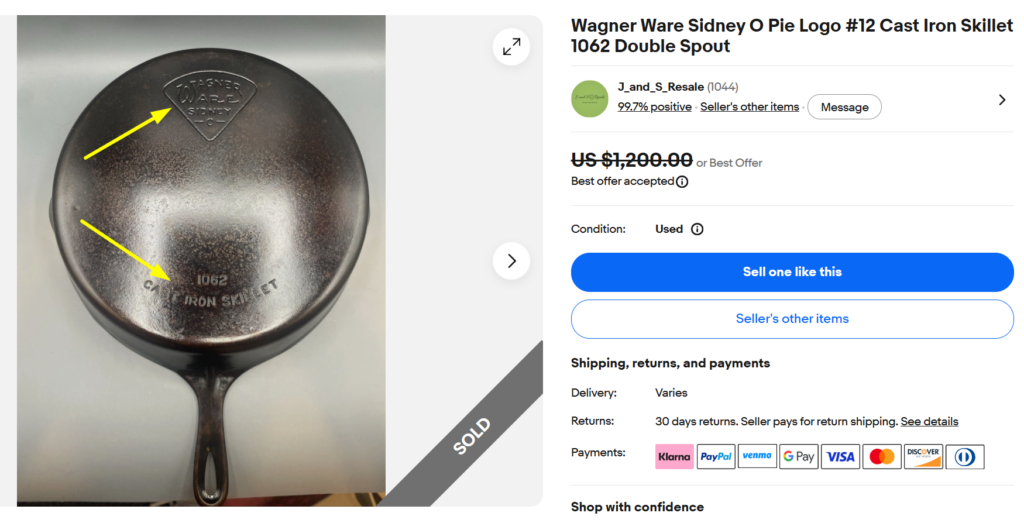
Wagner pieces featuring the pie logo are the most collectible in their line. The production run was short, and large sizes in good condition can fetch hundreds of dollars at auction. No one really knows why Wagner stopped producing these.
6. The National Line (1910s – 1930s)
Wagner also manufactured a budget range that came with the “NATIONAL” stamp for distribution to hardware stores and mail-order companies. While some are simply stamped with “National,” others bear a dual designation of “National” and “Wagner Ware.”
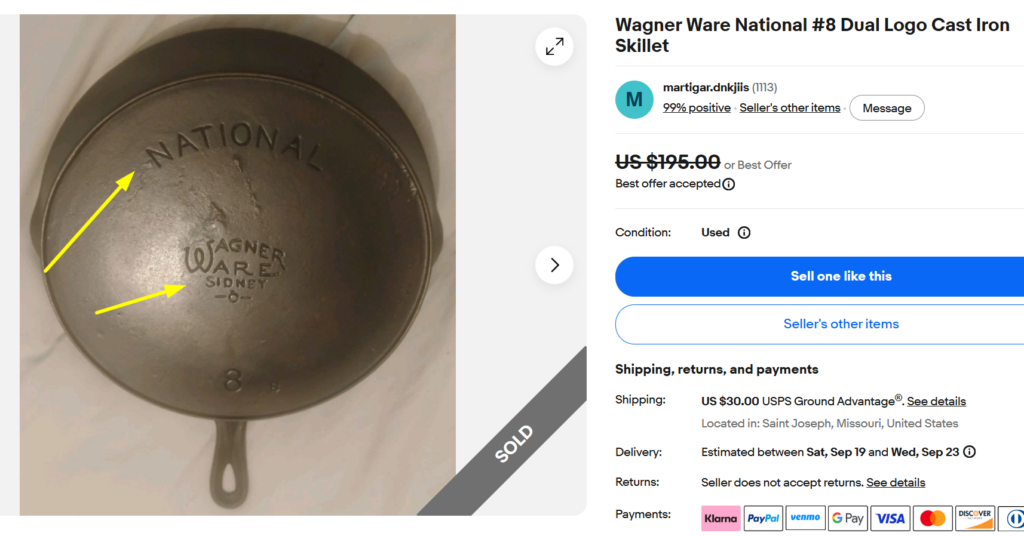
Although they can be considered Wagner-related, they are not considered the main line.
7. Post-Griswold Marks (1957-1959)
Following the Griswold purchase in 1957, Wagner began producing pans using molds from Griswold and selling them with the name “Griswold Early American.”
In addition to the stylized Wagner Ware mark, you can find hybrid products with stamping from both firms. These are the final authentic Wagner marks.
How to Identify Unmarked Wagner Cast Iron?
Unmarked Wagner is way more common in American kitchens than people realize. That’s because the company produced a large number of house brand items for hardware stores from molds used for its marked skillets.
So, when you have a cast iron skillet that does not bear any mark whatsoever, then try out these features:
- Handle: Wagner and Griswold both have a triangle near the handle. There is an extra feature in Wagner skillets; there is usually a small V-shaped groove or a flattened triangle near the handle. Although not unique to Wagner, it becomes a great indicator when used together with other clues.
- Handle top size number: The size was usually stamped on the handle of the skillet.
- Double maker’s marks: A letter resembling an “A” at the six o’clock position on the bottom and handle of the pot is known as the Wagner mark.
- Style of heat ring: Wagner heat rings are narrow and recessed, whereas Griswold used a wider ring.
- Weight: Unmarked Wagners are comparatively lighter and thinner compared to new Lodge pots of the same size.
Make sure to assess and connect all the above clues together; a single clue can be misleading. All three combined, especially the handle-top number and Wagner handle, are usually good enough.
Quick Reference: Wagner Logo Timeline at a Glance
| Logo Style | Approximate Years | Key Identifier |
| Wagner Block | 1890s | Plain block letters, no arch |
| Wagner Arc | 1891–1910 | Curved WAGNER, no Sidney |
| Wagner Sidney O variants | 1895–1920 | Multiple arc and straight layouts |
| Wagner Ware Stylized (heat ring) | 1922–1935 | Looped W, four-digit catalog no. |
| Wagner Ware Stylized (smooth base) | 1935–1959 | Looped W, no heat ring |
| Pie Logo | 1924–1934 | Wedge border, “Cast Iron Skillet” curve |
| National line | 1910s–1930s | National mark, sometimes dual |
| Post-Griswold marks | 1957–1959 | Hybrid stampings, some Griswold molds |
Importance of the Logo to Value
Most pre-1935 items with the logo and heat ring are more valuable than the post-1935 items with the smooth bottom. Large pie logo skillets are the pinnacle of value when it comes to normal production items.
Post-1959 items from the Randall period are not considered collectible Wagner items, although they may still make good cooking utensils.
Verification of Wagner status on unmarked items typically doubles or even triples the value of the item in question, which is why the tips given above are useful to learn.
Note: This article is intended for informational, educational, and entertainment purposes only. Some images are illustrative and may not represent actual brands, products, or related entities. All trademarks, product names, brand logos, packaging, and other intellectual property referenced remain the exclusive property of their respective owners. Any brand mentions or references are provided solely for descriptive and educational context and do not imply any formal or commercial association.