Antiques Know How Research
Antique Copper Tea Kettles Value
Our detailed analysis at Antiques Know How of several eBay sales and auction results shows that antique copper tea kettles can sell from $15 to $500, with rare pieces by known makers reaching $800 or more. The most collectible styles include Joseph Heinrichs copper‑and‑sterling‑silver kettles, gooseneck‑spout copper‑brass kettles, etched decorative goosenecks, and early 20th‑century whistling kettles from brands like Simplex. Check the hammered texture, age, construction, maker’s marks, and condition for authenticity and value.
Antiques Know How
Do you still have that old copper kettle your grandma once used so fascinatingly? If yes, chances are you own a valuable antique that can be worth as much as $1,000 today.
But do you even know whether it’s antique? And if it’s actually worth something? If not, this guide has all the answers.
Read along to learn what to check on antique copper tea kettles, which makers carry real collector interest, and which styles are trending, so you can find the real value of your old kettle.
3 Signs Your Copper Kettle Is Antique
Knowing whether a copper kettle is genuinely old comes down to how it was built. Pre-industrial kettles were made entirely by hand, and the evidence is right there on the surface. Pay attention to the following:
1. Hand-Hammered Texture
On antique kettles, hammering marks are real and irregular. As you run your fingers across the body, you’ll feel slightly uneven, individual impact strikes. Each dent is slightly different in depth and angle.
On modern “rustic” reproductions, the hammering pattern is stamped mechanically. So, the marks look uniform, evenly spaced, and repeat in a pattern around the body. Genuine hand-hammering never does that, and that’s what makes them special.
2. Material & Construction
The way a kettle was constructed tells a lot about its age and genuineness. The key things you must look at are:
Weight and Gauge
Old copper kettles were usually made from thick sheets of copper. Pick one up, and you’ll feel the difference right away. They’re heavier, more solid, and just have that “built to last” feel.
A lot of the newer or purely decorative kettles, especially from the late 20th century, tend to be thinner and lighter. That’s often the first clue you’re not looking at a true antique.
Dovetail Seams (Cramp Seams)
This is one of the clearest age markers on copper kettles. A dovetail seam (aka a cramp seam) is a zig-zag yellow-brass line running along the base or side of the body. This is how coppersmiths joined two sheets of copper before welding ever existed.
So, a distinctive brass-colored interlocking line at the base and sides means that the kettle was almost certainly made before the early 1900s. Post-1920s kettles were either welded or spun seamlessly, so there’s no dovetail line on them.
Rivets
Always pay attention to the rivets. Antique copper kettles feature large and handmade rivets, particularly around the mounting point for the handles. Rivets from modern machines are always neat and uniform, with consistent spacing and sizes.
3. Patina
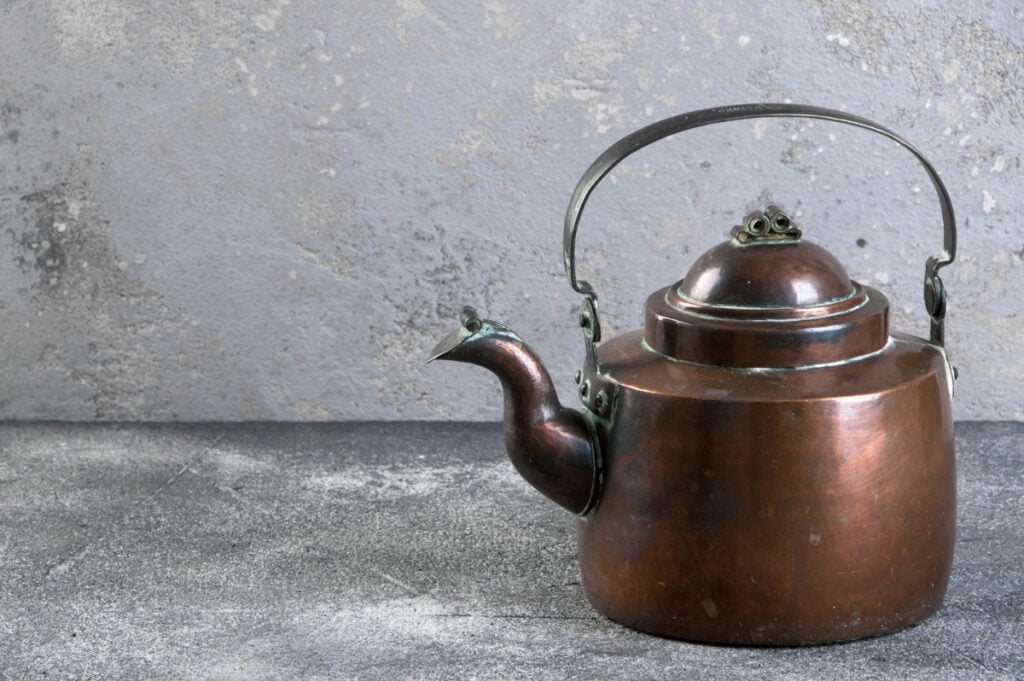
Genuine aged copper develops a layered patina. It’s a brownish, sometimes greenish surface oxidation from decades of use. The important point here is that the patina forms unevenly, darker in recessed areas and lighter on high surfaces.
The fake or polished patinas on reproductions are very even in color and appearance, almost metallic.
But, you shouldn’t confuse recent polishing, which removes the patina, with a fake one, since some owners clean their antique kettles. In such a case, assess its construction and material.
What Makes a Copper Tea Kettle Valuable?
Antique copper tea kettles can fetch anywhere from $10 to $1,000, depending on several factors, including when and how it was made, who made it, and how well it’s preserved.
Age and Construction Method
Even in the “antique” category, earlier Dovetail-constructed kettles from the 1700s–early 1800s consistently fetch the highest prices, often $200-$800 or more at auction.
Early 20th-century kettles can still have value, but are often less rare. These usually run $100–$200.
Later 20th-century pieces, even from known brands, rarely break $200 unless they’re in exceptional condition or from a collectible maker.
Brand Value
Named makers add immediate value. A kettle with a confirmed stamp from a recognized American or English maker will outperform an identical unmarked piece at auction every time.
So, always check the underside of the lid, the base, and beneath the handle for a mark.
Antique kettles often carry stamped numbers, initials, or a maker’s name. English pieces sometimes carry capacity numbers stamped under the lid (like “2” for 2 pints). Some American makers stamped their city and name on the handle base.
However, no mark doesn’t mean it’s not antique; many early pieces were never signed. But a confirmed maker’s mark is the fastest way to date and value a piece. Some brands collectors actively look for:
- Joseph Heinrichs (German): Collectible Arts & Crafts designs.
- Simplex / Newey & Bloomer (English): Patented designs are rare and collectible.
- Mauviel (French): Older, heavier-gauge pieces are valuable.
- Benham & Froud: Clear orb and cross symbol.
- Revere Ware (USA): Pieces marked “1801 Rome, NY” (U.S.-made, pre-1990s)
- Pennsylvania/American Folk Coppersmith Pieces
Style and Form
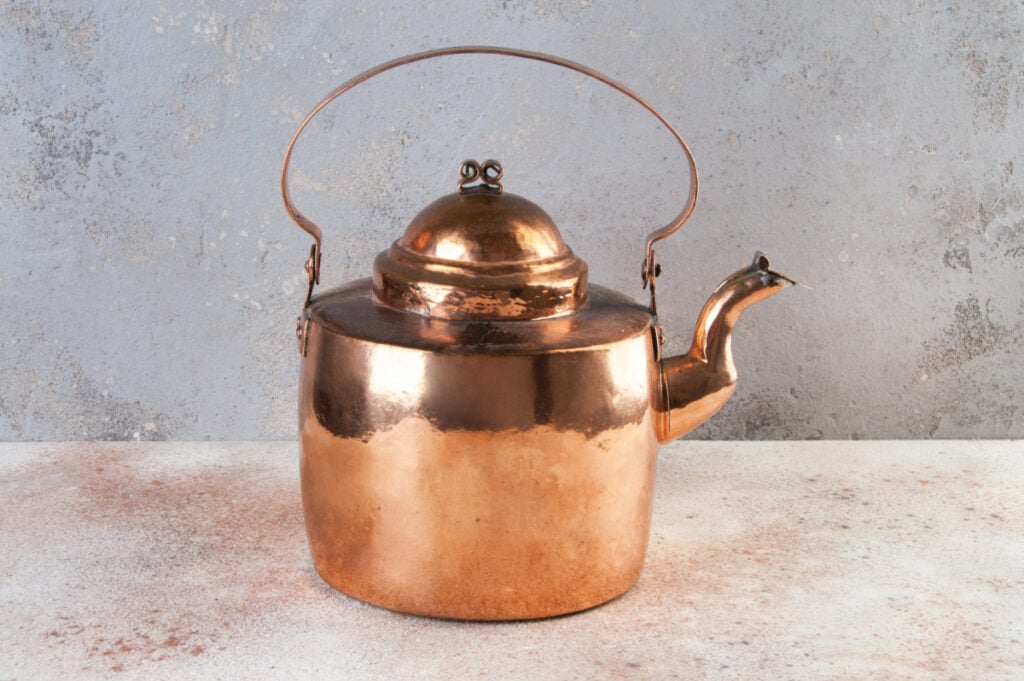
The style or design of a copper kettle is also crucial for its value. For example, Gooseneck spouts, the long, elegant, curved spout shaped like a bird’s neck, are more desirable than straight spouts on antique pieces.
Some other design elements that boost the value of old kettles are:
- Unique silhouettes (tall, bulbous, or sculptural forms)
- Specialized spouts (like gooseneck designs)
- Decorative elements (engraving, embossing, mixed metals)
- Complex construction (stands, spigots, or multi-part builds)
Apart from this, the unusual shape, purpose, and size of the kettles also play a big role in their valuation; the bigger and more unique, the more valuable.
Condition
Condition can dramatically affect value, sometimes more than the kettle’s age or style. Two similar kettles can have very different values simply because of their condition and preservation.
Some of the value-decreasing indicators include extensive denting, cracks on seams, or missing parts such as lids and handles. Small dents, patinas, and minor dings can be expected and are acceptable since they form part of the piece’s history. However, structural damage is a warning sign.
Over-cleaning also decreases the value of the item. If the kettle has undergone intensive polishing to remove its natural patina, then it will sell at a lower price compared to an intact and naturally aged item.
Valuable Antique Copper Tea Kettle Styles
The following are some examples of valuable antique copper tea kettles that collectors should look out for.
1. Joseph Heinrichs Copper-Sterling Silver Kettle
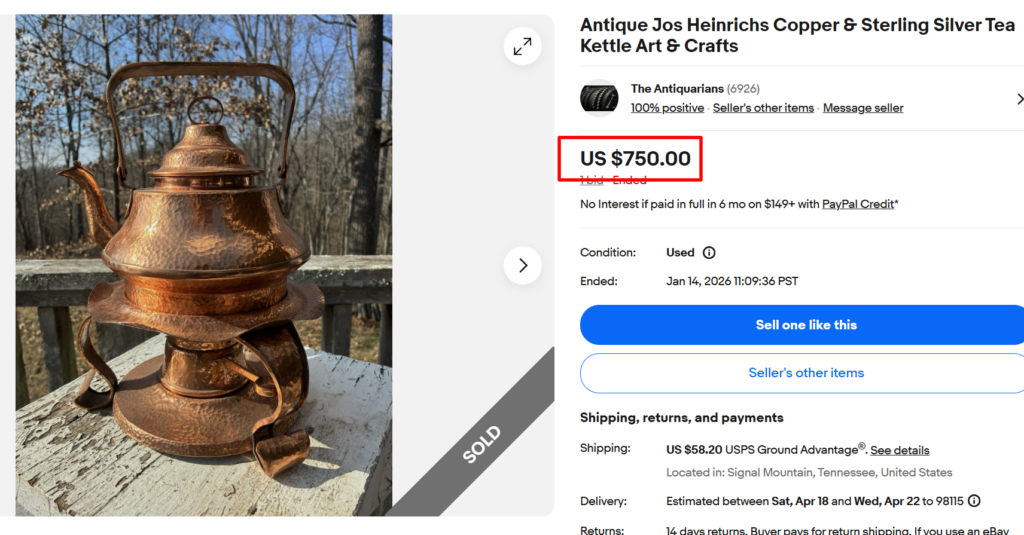
| Average Value | $500–$1,500+ (with stand) |
| Brand | Joseph Heinrichs |
| Production Period | Approx. 1895–1935 |
| Key Features | Hand-hammered copper, sterling silver mounts, stand included |
| Collector Notes | Look for the backstamp for authenticity |
This stunning kettle was designed by Joseph Heinrichs, a German-American metalsmith who operated in New York around 1900–1930. It sits on a matching burner stand, making it a complete tea service set.
Heinrichs’ kettles are hand-hammered copper with applied sterling silver mounts; a combination that is a hallmark of his work. Plus, the “JOS. HEINRICHS PARIS + NEW YORK PURE COPPER STERLING SILVER” stamp on the base confirms authenticity.
A single kettle complete with its original stand can easily fetch over $500 today, depending on condition.
2. Gooseneck Spout Copper-Brass Kettle
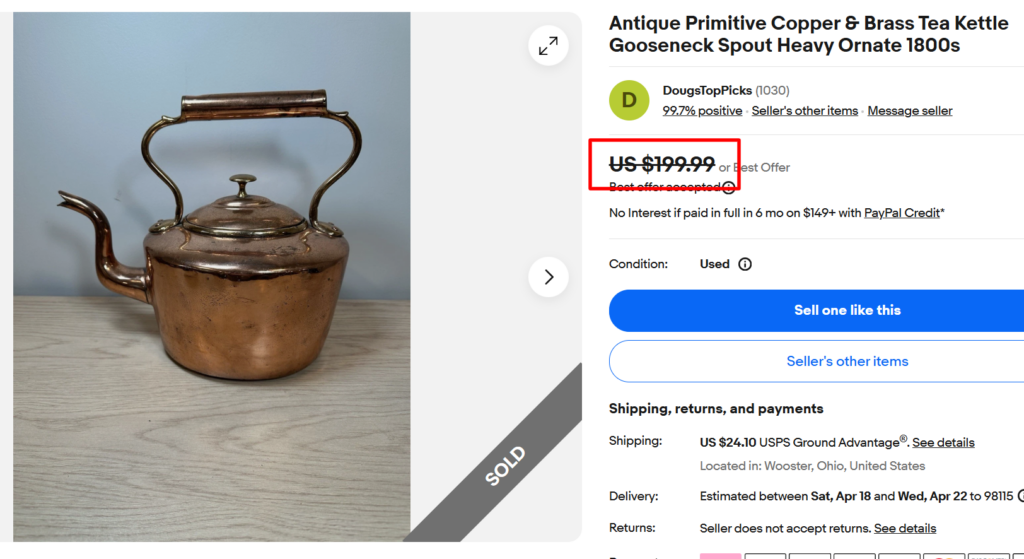
| Average Value | $100–$200 |
| Origin | India / Middle East |
| Production Period | 1800s |
| Key Features | Solid copper body, gooseneck spout |
| Collector Notes | Check lid fit; warped lids reduce value |
This is an old-fashioned 1800s Gooseneck spout kettle with a rounded copper body with brass fittings, such as the handle, lid decoration, and hinges. You can identify the shape by that long, narrow, curved spout designed for precise pouring.
This style is common in both American and English examples, and the distinction in provenance can affect the price.
Also, because of its plain surface, it was sold for a relatively reasonable price of close to $200, while those that have intricate designs like etchings or hand engravings could sell at higher prices. Make sure to check the rivets, original patina, and dovetail seams for authenticity.
3. Simplex Whistling Copper Kettle
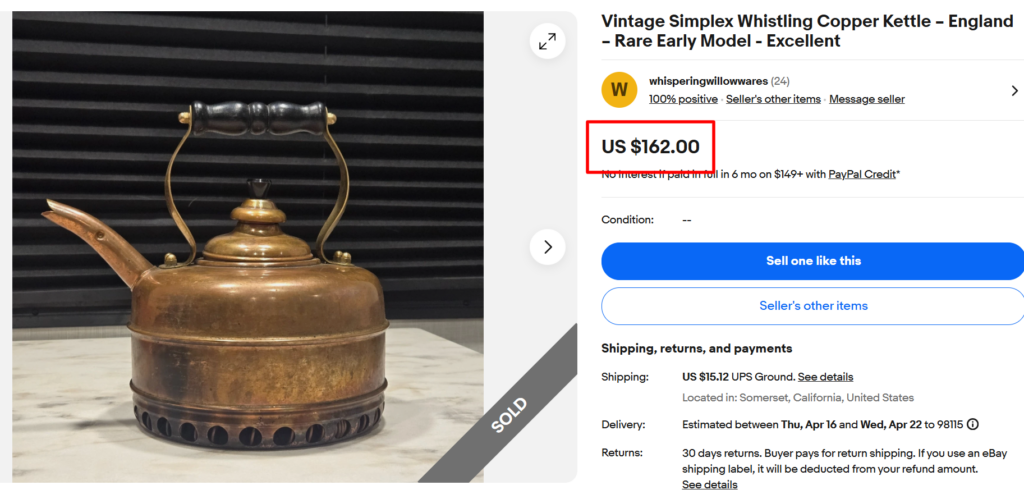
| Average Value | $100–$200 |
| Brand | Simplex / Newey & Bloomer (England) |
| Production Period | 1903–2010 (original run) |
| Key Features | Coiled base, whistle lid, hand-spun copper body |
| Collector Notes | Early patent models are most collectible |
The Simplex “Buckingham”-style kettle features a distinctive coiled base designed for gas stovetops; it concentrates heat and boils water faster. This design was made by Newey & Bloomer in Birmingham, England, since 1903.
One of its unique characteristics is its whistle function, built into the lid. In addition, the earlier versions have the initial patent numbers (400709-402190) printed on them, thus validating the piece’s originality.
Earlier versions typically sell between $150 and $200, while later 1960s-1980s pieces can be worth between $80 and $120.
4. Etched Decorative Gooseneck Copper Kettle
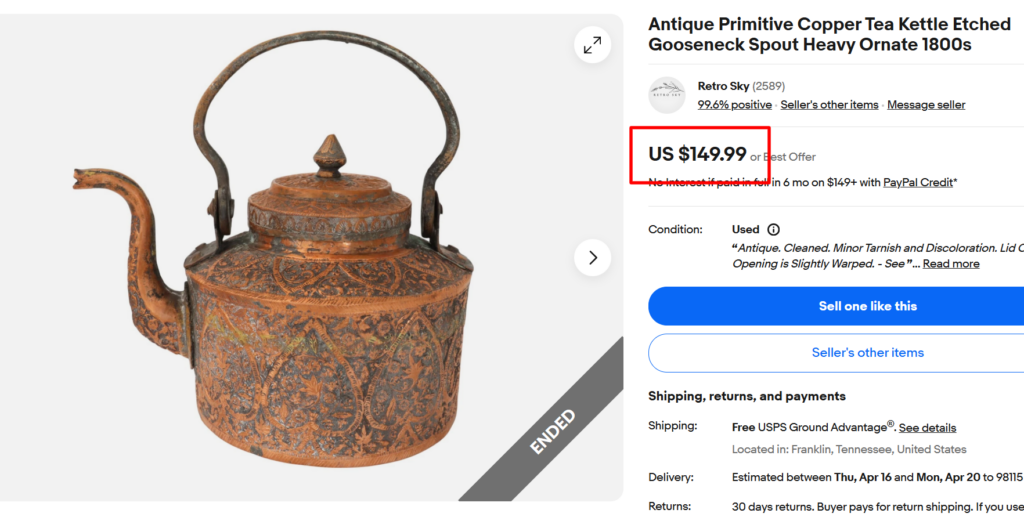
| Average Value | $100–$200 |
| Origin | India / Middle East |
| Production Period | 1800s |
| Key Features | All-over etched floral motifs, gooseneck spout |
| Collector Notes | Check lid fit, rivets, & patina. |
What makes this 1800s piece unique is its thick copper base and the heavy etching on it. These designs were produced in India and the Middle East during the entire 1800s and were used not only domestically but also exported.
Although these pieces are hardly marked, you can identify them by the gooseneck spout, domed lid with decorative finial, and swing handle.
Plus, this dark patina, which emphasizes all the intricate details, is really valued by collectors.
Note: This article is intended for informational, educational, and entertainment purposes only. Some images are illustrative and may not represent actual brands, products, or related entities. All trademarks, product names, brand logos, packaging, and other intellectual property referenced remain the exclusive property of their respective owners. Any brand mentions or references are provided solely for descriptive and educational context and do not imply any formal or commercial association.