A battered spoon at a flea market can be worth fifty cents or five hundred dollars. The difference comes down to four tiny stamps most people never bother to look for. Once you can read them, you can date a piece to the year and tell sterling from plate at a glance.
This guide walks through vintage silver hallmarks identification with visual cheat sheets you can screenshot and keep on your phone.
What Silver Hallmarks Actually Are?
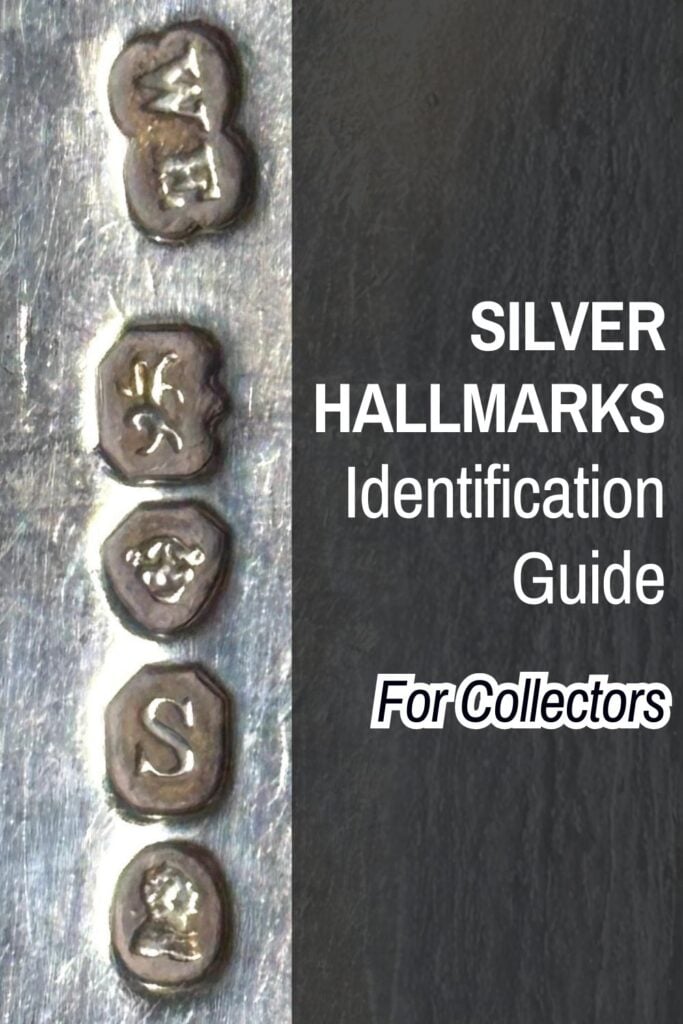
Hallmarks are basically tiny punched stamps that certify a piece’s metal content, trace its origin, maker, and production year.
The British hallmarking system goes back to 1300, when a law required all silver made and sold in England to meet the sterling standard of 92.5 percent purity. Every piece was tested at Goldsmiths’ Hall in London, giving the marks the work “hallmark.”
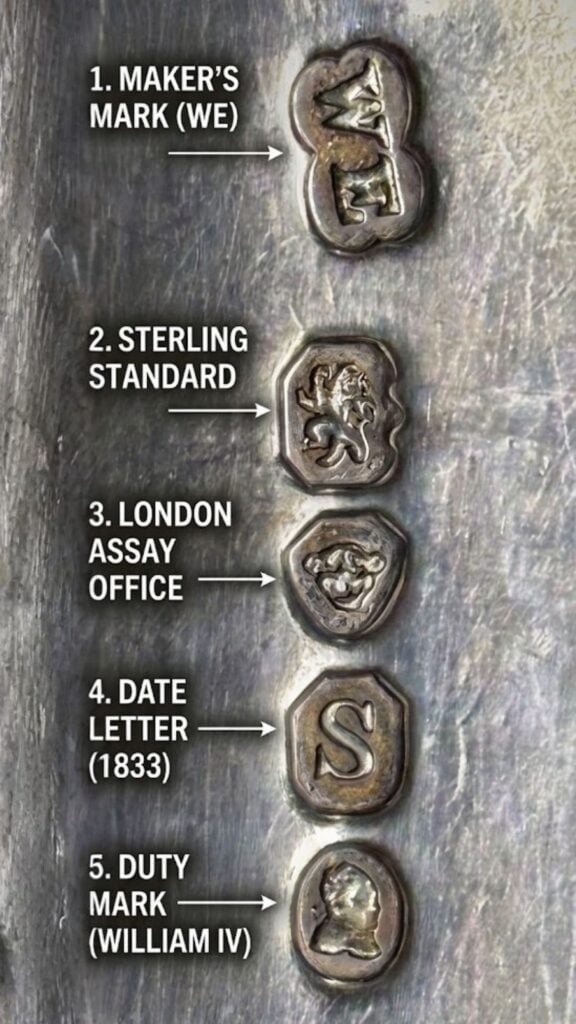
A full set of British hallmarks usually has four marks struck in a row. These are:
- The maker’s mark
- The standard or fineness mark
- The assay office mark
- The date letter.
Continental European silver follows different rules, often using a number like 800 or 925 instead of a symbol.
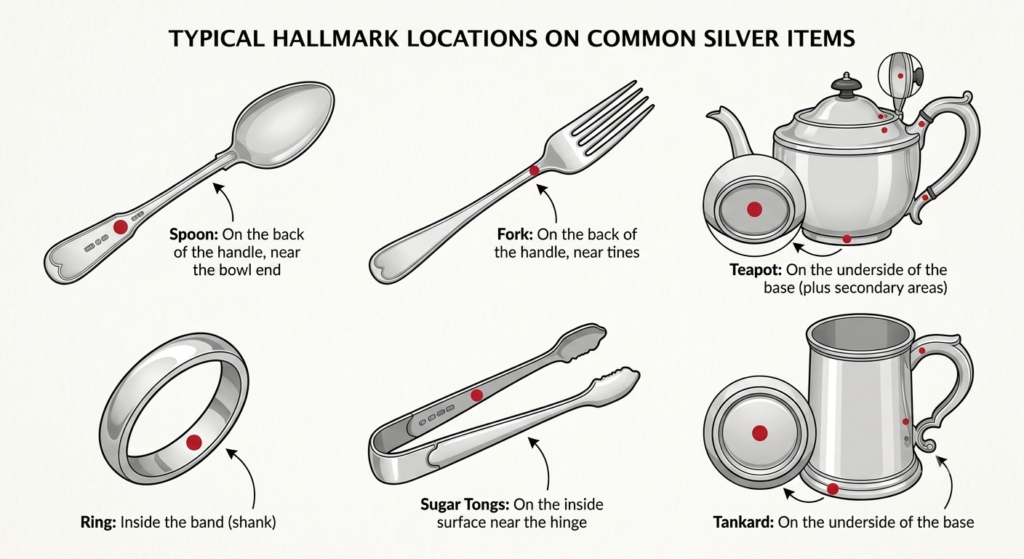
You’ll find these marks in quite predictable spots on most pieces. On spoons and forks, check the back of the handle near the bowl. On teapots and tankards, look on the underside. On rings, inside the band.
Is It Real Silver? Read the Standard Mark?
The standard mark tells you the actual silver content. This is the single most important hallmark, because it separates solid silver from plate.
A few things worth flagging here. EPNS stands for Electroplated Nickel Silver. It’s a thin silver layer over base metal and has almost no precious metal value. Sheffield Plate from the late 1700s and early 1800s is also plated, but the early fused kind has some collector value of its own.
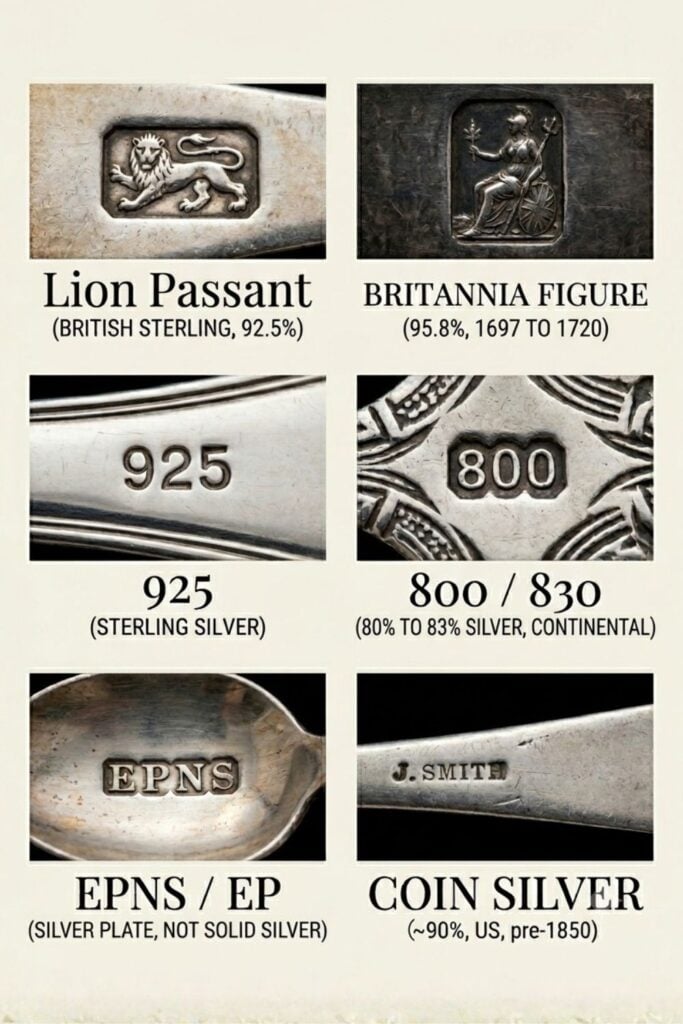
Britannia silver from the 1697 to 1720 window is genuinely scarce, because the standard was only mandatory for 23 years before sterling came back. Pieces from this period command a premium.
Where Was It Made? The Assay Office Mark
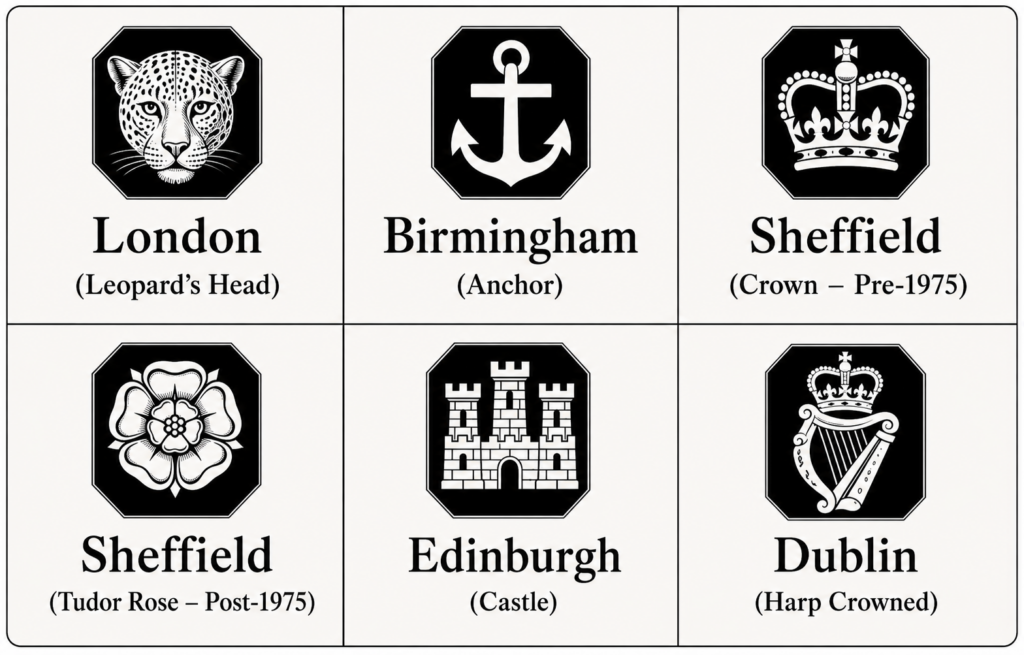
The assay office mark tells about the town where the silver piece was tested. Each British office had its own symbol and ran its own date letter cycle, so you need to identify the office before you can date the piece.
For continental pieces, France used a Minerva head from 1838 onward, Germany used a crescent and crown after 1888, and Russia used the kokoshnik mark from 1899.
The Date Letter: How to Date Your Piece to the Year
This is the most confusing mark to read. The date letter is a single letter in a shield, and the same letter appears many times across the centuries.
The letter itself doesn’t identify the year. The combination of:
- Letter
- Font style
- Shield shape
- Assay office
are what pin it to a specific year.
Each office runs its own alphabet cycle, usually 25 letters skipping I, J, or W. When the cycle ends, the office changes the font, switches case, or reshapes the shield and starts over at A.
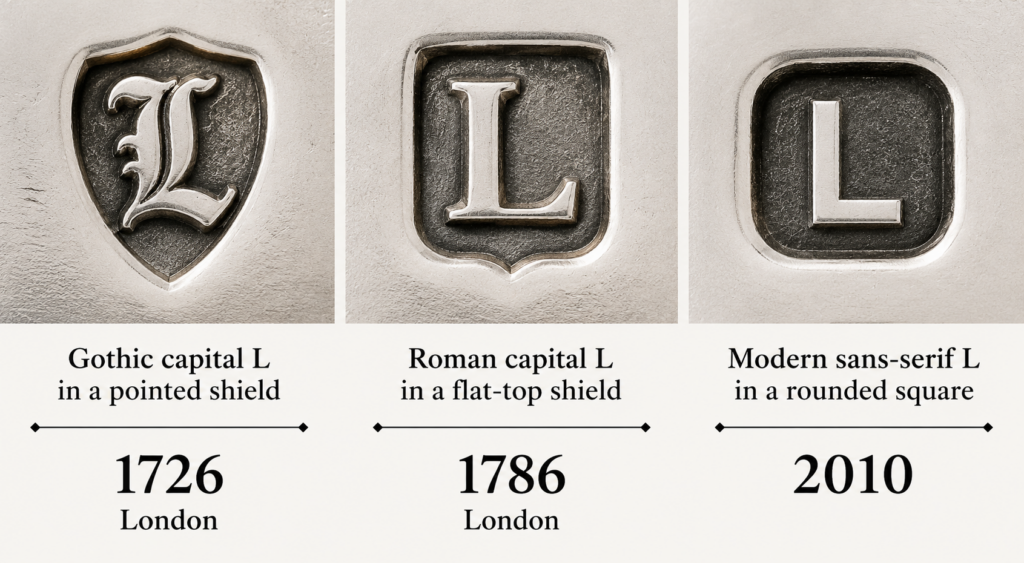
A practical note on dating.
Before 1975, British offices changed their date letter mid-year, not on January 1. London changed in May, Birmingham in July, and Edinburgh in October. So a London piece marked 1798 could have actually been struck anywhere from May 1798 to May 1799. From 1975 onward, all offices switched to a January-to-January cycle.
To match a date letter, use the free charts at 925-1000.com or silvermakersmarks.co.uk. Both have full visual charts for every British office going back centuries.
Spotting Fake Silver Hallmarks
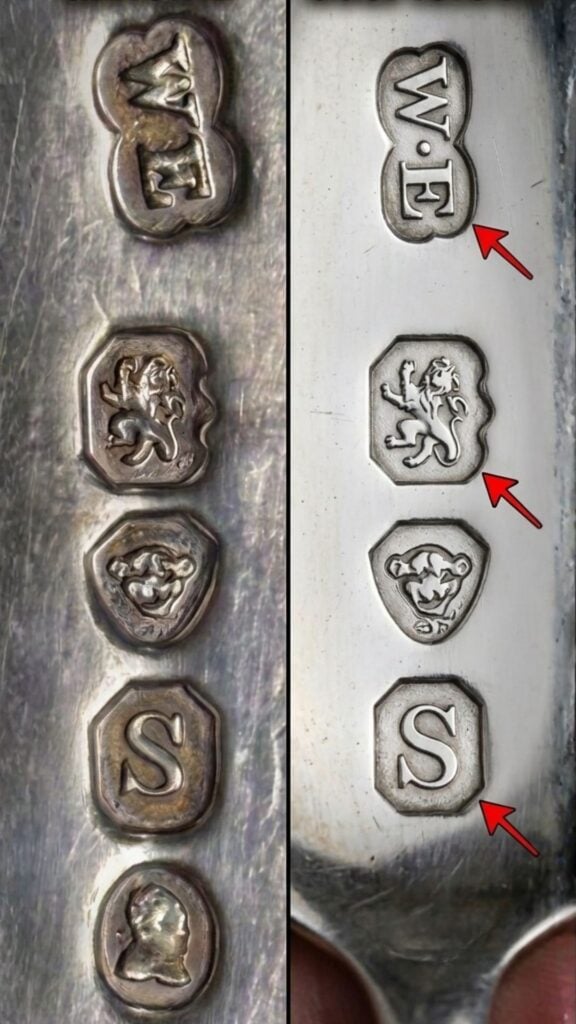
Fakes and misattributed silverware are common, especially on online listings. Here are some of the red flags you must look out for:
The biggest red flag is when the marks look freshly cut on an otherwise tarnished piece. Genuine vintage marks wear at roughly the same rate as the rest of the silver. Another tell is a mismatch between the maker’s mark and the date letter, since a maker registered in 1890 can’t appear next to an 1820 date letter.
A magnet test rules out the worst fakes, because silver isn’t magnetic. For a sharper check, a nitric acid test turns silver creamy white and base metal green or brown. Acid testing kits are cheap and worth owning if you buy regularly.
Collectors’ Note: Most electronic plate testers give false positives on heavy silver plating. If a piece reads sterling but feels light in the hand, weigh it against a known sterling piece of the same size. Plate is almost always noticeably lighter.
Note: This article is intended for informational, educational, and entertainment purposes only. Some images are illustrative and may not represent actual brands, products, or related entities. All trademarks, product names, brand logos, packaging, and other intellectual property referenced remain the exclusive property of their respective owners. Any brand mentions or references are provided solely for descriptive and educational context and do not imply any formal or commercial association.