Antiques Know How Research
Milk Glass Hobnail Vases Value
Research on eBay sales and auction results reviewed by Antiques Know How shows that hobnail milk glass vases can range from $20 to $300+, with higher prices for rare colors, larger sizes, and unusual forms. Collectible pieces include Fenton’s rose-pastel epergnes, L. E. Smith’s tall, swung vases, Westmoreland’s English Diamond pieces, and rare Italian Empoli cased-glass vases. Check maker marks, pattern design, color rarity, and condition to evaluate a piece.
Antiques Know How
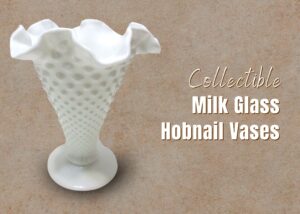
Milk glass hobnail vases are a common find at estate sales, but most people pass them by, thinking they are just regular vases. However, it turns out that many hobnail vases are common, and values can go well over $200 per vase, depending on color, shape, and maker.
The key is to know which pieces are worth picking up. This guide covers some of the most collectible milk glass hobnail vases in the market today. And some easy tips to tell if you’re looking at a valuable piece.
Rare Milk Glass Hobnail Vases to Know!
1. Fenton – White Hobnail Swung Vase
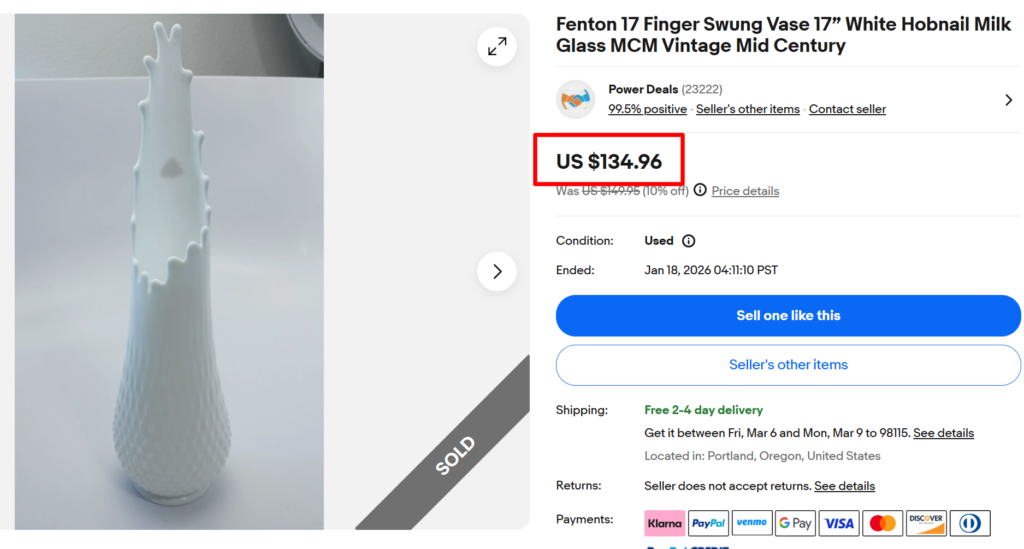
| Average Value | $80–$150 |
| Production Period | 1950s–1970s |
| Color | White Milk Glass |
| Collectibility | Moderately Collectible |
| Collector Notes | Long pieces are worth more; look for Fenton labels |
The Fenton Hobnail swung vase was made by literally swinging hot molten glass in a circular motion to stretch the neck. That’s why each piece is unique in height or shape.
Fenton produced these primarily in the 1950s–60s, and they remain among the most recognizable forms of swung vases. This particular vase is 17 inches tall with the Fenton “finger” design along the elongated neck. Its larger-than-average size makes it worth $80–$150; common smaller vases (8–12 inches) are $20–$40.
2. Fenton – Mint Green Uranium Bowl Vase
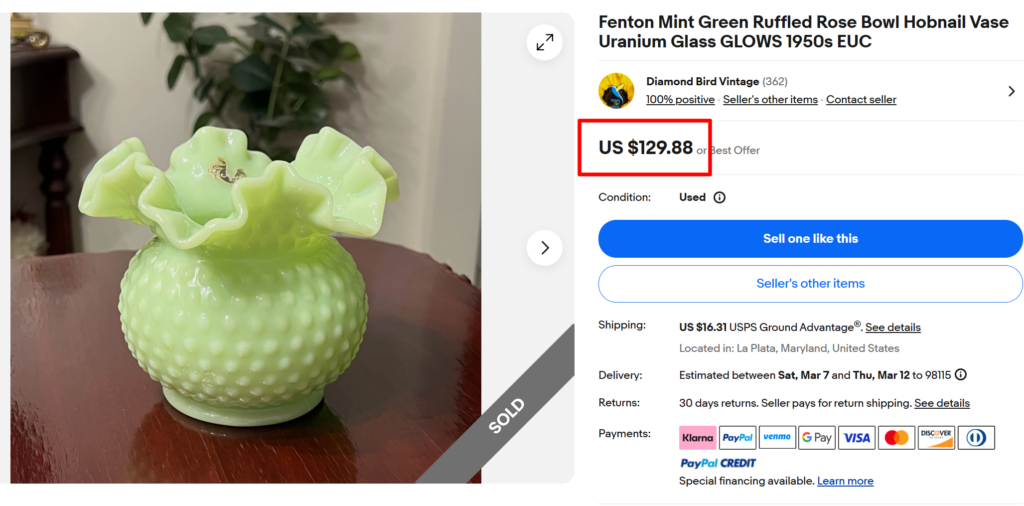
| Average Value | Test the uranium glow before buying |
| Color | Mint Green (Uranium/Vaseline Glass) |
| Production Year | 1950s (1952 – 1955) |
| Collectibility | Highly Collectible |
| Collector Notes | Test uranium glow before buying |
Produced in the late 1940s to 1950s, this “Mint Green” hobnail ball-shaped vase features a delicate ruffled edge. This specific color is highly collectible because it often contains uranium, causing the glass to glow neon green under a blacklight, a favorite trait for glass collectors.
Fenton produced vaseline and uranium glass items at the height of uranium glass popularity, and hobnail pieces in this color are among the most collected today.
3. L.E. Smith – Hobnail Swung Vase
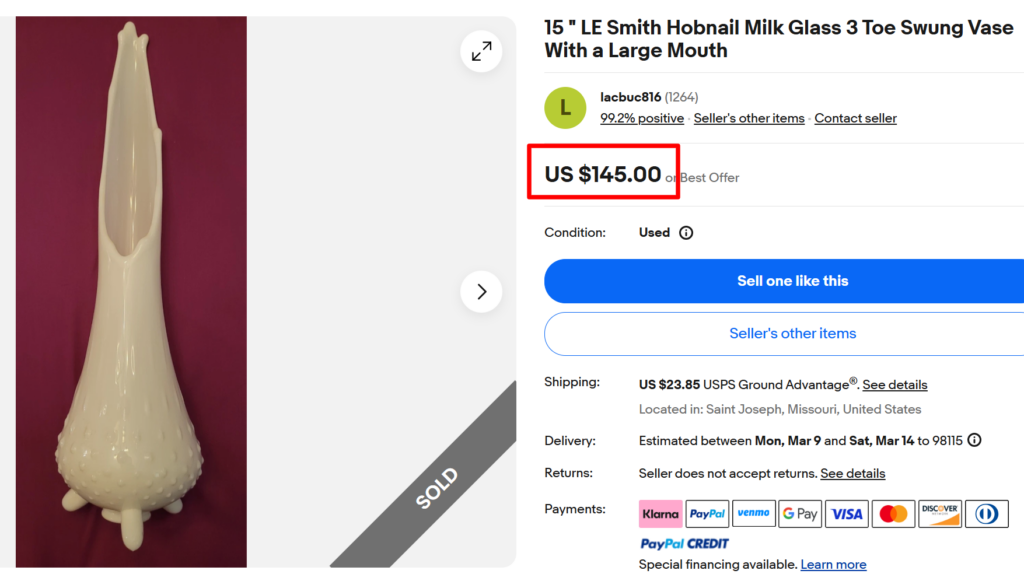
| Average Value | $100–$175 |
| Color | White Milk Glass |
| Production Year | 1960s–1980s |
| Collectibility | Moderately to Highly Collectible |
| Collector Notes | Identify it by a 3-toe footed base |
L.E. Smith’s hobnail swing vases are known for their unique “3-toe” tripod base and a swung, asymmetric neck. These swung vases are often thicker and heavier than their Fenton pieces, with a rugged yet elegant Mid-Century look.
White versions are the most common and sell for $40–$175 depending on size, while colored versions (Peacock Blue, etc.) can hit $150–$250!
4. Empoli Italian – Cased Art Milk Glass Hobnail Vase
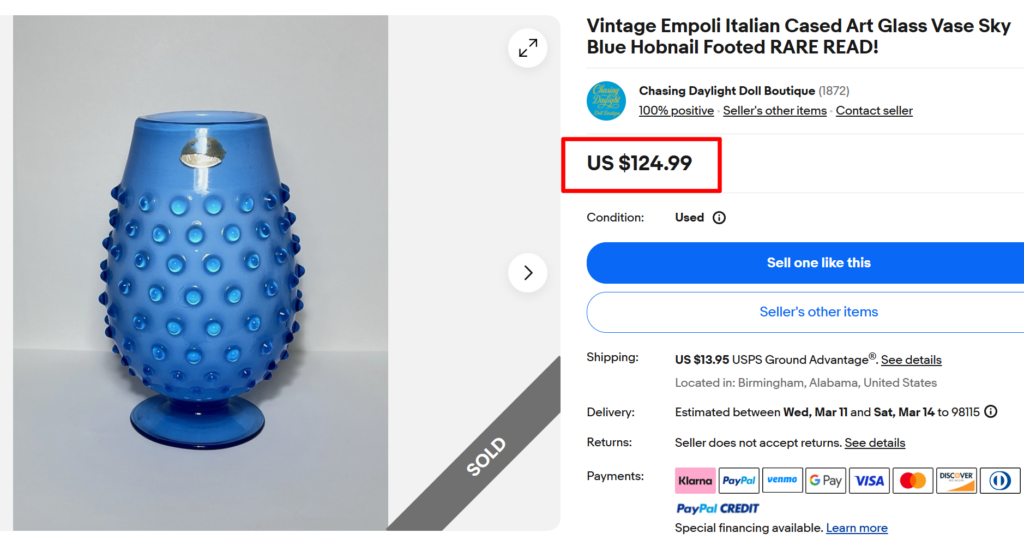
| Average Value | $50–$150 |
| Color | Sky Blue Cased over White Opaline |
| Production Year | 1950s–early 1970s |
| Collectibility | Highly Collectible |
| Collector Notes | Cased glass usually has a “Made in Italy” paper or embossed label |
Coming from the Empoli region of Italy, this footed barrel-shaped cased glass vase features a stunning sky-blue exterior layered over a white milk glass interior. The technique layers a colored glass over an inner layer of white opaline (lattimo) glass.
This piece also shows a distinctly Italian take on the hobnail format; the bumps are larger and more widely spaced than American versions. Empoli makers for this type include Cristalleria Fratelli Betti, Stelvia, and Cristalleria Arno, and pieces usually sell for $50 to $150!
5. Westmoreland – English Hobnail “Ivy Ball” Vase
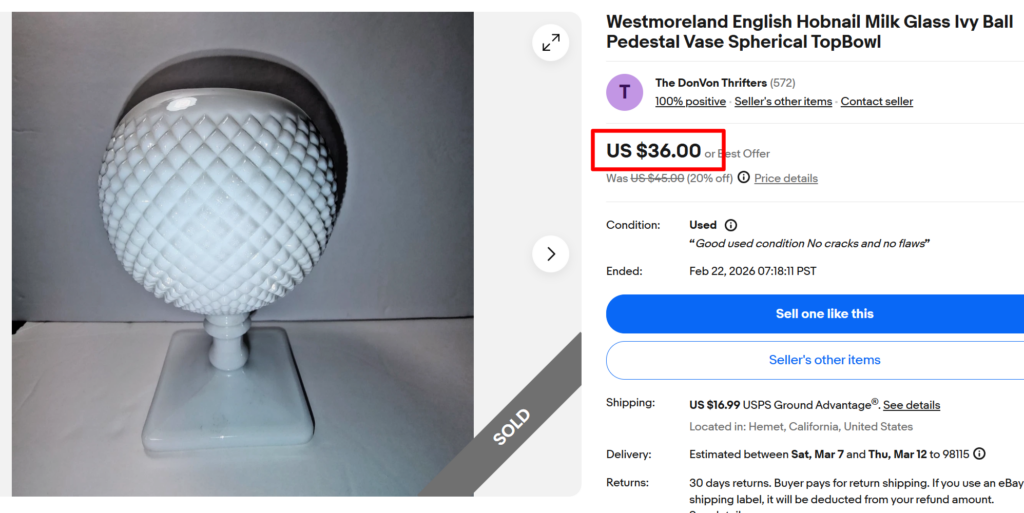
| Average Value | $25–$45 |
| Color | White Milk Glass |
| Production Year | 1940s–1960s |
| Collectibility | Moderately Collectible |
| Collector Notes | The pattern shows diamond-grid hobs |
Westmoreland’s “English Hobnail” differs from Fenton’s, featuring a tighter, more geometric diamond-like pattern. This “Ivy Ball” or spherical vase sits on a sturdy square pedestal, designed to hold water for ivy cuttings fed through rim notches.
Westmoreland’s harder-to-find forms like this piece (pedestal pieces, specialty shapes) hold more value than its common flatware.
Note: Westmoreland pieces with the intertwined WG mark (used after the mid-1940s) or the W-in-keystone mark (pre-1940s) are rarer than unmarked pieces.
6. Anchor Hocking – Coral Pink Trumpet Vase
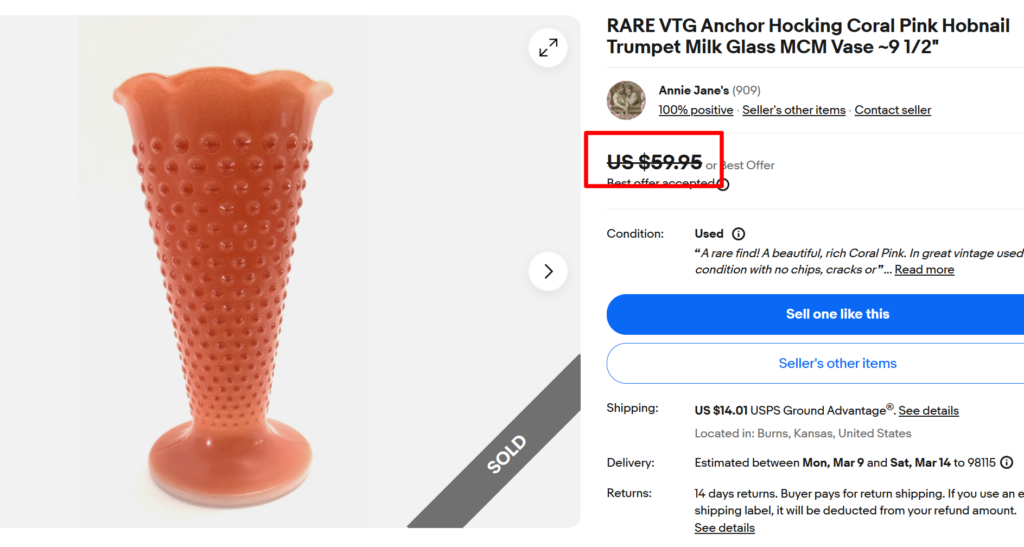
| Average Value | $35–$65 |
| Color | Coral Pink (Fired-On Color) |
| Production Year | 1950s–1970s |
| Collectibility | Moderately Collectible |
| Collector Notes | AH’s hobnails are rounder & more dome-shaped than Fenton’s |
Anchor Hocking produced their hobnail milk glass line from the 1950s through the 1970s. This standard trumpet vase shape, roughly 9.5 inches tall with a flared, scalloped rim and pedestal base, is one of the most common pieces in white.
The coral pink version is significantly harder to find. But unlike solid milk glass, this color was applied to the surface, making it difficult to find in mint condition without scratches or peeling.
Also, the fired-on process was used for limited runs, which is why this color is more sought-after than white examples. While white trumpet vases usually fetch $5–$15, coral pink pieces with no color wear or fading can fetch $35–$70!
7. Imperial Glass – Hobnail/Dewdrop Vase
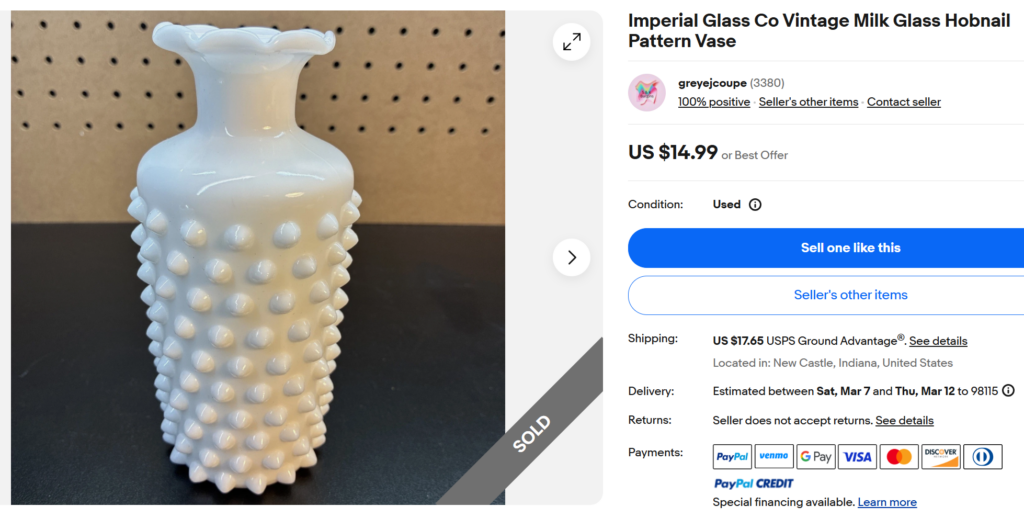
| Average Value | $12–$35 |
| Color | White Milk Glass |
| Production Year | 1950s–1970s |
| Collectibility | Low to Moderately Collectible |
| Collector Notes | Imperial’s hob bumps are more evenly spaced and less pointed than Fenton’s |
8. Fenton – Rose Hobnail Vase
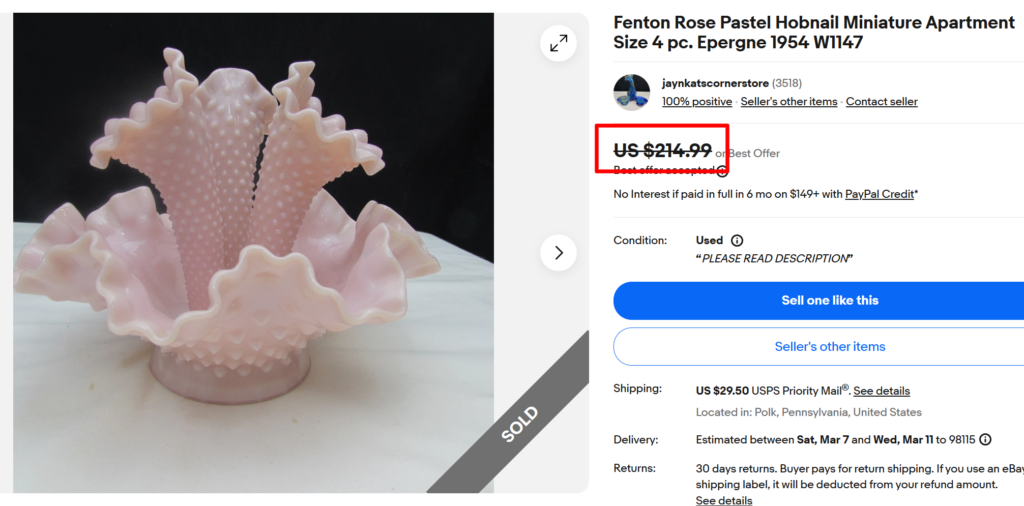
| Average Value | $125–$225 |
| Color | Rose Pastel (Soft Pink Milk Glass) |
| Production Year | 1954–late 1950s |
| Collectibility | Highly Collectible |
| Collector Notes | No Fenton logo will appear on these |
The epergne is a multi-piece centerpiece with a large ruffled bowl and removable “horns.” And this miniature 1954 version, in “Rose Pastel,” is highly collectible.
Why? Because Fenton’s rose pastel line was introduced in the mid-1950s and discontinued before the end of the decade, it’s one of Fenton’s shortest-lived and rarest colorways.
Complete, undamaged rose pastel mini epergnes usually fetch $120–$250. Larger or rarer color epergnes (plum opalescent, turquoise, cranberry) can sell for even more.
Tips for Collecting/Selling Hobnail Milk Glass Vases
Whether you want to add a new milk glass hobnail vase to your vintage glass collection or sell an old piece, checking the following factors will help you evaluate it properly.
Maker Identification
There are two ways to know who made a hobnail milk glass vase:
Marks and Labels
Marks are a bit tricky to find; many makers didn’t begin marking their pieces until a specific time. Fenton, for example, didn’t mark their glass until 1970–1972, when they introduced the “Fenton” oval-script mark. Pieces with a paper label but no embossed mark date from the 1950s to 1969 period.
Westmoreland used a W-in-keystone mark (1910s–mid-1940s) and then an intertwined WG mark. Imperial used an iron cross mark (from 1913) and an IG mark in later years. Anchor Hocking used an anchor-over-H mark from the 1940s onward.
You can easily identify the maker if you see these marks. But as I already said, not all pieces have marks.
Pattern Distinction
The next thing to check is the pattern details. Fenton, Westmoreland, Anchor Hocking, Imperial, and L.E. Smith all made hobnail milk glass. But not all hobnail patterns look the same, and they’re not all worth the same.
For example, Fenton’s hobs are sharp and pointed at the tip, but Anchor Hocking’s hobs are rounder and dome-shaped. Westmoreland’s English Hobnail uses a diamond-grid layout rather than rows of bumps. And Imperial’s Dewdrop pattern hobs are evenly spaced and slightly flatter.
Knowing these differences by feel and sight comes in handy for identifying the maker, since most pieces lack markings or labels.
Color Rarity
White is the most common color of milk glass hobnail, and also the lowest-valued. The premium color hierarchy, roughly from higher to lower value, goes:
- Uranium/vaseline glass
- Opalescent colors (cranberry, blue, French)
- Short-run pastels (rose, turquoise, mint green)
- Fired-on colors (coral, pink)
- Plain White
The “Ring of Fire” & “Ring” Test
The “Ring of Fire” helps a lot to spot pre-1958 milk glass. Hold the piece up to bright natural light, and you should see a faint iridescent halo (a multicolored ring effect) caused by iridized salts used in production.
Glass made after 1958 generally does not produce this effect. So, it’s one of the fastest ways to confirm age.
Another way to ensure a genuine piece is to tap the glass with your fingernail gently. Quality vintage milk glass (especially Fenton) will produce a clear, bell-like ring, whereas modern replicas often sound “thuddy.”
Size & Form
There is a wide variety of shapes and sizes of vases. Larger and more complicated pieces, like an epergne, tend to be harder to find, especially in good condition.
For swung vases, a 17-inch piece will be worth three to four times what a 10-inch version of the same form fetches. This is especially true for L.E. Smith and Fenton swung vases, where size directly reflects the glassworker’s skills!
Condition
Pay attention to the vase’s overall condition. Damage, such as severe chips and cracks, reduces the collector value almost entirely. Hairline cracks are often invisible until held up to light at an angle.
On swung vases, check the stretched neck section carefully because this is the most vulnerable point. On epergnes, check each horn base where it inserts into the bowl.
Also, look for dishwasher damage. Repeated machine washing dulls the surface and removes any fired-on colors, lowering its appeal and value.
Note: This article is intended for informational, educational, and entertainment purposes only. Some images are illustrative and may not represent actual brands, products, or related entities. All trademarks, product names, brand logos, packaging, and other intellectual property referenced remain the exclusive property of their respective owners. Any brand mentions or references are provided solely for descriptive and educational context and do not imply any formal or commercial association.