Antiques Know How Research
Collectible Costume Jewelry Brands
A detailed analysis by the Antiques Know How team of several eBay sales and auction results shows vintage costume jewelry from top brands can sell for $100–$1,000+. Most collectible brands include Trifari, Miriam Haskell, Eisenberg, Coro, Weiss, Schreiner, Hobé, Marcel Boucher, Kenneth Jay Lane, and Elsa Schiaparelli. Apart from the maker, the value highly depends on maker marks, design, style, material, rarity of techniques, condition, and completeness of sets.
Antiques Know How
People often throw away their old costume jewelry because they think it is not worth anything, because of those faux stones and cheap metal.
But that is not entirely true. Costume jewelry from some companies can actually be worth a lot of money, especially those that used fine jewelry techniques, used crystals from Austria, and hired designers who worked with houses like Cartier.
This guide covers 13 collectible vintage costume jewelry brands that consistently hold value with collectors. You’ll learn each brand’s key features, the designs that sell the most, and the marks to identify genuine pieces.
What Makes Vintage Costume Jewelry Valuable?
The value of vintage costume jewelry depends on several things. Some of these things are more important than others. Here is what makes old costume jewelry expensive:
- Maker or Brand: This is the important factor. The brand name can change a piece’s value from $10 to $1,000. For example, a Miriam Haskell brooch can sell for $200 to $500, but a similar piece without a brand name might only sell for $30 to $50. The brand name makes it more valuable.
- Rarity: Small production creates scarcity. And jewelry that was only made for a time or in small quantities can be more expensive. For instance, old Coro Duettes from the 1930s and 1940s are worth more than those made later in large quantities.
- Condition: If the jewelry is in good condition, it will sell for more. Missing stones, broken clasp, and worn plating make it less valuable. A piece with all its parts can sell for two to three times more than a damaged one.
- Signed vs. Unsigned: Artist signature is a big value driver. If a piece is signed by the maker or designer, it can be two to ten times more valuable than a piece without a signature. Always check the back, clasp, and any tags.
- Matched Sets: A complete set of jewelry, like a necklace, bracelet, earrings, and brooch, is worth more than each piece sold separately. This is commonly called a parure.
While all these factors work together to determine the value of a costume jewelry piece, the brand name is where the most value comes from. So let’s get into the 10 brands you should know.
10 Rare & Collectible Vintage Costume Jewelry Brands
1
Trifari
(1910–2000)
Founded by Italian goldsmith Gustavo Trifari around 1910, Trifari became one of the most recognized costume jewelry brands in America. The company hit its stride in 1930 when Alfred Philippe, a former designer for Cartier and Van Cleef & Arpels. joined as lead designer.
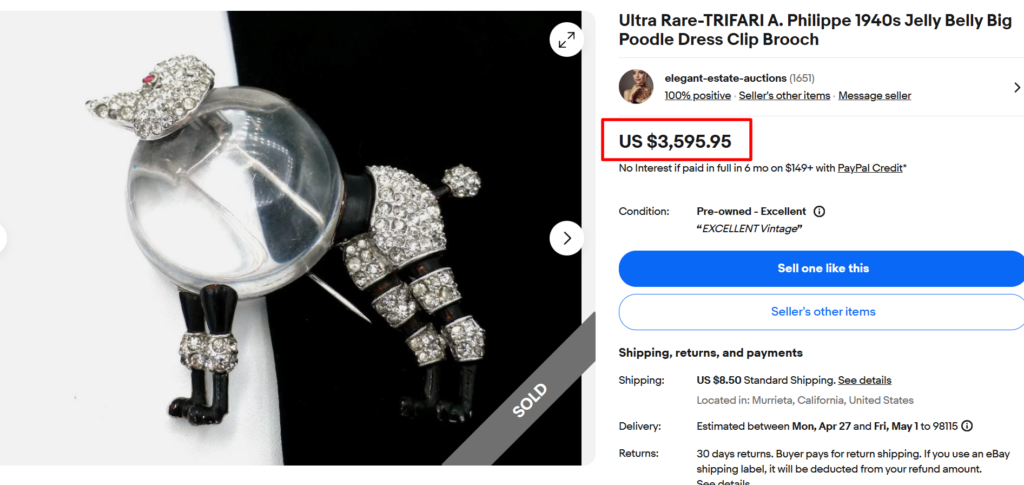
Philippe brought fine jewelry techniques to costume pieces, and his work defined Trifari’s golden era through 1968. Trifari pieces sell from $20 for common later pieces up to $2,000-$5,000 for rare designs.
Most Collectible Designs:
- Jelly Belly pins: Animal and fruit-shaped brooches with clear Lucite centers, made in the 1940s
- Crown brooches: Ornate crown-shaped pins that inspired the brand’s logo, designed by Philippe
- Fruit Salad / Tutti Frutti pieces: Colorful carved glass stones inspired by Cartier’s designs, from the 1930s–1940s
- Clip-Mates: Large brooches that split into two separate dress clips
Identification Marks:
Trifari signed nearly all of their jewelry and even advertised: “If it isn’t signed, it isn’t Trifari.” The marks changed over the decades, so you should know what to look for:
- 1920s-1930: “KTF” (for Krussman, Trifari, Fishel) with an oversized “T” in the center
- Early 1930s: “TRIFARI PAT. PEND.”
- 1937-1955: Crown above the letter “T” (the Crown Trifari mark), sometimes with “Pat. Pend.”
- 1955-1969: Crown Trifari mark with a copyright symbol ©
- 1970s-1980s: “Trifari” in cursive script, often in an oval, without the crown
- Late 1980s-2000: “TRIFARI TM”
WWII-era sterling silver pieces will also be stamped “STERLING.” After 2000, when Liz Claiborne bought the company, pieces were generally unmarked.
2
Miriam Haskell
(1926–Present)
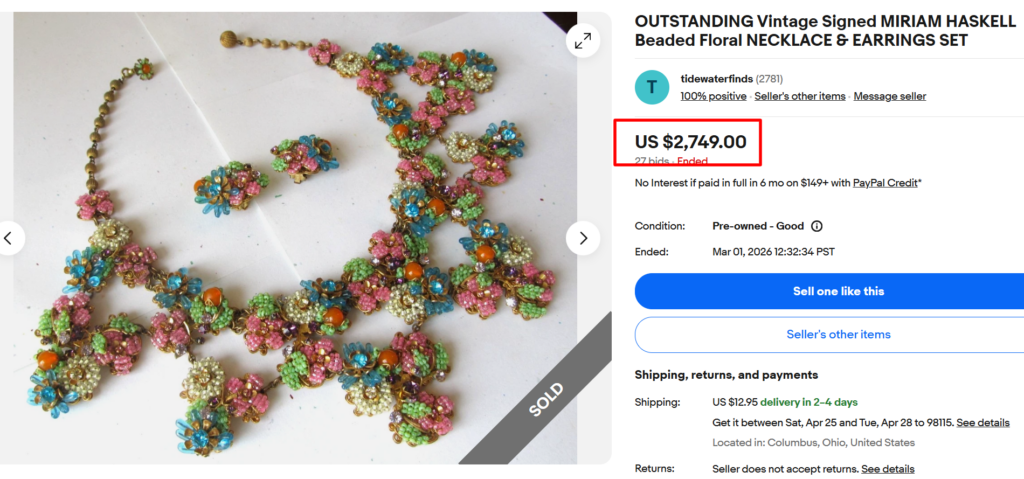
Miriam Haskell started her jewelry store in New York in 1926. She got Frank Hess to be her designer, and he worked with her for 36 years. During that time, he developed Haskell’s signature jewelry using lots of pearls, small seed beads, and flower motifs hand-wired onto filigree backings.
As for value, it ranges from $75 to $200 for earrings, while necklaces and brooches can go around $150 to $600. Fancy and elaborate Miriam Haskell pieces from the 1940s and 1950s can be worth $500 to $2,500 or even more.
Most Collectible Designs:
- Baroque pearl and seed bead parures: Multi-strand necklaces with matching earrings and brooches, the classic Haskell look
- Floral and leaf cluster brooches: Heavily beaded dimensional brooches from the Frank Hess era (1926–1960)
- Russian Gold filigree pieces: Pieces featuring Haskell’s proprietary gold finish that contained actual 24-karat gold
- WWII-era shell and wood designs: Made with non-traditional materials due to wartime shortages, now collectible for their rarity
Identification Marks:
Haskell didn’t sign pieces permanently until the late 1940s. Pre-1947 pieces are usually unsigned, which makes them the hardest to authenticate.
- Pre-1947: No permanent mark. Some had black and gold paper hang tags
- 1947-1950: “Miriam Haskell” on a horseshoe-shaped plaque attached to the back
- 1950s-late 1970s: “MIRIAM HASKELL” in block letters on an oval plaque, with the stamping visible (indented) on the reverse side
- 1980s-present: Similar oval plaque but with a flat back. The stamping does not come through to the reverse
Earring backs are sometimes marked just “Haskell.” Necklace clasps may have “Miriam Haskell” in tiny print. Be cautious with unsigned pieces that have filigree backs; these could be fake.
3
Eisenberg
(1914–Present)
Eisenberg & Sons first started as a women’s clothing company in Chicago in 1914. In the late 1930s, the firm started adding brooches and pins to its clothing displays, and customers kept stealing them.
That’s when Eisenberg started selling the jewelry separately.
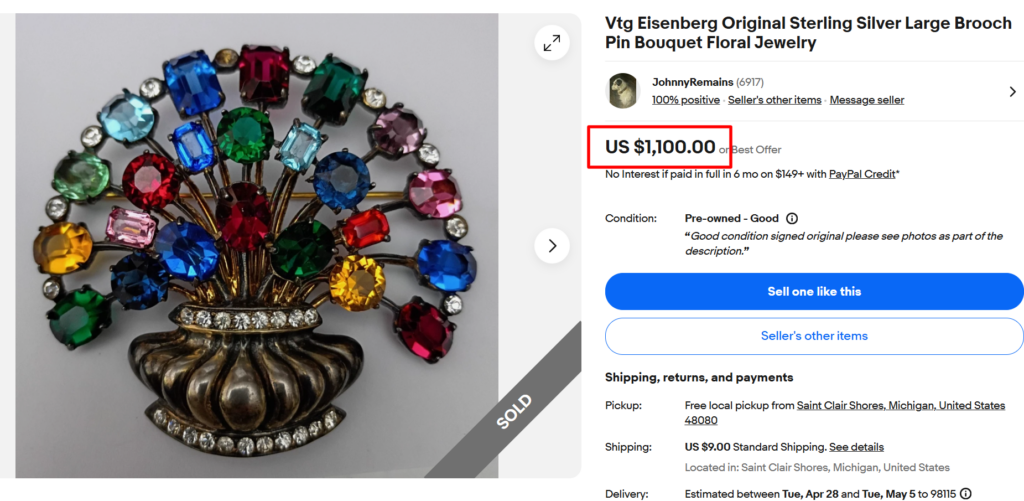
The pieces used large, high-quality Swarovski crystals and Austrian stones, with craftsmanship almost like fine jewelry. Eisenberg Original sterling pieces from the 1940s can sell for $200 to $500+, while common Eisenberg Ice pieces from the 1960s–1970s start around $30 to $60.
Collectible Designs:
- Eisenberg Original fur and dress clips: Large, bold rhinestone clips from the late 1930s–1940s
- Sterling silver brooches: These are from WWII, made in sterling silver because they couldn’t use metals back then, from 1943 to 1948.
- Figural brooches: These are shaped like animals, like horses, birds and butterflies. Some are fantasy figures, too.
- Christmas tree brooches: Rhinestone-studded tree pins for holiday tradition.
Identification Marks:
Eisenberg marks changed frequently, and some overlap in time periods:
- Pre-1935: Most pieces were unmarked
- 1935-1945: “Eisenberg Original” in script
- 1943-1948: “Eisenberg Original Sterling” or “Eisenberg Sterling” (wartime sterling period)
- Late 1940s-early 1950s: Script letter “E”
- 1945-1958: “EISENBERG” in block capitals
- After 1955: Added copyright symbol ©
- 1960s-present: “Eisenberg Ice”
Apart from marks, check the construction quality and stone quality carefully to spot fakes and reproductions.
4
Coro
(1901–1979)
Coro was one of the largest costume jewelry manufacturers in American history. It was started in 1901 by Emanuel Cohn (Co) and Carl Rosenberger (Ro) in New York, and operated until 1979.
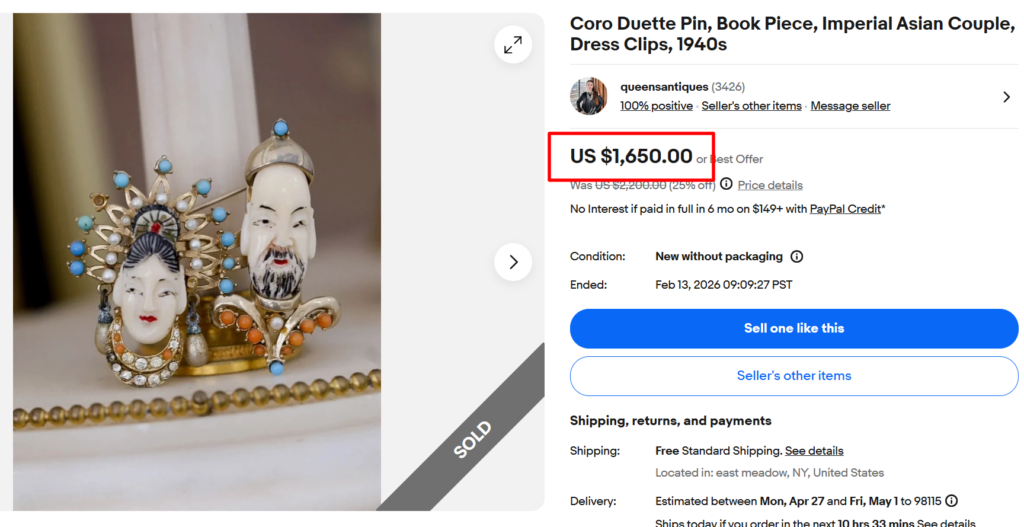
Coro made all kinds of jewelry, from everyday pieces to really fancy and collectible designs. But because they made plenty, most of the vintage Coro jewelry is not very expensive today. It’s only rare pieces from the 1930s, 1940s, or 1950s that fetch $200 to $1,500.
Valuable Designs:
- Duette brooches: Two matching clips held together by a bracket to form one brooch (patented 1931), especially Art Deco and enameled styles
- Jelly Belly pins: Animal figures with clear Lucite bodies, including the Pegasus (which echoes Coro’s logo)
- CoroCraft Sterling pieces: Higher-end sterling silver designs from the WWII era, including figural pins
- Vendôme line: Coro’s upscale division, known for quality materials and construction, made in the 1950s–1960s
Identification Marks:
Coro used many brand names and marks over their 78-year history. Original pieces must have one of these signs:
- Early pieces: “CR” mark
- Main line: “Coro” in script
- Higher-end line: “Corocraft” or “Coro Craft” (from 1937)
- Prestige line: “Vendôme”
- Sterling pieces: “CoroCraft Sterling” or “Coro Sterling”
- Duette pieces: “Coro Duette” with patent numbers on the frame
- Other sub-brands: “Francois,” “Norseland by Coro,” “Jewelcraft” (UK market)
Coro also used distinctive hang tags, including their well-known pear-shaped tag on necklaces.
5
Weiss
(1942–1971)
Albert Weiss founded his company in New York in 1942 after learning the trade at Coro. Weiss built a reputation for using top-quality Austrian rhinestones, imported stones with higher lead content that gave them more sparkle than the competition.
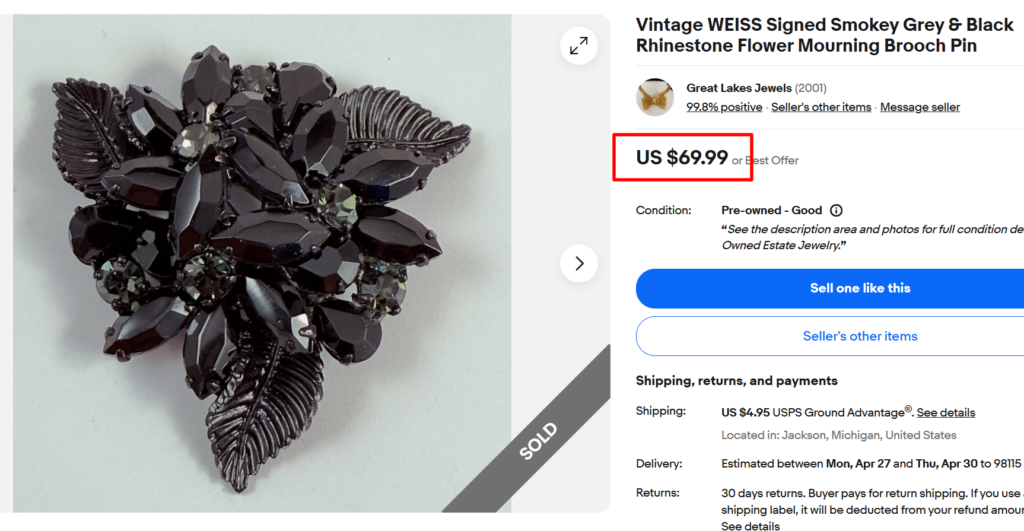
The company was small compared to giants like Coro and Trifari, but the craftsmanship was high in quality. Weiss pieces generally sell for $30 to $150, with rare designs and the “black diamond” smoky rhinestone pieces going higher.
Most Collectible Designs:
- Black Diamond rhinestone pieces: Smoky-colored rhinestones unique to Weiss, highly sought by collectors
- Aurora borealis crystal pieces: Weiss was one of the first companies to use Swarovski’s multicolored aurora borealis crystals in the 1950s
- Christmas tree brooches: Weiss pioneered the rhinestone Christmas tree pin, a format widely copied by other companies
- Japanned (black-lacquered) pieces: Dark metal settings paired with colorful rhinestones
How to Identify:
The company closed in 1971 when Albert Weiss’s son Michael could not sustain the business. A new company later acquired the Albert Weiss name and produces modern pieces. Remember that these are not vintage and have no collector value.
You can identify the original Weiss pieces by the following marks.
- 1942–1950s: “WEISS” in block letters or “Weiss” in script, stamped into the metal or on an applied plate
- Early marks: “Weissco” or “WEISS NY”
- Circa 1951: “Albert Weiss” or “A.W. Co.” (the crown-shaped W)
- After 1955: “WEISS” with a copyright symbol ©
- Boxes and hang tags: “Jewels by Albert Weiss” or “AWco.” with a crown W
6
Schreiner New York
(1932–1970s)
Henry Schreiner founded his company in the early 1930s and quickly built a reputation for technically innovative costume jewelry. Schreiner’s signature technique was setting rhinestones upside down (inverted) in their settings. This gave the stones a different look than conventional prong settings.
Major fashion houses, including Christian Dior, used Schreiner pieces on their runways. Today, signed pieces can be worth $100 to $500+, with signed pieces bringing significantly more.
Most Collectible Designs:
- Inverted-stone brooches and earrings: Schreiner’s hallmark technique of setting stones face-down for a unique visual effect
- Layered dimensional designs: Multi-level construction with depth and movement
- Haute couture pieces: Designs made for Dior and other fashion houses
- Ruffle brooches: Layered, textured pins with multiple rows of stones in unusual color combinations
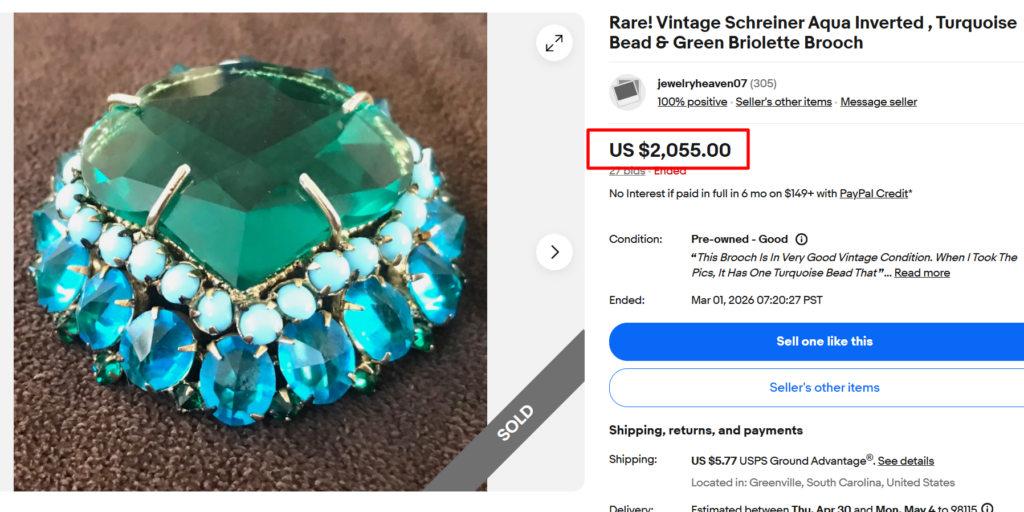
Maker Marks to Identify:
- Signed pieces: “Schreiner,” “Schreiner New York,” or “Schreiner N.Y.C.”
- Unsigned pieces: Many Schreiner pieces were never signed. Identification relies on recognizing the construction: inverted stone settings, unfoiled stones, layered dimensional construction, and unusual stone shapes and colors
Schreiner pieces made for fashion houses were typically not signed with the Schreiner name. They may carry the fashion house’s mark instead, or no mark at all. Usually, signed pieces hold higher value than unsigned ones.
7
Hobé
(1887–Present)
The Hobé family has been making jewelry since 1887, starting in Paris. William Hobé, Jacques’ grandson, came to the U.S. in the 1930s and began creating costume jewelry for the Ziegfeld Follies.
Hobé became known as “Jewels of Legendary Splendor” and was a favorite of Hollywood costume departments. The company used semi-precious stones, vermeil (gold-plated silver), and high-quality metalwork.
Pieces with rare designs and several semi-precious stones are the most valuable ones.
Most Popular Designs:
- Hollywood-era brooches and necklaces: Pieces made for film productions and celebrity clients in the 1940s–1950s
- Semi-precious stone pieces: Designs incorporating real stones like turquoise, jade, and amethyst alongside costume materials
- Vermeil (gold-plated silver) pieces: Higher-end production using precious metal as a base
- Sterling silver wartime pieces: WWII-era designs in sterling, featuring detailed craftsmanship
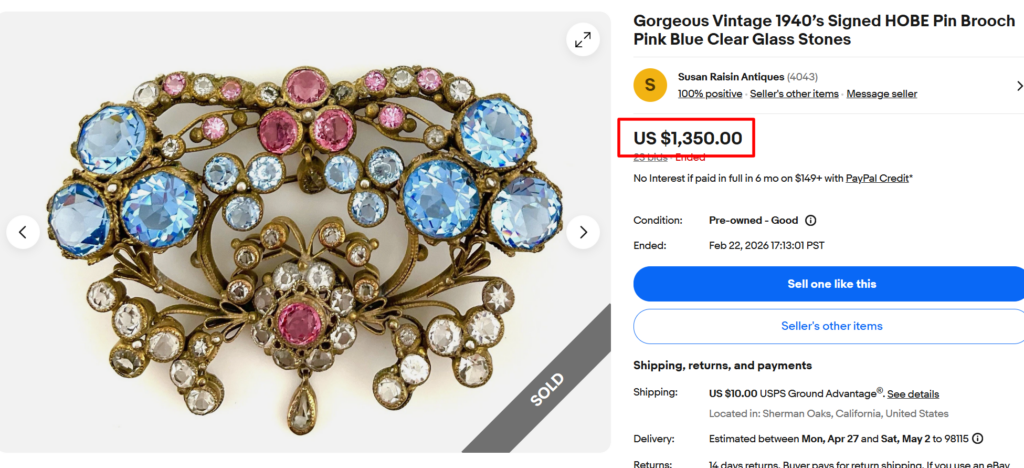
Key Identification Signs:
Signed Hobé pieces are generally more valuable. You might see one of the following marks on authentic pieces.
- Most common mark: “Hobé” in script
- Sterling pieces: “Hobé Sterling”
- Some pieces: Include the copyright symbol or “©Hobé”
- Early pieces: May include hang tags rather than stamped marks
8
Marcel Boucher
(1937–1977)
Marcel Boucher learned his craft as a model maker at Cartier in Paris before moving to New York. He started at Mazer Bros. in the early 1930s, designing shoe buckles before establishing his own company in 1937.
Boucher’s pieces were so well-made that they were often mistaken for real fine jewelry. He used fine jewelry construction techniques, specially ordered stones, and detailed enameling. Rare, high-quality Boucher enamel pieces have sold for over $2,000 recently.
Collectible Designs:
- Enameled figural brooches: Birds, frogs, flowers, and human figures with detailed enamel work
- Sterling silver WWII-era pieces: Brooches and clips made in sterling during wartime metal restrictions
- “Lovebirds” brooches: Sterling silver with gold wash paired bird pins (1944)
- Exotic themed pieces: Animals and figures with faux gemstones and fine metalwork
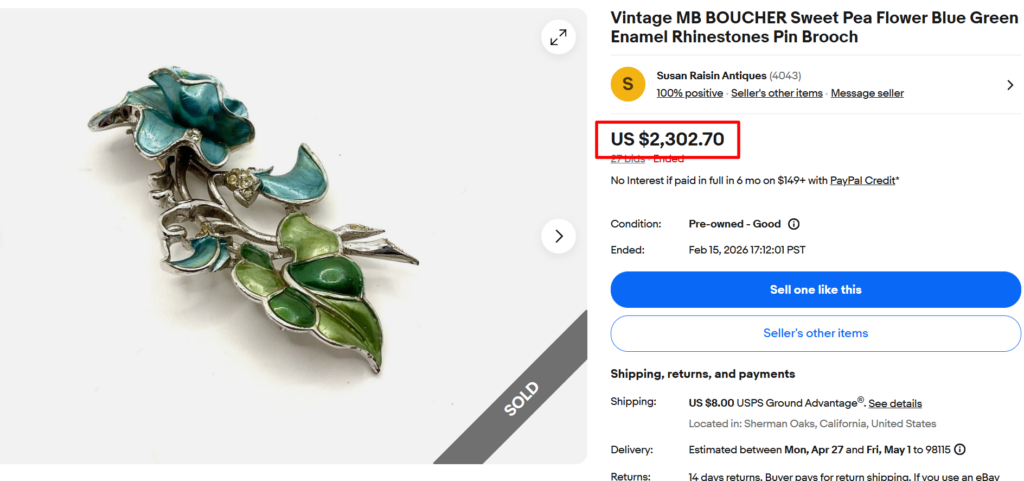
Key Identification Marks:
Boucher patented many of his designs in the 1940s to protect them from being copied. So, certain pieces may also show the patent mark on them, along with the following marks:
- Early pieces (late 1930s): “MB” (Marcel Boucher initials) with a Phrygian bonnet on top and inventory numbers
- 1930s–1940s: “Marboux” (a secondary line)
- 1940s–1960s: “Marcel Boucher” or simply “Boucher” with copyright and patent numbers on clasps
- Inventory numbers: Boucher often included inventory numbers on pieces, which helps with dating
- Patent signs: “Des. Pat’d” (with MB logo)
Sandra Boucher continued the company after Marcel’s death in 1965 until it was sold in 1970.
9
Kenneth Jay Lane
(1963–Present)
Kenneth Jay Lane launched his jewelry business in 1963 after working as creative director for Hattie Carnegie and designing shoes for Christian Dior. He’s known for making “fabulous fakes”; bold, oversized costume pieces that didn’t pretend to be anything other than fashion jewelry.
Jackie Kennedy, Elizabeth Taylor, and Audrey Hepburn all wore Lane’s designs. Early K.J.L. pieces from the 1960s today sell for $50 to $800+, while later QVC-era pieces are more affordable.
Most Collectible Designs:
- Big cat brooches: Leopard, panther, and lion pins, often with rhinestones and enamel
- Oversized cabochon earrings: Large clip-on earrings with faux gemstones, a Lane signature
- Egyptian and Renaissance Revival pieces: Elaborate necklaces and cuffs inspired by ancient motifs
- Celebrity replica pieces: Pieces modeled after famous jewels, like his versions of gems worn by the Duchess of Windsor
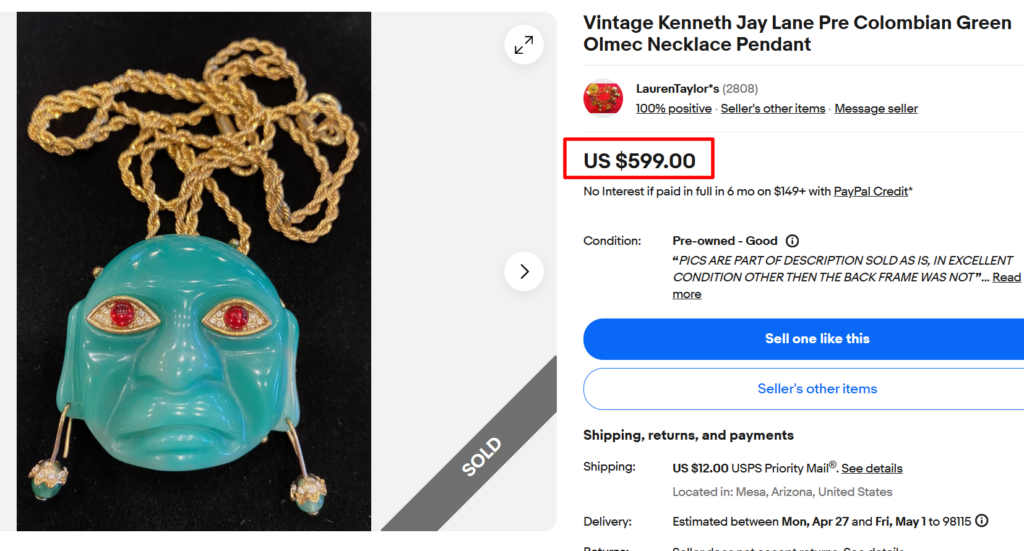
Key Identification Marks:
- 1963-early 1970s: “K.J.L.” (with periods)
- 1970s-1980s: “Kenneth Jay Lane” or “Kenneth Lane” in an oval plaque with a copyright symbol
- 1986-mid 2000s: “K.J.L. for Avon” (Avon catalog line)
- 1990s-2000s: “KJL” (no periods, used for QVC line) or “Kenneth ©Lane” in an oval
Lane died in 2017, but jewelry is still marketed under his brand name. The most collectible pieces are the early K.J.L. marked ones from the 1960s.
10
Elsa Schiaparelli
(1930s–1970s)
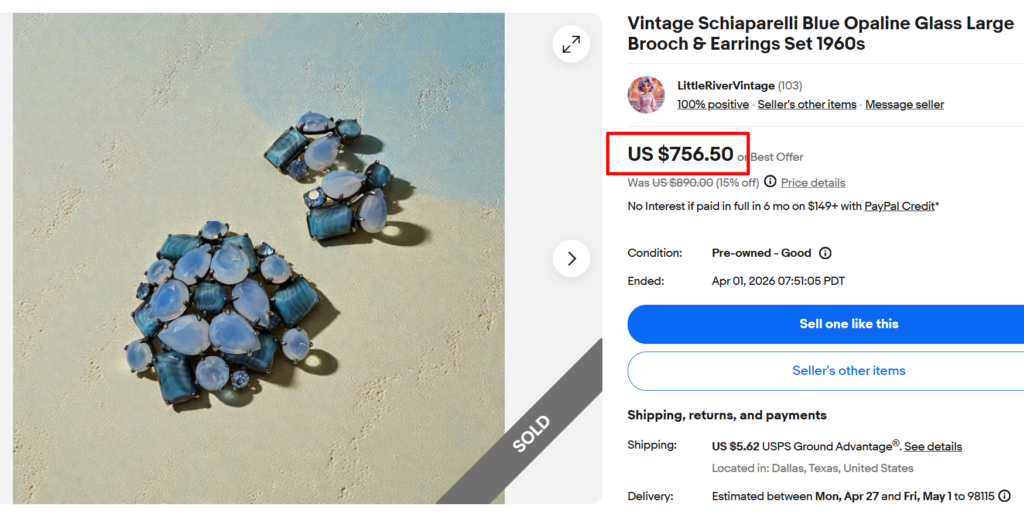
Italian-born designer Elsa Schiaparelli was one of fashion’s rule-breakers. She had collaborated with Salvador Dalí and other artists, and her jewelry reflected her Surrealist connections with bold, unusual, and often bizarre designs.
Besides, her uncle was astronomer Giovanni Schiaparelli, so celestial motifs appeared frequently in her work. Schiaparelli costume jewelry sells for $40 to $120 for common pieces, with rare sets and unusual designs going for $200 to $1,000+.
Most Collectible Designs:
- Aurora borealis crystal sets: Multi-colored iridescent crystal parures from the 1950s–1960s
- Surrealist-inspired figurals: Unusual forms reflecting her artistic collaborations
- Large statement brooches: Oversized, bold pins featuring nature motifs, animals, and abstract shapes
- “Shocking Pink” collection: Pieces in Schiaparelli’s signature hot pink shade
Identification Marks:
Schiaparelli fakes are common. And since pre-1930s pieces are unmarked, check the quality of the stones, the weight of the metal, and the craftsmanship to spot genuine pieces. Post-1930s pieces may have the following marks:
- 1930s–1950s: “Schiaparelli” in script, stamped into the metal
- 1950s–1970s (U.S. production): “Schiaparelli,” the company name and rights were sold after Elsa stopped making jewelry in the 1950s, but production continued through the 1970s
Note: This article is intended for informational, educational, and entertainment purposes only. Some images are illustrative and may not represent actual brands, products, or related entities. All trademarks, product names, brand logos, packaging, and other intellectual property referenced remain the exclusive property of their respective owners. Any brand mentions or references are provided solely for descriptive and educational context and do not imply any formal or commercial association.